Our readers keep the lights on and my smoothie glass nicely filled. As an Amazon Associate, I earn from qualifying purchases.
Specs are compiled from manufacturer listings and verified buyer reviews and can change over time — please confirm the key details on the product page before buying.
Dead zones don’t have to win. An external cellular antenna pulls a usable signal from a tower you can’t even see, then hands that clean signal to your router or hotspot so your video calls stop freezing and your downloads actually finish. This guide sorts the real performers from the paperweights by matching each antenna to the exact situation where it shines.
I’m Mohammad Maruf — the founder and writer behind WellFizz. This guide is built by comparing the manufacturers’ published specifications and the patterns across verified customer reviews, so you get each pick’s real strengths and trade-offs instead of marketing spin.
Compare antennas by their gain, frequency support, and mounting needs to choose the best external cellular antenna for your home, RV, or remote work setup.
Our Picks at a Glance

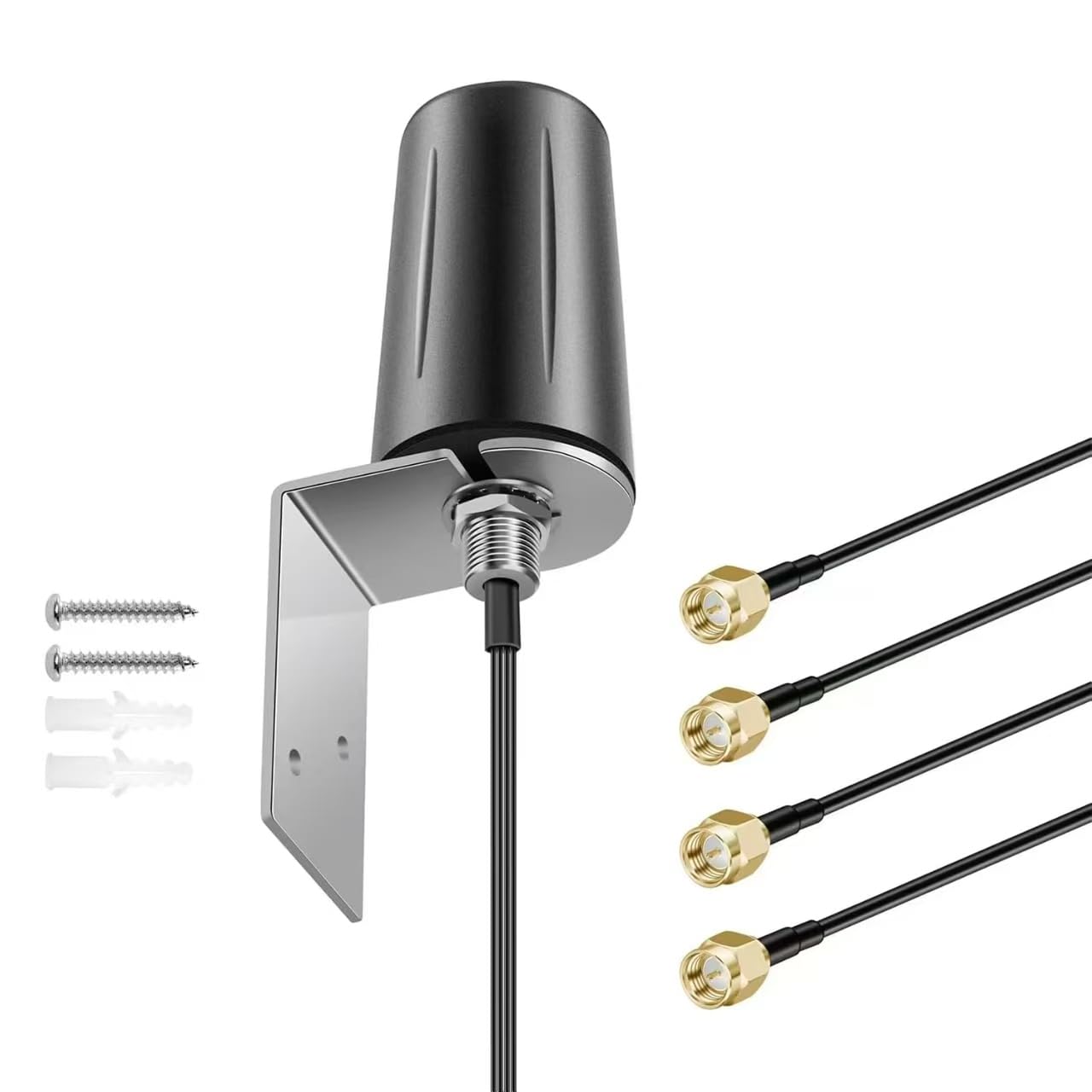

How To Choose The Best External Cellular Antenna
Before you buy, you need to match the antenna’s design to your specific problem. A directional antenna reaches a far tower but must be aimed precisely. An omnidirectional antenna grabs signal from every direction but trades away some of that extreme reach.
Decide Between Directional and Omnidirectional
If you know where your nearest tower is and you need maximum range, a directional panel or parabolic antenna is the right tool. If your signal is decent but unstable, or you move around (an RV or camper), an omnidirectional antenna pulls from all sides without any aiming.
Quick Comparison
| Model | Best For | MIMO Design | Direction | Frequency Range | Amazon |
|---|---|---|---|---|---|
| Poynting XPOL-2-5G★ Best Overall | Fixed-home tower aiming | 2×2 | Uni-directional | 5G/LTE bands | Amazon |
| Slinkdsco 4×4 MIMOBudget Champion | Budget T-Mobile gateways | 4×4 | Omni-directional | 698-6000 MHz | Amazon |
| Maswell GSM-202Top Performer | Easy no-aim installs | 2×2 | Omni-directional | 700-6000 MHz | Amazon |
| SIGNALPLUS Omni | RVs with metal roofs | Single | Omni-directional | 600-6000 MHz | Amazon |
| Proxicast ANT-129-001 | Mid-range directional reach | 2×2 | Directional 75° | 600-960/1710-6000 MHz | Amazon |
| Bolton Technical BT974822 | Extreme rural tower hunting | Single | Parabolic directional | 600-6500 MHz | Amazon |
| Waveform DualMini | 2-port routers & hotspots | 2×2 | Omni-directional | 4G/5G bands | Amazon |
| Peplink Mobility 42G | RV roof all-in-one | 4×4 Mobile + 2×2 WiFi | Omni-directional | 600-6000 MHz | Amazon |
| Waveform QuadMini | 4-port routers & gateways | 4×4 | Omni-directional | 4G/5G bands | Amazon |
In‑Depth Reviews
1. Poynting XPOL-2-5G Antenna
Our pick — over 4★ from 300+ verified ratings; the strongest balance of quality and price.
The fixed-home specialists that turn a weak fringe signal into a dependable daily connection.
If you have a permanent home or office where the tower is visible but far, this panel locks onto one specific tower with its uni-directional design (a design that focuses signal in one direction). Its maximum range rating is 105,600 feet (20 miles), so it is built for long-distance links. Buyers report dramatic results — one common real-world outcome was speeds jumping from 10/4 Mbps to 120/30 Mbps after mounting it outdoors and pointing it at the tower.
The ergonomic, compact housing keeps the 1.5 kg weight manageable on a pole or wall mount. A 50-ohm impedance matches standard router and modem setups, so it plays nicely with gear like a Cradlepoint LP6 on Verizon. It earns its keep with a solid 4.3-star average across a few hundred owners, and the chorus of “works as advertised” reviews backs up the engineering claims.
The honest trade-off is that this antenna demands proper outdoor placement and aiming to deliver its magic. A handful of owners saw no difference because they likely installed it indoors or misaligned it, and one unit arrived with loose internal parts — a rare quality-control stumble worth inspecting on delivery. If you are stationary and willing to aim, this is the one that wins.
Why it anchors the list
- Massive range rating (105,600 feet) for distant towers
- Climbed from 10/4 to 120/30 Mbps for a typical owner
- 2×2 MIMO for stable, faster data on 5G/LTE
Who should think twice
- Needs precise outdoor aiming to work
- Occasional quality-control issue on arrival
Reach for this if: you have a fixed home or office, a visible far-off tower, and you are willing to mount it outdoors and aim it properly.
A real limitation: it is not a grab-and-go antenna; without careful outdoor placement, some owners saw zero improvement.
2. Slinkdsco 4×4 MIMO Omnidirectional Antenna
The budget-friendly 4×4 that is a home run for T-Mobile gateway owners, but a gamble for everyone else.
This low-profile panel is an entry-level price point with premium ambitions. Its 4×4 MIMO design, 698-6000 MHz frequency range, and 5dBi gain let it catch signals from all directions without aiming, and the included 10-foot RG174 cable plus a fixed wall mount make installation approachable. T-Mobile gateway users report the best results, with one owner watching speeds soar from 120-200 Mbps all the way to 610 Mbps.
That success is not universal, and the review pattern makes it clear: functionality and antenna quality get mixed marks, while signal quality and speed skew negative. Some owners saw almost no change — one measured a jump from 92.59 to 99.14 Mbps download, which is within the noise of a home connection. The lesson is that results hinge heavily on your specific gateway, wire order, and mounting height.
This antenna is best treated as a low-cost experiment rather than a guaranteed fix. Its 10-foot cable is short, so plan to place it near a window or eave where the signal enters, not in a distant corner of your property.
Where it wins: At its budget price, no other 4×4 MIMO option is this accessible for a T-Mobile home internet user willing to mount it high.
Where it stumbles: Results are unpredictable — a substantial share of owners mention no improvement at all, so your carrier and gateway matter.
3. Maswell 4G LTE 5G Antenna Outdoor
The no-aim outdoor omni that rewards you the moment you stop fighting walls.
Maswell’s GSM-202 is the definition of an easy win for homes and campsites. Its cross-polarized 2×2 MIMO omnidirectional design means you do not need to locate the tower or aim anything, and its 700-6000 MHz support covers all global 3G/4G/LTE/5G bands. The 3 meters of cable is long enough to route through a wall, and the included U-bolt pole mount fits poles 30 to 50 mm in diameter.
Real-world speed stories are convincing. One reviewer noted their speed jumped from the 90s to 2-300 Mbps after moving it outside. Another picked up a T-Mobile tower just over a mile away through heavy obstructions, and a camper got signal on a Verizon MiFi hotspot (a portable Wi-Fi device) where the device alone would not. Quality earns the most praise, and owners in rural areas consistently report dramatically better download speeds.
Maswell is honest about a catch: this is entry-level gain, built for stabilization, not boosting. It also needs your router to have two LTE interfaces, and you must turn on external antenna mode and restart the router after connecting. Signal quality gets mixed reviews, so treat it as a solid upgrade for a spotty-but-present signal, not a miracle for a zero-signal dead zone.
What owners love
- No aiming needed thanks to omni design
- Speed jumped from 90s to 2-300 Mbps outdoors
- Picks up towers over a mile away with obstructions
Keep this in mind
- Entry-level gain is for stabilizing, not boosting
- Requires a router with two LTE ports
Best for: campers, RV owners, and rural homes who want a simpler outdoor setup without tower hunting.
Think twice if: your router has a single LTE port or your signal is completely absent — this antenna needs a weak signal to improve.
4. SIGNALPLUS Omni Directional Outdoor Antenna

The 25 cm trailer-saver that beats a full booster system for metal-roof owners.
This compact omnidirectional antenna is a stealthy problem-solver for RVs and trailers, packing a strong 10dBi gain into a short 25 cm body. Its 600-6000 MHz range covers all major carriers including Verizon, AT&T, T-Mobile, Bell Canada, and Rogers, and it works with a wide list of routers and hotspots like the LB1120, MR1100, and Verizon MiFi 8800L.
The 10-meter RG58 cable (a standard coaxial cable type) is a generous length that most competitors skip, letting you place the antenna far from your gear. Trailer customers note outstanding results — one RV user mounted it on a 40-inch arm and beat out a friend’s dedicated WeBoost system, while another called it a must-have for anyone with a metal roof that blocks internal signals. The signature experience is having better signal inside the house or trailer than outside it.
A few caveats exist. You need a 50-ohm cable with an N-Male connector for this antenna, and the cable’s other end must match your equipment. The hardware includes a bracket, U-bolts, and nuts, but no lightning surge protector, so consider adding one for permanent roof mounts.
Why it stands out: The 10dBi gain in a tiny 25 cm form factor makes it the best interior-vs-exterior signal fixer for trailers.
Who might skip it: Someone expecting it to fix a completely dead zone with no tower within reach — it needs a usable external signal to amplify.
5. Proxicast ANT-129-001 Directional Panel Antenna

The mid-range panel that gives rural homes 20-50 Mbps where DSL crawled at 1.5.
Proxicast delivers a serious signal upgrade for fixed rural locations. This cross-polarized MIMO panel offers 7-10 dBi gain with a 75-degree directional beam, covering 600-960/1710-6000 MHz for nearly every carrier and all 4G/LTE/5G sub-6 bands, including T-Mobile’s 5G Band 71 and the new 3 GHz mid-band. It is the rare antenna that supports both 5G mid-band and legacy low-band in one package.
The proof is in the results. Owners mounted this on 25-foot poles and gutters, aimed it with a phone app, and watched speeds more than double or climb from 15 to 40 Mbps. One island owner 10+ miles from the nearest tower finally got internet — 10-20 Mbps down versus 1.5 Mbps DSL. Signal metrics improved too, with RSRP jumping from -115 to -95/-105 dB in a tree-obstructed setup.
The trade-off is that this is not plug-and-play. It requires 2 coax extension cables for its 2 female N connectors, so plan that into your install. A few owners noted the weatherproofing is unproven long-term and the included hardware could be beefier. If you can aim a panel, this is the smart mid-range choice.
The strong points
- Doubled or tripled speeds for most owners
- Delivered internet 10+ miles from a tower
- Supports 5G Band 71 and 3 GHz mid-band
Fair warning
- Needs two separate coax extension cables
- Weatherproofing is unproven over many years
Go with this if: you have a fixed house, a known tower direction, and you want strong mid-range performance without paying premium prices.
Look elsewhere if: you want a no-cable, no-aiming install — this panel needs two extensions and careful aiming.
6. Bolton Technical BT974822 Long Range Parabolic Antenna

The 20-mile tower hunter for extreme rural dead zones — if you can aim a laser.
Bolton Technical builds the strongest outdoor antenna for signal booster kits, and it is in a category of its own. The parabolic grid delivers gains up to +26 dB across 600-6500 MHz, with a rated range of 20 miles — up to 4 times farther than a typical omnidirectional or yagi antenna’s 2 to 5-mile reach. It works with all carriers and all booster brands, from weBoost and SureCall to Cel-Fi.
Owners who understand aiming love it. A rural AT&T user replaced a yagi and saw downloads jump from 2-5 Mbps to 40-50 Mbps, with towers 4 to 6.5 miles away. Another discovered that shifting the antenna just 4 degrees (from 220° to 224° magnetic) gained a full 12 dBm on a Verizon tower 3 miles out. The biggest stories involve tower hunters who are methodical about aiming.
This antenna is honest about its demands. It requires a signal booster amplifier — it is not a standalone router antenna. The radiation cone is a narrow 4 to 20 degrees, so it works like a laser pointer that must be aimed carefully, and it needs a 10mm wrench or socket to assemble. Mount and cables are not included, so budget for those separately.
The big win: With a 20-mile range and +26 dB gain (a measure of signal amplification), this is the ultimate rural dead-zone fixer — if you live far from a tower, this is the one to pick.
The honest catch: It needs a booster amplifier, precise aiming measured in degrees, and separate mounting hardware — it is for the serious enthusiast.
7. Waveform DualMini 2×2 MIMO Window Antenna
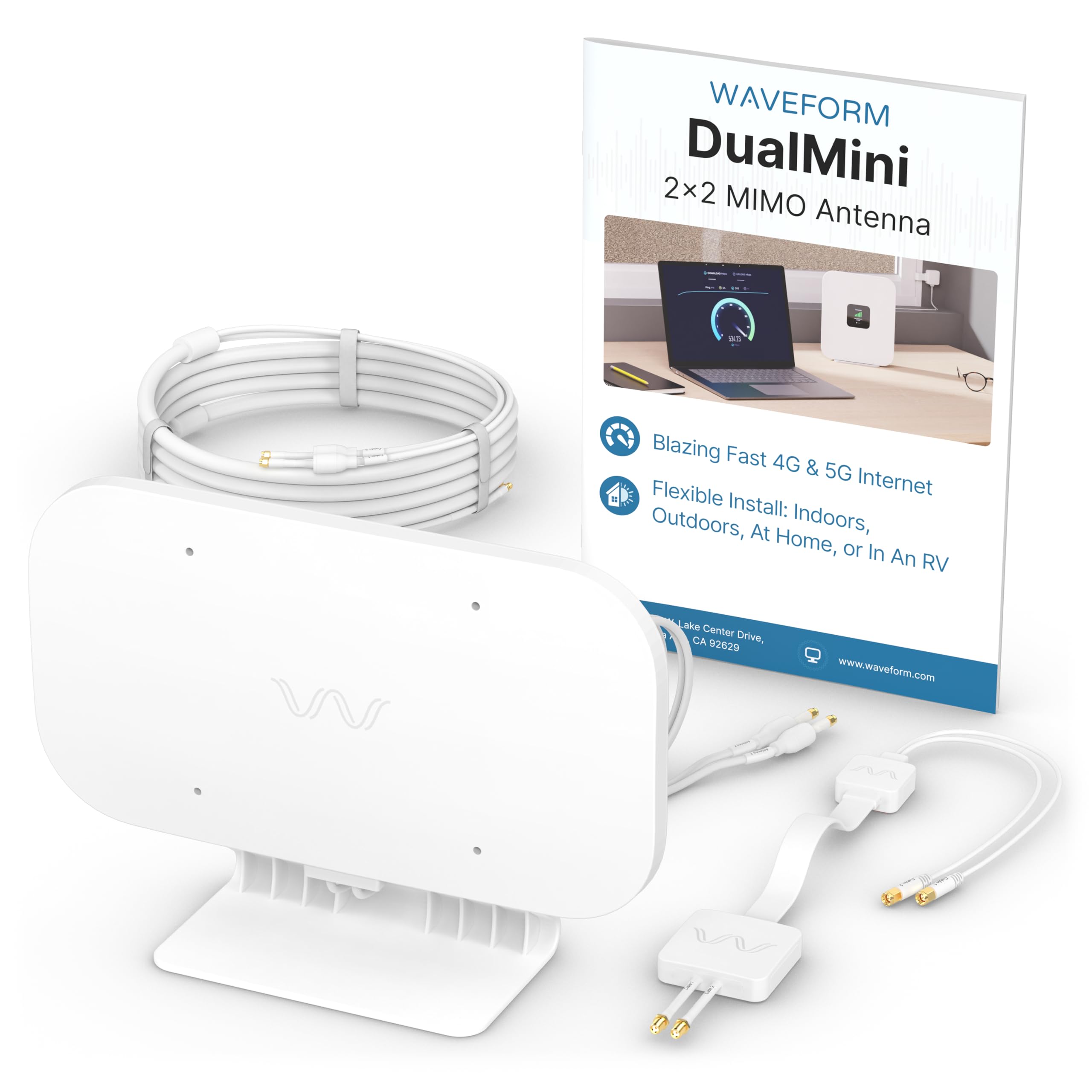
The window-hugging 2×2 that turns remote-work misery into smooth streaming and meetings.
Waveform’s DualMini packs premium engineering into an ultra-thin, lightweight profile with up to 5.2 dBi gain. Its omnidirectional design means zero aiming — just stick it on the side of the house where the signal is best. It is built specifically for routers and hotspots with 2 antenna ports, like the Netgear M5 and M6, and works with Verizon and AT&T.
The complete kit is the real story. You get the Window Entry Cable, UltraFlex-Twin cables, weatherproofing boots, and multiple mounting options — suction cups for windows, a pole adapter, a desktop stand, or direct wall mounting. The seven-days-a-week expert support is a genuine differentiator; owners consistently call it outstanding, and a rural Minnesota camper saw FirstNet speeds jump from 2 Mbps to 30+ Mbps with a 12-foot pole mount.
The numbers speak for themselves: one Verizon MiFi 8800L owner reported a 20x improvement in internet speed, and an AT&T Netgear M6 user watched uploads climb from 2-5 Mbps to 18-28 Mbps. Position matters — owners say placement is critical, and the rare complaints involve a steep price. If you want a complete, supported kit, this is worth the premium.
What makes it premium
- Complete kit with window entry and weatherproofing
- 20x speed improvement for one MiFi owner
- Expert support available seven days a week
Fair trade-offs
- Premium price for the full kit
- Placement is critical for the best results
Splurge on this if: you want a guided, complete install with a 2-port router and you value ongoing expert help.
skip it if: you are on a tight budget or your router has 4 antenna ports — the QuadMini is the better fit.
8. Peplink Mobility 42G Antenna System

The RV roof’s 7-in-1 powerhouse that adds cellular, WiFi, and GPS in one low-profile white dome.
Peplink’s Mobility 42G is the ultimate all-in-one for serious RV travelers. This cutting-edge 7-in-1 system bundles a 4×4 MIMO cellular antenna with a 2×2 MIMO dual-band WiFi antenna (2.4GHz & 5GHz) and a GPS receiver, all in a single low-profile, weatherproof unit. Its IP68 rating means it shrugs off rain, dust, and the harshest road conditions.
The performance is exceptional for an omni. One RV owner reported 100 Mbps down/up with a good signal, and the white housing helps reduce heat buildup in direct sun. Owners praise the secure mounting and quality cables and connectors, and one Peplink router user said the range increased by a factor of 10 after adding this antenna. The 600-6000 MHz frequency range keeps it ready for current LTE and future 5G networks.
This is an investment-grade product with a matching price tag. The 6.5-foot cable version is the one to choose — owners warn the 16-foot cable variant has a weak, unusable 5GHz WiFi signal. It is designed primarily for Peplink routers, so confirm compatibility before buying. For travelers married to the Peplink ecosystem, this is the definitive antenna.
Its superpower: A single IP68-rated rooftop unit replaces separate cellular, WiFi, and GPS antennas.
Who it is for: RV owners with Peplink routers who want one clean, durable, high-performance install — and are willing to pay for it.
9. Waveform QuadMini 4×4 MIMO External Antenna

The 4×4 workhorse that takes T-Mobile gateways from 1 bar to full-speed 4K streaming.
Waveform’s QuadMini is the bigger sibling to the DualMini, designed for routers and gateways with 4 antenna ports. It offers the same up to 5.2 dBi gain and no-aiming omnidirectional design, but with a 4×4 MIMO setup that fully open up modern gateways like T-Mobile’s home internet hardware and Verizon’s latest routers.
The crowd favorite — 4.1 stars across 500+ owners — tells a story of reliable transformation. T-Mobile users report upload speeds doubling to 100 Mbps, and one owner went from a dead zone with 1 bar to stable 4K streaming. A pole-mounted setup delivered a stunning 480 Mbps down and 18 Mbps up, while indoor placement still hit 220-280 Mbps. Installation and connectivity earn consistent praise, and the support team wins fans for helping owners aim at the correct tower months after purchase.
There are a few honest wrinkles. Signal strength and value for money draw mixed opinions, and some owners find the included cables stiff and bulky, which can interfere with mounting on certain gateways. A few T-Mobile gateways require opening the device to connect, and the window cable is short. If you have a 4-port router, this is the performance king.
The highlights
- Doubled upload speeds to 100 Mbps for T-Mobile users
- Pole-mounted setup hit 480 Mbps down
- Proactive support that persists after purchase
The wrinkles
- Stiff, bulky cables can complicate mounting
- Some gateways need opening to connect
Choose this if: you have a 4-port router or gateway and want the maximum MIMO performance Waveform offers.
Reconsider if: your gateway is awkward to open or you have limited space for bulky cables — the DualMini might mount more easily.
Understanding the Specs
MIMO Explained
MIMO stands for Multiple-Input Multiple-Output, and the number before it (2×2 or 4×4) tells you how many data streams the antenna can handle at once. A 2×2 antenna works with routers that have two antenna ports, while a 4×4 antenna needs four ports to reach full potential. Matching the antenna’s MIMO count to your router’s port count is the single most important compatibility step.
Gain and Direction
Gain, measured in dBi, tells you how much the antenna amplifies the signal — higher numbers reach farther but usually mean a narrower beam. A 5dBi omnidirectional antenna grabs from all sides without aiming, perfect for RVs. A 10dBi directional panel focuses all its power at one tower, ideal for fixed homes that know their tower’s location. Choose based on whether you can aim or not.
FAQ
Will an external antenna work with my specific home internet router or gateway?
What is the real difference between a directional and an omnidirectional cellular antenna?
How long does an outdoor cellular antenna last in harsh weather?
Can I use an external antenna with a cell phone signal booster?
Why do I need to turn on the external antenna mode in my router?
Is a 4×4 MIMO antenna always better than a 2×2?
How important is the cable that connects the antenna to my router?
Will an external antenna help me if my signal is already strong but slow?
Final Thoughts: The Verdict
Across the board, the external cellular antenna winner is the Poynting XPOL-2-5G because it pairs a massive 105,600-foot range rating with consistent real-world speed jumps for fixed homes. If you want a no-aim, easy outdoor install for a spotty signal, grab the Maswell GSM-202. And for extreme rural towers up to 20 miles away, the Bolton Technical is the one to reach for.
How We Picked
We do not accept paid placement. Every pick is matched to a real buyer and a real use-case; we do not hands-on test units.
Sources & Methodology
Specifications: manufacturer listings and product documentation. Review insights: verified customer reviews, as of August 2026. Pricing: not shown on this page (it changes often); check the current price via the retailer link.
As an Amazon Associate, WellFizz earns from qualifying purchases. This does not affect which products we feature.
Related Guides

Mo Maruf
I created WellFizz to bridge the gap between vague wellness advice and actionable solutions. My mission is simple: to decode the research and give you practical tools you can actually use.
Beyond the data, I am a passionate traveler. I believe that stepping away from the screen to explore new environments is essential for mental clarity and physical vitality.