Our readers keep the lights on and my smoothie glass nicely filled. As an Amazon Associate, I earn from qualifying purchases.
Specs are compiled from manufacturer listings and verified buyer reviews and can change over time — please confirm the key details on the product page before buying.
The single biggest headache with home EV charging is reach — your outlet is always exactly six feet too far from your parked car. A dedicated extension cord solves that without letting voltage sag turn your overnight charge into an all-weekend affair. This guide focuses on cords built for the continuous high loads of Level 2 charging, not the thin household extension you use for holiday lights.
I’m Mohammad Maruf — the founder and writer behind WellFizz. This guide is built by comparing the manufacturers’ published specifications and the patterns across verified customer reviews, so you get each pick’s real strengths and trade-offs instead of marketing spin.
You need a cord that won’t melt, won’t pop loose, and won’t freeze stiff when you plug in your EV overnight. These eight cords are rated by owners for real-world heat management, connector fit, and weather resilience — here is the best extension cord for ev charging for your setup.
Our Picks at a Glance

How To Choose The Best Extension Cord For EV Charging
Picking the wrong extension cord for Level 2 charging can mean slow charging, tripped breakers, damaged connectors, or even a fire risk. Here are the three details that separate a safe, lasting cord from a regret.
First, match the NEMA plug to your outlet
Your wall outlet or dryer outlet has a specific shape and prong configuration. A NEMA 14-50 is the standard four-prong, 50-amp outlet found in new garages and RV parks. A NEMA 10-30 is a three-prong, 30-amp outlet typical of older dryers. The cord must match exactly — physically forcing a 10-30 plug into a 14-50 socket is dangerous.
Second, check the amperage rating is equal to or higher than your charger
An extension cord must carry at least the same current as your charger delivers. If your Level 2 charger draws 32 amps, a 30-amp cord is already running at its limit and will heat up. A 50-amp cord running a 32-amp load stays cool and leaves a safety margin. Always size up.
Third, choose the right wire gauge (AWG) for the length
Thicker wire (lower AWG number) reduces voltage drop over long distances. A 10 AWG cord is fine for short 30-amp runs, but a 50-amp, 50-foot run needs a thick 6 AWG or 6/3+8/1 construction to deliver full power without significant loss. Pure copper wiring also conducts electricity more efficiently than copper-clad aluminum.
Quick Comparison
| Model | Best For | Amperage | Length | Wire Gauge / Material | Amazon |
|---|---|---|---|---|---|
| Cable Matters 50A★ Best Overall | Heavy-duty 50A reach | 50 A | 15 ft | 6/8 AWG | Amazon |
| CircleCord 10-30Smart Budget Pick | Dryer-outlet EV charging | 30 A | 15 ft | 10 AWG | Amazon |
| M1A2 Dryer CordLong 30-Amp Reach | Long-reach 30A charging | 30 A | 25 ft | 10 AWG | Amazon |
| POWGRN 50A | Value 50A EV/RV combo | 50 A | 25 ft | Pure copper | Amazon |
| PlugSaf 50A | Flexible 50A outdoor runs | 50 A | 30 ft | 4-conductor | Amazon |
| bokman NACS | Tesla-specific extension | 50 A | 21 ft | NACS connector | Amazon |
| Nilight 50A | Maximum 50-foot reach | 50 A | 50 ft | 6/3+8/1 pure copper | Amazon |
| VEVOR 50A | Extreme cold & long distance | 50 A | 50 ft | 6/3+8/1 pure copper | Amazon |
In‑Depth Reviews
1. Cable Matters 6/8 AWG 50 Amp RV Extension Cord, 15ft
Our pick — over 4.5★ from 650+ verified ratings; the strongest balance of quality and price.
The 50-amp workhorse that feels like it is built to outlast your car.
What wins people over is the build quality — 39 owners call it out as the top reason. The 6/8 AWG wiring (meaning thick 6-gauge conductors for the hot legs) handles 50 amps continuous without breaking a sweat. Buyers report it delivers “rock-solid connections” for Tesla Mobile Connectors and runs the A/C in RVs with full confidence. The STW jacket is weatherproof, and the easy-grip handles on the NEMA 14-50P and 14-50R ends make plugging and unplugging safer.
The honest trade-off is stiffness. The cord is heavy and rigid — owners describe it as “chonky” and note it is hard to coil or stow neatly. This is a semi-permanent installation cord, not something you throw in a trunk and unroll daily. At 15 feet, it is shorter than the 25-foot alternatives, but for bridging a garage gap it is precisely right. Unlike the heavier 50-foot cords, this one avoids the extreme bulk penalty while still delivering full 50-amp capacity.
Owner Obsession
- Rated 50 A with 6/8 AWG wiring for zero voltage drop at high loads
- Weatherproof STW jacket and easy-grip handles for outdoor safety
- Works flawlessly with Tesla and J1772 connectors per hundreds of owners
Physical Reality
- Extremely stiff and rigid — difficult to coil or store compactly
- Only 15 feet long; may not reach across a two-car driveway
Grab it if: you want the most durable, high-amp cord for semi-permanent garage use and value safety margin over flexibility.
Think twice if: you need to pack it in your car every day or need a longer span.
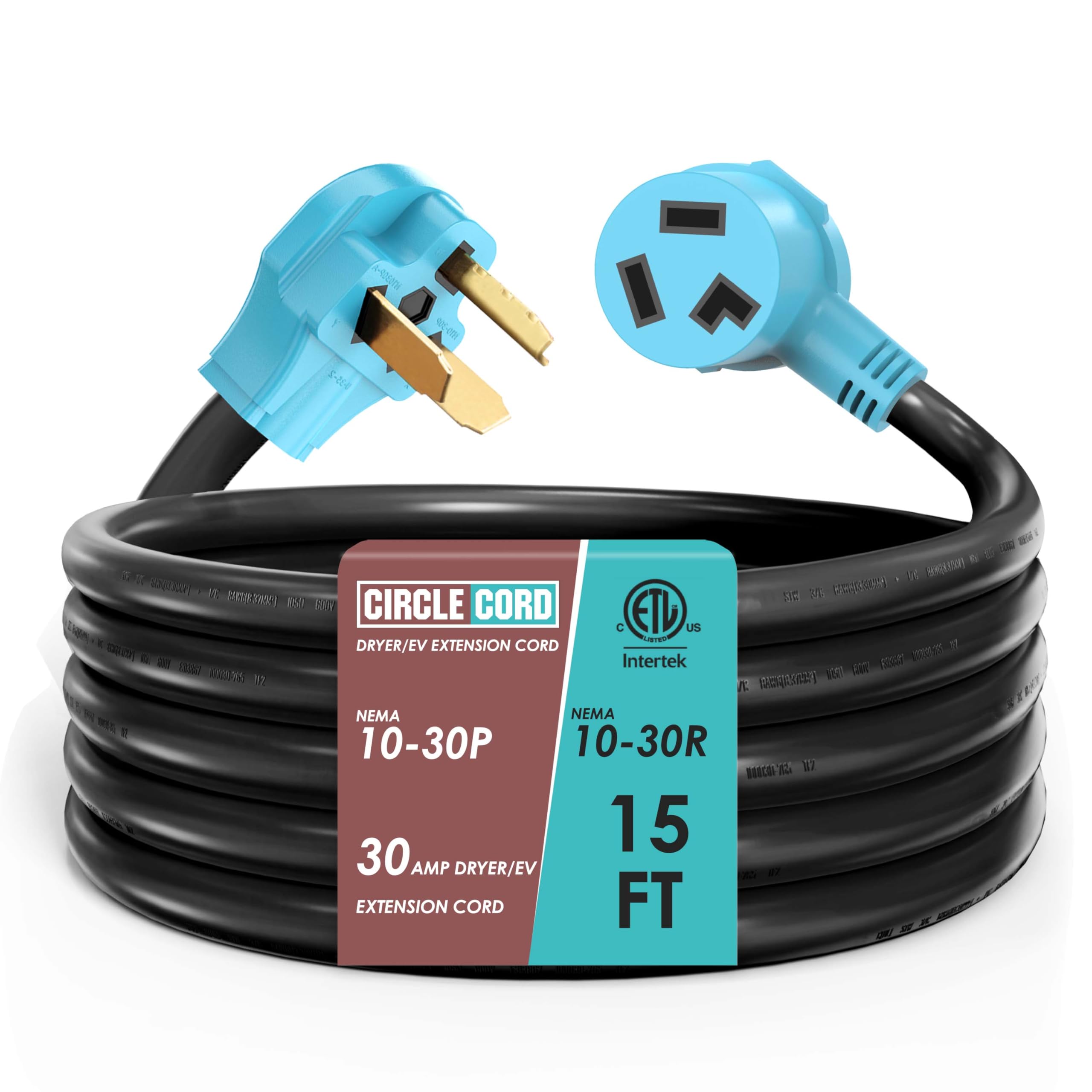
2. CircleCord 3 Prong 15FT Dryer/EV Extension Cord
Turns your dryer outlet into a dedicated EV charging station without an electrician.
Functionality is what owners praise most — 46 people highlight how well this NEMA 10-30 cord works. It connects a 3-prong dryer outlet to Level 2 chargers for Teslas (Model 3, S, X, Y) and other EVs. The 10 AWG pure copper wiring is coated in a flame-retardant, UV-resistant PVC jacket, so it can handle rain, snow, and sun without degrading. Owners note it stays cool even during extended charging sessions.
The catch here is fit. A subset of owners mention that the Tesla adapter does not mate as tightly as they would like — compatibility is the most-mentioned negative (9 mentions). The manufacturer advises setting your EV’s charging amplifier to no higher than 24 amps on a 30-amp circuit, which is good standard practice but caps your speed slightly.
Why Owners Love It
- Pure copper wiring with flame-retardant PVC for safe outdoor use
- Molded plug ends with grip space for easy, safe disconnection
- Comes with an adjustable cord organizer and storage bag
Fit Nuance
- Occasional fit issues with Tesla adapters — try before you commit
- Limited to 30 A; not for high-power 50-amp chargers
Reach for this when: you have a 30-amp dryer outlet and want a plug-and-play solution without hiring an electrician.
Look elsewhere if: you need a 50-amp cord or your adapter requires a very precise fit.
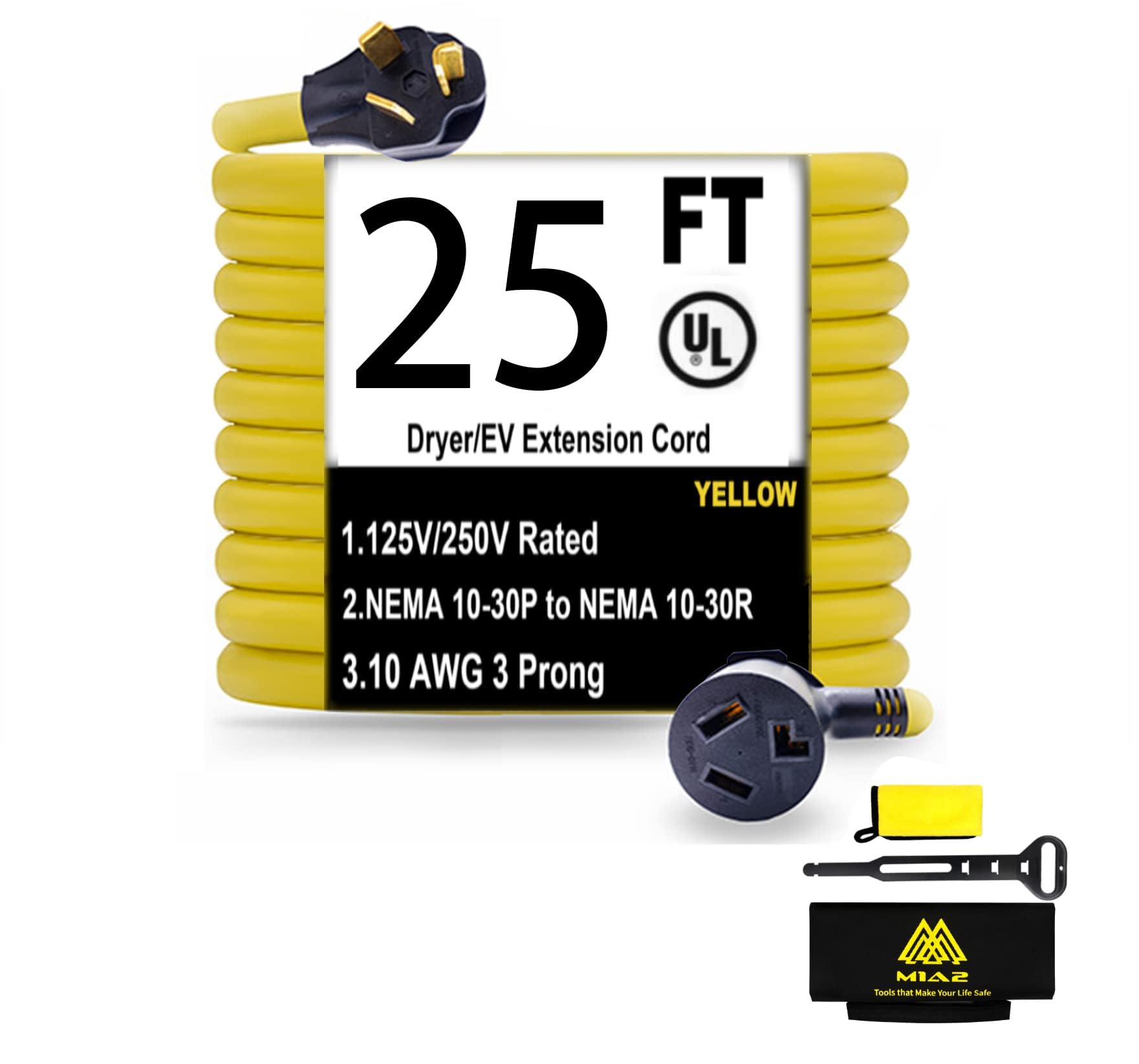
3. Dryer Extension Cord 3 Prong 30 Amp NEMA 10-30, 25 FT
UL-listed confidence for the driveway that is just a bit too far from the house.
Functionality again leads the praise here (20 mentions), and for good reason — this 25-foot 10 AWG cord gives you the extra span that most 15-foot cords lack. Customers note running it outdoors for two months straight on a 240V/30A Level 2 charger with zero overheating issues. It is UL listed, uses pure copper wire, and comes with a flame-resistant PVC outer sleeve. The ergonomic handle on the plug makes disconnecting easy.
The main owner caveat is potential quality-assurance variability — a few units have arrived with bent prongs, so inspect the connectors when it lands. Also, this is a 30-amp cord, not a 50-amp one, so it is not meant for high-power chargers that draw full 48 amps. As owners put it: “flexible, tough covering, solid connectors, accurate length.”
Standout Value: At 300 inches (25 feet), this cord is 67% longer than the Cable Matters 15-foot 50A cord, giving you the reach to park further from your dryer outlet. It also includes a storage bag and carrying strap — details that make daily packing easier than the CircleCord.
One Check: Prongs can arrive bent in transit — give them a once-over before plugging in.
Choose this when: you need UL-listed (safety-certified by Underwriters Laboratories) confidence for a 30-amp, 25-foot run and want a cord that flexes in cold weather.
skip it if: you require a 50-amp cord or cannot accept any chance of shipping damage.
4. POWGRN NEMA 14-50P to 14-50R 25 FT 50 Amp RV/EV Extension Cord
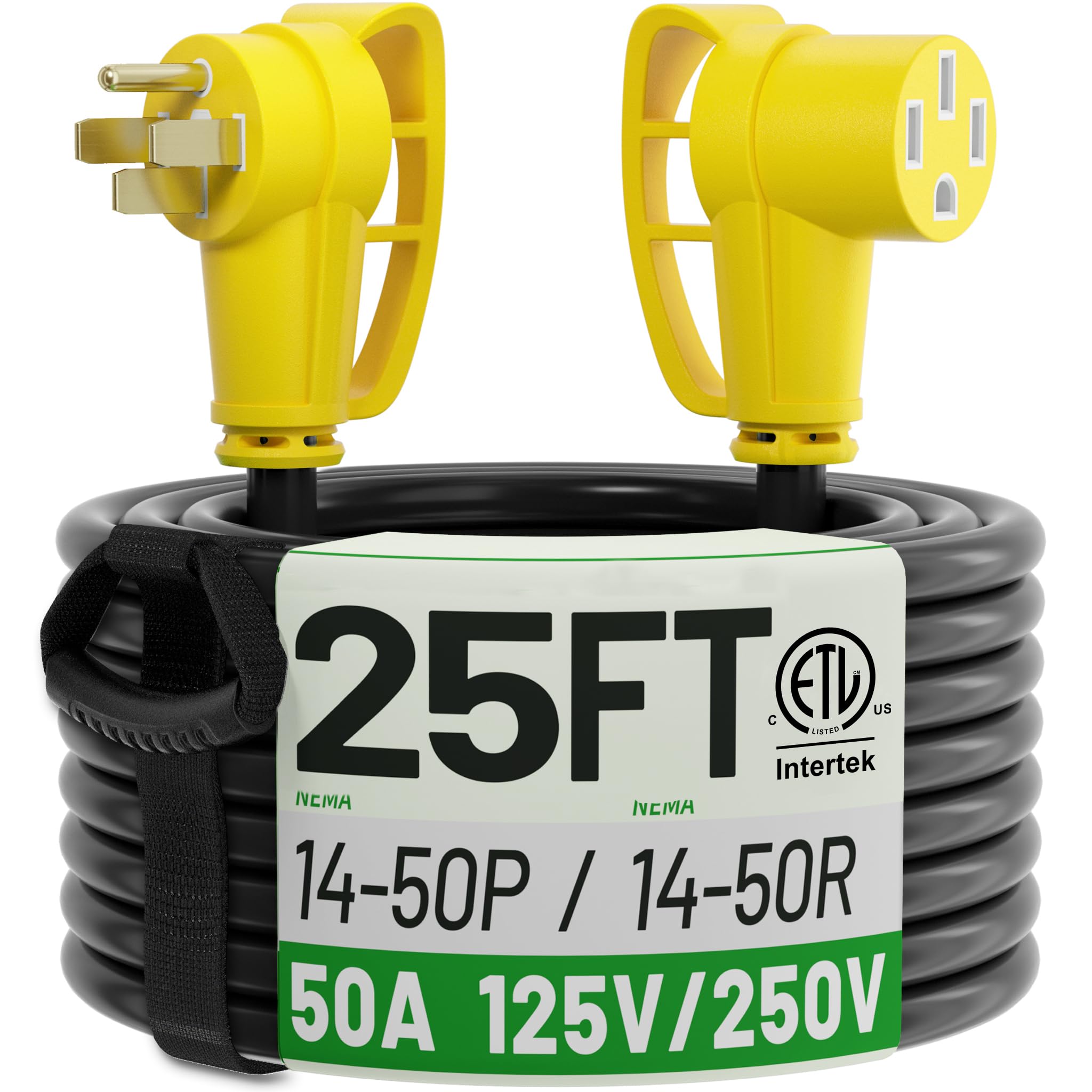
The 50-amp extension that costs half what you expect and delivers everything you need.
Quality is the standout here — 112 owners call it out, making it the most-praised aspect by a wide margin. The POWGRN is built with thick insulation and solid connectors, and it is IP65 waterproof, heat-resistant, and flame-retardant. Reviewers point out it delivers reliable 50A power with no heat issues, even when charging two EVs in a row. The insulated grip handles make plugging and unplugging easy—a feature owners say they did not know they needed until they used it.
Unlike the stiffer Cable Matters, this cord is softer and more flexible, especially in cold weather (rated to -40°F). The trade-off is that length is a mixed aspect (24 mentions) — some owners find the 25 feet perfect for crossing a garage, while others wish it were 5 feet longer. The 4-prong NEMA 14-50 configuration is standard for Level 2 chargers, but double-check your outlet before buying.
Crowd Favorites
- IP65 waterproof and weather-resistant for all-season outdoor use
- Insulated grip handles for safe, one-handed disconnection
- Flexible jacket at -40°F — much easier to unroll than the Cable Matters 50A
Owner Notes
- Length is 25 ft; some owners want 30 ft for bigger garages
- Must be fully uncoiled before use for heat dissipation
Best for: the owner who needs a 50-amp, 25-foot cord that is flexible, waterproof, and budget-friendly — it is the least expensive 50-amp cord on this list.
Not for: anyone who needs a 50-foot reach or wants a cord that coils stiffly for permanent mounting.
5. PlugSaf 30 FT 50 Amp RV/EV Extension Cord
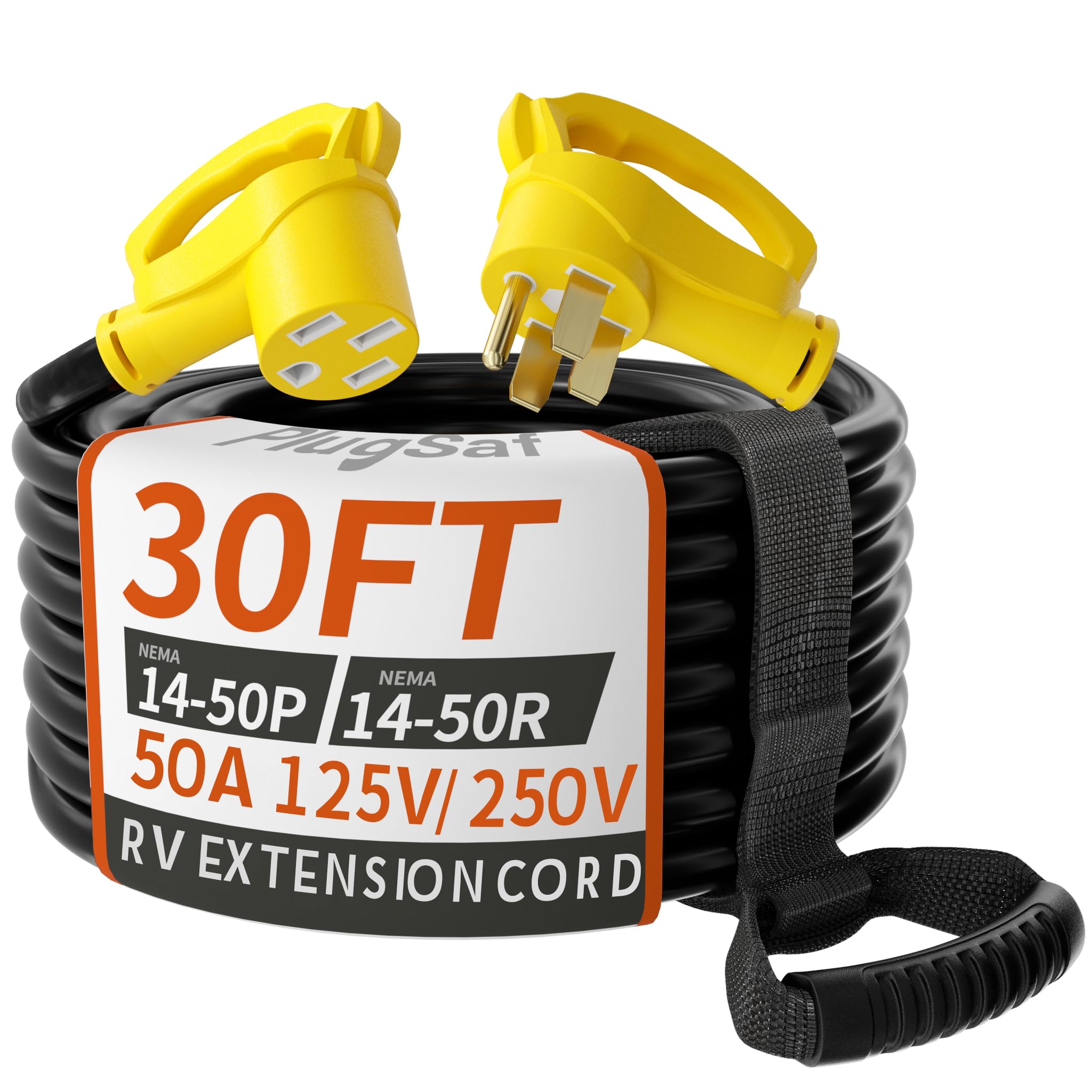
The 30-footer that stays cool under a full day of Level 2 charging — even in summer.
Owners love how this heavy-duty cord works: “works perfectly with my EV charger” and “cool to the touch after 6 hours of Level 2 charging two BEVs” are typical. The PlugSaf uses a thick 4-conductor STW jacket with IP65 waterproofing and an ergonomic grip handle. It is rated for 50A at 125/250V, handling up to 12500W. The flex characteristic is noticeably better than the 50-foot giants — it routes easily along garage walls or ceilings using clamp anchors.
The 30-foot length splits the difference between shorter 25-foot cords and heavy 50-footers. Owners find it long enough to cross a standard two-car garage or reach across a driveway without the extreme bulk of a 50-foot cord. The only recurring note is that the jacket is slightly stiffer when cold, but once warmed by passing current, it becomes flexible again.
Best Balance: At 30 feet, the PlugSaf gives you 33% more reach than the 25-foot POWGRN without the 40% weight penalty of a 50-footer. It is the just-right option for most home garages.
Consideration: The grip handle is ergonomic but adds a small amount of bulk at the plug end — still easy to manage.
Ideal for: the homeowner whose charger outlet is on one side of the garage and the car parks on the opposite — 30 feet gives you the margin you need.
Think twice if: you need to span a driveway longer than 30 feet or want the absolute lightest option.
6. bokman Extension Cable for Tesla Charger, 50A 21FT NACS
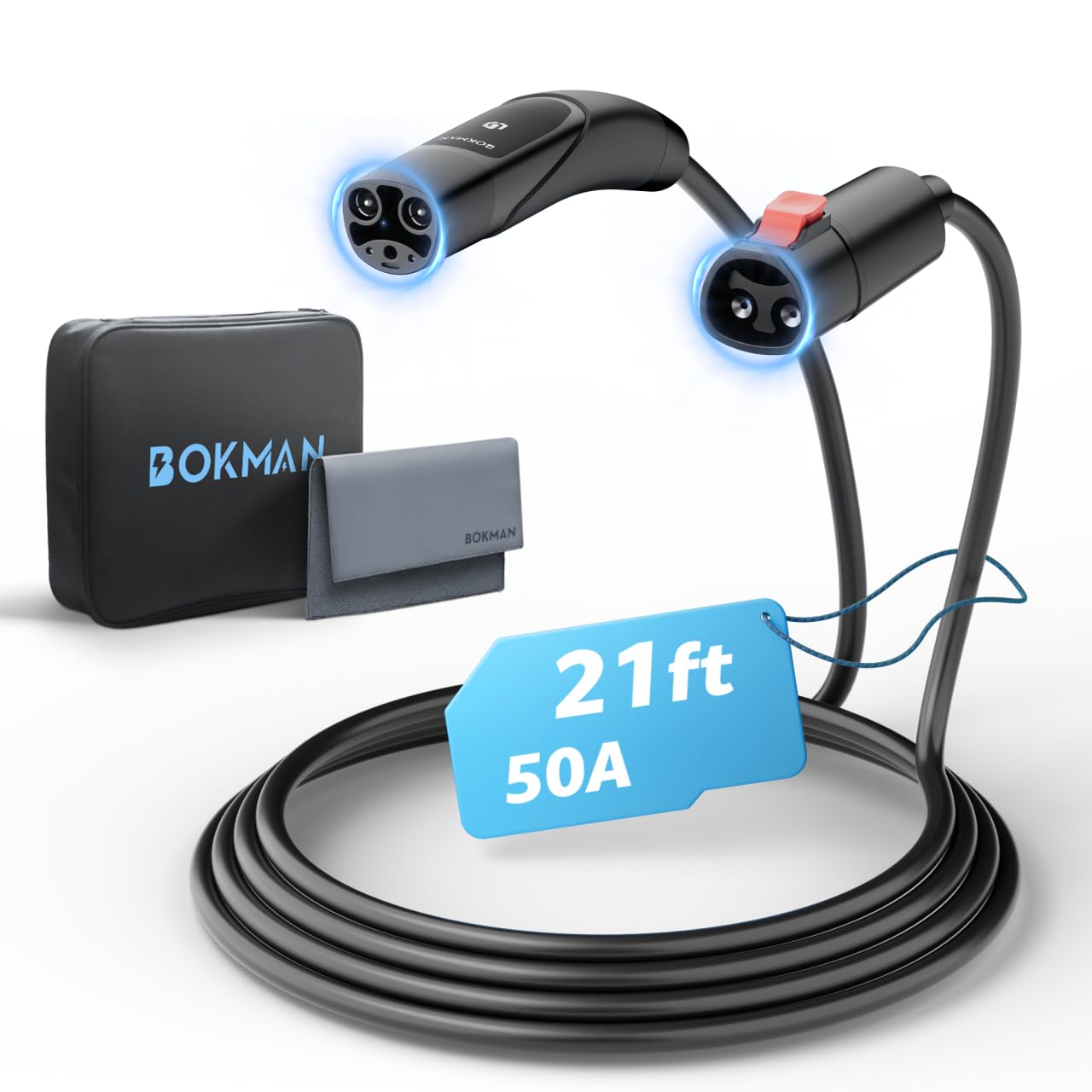
The only cord here that plugs directly into your Tesla’s port — no wall plug, no NEMA adapter.
This is a different breed of extension cord. Instead of matching your wall outlet, the bokman uses the NACS connector (Tesla’s charging standard) to extend your existing Tesla Wall Connector or Mobile Charger by 21 feet. It supports up to 50A at 240V (12,000 watts) with zero speed loss — shoppers say restoring full charge rates of 47 mph on a 2026 Model Y. The IPX5 waterproof rating means it lives outdoors in rain or snow without issues.
There are two quirks to know. First, the cord is twice as thick and heavy as the original Tesla cable — one owner notes their wife struggles to roll it up. Second, the handle has no release button; you must stop charging from the car’s screen or app before unplugging. This is a safety lock, not a flaw, but it is a different habit than the original Tesla handle. Also, it does not work with Superchargers.
Why Owners Buy It
- NACS connector plugs directly into Teslas — no wall plug interface needed
- Full 50A, 240V, 12KW support with no speed drop from original
- IPX5 waterproof, rated from -30°C to +50°C for year-round outdoor use
Adjustment Needed
- Much thicker and heavier than the original Tesla cable
- No release button — must stop charging via app before disconnecting
Reach for this when: you already own a Tesla and need to extend your Wall Connector or Mobile Charger by 21 feet without touching your home’s wiring.
Look elsewhere if: you own a non-Tesla EV, need Supercharger compatibility, or prefer a plug-to-plug extension.
7. Nilight 50 Amp 50FT RV EV Extension Cord

100% pure copper and a full 50 feet — the distance king for the farthest corner of the yard.
Owners describe the Nilight as “heavy-duty good length” and note it is ideal for RVs and BMW i5s connected to a 60-amp 220V circuit. The wire construction is its standout: 100% pure copper with a full 6/3+8/1 AWG configuration (three 6-gauge conductors plus one 8-gauge ground). This minimizes voltage drop even over 50 feet. It is UL and ETL certified, so it meets safety standards in both the US and Canada.
The weight, however, is substantial. At 50 feet with thick 6-gauge copper, this is not a cord you casually toss in the trunk. Owners say it “took a while to unroll and set up.” It is best for semi-permanent or seasonal installation. The included drag tool helps, but expect a workout during setup. Unlike the 15-foot Cable Matters, this one is flexible enough to coil, but it is still a big, heavy cable.
Performance Proof: The 6/3+8/1 pure copper construction minimizes voltage drop over 50 feet — critical for maintaining full Level 2 charging speed at distance. The UL and ETL double certification is rare at this length and price point.
Logistics: Plan for storage — a 50-foot, 6-gauge cord takes up real space and weight in your garage.
Best for: the setup where the outlet is 40+ feet from the car and you cannot afford any voltage drop — RV parks, large driveways, or farm shops.
Not for: daily coiling and uncoiling; it is a heavy cord best left in place for the charging season.
8. VEVOR 50FT 50 Amp RV Extension Cord

The 50-footer with a built-in LED that tells you power is live before you walk to the car.
Quality is the top praise (18 mentions), and the feature set backs it up. The VEVOR uses STW 6/3+8/1 AWG pure copper wire, is ETL listed, and includes an LED power indicator on the female plug — a small but genuinely useful safety feature for outdoor use at night. The STW jacket resists rain, snow, and UV, and remains flexible down to -40°C (yes, negative 40) and up to 60°C. The oversized anti-slip handle on the male plug makes one-handed disconnection easy even in tight pedestal spaces.
Owners note the cord is “heavy gauge, high quality” but “adds a lot of weight to travel with.” It also includes a 15A to 50A adapter (lets you plug into a standard household outlet) — a thoughtful bonus for topping off at a friend’s house. The flat plug design helps it fit RV cabinets during storage.
Standout Features
- LED power indicator on the female plug for instant safety confirmation
- Flexible from -40°C to 60°C — best cold-weather performance on this list
- Includes a 15A-to-50A adapter for household outlet use
Weight Reality
- 50 feet of 6-gauge copper is heavy; owners note travel weight is significant
- Return shipping for misbought units can exceed — confirm your plug type
Choose this for: harsh winter climates where a stiff cord would crack — the -40°C rating (stays flexible down to -40° Celsius, which is also -40° Fahrenheit) is class-leading — and you want the LED safety check (a light on the plug that shows power is flowing).
pass on it if: you need a lightweight portable cord for daily trunk storage; this stays where you place it.
Understanding the Specs
AWG (American Wire Gauge) — The Wire Thickness
In simple terms, a lower AWG number means a thicker wire that can carry more electricity without heating up. A 6 AWG wire is roughly twice the diameter of a 10 AWG wire. For a 50-amp charger at 50 feet, you want 6 AWG. For a 30-amp charger at 15 feet, 10 AWG is fine. Thinner wire at long distances causes voltage drop — your car charges slower and the cord can overheat.
NEMA Plug Types — The Physical Connector
The National Electrical Manufacturers Association standard defines the shape, prong count, and voltage rating of plugs and outlets. A 10-30 has three prongs (two hots, one neutral) and handles 30 amps at 125/250V — common on older dryers. A 14-50 has four prongs (two hots, a neutral, and a ground) and handles 50 amps. They are not interchangeable, so match the plug to your exact outlet type.
STW Jacket — The Outdoor Rating
STW stands for Service, Thermoplastic, Weather-resistant. It is a heavy-duty jacket that stands up to sunlight, rain, snow, and abrasion. For an extension cord that lives outdoors or in a garage, STW is the minimum. Some cords add an IP65 waterproof rating (dust-tight and protected against water jets), which is even better for rain exposure.
Continuous Load vs. Peak Load
EV charging is a continuous load — your car draws high current for hours, not minutes. A cord rated for 50 amps peak might overheat at a sustained 48-amp draw. Always use a cord whose amp rating equals or exceeds your charger’s continuous output. The National Electrical Code recommends sizing for no more than 80% of the cord’s rating for continuous loads, so a 50-amp cord is ideal for a 40-amp charger.
FAQ
Can I use a standard household extension cord for EV charging?
What happens if I use a 30-amp extension cord on a 50-amp charger?
Does a longer extension cord reduce my charging speed?
Is it safe to run an EV extension cord through a window or garage door?
What is the difference between NEMA 10-30 and NEMA 14-50?
Will an extension cord for EV charging work with my Tesla Mobile Connector?
How do I store a heavy-duty EV extension cord?
Can I leave a 50-amp extension cord plugged in all the time in the rain?
Is pure copper wiring worth paying extra for?
What does the 80% rule mean for my EV extension cord?
Final Thoughts: The Verdict
For most buyers, the best extension cord for ev charging is the Cable Matters 50A 15ft because it combines a flawless 4.8-star track record with true 50-amp capacity, weatherproof build, and easy-grip handles that make daily plugging safe. If you need a budget-friendly, plug-and-play solution for a 30-amp dryer outlet, the CircleCord 15ft is the smart call. And for Tesla owners who want to extend their existing charger without touching the wall connection, the bokman NACS 21ft is the only cord that plugs directly into the car’s port — no adapters needed.
How We Picked
We do not accept paid placement. Every pick is matched to a real buyer and a real use-case; we do not hands-on test units.
Sources & Methodology
Specifications: manufacturer listings and product documentation. Review insights: verified customer reviews, as of July 2026. Pricing: not shown on this page (it changes often); check the current price via the retailer link.
As an Amazon Associate, WellFizz earns from qualifying purchases. This does not affect which products we feature.
Related Guides

Mo Maruf
I created WellFizz to bridge the gap between vague wellness advice and actionable solutions. My mission is simple: to decode the research and give you practical tools you can actually use.
Beyond the data, I am a passionate traveler. I believe that stepping away from the screen to explore new environments is essential for mental clarity and physical vitality.