Our readers keep the lights on and my smoothie glass nicely filled. As an Amazon Associate, I earn from qualifying purchases.
Specs are compiled from manufacturer listings and verified buyer reviews and can change over time — please confirm the key details on the product page before buying.
Nailing exposure on a film camera or a studio flash rig shouldn’t be a roll of the dice or a string of wasted shots. An exposure meter tells you exactly how much light is hitting your subject, so you can set your camera with confidence instead of bracketing every frame and hoping for the best. This guide breaks down the best exposure meters across every price tier, from the touchscreen studio powerhouses to pocket-sized dial-driven companions for vintage rangefinders, so you can match the tool to the way you actually shoot.
I’m Mohammad Maruf — the founder and writer behind WellFizz. This guide is built by comparing the manufacturers’ published specifications and the patterns across verified customer reviews, so you get each pick’s real strengths and trade-offs instead of marketing spin.
You’ll learn which metering modes matter, how accuracy is judged, and where your money goes when you buy a exposure meter that matches a film-shooter’s workflow versus a cinematographer’s on-set demands.
Our Picks at a Glance

How To Choose The Best Exposure Meter
Choose your metering style before you set a budget. A meter that reads the light falling on your subject (incident) behaves very differently from one that reads the light bouncing off a tiny area of the scene (reflected spot). Pick the metering type that fits your camera’s strengths, not the reverse.
Incident vs. Reflected Spot Metering
Incident metering, done with a white dome over the sensor, measures the light arriving at the subject. It’s the classic choice for studio portrait and flash work because it ignores how dark or bright the background is. Reflected spot metering uses a built-in (or clip-on) viewfinder to read a narrow 1° or 17° patch of the scene — the tool of choice for landscapes and contrast-heavy scenes where you want to place shadows and highlights precisely.
Flash Capability and Radio Control
If strobes or remote triggers are part of your kit, a meter that reads flash is non-negotiable. The premium tier goes further: built-in radio transmitters that fire and adjust Elinchrom, Phottix, or PocketWizard packs straight from the meter’s touchscreen, and flash-duration analysis that reads t.1 and t.5 times so you can freeze motion precisely.
Battery, Build, and Workflow Fit
Weights range from a featherlight 1.23 ounces to a 10.5-ounce studio brick, and batteries run from single-use AAs to built-in rechargeable packs with over 20 hours of life. Your workflow—pocket carry for a rangefinder walk or strap duty on a lighting stand—dictates the right size and power scheme.
Quick Comparison
| Model | Best For | Metering Type | Flash Duration | Battery | Amazon |
|---|---|---|---|---|---|
| Sekonic L-858D Speedmaster★ Best Overall | Pro studio & hybrid sets | Incident & Spot | Yes | AA | Amazon |
| Sekonic L-858D-U SpeedmasterTop Performer | Cinema & HSS specialists | Incident & 1° Spot | Yes | — | Amazon |
| Sekonic L-478DR-U LiteMaster Pro | PocketWizard shooters | Incident | Yes | Nonstandard | Amazon |
| Datacolor LightColor Meter | Mixed-temp color matching | Reflected | No | 2 × AAA | Amazon |
| LightMate Area 2S + OV-X1 | Compact spot metering | Reflected 17° Spot | No | Rechargeable | Amazon |
| LightMate AirPro | Vintage film bodies | Reflected 35° | No | Rechargeable | Amazon |
| TTartisan Light Meter II | Budget rangefinder users | Reflected | No | — | Amazon |
In‑Depth Reviews
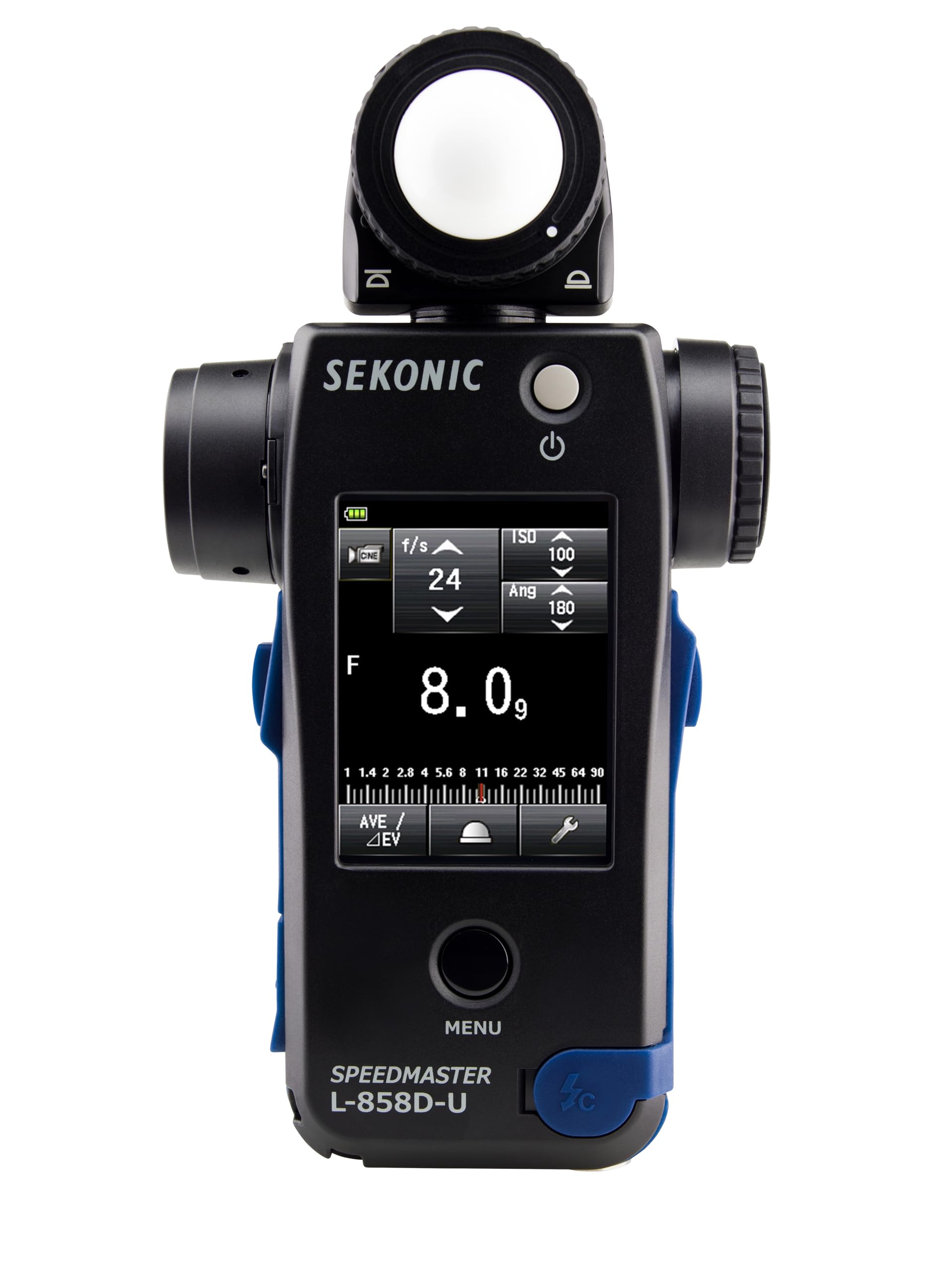
1. Sekonic L-858D Speedmaster Light Meter
Our pick — over 4.5★ from 150+ verified ratings; the strongest balance of quality and price.
The studio workhorse that measures flash bursts, ambient light, and 1° spots from one 2.7-inch color touchscreen.
This is the full-spec flagship that reads the light falling on your subject (incident metering with the white dome), while also pulling off spot readings and flash-duration analysis — the t.1 and t.5 times that tell you exactly how quickly a strobe freezes motion. It handles dim scenes down to a faint 0.1 lx, which means you can capture an accurate ambient reading in a nearly dark room without cranking your ISO on a guess. That low-light reach pairs with a wider ISO and shutter-speed range than older Sekonic units, plus wireless triggering compatibility with Elinchrom, Phottix, and PocketWizard kits so you can fire remote packs right from the meter.
Buyers report that the touchscreen menu feels intuitive and that the upgrade from an older Sekonic L-358 is a genuine leap forward. It’s not a light object — at 10.5 ounces it’s the heaviest meter here, and the price tag makes it a serious investment. But the refrain is consistent: “Pricy… But the best I’ve ever owned.” For pros shooting studio flash, film, or cinematography, this is the meter that removes the guesswork entirely.
It is dust-proof and splash-proof, so it shrugs off the grit and weather of a real location shoot rather than confining itself to a clean studio table. The colour screen makes navigating the many modes faster than any button-and-wheel layout, which is exactly why hybrid shooters bouncing between stills and motion keep gravitating to it.
Where it shines
- Full incident, spot, and flash-duration metering in one body
- Wireless radio compatibility for Elinchrom, Phottix, and PocketWizard
- Dust-proof and splash-proof housing for on-location reliability
Where it bites
- Heaviest pick here at 10.5 ounces
- Premium price puts it out of reach for casual shooters
Reach for it: you’re a professional or serious enthusiast who needs one meter for flash, ambient, and spot work without switching tools.
Look elsewhere if: you’re on a budget and your shooting is casual — the heft and cost are overkill for a walk-around rangefinder kit.
2. Sekonic L-858D-U Speedmaster Light Meter
The cinema-grade powerhouse with a built-in 1° spot viewfinder and flash analysis down to the tenth of a stop.
High-speed sync (HSS) work is this meter’s superpower — it measures short flash bursts at t.1 and t.5 durations, the exact readings you need to freeze action with speedlights. The built-in 1° spot viewfinder lets you pick out a tiny patch of a landscape and read the reflected light right there, which is why owners call it an essential upgrade over a plain incident-only meter. Accuracy lands at 1/10 of a stop, and the -5 to 22.9 EV range at ISO 100 keeps it dependable in both near-darkness and blazing sunlight.
Owners mention it works flawlessly in low light with flash configurations, and studios call it a must-have for both photo and film work. Owners praise the clear touchscreen and the way it eliminates exposure guessing, though a few note the touch sensitivity and settings could be more forgiving — the interface rewards a little patience. As owners put it: “Provides an accurate starting point eliminating guess works and is more reliable than most camera metering systems.” It’s the same accuracy family as the L-858D above but adds the dedicated 1° spot and HSS precision that gaffers and sports shooters rely on.
Optional radio modules expand it to trigger major lighting brands directly, meaning it can grow with your studio rather than being replaced. At 8.8 ounces it’s lighter than the base L-858D and lives comfortably on a strap between setups.
Pro’s choice: If high-speed sync and pinpoint spot readings define your work, this is the most complete meter in the lineup — and the recurring praise is its dependability, not just its feature list.
Who it fits: studio photographers and gaffers who need flash-duration precision and a built-in spot meter without carrying a second device.
The trade-off: the touchscreen interface has a learning curve, and a handful of owners found it finicky at first.
3. Sekonic L-478DR-U LiteMaster Pro
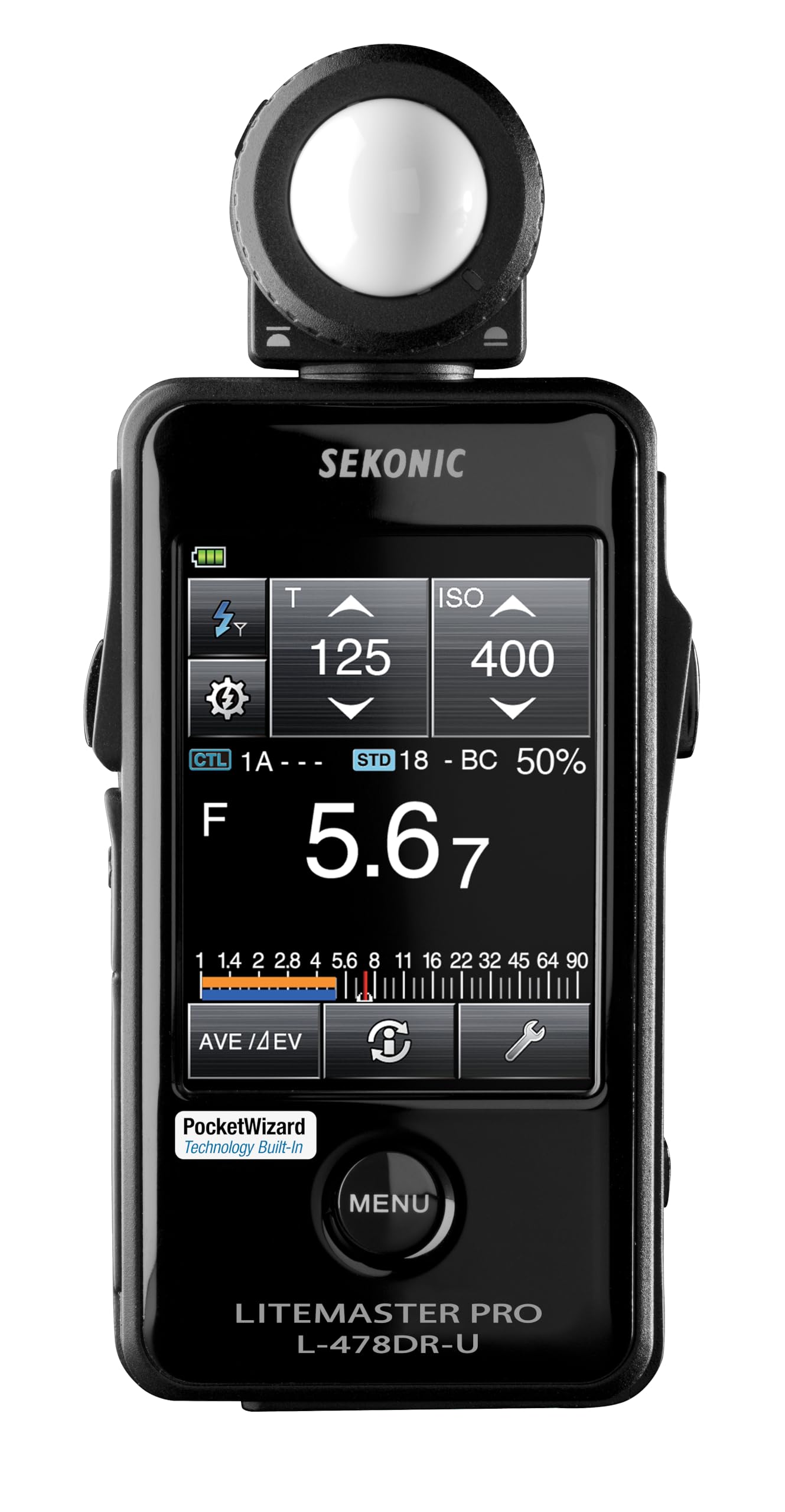
The PocketWizard native that fires and tunes your remote flashes straight from a 2.7-inch color touchscreen.
Built for the PocketWizard radio system, this meter embeds a transmitter so you can trigger and remotely adjust your flash power without touching the light itself. The retractable lumisphere (the white incident dome) tucks away when you want the optional 5° viewfinder attached for reflected spot readings, making it a genuine hybrid in a lighter body. Dedicated Cine settings let you set frame rate and shutter angle, which is why filmmakers and hybrid creators keep it in the kit alongside stills.
Buyers who set it up with their remote triggers report it saves real time — “I nail it every time” — because the meter and the lights talk to each other directly. The flash analyzing function reads the flash-to-ambient ratio, so you can balance a strobe against window light and see the relationship before you take a single frame. It weighs in at 8 ounces, which is lighter than the L-858D’s 10.5 ounces, and owners call the touchscreen accurate and well constructed.
Landscape shooters who grab the spot attachment keep it for the precision highlights give; the meter’s core is incident, so the spot device is sold separately if you need it. If your triggers are PocketWizard, there is no faster path from “scene” to “set” than this.
Workflow winner: the integrated radio control collapses a multi-step lighting setup into one screen — the clearest time-saver in this lineup if you’re already PocketWizard-native.
Grab it if: your studio is PocketWizard-based and you want to fire and tune packs from the meter itself.
skip it if: your triggers are Elinchrom or Phottix — the L-858D family covers those brands, while this one is PocketWizard-specific.
4. Datacolor LightColor Meter
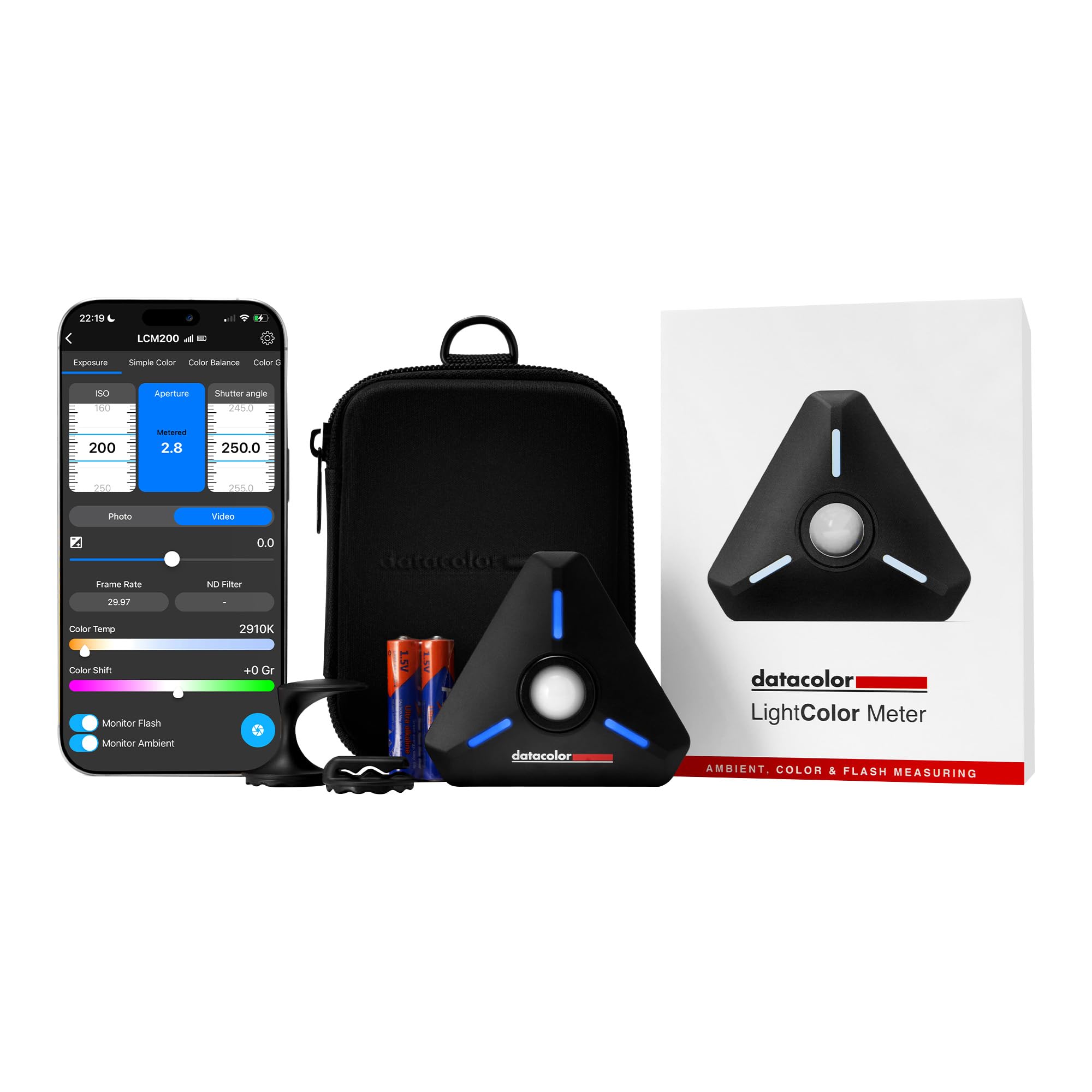
The tiny color-nerd’s sidekick that syncs light and color temperature to your phone over Bluetooth in real time.
This one measures more than exposure — it reads color temperature from 1,600K to 20,000K, green-magenta balance (DUV), and chromaticity across ambient and flash. That makes it the pick for anyone mixing video lights and strobes of different temperatures, a headache owners describe as instantly solvable: adjust a few lights, and the results are “amazing.” Bluetooth 4.0 LE streams live data to the free app, and you can connect multiple meters simultaneously up to 80 feet away for large productions.
At 1.73 ounces and powered by 2 AAA batteries (included), it’s nearly pocket-weight and runs up to 40 hours. It’s drop-resistant, and the free-hand wireless operation is a real plus on set. The catch buyers flag: as a pure exposure meter it ran about a stop below two different Sekonic meters in one direct comparison, so think of it as a color specialist first and an exposure helper second. If your main question is “what temperature is this light,” there’s nothing close at this size.
It measures all lighting types — LED, tungsten, HMI, fluorescent, strobe, and outdoor — which is rare in a device this compact.
The color edge
- Real-time Bluetooth streaming to the free app
- Wide 1,600K–20,000K color temperature range
- Featherlight at 1.73 ounces with 40-hour battery
The honesty check
- Reports of exposure readings about a stop off versus Sekonic
- Requires a phone to see the color data
Choose this for: color-critical work — matching mixed lighting temperatures and green-magenta shifts on set.
Think twice if: your primary need is pure exposure accuracy; a dedicated exposure meter is the more proven tool.
5. LightMate Area 2S + OV-X1 17° Retro Viewfinder
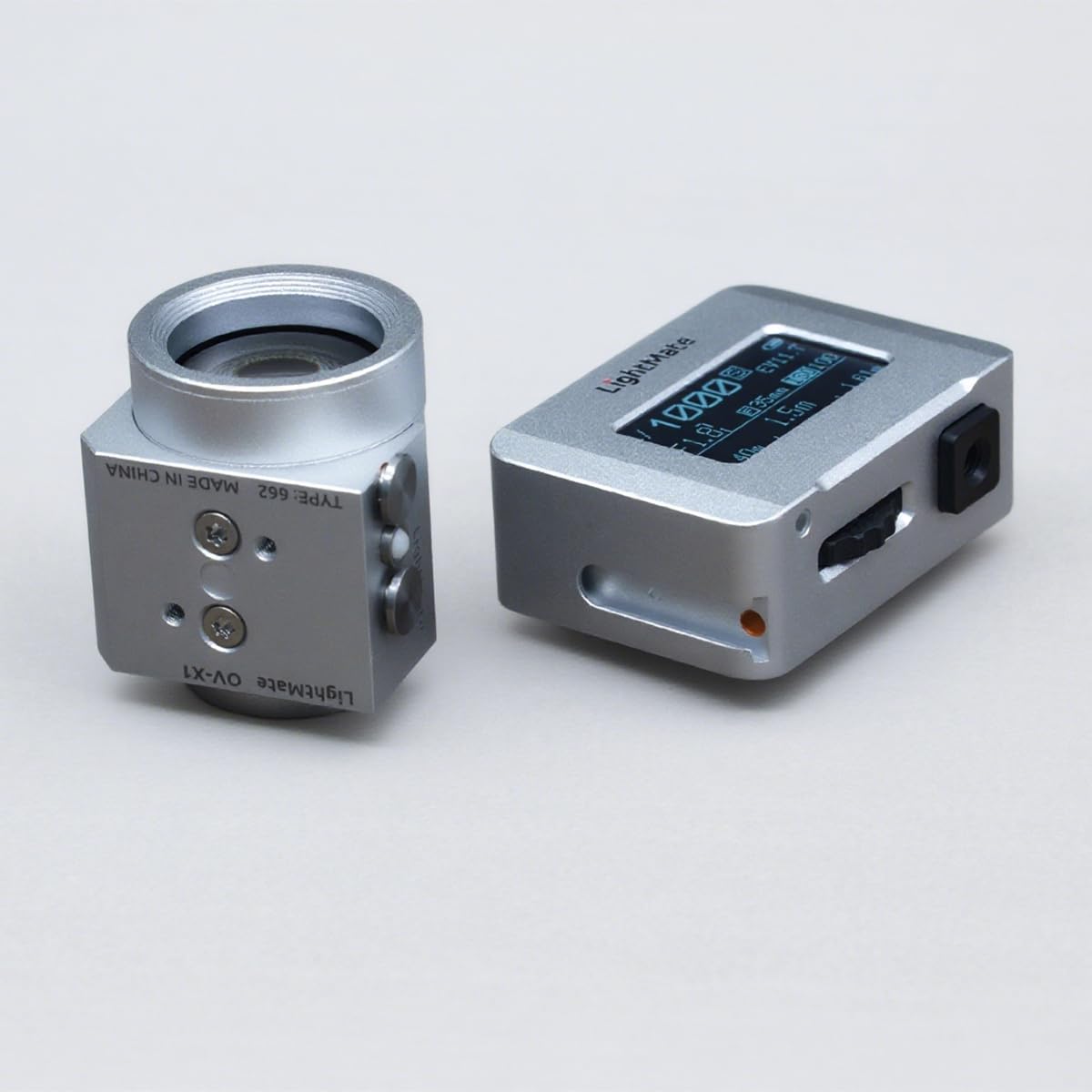
The 1.23-ounce spot meter with a clip-on retro viewfinder that measures exactly what you’re aiming at.
This is the ultra-compact spot meter for rangefinder shooters: the clip-on OV-X1 17° viewfinder snaps onto the meter’s vfPort, so you look through it, center the target, and read the light within that circle. Customers note it matches the accuracy of two other meters with identical readings at ISO and f/5.7, and many prefer it for spot work because it’s so precise. It weighs just 1.23 ounces — the lightest meter in this roundup, versus the Sekonic L-858D at 10.5 ounces — so it disappears into a shirt pocket.
The 0.96-inch OLED screen is readable outdoors with a brightness boost, and the built-in rechargeable battery runs over 20 hours with a standby beyond 6 months on a full charge. Modes cover aperture priority, shutter priority, single, continuous, and average metering, plus exposure compensation and an ND-filter compensation function. There’s even a digital depth-of-field calculator that uses hyperfocal distance for street photography.
Owners note the spot read tended to run about 0.6 EV underexposed on one unit until the offset was applied — a quick fix in a menu — and low-light scenes are its weak spot, so incident metering is the better fallback after dark. For daylight street and landscape shooting, this is a superb value in a tiny package.
Tiny but serious: the removable viewfinder makes true spot metering portable in a way no other compact here matches.
Reach for this if: you shoot a rangefinder or Leica M and want a precise spot reading without carrying a studio meter.
Who it’s not for: low-light or night shooters — keep an incident meter handy for dim scenes.
6. LightMate AirPro Light Meter
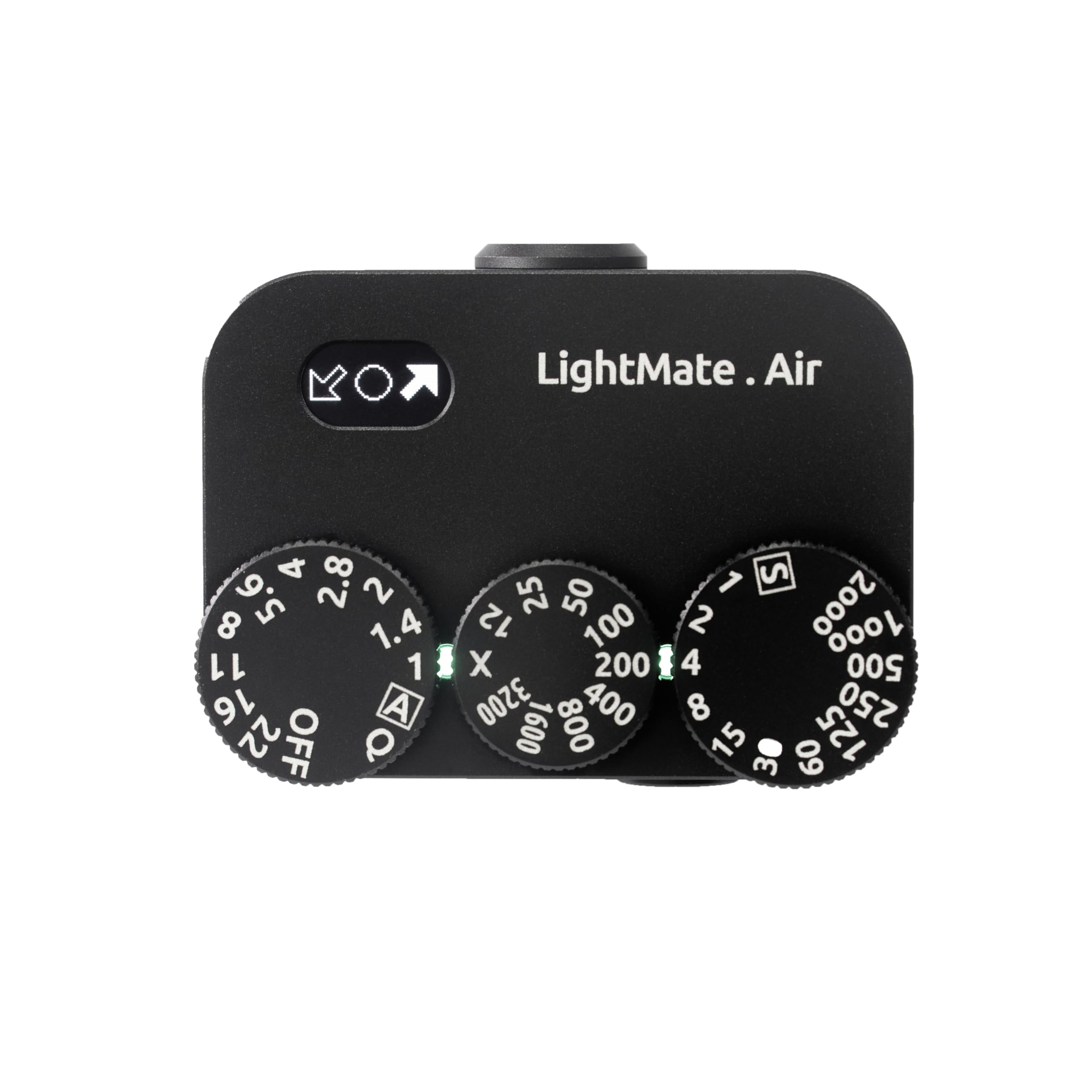
The dial-driven retro meter that film shooters say beats a Voigtlander at half the cost.
Three physical dials for aperture, ISO, and shutter speed give this meter a tactile, old-school feel, with satisfying clicks and half-stop resolution that adjusts down to 1/3 or 2/3 stops. There are no menus to drown in — buyers describe a 10-minute learning curve and accuracy within half a stop, and the thing everyone raves about is the ease of use. It’s ideal for vintage cameras with dead light meters, with owners successfully pairing it with Argus C3, Mercury II, and Revere 33 bodies, plus any hot or cold shoe.
The 35° reflective metering angle covers a wide scene, and the full metal shell feels premium. Batteries are built-in and rechargeable via USB-C, running over 20 hours with a standby of more than 6 months. The customizable OLED display shows five stops for zone-system shooters and is readable even in bright light, with over 10 exposure indicators and dual LED cardinal points you can recolor to your liking.
The quirks: the [A] and [S] mode labels confuse some owners, a few random Chinese characters appear in the interface, and pressing the exposure button inside a bag can leave the light on and drain the battery. None of that dents the core appeal — accurate, intuitive, and a fraction of the cost of the big-name competition.
Old-school charm
- Three tactile dials beat scrolling menus for speed
- Metal body, satisfying clicks, half-stop accuracy
- USB-C rechargeable with 20+ hours per charge
Small frustrations
- Confusing [A]/[S] mode labels and interface text quirks
- Easy to leave on in a bag, draining the battery
Who it’s for: film shooters reviving old cameras who want an accurate, intuitive meter without the Voigtlander or Sekonic price.
The one habit to build: always press the off switch before stowing it in a bag.
7. TTartisan Light Meter II

The entry-level shoe-mounted dial meter for older Leicas and folding cameras that won’t break the bank.
This is the budget on-ramp to metered shooting for old rangefinder and folding cameras. The shutter speed dial has been expanded to 23 gears with a clickable, upgraded design, and the two-dial layout lets you dial in ISO, aperture, and shutter speed cleanly. The cold shoe mount is adjustable so it sits properly on a variety of old bodies, and it comes in silver or black to match your vintage kit. It weighs just 3.17 ounces, so it rides on the camera without adding meaningful heft.
Owners love how it looks on classic cameras and find it “perfect for my older folding camera,” and it earns praise for lifting the analog shooting experience. The flip side: quality control has been inconsistent, with reports of units arriving that “gave inconsistent readings” — a frustrating lottery that two separate orders didn’t fix. It also needs batteries that aren’t included, so budget for those on day one.
Noticeably more compact and affordable than the LightMate options above, this is the pick when you want to try metered film shooting without a bigger commitment. Just be ready to test the unit on arrival and return it if the readings wobble.
Value play: the cheapest path to a dial-driven meter that looks right at home on a vintage Leica — if you get a good one, it’s a steal.
Best for: curious film shooters who want to dip into metering without spending mid-range money.
The gamble: consistency is the open question here, so verify your unit’s readings early and exchange if needed.
Understanding the Specs
Incident vs. Reflected Spot Metering
The white dome (lumisphere) reads the light falling on the subject, which is ideal for flash and portrait work. A spot viewfinder reads light bouncing off a narrow angle — 1°, 17°, or 35° — letting you place shadows and highlights with precision in a contrasty landscape.
Flash Duration and EV Range
Flash duration analysis reads t.1 and t.5 times, telling you how fast a strobe really fires so you can freeze motion. EV range — like the Sekonic’s -5 to 22.9 EV at ISO 100 — shows how dim or bright a scene the meter can handle before it gives up.
FAQ
What is the difference between incident and reflected spot metering?
Will an exposure meter work with my vintage film camera?
What does flash duration analysis actually tell me?
How important is EV range when choosing a meter?
Do I need radio triggering built into my meter?
How long does the battery last on a rechargeable light meter?
Is a light meter the same as a color meter?
Can I use a specialized spot meter for everyday general shooting?
Final Thoughts: The Verdict
For most buyers, the exposure meter winner is the Sekonic L-858D Speedmaster because it bundles incident, spot, and flash-duration metering into one durable, touchscreen body that earns its keep the moment you set up multiple strobes. If you want precise spot readings and HSS work on a tight budget, the LightMate AirPro delivers the best value with its tactile dials and half-stop accuracy. And for color-critical mixed lighting, the Datacolor LightColor Meter is the one to reach for, since it bridges the gap between exposure and color temperature in a pocket-sized body.
How We Picked
We do not accept paid placement. Every pick is matched to a real buyer and a real use-case; we do not hands-on test units.
Sources & Methodology
Specifications: manufacturer listings and product documentation. Review insights: verified customer reviews, as of August 2026. Pricing: not shown on this page (it changes often); check the current price via the retailer link.
As an Amazon Associate, WellFizz earns from qualifying purchases. This does not affect which products we feature.
Related Guides

Mo Maruf
I created WellFizz to bridge the gap between vague wellness advice and actionable solutions. My mission is simple: to decode the research and give you practical tools you can actually use.
Beyond the data, I am a passionate traveler. I believe that stepping away from the screen to explore new environments is essential for mental clarity and physical vitality.