Our readers keep the lights on and my smoothie glass nicely filled. As an Amazon Associate, I earn from qualifying purchases.
Specs are compiled from manufacturer listings and verified buyer reviews and can change over time — please confirm the key details on the product page before buying.
Walking into a room with the faint smell of gas is a tense experience. You know a tiny, invisible leak can turn into a serious problem, but finding exactly where that leak is coming from often feels like guessing in the dark. A reliable explosive gas detector turns that anxiety into action, giving you a tool to pinpoint the exact source of natural gas, propane, or methane before a small issue becomes a big one.
I’m Mohammad Maruf — the founder and writer behind WellFizz. This guide is built by comparing the manufacturers’ published specifications and the patterns across verified customer reviews, so you get each pick’s real strengths and trade-offs instead of marketing spin.
You need a detector that warns you before a gas leak turns into a disaster. Here are the top models for finding combustible gases, from handheld sniffers for professionals to plug-in alarms for your home, so you can pick the right explosive gas detector for your situation.
Our Picks at a Glance


How To Choose The Best Explosive Gas Detector
Not every gas detector does the same job. Some are designed for quick spot-checks around a stove or water heater, while others are built for continuous monitoring in a workshop or near a furnace. Understanding the core differences helps you avoid buying a tool that doesn’t fit your worry.
Portable Sniffer vs. Plug-In Alarm
The biggest fork in the road is between a handheld sniffer and a stationary alarm. A portable sniffer, like most of the picks here, is for active searching — you walk around a room, stick the probe near joints, and watch the reading climb. A plug-in alarm (like the Kidde) sits in one spot and screams when the concentration hits a danger threshold. For many, owning one of each is the ideal setup.
Understanding %LEL and PPM
You will see readings listed as %LEL (Lower Explosive Limit) or PPM (Parts Per Million). %LEL tells you how close the gas concentration is to becoming explosive — 20% LEL means the air has reached one-fifth of the level needed for an explosion. PPM is a more granular measure, often used for smaller leaks. A detector that shows both gives you the most information about the severity of a leak.
Probe Reach and Flexibility
A long, bendable probe is the difference between checking a pipe joint behind your dryer and having to guess. Models with a gooseneck or telescopic rod let you reach into tight spaces without contorting yourself. The longer the probe, the easier it is to inspect gas lines in crawlspaces, behind appliances, or inside an RV cabinet.
Quick Comparison
| Model | Best For | Sensor Type | Probe Length | Power Source | Amazon |
|---|---|---|---|---|---|
| TopTes PT760★ Best Overall | Overall Value & Ease | Catalytic | 12-inch telescopic | USB-C Rechargeable | Amazon |
| TopTes PT299Best Value | Budget-Friendly Sniffer | Gas Sensitive Semi Conductor | 6.3-inch telescopic | 2x AAA Batteries | Amazon |
| AGT-1988PROPro Grade | Flexible Gooseneck Access | — | 6.9-inch gooseneck | USB-C Rechargeable | Amazon |
| TopTes PT520A+ | Long-Reach Gooseneck | — | 17-inch gooseneck | USB-C Rechargeable | Amazon |
| Kidde KN-COEG-3 | Continuous Home Monitoring | — | N/A (Plug-in) | 120V Plug-in + 9V Backup | Amazon |
| Alopex AS8800L | Reliable, Budget Pro Tool | gas sensor | Flex probe (short) | 3x AA Batteries | Amazon |
| TopTes Guard-101 | 4-Gas Safety Monitor | Multi-sensor | None (diffusion) | Rechargeable (14h life) | Amazon |
| RIDGID CD-100 | Professional-Grade Durability | — | 16-inch flexible probe | 4x AA Batteries | Amazon |
| UEi CD100A | HVAC Contractor Standard | — | 18-inch flexible gooseneck | 4x AA Batteries | Amazon |
In‑Depth Reviews
1. TopTes PT760 Rechargeable Natural Gas Detector
Our pick — over 4.5★ from 850+ verified ratings; the strongest balance of quality and price.
The rechargeable sniffer that makes professional-level leak hunting feel simple.
This device starts working in just 30 seconds, and its readable display shows the %LEL range from 1% to 20% (which translates to 100 to 10,000 PPM). The built-in flashlight is a simple touch that makes a huge difference when you are peering under a dark sink or behind a water heater. A 12-inch stainless steel telescopic probe extends to reach joints inside pipes and behind cabinets, then retracts so the whole unit stores neatly in the included protective box.
Buyers report the PT760 is the kind of tool an RV tech with 40 years of experience trusts. The thing that wins people over is its sheer functionality — it is praised by far more than any other feature. The alarm triggers within half a second, and a low battery indicator plus automatic power-off keeps you from being caught off guard. Unlike the PT299 further down this list, this model comes with a rechargeable battery charged via a USB-C port, which owners say eliminates the constant need for new batteries.
The only real consideration is its size — at 6.3 inches deep by 2.95 inches wide, it is a handheld unit that feels solid, not tiny. If you are looking for something that fits in a pocket, you might prefer the slimmer AGT-1988PRO. But for a do-it-all home detector that has already paid for itself finding tricky propane leaks, this is the one.
Why Owners Reach for It
- USB-C rechargeable means no hunting for AAA batteries.
- 12-inch telescopic probe reaches behind appliances with ease.
- Responds in under a second with both sound and a color-changing screen.
The Trade-Off
- Bulky shape doesn’t slide into a pants pocket like the slimmer models.
The go-to for most homes: If you have gas appliances, an RV, or a propane grill and want one reliable tool to check them all, this is your best bet.
Not the one for: Techs who need a pocket-sized daily carry — the AGT-1988PRO is much thinner.
2. TopTes PT299 Gas Leak Detector
The budget-friendly leak finder that still delivers pro-level sensitivity.
This device uses a gas-sensitive semiconductor sensor and runs on two included AAA batteries, making it a grab-and-go tool that never needs to sit on a charger. You will want to wait for the 30-second warm-up before moving the probe toward a suspected leak. The telescopic pole extends from 2.2 inches to 6.3 inches, giving you just enough reach to check a pipe joint without putting your face too close to the danger.
What buyers consistently praise is the sheer effectiveness here — the unit’s functionality is the top-mentioned positive by a wide margin. Owners share stories of pinpointing LPG leaks at two pipe joints in under two minutes and then confirming the repair was successful in half an hour. It even detected a natural gas leak inside a dryer that the homeowner could not smell at all. The non-slip texture on the handle gives you a secure grip, and the 5-minute auto shut-off saves battery life when you get distracted.
The catch is that the extension rod is a solid piece that some find hard to pull out at first. And while it is very sensitive, the gas detection aspects get mixed feedback from a smaller group of owners. At this price point, however, it is an incredible entry point for anyone who just wants to check their RV or home appliances.
What Makes It a Steal
- Runs on standard AAA batteries — always ready to go.
- Compact enough for a kitchen drawer or glove box.
- Detects tiny leaks that the nose misses entirely.
Keep in Mind
- The telescopic rod is stiff to extend initially.
- A few owners found the detection wand less consistent than expected.
Best for first-time buyers: If you need a simple, affordable tool to start checking your home’s gas connections, this is a smart buy.
skip it if: You need a rechargeable unit — this one drains AAA batteries over time.
3. AGT-1988PRO Rechargeable Natural Gas Detector
The slender wand that bends into the tightest spots with a crisp TFT screen.
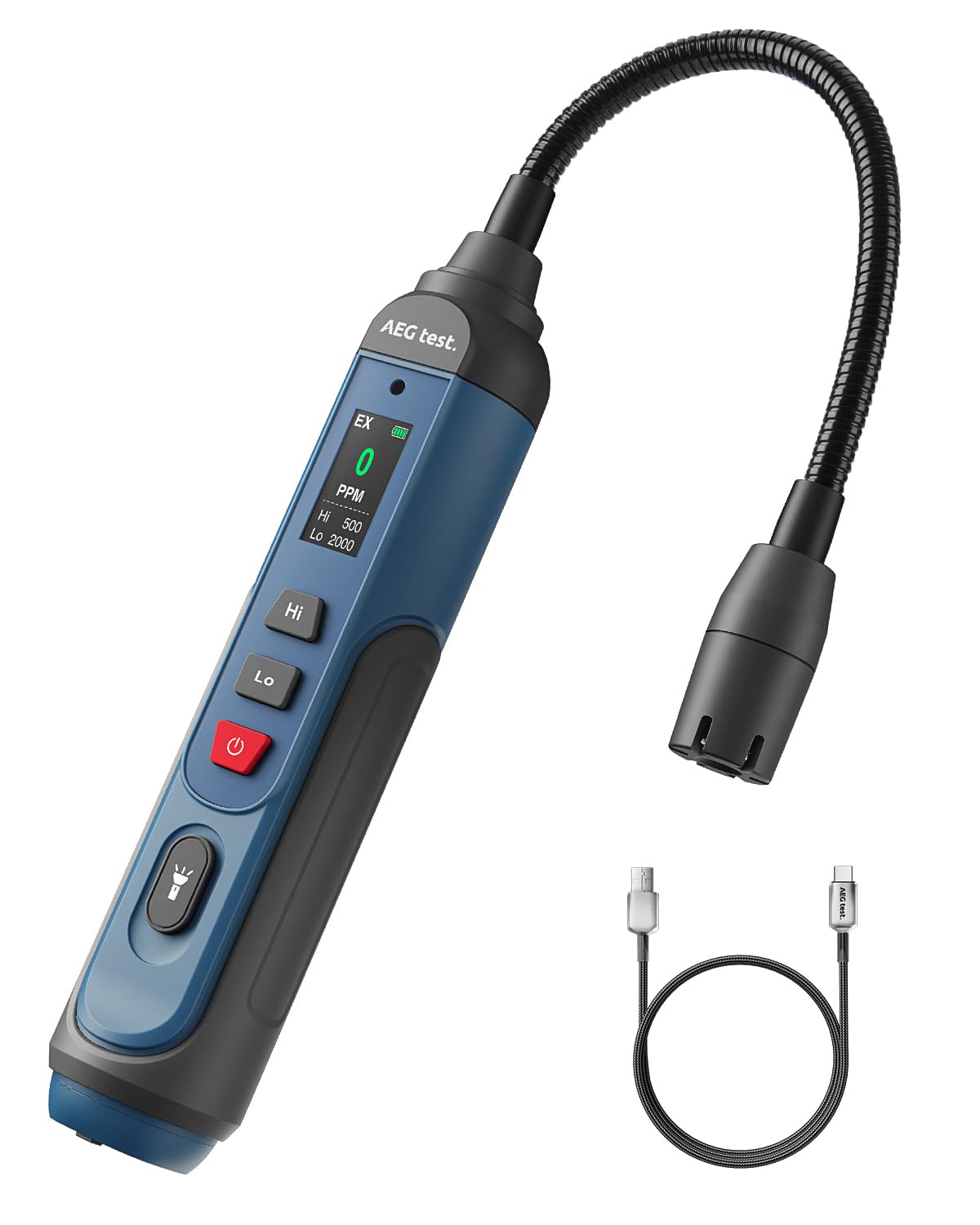
At just 1.1 inches wide and 12.6 inches tall, this detector is a strikingly thin tool compared to the wider TopTes PT760 (which is 6.3 inches deep). The 6.9-inch gooseneck probe is flexible, so you can bend it around obstacles to check the back of a stove or the underside of a furnace. The warm-up time is a fast 15 seconds, and the response speed is a snappy half-second — meaning you get readings almost immediately.
The TFT color screen displays the gas concentration in PPM from 0 to 9999, along with battery status and alarm indicators. When it hits a leak, the screen color-codes the severity. It also includes a built-in flashlight for dim crawlspaces. As owners put it, this device can max out its sensor instantly on unexpected sources, which tells you how responsive it is.
This model is newer than the others, so it has fewer customer ratings and less long-term durability data. The manufacturer backs it with a 36-month warranty. Buyers who want a slim detector with a probe that stays bent exactly where you set it will find this a strong option.
Standout Features
- Extremely slim body fits in any tool pouch.
- Flexible gooseneck probe is perfect for tight, awkward spaces.
- Fast 15-second warm-up gets you working quickly.
Limitation
- Smaller review pool means fewer real-world longevity stories.
Ideal for precision work: If you often need to snake a probe behind fixed appliances or inside confined cabinets, this is your tool.
Think twice if: You want the most proven product with the largest owner base — the TopTes PT760 has many more reviews.
4. TopTes PT520A+ Rechargeable Gas Leak Detector
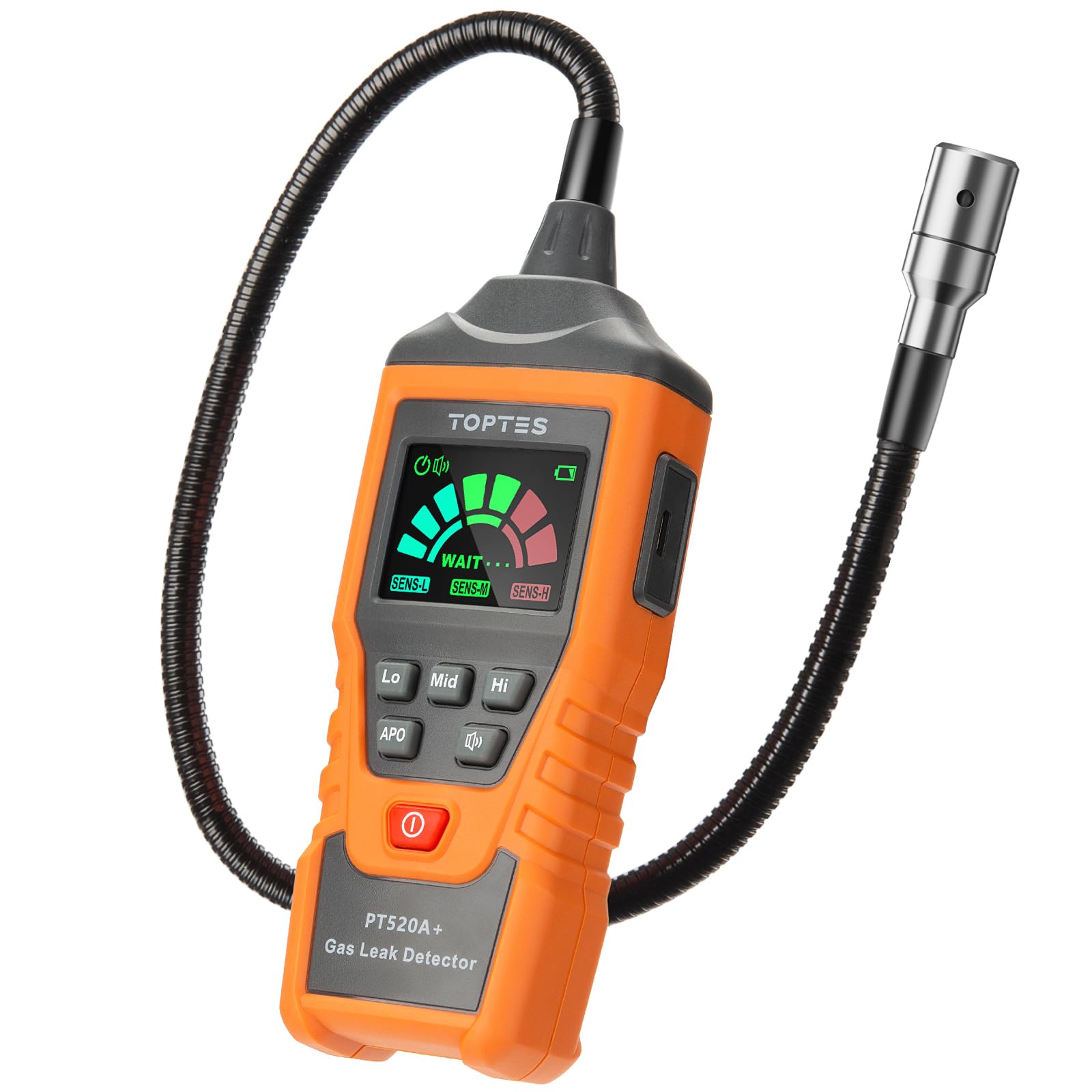
The 17-inch bendable neck that reaches what every other detector leaves behind.
When a leak is tucked behind a water heater, deep inside a dryer vent, or under a propane grill, you need reach. This model delivers it with a 17-inch gooseneck that you can bend and hold in place, so you keep your distance from the potential leak source. It is also rated for over 3000 recharge cycles via its USB-C port, making it a tool that can last for years rather than months.
Owners mention it is worth the cost for finding an RV propane regulator leak immediately after the 30-second warm-up. The audible alarm can be muted with a dedicated button for quieter work, and the auto power-off kicks in after 10 minutes of inactivity. The double-sided bar-shaped groove and non-slip material make it easy to hold onto, even when your hands are sweaty in a hot utility closet.
The main trade-off is that sensor sensitivity gets mixed feedback from owners. A few folks note that it is less sensitive than they expected for very small leaks. It is still a very capable tool, but you might need to get the probe closer to a tiny pinhole leak than you would with the more expensive RIDGID CD-100.
The Reach Advantage
- 17-inch gooseneck reaches deep into machines and crawlspaces.
- Mute button allows quiet operation in occupied homes.
- Rated for thousands of recharge cycles.
What to Watch
- Sensor sensitivity is occasionally called out as less sensitive than hoped.
Reach for this if: You need to inspect gas lines behind large fixed appliances where most probes won’t fit.
Look elsewhere if: You are chasing ultra-fine, sub-100 PPM leaks that require the highest sensitivity.
5. Kidde KN-COEG-3 Carbon Monoxide & Explosive Gas Alarm

The 24/7 wall-mounted guard that never sleeps or needs a warm-up.
This product is fundamentally different from the handheld sniffers above — it is a stationary alarm that plugs into a standard 120V outlet and provides continuous monitoring. It also has a 9-volt battery backup, so it keeps working even during a power outage. The digital LED display shows the level of carbon monoxide or reads “GAS” when explosive gas is detected.
When the alarm triggers, it hits 85 decibels — plenty loud to wake you up or alert you from across the house. The Peak Level Memory function records the last time carbon monoxide was detected or when the unit was last tested, which is a helpful feature for tracking potential issues over time. Owners describe it as an affordable, reliable addition to home safety that is incredibly easy to install right from the start.
The limitation is that it is a stationary device, not a leak finder. You cannot use it to pinpoint the exact source of a smell; it only tells you that a dangerous concentration has hit its location. For total coverage, you would use this as a continuous monitor in a hallway or bedroom and keep a handheld sniffer like the TopTes PT760 for active inspection.
Always-On confidence
- Continuous monitoring with battery backup during outages.
- Digital display shows real-time CO levels or alerts for gas.
- Simple plug-in installation takes seconds.
The Limitation
- Does not locate the source of a leak — it only alarms at the concentration threshold.
Best for whole-home safety: Perfect to pair with a portable sniffer for a complete detection strategy.
Not a replacement for a handheld: If you need to trace a pipe for a specific leak, get one of the portable units instead.
6. Alopex AS8800L Combustible Gas Detector

The bare-bones sniffer that has rewarded thousands of homeowners with leak-free confidence.
This is a classic, no-frills combustible gas detector that has earned a loyal following. It needs 3 AA batteries (not included) and has a 20-second sensor warm-up. The key technique that owners rave about is the adjustable sensitivity — you start with high sensitivity to find the general area, then reduce it to pinpoint the exact source of the leak. The LED bar lights up and the tick rate increases as you get closer to the source.
Owners have shared stories of it detecting gas leaks on water heater pipe joints that prompted a contractor to return and fix the leaks within 10 minutes, and finding gasoline vapor sources in a houseboat engine compartment. The reliability is the single most-praised aspect by a wide margin. It is not waterproof, but it is tough enough to be mounted on a pole or tripod for industrial work.
The Leakage tracking gets mixed feedback, meaning some owners found it less intuitive to trace the leak precisely. It also lacks a long probe — you get a short flexible tip, so reaching into deep spaces requires getting close. For the price and proven performance, though, this is a tool that has literally saved lives.
Why It Endures
- Adjustable sensitivity lets you zero in on the leak point accurately.
- Highly reliable sensor with thousands of positive owner experiences.
- Simple, intuitive interface with no complex menus.
Consider This
- The probe is short — you must get close to the pipe joint.
- Leak tracking feedback isn’t as clear as some newer models.
Best for no-nonsense reliability: If you want a proven, affordable tool that just works without any frills, this is a safe choice.
Look elsewhere if: You need a long gooseneck for reaching deep into appliances — check the PT520A+ or RIDGID instead.
7. TopTes Guard-101 4 Gas Monitor

The industrial-grade 4-in-1 that monitors oxygen, CO, H2S, and combustibles.
This is a different beast from the other detectors here. Instead of just looking for explosive gas (LEL), the Guard-101 also monitors for Hydrogen Sulfide (H2S), Carbon Monoxide (CO), and Oxygen (O2) levels. It is built for industrial environments, with a high-strength ABS plastic housing that is waterproof, dustproof, and explosion-proof. The battery life is rated at 14 hours, giving you a full shift of continuous monitoring.
It features triple alarms — LED light, vibration, and sound — that respond within half a second and continue until the gas concentration returns to safe levels. The back clip makes it easy to wear on a belt, and password protection (default: 69) prevents accidental changes to the settings. It even has an alarm record storage function so you can review past events.
The honest truth is that this unit has a mixed reliability record. While battery life is praised, the highest-count aspect is reliability, which Amazon marks as MIXED — meaning some owners had great experiences and others did not. The calibration feature is a notable negative, with many reporting there is no user way to calibrate it. It is a capable unit but best suited for someone who understands the limitations of a budget multi-gas monitor.
Multi-Gas Advantage
- Detects four different gas types in one rugged, portable device.
- 14-hour battery easily lasts through a full workday.
- Triple alarm (light, sound, vibration) ensures you never miss a warning.
Honest Caveats
- Cannot be user-calibrated, which is a concern for accuracy over time.
- Overall reliability is hit-or-miss based on owner feedback.
Best for confined space entry: If you need a personal safety monitor that covers oxygen and toxic gas in addition to LEL, this fits the bill.
Not for home use: If you just need to check your stove for a propane leak, a simpler LEL-only detector is more appropriate and reliable.
8. RIDGID 36163 CD-100 Micro Combustible Gas Detector

The professional’s choice that has found thousands of leaks in the tightest spaces.
This is the tool that HVAC pros and plumbing contractors reach for. It features a 16-inch flexible probe that snakes into confined spaces with ease, and the tri-mode detection lets you choose between visual, audible, or vibration alerts. You can run it on low sensitivity to ignore background contamination, then switch to high sensitivity to zero in on a tiny leak. The field-replaceable sensor means you don’t send the whole unit back for service when the sensor eventually wears out.
The build quality is a standout feature here, with owners describing it as a rugged tool that survives heavy daily use on job sites. It detected a 640+ PPM leak at a loose joint in a crawlspace that an HVAC contractor had missed. The vibration alarm is particularly useful in noisy environments where you might not hear an audible beep. At 600 grams (about 1.3 pounds), it has a solid, reassuring weight in the hand.
The only common owner gripe is the 10-minute auto shutoff feature — it turns off to save battery even when you are mid-inspection, forcing you to recalibrate in a gas-free area before continuing. For contractors who use it all day, this is a minor but persistent annoyance. If you want a tool that feels like it will survive being dropped off a ladder, this is the one.
Why Pros Love It
- Field-replaceable sensor extends the life of the tool.
- 16-inch flexible probe reaches deep into confined spaces.
- Tri-mode alarm (light, sound, vibration) works in any environment.
The Pro’s Frustration
- 10-minute auto shutoff interrupts long inspection sessions.
Invest in this if: You are a tradesperson or landlord who needs a durable, daily-use gas detector that you can repair instead of replace.
pass on it if: You are a casual home user — the TopTes PT760 gives you 90% of the capability at a much lower price.
9. UEi Test Instruments CD100A Combustible Gas Leak Detector

The 18-inch gooseneck that HVAC pros trust to confirm even a 50 PPM whisper.
This is a classic instrument in the HVAC world, known for its extreme sensitivity and reliable build. It has a 10-second warm-up (the fastest on this list) and an 18-inch flexible gooseneck, making it the longest-reach sniffer here. A tip light at the end of the gooseneck illuminates the inspection point in dark environments, which is a thoughtful touch for anyone working in basements and crawlspaces. The battery life is rated at 15 hours on four AA batteries.
Reliability is the aspect that gets the most praise by far — over 130 owners single it out positively. Build quality also earns very high marks. The adjustable sensitivity is critical for an HVAC pro who needs to detect combustibles down to a 50 PPM level. It is not auto-zeroing, which is preferred by experienced users who want to control the baseline themselves rather than have the device reset mid-inspection.
The unit does not have a PPM readout — it uses an increasing tick rate like a Geiger counter to tell you how close you are to the source. This makes it a leak locator rather than a concentration monitor. A small number of buyers received units with a broken on/off switch, suggesting the occasional quality control issue. If you need the maximum probe reach and the gold standard for sensitivity, this is the professional’s pick.
The Professional Edge
- 18-inch gooseneck is the longest reach available for tight spaces.
- Extremely sensitive — detects combustibles down to 50 PPM.
- Tip light illuminates dark inspection areas.
Potential Hiccups
- No numeric PPM display — only an audible tick rate.
- Rare reports of defective units on arrival.
The gold standard for pros: If you are an HVAC tech or contractor who needs the longest reach and highest sensitivity for daily leak detection, this is the benchmark.
Not for data lovers: If you want to read exact PPM values on a screen, you will prefer the AGT-1988PRO or TopTes PT760.
Understanding the Specs
%LEL (Lower Explosive Limit)
This is the most critical number on any explosive gas detector. %LEL tells you what percentage of the air is made up of gas compared to the lowest concentration that can explode. For example, methane explodes at 5% concentration in air — that is 100% LEL. If your detector reads 10% LEL, the air is at one-tenth of the explosive threshold. You want to find and fix any leak well before this number climbs significantly.
PPM (Parts Per Million)
This is a finer measurement for smaller gas concentrations. One percent LEL equals roughly 10,000 PPM for many gases. A reading of 500 PPM is a tiny leak that you might not even smell, while 5,000 PPM should trigger a more urgent response. Many good detectors show both %LEL and PPM, giving you a clear picture of whether the leak is a small nuisance or a real threat.
Catalytic vs. Semiconductor Sensors
The sensor is the heart of the detector. A catalytic sensor uses a heated bead that burns gas on contact, causing a measurable resistance change. They are very accurate for LEL ranges but can be poisoned by silicone or lead. Semiconductor sensors are cheaper and detect a wider range of gases, but they are less precise and can drift over time. Most home-use detectors use semiconductor sensors, while industrial units tend toward catalytic.
Warm-Up and Response Time
A sensor needs to stabilize before it can give you an accurate reading. This is the “warm-up” time, typically between 10 and 30 seconds. Response time is how fast the sensor reacts once it hits a gas cloud. A half-second response means you can sweep a probe past a joint and know immediately if there is a leak, rather than waiting for the sensor to catch up.
FAQ
Will an explosive gas detector find a very small leak I cannot smell?
What is the difference between a gas detector and a carbon monoxide alarm?
Do I need one detector for natural gas and another for propane?
How long does the sensor in a gas detector last?
Can a gas detector be used to check for gas in a car or boat?
Should I buy a rechargeable model or one that uses disposable batteries?
What does the “preheat” or “warm-up” time mean?
How do I know if the detector is picking up gas or something else like hairspray or cleaning fumes?
Do these detectors need regular calibration?
Can I use a plug-in alarm like the Kidde as my primary gas detector?
Final Thoughts: The Verdict
For most homes and RVs, the explosive gas detector that strikes the best balance is the TopTes PT760. It recharges fast via USB-C, has a 12-inch telescopic probe to reach tight spots, and shows gas concentration as %LEL (Lower Explosive Limit — the percentage of gas in the air before it can ignite). Thousands of owners have trusted it. If you need a simple, budget-friendly tool for occasional checks, the TopTes PT299 runs on standard AAA batteries and works without any extra features. For the professional or serious homeowner who needs the longest reach and highest sensitivity, the UEi CD100A has an 18-inch gooseneck probe and detects gas down to 50 PPM (parts per million — a very small concentration). It remains the industry benchmark.
How We Picked
We do not accept paid placement. Every pick is matched to a real buyer and a real use-case; we do not hands-on test units.
Sources & Methodology
Specifications: manufacturer listings and product documentation. Review insights: verified customer reviews, as of July 2026. Pricing: not shown on this page (it changes often); check the current price via the retailer link.
As an Amazon Associate, WellFizz earns from qualifying purchases. This does not affect which products we feature.
Related Guides

Mo Maruf
I created WellFizz to bridge the gap between vague wellness advice and actionable solutions. My mission is simple: to decode the research and give you practical tools you can actually use.
Beyond the data, I am a passionate traveler. I believe that stepping away from the screen to explore new environments is essential for mental clarity and physical vitality.