Our readers keep the lights on and my smoothie glass nicely filled. As an Amazon Associate, I earn from qualifying purchases.
Specs are compiled from manufacturer listings and verified buyer reviews and can change over time — please confirm the key details on the product page before buying.
Your exercise mat does one simple job: it sits between you and the floor. But picking the right one gets complicated fast. Too thin and your knees ache. Too thick and you wobble in standing poses. The wrong surface turns into a slip-and-slide the moment you sweat. This guide cuts through the noise to match you with the mat that actually fits your workout style, your flooring, and your body.
I’m Mohammad Maruf — the founder and writer behind WellFizz. This guide is built by comparing the manufacturers’ published specifications and the patterns across verified customer reviews, so you get each pick’s real strengths and trade-offs instead of marketing spin.
The right exercise mat depends on how much cushion you need, how much space you have, and whether grip matters more than portability in your routine. This guide walks through nine distinct options to help you decide.
Our Picks at a Glance


How To Choose The Best Exercise Mat
Picking a mat is not about grabbing the thickest one. The best exercise mat for you balances three things: how much padding your joints need, how stable the surface feels under your weight, and whether you will be carrying it to a studio or leaving it on your bedroom floor.
Thickness: The Cushion vs. Stability Trade-Off
A thicker mat (10mm or more) protects your knees, elbows, and spine on hard floors. But that plush feel makes it harder to balance in standing poses or when pressing through your hands. A thinner mat (4mm to 6mm) keeps you connected to the floor for better stability, yet offers less shock absorption for floor work.
Material and Grip
PVC (polyvinyl chloride) is the most common material — durable, affordable, and naturally sticky. TPE (thermoplastic elastomer) is lighter and more eco-friendly but can stretch under load. NBR (nitrile butadiene rubber) foam delivers serious cushioning at the cost of density. Grip is not just about the top surface: a mat that slides on the floor is just as dangerous as one that slips under your hands. Look for double-sided non-slip textures or a bottom layer with suction-cup grip if you are on hardwood or tile.
Size and Portability
Standard mats measure 24 inches wide and about 68 to 72 inches long. If you are taller than six feet or like wider stances in poses, a 36-inch wide or longer mat gives you room to move without stepping off the edge. But bigger mats are heavier and harder to roll and carry. A carrying strap or bag makes a real difference if you travel with your mat.
Quick Comparison
| Model | Best For | Thickness | Material | Size (L x W) | Amazon |
|---|---|---|---|---|---|
| Gaiam Premium (6mm)★ Best Overall | Daily yoga & Pilates | 6mm | PVC | 68″ x 24″ | Amazon |
| Fitvids (½”)Best Value | Value & joint cushioning | ½” (12.7mm) | Foam | 71″ x 24″ | Amazon |
| Gaiam Thick (10mm)Plush Comfort | Maximum plush comfort | 10mm | NBR Foam | 72″ x 24″ | Amazon |
| Amazon Basics (¼”) | Budget-friendly portability | ¼” (6.35mm) | TPE | 73.6″ x 24″ | Amazon |
| HAPBEAR (36″ Wide) | Extra width for room to move | 6mm | TPE | 72″ x 36″ | Amazon |
| Karma Fitness (10mm) | Wide & thick home workouts | 10mm | TPE | 72″ x 32″ | Amazon |
| GymCope (7mm) | Large home gym flooring | 7mm | PVC | 72″ x 48″ | Amazon |
| HAPBEAR Large (8mm) | Full-room home gym coverage | 8mm | PVC | 84″ x 60″ (7’x5′) | Amazon |
| Liforme Special | Premium hot yoga grip | 4.2mm | Eco-PU / Rubber | — | Amazon |
In‑Depth Reviews
1. Gaiam Premium Yoga Mat, 6mm Thick Print Mat
Our pick — over 4.5★ from 22,000+ verified ratings; the strongest balance of quality and price.
the just-right thickness that pleases both knees and balance — a crowd favorite for good reason.
The 6mm thickness of this Gaiam mat is the reason it is the top pick. That is enough padding so your knees and wrists do not ache on hardwood floors, yet it stays thin enough to feel stable in standing poses. The textured non-slip surface — what Gaiam calls a “sticky” grip — keeps you planted during flow sequences. It is also 6P-free PVC, meaning it avoids the common phthalates (plastic softeners) and plasticizers that give cheaper mats that chemical smell. The build quality is what wins over 1,200+ owners who mention it specifically — the mat holds up to daily use without showing wear or stretching out of shape.
One area where opinions split is grip. While the textured surface works well for dry workouts, some owners find it slippery when hands get sweaty. That is a common trait in smooth-top PVC mats; they grip the floor well but do not always absorb palm sweat the way a porous material like natural rubber does. The 68-inch length is slightly short for very tall users — anyone over 5’10” may find their hands or feet resting on the floor in extended poses.
Another point: the initial odor. A few buyers report a strong plastic smell when unrolling the mat for the first time. The manufacturer recommends airing it out for two to three days before use, which resolves the smell in most cases. Once past that, the mat delivers what owners describe as “great cushion for floor workouts” without the bulk of a thicker mat.
Grippy Printed Surface
- Quality construction that outlasts cheaper mats — the top-rated aspect by a wide margin
- Non-toxic, 6P-free PVC avoids harsh chemicals
- Lightweight enough to carry to a studio or class
Heavier Than Thinner Mats
- Grip is mixed for sweaty hands — some find it non-slip, others report sliding
- Initial odor needs a few days to air out before first use
- At 68 inches, tall users may need more length
Print Lovers: you practice yoga, Pilates, or stretching several times a week and want a mat that balances joint comfort with stability.
Weight Watchers: you are over 5’10”, practice hot yoga regularly, or prefer a thicker mat for floor-based core workouts.
2. Fitvids Yoga Mat, ½-Inch Extra Thick
Half an inch of cushion that has kept owners going strong for seven years and counting.
The Fitvids mat delivers the most serious padding in this lineup at a price that undercuts many thinner mats. At ½ inch thick, this Fitvids mat comfortably cushions your spine, hips, knees, and elbows on hard floors. The high-density foam is soft enough for floor work but not so squishy that you sink during standing poses. Owners consistently call it “extremely durable after 7 years,” which is remarkable at this price point. The 71-inch length gives you a bit more room than standard mats — helpful if you are tall. But unlike the Gaiam Premium, which balances cushion with portability, this mat is bulky. The foam rolls up into a larger cylinder than thinner mats, making it less convenient to carry to a studio.
The trade-off with that much foam is bulk. The mat rolls up into a larger cylinder than thinner mats, making it less convenient to carry to a studio. The double-sided non-slip surface works well when dry, but owners mention the surface gets slippery when wet. If you sweat heavily during workouts, you may need a towel on top. The foam also dents under heavy pressure over time, though owners say it returns to shape and does not tear.
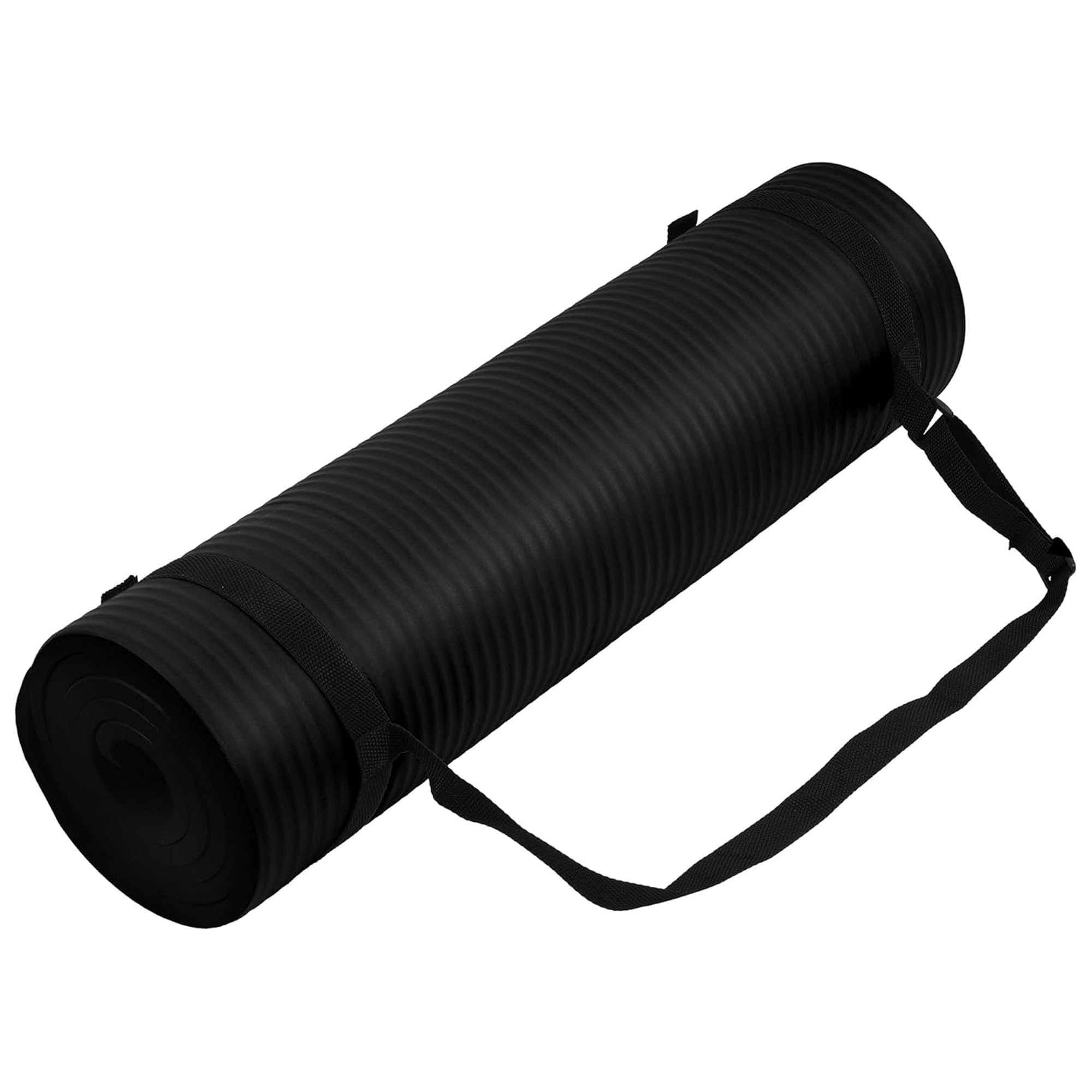
A minor but appreciated detail: the mat includes a carrying strap, saving you the extra expense. The foam has a slight chemical smell initially that fades after airing out. For anyone doing floor stretches, Pilates, or gentle yoga on tile or concrete, this mat delivers the most cushion per dollar in this lineup.
Cushioning Extra Thick
- Half-inch thickness at a price that undercuts most competitors
- Customers note lasting 7+ years with no tears — real durability
- Comes with a carrying strap; easy to clean with soap and water
Slightly Bulky Roll
- Surface gets slippery when wet — not ideal for hot yoga or heavy sweat sessions
- Bulky roll makes it less portable than thinner mats
- Foam dents under point pressure, though it recovers
Joint Comfort: budget-conscious buyers, plus-sized individuals, or anyone with joint pain who needs extra cushion on hard floors.
Portability: you practice hot yoga, need a mat that rolls up compactly for travel, or prefer a firm surface for balance-intensive poses.
3. Gaiam Thick Yoga Mat, 10mm with Easy-Cinch Carrying Strap
A 10mm cloud of NBR foam that makes cold floors and tender joints a non-issue.
This Gaiam mat is 67% thicker than their 6mm Premium mat, and you feel every millimeter of that difference. Made from high-density NBR foam (nitrile butadiene rubber, a soft synthetic rubber), it delivers plush cushioning that buyers describe as “perfect for older people or people with joint pain.” Reviewers point out falling on it without injury — proof of how much shock absorption it provides. The 72-inch length is also a welcome extra four inches over standard mats, keeping your head and feet on the mat during full-body stretches.
The catch with this much foam is stability. The material is soft enough that your weight sinks in slightly, which can make balancing poses feel less secure than on a firmer, thinner mat like the Gaiam Premium. Durability also earns mixed feedback: 856 owners mention it, and while many say the mat holds up well, others report it tearing or showing permanent indentations. The “permanent curve” some owners note is the mat retaining a rolled shape if stored tightly. The carrying strap system — velcro straps with a handle — works well for transport but some find it less convenient than a full bag.
Another point: the strong chemical smell. This is the most common criticism, with 465 mentions classified as negative. The manufacturer recommends airing it out for 24 to 48 hours. Owners who tolerate the initial odor find the mat is comfortable and easy to clean with a damp cloth. The textured surface reduces slipping on hard floors during dry workouts, though it is not designed for hot yoga.
Maximum Padding: you have joint pain, work out on cold or concrete floors, or do mostly floor-based stretching and Pilates rather than standing balance poses.
Minimalists: you need a firm surface for hand-balance poses, want a mat with no initial odor, or plan to do sweaty cardio sessions where grip is critical.
4. Amazon Basics ¼ Inch Thick TPE Exercise Yoga Mat

A thin, light mat that rolls up tight and goes anywhere — the yoga practitioner’s travel companion.
This Amazon Basics mat is the thinnest and most portable option here, making it the ideal pick if you carry your mat often. At a quarter-inch thick, it gives you just enough cushion for joint comfort while keeping you close to the floor for stability. The TPE material (thermoplastic elastomer, a lightweight recyclable plastic) is lighter than PVC, with a spring-back elasticity that helps you maintain balance during poses. Shoppers say it is “very portable, because it’s thinner, and can roll up tight.” At 73.6 inches long, it is the longest standard-width mat in this lineup — a real plus for taller practitioners. It is also more eco-friendly than PVC, made from recyclable materials and free of the phthalates found in some rubber mats.
The thin profile has limits. Owners doing yoga poses that involve significant stretching of the mat report that it stretches too much, causing instability during certain movements. The grip is rated positively by 11 mentions, described as “non-slip” by most, though a few find it slightly slippery. Durability gets mixed marks — at this price and thickness, heavy daily use will wear it faster than a thicker PVC mat. The included carrying strap makes transport easy, and owners agree the mat has no strong chemical smell from the start, which is a refreshing change from many new mats.
For someone who does yoga a few times a week, stores their mat in a closet, and does not want to spend much, this delivers excellent value.
Budget Pick: occasional yoga practitioners, travelers who need a compact mat, and anyone on a budget who still wants a clean, functional surface.
Long Haul: you do daily workouts on hard floors and need substantial joint cushioning, or if you practice intense yoga that stretches the mat out of shape.
5. HAPBEAR Large Yoga Mat, 72″x36″

36 inches wide versus standard 24-inch mats — no more stepping off the edge during wide stances.
The 36-inch width of this HAPBEAR mat is the headline feature. Standard mats are 24 inches wide — this one gives you a full foot of extra space on each side. For Tai Chi, dynamic stretching, or yoga flows with wide-legged poses, that extra width eliminates the annoying feeling of your foot or hand slipping off the edge. Owners mention using it for “a lot of moving around when doing Tai Chi” and appreciate having “freedom to stretch and move without limitation.” The 6mm thickness sits in the middle ground — enough cushion for knees and wrists in floor poses, not so thick that you wobble in standing balances.
The double-sided textured grip keeps the mat in place on smooth surfaces, though the manufacturer explicitly notes it is not for use on carpet. The TPE material is durable and easy to clean with hand washing. A few owners note an initial scent that requires one to two days of airing out. The width is the main trade-off: rolling up a 36-inch wide mat takes more effort than a standard mat, and the carry bag helps but does not make it genuinely compact. If you have limited storage space, a wider mat may feel cumbersome.
The quality of materials gets strong praise, with 42 owners mentioning it positively. The mat also includes a carry bag for transport. For anyone who does floor-based workouts where arm or leg width exceeds a standard mat, this is the solution.
Spacious Practice: you do dynamic flows, Tai Chi, or bodyweight workouts where you move laterally and need the extra room.
Tidy Storage: you have limited storage space, practice on carpet, or prefer a mat that rolls up small enough to fit in a weekend bag.
6. Karma Fitness Large Exercise Mat, 10mm (72″x32″)

A 10mm double-layer TPE mat that is 32 inches wide versus standard 24-inch mats — built for bodyweight workouts that demand space and cushion.
Karma Fitness combines two features rarely found together: serious 10mm thickness and a wide 32-inch surface. Standard mats stop at 24 inches; this one gives you 33 percent more width. The double-layered TPE material is denser than NBR foam, providing a stable platform that does not let you sink too far. Owners doing Pilates, weights, and stretching report the mat is “larger than standard, comfortable for lower back” and the textured diamond grip on both sides keeps it planted on the floor. The included carry bag with an over-the-shoulder strap makes the bulky mat easier to transport.
The main downside is bulk. At 10mm thick and 32 inches wide, this mat is heavy to carry and takes up more storage space than any standard mat. The double-layer TPE is also more expensive than single-layer PVC. While owners praise the quality of material and size, some note that the mat is “slightly bulky to carry.” The dark grey color looks premium and hides dirt well, and the mat is waterproof for easy cleaning with a damp cloth.
For someone doing HIIT, strength training, or Pilates at home on a hard floor, the combination of width and thickness makes this a premium option that competes directly with the thicker NBR mats but with the superior density and recyclability of TPE.
Tall Users: home gym users who do floor-based strength work, stretching, and Pilates on hard floors and want both cushion and elbow room.
Light Packing: you need to carry the mat to a studio regularly, or if a 24-inch wide mat already gives you enough space.
7. GymCope Large Exercise Mat, 6’x4′ (7mm)

A 6×4 foot mat that turns a corner of your garage into a proper workout floor — shoes welcome.
The GymCope mat crosses into the territory of home gym flooring rather than a personal yoga mat. At 6 feet by 4 feet (72″ x 48″), it provides a dedicated workout zone for cardio, jump rope, weightlifting, or MMA (mixed martial arts). The 7mm thickness is tune for shoe-friendly use — thick enough to absorb impact and protect your floor, but firm enough that weight plates and dumbbells do not sink in. Owners use it “under cage and dumbbells” and report it stays flat and stable, “not too soft or hard.” The high-density PVC (polyvinyl chloride) material is tear-resistant and durable enough for frequent high-intensity training.
The size is the main consideration. This is not a mat you roll up and carry to a studio — it is meant to stay in one place, or be rolled up with the included bag and straps for occasional transport. A few owners mention an initial odor that dissipates after about 24 hours. The double-sided anti-slip surfaces provide a secure grip on tile, carpet, concrete, and hardwood, which is rare for a mat this large. The pack also includes a microfiber towel.
For anyone wanting to protect their floors and their joints during standing workouts, this gives you a genuine training surface without installing permanent gym flooring. It is built for the person who jumps rope, does burpees, and deadlifts in their garage or spare room.
Group Sessions: you do high-intensity workouts at home — jump rope, burpees, weightlifting, or cardio — and need a large, durable floor protector.
Floor Comfort: you need a portable yoga mat for a studio, or if your workout space cannot accommodate a 6×4 foot footprint.
8. HAPBEAR Large Exercise Mat, 7’x5′ (8mm)

A 7×5 foot padded floor that fits two people working out side by side without bumping elbows.
If 6×4 feet is still not enough space, HAPBEAR sells this mat in sizes up to 12×6 feet. The 7×5 version (84″ x 60″) is the balance for a home gym — it accommodates a full-body workout zone where you can do lunges, sprawling cardio moves, or even bodyweight circuits alongside a partner. The 8mm thickness (greater than 1/3 inch) uses high-density foam technology that protects knees and wrists during intense aerobic exercise while also dampening sound. The PVC (polyvinyl chloride) material is waterproof and sweat-proof, making cleanup as simple as a wipe-down.
The corrugated top surface and suction-cup bottom layer work together to prevent sliding, even during jump-heavy routines. Owners find it works well on concrete, under gym equipment like Tonal, and as a general garage gym floor. The package also includes resistance bands and a storage bag. Durability gets mixed feedback, with some owners concerned about long-term wear, though quality is the most-mentioned positive aspect (85 mentions). The mat is heavy — 15.6 pounds for the 7×5 size — so it is not meant for daily transport. It is designed to be laid down and left there.
This is for the person building a dedicated home gym space and wants a shock-absorbing, easy-to-clean foundation that protects both the floor and the joints. It is the most coverage you can get among these picks, short of permanent gym flooring.
Full Coverage: dedicated home gyms, garage workouts, couples who exercise together, or anyone who wants a padded floor for high-impact cardio.
Small Spaces: you need a portable mat for classes, have limited floor space, or only do seated stretching.
9. Liforme Special Yoga Mat

The grip stays locked even when sweat is pouring — the gold standard for hot yoga practitioners.
Liforme has built a reputation around one thing: grip that works when it is wet. The “GripForMe” material, a proprietary eco-polyurethane surface bonded to natural rubber, is designed to stay sticky even when saturated with sweat. Owners describe it as the “grippiest Yoga mat currently available” and say they can practice hot yoga without needing a towel on top of the mat — a major advantage over PVC and TPE mats that turn slick with moisture. The mat is 4.2mm thick — thinner than most on this list — because Liforme prioritizes ground feel and tactile feedback over cushioning. The alignment guides printed on the surface help with hand and foot placement, which owners find “subtly remind them to maintain proper form.”
The price is the biggest barrier. At well over a hundred dollars, this is an investment, not an impulse buy. A few owners note the premium price does not always match their expectations — some find it “overpriced” compared to other high-end mats. The 4.2mm thickness is thin enough that users on cement floors may feel pressure on their knees and elbows during floor work, unlike the cushioned 6mm Gaiam Premium. The orange color with bird design gets strong aesthetic praise, though the mat is not available in many sizes. The top layer can bubble or separate from the rubber base in rare cases, though the manufacturer replaces defective units. The mat comes with a free yoga bag, which helps offset the cost slightly.
For a serious yoga practitioner who sweats heavily, does hot yoga, or wants a mat that simply does not slide under any condition, Liforme is in a class of its own. For a casual exerciser, the price is hard to justify.
Serious Yogis: you practice hot yoga daily, have had problems with slipping on other mats, or want the best grip money can buy.
Budget Minded: you stay within a budget, need significant cushion for joint pain on hard floors, or do mostly non-yoga exercises.
Understanding the Specs
Thickness and Density
Thickness is measured in millimeters or fractions of an inch. A 6mm mat provides moderate cushion — enough for yoga and stretching without sacrificing balance. A 10mm mat (or ½ inch) absorbs more shock for floor work, high-impact cardio, or joint-sensitive users. But more thickness also means greater instability for standing poses, especially on soft foam. Dense materials like TPE (thermoplastic elastomer) or high-density PVC (polyvinyl chloride) offer better stability at the same thickness compared to NBR (nitrile butadiene rubber) foam, which is softer and more compressible.
Material Types
The three main materials each behave differently. PVC (polyvinyl chloride) is durable, naturally sticky, and holds up to heavy use but can have a strong initial odor. TPE (thermoplastic elastomer) is lighter, more eco-friendly, and recyclable, but tends to stretch over time under stress. NBR (nitrile butadiene rubber) foam is the softest and thickest option, ideal for joint cushioning, but it is less dense and can show wear faster. Natural rubber offers the best wet grip for hot yoga but is heavy and expensive.
Non-Slip and Grip
Grip happens on two surfaces: the top (where your hands and feet touch) and the bottom (where the mat meets the floor). Textured surfaces, diamond patterns, and materials like natural rubber increase top-side grip, especially when wet. Bottom grip often relies on suction-cup patterns or corrugation to prevent sliding on hardwood or tile. A mat can have excellent hand grip but still slide on a smooth floor if the underside is slick — both matter.
Portability and Storage
A mat’s weight and rolled size determine whether you can carry it to a studio or leave it at home. Thinner mats (4mm to 6mm) roll up into a compact cylinder that fits in a backpack or carry bag. Thicker mats (10mm to ½ inch) create a bulkier roll that requires a dedicated carrying strap or bag. Wider mats (32 to 48 inches wide) are heavier and less portable — designed to stay in one place. Think about where you actually use the mat before choosing.
FAQ
Does a thicker mat always mean more comfort?
Can I use a yoga mat for high-intensity cardio or weightlifting?
How do I get rid of the chemical smell on a new mat?
What is the difference between TPE and PVC mat materials?
Will an extra-wide mat fit in a standard yoga bag?
Is a more expensive mat always better for yoga?
How do I clean and maintain my exercise mat?
Can I use an exercise mat on carpet?
Final Thoughts: The Verdict
For the majority of shoppers, the best exercise mat is the Gaiam Premium 6mm Mat because it nails the balance between joint comfort, stability, portability, and price that the widest range of buyers need. If you want thick plush cushioning for floor work on hard surfaces, grab the Gaiam Th
Related Guides

Mo Maruf
I created WellFizz to bridge the gap between vague wellness advice and actionable solutions. My mission is simple: to decode the research and give you practical tools you can actually use.
Beyond the data, I am a passionate traveler. I believe that stepping away from the screen to explore new environments is essential for mental clarity and physical vitality.