Our readers keep the lights on and my smoothie glass nicely filled. As an Amazon Associate, I earn from qualifying purchases.
Specs are compiled from manufacturer listings and verified buyer reviews and can change over time — please confirm the key details on the product page before buying.
Starting a fitness routine when you are carrying extra weight is a different challenge, and the right machine makes or breaks the habit. High-impact moves punish knees and backs, so the best equipment for this stage is all about low-impact, seated, or supported motion that builds confidence without pain. This guide focuses on that specific need, breaking down the features that actually matter for a larger beginner.
I’m Mohammad Maruf — the founder and writer behind WellFizz. This guide is built by comparing the manufacturers’ published specifications and the patterns across verified customer reviews, so you get each pick’s real strengths and trade-offs instead of marketing spin.
You will find the right low-impact machine for your home, budget, and fitness level in this roundup of the best exercise equipment for obese beginners on the market today, covering everything from recumbent bikes to under-desk ellipticals.
Our Picks at a Glance
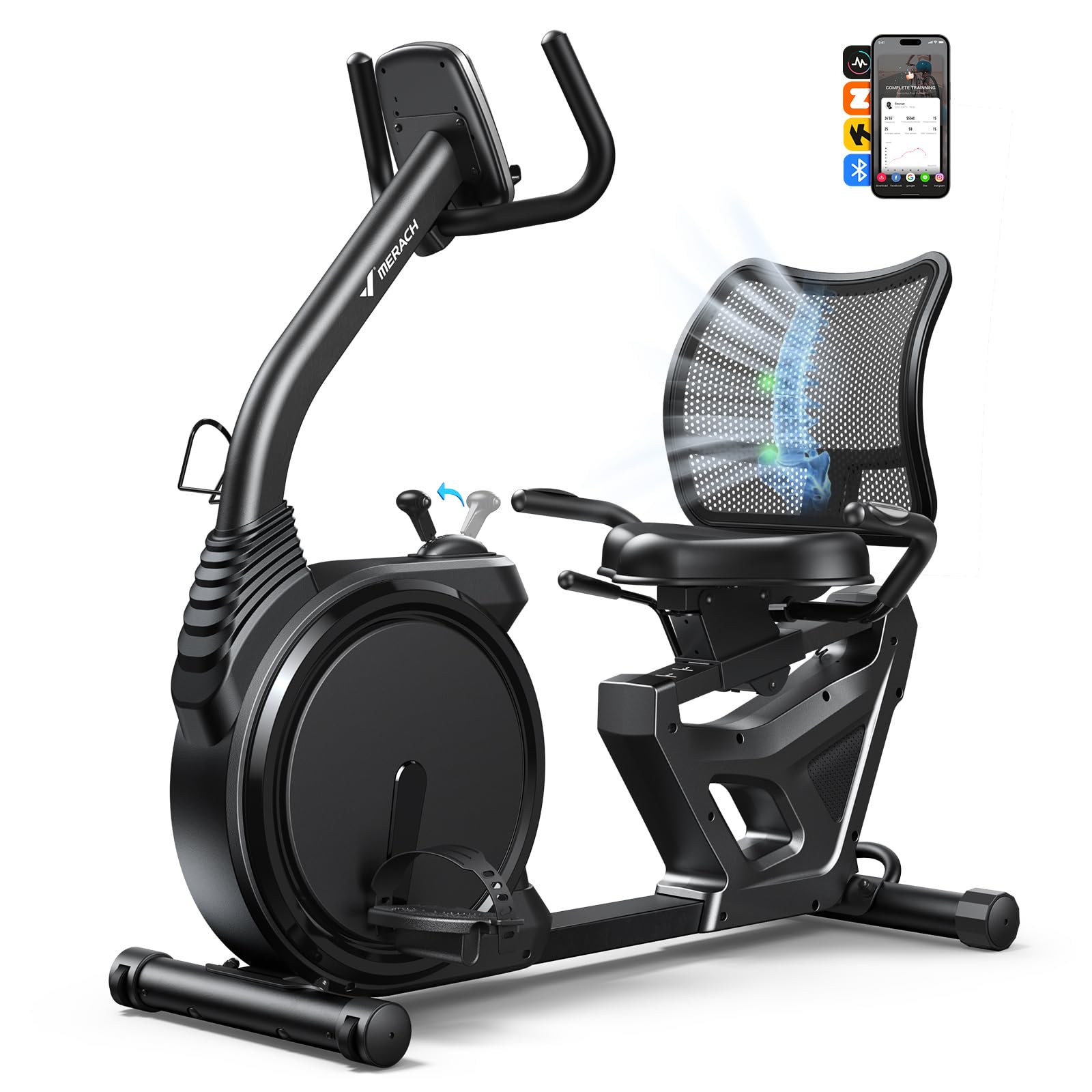

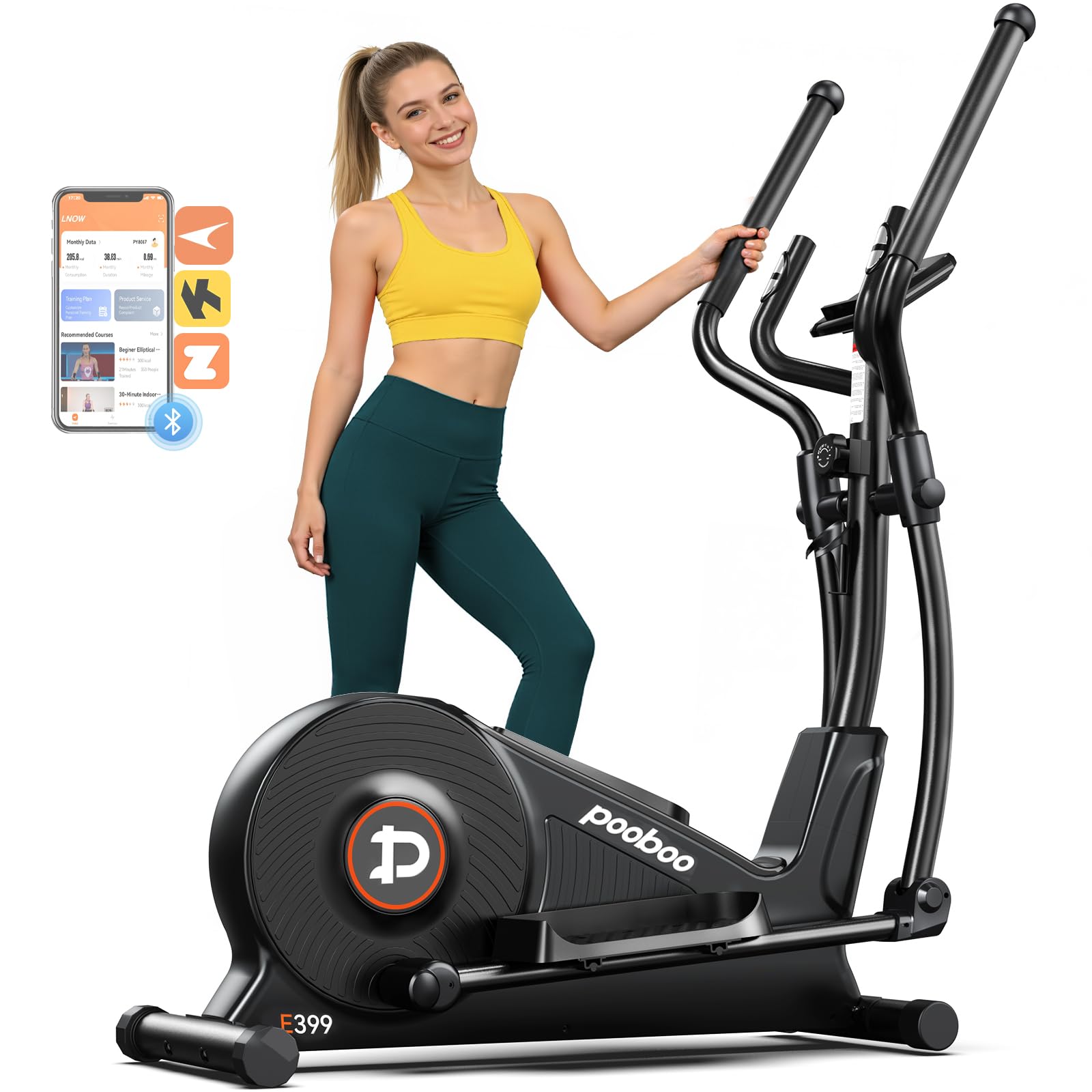
How To Choose The Best Exercise Equipment For Obese Beginners
Your joints come first when you start exercising, so every machine here is low-impact (it won’t pound your knees or spine) and supports at least 300 pounds of body weight. Pick anything that fails either test, and you risk injury or a frame that breaks under you.
Weight Capacity: The First Filter
Check the rated weight limit before you check anything else. A machine rated below your body weight will wobble, strain, and fail prematurely. The safest bets here start at a 300-pound capacity, with the sturdiest options rated up to 350 or even 400 pounds, giving you a solid margin of safety.
Seated vs. Standing: Know Your Balance
Recumbent bikes and under-desk ellipticals let you exercise from a supportive seated position, which is ideal if your balance is shaky or your back is sensitive. Standing steppers demand more coordination and core strength. For a true beginner, seated machines are almost always the more forgiving and sustainable starting point.
Resistance Levels: Room to Grow
A machine with multiple resistance levels (like 12 or 16) lets you start easy and progress without buying new gear. Magnetic resistance is the quietest and smoothest, which means you are more likely to use the machine without disturbing your household—and more likely to stick with it.
Quick Comparison
| Model | Best For | Weight Capacity | Resistance Levels | Item Weight | Amazon |
|---|---|---|---|---|---|
| MERACH Recumbent Bike★ Best Overall | Stability & Comfort | 330 lbs | 8 Levels | 84.9 lbs | Amazon |
| Teeter FreeStepPhysical Therapy Pick | PT-Style Stride | 300 lbs | 13 Levels | 110.2 lbs | Amazon |
| pooboo EllipticalTop Performer | Full-Body Glide | 350 lbs | 16 Levels | — | Amazon |
| YOSUDA Recumbent Bike | Tall Users | 350 lbs | 16 Levels | 26.5 kg | Amazon |
| Kawnina Recumbent Bike | Highest Weight Limit | 400 lbs | 16 Levels | 55.8 lbs | Amazon |
| Cubii Total Body | Desk & Office Use | 300 lbs | 12 Levels | — | Amazon |
| GooMags Under-Desk Elliptical | Gentle Seated Motion | 300 lbs | 15 Levels | 11.1 lbs | Amazon |
| ZIWWVY Stepper | Stepping With Handlebar | 300 lbs | Adjustable Height | 24.5 lbs | Amazon |
| MERACH Rocking Stepper | Budget Lateral Motion | 330 lbs | Resistance Bands | 13 lbs | Amazon |
In‑Depth Reviews
1. MERACH Recumbent Exercise Bike
Our pick — over 4.5★ from 700+ verified ratings; the strongest balance of quality and price.
The heavy, stable foundation that gets you pedaling without a wobble
This is the pick most likely to get a larger beginner moving and keep them moving. At 84.9 pounds, the machine’s heft is its superpower—it stays planted on the floor even during vigorous pedaling, and its 330-pound weight capacity gives you real headroom to grow into your fitness. The recumbent design (a reclined seat with pedals out front) means your back gets continuous support from the breathable mesh backrest, which is a standout for anyone with lower-back sensitivity.
Assembly is the most-praised aspect of this model, with owners consistently noting the 80% pre-assembled frame and 30-minute setup time, a huge plus when you are just starting out. The 8-level car-style resistance lever is refreshingly simple—no menus, just a shift to make the pedaling harder or easier. Buyers report the ride is “solid, smooth, quiet,” and they appreciate the frosted (textured, non-slip) handlebars that keep your grip secure even when you sweat.
As owners put it: the seat needs padding for longer sessions. It is a classic starter trade-off—the machine supports you well, but you may want a gel cover for comfort on 30-minute rides. The LCD screen keeps you informed on time, distance, speed, calories, and heart rate, and the MERACH app links via Bluetooth for extra motivation.
Why It Wins
- Heavy 84.9-lb frame stays rock-solid during workouts
- Fully supported reclined seat spares your back and knees
- 80% pre-assembled and rated for easy 30-minute setup
- Near-silent belt drive keeps workouts neighbor-friendly
Consider This
- Owners note the seat can feel firm and may need extra padding
- Best suited for heights 5’2″ to 5’10”
Reach for this if: you want the most stable, supportive starting point and plan to ride regularly.
Look elsewhere if: you are taller than 5’10” and need a longer leg track.
2. Teeter FreeStep Recumbent Cross Trainer
A seated stepper that mimics physical therapy motion for serious joint relief
This is the premium pick that borrows its core motion from commercial physiotherapy machines. The patented stride keeps joints aligned and stress-free, a standout for arthritis, sciatica, or post-surgery recovery. Unlike a typical recumbent bike’s circular pedal motion, the FreeStep’s natural stepping action lets you engage your muscles with less strain on the hips, knees, and ankles. Rated for users up to 300 pounds, it is built on a low-profile 54″ x 38″ footprint that fits comfortably in a living room.
The machine is engineered for quiet, friction-free motion with 13 magnetic resistance levels, so you can progress from light to intense smoothly. Owners consistently highlight the whisper-quiet operation and the fact that it delivers a full-body workout—the dual-power motion works your arms and legs together, and 4 grip positions let you target different upper-body muscles. Assembly is rated as straightforward, and the free Teeter Move app includes trainer-led classes to keep you motivated without a subscription fee.
The trade-offs are specific: the seat sits high, so some shorter users report needing to step carefully over the frame to sit down, and the seat itself is on the firmer side. It is also the heaviest and most expensive option here at 110.2 pounds, so it is not a machine you will be moving around casually. For someone who needs a joint-friendly workout that feels genuinely therapeutic, this delivers an experience few home machines can match.
Why It’s Worth It: The PT-style stride is uniquely gentle on joints while still building strength and burning calories. The free training app adds structure that beginners often need.
The Caveat: The high seat and heavy frame (110.2 lbs) make it a stationary piece for a dedicated corner of your home.
Choose this if: you have joint pain or mobility limitations and want the most therapeutic home workout available.
skip it if: you need something portable or have trouble stepping over a high frame to sit down.
3. pooboo Elliptical Machine
The full-body glider that lets you stand tall while protecting your joints
For beginners who want to exercise standing up but are worried about impact, this elliptical offers a smooth middle ground. Its 15.5-inch stride simulates a natural walking motion, and the design supports up to 350 pounds, making it one of the more generous weight capacities outside of recumbent bikes. The rear-drive system with a heavy 16-lb flywheel shifts the center of gravity backward, which owners mention makes the machine feel safer and more stable to use.
The 16-level magnetic resistance knob is straightforward, letting you dial in anything from a gentle recovery pace to a serious fat-burning session. It is also notably quiet, operating at 20DB, so you can watch TV or listen to music without the machine drowning out the sound. Assembly is the most-cited positive in owner feedback, with the 45-minute setup being manageable for a single person, and the foldable frame means you can tuck it into a corner when you are done.
Full-body engagement is where this machine shines—it works your legs, arms, waist, and hips, and it is compatible with the KINOMAP and Zt fitness apps to track your progress. Some owners note that the display sits low and that the stride length is relatively short, which taller users may notice. But for a beginner seeking an affordable, full-body, low-impact option, this is a compelling choice.
The High Points
- 350-lb capacity with a stable rear-drive design
- 16 resistance levels cover gentle to intense workouts
- Quiet 20DB operation keeps household peace
- Foldable frame with transport wheels for easy storage
The Low Points
- 15.5-inch stride may feel short for taller users
- Display console sits low and is not backlit
Best for: beginners who want a standing, full-body workout with generous weight support.
Not ideal if: you are over 6 feet tall and need a longer stride.
4. YOSUDA Recumbent Exercise Bike
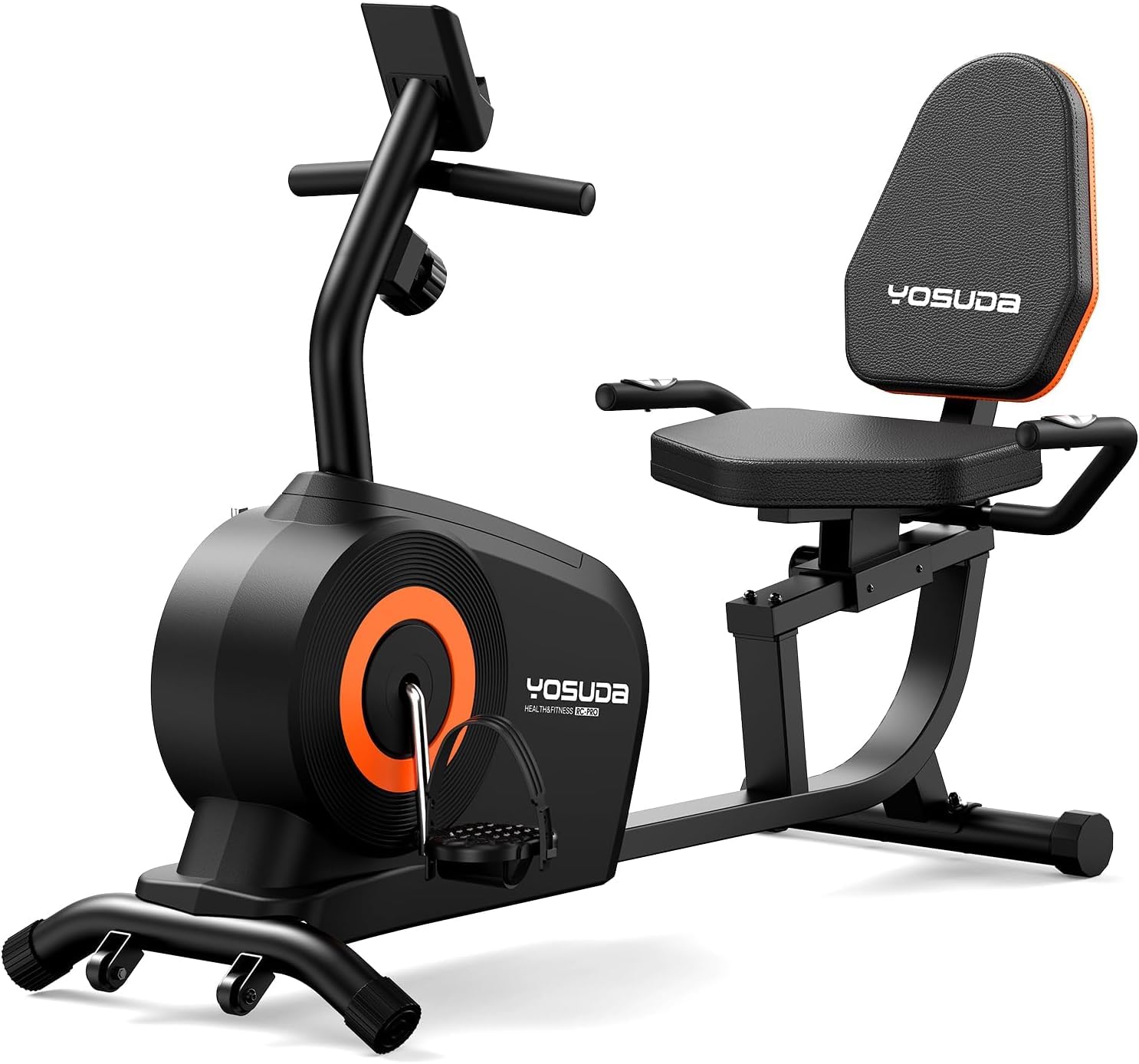
A quiet recumbent bike with an infinite seat adjustment that fits everyone
This recumbent bike nails the fundamentals for a larger beginner while offering one standout feature: an infinitely adjustable seat. The knob-based adjustment lets riders from 4’9″ to 6’2″ find their perfect leg position, which is a huge advantage in a household with multiple users or for taller beginners who often feel cramped on smaller bikes. With a 350-pound weight capacity, it provides a solid margin of safety on a frame built from light commercial-grade steel.
The 16 resistance levels give you plenty of room to progress, from a gentle recovery spin to a challenging 60-lb resistance workout. Assembly is a frequently praised strength, with most parts pre-installed and a clear video guide, and owners appreciate the transport wheels that make it easy to roll between rooms. The bike is also notably quiet, making it easy to watch TV or read while you ride without disturbing anyone else in the house.
Buyers consistently call this bike solid and well-built, with one saying it will “last for years.” The catch is comfort: several users report the seat runs small and thin, and some add a gel cushion or pillow for longer rides. A few also struggled with the seat adjustment mechanism, so test that function early.
Standout Feature: The infinite seat adjustment is a rare find at this level, making it the most accommodating bike for multi-user households and taller riders.
Honest Trade-off: Budget for a seat cushion upgrade, as the stock padding is a common source of minor complaints.
Pick this for: its class-leading seat adjustability and a ride that stays quiet and stable even during intense sessions.
Think twice if: you want a plush, ready-to-use seat straight from the start.
5. Kawnina Recumbent Exercise Bike
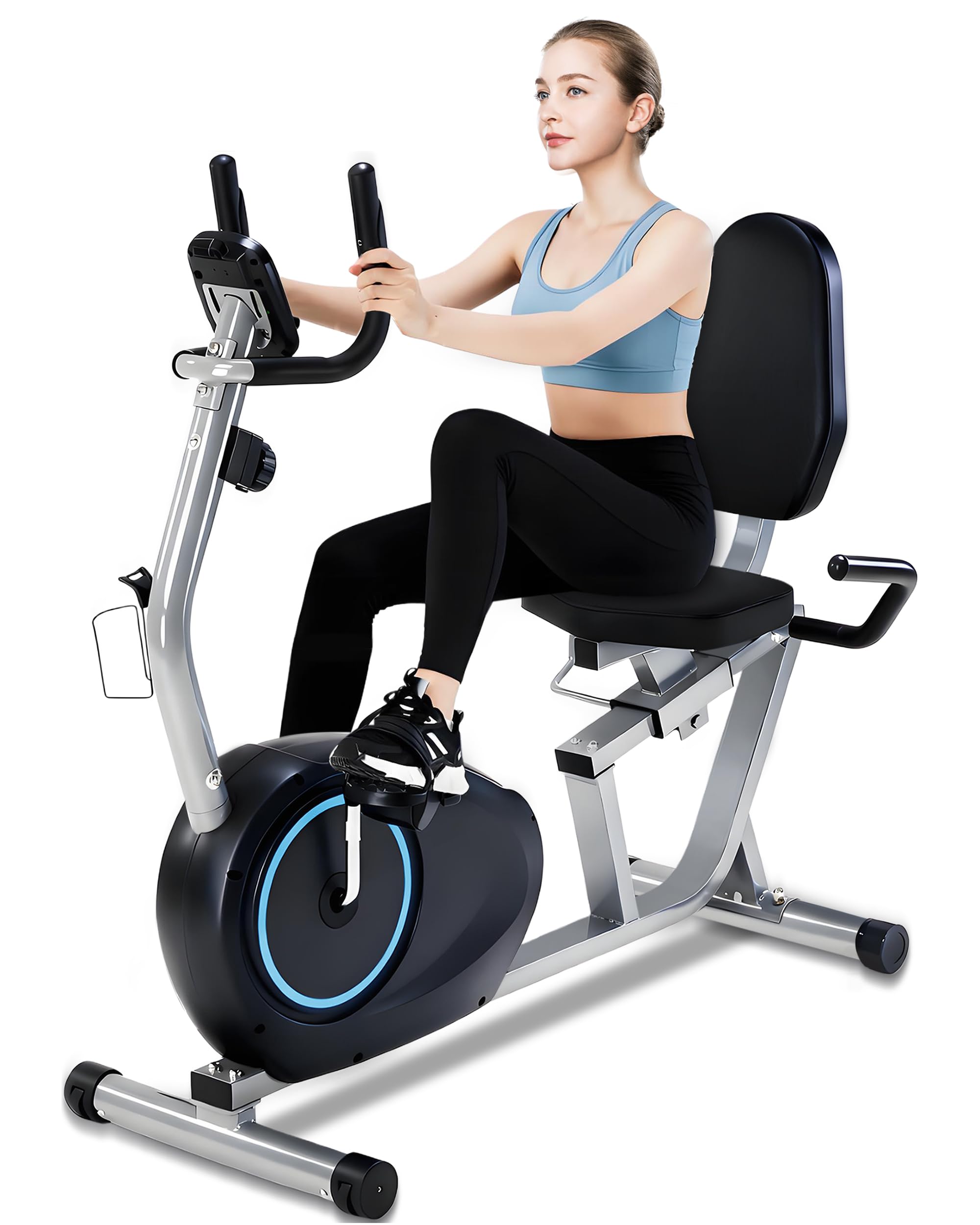
The sturdiest frame here, rated to hold up to 400 pounds with ease
If weight capacity is your absolute first priority, this is the machine to beat. At 400 pounds, it supports more than any other pick here, so you get a real safety margin and confidence the frame won’t flex or fail. It’s built from commercial-quality steel, and its 55.8-pound weight keeps it grounded and stable even when you pedal hard.
The bike is pre-assembled up to 85%, which customers note translates to a quick and painless 30-minute setup. The 16-level magnetic resistance system is impressively quiet, operating at levels as low as 5DB—quieter than a whisper—so you can work out while others sleep or watch TV. The seat and backrest feature a 10-degree forward tilt and high-quality sports sponge, which many owners find notably more comfortable than flatter, firmer seats on comparable bikes.
The step-through frame design makes mounting and dismounting much easier, which is a critical safety feature for beginners with limited mobility. While the LCD monitor and pulse sensor provide the essential tracking data you need, some users note that the pulse readings can be slightly inaccurate compared to a dedicated heart rate monitor. Assembly instructions have also been flagged as poorly translated, though the included video tutorial helps fill in the gaps.
What Stands Out
- Industry-leading 400-lb weight capacity
- Ultra-quiet operation at just 5DB
- 85% pre-assembled for fast setup
- Comfortable tilting seat and supportive backrest
What to Watch
- Pulse sensor readings can be slightly off
- Paper instructions are not well-translated
Choose this if: you need the highest possible weight capacity and prioritize a low step-through entry.
Consider another if: you rely on precise heart-rate data from the machine’s sensors.
6. Cubii Total Body Under Desk Elliptical
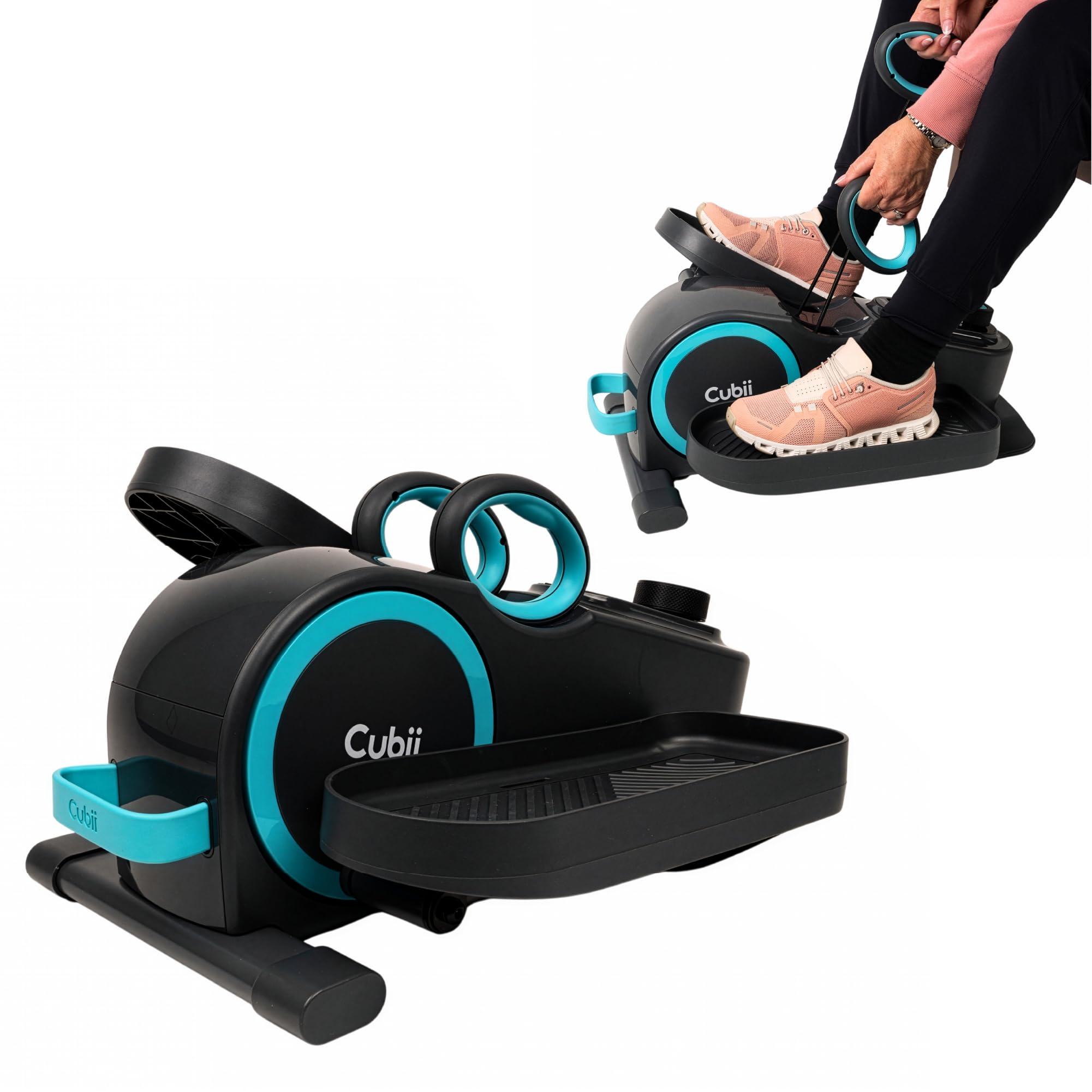
The seated glider that turns your desk chair into a full-body gym
This is the machine for the beginner whose biggest obstacle is time. Designed to slide under a desk, the Cubii lets you pedal your legs and pull resistance bands for your arms while you work, watch TV, or read. The 2-in-1 design combines a smooth elliptical motion with an ergonomic pulley system, so you can burn calories and tone muscles without ever leaving your chair—a huge win for anyone who struggles to find dedicated workout time.
It supports up to 300 pounds and offers 12 adjustable resistance levels, which is plenty of range for a beginner to progress. Magnetic resistance delivers a smooth, joint-friendly glide that reviewers point out causes no knee or hip pain, ideal for recovery or chronic stiffness. The built-in LCD display tracks time, distance, and resistance level, and the unit is lightweight and easy to move between home and office.
Owners love that it stays put on a rug and is near-silent, so you can use it in a shared space without distraction. The included resistance bands add a genuine upper-body component, with users noting you can do curls, flies, and rowing motions. The main limitations are that it requires a cord to recharge (you cannot generate power by pedaling) and the arm pulls can drag on a desktop if your desk is low. It is also not a heavy-duty cardio machine—it is best for low-intensity, consistent movement.
Best Use Case: Adding thousands of gentle steps to your day while you sit, perfect for absolute beginners building an exercise habit.
Know This: It is a movement and toning tool, not a sweat-drenching cardio session; the resistance bands are the real upper-body bonus.
Reach for this if: you want to stay active during work hours and build a low-effort daily habit.
Look elsewhere if: you are seeking a high-intensity, heart-pounding cardio workout.
7. GooMags Under Desk Elliptical
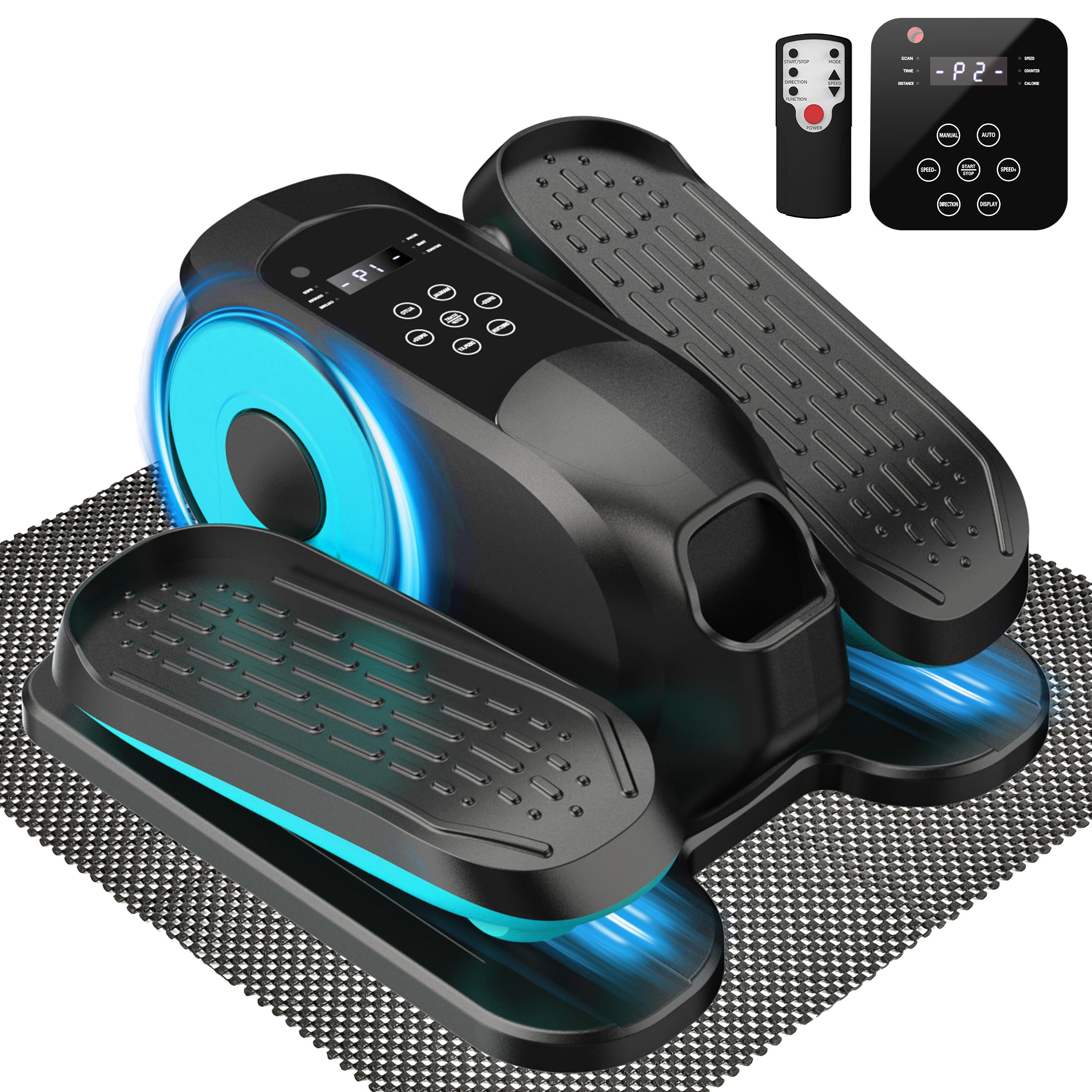
A featherweight pedaler (11.1 lbs) you can move from couch to desk in seconds
This under-desk elliptical is the definition of low-barrier exercise. Weighing just 11.1 pounds with a built-in handle, it is the easiest machine on this list to move and store—you can carry it from your living room to your office chair in one hand. Despite its light weight, it supports users up to 300 pounds, making it a surprisingly sturdy option for a compact device. The low-impact motion minimizes stress on knees, ankles, and back, ideal for seniors or those recovering from joint pain.
Convenience sets this model apart. The high-sensitivity RF remote (a wireless remote that works from across the room) lets you change resistance without bending down, and the clear LCD display shows time, distance, speed, calories, and step count. With 15 resistance levels and forward and backward pedal motion, you can target different muscle groups, from a gentle rehab session to a more active leg workout.
The nearest competitor to the Cubii, this machine trades the upper-body resistance bands for a lighter, more portable design and a much lower price point. A non-slip mat and a generous 2.5-meter power cord add to the user-friendly package. Shoppers say improved circulation and relief from stiff legs, especially when used while watching TV. The one quirk to know: if you leave it on in idle mode, it emits a gentle intermittent beep as a reminder to unplug it—a safety feature, not a malfunction.
The Good
- Ultra-portable 11.1-lb design with a carry handle
- Remote control for easy resistance adjustment
- 15 resistance levels with forward and reverse motion
- Gentle on knees, ankles, and back
The Trade-off
- No upper-body workout bands like the Cubii
- 1-inch stride length is very short, best for gentle movement
Best for: anyone wanting an ultra-portable, joint-friendly way to keep legs moving during sedentary hours.
Not for: those seeking a leg-burning workout or upper-body engagement.
8. ZIWWVY Stepper Machine
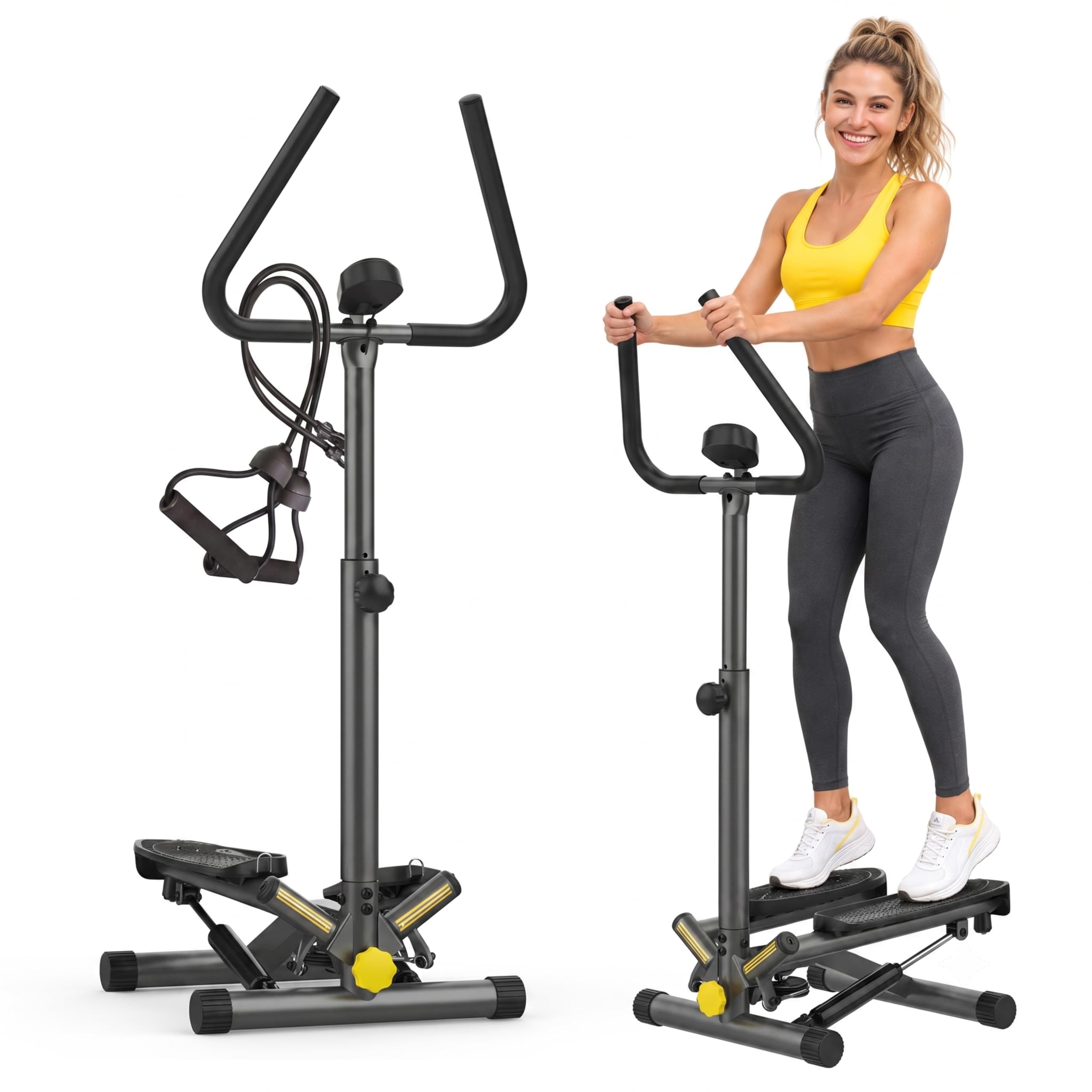
A supportive handlebar stepper that adds upper-body bands to a leg workout
This stepper is budget-friendly and built for a beginner: a secure handlebar keeps you balanced as you step up and down. Its 300-pound weight capacity rests on a frame of sturdy 1.5mm thick commercial steel, and owners consistently praise its stability during use. The included resistance bands work your arms, shoulders, and biceps while your legs step, turning a simple leg machine into a full-body tool.
The stepper uses a dual hydraulic cylinder resistance source, which the manufacturer claims is the industry’s quietest. Real-world feedback is more mixed on this point—some users find it pleasantly quiet, while others report a clunking or squeaking sound, particularly at higher step heights. The adjustable step height is a valuable feature that lets you customize the intensity to your fitness level, and the LCD monitor tracks your steps, time, and calories burned.
The side-to-side twist motion is a natural, low-impact movement that feels comfortable for most users. Buyers report effective weight loss and suitability across fitness levels, from a petite user with a knee injury to fitter individuals. The main trade-offs are that the calorie counter is a bit gimmicky and the noise level can vary from unit to unit. It is also a standing exercise, so it requires more balance and coordination than a recumbent bike.
What Wins People Over: The handlebar support and adjustable step height make it feel safer and more customizable than a basic stepper.
The Recurring Gripe: The noise level is inconsistent—some units hum quietly, others squeak, so consider a return policy.
Choose this if: you want a compact, supported stepping workout with upper-body bands on a tight budget.
pass on it if: you prefer a fully seated exercise or cannot tolerate any mechanical noise.
9. MERACH Rocking Stepper
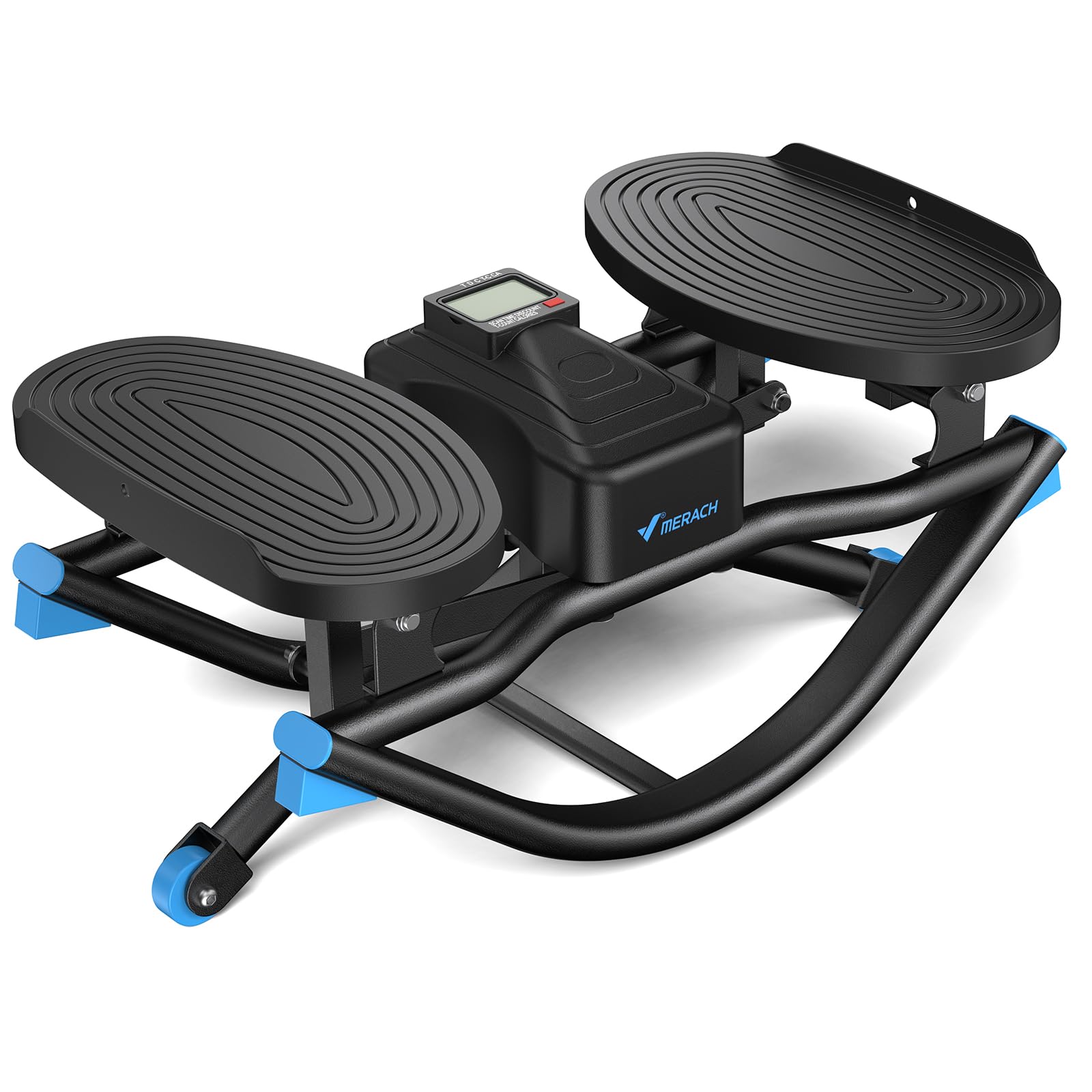
A tiny 13-lb stepper that delivers a surprisingly big lower-body burn
This is the most affordable and compact option on the list, and it fills a specific niche for the beginner who wants a challenging but low-impact workout without a large footprint. Unlike standard up-and-down steppers, this machine uses a side-to-side rocking motion that specifically targets your hips, thighs, glutes, and core. It supports up to 330 pounds with a commercial-grade steel construction, which is impressive for a machine that weighs just 13 pounds.
The 3D motion feels like skiing rather than stepping, which owners find fun and engaging—several note it’s great for exercising while watching TV. The included resistance bands add an upper-body element, and the LCD screen tracks your time, steps, and calories burned. The parallel-to-ground platform minimizes shear force and joint impact, a biomechanically sound choice for all ages.
The biggest drawback is noise: a significant number of owners mention that squeaking begins after about two weeks of use, often originating from a green block component. This is the most-discussed trade-off, and while it does not impact the workout’s effectiveness, it can be annoying. It is also a balance-dependent exercise, so it is not the best first choice for anyone with significant mobility or balance issues.
Why It Stands Out
- Ultra-compact and lightweight at just 13 lbs
- 330-lb capacity is generous for its size
- Lateral motion targets hips and glutes effectively
- Includes resistance bands for a full-body option
Be Aware
- Frequent reports of squeaking starting after a couple of weeks
- Requires balance, so not ideal for those with mobility issues
Best for: budget-conscious beginners who want a fun, effective lower-body burner and have good balance.
Not suitable if: you need a silent machine or require a seated, fully-supported exercise.
Understanding the Specs
Weight Capacity
This is the single most important number for a larger beginner. It tells you the maximum user weight the frame is engineered to hold safely. Always look for a capacity that is at least 300 pounds, and ideally one that leaves a 50- to 100-pound buffer above your current weight. A machine rated too close to your weight will feel unstable and may wear out prematurely.
Resistance Levels
This number dictates how much you can progress before you outgrow the machine. A bike with 16 levels offers a much longer runway than one with 8, letting you gradually increase intensity as you get stronger. Magnetic resistance is generally preferred because it is quieter and smoother than friction-based systems, which rely on pads that wear down over time.
Low-Impact Design
This is a blanket term for machines that minimize stress on your joints. Recumbent bikes and ellipticals are inherently low-impact because your feet never leave the pedals. This lets you sustain cardio longer without joint pain, key to building a consistent habit.
Footprint & Portability
Consider the machine’s physical size and weight. A heavy recumbent bike (like an 84.9-lb frame) offers stability but is difficult to move. A lightweight under-desk elliptical (around 11 lbs) is portable but may feel less substantial. Measure your space and decide if you want a permanent fixture or something you can tuck away.
FAQ
What is the safest type of exercise machine for an obese beginner?
Why is weight capacity more important than the workout features?
Is a recumbent bike better than an upright bike for a larger beginner?
Can I use a stepper machine if I have balance issues?
How long does a typical assembly take for these machines?
Are under-desk ellipticals effective for weight loss?
What does “low-impact” actually mean for my joints?
Should I get a machine with an app or Bluetooth connectivity?
How do I know which resistance level to start with?
Final Thoughts: The Verdict
Across the board, the best exercise equipment for obese beginners is the MERACH Recumbent Bike because its heavy, stable frame and supportive seat provide the safest and most confidence-inspiring start. If you want a full-body workout from a seated position with upper-body bands, grab the Cubii Total Body. And for the highest possible weight capacity, the Kawnina Recumbent Bike is the one to reach for at 400 pounds.
How We Picked
We do not accept paid placement. Every pick is matched to a real buyer and a real use-case; we do not hands-on test units.
Sources & Methodology
Specifications: manufacturer listings and product documentation. Review insights: verified customer reviews, as of August 2026. Pricing: not shown on this page (it changes often); check the current price via the retailer link.
As an Amazon Associate, WellFizz earns from qualifying purchases. This does not affect which products we feature.
Related Guides

Mo Maruf
I created WellFizz to bridge the gap between vague wellness advice and actionable solutions. My mission is simple: to decode the research and give you practical tools you can actually use.
Beyond the data, I am a passionate traveler. I believe that stepping away from the screen to explore new environments is essential for mental clarity and physical vitality.