Our readers keep the lights on and my smoothie glass nicely filled. As an Amazon Associate, I earn from qualifying purchases.
Specs are compiled from manufacturer listings and verified buyer reviews and can change over time — please confirm the key details on the product page before buying.
Lower back pain changes how you move, sit, and sleep. The right equipment does not just mask the ache—it targets the root, whether that is tight hamstrings pulling on your pelvis, a stiff spine that needs gentle traction, or weak core muscles that leave your lower back doing all the work. This guide breaks down the nine top-rated tools for the job, from a collapsible roller you toss in a carry-on to a full inversion table built for 350 lb users, so you pick the one that actually fits your routine and your body.
I’m Mohammad Maruf — the founder and writer behind WellFizz. This guide is built by comparing the manufacturers’ published specifications and the patterns across verified customer reviews, so you get each pick’s real strengths and trade-offs instead of marketing spin.
Whether you have a herniated disc, sciatica, or just the stiffness of sitting too long, these picks deliver measurable relief. Scroll on for the complete breakdown of the best exercise equipment for lower back pain.
Our Picks at a Glance


How To Choose The Best Exercise Equipment For Lower Back Pain
Not every back issue responds to the same tool. A bulging disc often needs gentle traction, while tight hamstrings call for sustained stretching, and general soreness can vanish with a few minutes of deep-tissue rolling. The first step is matching the equipment to your specific discomfort.
Understand Your Pain Type
Sciatica and nerve pain often respond well to inversion tables, which decompress the spine and take pressure off compressed nerves. Muscle tightness and trigger points usually break up faster with a textured foam roller or massage ball. For stiffness caused by weak glutes and hamstrings, a stretch machine that targets the posterior chain (the muscles running down the back of your body) can produce lasting relief.
Know the Weight and Size Limits
An inversion table rated for 300 lb will feel rock-solid, while one rated for 250 lb might flex at the joints. Similarly, a foam roller that is 14.5 inches long covers your entire back, while a 13-inch roller leaves the edges of your lats (the broad muscles on the sides of your back) untouched. Check your height and weight against the product specs—most tables list a user height range—before you buy.
Consider Your Space and Daily Routine
A collapsible foam roller that folds to 2 inches thick slides into a gym bag and works on an office floor. A 65 lb inversion table demands a dedicated corner of the bedroom and about 30 minutes of assembly. Be honest about how much friction your setup creates—if the machine is hard to pull out, you will not use it daily.
Quick Comparison
| Model | Best For | Weight Capacity | Key Feature | Weight | Amazon |
|---|---|---|---|---|---|
| Brazyn Morph Foam Roller★ Best Overall | Portable daily rolling | 350 lb | Collapses to 2 inches | 1.5 lb | Amazon |
| TEETER ComforTrak EP-560Premium Inversion | Premium inversion therapy | 300 lb | FDA Registered, Acupressure Nodes | 65 lb | Amazon |
| Stamina InLine TractionSpace Saver | Spinal decompression standing up | 250 lb | Upright traction, no inversion needed | 29 lb | Amazon |
| Teclor Inversion Table | Budget-friendly inversion | 350 lb | 30.3-inch long backrest | — | Amazon |
| Roman Chair Back Extender | Back strengthening and core work | 245 lb | Angle & height adjustable | — | Amazon |
| HARISON Inversion Table | Heavy-duty inversion for tall users | 350 lb | 80% pre-assembled, 180-degree range | 70+ lb | Amazon |
| Limber Pro Stretch Machine | Flexibility and full-body stretching | — | Adjustable sliding seat, 60 lb steel frame | 56 lb | Amazon |
| 5 in 1 Foam Roller Set | All-in-one muscle recovery kit | — | Roller + stick + ball + band | 2.8 lb | Amazon |
| Sac Bowl | Pelvic and hip mobility | — | Non-slip rubber, includes exercise manual | 3 lb | Amazon |
In‑Depth Reviews
1. Brazyn Morph Foam Roller: Collapsible Travel Foam Roller
Our pick — over 4.5★ from 850+ verified ratings; the strongest balance of quality and price.
The featherweight roller that hides in your carry-on but hits like a full-size tube.
The defining trick here is pure engineering: this roller collapses to a flat 2.6 inches thick and weighs just 1.5 lb, yet it expands to a full 14.5 inches long and 5.5 inches in diameter when you need it. That means you can stash it in a backpack, take it to the office, or even carry it on a flight—which removes the single biggest reason people stop rolling (the roller stays at home). Buyers report that a few minutes of rolling “works wonders” on sore backs, and the textured surface grabs trigger points in the lower back effectively.
Compared to the 5 in 1 set below, the Brazyn is a single-purpose tool—you do not get a massage ball or bands. But it is 2.0 times lighter than the Sac Bowl, and the 350 lb weight rating means it supports nearly any user without squishing flat. The trade-off is firmness: a few owners wanted a denser foam, calling it “a bit on the soft side” for deep muscle work, so if you need a rock-hard roller for aggressive pressure, this may not deliver. Still, as the crowd favorite with a 4.6-star consensus across nearly 900 owners, this is the portable solution that actually gets used.
Why it travels
- Collapses under 2.6 inches thick for easy packing
- Weighs only 1.5 lb, so it goes in any bag
- Rated for 350 lb—surprisingly sturdy for its size
- As seen on Shark Tank with proven durability after years of use
The softness caveat
- Some owners find it too soft for deep-tissue trigger point work
- Single roller only—no massage stick or ball included
Reach for this if: you travel, work in an office, or have never stuck with a foam roller because storing a big tube feels like a hassle.
Think twice if: you need maximum density for aggressive pressure on a chronic knot—a traditional solid roller or a massage ball may work better.
2. TEETER ComforTrak EP-560 Inversion Table
The inversion table that has 40 years of engineering—and an FDA registration to prove it.
This is the only device on this list registered with the FDA as a 510(k) medical device for back pain, muscle tension, herniated disc, sciatica, and spinal stenosis. The ComforTrak backrest is designed to let your body slide deeper into the stretch for better spinal decompression, and the eight built-in acupressure nodes offer trigger-point release on your upper and lower back while you invert. The Lumbar Bridge attachment adds an adjustable arch that focuses traction directly on the lower back region—the spot most people need it most.
The frame uses heat-treated steel—the only brand that does—and it is UL Safety Certified, tested to last significantly longer than typical budget tables. Setup takes under an hour with the Bilt app, and the folding design means you can store it upright against a wall without disassembling anything. The 300 lb capacity and height range (4 ft 8 in to 6 ft 6 in) fit a broad range of users. Owners consistently call it a back-saver, with one commenting that early use made his back “feel better after brief use,” though a few note the ankle-lock mechanism could be more refined. The comfort trade-off is that the lumbar support can feel too arched for some, but the overall consensus is that this is “the best” for budget-minded buyers wanting premium features.
Best for: buyers with diagnosed back issues (sciatica, herniated disc, stenosis) who want a medically validated device with real safety certifications.
Its strength: class-leading safety pedigree, FDA registration, and acupressure extras that make every session more than just hanging upside-down.
3. Stamina InLine Traction Control System
Gravity works differently here—you get spinal decompression without ever going upside down.
This is a rare product in the back-pain world: it mimics the traction you would get from a physical therapist’s table, but you stand flat-footed on the floor. A padded belt wraps around your hips, and as you lean forward into the chest cushion, the belt pulls upward on your pelvis, creating a gentle separation between your vertebrae. The setup is ideal if you have high blood pressure, glaucoma, or any condition that makes inversion tables risky—you never leave the upright position.
Owners dealing with bulging discs and herniated disks report the InLine feels like “mimics PT traction,” providing relief comparable to expensive DRX9000 sessions. The padded chest cushion and high-density foam arm supports make longer sessions comfortable, and the frame, made of stainless steel, supports up to 250 lb. The 29 lb unit is compact enough to slide under a bed. The main downsides are that the chest pad can cause initial soreness for new users, and the build quality varies—some units have had minor welding issues. A floor mat is recommended to protect your floors from the steel base. This is a clever choice for anyone who wants decompression without the head-rush of inversion.
One-of-a-kind upright traction: easier on the body than inversion, yet still decompresses the lumbar spine effectively. Best for those with medical restrictions on inversion.
Who this helps: people with bulging discs, sciatica, or limited mobility who cannot safely invert.
4. Limber Pro Stretch Machine

A stretch table that adjusts to your proportions—not the other way around.
Most stretching machines lock you into a fixed seat position, which forces shorter or taller users to compromise their posture. The Limber Pro solves that with a patented adjustable sliding seat that locks into place, ensuring your hips, knees, and ankles align properly through every stretch. The 60 lb commercial-grade steel frame keeps the machine planted during intense sessions, and the included calf stretch board (a detachable slant board) targets the Achilles and calf muscles that often contribute to lower back tightness.
Owners fighting hip bursitis and chronic back pain praise the deep stretch it delivers, with one calling it “bad back? Buy the Nitrofit!” after using it for lumbar relief. The extra-large seat and back cushions are comfortable for extended use, and the dual grip handles offer two positions—inward for seated stretches and outward for standing slant-board work. The assembly is straightforward with pre-installed bolts, though a few owners note the foot board edge could use more padding. At 56 lb, it is not portable, but the integrated transport wheels make it easy to roll across a room. If your back pain stems from tight hamstrings, hips, or calves—the classic posterior-chain culprit—this machine targets them all in one session.
Why it stands out
- Adjustable sliding seat fits different body proportions
- 60 lb steel frame stays stable during use
- Includes calf stretch board for lower-leg flexibility
- Easy transport wheels for home gym movement
The small trade-offs
- Foot board edge padding is thin—some owners add a folded shirt
- Exercise placard included is small and hard to read
Best for: anyone whose lower back pain is linked to tight hamstrings, hip flexors, or calves—this machine systematically loosens the entire posterior chain (the chain of muscles down the back of your body).
5. Teclor Inversion Table

A 350 lb-rated inversion table at a price that leaves room in your budget for a heating pad.
The Teclor does not try to reinvent the wheel. It delivers a sturdy steel frame, a 30.3-inch long and 15.3-inch wide backrest for ergonomic support, and a ratchet-style closure for the ankle holders. The adjustable height range (4 ft 3 in to 6 ft 8 in) covers nearly everyone, and the safety belt adds extra security if you are new to inversion. Owners say the locking system feels secure and that the unit provides real relief for lower back tension after daily use.
The honest downsides: several owners found the padded back “cheaply made with staples,” and the lumbar support lacks a hook-and-loop attachment to stay put. The ankle foam pads can slip off, and the included wrenches are not great—plan to use your own tools during the roughly 45-minute assembly window. The safety strap has been called “useless” by some owners. But the 4.2-star consensus across more than 840 buyers is solid, and for the price tier, this is a functional entry into inversion therapy. The key difference from the TEETER is that the Teclor lacks the FDA registration and acupressure features, but it matches its 350 lb weight capacity at a significantly lower entry point. If you are not sure whether inversion will help your back and want to try without sinking serious cash, this is the logical first step.
The value equation: strong frame, tall user height range, and a 350 lb weight limit at a low entry price. The assembly and padding quality remind you where the savings went.
Choose this if: you are tall (up to 6 ft 8 in), heavy (up to 350 lb), or new to inversion and want a low-risk trial.
6. Roman Chair Back Extender

The fix for chronic back pain sometimes comes from making your back stronger—not just stretching it.
A Roman chair (also called a hyperextension bench) is the go-to machine for strengthening the erector spinae muscles (the muscles running along your spine) and the glutes, which take pressure off the lower back. This model from SUCXDZQ offers both angle and height adjustments, fitting users up to 6 ft 3 in, with a 45-degree ergonomic design that keeps your hips properly positioned. The alloy steel frame with anti-abrasive coating supports up to 245 lb, and the cushioned pads make extended sets more comfortable.
The standout praise here is stability—it is the top aspect by a wide margin. The bench locks in place without wobble, which is critical for back extensions where any sway can strain the lower back. A firefighter who uses this daily described it as “literally life-changing for chronic lower back pain,” doing static holds to full extensions every morning. Assembly takes about 30-40 minutes, and at roughly 30 inches deep and 21 inches tall, it fits in tight home gym spaces. The packaging has been a frustration for some, with paint chipping on arrival, and the hardware can be confusing (machine screws vs. bolts). After two years of daily use, one owner noted the frame inevitably gets less steady. The thing that wins people over, though, is that a relatively simple piece of steel can eliminate back pain by making the supporting muscles strong enough to handle daily load.
Stability wins here
- Locks in with zero wobble—critical for safe back extensions
- Adjustable angle and height to fit different users and exercises
- Works for back, core, hips, and legs in one compact frame
- Sturdy enough for daily use by active individuals (firefighters, athletes)
What to watch for
- Packaging can cause paint damage on arrival
- Hardware sometimes mismatches the manual
- Frame may loosen after 2 years of intense daily use
Who it fits: people whose back pain comes from weak glutes and a sedentary lifestyle—strengthening beats stretching here.
skip it if: your pain is from an acute disc injury that needs decompression, not strength work.
7. HARISON Inversion Table
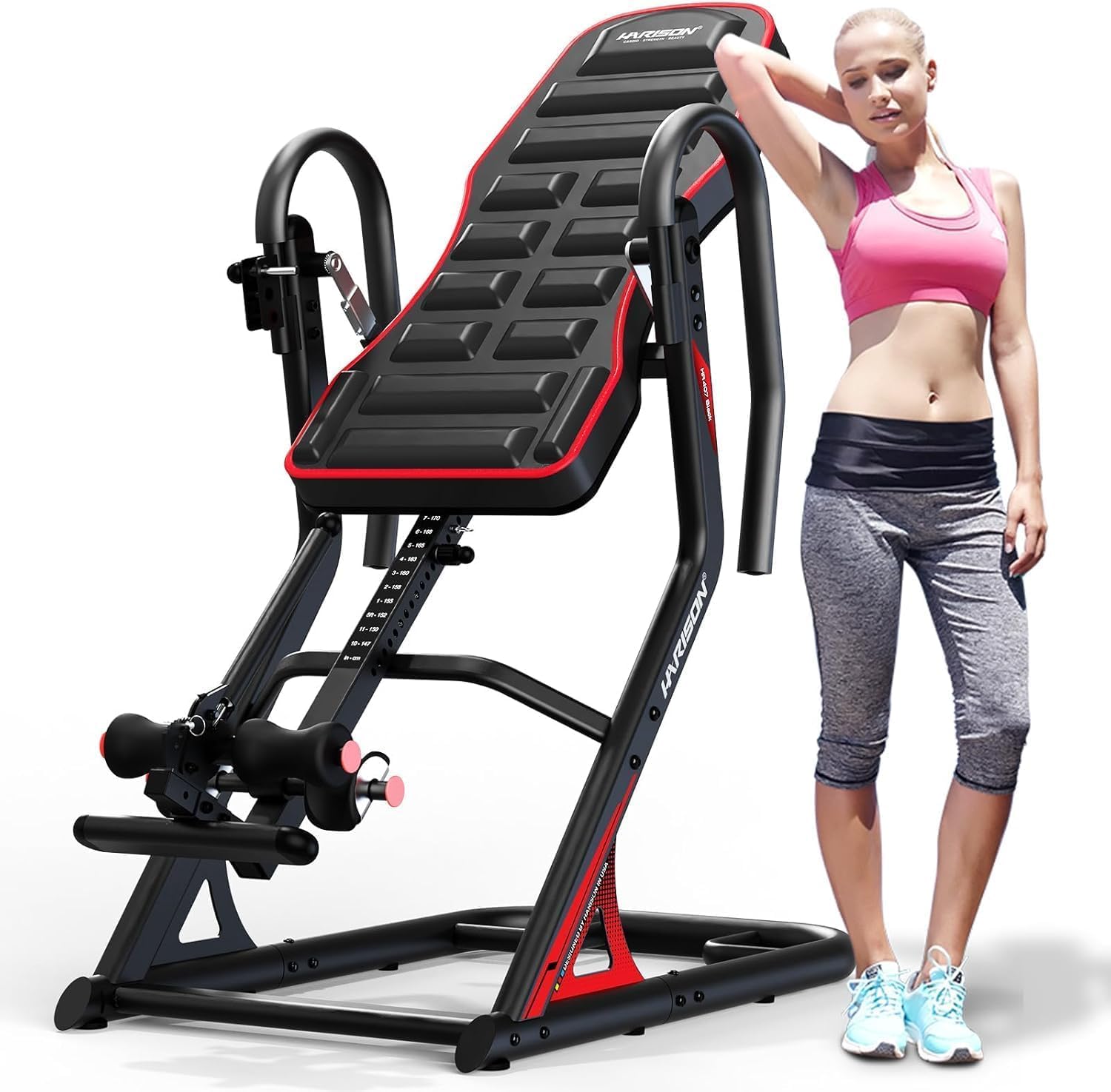
A gym-grade inversion frame for taller, heavier users, right from the start.
The HARISON is built around a heavy-duty alloy steel frame rated for 350 lb and users up to 6 ft 5 in. It comes 80% pre-assembled, so you can go from box to first session in about 20 minutes—much faster than most tables in this class. The 4-position side pin system lets you lock in 20, 90, 130, or 180 degrees of inversion, so you can ease into it with mild angles before committing to a full head-down stretch. The 3D memory foam backrest adds comfort that budget tables skip entirely.
Buyers consistently call it “very sturdy” and “safe to use,” with one owner saying it gave him a clearer head and lighter body after full inversion. The quadruple safety system—safety belt, ankle immobilizer, shoulder support, and those locking pins—makes it feel secure even during full 180-degree inversion. A few owners note that the ankle holders can pinch without supportive shoes or extra padding, and the foot lock instructions are not well written. The footprint is large (55 inches deep), so it needs floor space, but for big and tall users who previously felt cramped on other tables, this is the most spacious option. At a 4.5-star consensus, it edges out the Teclor on build quality while matching its weight capacity.
Designed for larger frames: fits up to 6 ft 5 in and 350 lb with a memory foam backrest that smaller tables leave out. The 20-minute assembly is a rare bonus.
Its edge: the most pre-assembled inversion table here—open the box, attach a few parts, and hang within 20 minutes.
8. 5 in 1 Foam Roller Set
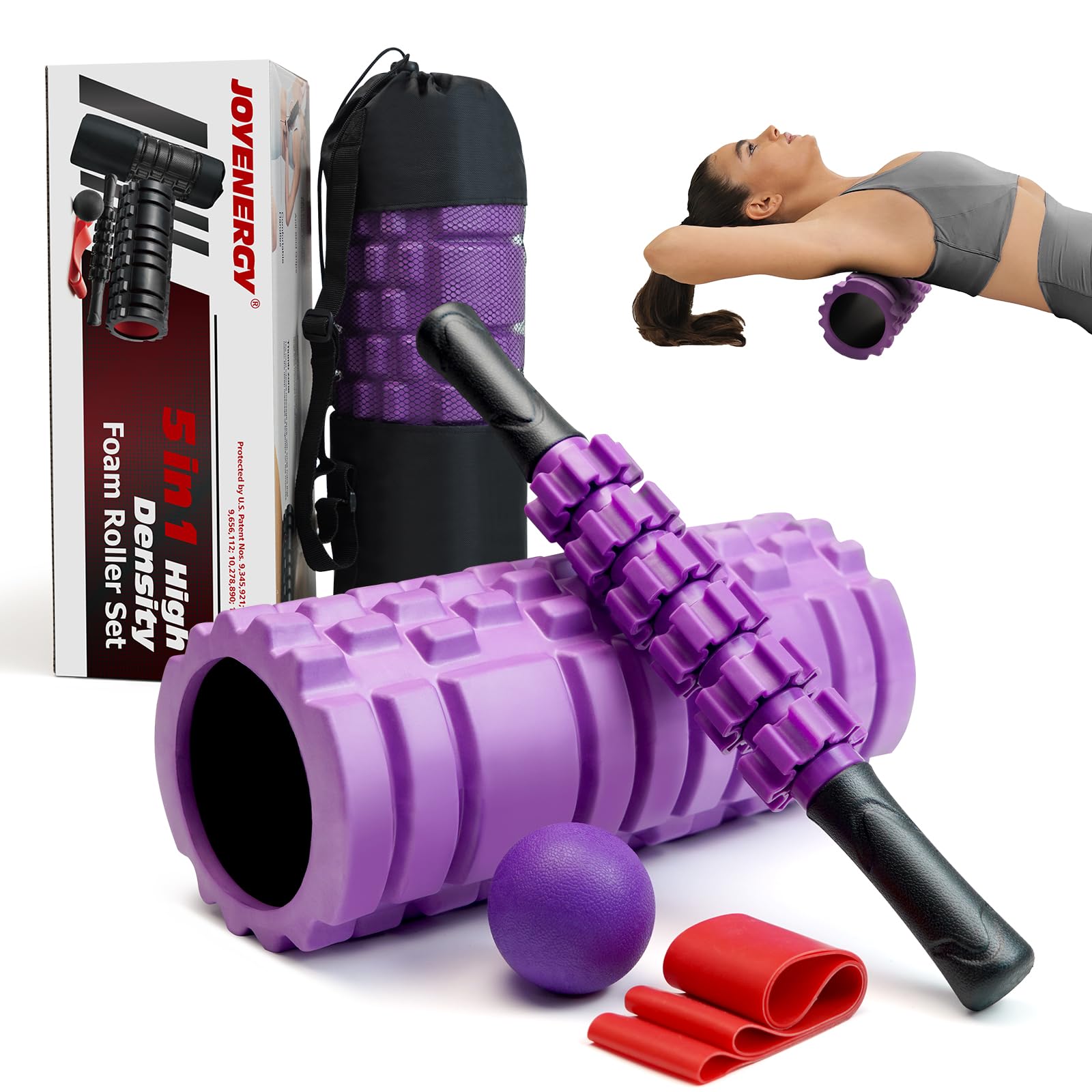
The complete trigger-point kit that costs less than a single physio session.
This is the ultimate starter pack for self-myofascial release—a 13-inch high-density foam roller with a textured surface, a 16-inch muscle roller stick for quick self-massage, a 2.5-inch massage ball for pinpoint trigger points, and a resistance band for light strengthening. Everything packs into a nylon mesh bag that travels easily. The foam is high-density, which means it holds its shape under heavy use without turning into a squishy mess, and it is waterproof and sweat-proof for easy cleaning.
What owners rave about is the effectiveness: the roller’s ridges are deep enough to release leg knots and lower back tension, and the ball is “the perfect size for precise spots” like the piriformis muscle deep in the glute—a common hidden source of back pain. One owner summed it up: “I have a lot of pain and it really helped with my pain relief… I am obsessed with it.” The stick is handy for a quick back rub after sitting all day. The main gripes center on the roller length—at 13 inches, it is shorter than the Brazyn, and taller users (around 5 ft 6 in) find it too short for full back coverage. The firmness is mixed: some love the rigidity, others find it uncomfortable on boney areas. But for under 3 lb total, this set gives you five ways to attack back pain in one bag.
The value of variety
- Five tools in one carry bag for full-body coverage
- High-density foam maintains shape and provides deep pressure
- Massage ball is ideal for glute and piriformis trigger points
- Waterproof, sweat-proof surface cleans easily
The length limit
- Roller is only 13 inches—taller users find it too short
- Firmness can be uncomfortable on bony areas
Pick this if: you want a portable, versatile kit to keep at home, in the car, or at the office—and you want to try different release techniques without buying five separate items.
9. Sac Bowl for Lower Back and Hip Pain Relief

A rubber bowl that teaches your pelvis to move—and can stop back pain at its source.
The Sac Bowl looks deceptively simple: an 8.5-inch wide rubber dome weighing 3 lb. You sit on it and perform “clock exercises”—tilting your pelvis forward, back, and side to side—which mobilizes the sacroiliac joint (the joint connecting your sacrum, the triangular bone at the base of your spine, to your pelvis) and strengthens the deep core muscles that stabilize the lower back. The non-slip, non-marking rubber grips your floor without sliding. An included exercise manual walks you through the movements.
For some owners, this has been transformational. One person who was “saved from crippling pain” described it as a miracle after using it on a bed for 30 minutes: their chronic hip and sacroiliac pain vanished after just two sessions. Others praise it for improving hip mobility in ways floor exercises cannot replicate. The honest trade-off is that the rubber is very hard and not malleable at all—a post-spinal-fusion user found it too hard to use, and even some healthy owners cut a piece of foam to place on top. The size is polarizing too: at 8.5 inches in diameter, some find it “slightly large” and it can pinch the skin depending on your seating position. The 4.0-star consensus reflects this split. The people who love it use it daily as part of a stretching routine, while those who bounce off it are often expecting a soft cushion rather than a firm mobility tool.
A love-it-or-hate-it rubber dome: fantastic for sacroiliac and hip mobility if you tolerate the hardness; uncomfortable if you need cushioning.
Who it works for: people with sacroiliac joint dysfunction, hip tightness, or pelvic alignment issues who need a firm, stable surface for controlled movement.
Who should pass: anyone with recent spinal fusion, bone-on-bone joint issues, or a preference for soft cushioning.
Understanding the Specs
Inversion Angle and Control
An inversion table’s angle positions (often listed as 20/90/130/180 degrees) determine how much of your body weight is pulling on your spine. A 20-degree tilt is a gentle incline that takes pressure off your lower back without a head rush, while a full 180-degree hang puts maximum traction on the spine. Most tables use a side pin or an angle tether to limit how far you can tilt, which is a safety feature for new users. Tables with a smooth rotation control (like the TEETER’s responsive balance system) let you return upright simply by moving your arms—no wrestling with a heavy frame.
Foam Density and Trigger Point Texture
Foam rollers come in high-density and medium-density options. High-density foam (found on the 5 in 1 set) is firm enough to release deep muscle knots without flattening under your body weight, but it can be uncomfortable on bony areas like the spine. A collapsible roller like the Brazyn uses a honeycomb core wrapped in textured foam—softer than solid foam but more portable. The surface pattern matters too: smooth rollers are gentler for beginners, while nubs or ridges (called “textured” rollers) dig into trigger points for a more targeted release. If you have a low pain tolerance, start with a smooth surface and move to textured as your muscles adapt.
FAQ
Is it safe to use an inversion table if I have high blood pressure?
How many minutes a day should I use a foam roller for lower back pain?
Will a Roman chair make my back pain worse if I have a herniated disc?
What is the difference between inversion and traction for back pain?
Can I use a foam roller on my lower back directly?
How long does a foam roller last before it loses its shape?
Do I need a safety belt on an inversion table?
Can the Limber Pro Stretch Machine help with sciatica?
Final Thoughts: The Verdict
For most people, the best exercise equipment for lower back pain is the TEETER ComforTrak EP-560 because it combines medical-grade validation (FDA registration) with proven build quality and features like acupressure nodes and a lumbar bridge that no other table matches. If you need something you can take anywhere, the Brazyn Morph is the compact daily roller that actually gets used. And if upright decompression is safer for your health, the Stamina InLine delivers traction without ever going upside down. Between those three, you will find your relief.
How We Picked
We do not accept paid placement. Every pick is matched to a real buyer and a real use-case; we do not hands-on test units.
Sources & Methodology
Specifications: manufacturer listings and product documentation. Review insights: verified customer reviews, as of July 2026. Pricing: not shown on this page (it changes often); check the current price via the retailer link.
As an Amazon Associate, WellFizz earns from qualifying purchases. This does not affect which products we feature.
Related Guides

Mo Maruf
I created WellFizz to bridge the gap between vague wellness advice and actionable solutions. My mission is simple: to decode the research and give you practical tools you can actually use.
Beyond the data, I am a passionate traveler. I believe that stepping away from the screen to explore new environments is essential for mental clarity and physical vitality.