Our readers keep the lights on and my smoothie glass nicely filled. As an Amazon Associate, I earn from qualifying purchases.
Specs are compiled from manufacturer listings and verified buyer reviews and can change over time — please confirm the key details on the product page before buying.
Finding a solid indoor bike that won’t strain your wallet is tough. You want something quiet enough for apartment life, sturdy enough to feel safe, and with enough resistance to actually challenge you. This guide cuts through the noise to find the one that delivers on all three.
I’m Mohammad Maruf — the founder and writer behind WellFizz. This guide is built by comparing the manufacturers’ published specifications and the patterns across verified customer reviews, so you get each pick’s real strengths and trade-offs instead of marketing spin.
You want a bike that fits your home and your budget without falling apart. These exercise bike under 200 picks each solve a real problem — like folding up small or being gentle on sore knees — so you get a machine that actually works for you.
Our Picks at a Glance

How To Choose The Best Exercise Bike Under 200
Your height, your fitness goals, and the floor space you can spare decide which style fits. A foldable bike saves room; a recumbent bike (one with a chair-like seat and pedals out front) is easier on your knees.
Upright vs. Recumbent: Which Frame Fits You?
Upright bikes (like a traditional spin bike) work your core more and let you lean into sprints. Recumbent bikes put you in a laid-back seat with your legs out in front, which is easier on your back and hips — ideal for seniors or rehab.
Magnetic Resistance is the Quiet King
Friction resistance (pad on a wheel) gets louder over time and wears down. Magnetic systems use magnets that don’t touch, meaning near-silent operation and zero maintenance. For an apartment or shared wall, it is the only choice.
Weight Capacity is Your Stability Guarantee
A heavier frame with a higher weight limit (300 lbs or more) doesn’t just hold more weight — it wobbles less during a hard effort. Check the “Maximum Weight Recommendation” number for a quick read on build quality.
Quick Comparison
| Model | Best For | Resistance Levels | Max Weight | Weight | Amazon |
|---|---|---|---|---|---|
| Foldable Exercise Bike (Birdfeel)★ Best Overall | Small Spaces | 8 | 300 lbs | 39.2 lbs | Amazon |
| pooboo Exercise BikeAlso Great | Precision Training | 100 | 350 lbs | — | Amazon |
| MERACH Recumbent BikeRecumbent Comfort | Seniors & Rehab | 8 | 300 lbs | 57.3 lbs | Amazon |
| DMASUN Exercise Bike | Stability & Quiet | 100 | 330 lbs | 66 lbs | Amazon |
| Wenoker App Bike (JC302) | App Integration | Unlimited | 250 lbs | — | Amazon |
| Indoor Cycling Bike (Lacuffy) | Spin-Class Feel | 32 | 300 lbs | 43.1 lbs | Amazon |
| Wenoker Spin Bike (JC306) | Heavy-Duty Build | Unlimited | 350 lbs | 61.7 lbs | Amazon |
| Recumbent Bike (TRMDDF) | Low-Impact Cardio | 16 | 400 lbs | 35 lbs | Amazon |
| EYESUN Spin Bike | Family Sharing | — | 330 lbs | 47 lbs | Amazon |
In‑Depth Reviews
1. Foldable Exercise Bike (Birdfeel)
The three-in-one foldable that morphs into storage when the workout ends.
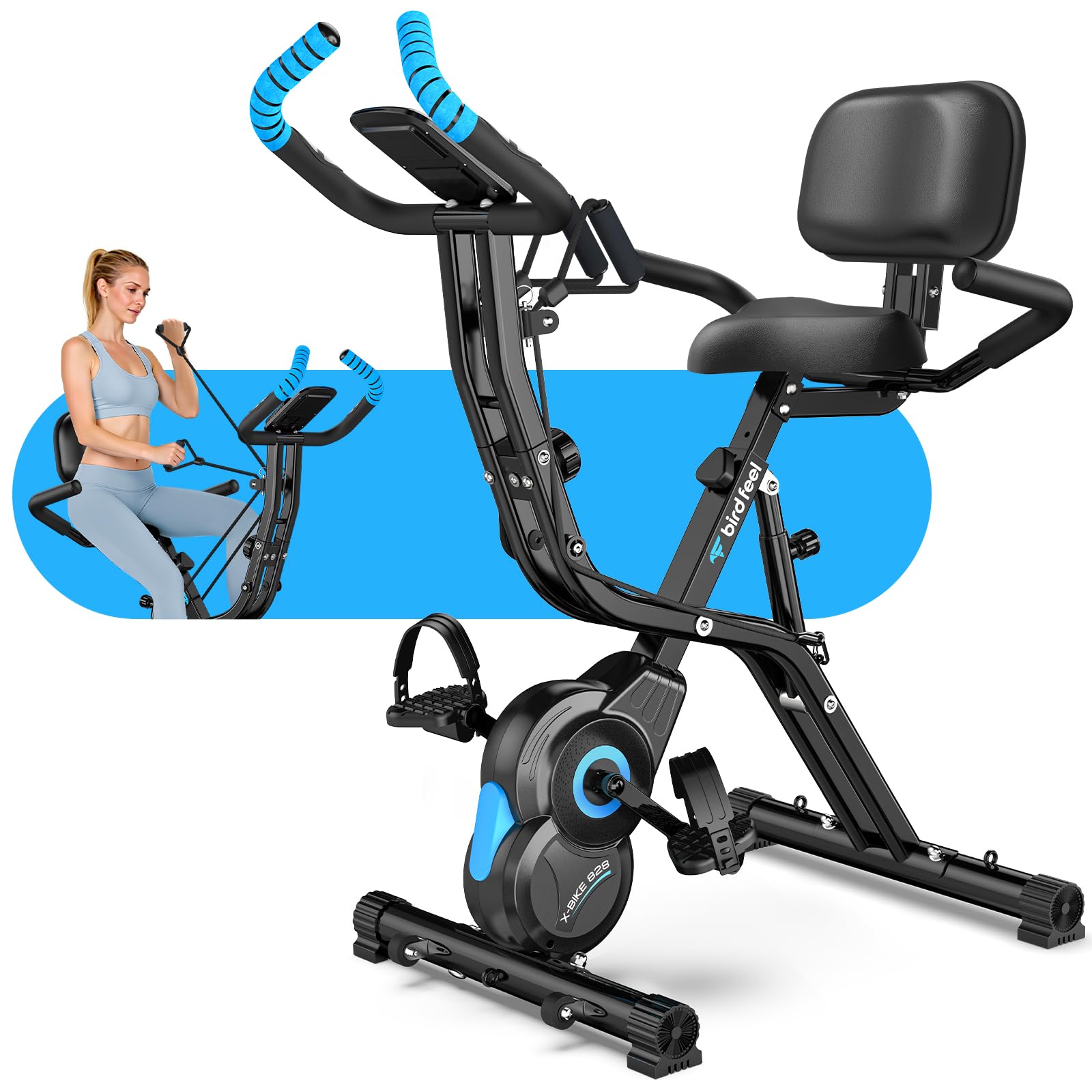
This Birdfeel bike switches between upright mode for cardio, recumbent “lazy” mode for a relaxed ride, and a fully folded shape that tucks into a closet. It is the only bike here that folds completely flat, making it the obvious pick for apartments, dorms, or anyone who cannot dedicate permanent floor space to a machine. The 8-level magnetic resistance is smooth and stays under 15 decibels — almost silent.
The frame holds 300 lbs and the bike itself weighs just 39.2 lbs, so it is easy to tip onto its transport wheels and roll away. The maximum seat height accommodates riders from 4’4″ to 6’6″, an unusually wide range. Owners mention it is a massive hit with seniors: one review notes a 71-year-old found it easy to mount thanks to the low-step-through recumbent position, and the arm resistance bands add upper-body work that upright bikes lack.
The trade-off is the resistance range — 8 levels may feel light for experienced cyclists who like a deep gear grind. The included arm bands help, but they are bands, not a cable system, so the tension is limited. The monitor also lacks a backlight, which makes it hard to read in dim rooms. For gentle daily movement and small-space living, it is a clever solution.
Standout spec: The 4.0x gap in resistance levels compared to the Lacuffy (8 vs. 32) tells you this is designed for comfort and accessibility, not hard-core training.
Customers note: “Great for elderly (71yo mom): easy on/off, backrest for back problems, super quiet, lightweight (45lbs), sturdy, folds easily.”
Perfect for: seniors, small apartments, and anyone who needs a bike that disappears after use.
Not for: athletes who need heavy resistance — this is a movement and light-cardio bike.
2. pooboo Exercise Bike
The precision tuner that turns a living room into a spin studio.
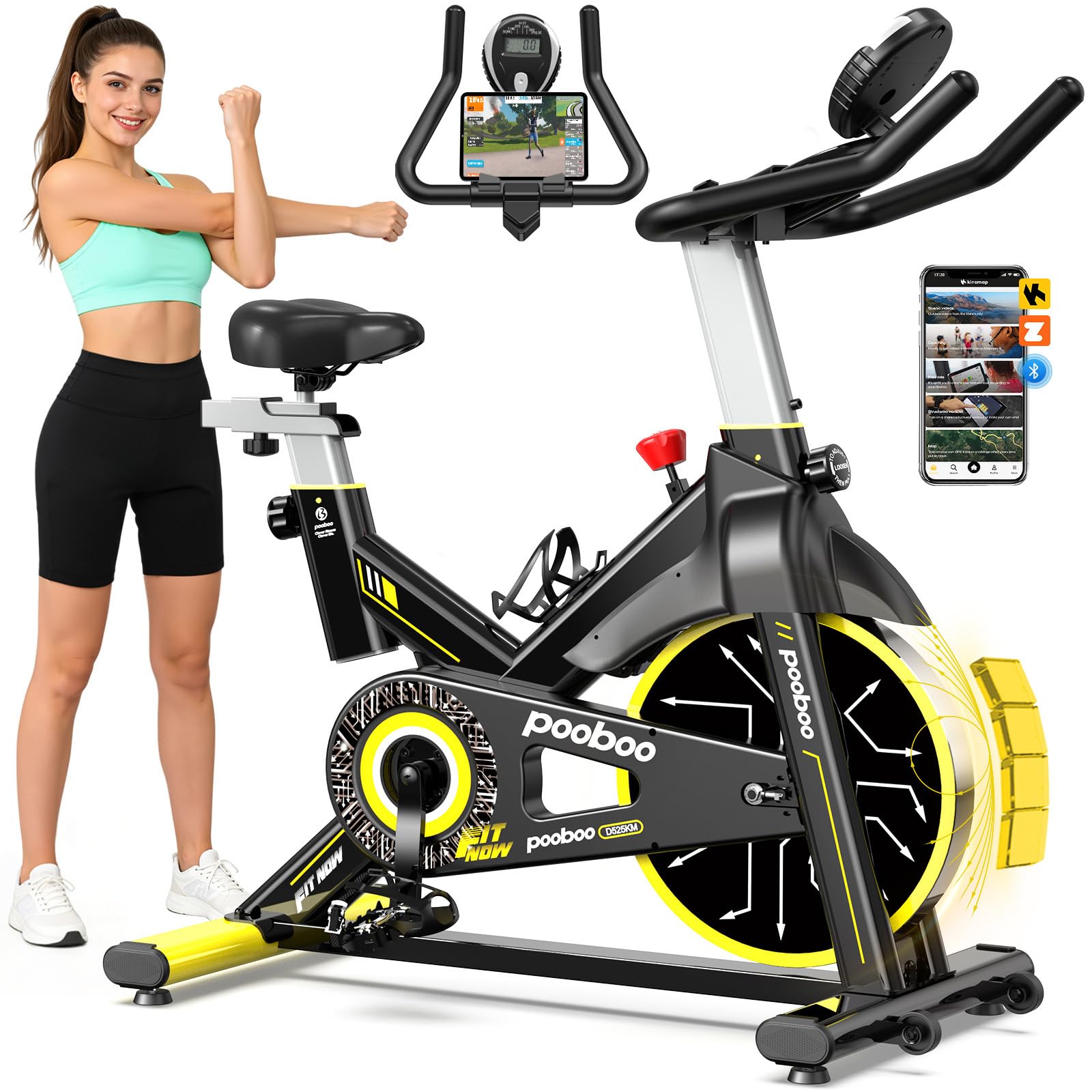
Most budget bikes give you maybe 8 or 16 resistance levels and call it a day. This pooboo throws that out the window with 100 micro-adjustable magnetic levels, so you can dial in a specific tension that matches a real road gradient. The belt drive keeps it at whisper level — below 25 decibels — meaning you can spin at 6 a.m. without waking anyone up.
The heavy-duty steel frame supports up to 350 lbs, and owners consistently call it the most solid they have tried at this price. The crowd favorite trait is sturdiness, with over 46 mentions from buyers who say it stays planted even during standing sprints. Assembly runs about an hour solo, and all tools are included in the box.
One honest trade-off: the LCD display is basic (time, distance, calories — the essentials, no heart rate strap connectivity). If you want a full metrics dashboard, you will rely on the Bluetooth app connection instead. But for sheer ride quality and adjustability, this bike sets the bar.
What Wins People Over
- 100 resistance levels — more than any other bike in this price range by a wide margin
- Ultra-quiet belt drive (under 25dB) for apartment or late-night use
- 350 lb weight capacity with a stable triangular steel frame
- Fits riders from 4’8″ to 6’1″ with 4-way seat and 2-way handlebar adjustment
The Catch
- Basic on-board LCD lacks advanced metrics like RPM or heart rate
- Pedal straps are functional but not the most durable — a few owners swap them
Reach for it if: you want the widest resistance range possible and plan to use app-guided workouts like Zwift or Kinomap.
Think twice if: you need a built-in heart rate display without a separate monitor — the basic screen is simple by design.
3. MERACH Recumbent Exercise Bike S08
The laid-back ride that supports your back as much as your legs.
Recumbent bikes are the smart play for anyone with lower back issues, hip trouble, or rehab needs — and this MERACH is the pick that keeps coming up in those conversations. The 8-level magnetic resistance is simple enough for gentle warm-ups (levels 1–3) but can climb to simulate uphill work (levels 7–8). The seat is wide and comfortable, and the laid-back position transfers load off your wrists and spine.
The built-in heart rate pulse sensor in the handlebars lets you track your intensity without buying a separate chest strap. Owners recovering from knee replacement surgery say it is “perfect for knee rehab” and that the Bluetooth sync to the MERACH app makes logging progress easy. At 57.3 lbs, it is heavy enough to feel anchored but still rolls on transport wheels when you need to shift it.
The thing that wins people over most is how easy it is to assemble — the top positive aspect from the review data is assembly ease, with 12 owners specifically praising the straightforward directions. The honest limit is the 8 resistance levels, which might feel restrictive if you are used to bikes with 16 or 32 steps. For steady-state cardio and joint-friendly movement, though, it is exactly right.
Best use-case: Seniors, post-surgery recovery, or anyone who finds an upright bike uncomfortable for the back or hips.
The head-to-head: At 57.3 lbs it is 22 lbs heavier than the TRMDDF recumbent, but the MERACH frame feels tank-like — owners call it “very sturdy for its size.”
Perfect for: low-impact daily cardio and rehab workouts where comfort is the priority.
Not for: experienced cyclists who need a wide gear range — 8 levels top out quickly for hard training.
4. DMASUN Exercise Bike
The tank of the category — a 66-pound brute that refuses to wobble.
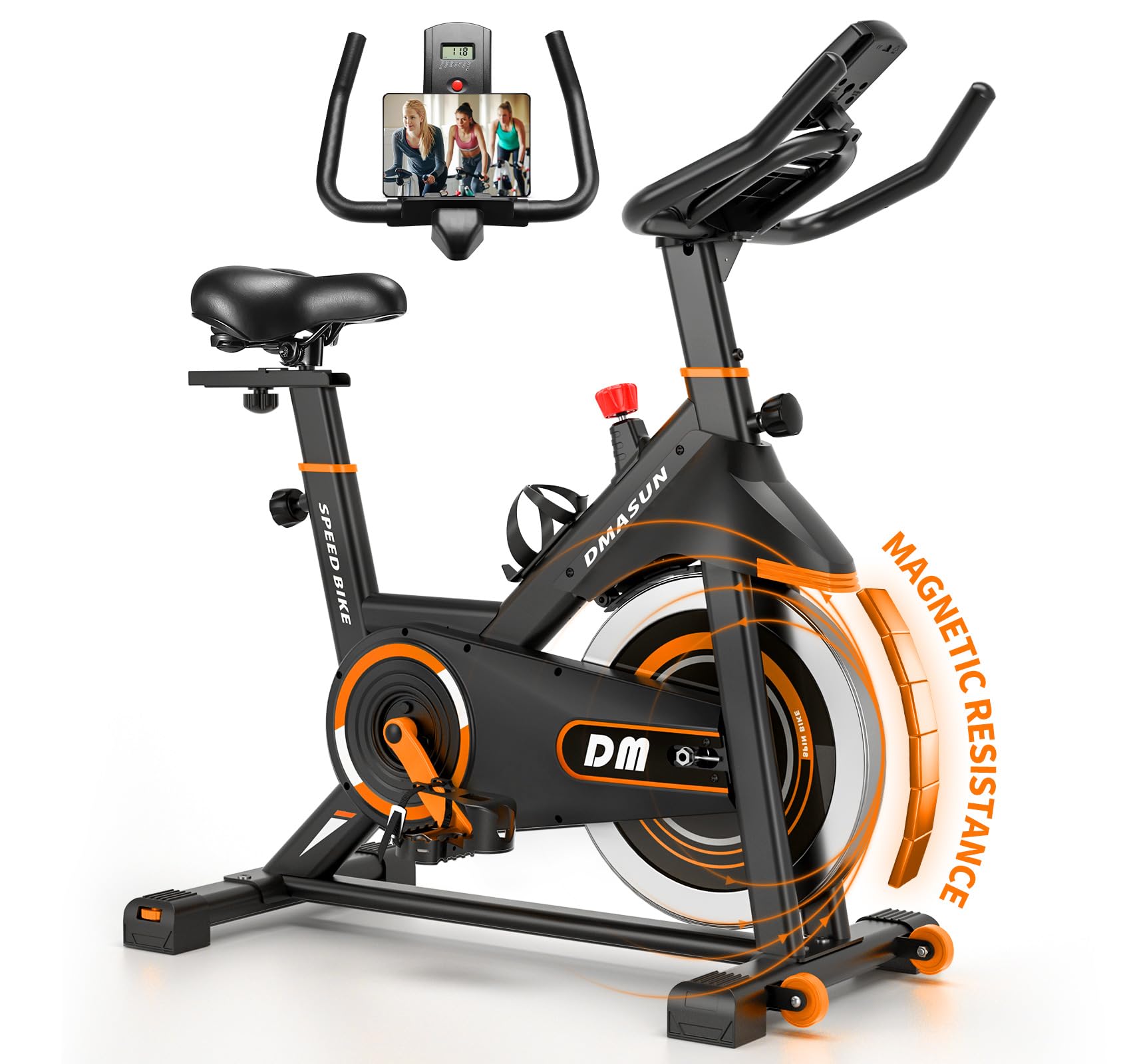
When a bike weighs 66 lbs and uses a 35 lb solid steel flywheel, you know it is built for stability. The DMASUN is the heaviest bike in this roundup, and owners say it feels planted even during all-out sprints. The magnetic resistance sweeps from 0% to 100%, giving you everything from a warm-up spin to a steep climb simulation. The brand says noise stays under 20 decibels — quieter than a whisper.
Buyers report that 37 owners call this bike well-made. The company has made sports equipment for over 30 years, and small details show: anti-loosening nuts on the pedals (a common failure point on cheaper bikes), a seat cushion included in the box, and compatibility with Wahoo sensors (a brand of Bluetooth speed and cadence sensors) for tracking your pedal RPM (revolutions per minute). Assembly takes about 30 minutes because 70% of the bike arrives pre-built.
The main adjustment is the handlebars — some owners note they do not tilt back, which can make the reach awkward for shorter or older riders. If you are under 5’4″, you will want to double-check that the handlebar position feels natural before committing. For everyone else, this is a rock-solid daily driver.
Why Buy This One
- 35 lb flywheel provides incredibly smooth, momentum-rich pedaling
- 66 lb frame and 330 lb capacity mean zero wobble at high intensity
- Quieter than 20dB — one of the quietest bikes tested in this group
- Comes with anti-loosening pedal nuts to prevent a common failure
The Fit Note
- Handlebars lack tilt adjustment — can be a stretch for shorter riders
- At 66 lbs, moving it upstairs requires the front transport wheels and some muscle
Grab this for: the smoothest, most stable ride in this price band — the flywheel mass smooths out every pedal stroke.
skip it if: you are under 5’4″ or need handlebars that tilt toward you for a comfortable reach.
5. Wenoker Exercise Bike JC302
The app-savvy spinner that keeps your cardio from getting boring.
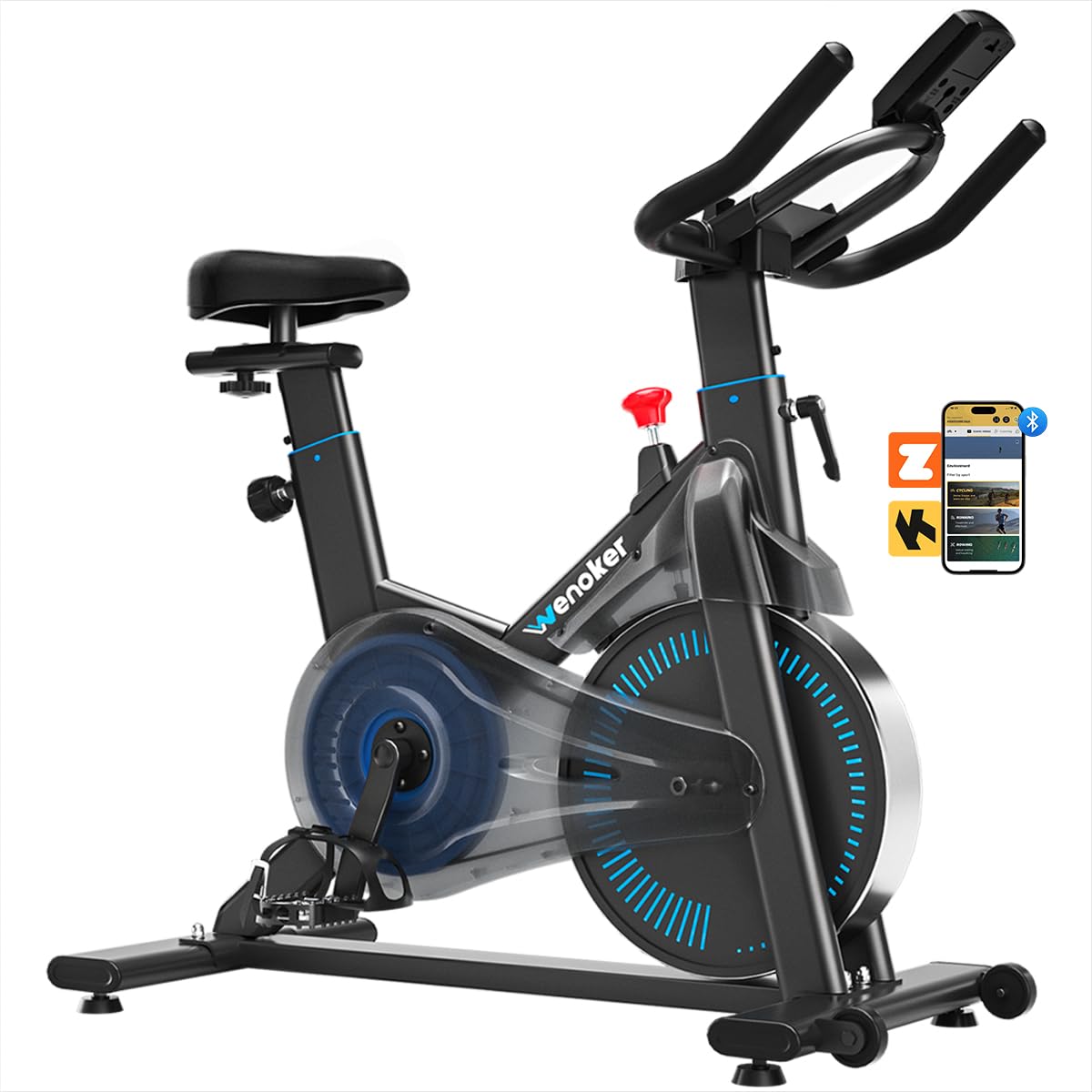
If you want a bike that works with Zwift or Kinomap (apps that show virtual routes and guided rides), this Wenoker is the smoothest option at this price. The unlimited micro-adjustable resistance lets you match the app’s terrain changes exactly — the tension knob has no clicks, just a smooth turn from easy to hard. The magnetic belt drive (a quiet friction-free system) stays under 25 decibels, so your virtual ride won’t bother anyone in the next room.
The build is notably compact: 35.8 inches deep and 39.4 inches tall, with a footprint smaller than a yoga mat. It fits riders from 4’6″ to 5’8″, making it an especially solid match for teens, beginners, and shorter adults. Assembly is 80% pre-assembled and can be done in about 20 minutes — a 13-year-old put one together solo, according to a review. The frame supports up to 250 lbs, and the one-piece steel design minimizes flex.
The catch is the weight limit — at 250 lbs, it is lower than most other picks here. The seat post uses a plastic adjustment clamp that one owner flagged as a potential weak point. For lighter riders who prioritize compact size and app connectivity, though, this is a natural fit.
Why it stands out: Owners describe the Kinomap integration as “smooth,” and the small footprint (it is the shortest bike here at 35.8 inches deep) makes it the best fit for tight bedrooms or dorms.
Best for: app-guided training, Zwift riders, and anyone with limited floor space (it is the most compact upright in this list).
Not ideal for: heavier riders or tall users over 5’8″ — the adjustment range tops out earlier than the competition.
6. Indoor Cycling Bike (Lacuffy S1-Pro)
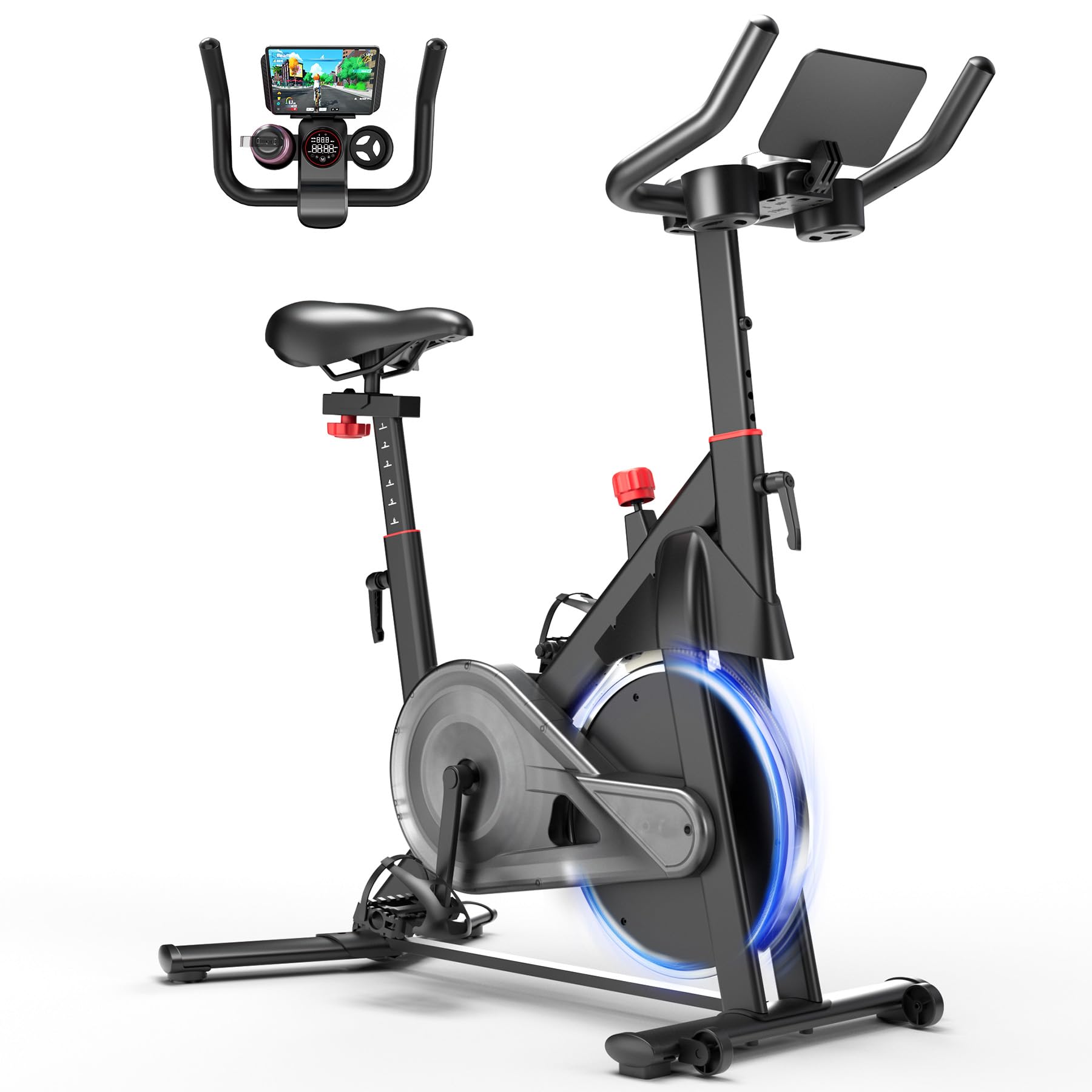
The data-driven spin bike for riders who love measurable progress.
With 32 hardware-calibrated magnetic resistance levels, the Lacuffy S1-Pro offers more than triple the steps of a typical 8-level bike. That 4x gap (32 vs. 8) means you can fine-tune your effort to a much more precise degree — perfect for interval training where every watt counts. The belt drive operates under 25 decibels, and the alloy steel frame holds up to 300 lbs with no wobble during out-of-the-saddle sprints.
It connects via Bluetooth to the exclusive PitPat App, which tracks real-time speed, RPM, distance, and calories. Owners call it “easy to use and easy to assemble” — the instructions are clear, tools are included, and one review had it running in under 30 minutes. The seat adjusts 7 ways, and the handlebars move forward and back, accommodating riders from 5’1″ to 5’11”.
The honest trade-off is the height cap. At 5’11” max, taller riders will find the cockpit cramped — the handlebars may feel too close. The screen is also basic (no backlight, no heart rate strap connection). For focused riders who want resistance precision without paying for a smart trainer, the S1-Pro is a steal.
The Standout Features
- 32-level magnetic resistance — a 4x gap over the 8-level foldable bike below
- PitPat app syncs real-time stats including RPM and speed
- Small footprint (40.6″D x 19.3″W) — fits on a mat-sized space
- Quiet enough for library-level focus, owners say
The Limits
- Height range tops out at 5’11” — taller users may feel cramped
- On-board display is simple; the app does the heavy lifting for tracking
Ideal for: data-motivated riders who want precise progressive resistance and app tracking without breaking budget.
Not for: anyone over 5’11” or those who want a full-color console on the bike itself.
7. Wenoker Spin Bike JC306

The weighty spin bike that puts stability before everything else.
At 61.7 lbs, this Wenoker is the second-heaviest bike in the lineup, and the steel frame uses a reinforced 7-shaped front handlebar post that eliminates rocking. The unlimited tension adjustment lets you dial the exact resistance without preset clicks — a smooth, continuous sweep from a warm-up spin to a full climb. The belt drive is quiet enough that owners say they cannot hear it over music, and the large LED display shows time, speed, distance, calories, and odometer.
The Bluetooth connectivity works with the Kinomap app for guided routes, though owners treat it as a bonus rather than the main feature. The pedals have secure straps and clips, and the multi-point handlebar grips let you change hand positions during long rides. Assembly is straightforward at 70% pre-assembled, and most owners finish in under 30 minutes.
The catch is that at 61.7 lbs, it is not easy to reposition — the front transport wheels help, but you will not want to carry it up stairs daily. The seat comfort splits opinion: some owners find it fine for casual rides under 30 minutes, while others swap it for a gel cover. If you are looking for a solid, unflashy workhorse that stays planted during standing efforts, this is it.
Why It Works
- 61.7 lb frame with thick steel construction and 350 lb capacity — zero wobble
- Unlimited micro-adjustable resistance for smooth transitions
- Large LED console with odometer tracking
- App compatibility with Kinomap for virtual riding
Considerations
- Heavy enough to be a chore to move between floors
- Seat comfort is average — a gel cover is a common addition
Best for: riders who value a rock-solid platform and unlimited resistance range for casual-to-moderate daily training.
Not ideal for: anyone who needs a lightweight machine to move frequently or wants a plush seat from the start.
8. Recumbent Exercise Bike (TRMDDF)
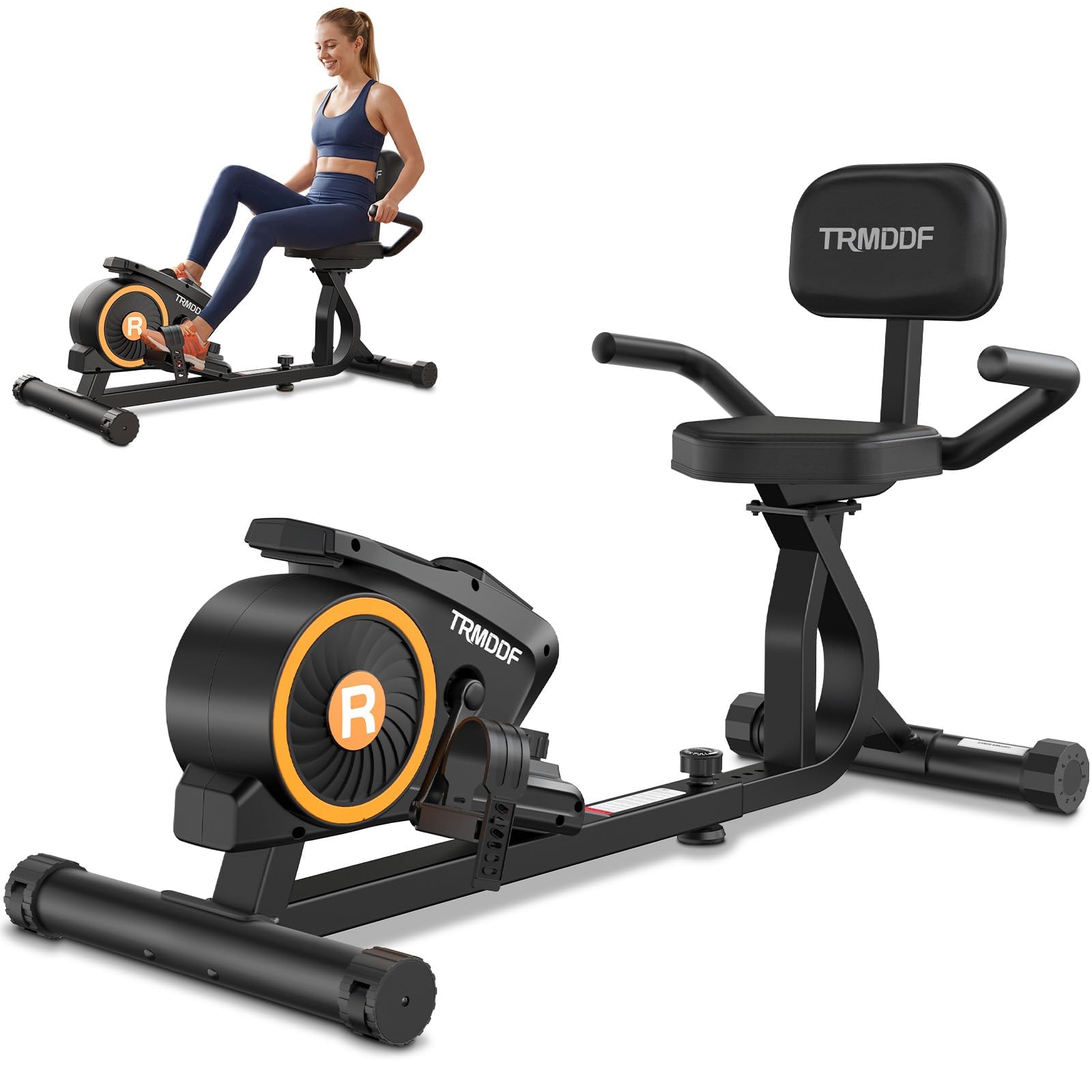
The 400-pound capacity recumbent that proves budget and brawn can coexist.
This TRMDDF recumbent bike carries the highest weight limit in the entire roundup — 400 lbs — while costing the same as many lighter-duty machines. The thickened alloy steel frame is built to handle heavy daily use, and the 16-level magnetic resistance gives you enough range for steady cardio without the complexity of 50+ settings. Owners are “impressed with the quality and stability.”
The 55.9-inch length is nearly 2.7x longer than the foldable Birdfeel, so this is not a space-saver — you need dedicated floor room. The payoff is a full recumbent position with a soft padded seat that supports the lower back during longer sessions. The LCD monitor tracks time, speed, distance, calories, and heart rate via pulse sensors in the handlebars. Assembly is the most positively reviewed aspect — the bike arrives 90% pre-assembled and can be ready in 20 minutes.
The main adjustment is physical footprint. At 55.9 inches deep, it is the longest bike here and will dominate a room. The seat adjustment mechanism also gets occasional notes of being a bit fiddly. If you have the space and need a high-capacity recumbent for comfortable, joint-friendly exercise, this is the strongest value in the category.
Capacity edge: The 400 lb limit beats the 300 lb foldable by 33% more, making it the clear choice for heavier riders or anyone who wants maximum structural margin.
Best for: larger riders, seniors, and anyone who needs a high weight capacity recumbent without the premium price tag.
Not for: small spaces — the 55.9-inch depth requires a dedicated workout corner.
9. EYESUN Spin Bike
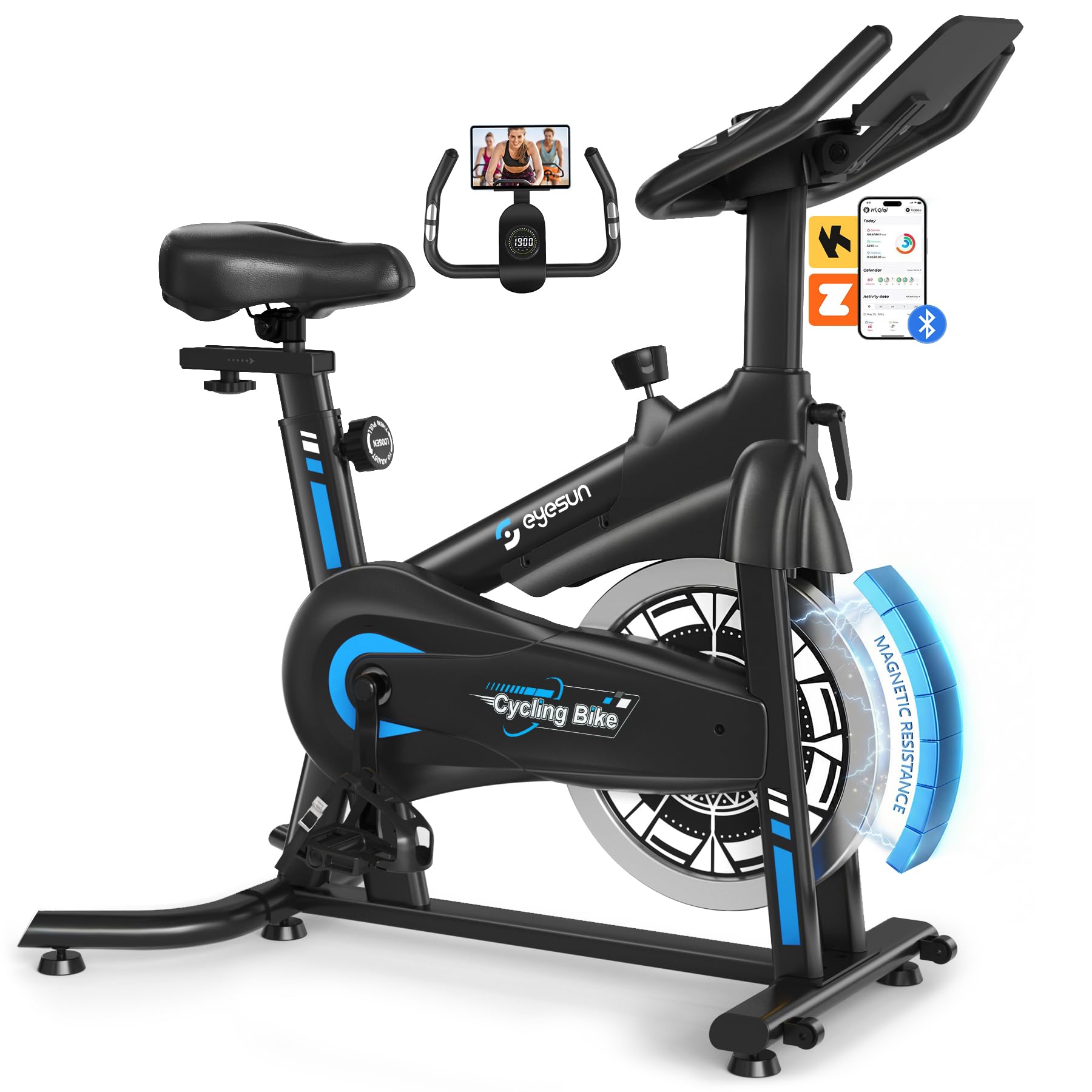
The budget-friendly spin bike that covers the whole family from 4’8″ to 6’3″.
The EYESUN is built around a 13.5 lb flywheel that delivers a smooth, momentum-driven ride, and its height range (4’8″ to 6’3″) is wider than almost anything else in this budget band. The 3-way handlebar and 5-way seat adjustments mean a tall parent and a shorter teen can both find a comfortable position without tools. The magnetic resistance is quiet but uses a hybrid friction pad, which some owners note may wear faster than a pure magnetic system.
The Bluetooth LCD monitor tracks time, speed, distance, calories, pulse, and total mileage, and the tablet holder on the console is positioned for easy viewing during rides. The 330 lb weight capacity and 47 lb frame keep things stable during standing climbs. Assembly ranks as the most positive aspect, with 37 owners praising the straightforward process and included tools.
The stability feedback is mixed — some owners find it rock-solid, while a few describe flex at higher resistance settings. The seat comfort also splits opinion; about half the owners find it fine, half swap it. For a family that needs one bike to serve multiple body types and fitness levels on a budget, the EYESUN covers the bases.
The Good
- 13.5 lb flywheel provides smooth, inertia-rich pedaling
- Fits riders from 4’8″ to 6’3″ — among the widest ranges in this group
- Bluetooth connectivity and tablet mount for entertainment
- 330 lb capacity and 47 lb frame for stable high-effort rides
The Mixed Feedback
- Hybrid friction/pad resistance may wear differently than pure magnetic
- Seat comfort is a split — some owners find it great, others add a gel cover
Ideal for: families sharing a bike across different heights and fitness levels on a single budget.
Not ideal if: you need whisper-quiet pure magnetic resistance — the hybrid system has a different feel.
Understanding the Specs
Resistance Levels
The number of steps or settings in the bike’s tension system. More levels (like 32 or 100) let you make small, precise adjustments so you can find the exact effort for intervals or recovery without a jarring jump between gears. A bike with 8 levels is simpler and fine for steady-state cardio, while 32 or above suits structured training where you follow a watt-based plan.
Maximum Weight Recommendation
This number tells you the heaviest rider the frame is certified to support safely. It is also a strong signal of overall build quality — a bike rated for 400 lbs will almost always feel sturdier at speed than one rated for 250 lbs, even for lighter riders. A higher number means thicker steel and a wider stability base, both of which reduce wobble.
Belt Drive vs. Chain Drive
Belt drives use a rubber belt, like a car’s serpentine belt, to connect the pedals to the flywheel. They are nearly silent, require no lubrication, and never rust. Chain drives (typical on cheaper bikes) are noisier, need periodic oiling, and will stretch over time. For a home bike, belt drive is the upgrade that keeps your workout peaceful and maintenance-free.
Flywheel Weight
The flywheel is the weighted disc that keeps spinning once you pedal. A heavier flywheel (like 35 lbs) stores more momentum, which means a smoother, more continuous pedal stroke — you feel less of a dead spot at the top of each rotation. Lighter flywheels require more constant effort and can feel jerky. For a natural road-like feel, look for at least 13 lbs.
FAQ
How much space do I need for an exercise bike under?
Is 8 resistance levels enough for a good workout?
Will a cheap exercise bike wobble during standing sprints?
Which bike is best for someone recovering from knee surgery?
How quiet are these bikes — can I ride while my family sleeps?
How long does assembly usually take for these bikes?
Can I connect these bikes to Zwift or Peloton-style apps?
How do I keep my bike from sliding on a hardwood floor?
Final Thoughts: The Verdict
For most buyers, the exercise bike under 200 winner is the pooboo Exercise Bike because its 100-level magnetic resistance and rock-solid 350 lb frame deliver studio-quality feel without the premium price. If you need a recumbent for back-friendly cardio, the MERACH Recumbent Bike is the one for seniors and rehab. And for compact living spaces, the Birdfeel Foldable Bike folds completely flat and still gives you a comfortable ride.
How We Picked
We do not accept paid placement. Every pick is matched to a real buyer and a real use-case; we do not hands-on test units.
Sources & Methodology
Specifications: manufacturer listings and product documentation. Review insights: verified customer reviews, as of July 2026. Pricing: not shown on this page (it changes often); check the current price via the retailer link.
As an Amazon Associate, WellFizz earns from qualifying purchases. This does not affect which products we feature.
Related Guides

Mo Maruf
I created WellFizz to bridge the gap between vague wellness advice and actionable solutions. My mission is simple: to decode the research and give you practical tools you can actually use.
Beyond the data, I am a passionate traveler. I believe that stepping away from the screen to explore new environments is essential for mental clarity and physical vitality.