Our readers keep the lights on and my smoothie glass nicely filled. As an Amazon Associate, I earn from qualifying purchases.
Specs are compiled from manufacturer listings and verified buyer reviews and can change over time — please confirm the key details on the product page before buying.
If you stand for long shifts, sit at a desk for hours, or spend time on a plane, your legs pay for it by the end of the day with that familiar heavy, achy feeling. Everyday compression socks work by gently squeezing your lower legs to help blood flow back up toward your heart, which is what takes the edge off that fatigue and swelling. This guide ranks the best everyday compression socks by their published specs and verified owner feedback on all-day comfort.
I’m Mohammad Maruf — the founder and writer behind WellFizz. This guide is built by comparing the manufacturers’ published specifications and the patterns across verified customer reviews, so you get each pick’s real strengths and trade-offs instead of marketing spin.
From featherlight 15-20 mmHg pairs for all-day wear to firmer 20-30 mmHg options for flights and long shifts, here are the everyday compression socks that actually hold up wash after wash.
Our Picks at a Glance

How To Choose The Best Everyday Compression Socks
The most common mistake is choosing the highest mmHg rating, assuming more pressure means better support. That backfires when the sock is too tight to wear all day, so you stop using it and lose the benefit.
Match the mmHg to your day
Compression strength is measured in millimeters of mercury, or mmHg (a unit that tells you how much pressure the sock applies to your leg). For everyday wear — desk jobs, retail shifts, light travel — the 15-20 mmHg range is the balance because it’s firm enough to support circulation without feeling restrictive. The 20-30 mmHg range is a step up in firmness, often chosen by people who fly frequently, stand on concrete for 10-hour shifts, or want a stronger squeeze for tired legs.
Look at the fabric and toe construction
Cotton blends feel softer and more breathable but can hold moisture, while nylon and spandex blends are thinner, dry faster, and slide more easily under pants or boots. A smooth toe seam prevents irritation that would otherwise send you back to regular socks.
Quick Comparison
| Model | Best For | Compression | Pairs | Key Material | Amazon |
|---|---|---|---|---|---|
| Benirap★ Best Overall | All-day comfort with a light feel | 15-20 mmHg | 2 | Breathable fabric | Amazon |
| PULIOU CoolingMax Support | Firmer support for long shifts | 20-30 mmHg | 2 | Cooling knit | Amazon |
| CHARMKINGValue Rotation | Budget-friendly daily rotation | 15-20 mmHg | 8 | Copper-infused | Amazon |
| FEYHAY Copper | Style variety with solid support | 15-20 mmHg | 8 | Copper-blend | Amazon |
| LEVSOX Cotton | Cotton softness with firm pressure | 20-30 mmHg | 1 | 70% Cotton | Amazon |
| JOBST Relief | Reliable medical-grade brand | 15-20 mmHg | 1 | Circular knit | Amazon |
| ABSOLUTE SUPPORT | Sheer look under dresses | 15-20 mmHg | 3 | 80% Nylon | Amazon |
| Dr. Motion | Mild support, fashionable prints | 8-15 mmHg | 6 | Cotton blend | Amazon |
| Soxland | Playful designs, light feel | 8-15 mmHg | 6 | Cotton blend | Amazon |
In‑Depth Reviews
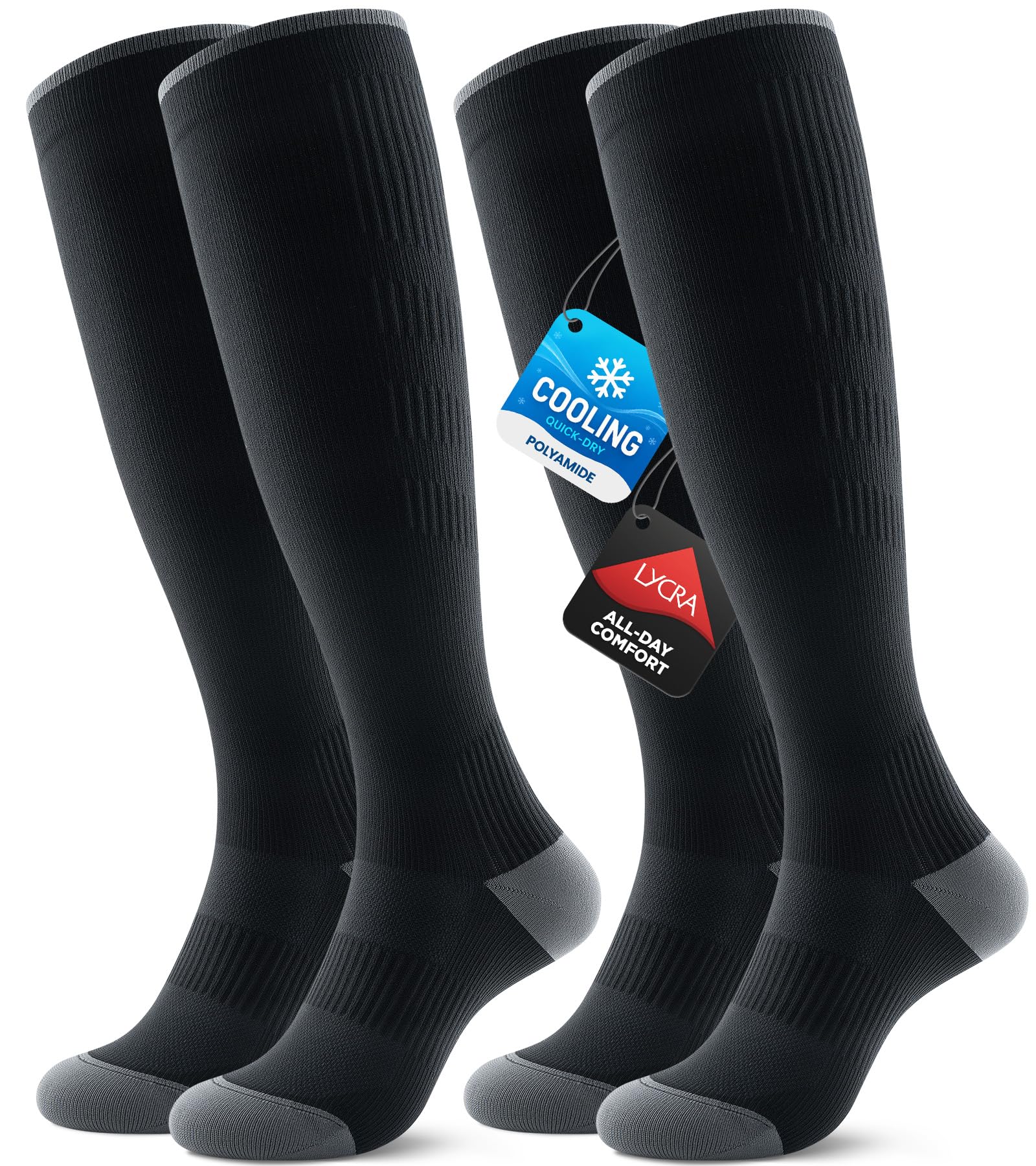
1. Benirap Breathable Compression Socks
Our pick — over 4.5★ from 500+ verified ratings; the strongest balance of quality and price.
The pair you forget you’re wearing, which is exactly the point of all-day support.
Owners describe this 15-20 mmHg sock as barely noticeable, delivering support that feels like a regular pair. Buyers report wearing them for full workdays on their feet and noting the solid fabric and firm compression that never crosses into too-tight territory, with the stitching holding up after several days of wear.
Buyers praise the easy slip-on fit, non-tight toes, and breathable knit that keeps legs cool in summer. One owner with venous insufficiency called them a new favorite specifically because they stay lightweight and cool, which is often the first thing to fail on cheaper compression socks.
Compared to the CHARMKING 8-pack below, this is a lighter commitment at 2 pairs — but the fit and fabric quality justify it as a daily driver. The trade-off for that all-day comfort is that it’s a 15-20 mmHg sock, so if you want the firmer squeeze of a 20-30 mmHg pair for long flights, you’d want to look at the PULIOU instead.
What owners rave about
- Comfort is the top praise — buyers single it out most often
- Firm enough to manage fluid retention without squeezing toes
- Breathable fabric stays cool in summer heat
- Solid stitching that survives repeated wear
Who should look elsewhere
- Only 2 pairs per pack — not a weekly rotation
- 15-20 mmHg is gentle; not for those wanting max firmness
Grab these if: you want a comfortable, breathable pair for everyday shifts that you’ll actually want to wear all day.
Think twice if: you need the stronger squeeze of a 20-30 mmHg sock for travel or medical needs.
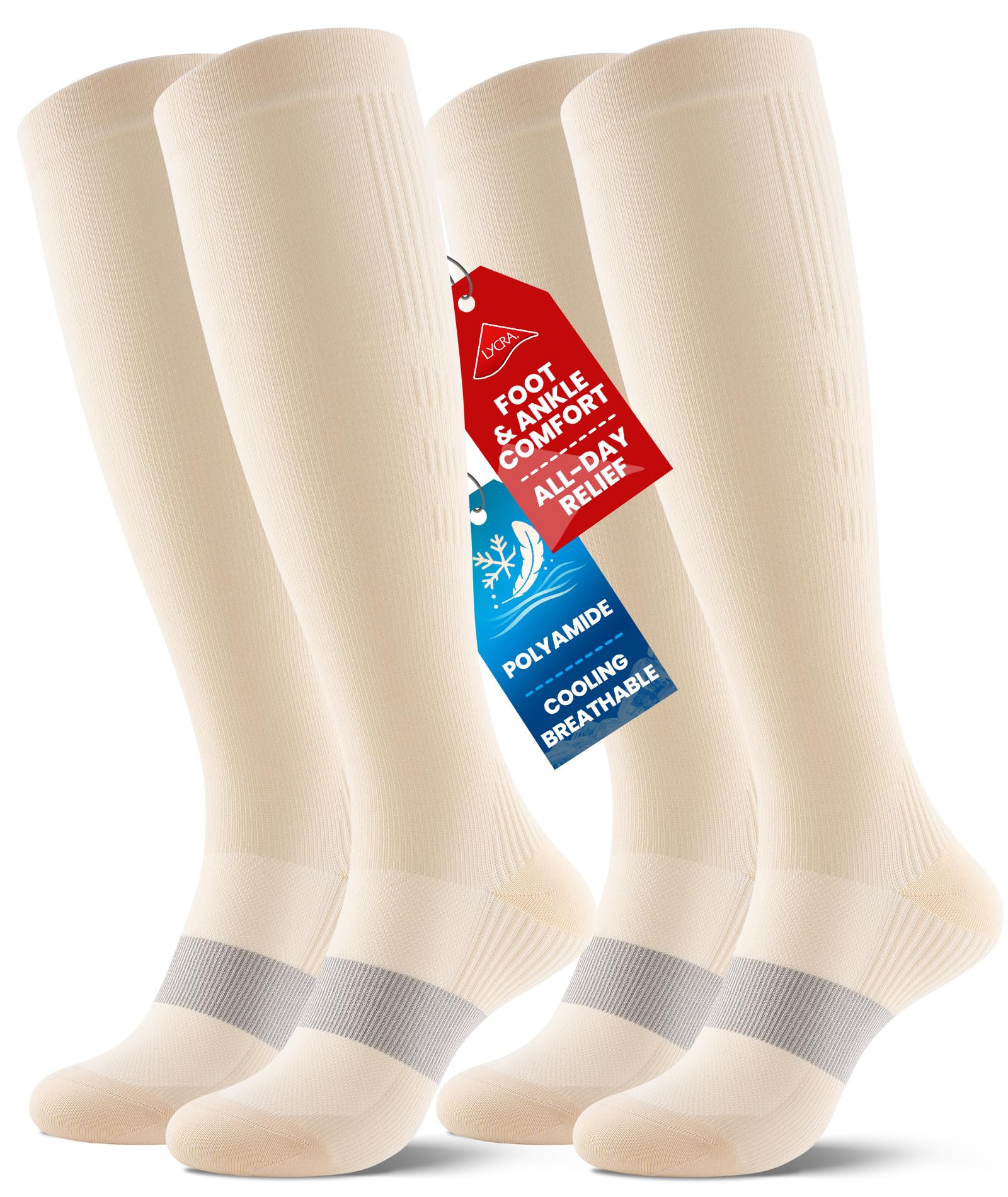
2. PULIOU Cooling Compression Socks
A firmer 20-30 mmHg squeeze for long days that still goes on without a fight.
This pair steps up the pressure to 20-30 mmHg, which is a solid 33% firmer than the 15-20 mmHg Benirap above — the kind of support that keeps legs feeling less tired after long hours of standing, traveling, or exercising. What’s notable is that owners consistently describe the compression as firm yet comfortable, with the cooling fabric keeping feet dry and the socks staying in place without digging into the calf.
The smooth toe area prevents irritation and blisters in tighter shoes, and the fit slides easily under pants. The smooth toe, a common failure point on cheap socks, signals the quality that appears throughout the reviews.
There is one honest caveat: a few owners mention the compression feels closer to a 15-20 mmHg sock than the labeled 20-30 mmHg, with the knee cuff feeling tighter than the rest. If your need is specifically for a true medical-grade 20-30 mmHg fit, that’s worth knowing before you buy.
Why it stands out
- Smooth smooth toe prevents blisters and irritation
- Cooling, breathable fabric keeps feet dry
- Stays up all day without slipping or digging in
- Easier on/off than pricier 20-30 mmHg brands
The honest catch
- Some say the real compression feels closer to 15-20 mmHg
- Knee cuff can feel tighter than the calf portion
Reach for this if: you want firm, cooling support for long shifts, flights, or exercise without the struggle of medical-grade socks.
Look elsewhere if: you need a precisely calibrated 20-30 mmHg for a medical recommendation.
3. CHARMKING Compression Socks (8 Pairs)
Eight pairs of gentle, stay-put support that look like normal socks.
The headline here is the 8-pair count, which makes this the rotation king — at a 4.0x pair advantage over the Benirap 2-pack, you’re set for a full work week plus backups. Customers note the fit is the thing that wins people over, with no bunching or slipping and the socks staying in place all day without rolling down, which is the most common complaint across compression socks in this price range.
The 15-20 mmHg pressure reads as “right amount” to most owners — supportive without strangling, as one chronic-illness buyer put it, worn 10-18 hours daily on hardwood and carpet while holding up great. The copper-infused fabric stays soft and breathable, and the range of colors means they pass as regular socks under work clothes.
There’s a specific fit note to flag: buyers on the shorter side (around 5′) found them a touch long, and patterned versions can leave faint indentations and shrink slightly in the wash — solid colors are the safer bet. It’s a minor trade-off for a pack this size at this level of support.
The big wins
- 8 pairs — a full week’s rotation in one buy
- Fit is the most-praised aspect, no slipping or bunching
- Stays put all day without rolling down
- Look like normal socks with lots of color options
Fit notes to know
- Patterned pairs may leave indentations and shrink slightly
- Runs long for shorter legs around 5′
Best for: anyone who wants a low-fuss, high-volume rotation for daily desk or retail work without thinking about laundry.
skip it if: you have shorter legs or prefer solid colors only, since patterns have fit quirks.
4. FEYHAY Copper Compression Socks (8 Pairs)

Eight pairs of snug, fun-patterned support that feel like a leg massage.
What defines this pick is the fit — reviewers point out the snug, supportive feel that stays up all day, with one owner describing it as feeling like their legs are being massaged. At 8 pairs with a 15-20 mmHg compression level, it matches the CHARMKING count while offering a distinctly different personality: playful designs and color combinations that make compression feel less like medical gear.
The support holds up for daily life — reducing leg fatigue and swelling during long periods of sitting or standing, and one frequent flier calls them a must-have for airplane travel when you’re stuck seated for hours. Multiple owners note they wash well and retain their shape and compression without snagging, even in a lingerie bag.
The one recurring gripe is specific to the patterned pairs: the embroidery threads on the inside can leave rubber-band-like indentations on your skin that itch. Solid colors avoid this entirely, so if you’re drawn to the fun designs, that’s the trade-off to weigh — and a few shoppers say holes after only a few wears.
What stands out
- 8 pairs with fun, varied color combinations
- Fit is the most-praised aspect — snug and stays up
- Feels like a gentle leg massage to some owners
- Washes well and retains compression
Watch for
- Patterned designs can leave itchy indentations on skin
- Mixed durability reports, occasional holes after few wears
Choose this if: you want a big pack of colorful, snug support and will stick to the solid colors.
Pass if: you’re set on the patterned designs, since those have the itchy-indentation issue.
5. LEVSOX Cotton Compression Socks

A 70% cotton build brings softness to a firm 20-30 mmHg squeeze.
The standout spec here is the fabric: 70% cotton, which is rare in compression socks that typically lean on synthetic blends. Buyers report the cotton makes a real difference — no itching, no pinching at the toes, and a softness that’s hard to find at this 20-30 mmHg firmness level. The compression is the most-praised aspect, with the extra cushioning in the foot and heel adding comfort for long wear.
This is the pair for long-haul flights and all-day shifts, with buyers reporting legs that aren’t swollen after 9-hour flights and nurses finding the support holds up through full workdays. The smooth toe and non-binding top band are highlights, with one owner noting the top does NOT cut off circulation even with larger legs — a common failure point on firmer socks.
The fit does run specific: the medium/large runs closer to a medium, so buyers with wider calves or size 11 feet may want to size up, and it runs long enough that some found it pulling past the knee. It also comes as a single pair, which is a premium price for one — but for cotton comfort at this compression, owners say it’s worth it.
Why it earns its spot
- 70% cotton feels soft and non-itchy
- Firm 20-30 mmHg support for flights and long shifts
- smooth toe with no pinching
- Extra cushioning in foot and heel
Fit considerations
- Runs long — may pull past the knee for some
- Single pair only at a premium price point
- M/L runs closer to a true medium
Pick this if: cotton softness and firm compression for travel or nursing are your top priorities, and you’re fine with one pair.
Think again if: you’re between sizes or want a multi-pack for daily rotation.
6. JOBST Relief 15-20 mmHg Knee High

The medical-grade name that feels almost like regular hosiery.
JOBST is a name that carries weight in the compression world, and this Relief model delivers the brand’s graduated 15-20 mmHg support in a package that owners repeatedly describe as comfortable and normal-looking — not like medical equipment. Owners mention wearing them for three weeks straight post-surgery and then continuing because the support felt that good, with one calling them a constant companion on every flight.
The quality is consistent — true to size, durable through repeated wears, and effective at reducing swelling while providing support that doesn’t feel too heavy or warm, even during pregnancy. The closed toe and regular band make it a straightforward everyday option, and the unisex sizing means it works for men and women alike.
The main fit note is that some owners found the stretch loosens after 1-2 wears, with excess material appearing despite following the sizing chart — the advice from those buyers is to size down if you’re between sizes. It’s also sold as a single pair, which at this price tier makes it a deliberate purchase rather than a casual grab.
The strengths
- Trusted brand with consistent quality
- Comfortable enough for post-op and daily wear
- Effective at reducing swelling and supporting circulation
- True to size with a non-heavy feel
Fit caveats
- Can stretch out after 1-2 wears — size down if between sizes
- Single pair only at a premium price
Reach for this if: you want a reliable brand name for consistent daily support and you know your exact size.
Look elsewhere if: you’re between sizes or want a multi-pack for the price.
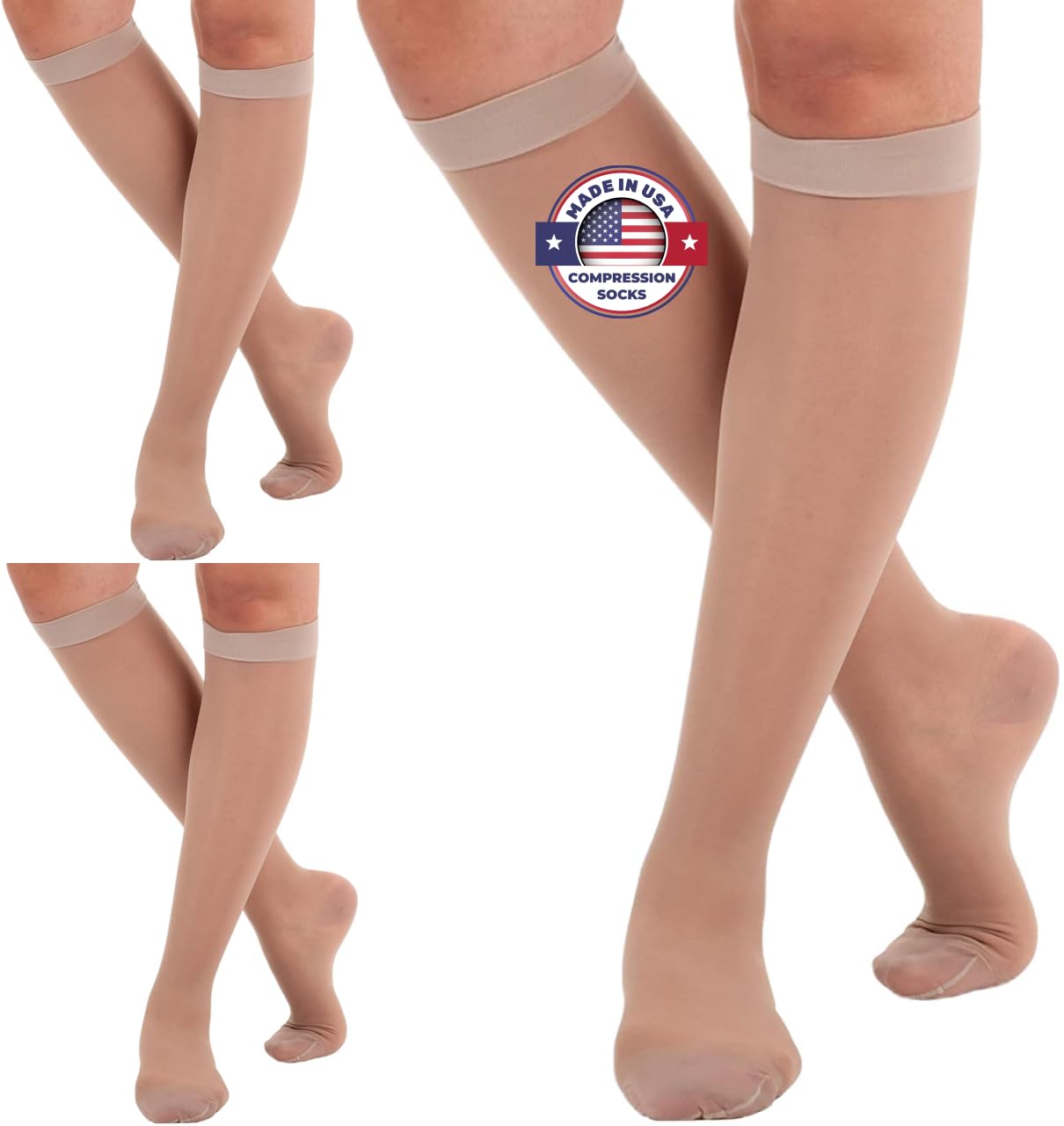
7. ABSOLUTE SUPPORT Sheer Compression Socks
The sheer, skin-tone pair that hides compression under a dress.
This is the pick for anyone who needs compression but refuses to wear athletic socks with a dress. The 120-denier sheer fabric with 15-20 mmHg graduated compression delivers the support while looking like regular hose, and customers note it matches skin tone well enough to pass as normal hosiery in professional or dressy settings.
The construction is Made in the USA from 80% Nylon and 20% Spandex, with a reinforced heel and toe for durability and a design specifically meant to prevent skin marks and slippage. Reviewers point out it stays put without a silicone strip — even through sleep — and works well for controlling ankle and foot swelling, with one noting it eased varicose vein discomfort.
The honest limitation: it runs short for taller women, with a 5’8″ owner noting it doesn’t reach all the way to the knee. If you’re tall, that’s a real fit consideration. The sheer fabric is also thinner by nature, so it prioritizes the dress-friendly look over the cushioned warmth of cotton options.
What’s special
- Sheer look passes for normal hose under dresses
- Reinforced heel and toe for durability
- Stays put without silicone strip
- Made in USA from 80% Nylon, 20% Spandex
Know before buying
- Runs short — doesn’t reach the knee for taller women
- Sheer fabric is thinner, less cushioned
Choose this if: you want compression you can wear with dresses and need a sheer, skin-matching look.
Pass if: you’re 5’8″ or taller, since it runs short of the knee.
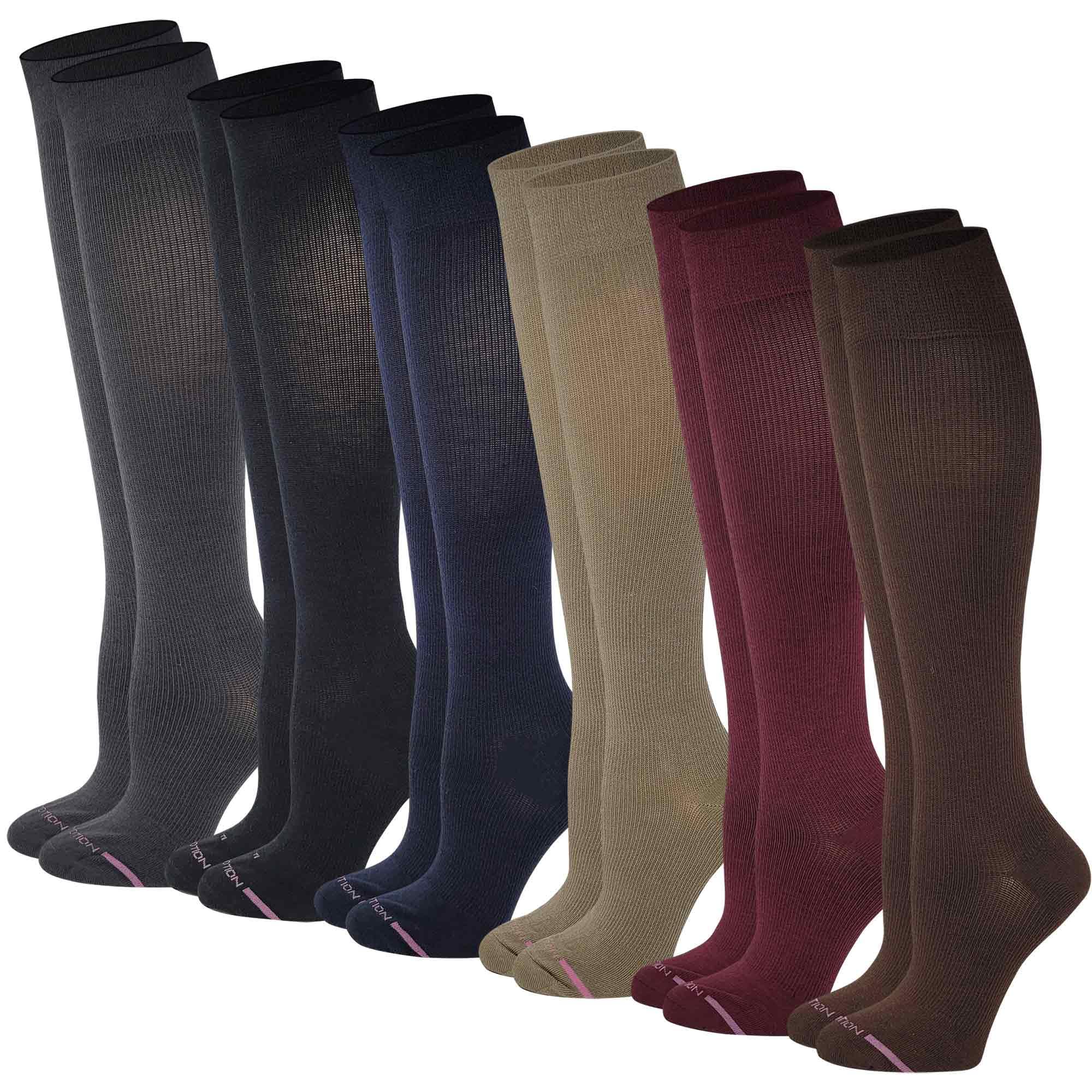
8. Dr. Motion Women 6-Pack Compression Socks
A gentle 8-15 mmHg entry point with cat designs that fit under boots.
Dr. Motion takes a lighter approach with a tested Class I mild compression of 8-15 mmHg, which is the easiest entry point on this list — ideal for all-day wear when you want circulation support without any real squeeze. The three-zone graduated knit from ankle to calf applies pressure where it matters, and shoppers say it keeps legs from getting overtired during a 10-day mountain hike and prevents end-of-shift swelling for medical workers.
The non-binding cuff is the standout feature — it provides just enough pressure to stay in place all day without interfering with circulation, and buyers specifically note it doesn’t bind or cut in at the knee. The fabric blend (36% cotton, 20% acrylic, 6% spandex, 2% nylon) is thin enough to fit into boots while staying warm for winter, and the fun kitty designs are a genuine draw.
Because the compression is light, this isn’t the pair for anyone needing serious 20-30 mmHg medical-style support — a few buyers noted the compression feels lighter than other Dr. Motion socks they’ve owned. And opinions split on ease of putting them on: some find it easy, others struggle initially, though the non-binding fit makes the effort worth it.
The appeal
- Gentle 8-15 mmHg is easy for all-day first-timers
- Non-binding cuff doesn’t cut into the knee
- Thin enough to slide into boots
- 6 pairs with fun cat and pattern designs
Consider
- Light compression — not for those needing firm support
- Mixed feedback on how easy they are to pull on
Pick this if: you’re new to compression or want a light, fashionable pair for boots and all-day comfort.
Skip if: you need the firmer squeeze of a 15-20 mmHg or higher sock.
9. Soxland Women’s Graduated Compression Socks (6 Pairs)
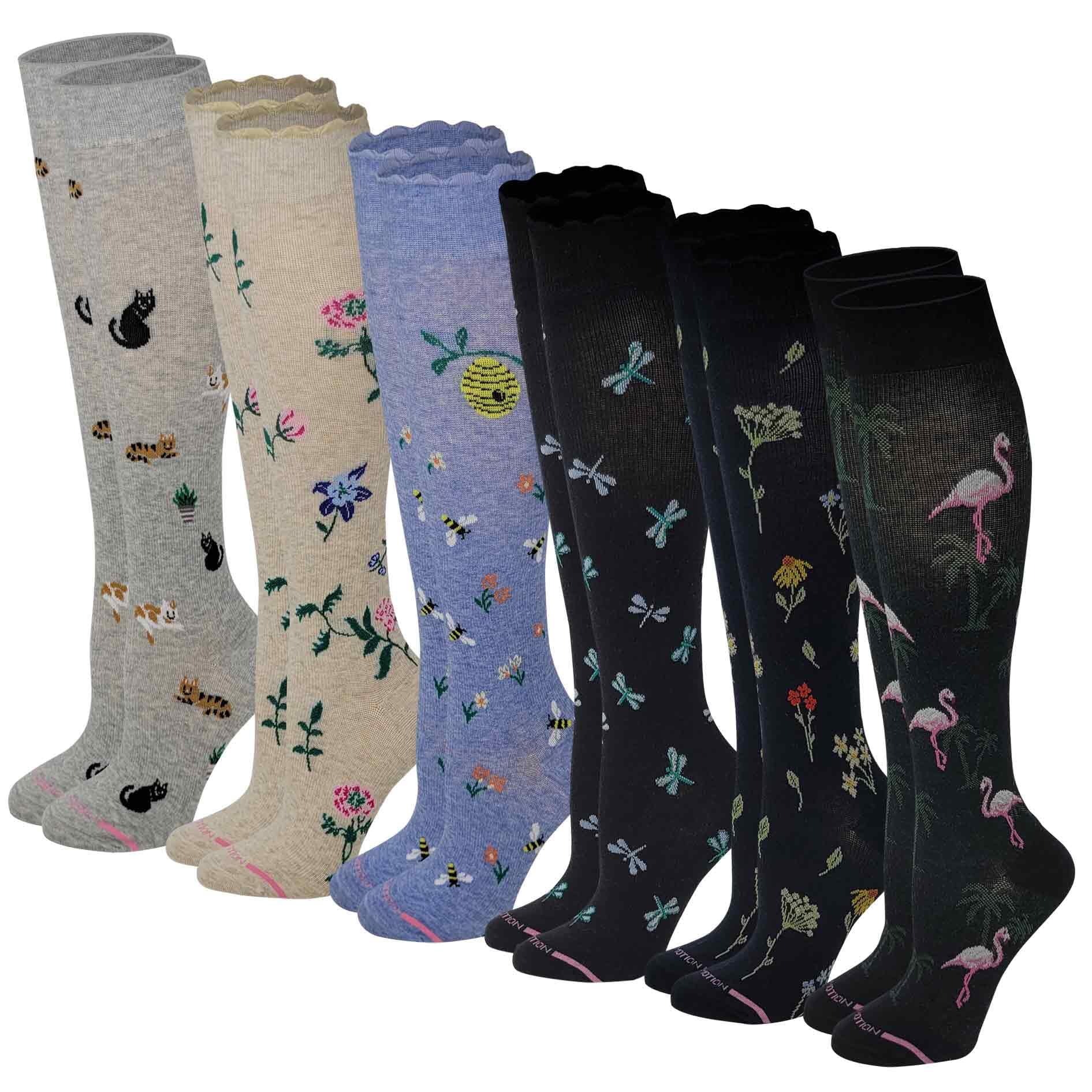
Six pairs of playful prints that carry real support for long shifts.
This pack from Soxland is the design-forward sister to the Dr. Motion above, sharing the same tested Class I mild compression of 8-15 mmHg while leaning harder into cute, themed prints — from Christmas to florals. The compression is the most-praised aspect, with owners reporting it effectively reduces swelling in ankles and calves, and a nurse noting it eliminates leg pain after shifts and keeps legs strong through a long day serving tables.
The three-zone graduated knit and non-binding cuff are the same thoughtful engineering, delivering pressure from ankle to calf without digging into the shin. Buyers with small feet (size 5) report no bunching, while larger feet still fit thanks to the stretch, and the smooth toe seam keeps things comfortable in tighter shoes. The 6-pair count at this price makes it a strong value for the rotation.
Like the Dr. Motion, this is a lighter compression — buyers used to 20-30 mmHg socks will find this noticeably gentler, which is exactly the point for all-day everyday wear. It’s also best to avoid the dryer to keep the elastic and patterns fresh, a note that applies across most compression socks on this list.
Why it works
- Themed prints make compression feel fun, not medical
- Effective at reducing ankle and calf swelling
- Non-binding top doesn’t dig into the shin
- Fits small feet (size 5) without bunching
Keep in mind
- Mild 8-15 mmHg — gentler than firmer medical socks
- Air-dry recommended to preserve elastic and prints
Best for: anyone who wants supportive, cute socks for long shifts or desk days without a heavy squeeze.
Not for: those needing the firmness of a 20-30 mmHg medical-grade compression.
Understanding the Specs
What mmHg Actually Means
The mmHg number measures the pressure the sock applies to your leg in millimeters of mercury. Lower numbers like 8-15 mmHg feel like a gentle hug and suit all-day desk wear or first-timers, while 15-20 mmHg is the everyday balance for most people, and 20-30 mmHg delivers a firm squeeze favored for flights, nursing, and standing shifts. Match the number to your day rather than chasing the highest figure.
Graduated vs. Uniform Compression
Graduated compression means the sock is tightest at the ankle and gradually loosens as it moves up the calf, which helps push blood back toward your heart. Uniform compression applies the same pressure everywhere and does less for circulation. Look for the word “graduated” on the label — it’s the difference between a sock that helps your legs and one that just feels tight.
FAQ
What does the mmHg number on compression socks tell me?
How long can I wear compression socks in a day?
Should I wash compression socks in the washing machine?
Is 15-20 mmHg or 20-30 mmHg better for everyday use?
Why do compression socks feel tight around the knee cuff?
How do I know which size compression sock to buy?
Can I wear compression socks while sleeping?
Why do my compression socks leave marks or indentations on my skin?
Are compression socks supposed to be hard to put on?
What is the difference between compression socks and compression stockings?
Final Thoughts: The Verdict
For most buyers, the everyday compression socks winner is the Benirap because it delivers that rare combination of genuine 15-20 mmHg support and all-day comfort that owners genuinely forget they’re wearing. If you want firmer 20-30 mmHg pressure for long flights or standing shifts, grab the PULIOU Cooling pair. And for a budget-friendly weekly rotation that holds up to 10-18 hour days, the CHARMKING 8-pack is the one to reach for — the crowd favorite with a massive following that swears by its stay-put fit.
How We Picked
We do not accept paid placement. Every pick is matched to a real buyer and a real use-case; we do not hands-on test units.
Sources & Methodology
Specifications: manufacturer listings and product documentation. Review insights: verified customer reviews, as of July 2026. Pricing: not shown on this page (it changes often); check the current price via the retailer link.
As an Amazon Associate, WellFizz earns from qualifying purchases. This does not affect which products we feature.
Related Guides

Mo Maruf
I created WellFizz to bridge the gap between vague wellness advice and actionable solutions. My mission is simple: to decode the research and give you practical tools you can actually use.
Beyond the data, I am a passionate traveler. I believe that stepping away from the screen to explore new environments is essential for mental clarity and physical vitality.