Our readers keep the lights on and my smoothie glass nicely filled. As an Amazon Associate, I earn from qualifying purchases.
Specs are compiled from manufacturer listings and verified buyer reviews and can change over time — please confirm the key details on the product page before buying.
The difference between a good espresso shot and a great one almost always depends on the grind. A blade grinder will tear your beans into uneven shards, while a proper burr grinder crushes them into uniform particles for a clean, balanced extraction. This guide sorts through the best espresso burr grinder options, breaking down what each pick delivers in real-world use so you can confidently choose the one that fits your workflow.
I’m Mohammad Maruf — the founder and writer behind WellFizz. This guide is built by comparing the manufacturers’ published specifications and the patterns across verified customer reviews, so you get each pick’s real strengths and trade-offs instead of marketing spin.
Whether you are pulling your first shot or chasing the perfect recipe, finding the best espresso burr grinder means matching grind consistency, adjustability, and build quality to how you like to brew each day.
Our Picks at a Glance

How To Choose The Best Espresso Burr Grinder
Every espresso grinder on this list uses burrs (two ridged discs that crush beans) instead of spinning blades. But differences in burr geometry, adjustment range, and build quality will dramatically shape your daily routine and the flavor in your cup. Here is what to watch for when comparing models.
Flat Burrs vs. Conical Burrs: Flavor Focus vs. Versatility
Flat burrs, like the 64mm sets found on premium pick AMZCHEF and MOKKOM models, produce very uniform particles that give you a cleaner, brighter espresso with more flavor separation. Conical burrs, as used on the KINGrinder K6 and 1Zpresso J-Ultra, create a wider particle distribution that tends to yield a fuller body and a more traditional, syrupy shot. Neither is “better” — choose flat burrs if you prize clarity in light-roast single origins, and conical burrs if you prefer a richer mouthfeel with darker roasts.
Grind Adjustment: How Fine Can You Really Go?
The number of settings (51, 100, or stepless) defines how precisely you can tweak the grind size to control your shot time. Models with stepless adjustment, such as the SHARDOR and Eureka Mignon Notte, let you dial in infinitely small changes, which is critical for espresso where a single click can shift extraction by several seconds. Stepped grinders with fine increments, like the KINGrinder K6 with its 16 microns per click or the 1Zpresso J-Ultra at 8 microns per click, are also highly capable — the key is whether the step size is small enough to keep your shots from jumping between too fast and too slow.
Retention: The Mess You Do Not See
Retention refers to the coffee grounds that get stuck inside the grinding chamber after you dose. A grinder with high retention wastes coffee and spoils the next batch with stale grounds. Single-dose models like the Viesimple Gen 4 use bellows to blow out nearly every particle (less than 0.2% debris residue is claimed), while the Eureka Mignon Notte with a bellows mod achieves similarly low retention. For home use, look for a grinder that retains less than 0.5g per dose, or plan to purge a few grams before your morning shot.
Quick Comparison
| Model | Best For | Burr Type & Size | Grind Settings | Capacity | Amazon |
|---|---|---|---|---|---|
| KINGrinder K6★ Best Overall | Portable Precision | Conical, 38mm | 16 microns/click (stepped) | 30 g | Amazon |
| Homtone ElectricBest Value Electric | Budget Electric Convenience | Conical, 40mm | 51 settings | 275 g | Amazon |
| TIMEMORE C3 ESPCompact Manual | Entry-Level Manual | Conical, 38mm | ~36 settings (0.0233mm/click) | ~25 g | Amazon |
| TIMEMORE C5 ESP Pro | Finest Manual Adjustment | Conical, 42mm | ~50 settings (0.015mm/click) | 25 g | Amazon |
| Viesimple Gen 4 | Quiet Electric Single Dose | Conical, 48mm | 5-blade (stepped) | 30 g | Amazon |
| AMZCHEF 64mm | Flat Burr Flavor Clarity | Flat, 64mm | 90 settings | 9.88 oz | Amazon |
| SHARDOR 64mm | Stepless Flat Burr Value | Flat, 64mm | 100 settings + stepless dial | 250 g hopper | Amazon |
| MOKKOM 64mm | Premium Build Flat Burr | Flat, 64mm | 100 settings | 12.35 oz | Amazon |
| 1Zpresso J-Ultra | Ultra-Fine Manual Control | Conical, coated | 8 microns/click | 35-40 g | Amazon |
| Eureka Mignon Notte | Italian Electric Workhorse | Flat, 50mm | Stepless (infinite) | 150 g | Amazon |
| Baratza Sette 270 | Fast Programmable Dosing | Conical, 40mm | 270 settings (macro + micro) | 14 oz | Amazon |
In‑Depth Reviews
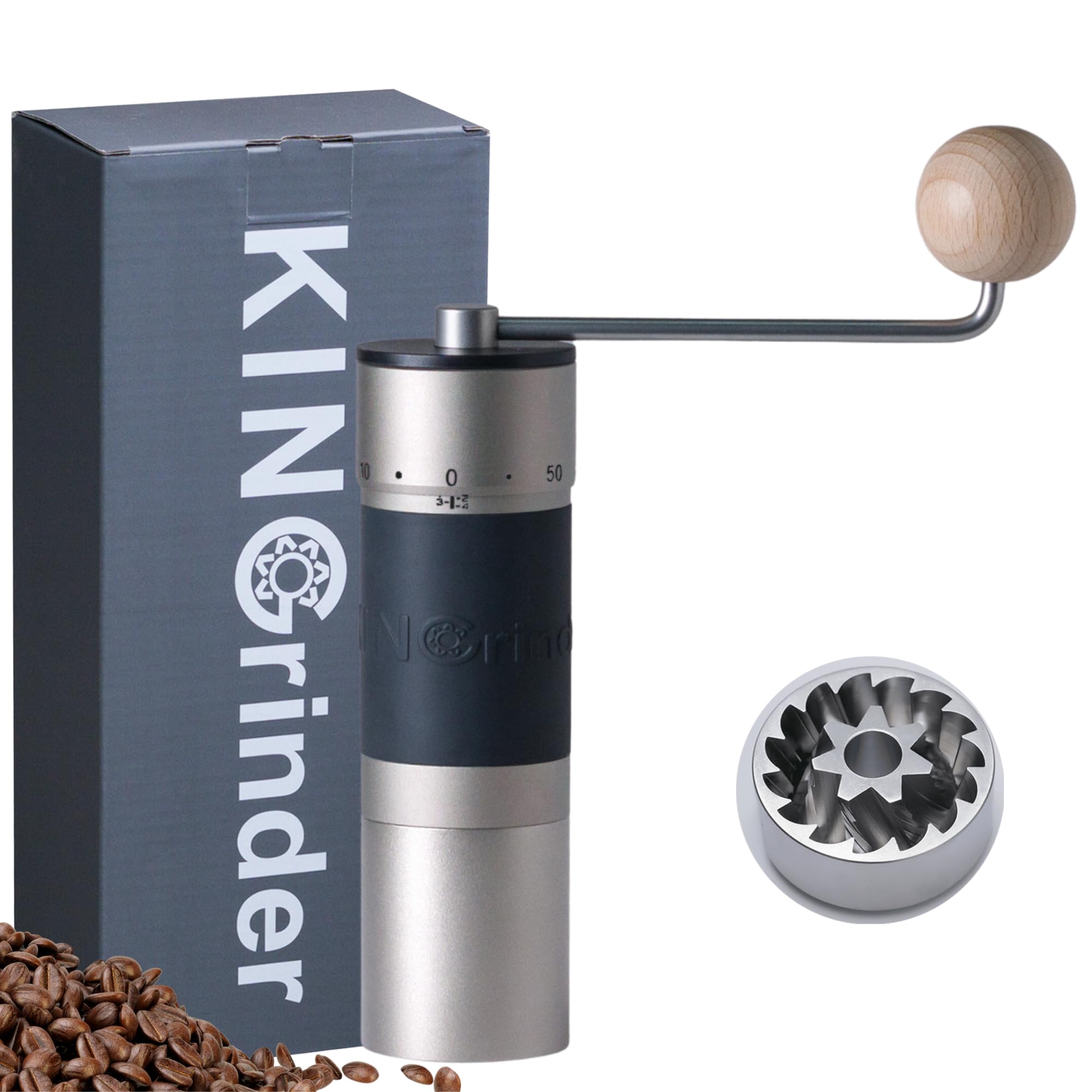
1. KINGrinder K6 Manual Coffee Grinder
Our pick — over 4.5★ from 850+ verified ratings; the strongest balance of quality and price.
The hand grinder that delivers espresso precision without the electric price tag.
The KINGrinder K6 is the crowd favorite for good reason — it punches well above its weight. With 16 microns per click across four full rotations of the adjustment nut, you get 60 clicks per rotation, meaning you can fine-tune your grind for espresso with real precision. The 38mm conical stainless steel burrs produce balanced, mellow shots, and owners note the grind quality is the most praised aspect, with hundreds of buyers singling it out. At 30g capacity, it handles a single dose or a small batch for a few cups, and the full metal build (aluminum body with stainless steel burrs) feels like it will outlast many plastic electric alternatives.
Grind quality and grind consistency are the top two aspects owners praise most, and the wide range (espresso at roughly 30 clicks, moka at 60, pour-over at 90, French press at 130) covers every brewing method you are likely to need. For anyone looking to step into serious espresso without a big electric investment, this is the one to start with.
What wins people over
- 16-micron click adjustment offers real espresso dial-in capability
- Full metal build feels durable and substantial
- Zero retention, with easy disassembly for cleaning
The honest trade-offs
- Straight handle can be tiring during longer grinding sessions, especially with light roasts
- Threaded catch cup can occasionally stick or jam
- 30g capacity means refilling for larger batches
Your best bet if: you want a manual grinder capable of real espresso precision and travel-friendly build for under the mid-range price point.
Think twice if: you need to grind for multiple people daily — the manual effort and small capacity may slow you down.
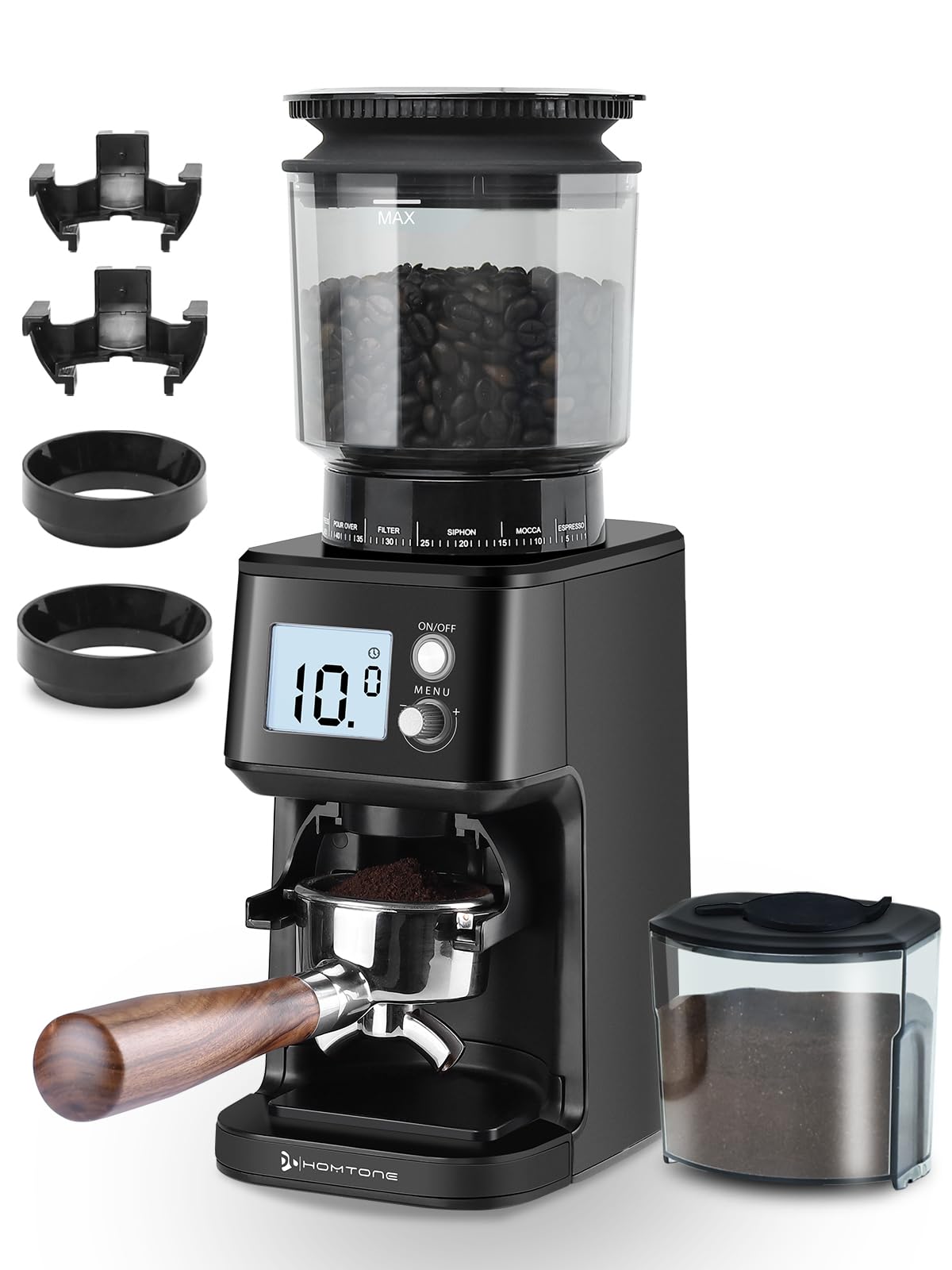
2. Homtone Conical Burr Espresso Coffee Grinder
A quiet electric grinder that auto-doses straight into your portafilter.
The Homtone delivers a feature set usually found on more expensive electric grinders at a budget-friendly price. Its 40mm stainless steel conical burrs have 51 precise settings, covering everything from ultra-fine espresso to coarse French press, and the 275g bean hopper holds over nine times the capacity of the KINGrinder K6 (275g vs 30g), so you can fill it and forget it for a week or more. The hands-free grinding feature starts and stops automatically when you place or remove your portafilter (fits 51mm to 58mm), making the morning workflow smooth and fast.
The smart digital timer lets you program doses from 1 to 12 cups via an intuitive display and knob, and owners note it is noticeably quieter and produces less static than previous grinders they have owned. That said, the portafilter holder feels a bit flimsy, and the minimum grind time is 5 seconds, which makes a true single shot difficult to dial in. The On/Off button doubles as the grind button with no separate power switch, and the standby light is quite bright. Overall, though, this is a solid electric entry point — buyers report hoping for a 2-year lifespan similar to past models.
Who it fits: daily espresso drinkers who want the convenience of an electric grinder with auto-dosing and a large hopper, without paying for premium models.
A real limitation: the 5-second minimum grind time means single-shot fans will need to work around it, so double-shot users will find it a smoother fit.
3. TIMEMORE Chestnut C3 ESP Manual Coffee Grinder
A portable manual grinder built specifically for dialing in espresso.
The TIMEMORE C3 ESP is the “Espresso” version of the popular C3 line, equipped with patented S2C660 stainless steel conical burrs that deliver 38mm of grinding surface with a finer adjustment pitch than the standard model. Each click moves the burrs by 0.0233mm, giving you approximately 36 grind levels that are tune for espresso but also cover moka, pour-over, and French press. The all-metal one-piece body and folding handle make it compact enough to slip into a travel bag (just 2.05 inches wide and 5.79 inches tall), which is notably more portable than the KINGrinder K6 at 2.17 x 2.05 x 6.69 inches.
The double bearing central axis keeps the burrs stable for uniform particles, and owners praise the build quality — it is “very well made” and “grinds quickly,” with the ease of use being the second-most mentioned positive aspect. The screw-on bottom prevents the catch cup from detaching mid-grind, and the folding handle tucks away neatly. The instructions for the adjustment system are not the clearest, but a quick online video solves that.
Perfect for: the traveler or small-kitchen owner who needs espresso-capable grinding in a compact, high-quality manual package.
skip it if: you regularly brew more than two shots at once — the 25g capacity means refilling mid-session.
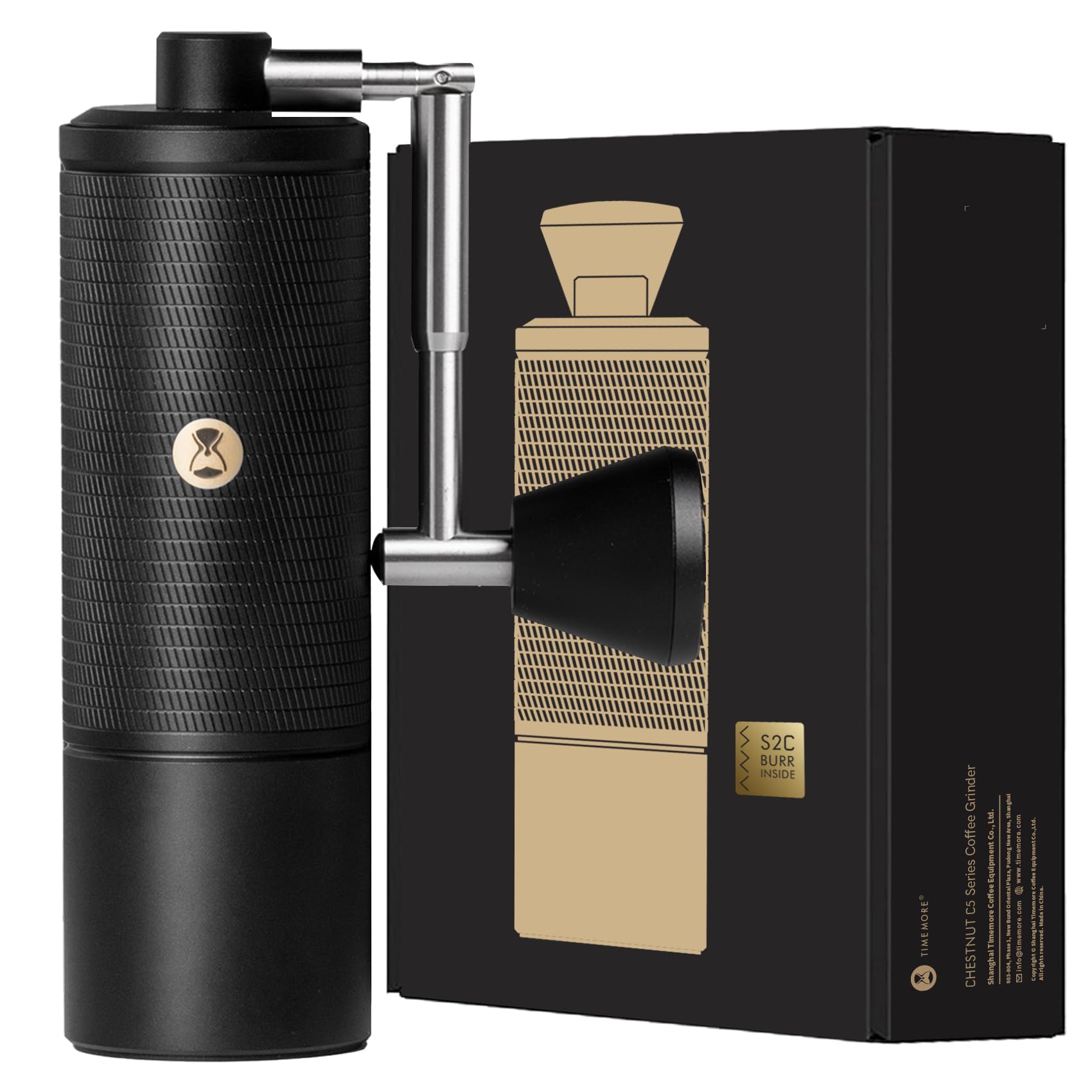
4. TIMEMORE C5 ESP Pro Manual Coffee Grinder
Finer adjustment than any other manual grinder at this price.
The C5 ESP Pro is TIMEMORE’s latest manual flagship for espresso enthusiasts who want the finest possible control. Its patented S2C-042-III stainless steel conical burrs measure 42mm, slightly larger than the C3 ESP’s 38mm, and deliver a remarkable 0.015mm per click across about 50 levels. That is one and a half times finer than the C3 ESP’s 0.0233mm per click, which translates to an even greater ability to fine-tune your shot timing. The all-metal one-piece body (aluminum construction) is 53mm wide and weighs 0.8 kg, giving it a dense, premium feel in the hand.
The built-in bearing lets the handle spin freely for a moment even after you let go, making the grinding motion smoother, and the folding handle makes it travel-friendly. Owners emphasize the consistent grind quality and the precise adjustment dial. The compact size is appreciated, but it becomes a trade-off — the maximum capacity is just 25g to 30g, and some owners note it takes noticeably longer to grind for espresso than the C3 Pro. If you are brewing for one or two and prize precision above speed, this manual grinder is a top contender.
The precision advantage
- 0.015mm per click is among the finest manual adjustments available
- 42mm burrs and double bearing deliver uniform, high-quality grinds
- Folding handle and compact body suit travel and small kitchens
Where it slows you down
- Maximum capacity is only 25-30g, requiring refills for larger doses
- Grinding speed is slower than the C3 Pro and some electric alternatives
- No storage bag or case is included
Best for: the manual purist who wants the utmost control over espresso grind size and values precision over speed.
Not ideal for: busy mornings when you need to grind multiple shots quickly — the slower speed and small capacity will add time.
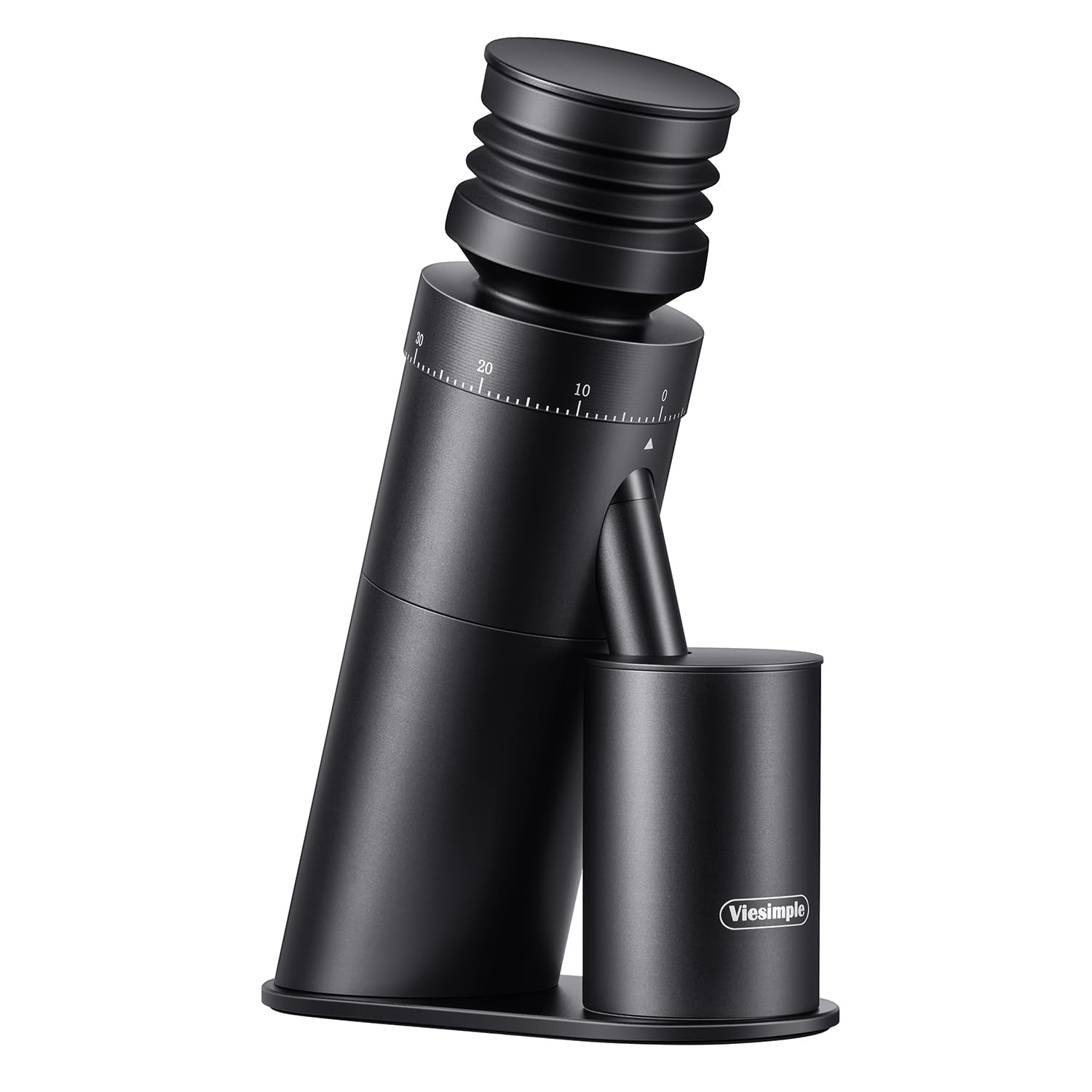
5. Viesimple Gen 4 Electric Burr Coffee Grinder
An ultra-quiet electric grinder that keeps your counter clean.
The Viesimple Gen 4 is designed for two things espresso drinkers care about: a quiet morning routine and a tidy workspace. Its low-RPM DC motor runs at under 50 decibels, which owners consistently praise — noise level is the second most-mentioned positive aspect, with 57 buyers calling it out. The 48mm conical burrs handle everything from espresso to French press, and the patented anti-clogging channel promises 100% powder discharge. The anti-static coating claims less than 0.2% debris residue, and the magnetic dosing cup with a sealed lid keeps grounds from flying around.
This is a single-dose grinder with a 30g capacity, so you grind only what you need each time, and the included bellows blow out any retained grounds. Owners mention it grinds fine enough to choke a machine at the finer settings (around 10 out of 17), and it pairs well with machines like the Breville Bambino. The build uses high-quality aluminum with a compact footprint (6″ x 3″ x 9″) and weighs 3.4 pounds. The main downsides are that the grind setting markers are not perfectly aligned, and there is a separate external power supply. It comes with a 2-year warranty and a 100-240V voltage range for international use.
Reach for this if: you want an electric single-doser that will not wake the house and leaves no static mess on the counter.
Look elsewhere if: you prefer a large hopper for batch grinding — the 30g capacity is strictly for single doses.
6. AMZCHEF 64mm Flat Burr Coffee Grinder
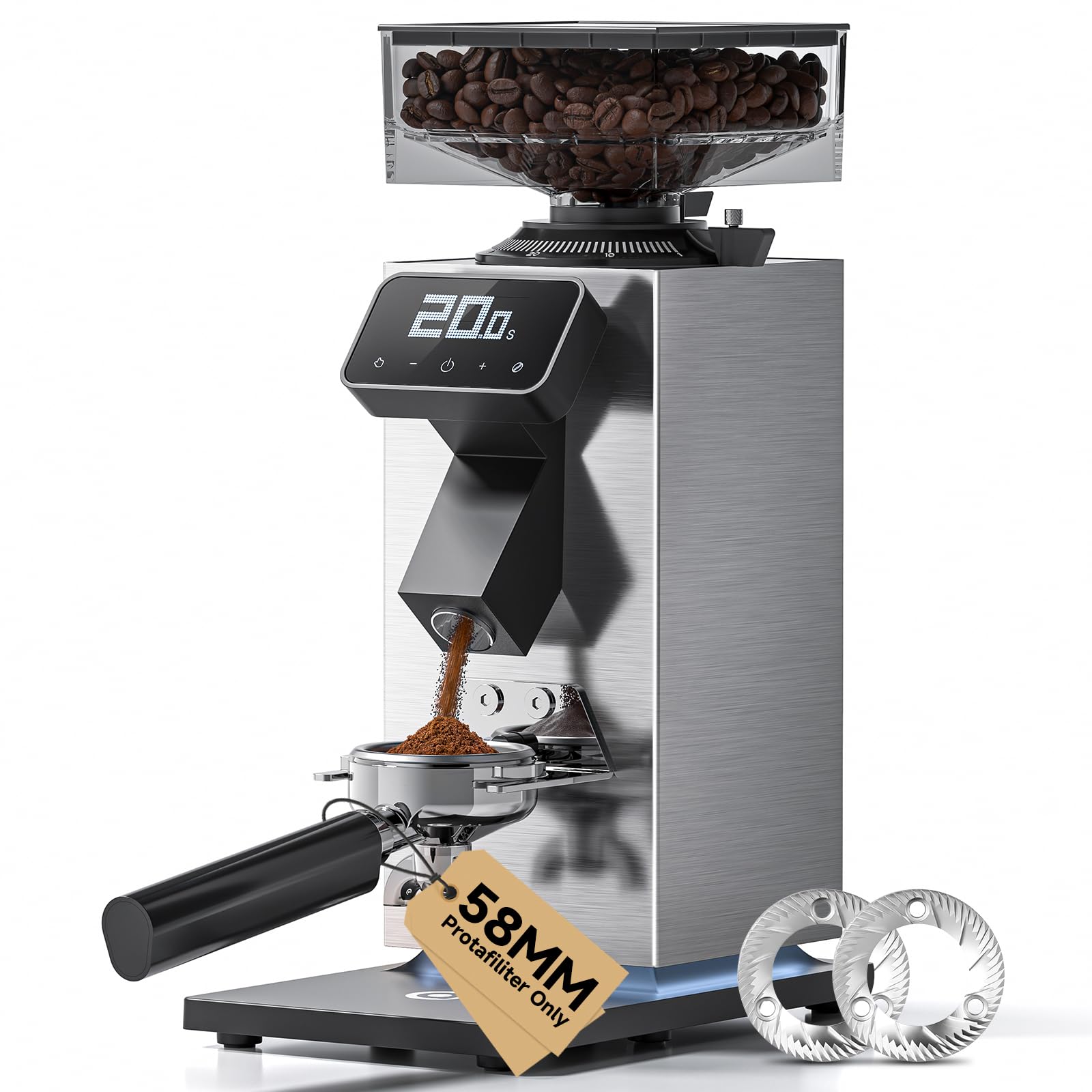
Commercial-grade flat burrs in a machine that grows with you.
The AMZCHEF FC6202 brings 64mm flat burrs to the home market at a very competitive price. Flat burrs produce tighter, more uniform particles than conical burrs, giving you cleaner flavor separation and sweeter extractions — especially noticeable with light-roast single origins. With 90 precision settings grouped by brew method (espresso at 4–15, moka and pour-over at 16–55, French press and cold brew at 56–90), you can micro-step your way to the perfect shot. The all-metal chamber and 12.6-pound stainless steel body dampen vibration and dissipate heat naturally, and the triple anti-static system (built-in negative ion generator, angled exit chute, magnetic catch cup) keeps your station clean.
The LED touch panel lets you set grind time in 0.1-second increments for gram-level dosing, and the 200W DC motor handles non-pressurized baskets with ease. A key long-term advantage: the 64mm burr mount is SSP-compatible, so you can upgrade to premium burrs later without replacing the whole machine. The dosing cup and holder are designed for 58mm portafilters (sold separately). Owners describe it as “exceptional quality” and say it grinds “from Turkish to French press” with no problem. The touch screen can occasionally feel a bit finicky, and the portafilter holder does not actually fit a standard 58mm portafilter — you will grind into the steel cup instead.
What makes it special
- 64mm flat burrs deliver exceptional particle uniformity and flavor clarity
- SSP-compatible burr mount means you can upgrade later
- Triple anti-static system and all-metal build reduce mess and noise
The honest catch
- Portafilter holder does not fit a standard 58mm portafilter; you use the steel cup
- Touch controls can be overly sensitive or unresponsive at times
- At 12.6 pounds, this is a heavy countertop fixture
Ideal for: the enthusiast who wants flat-burr clarity on a budget and plans to upgrade burrs over time.
A note on fit: if you need to grind directly into a portafilter, the cup-based workflow means an extra step each time.
7. SHARDOR 64mm Flat Burr Coffee Grinder
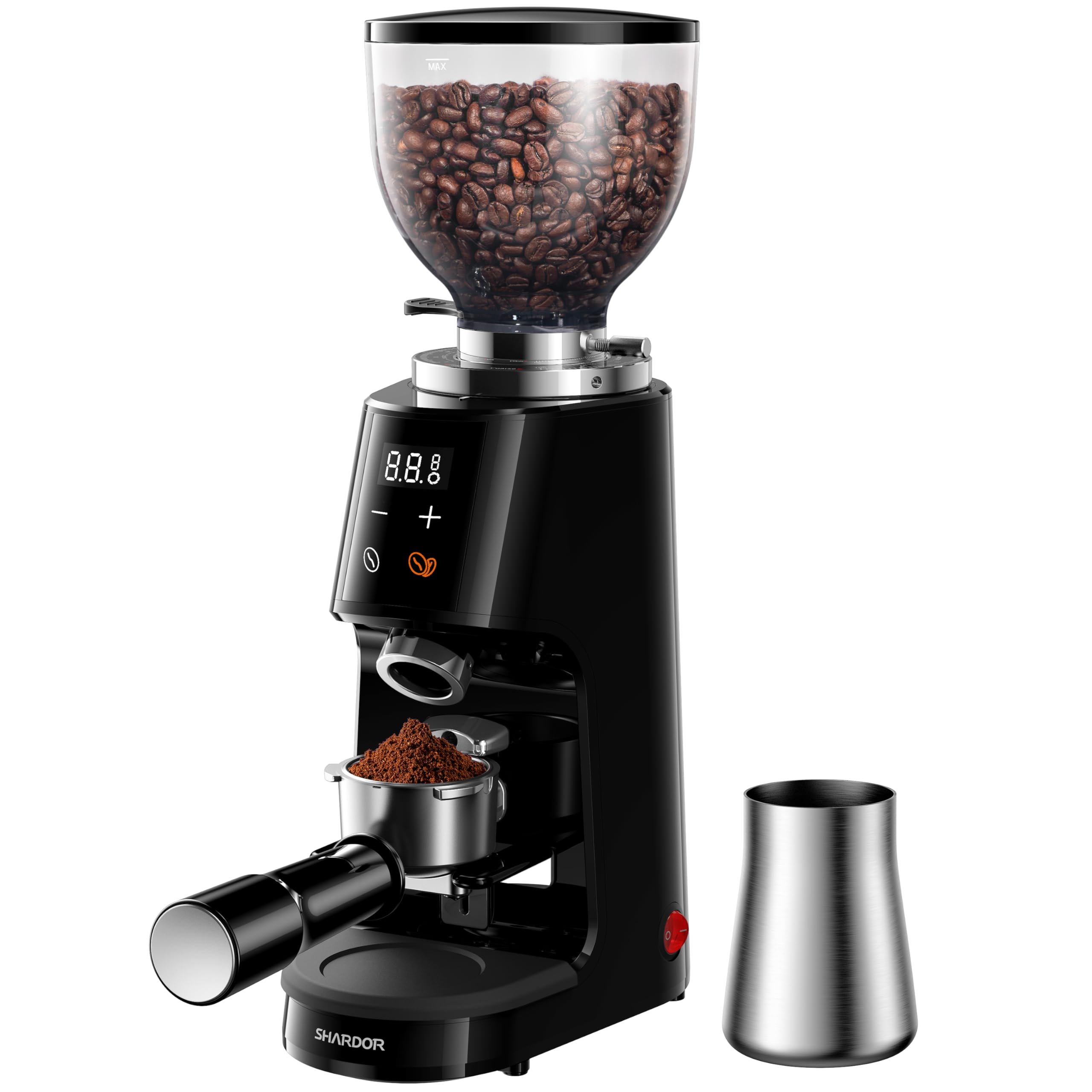
Stepless flat-burr control at a price that undercuts most competitors.
The SHARDOR CG301 pairs 64mm stainless steel flat burrs with a stepless adjustment dial, giving you near-infinite grind settings rather than being locked into predefined clicks. This is a major advantage for espresso where the difference between perfect and too-fine is tiny — you can dial in by feel rather than jumping from one step to the next. The 100 grind settings cover everything from fine Turkish and espresso to coarse French press and cold brew, and the all-metal grinding chamber (with a plastic outer body) keeps the cost down while maintaining burr stability. The LED display lets you program grind times for single, double, and continuous doses with 0.1-second accuracy.
Owners consistently note that this grinder punches above its price, with one calling it “hits beyond its price point.” It grinds significantly faster and quieter than many alternatives, and the 64mm burrs are compatible with Mazzer Super Jolly burrs for future upgrades. The plastic case is the main functional downside — it feels less premium than the all-metal AMZCHEF or MOKKOM, and the included rubber mat is considered poor quality by many. The dosing cup is also a bit too tall to fit comfortably under a scale. It comes with a 2-year warranty and a 260W motor, but note it is 120V only — using 220V will damage the machine.
Best for: the espresso enthusiast who wants the infinite control of a stepless flat-burr grinder without paying a premium for an all-metal body.
A practical caveat: the plastic body and tall dosing cup may not match the feel of pricier all-metal competitors, but the grinding performance holds its own.
8. MOKKOM Professional 64mm Flat Burr Coffee Grinder
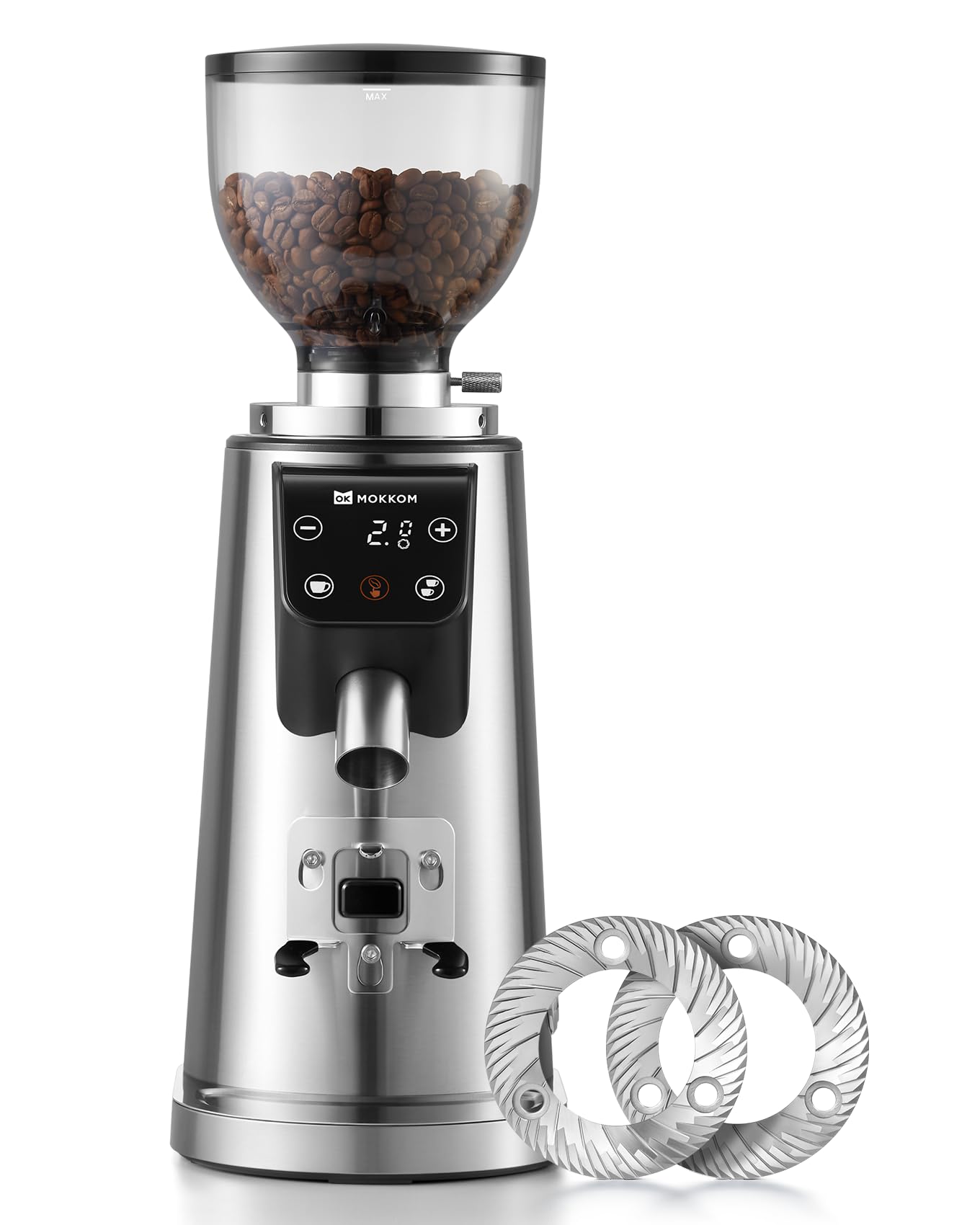
An all-metal body with a built-in plasma generator for static-free grinding.
The MOKKOM BD-CG308 is built like a tank — its full stainless steel body is paired with an aluminum alloy grinding chamber base and a 7mm brass grind adjustment ring, giving it a weight and rigidity that rivals commercial machines. The 64mm flat burrs produce uniform particles for clean, sweet extraction, and the 100 grind settings (stepless via the brass ring) let you dial in espresso with real precision. A plasma generator inside the exit chute neutralizes static electricity, so coffee grounds do not fly everywhere when you remove the catch cup — owners confirm it keeps the workspace tidy.
Grind speed is impressive: 20g of espresso in 7 to 8 seconds, according to owners, and the noise level is lower than expected for a flat-burr grinder. Retention is minimal at about 0.1g when using the included silicone bellows single-dose hopper. The package also includes a 350g (12.35 oz) large hopper for bulk grinding. Owners say it “outperforms grinders 2 to 3 times its price” and performs noticeably better than built-in Breville grinders. The portafilter holder design has a minor flaw — it can be a bit fiddly — and the grind dial cannot be zeroed (it is fixed in position). But for the price, this is one of the best-value flat-burr grinders available.
Strengths that stand out
- Full stainless steel and aluminum build feels genuinely commercial-grade
- Plasma generator nearly eliminates static mess
- Fast grinding speed with fluffy, consistent grounds and low retention
Small design frustrations
- Portafilter bracket is removable and not the most secure design
- Grind dial is fixed in position (cannot be zeroed)
- No variable speed control if you want to experiment with RPM
Perfect if: you want a premium all-metal flat-burr grinder with fast throughput and minimal static — a clear upgrade from entry-level electrics.
Not for: those who need infinite grind adjustment flexibility (the stepless dial is fixed) or a perfect portafilter holder fit.
9. 1Zpresso J-Ultra Manual Coffee Grinder

Eight-micron clicks for the most precise manual espresso dial-in available.
The 1Zpresso J-Ultra is the manual grinder that serious espresso enthusiasts graduate to. Each click of the external adjustment dial shifts the coated conical burrs by only 8 microns — that is half the step size of the KINGrinder K6’s 16 microns, giving you twice the precision for dialing in a shot. The coated burrs are specially designed to enhance sweetness and produce fines that create a syrupy body, ideal for traditional espresso profiles. The grind range extends from ultra-fine Turkish coffee (finer than most grinders can go) all the way to coarse French press, so it covers every brew method you own.
The magnetic catch cup holds 35 to 40g of grounds and snaps into place securely, speeding up your workflow. The foldable handle tucks away to prevent tipping, and a premium travel case is included, making this the most portable serious espresso grinder on the list. Build quality is the aspect owners praise most by a wide margin (109 counts), and the silent bearings and smooth action get frequent mentions. One practical note: the handle can be difficult to turn with very light roasts, and some owners find the grinding process takes 5 to 10 minutes per cup if you lack upper-body strength. The magnets on the catch cup can also fail if knocked hard.
Who it suits: the espresso perfectionist who wants unrivaled manual adjustment precision and a travel-ready build.
Consider alternatives if: you need speed in the morning — manual grinding at 8 microns per click is slow, especially with light roasts, and the handle effort is real.
10. Eureka Mignon Notte Espresso Grinder

Italian-made stepless precision that has been a home espresso staple for years.
The Eureka Mignon Notte is a dedicated espresso grinder from a trusted Italian manufacturer, built around 50mm hardened steel flat burrs and a stepless adjustment system that lets you dial in with near-infinite precision. Unlike many competitors that are designed for multiple brew methods, the Notte is tune for fine espresso grinding — the hopper holds 150g of beans, and you dose manually by pressing your portafilter into the grind switch. The bottom-burr adjust design (unique to Eureka) means you can disassemble the burrs for cleaning without losing your grind setting, a thoughtful touch for daily use.
The all-metal case and 15.2-pound weight give it a solid, vibration-free presence on the counter, and the ACE anti-clump system reduces static buildup for cleaner dosing. Owners describe it as a “fantastic entry-level electric espresso grinder” and note that low retention is achievable with a simple bellows mod. The main trade-offs are noise — it is louder than many alternatives — and the hopper and portafilter holder feel less durable than the rest of the build.
What makes it a classic
- Stepless adjustment enables truly precise espresso dial-in
- 50mm flat burrs deliver consistent, clump-free grounds
- Bottom-burr adjust means cleaning does not reset your grind setting
Where it shows age
- Noisier than most modern electric grinders
- Hopper and portafilter holder feel a bit plasticky and cheap
- Manual button activation means you hold the portafilter in — no auto-dosing
Best for: the dedicated espresso drinker who values proven Italian engineering, stepless control, and a compact footprint.
Not ideal if: you want a quiet, modern electric with programmable dosing and a more refined plastic-free build.
11. Baratza Sette 270 Conical Burr Coffee Grinder

SCAA-awarded speed demon with 270 settings and programmable dosing.
The Baratza Sette 270 is an award-winning grinder (recognized by the Specialty Coffee Association) that prioritizes speed and dosing precision for the home espresso workflow. Its unique straight-through grind mechanism and 40mm conical burrs push grounds out at up to 5 grams per second — meaning an 18g double shot is ready in about 6 seconds. The 270 grind settings combine a macro adjust ring for broad range and a micro adjust ring for fine espresso tuning, and the three programmable dosing buttons save your preferred single, double, and continuous doses with 0.1-second accuracy.
The built-in convertible holder switches between a 58mm portafilter and the included grounds bin, and the bean hopper holds 14 ounces. Grind quality and consistency are the two most-praised aspects (118 and 77 counts respectively), and owners say it delivers “consistent, fluffy results” that are easy to dial in. However, the noise level is a real downside — the Sette 270 is loud, with 80 owners calling out the noise as a negative. Reliability is also mixed: while many customers note years of trouble-free use, a significant number mention units that stop working or break within months. The plastic build feels less premium than metal alternatives, but Baratza’s customer support (including easy-to-replace parts) is widely praised, with one owner noting a free motor replacement after a failure.
Perfect for: the home espresso enthusiast who values speed and programmable dosing above all else, and does not mind some noise and a plastic body.
Think twice if: you want a quieter machine that will blend into your kitchen aesthetic — the Sette is loud and utilitarian, and reliability concerns are worth noting.
Understanding the Specs
Burr Type: Flat vs. Conical
A burr grinder uses two abrasive surfaces to crush coffee beans into uniform particles, and the shape of those surfaces affects your espresso flavor. Flat burrs (two parallel discs) produce a very even particle size distribution that gives you a cleaner, brighter cup with more flavor separation — ideal for light-roast single origins where you want to taste distinct notes. Conical burrs (a cone-shaped inner burr inside a ring) produce a wider range of particle sizes that tend to create a fuller body, a syrupy mouthfeel, and more traditional espresso characteristics. Neither is universally better, but flat burrs generally cost more and are preferred by specialty coffee enthusiasts chasing clarity.
Grind Adjustment: Stepped vs. Stepless
This defines how precisely you can change the distance between the burrs. Stepped adjustment uses clicks or numbered settings (like 51, 90, or 270) — each click moves the burrs a fixed distance, such as 16 or 8 microns. Stepped grinders are easier to reproduce settings (you can always return to “click 12” for espresso), but the step size must be small enough that one click does not swing your shot from too fast to too slow. Stepless adjustment uses a smooth dial with no detents, allowing you to make infinitely small changes by feel. This is preferred by serious espresso hobbyists who want to fine-tune extraction pressure without being limited by a defined step. The trade-off is that reproducing yesterday’s exact setting is harder without marking the dial.
FAQ
Can I use a blade grinder for espresso?
How many grind settings do I really need for espresso?
Are flat burrs better than conical burrs for espresso?
What does “retention” mean and why does it matter?
Can a manual grinder deliver espresso-quality grinds?
How often should I clean my espresso burr grinder?
Does the warranty support matter for a coffee grinder?
Can I use a grinder designed for espresso for pour-over or French press?
How important is anti-static technology in an espresso grinder?
Why do some grinders have a “stepless” adjustment and what does that mean for espresso?
Final Thoughts: The Verdict
If you want one dependable pick, the best espresso burr grinder winner is the KINGrinder K6 because it delivers genuine espresso-capable precision and durable all-metal construction at a price that undercuts electric alternatives by a wide margin — the grind quality is the most-praised feature with nearly 200 owners calling it out, and the 16-micron adjustment is fine enough to dial in most espresso recipes on the first try. If you want a quiet electric single-doser with a clean, static-free workflow, grab the Viesimple Gen 4. And for the dedicated enthusiast chasing flat-burr clarity and a future upgrade path, the AMZCHEF 64mm offers SSP-compatible burrs in an all-metal chamber that could serve you for years as your skills grow.
How We Picked
We do not accept paid placement. Every pick is matched to a real buyer and a real use-case; we do not hands-on test units.
Sources & Methodology
Specifications: manufacturer listings and product documentation. Review insights: verified customer reviews, as of July 2026. Pricing: not shown on this page (it changes often); check the current price via the retailer link.
As an Amazon Associate, WellFizz earns from qualifying purchases. This does not affect which products we feature.
Related Guides

Mo Maruf
I created WellFizz to bridge the gap between vague wellness advice and actionable solutions. My mission is simple: to decode the research and give you practical tools you can actually use.
Beyond the data, I am a passionate traveler. I believe that stepping away from the screen to explore new environments is essential for mental clarity and physical vitality.