Our readers keep the lights on and my smoothie glass nicely filled. As an Amazon Associate, I earn from qualifying purchases.
Specs are compiled from manufacturer listings and verified buyer reviews and can change over time — please confirm the key details on the product page before buying.
Every content creator hits the same wall: your idea is good, but the recording picks up every hum, echo, and rumble, and the video looks flat. The fix isn’t a bigger budget — it’s choosing gear that matches how you actually work, whether that’s a solo podcast at a desk or on-the-go vlogs. This guide breaks down the microphones, audio interfaces, lights, and cameras that consistently earn their place in a creator’s kit, based on the specs that matter and the real patterns in thousands of owner experiences.
I’m Mohammad Maruf — the founder and writer behind WellFizz. This guide is built by comparing the manufacturers’ published specifications and the patterns across verified customer reviews, so you get each pick’s real strengths and trade-offs instead of marketing spin.
Here is the honest breakdown of what actually moves the needle for your channel, so you can find the best equipment for content creators without overpaying or under-buying.
Our Picks at a Glance


How To Choose The Best Equipment For Content Creators
Buying a full creator setup can feel like a leap into a technical swamp. The secret is to build it in layers: start with the audio chain, then light, then camera. Each piece serves a different job, and matching the gear to your specific format — talking head, podcast, music, or travel vlog — is what separates a good purchase from a regret.
Start with the microphone type
The biggest question is dynamic versus condenser. A dynamic mic (like the Shure MV7+) rejects background noise from the sides, making it ideal for untreated rooms and close-up podcasting. A condenser mic (like the Blue Yeti) captures a wider, more detailed soundstage, which is great for rich vocals and instruments, but it will pick up your keyboard clicks and the neighbor’s lawnmower. Match the mic to your room, not just the price tag.
Decide if you need an audio interface
An interface (like the Focusrite Scarlett Solo or PreSonus AudioBox) converts your XLR mic’s analog signal into digital for your computer. They give you clean preamps, usually with more gain and lower noise than a USB mic’s internal circuitry. If you are recording music or want to upgrade your mic later, an interface is the right path. If you only record speech for YouTube or Twitch, a quality USB mic like the Shure or Logitech is simpler and gets you 90% of the way there.
Lighting: softness and color accuracy
Lighting determines your video’s perceived quality more than the camera does. Look for a high CRI (Color Rendering Index), with 97+ being excellent for accurate skin tones. Adjustable color temperature (measured in Kelvin, like 3200K to 5600K) lets you match indoor tungsten or daylight. Dimming control gives you flexibility, but remember that battery-powered lights drain fast at high output, so check power options before relying on them for long shoots.
Quick Comparison
| Model | Best For | Type | Connectivity | Key Spec | Amazon |
|---|---|---|---|---|---|
| Shure MV7+★ Best Overall | Pro podcast / stream audio | Dynamic Mic | USB-C & XLR | OBS Certified | Amazon |
| Logitech Blue YetiBest Value | Versatile entry-level USB | Condenser Mic | USB | 4 Pickup Patterns | Amazon |
| MAONO PD200WMost Versatile | Wireless freedom + kit | Dynamic Mic Kit | Wireless, USB, XLR | 60hr Battery | Amazon |
| PreSonus AudioBox 96 | Beginner studio bundle | Interface Kit | USB | 96kHz Sample Rate | Amazon |
| Neewer LED 2-Pack | Studio key + fill lighting | LED Panel Kit | AC / NP-F Battery | CRI 97+, 4800Lux | Amazon |
| Focusrite Scarlett Solo | Songwriter / musician setup | Interface Kit | USB | 192kHz, 120dB | Amazon |
| Zoom PodTrak P4 | Multi-track remote podcast | Recorder Kit | USB, XLR | 4 XLR Inputs | Amazon |
| DJI Osmo Pocket 3 | Travel vlog / action capture | Gimbal Camera | Wi-Fi, Bluetooth | 4K/120fps, 1″ CMOS | Amazon |
| Sony ZV-1F Bundle | Beginner vlog / streaming | Vlog Camera | USB-C, Wi-Fi | 20.1MP, 4K | Amazon |
In‑Depth Reviews
1. Shure MV7+
Our pick — over 4.5★ from 550+ verified ratings; the strongest balance of quality and price.
The desk mic that makes a noisy room sound like a treated studio.
The Shure MV7+ is the upgrade path for creators who have outgrown thin-sounding USB mics. It is a dynamic capsule that ignores side noise, and buyers report it cleans up background chatter that a Yeti Nano let through. Real-time noise reduction and Voice Isolation Technology clean up audio on the fly, eliminating post-production fixes.
It connects via USB-C for instant plug-and-play on a MacBook Pro M4, or via XLR for a professional audio interface later. OBS certification ensures plug-and-play streaming integration without fiddling with settings. As one owner put it: “This is a great microphone… Software just worked. Audio quality is great.” Its 3.6-pound all-metal build feels like a permanent studio fixture, not a disposable gadget.
The LED touch panel offers tap-to-mute and level display, while Auto Level Mode adjusts gain as you move closer or farther. The catch is the price — it is the premium pick for a reason, and the included stand is substantial rather than compact. Think of it as the last USB mic you will buy before moving to a full XLR studio chain.
Why It Wins
- Broadcast-quality dynamic sound with real-time denoiser.
- Dual USB-C and XLR outputs for future-proofing.
- OBS certification means flawless streaming integration.
- Zero-latency headphone monitoring for live checks.
The Trade-offs
- Premium price point, justifiable for serious use.
- Larger and heavier than compact rival mics.
- Requires a solid stand or boom arm to really shine.
Reach for this if: you are a podcaster or streamer who wants professional sound straight from the start, with the option to go XLR later.
Look elsewhere if: your budget is tight and you only need a simple USB mic for casual calls.
2. Logitech Creators Blue Yeti
The multi-talented condenser that taught a generation how to record.
You get four mics in one frame with the Blue Yeti, a USB microphone that plugs straight into your computer. Its four pickup patterns let you switch how it hears: cardioid (front-only) for solo voice, omni (all directions) for round-table chats, bidirectional (front and back) for interviews, and stereo for instruments. Reviewers back its reputation — they call it a “solid upgrade from headset/laptop mics” that stays “reliable after 5 years.”
Unlike the dynamic Shure above, the Yeti is a condenser, so it is sensitive to room noise. The practical advice from experienced owners is to keep it 3 to 6 inches away with low gain, and to use cardioid mode plus a pop filter. The built-in headphone jack gives you no-latency monitoring, and the Blue VO!CE software adds broadcast effects and HD audio samples for fun modulation.
The metal body and heavy desktop stand give it a professional presence, and setup takes seconds. The trade-off is that it is not portable, and the micro-USB connection feels dated next to USB-C rivals. For the price, it remains the best entry point for a creator who wants to grow without changing gear.
Consensus take: Owners consistently call it “worth the cost” and “a dramatic improvement” over built-in laptop mics, making it the default recommendation for beginners.
Honest limit: The sensitivity to ambient sound means you will want a quiet room or a pop filter to get broadcast-clean results.
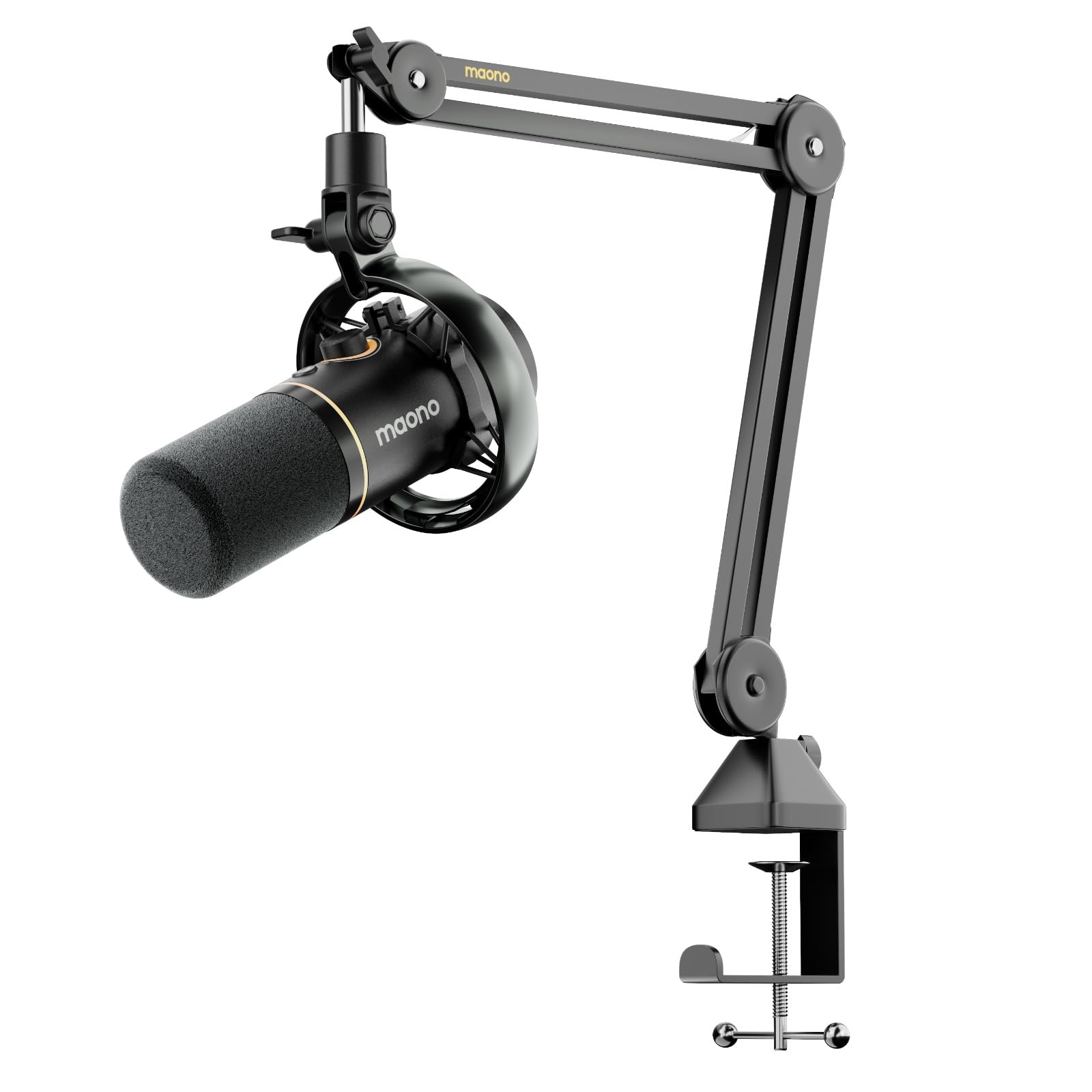
3. MAONO PD200W
The cord-free kit that lets you roam the room while you talk.
The MAONO PD200W removes the biggest restriction in podcasting: the cable. It offers three connection modes — wireless for freedom, USB for instant plug-and-play, and XLR for a pro audio interface. Owners highlight it “works flawlessly for hours with no wires,” which makes it a standout for interviewers who move around or presenters who prefer to stand.
Its 30mm dynamic capsule handles up to 128dB SPL without distortion, and the 82dB signal-to-noise ratio keeps vocals clean. The MAONO Link app gives you four master-tuned presets plus full EQ and reverb control. Battery life is a huge differentiator: up to 60 hours with RGB off, and a stable 60m wireless range for large rooms.
The kit includes a boom arm and a Type-C receiver, so it is ready to go from the start. One note for buyers: it does not include a USB-C to USB-C cable (only USB-C to USB-A/B), so order one separately. The included desktop stand is sturdy, but the RGB lighting is a nice touch if you want flair on stream.
Standout Strengths
- True wireless freedom with a 60m range.
- 60-hour battery life outlasts any long shoot.
- Duo support lets two mics record to separate tracks.
- Full kit includes boom arm and receiver.
What to Know
- Missing USB-C to USB-C cable in the box.
- Battery needs recharging about twice weekly with heavy use.
- Camera receiver sold separately.
Best for: podcasters and interviewers who want the flexibility to move and record without being tethered to a desk.
Consider the catch: if you plan to record camera audio directly, you will need to buy the camera receiver separately.
4. PreSonus AudioBox USB 96
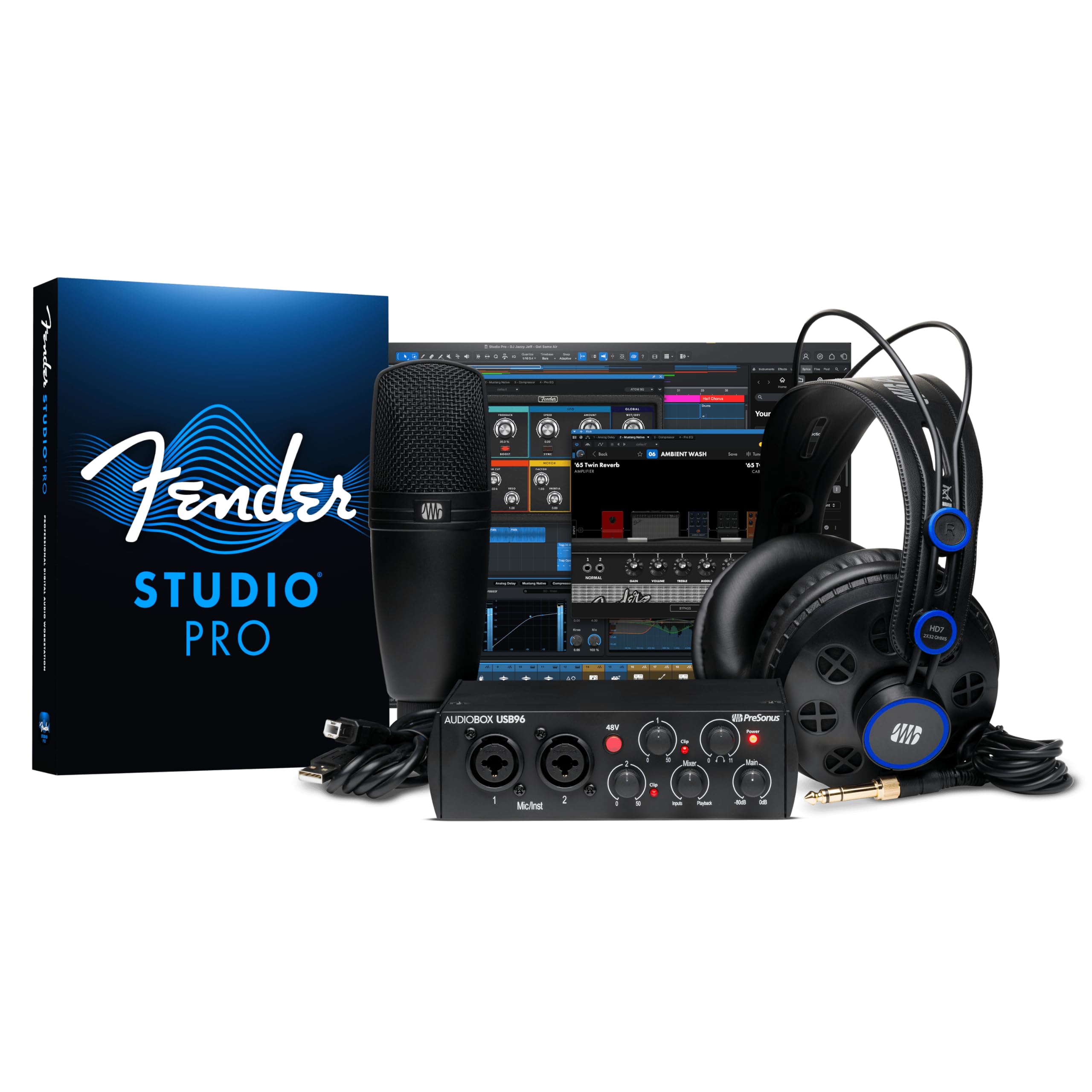
The all-in-one box that turns a bedroom into a recording studio.
The bundle includes the AudioBox USB 96 audio/MIDI interface, an M7 large-diaphragm condenser mic, HD7 studio headphones, a desktop stand, and all the cables. For someone “way above my skill” looking to learn, this is a forgiving and complete starting point.
The core interface records at up to 96kHz, which is more than enough for vocals and acoustic instruments. The M7 condenser captures a detailed sound, and the HD7 headphones let you monitor without disturbing anyone. It ships with Studio One Artist, which owners describe as a drag-and-drop workflow that is easy to learn quickly.
Compared to the Focusrite below, this kit trades a bit of high-end sample rate (96kHz vs 192kHz) for a more complete physical bundle. Setup gets mixed feedback in reviews — some find it easy, others struggle — so be patient during the software install. The recurring praise is that the durability is great and the value is undeniable for a beginner.
Value read: For a first studio, this is “great set-up for the money” and “way above my skill” but helpful for learning — a low-risk way to see if music production sticks.
Who it suits: total beginners who want everything in one box, not a specific professional tool.
5. Neewer LED Panel 2-Pack

The soft glow that makes faces look like a million bucks on camera.
The Neewer 2-pack is the workhorse lighting kit for studio setups. Each panel packs 288 LEDs and delivers up to 4800Lux of brightness with a CRI of 97+, meaning colors render accurately on camera. The bi-color range (3200K to 5600K) lets you match warm indoor tungsten or cool daylight, giving you creative control over the mood.
What wins people over is the portability and control. The included 2.4GHz remote lets you toggle between 40 channels and 4 groups (A/B/C/ABC) to adjust lights individually. Owners use them for church video shoots, podcast studios, and still photography, calling them “super bright and balanced.” The package includes two aluminum alloy tripods, two power adapters, and a carrying bag.
You can run them on AC power or use Sony NP-F batteries (not included) for on-the-go shooting. The honest caveat from reviews is that battery life is the mixed point — they drain quickly, so plugging in is the reliable choice for long sessions. The tripods are light but stable, though a cord tug can tip one over.
Why It Shines
- High CRI 97+ for accurate, flattering skin tones.
- Adjustable brightness from 1% to 100%.
- Remote control with 40 channels for multi-light setups.
- Compact storage bag keeps the kit organized.
What to Watch
- Battery life is mixed — plan on AC power for long shoots.
- NP-F batteries are not included.
- Tripods are light and can tip if cords are pulled.
Ideal for: streamers and studio creators who need a reliable key and fill light that can be set up and broken down quickly.
Note: if you need all-day battery operation, look for a higher-capacity power solution as this performs best plugged in.
6. Focusrite Scarlett Solo Studio
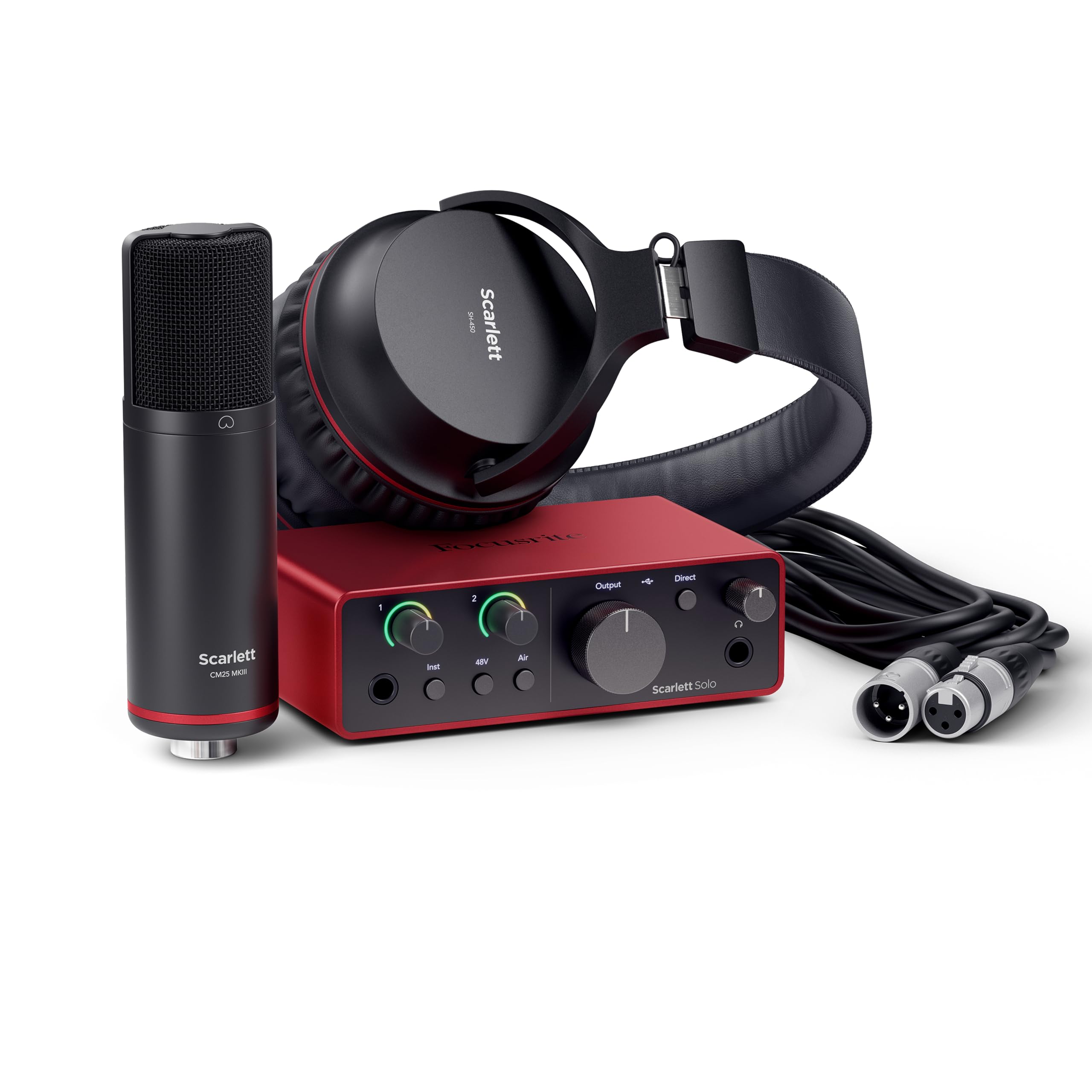
The songwriter’s studio-in-a-box that makes your guitar and voice sit perfectly together.
The Focusrite Scarlett Solo Studio 4th Gen is the complete package for musicians and vocalists. The interface uses the same converters as Focusrite’s flagship models, giving a huge 120dB dynamic range — enough headroom to record loud sources without distortion. It handles up to 192kHz sample rate, which is why musicians prefer it over the PreSonus’s 96kHz limit.
The bundle includes the CM25 MkIII condenser mic for detailed vocal capture and SH-450 headphones for mixing and monitoring. The signature feature is Air mode, which lifts vocals and guitars to the front of the mix, adding musical presence and harmonic drive. Owners describe it as “amazing quality, especially for beginners,” and “totally worth it.”
It works on Windows, Mac, and iPad, and the included software collection (Pro Tools Intro+, Ableton Live Lite, Cubase LE) means you can record the day it arrives. Unlike the Shure mic which is USB-native, this setup requires an XLR cable, which is included in the box. The build is compact at just over 3 pounds, but the sound is unquestionably professional.
Musician’s pick: If you play guitar or sing, this bundle beats a USB mic for multi-track flexibility; owners run guitar straight into a DAW with amp sims.
Beginner note: Setup is straightforward — ” watched a quick video and I was off and recording” — even with zero prior experience.
7. Zoom PodTrak P4 Bundle

The portable multitrack recorder that lets a four-person podcast go anywhere.
The Zoom PodTrak P4 is the mobile powerhouse for podcasting. It has four high-gain XLR mic inputs with +48V phantom power, four independent headphone outputs, and four sound pads for music and samples. The bundle includes two Zoom ZDM-1 podcast mics, making it a ready-to-record kit for a duo or a full panel.
The defining feature is simultaneous TRRS & USB call-ins, meaning you can record a remote guest and in-person hosts on separate tracks at the same time. Owners recording a verbal history of their grandparents found it “very easy to use” with great mic performance. It records directly to an SD card or via USB, so you do not need a computer in the room.
The bundled ZDM-1 mics sound solid, but the small tripods feel cheap and lack shock mounts, making table bumps audible. The bundled headphones are non-adjustable and run large. The pro advice is to use the power supply port instead of batteries for long sessions, and to buy a USB-A to USB-C cable for MacBook connection.
Power Features
- Records 4 separate tracks for precise editing.
- Remote call-ins and in-person hosts on one device.
- Battery or USB-C power for field use.
- Includes two solid ZDM-1 mics.
Kit Quirks
- Mic stands are too short and lack shock mounts.
- Bundled headphones are non-adjustable.
- Needs USB-A to USB-C cable for modern laptops.
Choose this if: you run an in-person or hybrid podcast and want hardware recording without a computer at the table.
Skip the bundle if: you already own decent mics and headphones — the P4 recorder alone is the smart buy.
8. DJI Osmo Pocket 3 Creator Combo

The pocket camera that delivers gimbal-stable 4K while you chase the action.
The DJI Osmo Pocket 3 is a major leap for mobile creators. It packs a 1-inch CMOS sensor that records 4K at 120fps — incredibly smooth slow motion — and it excels in low light, which is where phone cameras struggle. The 3-axis mechanical stabilization means you can run, dance, or hike and the footage stays smooth without a separate gimbal rig.
The Creator Combo includes the DJI Mic 2 transmitter, a battery handle, a wide-angle lens, a mini tripod, and a carrying bag. The ActiveTrack 6.0 keeps you center-frame even when you set it on a tripod and move around, and the rotating 2-inch touchscreen flips for vertical social media. Owners say it “upped my video quality instantly” and is “perfect for vlogging or just for personal use.”
You can shoot for 166 minutes on a single charge, and the included battery handle stretches that further for long shoots. The rotating screen and 10-bit color depth (one billion colors) let you frame from any angle and grade footage smoothly. Owners note it “democratizes cinematic video,” though it is not a full-frame cinema camera — for travel and daily content, it stands out.
The verdict: This is the ultimate grab-and-go upgrade from an iPhone-plus-gimbal setup, with stabilization that actually works.
Consider the scale: For studio interviews or product shots, a bigger sensor camera will out-resolve it, but nothing this size beats it in the field.
9. Sony ZV-1F Vlog Camera Bundle

The pocket vlogger built for selfie-style shooting with one-touch background blur.
The Sony ZV-1F is designed from the ground up for vloggers, with a wide-angle 20mm F2.0 lens that captures the whole scene even at arm’s length. The 1-inch sensor delivers 20.1-megapixel stills and smooth 4K video, and Sony’s Eye-AF keeps your face sharp while you talk. The Bokeh Switch button instantly blurs the background for that premium look.
The bundle is generous: a Deco Gear travel case, a spare compatible battery, an external charger, a UV/Polarizer/FLD filter kit, a Lexar 32GB SD card, a 12-inch tripod grip, and cleaning accessories. The built-in directional 3-capsule mic captures clear voice, and the vertical video mode auto-tags clips for direct smartphone transfer — a huge time-saver for social media.
For streamers, it transforms into a high-quality USB webcam with a simple connection. The trade-off is that the bundled software links mostly require contacting support for codes, which is frustrating. Owners also note the SD card can be finicky, so test it before a big shoot. The camera itself, though, is praised as a “great starting point” with crisp, clean footage.
Creator Friendly
- 20mm wide lens is perfect for arm’s-length selfie video.
- Vertical video auto-tagging for instant social posts.
- USB webcam mode doubles as a streaming cam.
- Bundle includes case, batteries, filters, and tripod.
Bundle Caveats
- Software redemption codes are a hassle to activate.
- Some bundle accessories can be missing or incompatible.
- Compact sensor means lower light performance than larger cams.
Start here if: you are new to vlogging and want a purpose-built camera with a complete accessories bundle to learn on.
Proceed with care: the bundle’s software and extras are the weak link — verify everything arrives and works before your first big trip.
Understanding the Specs
Dynamic vs Condenser Mic
A dynamic microphone uses a moving coil to capture sound, which makes it naturally resist background noise from the sides. This is why dynamic mics like the Shure MV7+ are forgiving in untreated rooms. A condenser microphone uses a charged diaphragm, picking up a wider, more sensitive soundstage. It is flattering for vocals but will capture your keyboard and AC hum, so it suits quiet, treated spaces.
Sample Rate & Dynamic Range
Sample rate (measured in kHz) is how many times per second the audio is captured. 96kHz is plenty for most recording; 192kHz (like the Focusrite) gives extra headroom for heavy processing or high-pitched sources. Dynamic range (measured in dB) is the gap between the quietest and loudest sound before distortion. A 120dB range means you can record loud guitar amps without clipping.
CRI & Kelvin for Lighting
CRI (Color Rendering Index) measures how accurately a light reveals true colors, with 97+ being excellent for honest skin tones. Kelvin is the color temperature: 3200K is warm orange like a household bulb, 5600K is cool daylight. Having both extremes in one panel lets you match ambient light instead of fighting it.
Stabilization & Sensor Size
Optical or mechanical stabilization physically moves the lens or sensor to cancel shake, giving smooth handheld footage. Sensor size (like 1-inch CMOS) determines low-light quality and depth of field. A larger sensor collects more light, so it performs better at night — a key reason the DJI Pocket 3 and Sony ZV-1F outperform phones in dim settings.
FAQ
Should I buy a USB mic or an XLR mic with an interface?
What is the difference between a dynamic and condenser microphone?
How many pickup patterns do I really need on a mic?
What does CRI mean for video lighting?
Do I need a 4K camera or is 1080p enough?
What is the advantage of an audio interface over a USB mic?
How long does a vlog camera battery last for a full shoot?
Why is my condenser mic picking up too much background noise?
Can I use a vlog camera as a webcam for streaming?
Is the Zoom PodTrak P4 better than recording on a computer?
Final Thoughts: The Verdict
For most people, the equipment for content creators winner is the Shure MV7+ because it delivers pro-grade audio with easy setup and future-proof XLR. If you want the most versatile jam-packed bundle for a beginner studio, grab the Logitech Blue Yeti. And for the creator who needs to move, the DJI Osmo Pocket 3 is the one to reach for when your office is the world.
How We Picked
We do not accept paid placement. Every pick is matched to a real buyer and a real use-case; we do not hands-on test units.
Sources & Methodology
Specifications: manufacturer listings and product documentation. Review insights: verified customer reviews, as of August 2026. Pricing: not shown on this page (it changes often); check the current price via the retailer link.
As an Amazon Associate, WellFizz earns from qualifying purchases. This does not affect which products we feature.
Related Guides

Mo Maruf
I created WellFizz to bridge the gap between vague wellness advice and actionable solutions. My mission is simple: to decode the research and give you practical tools you can actually use.
Beyond the data, I am a passionate traveler. I believe that stepping away from the screen to explore new environments is essential for mental clarity and physical vitality.