Our readers keep the lights on and my smoothie glass nicely filled. As an Amazon Associate, I earn from qualifying purchases.
Specs are compiled from manufacturer listings and verified buyer reviews and can change over time — please confirm the key details on the product page before buying.
You want jewelry resin that pours clear, cures hard, and stays that way without a sticky mess. The wrong bottle turns a pendant project into a cloudy, tacky headache. The right formula separates a professional finish from a cloudy, tacky failure.
I’m Mohammad Maruf — the founder and writer behind WellFizz. This guide is built by comparing the manufacturers’ published specifications and the patterns across verified customer reviews, so you get each pick’s real strengths and trade-offs instead of marketing spin.
The best resins cure hard, resist yellowing, and let you focus on designing. Here is what matters when you shop for the best epoxy resin for jewelry that actually performs.
Jewelry resin is a different beast from the deep-pour epoxy you would use for a river table. Because your pieces are small, delicate, and meant to be worn, the resin needs to cure completely hard, stay optically clear, and not yellow after a few weeks of sunlight exposure.
UV Resin vs. Two-Part Epoxy
For most jewelry work, you want a UV-curable resin. It comes ready to use in a bottle — no measuring Part A against Part B, no waiting 24 hours for a full cure. A UV lamp or even direct sunlight hardens it in minutes. Two-part epoxy is better for larger pieces or deeper pours (over about 1/4 inch) because it cures all the way through, but UV resin is the speed champion for thin layers, coatings, and small castings.
Clarity and Yellowing Resistance
A resin that pours crisp but yellows under UV exposure defeats the purpose of making a beautiful piece. Look for formulations that specifically mention UV inhibitors or anti-yellowing additives.
Viscosity — Thick or Thin
Low-viscosity resin (thin, like water) flows into every detail of a silicone mold and releases bubbles on its own. Higher-viscosity resin (thick, like honey) stays put when you dome-coat a cabochon or seal a flat surface. Your project dictates the ideal viscosity.
The rainbow kit that takes the guesswork out of color mixing for any jewelry maker.
You get eight bottles — black, white, purple, lavender, red, green, yellow, and blue — so you can start casting right away without hunting for separate pigments. The resin cures to a high scratch-resistant hardness of 80D (Shore D scale, a standard measure of material hardness), with a shrinkage rate of less than 3%. That means intricate bezel settings and earring molds keep their precise shape as the resin hardens. The formula includes UV inhibitors that the brand says resist yellowing significantly better than standard UV resins. Owners consistently call out the vibrant color accuracy and the way it cures without any sticky residue. As one buyer sums it up, “the colors are vibrant and cured easily under my uv lamp.”
Each bottle is compact — the total kit weighs 240g. Owners do wish for larger containers because they go through popular shades fast. The colors are translucent rather than opaque, which is intentional for UV light penetration, but this means deep, solid-color pours are not its strength. For standard jewelry work like pendants, studs, and thin castings, however, this kit delivers a smooth, glossy surface that outshines mixing your own pigments from scratch.
Color accuracy wins people over here.: 69 owners specifically praise how the cured shade matches the bottle label, with only a couple of hues running slightly different. The curing process itself gets high marks from over 30 owners for its speed and lack of tackiness, making this a reliable daily driver for both newcomers and experienced crafters. If you need a deeper pour or an opaque solid color, the Art ‘N Glow two-part epoxy handles that job better.
What owners love
Eight pre-mixed colors mean you start creating immediately—no separate pigments needed.
Cures rock-solid with a glossy, non-sticky surface in under 2 minutes under a UV lamp.
Low odor formulation makes indoor crafting comfortable without overpowering fumes.
The trade-off
Bottles are small (240g total split across eight colors); heavy users run out of favorites quickly.
Translucent colors are not suitable for thick, opaque castings — designed for UV light penetration.
Reach for this kit if: you want a ready-to-go palette of accurate, vibrant colors and a fast-curing formula that delivers consistent gloss every time.
Keep in mind: the 240g total capacity is best for small projects — if you make resin jewelry in volume, you will be reordering the popular shades.
A massive 500g bottle that keeps you working without constant reordering.
The hard-type formula cures with an anti-scratch, non-sticky finish. Buyers report that it hardens almost immediately under a 36W UV lamp, with both sides taking just 1 to 3 minutes. As buyers describe it, “super easy to apply and cures almost immediately once exposed to my LED UV lamp.”
The resin has self-leveling and self-degassing properties — it spreads evenly and releases trapped air on its own. That saves time when you coat a batch of pendants or dome cabochons. Odor is a point where experiences split; some owners find it low-odor, while others note a stronger smell. Bubble results are also mixed, with the majority managing fine results after a quick pass with a heat gun or torch. It pairs well with both liquid and powder pigments, so you can tint it to any shade.
What the owner feedback underscores most is curing speed — 44 separate mentions call out how fast it sets solid. The 500g bulk format means you refill your smaller squeeze bottles from this jug, keeping your workspace tidy and your cost per piece low. It is not ideal for laminating non-transparent materials because the UV reaction cannot transfer through opaque layers, but for clear jewelry, thin castings, and top coatings, it delivers consistent clarity.
The bulk advantage: A full 500g of hard, clear resin at a budget-friendly entry point — you get a lot of working material without a lot of waste.
The honest note: Bubble performance and odor are not universally perfect; plan to pop surface bubbles with heat and work in a ventilated spot.
Choose this for: high-volume jewelry making where you need a big supply of clear resin that cures fast and stays hard.
Best suited if: you already have pigments and want a bulk clear base, and you are comfortable managing bubbles with a quick torch pass.
The thin formula that flows into every tiny crevice and releases bubbles on its own.
This JDiction upgrade is formulated with a viscosity of just 1100-1300 cps (centipoise — a measurement of a liquid’s resistance to flow; water is about 1 cps, honey is around 10,000 cps). That low viscosity does two critical things for jewelry work: it runs into the most delicate mold details without trapping air, and it self-degasses so bubbles rise and pop before you ever hit it with a UV lamp. The resin cures to a high hardness of 80D with a shrinkage rate below 3%, so fine filigree designs keep their sharp edges. It is much thinner than the Nicpro’s 3000-4000 cps formula, which is better for staying put on vertical surfaces.
Clarity is the top praise here — 25 owners single out how crisp it finishes, and the included UV inhibitors are engineered to resist yellowing over time. The odor is described as very low, making it a comfortable choice for a home craft room. A full cure takes about 4 minutes under a UV lamp, and owners note that it domes beautifully on flat surfaces like pendant trays.
The aspect most discussed is curing, and it is a mixed verdict: while the resin cures fast and clear, some owners note that the thinness means it can run off vertical surfaces more easily than a thicker resin. This is not a flaw — it is a characteristic of low-viscosity formulas — but it means you should plan for gravity, especially when coating the sides of a bezel or a domed cabochon.
Why it stands out
Ultra-low viscosity (1100-1300 cps) flows into fine mold details without bubbles.
Self-leveling and self-degassing properties eliminate most surface defects automatically.
Cures to a scratch-resistant 80D hardness with strong yellowing resistance.
The one consideration
The thin consistency can run off vertical or angled jewelry surfaces if not applied carefully in layers.
Perfect for: intricate silicone molds, thin coatings, and any project where bubble-free clarity is non-negotiable.
Not ideal for: thick domed coatings where you want the resin to stay piled high without running down the sides.
The classic two-part epoxy that handles deeper pours and larger jewelry pieces.
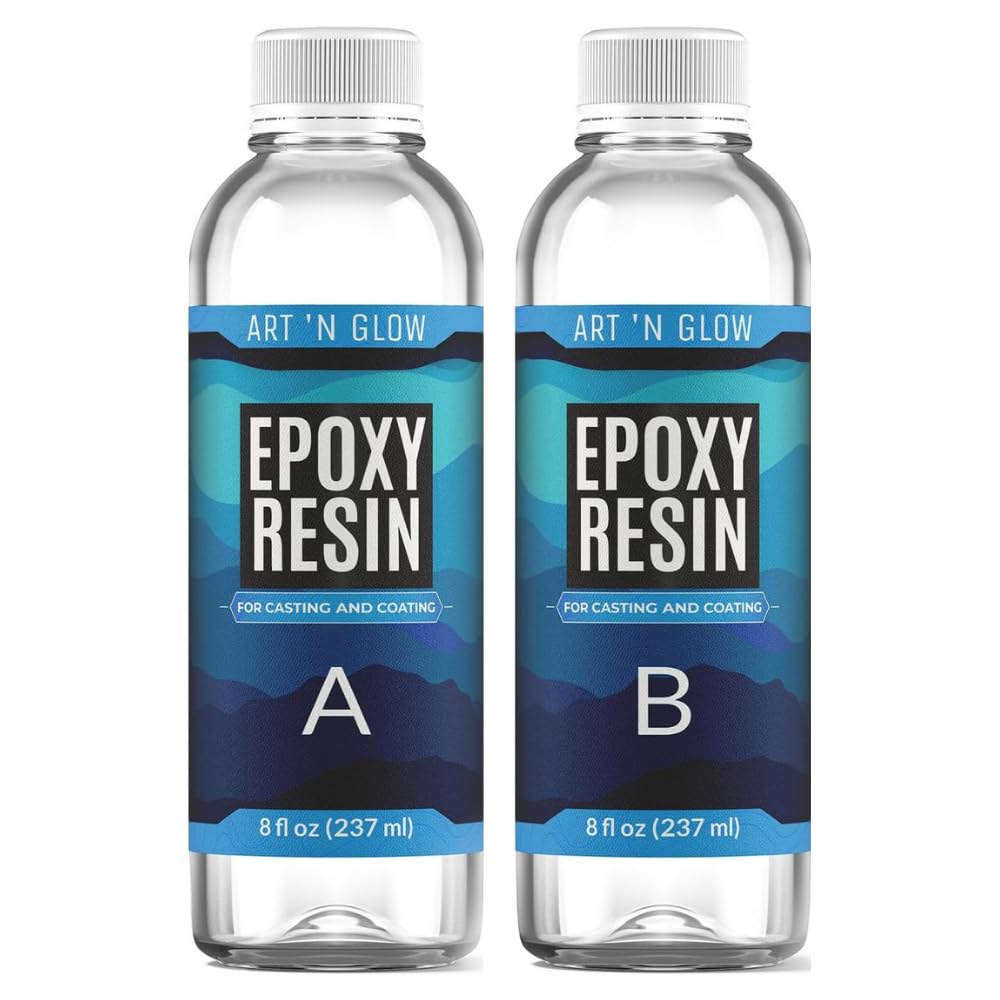
Unlike the UV resins above, this Art ‘N Glow kit is a two-part epoxy that you mix in a 1:1 ratio by volume. You get a 40-minute work time — plenty of room to pour, arrange inclusions, and pop bubbles — and a full cure to 80+ Shore D hardness in 24 hours (72 hours for a complete, maximum-strength cure). The payoff is that it can handle pours up to 6 oz per layer, which is far thicker than UV resin can manage. This makes it the go-to for chunky pendants, paperweight-style charms, and encapsulating larger objects inside clear resin.
The formula includes premium UV stabilizers and HALS (Hindered Amine Light Stabilizers) additives that the brand says fight yellowing and keep your work crisp over years. Over 1,200 owners highlight its ease of use, and 1,100 specifically mention the quality of the cured finish. It is also food-safe when fully cured and heat-resistant up to 200°F, so coasters, serving boards, and jewelry that contacts skin are all fair game. The kit comes from a Dallas-based small business with nearly a decade of resin experience, and owners mention the instructions are clear enough for a total beginner to follow.
The volume of praise here is class-leading among UV resins.: the crowd of over 12,000 ratings makes this the most-vetted product on this list. The company has sold over 100,000 kits, and US-based support is a real differentiator if you hit a mixing problem. The 40-minute pot life is generous, but if you want instant gratification under a lamp, you will prefer the UV options above. The JDiction 8-color kit is faster for small, thin jewelry, but this one wins for depth and certification.
The depth advantage: A 6-ounce per-layer capacity lets you cast thick jewelry pieces that UV resin simply cannot cure all the way through.
Know before you pour: This requires measuring and mixing two parts, plus a full 24-hour wait before demolding — the UV options cure in minutes.
Best for: substantial resin pieces, deep bezel settings, encapsulating keepsakes, and any project that demands a food-safe certified finish.
Skip it for: quick single-pendant production runs — the UV resins above are faster for thin, small jewelry.
A forgiving 1:1 ratio kit that keeps things simple while delivering professional-grade clarity.
This Craft Resin kit gives you 17 oz of resin and 17 oz of hardener (34 oz total), making it among the most generous two-part epoxy volumes near its price tier. The 1:1 mixing ratio is about as simple to use as epoxy gets — no tricky volume fractions — and the formulation is designed to release air bubbles automatically when the resin is warm, with a recommended pour depth of 1/4 inch for optimal results. It cures rock-hard in 24 hours and is heat-resistant up to 203°F (95°C), so finished jewelry pieces hold up to daily wear without softening.
What sets this apart is its certification: it is food-safe, non-toxic, and free of VOCs (Volatile Organic Compounds — the chemicals that cause strong fumes and potential health concerns). That makes it a strong option if you work in a shared living space or are sensitive to strong chemical smells. Over 12,000 ratings back it, and the feedback from long-term users is telling — some owners are on their seventh purchase, reporting no yellowing or curing issues after 6 months. Included accessories (mixing stick, gloves, manual) let you start your first pour immediately.
The main quibble from the feedback is the foil seal on the containers: a few owners note that bits of foil can break off into the resin during opening, requiring careful picking out or sanding afterward. This is not a formula problem but a packaging detail to be aware of — slice the foil carefully rather than tearing it.
The beginner-friendly edge: A simple 1:1 mix, a clear 24-hour cure timeline, and enough volume for many projects before you need to reorder.
The packing heads-up: The foil seal on the bottles can shed tiny bits into the resin — open gently to avoid picking plastic foil out of your pour.
Ideal for: new resin users who want a forgiving, food-safe epoxy that mixes easily and delivers glass-like results every time.
Consider if: you plan to cast a mix of coasters, jewelry, and art pieces — the pour depth and versatility stretch beyond just small charms.
A full kilo of resin plus a UV light and tools — everything a beginner needs in one box.
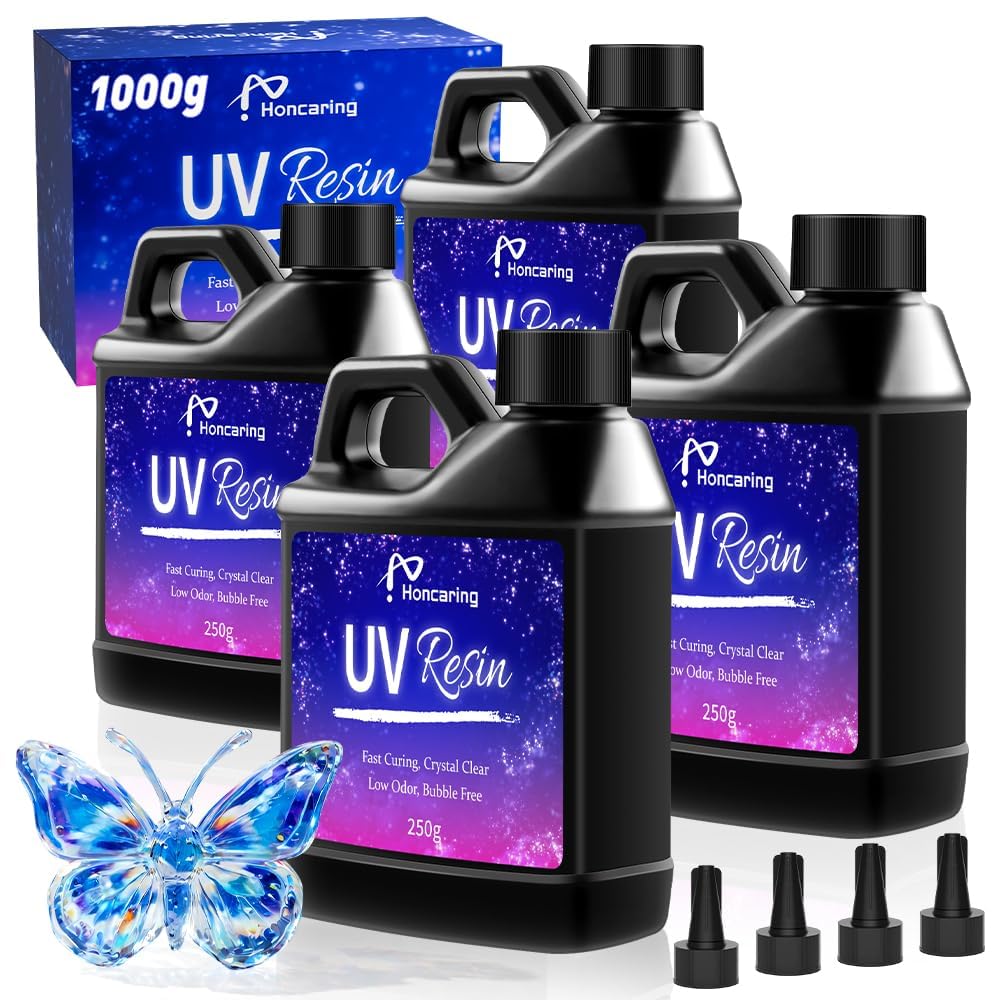
This Honcaring kit takes a different approach: instead of just a bottle of resin, you get 1000g of clear UV resin split into four 250g bottles, a compact UV light, and silicone gluing tools. That makes it the most complete starter package on this list — you can open the box and make your first pendant within minutes without a separate light purchase. The upgraded formula is designed by the maker to be low-odor and produce fewer bubbles than standard UV resins, though the manufacturer notes that winter temperatures thicken the resin and recommends soaking the bottle in hot water for 1-2 minutes before use to restore flow and prevent bubbles.
The pack of four individual bottles is a smart convenience: you can keep one in active use and store the others in a cool, dark place to preserve freshness. The UV light included in the kit is powerful enough for small pieces, though owners with higher-end lamps note that curing is even faster with a 36W or stronger unit. The crowd feedback highlights quality (41 mentions) and functionality (29 mentions) as the strongest positives, with many appreciating that it cures clear and glossy without any yellowing.
A note on the bubble aspect: while the formula is improved, some owners find it does not come out completely bubble-free from the bottle. A brief 10-minute rest after pouring (letting the resin settle) and a light mist of isopropyl alcohol are common fixes mentioned in the feedback to achieve that perfect glass-like surface. This resin is less expensive per gram than the EPRESINART, but the included tools make it the better value for a first-time buyer.
What makes it a starter special
Includes UV resin, a UV light, and silicone tools — everything needed for a first project.
1000g total capacity (4 x 250g) means less frequent reordering and easy storage.
Cures to a hard, glossy, low-odor finish that owners consistently praise.
What to watch
Bottle-to-bottle bubbles still need attention — a settling rest and alcohol mist help.
Winter thickening is real; pre-warming the bottle in hot water is recommended by the maker.
Perfect entry point for: new resin crafters who want a one-box solution with enough resin to practice and make gifts without buying additional gear.
Best approached knowing: the UV light is handy for small pieces, but upgrading to a higher-wattage lamp later will speed up your workflow.
The hardest-curing UV resin on the list — tough enough for daily-wear jewelry that takes knocks.
Nicpro’s bulk UV resin hits a cured hardness of 90D — a full 10 points higher than the 80D resins from JDiction — which translates to a noticeably harder, more impact-resistant finish. For jewelry that gets banged around (pendants that tap against desks, rings that scrape against zippers), that extra hardness means fewer scratches and a longer-lasting gloss. The viscosity sits at 3000-4000 cps, which is thicker than JDiction’s Low Viscosity (1100-1300 cps) but still fluid enough to pour cleanly into molds. It is designed by the maker to cure in 2-4 minutes under a UV lamp or even direct sunlight, with a shrinkage rate below 2% (the lowest on this list).
Odor is notably low — owners mention it as the least smelly UV resin they have tried — and the formula resists yellowing over time. The 1000g bulk format (35.27 oz) gives you a lot of material for large batches. A minor visual note: some customers note a slight blue tint in the bottle, but it dries crisp with no residual color in the cured piece. Post-cure waxiness (a temporary surface film on some UV resins) is a known trait here; a quick wipe with alcohol or a primer coat resolves it.
The feedback split on curing time is worth noting: while 42 owners praise how fast it cures, an almost equal number (41) find the curing time mixed, meaning your lamp wattage and pour depth will make a real difference. Stick to thin layers (under 1/4 inch) and use a strong lamp for the best results. It is tougher than the KISREL but requires more care with lamp power.
The toughness edge: A 90D Shore hardness and sub-2% shrinkage make this the most durable UV option here for jewelry that needs to withstand daily friction.
The realistic expectation: Curing speed depends heavily on your lamp; owners with weaker lights report needing more time than the stated 2-4 minutes.
Choose this for: hard-wearing jewelry items like rings, keychains, and wearable art that face constant handling and need maximum scratch resistance.
Know before you pour: This resin is thicker than ultra-low-viscosity alternatives — it stays put on flat surfaces but moves slowly into very fine mold details.
A premium clear resin that delivers a glass-like dome finish with minimal work.
EPRESINART markets this as a premium-grade crisp resin with advanced self-leveling technology — it spreads and smooths itself out, reducing the amount of manual manipulation needed for a perfect surface. The full cure time is a fast 3 minutes with a 36W or higher UV lamp, which ties it with the fastest options here. It is also scratch-resistant, stain-resistant, and formulated specifically to fight yellowing over the long term. That matters most for clear resin jewelry that sits near a window or under display lighting — the Honcaring kit is better for a beginner, but this one prioritizes ultimate clarity.
The 1000g bottle is a single container rather than multiple smaller bottles, which is a trade-off: you get a lot of resin without plastic waste, but owners note that transferring it to smaller working bottles is wise because the main bottle can get sticky with use. The manufacturer recommends it for jewelry, craft decorations, castings, coatings, and sculptures, and it mixes well with mica powders, colorants, glitter, and sequins. The odor during curing is present (some owners describe it as strong while the lamp is on) but dissipates completely after the piece airs out — once cured, it is completely odorless as advertised.
Quality is the most-praised aspect (38 mentions), with clarity close behind. The main limitation is pour depth — like all UV resins, thin layers are the safe bet. Reviewers point out that thick objects or pieces over about 1/4 inch can crack or warp, so stick to jewelry-scale projects for the best outcome. If you need a pre-colored kit, the JDiction 8-color set is a better choice.
The premium payoff
Self-leveling formula creates a smooth, glass-like finish with minimal effort — great for dome coatings on pendants.
Fast 3-minute cure time under a 36W UV lamp gets you from pour to finished piece quickly.
Sturdy anti-yellowing formulation keeps clear jewelry crisp under light exposure.
What to plan for
Single 1000g bottle is less convenient than smaller split bottles — plan to decant into squeeze bottles for daily use.
Thick pours (over about 1/4 inch) can crack or warp; this is best for thin jewelry castings and coatings.
Reach for this when: ultimate clarity and a self-leveling dome finish are the priority, especially for clear pendant tops or encapsulating small keepsakes.
Consider the alternative if: you want a pre-colored kit (the JDiction 8-color set) or a two-part epoxy for deeper pours (the Art ‘N Glow kit).
Understanding the Specs
UV Resin vs. Two-Part Epoxy
UV resin comes ready to use in a single bottle. It cures in minutes when exposed to a UV lamp or strong sunlight. It is best for thin layers (under about 1/4 inch) because UV light needs to penetrate all the way through the resin to harden it. Two-part epoxy is mixed from a resin and a hardener. It cures chemically, which means it can set up in thicker pours (often 1/2 inch or more per layer). The trade-off is that it requires measuring, has a finite working time (the “pot life”), and takes several hours or a full day to harden completely. For most jewelry making — pendants, earrings, rings, charms — UV resin is the faster, simpler choice. For chunky pieces or encapsulating objects, two-part epoxy is the way to go.
Viscosity and Its Effect on Your Work
Viscosity is simply how thick or thin the liquid resin is, measured in centipoise (cps). Water is about 1 cps. Ultra-thin UV resin, like the JDiction Low Viscosity at 1100-1300 cps, flows like water into every detail of a silicone mold and releases trapped air easily. Medium-viscosity resin (around 3000-4000 cps, like the Nicpro) is thicker — it stays where you put it, which is useful for doming a cabochon or coating a vertical bezel without running. Which one you pick depends on your project: thin for intricate molds, medium for coatings and domes. A low-viscosity resin will also require you to work faster or in thinner layers because it tends to pool flat very quickly.
FAQ
What is the difference between UV resin and epoxy resin for jewelry?
UV resin is a single-component liquid that hardens (cures) only when exposed to ultraviolet light from a lamp or the sun. It is ready to use straight from the bottle and cures in minutes, making it ideal for small jewelry projects. Epoxy resin (two-part) requires mixing a resin and a hardener in a specific ratio. It cures chemically over several hours or a day and can be poured in thicker layers. UV resin is easier for quick, small pieces; two-part epoxy is needed for deep, chunky casts.
How do I prevent bubbles in my UV resin jewelry?
Bubbles form when air gets trapped in the resin. To minimize them, use a low-viscosity (thin) resin that flows into mold details on its own. Let the filled mold sit for 5-10 minutes before curing so bubbles can rise to the surface. Gently pass a heat gun or a lighter flame over the surface to pop any remaining bubbles. Working in a warm room (above 70°F) also reduces bubble formation because the resin flows more easily.
Will my resin jewelry turn yellow over time?
Many standard UV resins yellow after exposure to sunlight, but formulations with added UV inhibitors (often called “anti-yellowing” on the bottle) resist this much better. The resins on this list from JDiction, Art ‘N Glow, and EPRESINART specifically mention UV inhibitors. For maximum longevity, store finished jewelry away from direct window light when not being worn, and choose a resin that advertises yellowing resistance in its description.
Can I use any UV lamp to cure the resin?
Yes, but the lamp’s wattage directly affects curing time. Most UV resin labels recommend a 36W lamp for best results. A weaker lamp (like a tiny nail-curing pen light) will take longer or may not cure the resin all the way through, leaving a tacky surface. Stronger lamps and sunlight cure faster. If you are buying a bulk resin separately from the kit, ensure you have a UV lamp rated at 36W or higher for consistent results in 2-4 minutes.
Why is my resin still sticky after curing?
A sticky surface usually means the resin did not cure completely. This can happen if: (1) your UV lamp is not strong enough (wattage below 36W), (2) the resin layer is too thick for UV light to penetrate (keep layers under 1/4 inch or about 6 mm), (3) the resin was not exposed to the lamp long enough, or (4) the bottle is old or was stored in a hot place, degrading the photoinitiator. Try curing in thinner layers with a fresh, strong lamp for the full recommended time.
Is UV resin safe to use indoors?
Most modern UV resins are low-odor and non-toxic compared to older formulas, but “low odor” is not the same as “no fumes.” Always work in a well-ventilated area. Wear nitrile gloves to prevent skin contact (uncured resin can cause skin sensitization over time). Once cured, the resin is inert and safe to handle. Some brands like Art ‘N Glow and Craft Resin offer food-safe certification for their two-part epoxies when fully cured.
Can I mix mica powder or alcohol ink into UV resin?
Yes. UV resin accepts mica powder, alcohol ink, glitter, and liquid pigment very well. Start with a small amount of colorant (a tiny pinch of mica or a single drop of ink) and stir gently to avoid introducing bubbles. Note that adding too much pigment can block UV light from penetrating the resin, causing incomplete curing. For deep, opaque colors, it is often better to use a pre-colored resin like the JDiction 8-color kit, which is formulated to cure properly while pigmented.
What is the best resin for beginners making jewelry?
For absolute beginners, a UV resin kit that includes a lamp and tools (like the Honcaring 1000g kit) removes the need to buy separate gear. If you want pre-mixed colors and no pigments to buy, the JDiction 8-color kit is the most forgiving way to start. For those who prefer a two-part epoxy with a long work time, the Art ‘N Glow 16oz kit has excellent instructions and a 40-minute pot life that gives you time to learn the process without rushing.
I created WellFizz to bridge the gap between vague wellness advice and actionable solutions. My mission is simple: to decode the research and give you practical tools you can actually use.
Beyond the data, I am a passionate traveler. I believe that stepping away from the screen to explore new environments is essential for mental clarity and physical vitality.
Feedback
Send us your feedback
Tell us what you thought about this post — we read every note.