Our readers keep the lights on and my smoothie glass nicely filled. As an Amazon Associate, I earn from qualifying purchases.
Specs are compiled from manufacturer listings and verified buyer reviews and can change over time — please confirm the key details on the product page before buying.
You need a bond between the blade and handle that won’t fail mid-swing — a loose handle can ruin a knife or even cause an accident. The difference between a knife that lasts for decades and one that rattles apart after a season often depends on which epoxy you pour into that joint. Below are six options, with the real trade-offs in working time, strength, and clarity, so you can match the glue to your handle material and skill level.
I’m Mohammad Maruf — the founder and writer behind WellFizz. This guide is built by comparing the manufacturers’ published specifications and the patterns across verified customer reviews, so you get each pick’s real strengths and trade-offs instead of marketing spin.
Every knife maker, from weekend hobbyists to seasoned bladesmiths, needs an epoxy that bonds tough materials without cracking under stress. These are the best options for a rock-solid handle, and finding the right epoxy for knife handles means matching working time to your pace and strength to your blade’s intended life.
Our Picks at a Glance

How To Choose The Best Epoxy For Knife Handles
Not all two-part adhesives are built for the job. A general craft epoxy might hold a bead on a bracelet but shatter under the lateral force of a blade in use. For knife handles, you need an epoxy that resists impact, grips oily woods and steel equally, and gives you enough time to align the tang before the chemical clock runs out.
Working Time — Your Window for a Perfect Fit
Working time is the number of minutes you have to mix, apply, clamp, and adjust before the epoxy gets too thick to move. A fast-setting epoxy gives you around 5 minutes, which forces you to work quickly and precisely with no second chances. A medium-set formula offers 15 minutes, which is a comfortable window for most handle scales. Some slow-curing options stretch beyond 30 minutes, which is ideal for complex assemblies or hot workshops where the chemical reaction speeds up.
Bond Strength and Flexibility — The Right Kind of Tough
A rigid epoxy gives you a very hard, brittle bond — it resists deformation but can crack under a sharp impact. A flexible epoxy, by contrast, absorbs shock and expands and contracts with temperature changes, which matters for blades that go through thermal cycling (a hot grinder, a cold river). For oily woods like cocobolo or ironwood, a specialized flexible epoxy actually wets the surface better than a standard rigid formulation, creating a stronger chemical grip.
Heat Resistance — Surviving the Grinder
If you shape the handle after the epoxy cures — and you almost always will — the friction heat from a belt grinder can soften or burn lower-temperature epoxies. An epoxy rated to withstand around 300 degrees Fahrenheit gives you a safety margin during sanding and shaping. It also matters if the finished knife will be used in a hot environment or cleaned in hot water.
Quick Comparison
| Model | Best For | Working Time | Full Cure Time | Item Weight | Amazon |
|---|---|---|---|---|---|
| Bob Smith Industries BSI-203H Mid-Cure™★ Best Overall | Versatile medium-set work | 15 minutes | 30-45 minutes | 0.13 kg | Amazon |
| G/FLEX EPOXY QT KITAlso Great | Premium knife-making bond | 35 minutes | 7 hours | 2.2 pounds | Amazon |
| 3M Scotch-Weld DP100 Plus | Fast industrial-grade repairs | 2-5 minutes | 1 hour | 2.4 ounces | Amazon |
| 5 Minute Epoxy Glue 8.45 fl oz | Quick, high-heat bonding | 5 minutes | 24 hours | 0.2 kg | Amazon |
| West System 105-B Epoxy Resin | Customizable system builds | Varies by hardener | 4 days | 5 pounds | Amazon |
| Vigor Jeweler’s Epoxy 2 Step | Detail work & small repairs | 4 minutes (sets) | 24 hours | — | Amazon |
In‑Depth Reviews
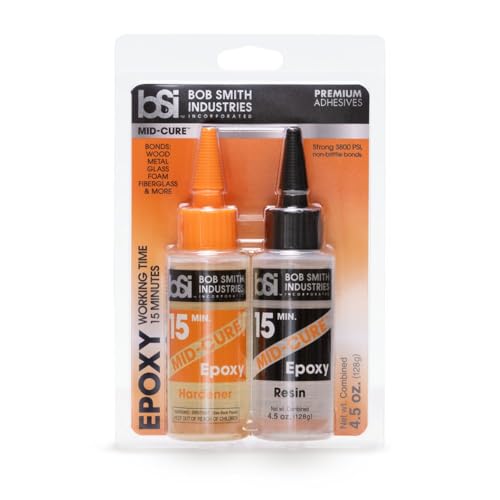
1. Bob Smith Industries BSI-203H Mid-Cure™ Epoxy – 4.5 oz
Our pick — over 4.5★ from 900+ verified ratings; the strongest balance of quality and price.
The 15-minute balance that balances control and speed for everyday knife builds.
This epoxy is the crowd favorite because it sits right in the middle of the working-time spectrum: you get a full 15 minutes to mix and apply before it starts to firm up, then it reaches a functional cure in 30 to 45 minutes. For a knife handle, that means you can coat the tang, position the scales, apply clamp pressure, and still have a moment to adjust the alignment before the epoxy locks. Owners praise the generous quantity — a 4.5-ounce combined set goes a long way on multiple blades. The light-amber color is barely noticeable in a dark handle and disappears under a coat of mineral oil or wax.
The bond is tough and rigid once cured, with good resistance to impact and stress. It works on wood, metal, fiberglass, and most plastics, so it is a single-bottle solution for handle scales, hidden tangs, and even sheath repairs. The slightly thicker consistency helps fill small gaps between an imperfectly fitted tang and the handle cavity, which thin epoxies simply run out of. On the downside, the rigid nature means it is less forgiving on knives that see heavy shock loads or extreme temperature swings than a flexible epoxy like G/Flex.
mid-cure control
- 15-minute working time is long enough to work carefully, short enough to keep the project moving
- Cures in 30 to 45 minutes, so you are not waiting all day to handle the knife
- Gap-filling consistency seals uneven joints that thin adhesives cannot bridge
brittle edges
- Rigid bond is excellent for fixed handles but less suited for blades that endure heavy repeated shock or thermal cycling
model makers: You are a hobbyist or production maker who wants a predictable, fast-curing epoxy that works on almost every handle material without fuss.
high stress: You are building a knife for extreme outdoor use where the handle will face constant vibration and impact — a flexible epoxy handles that scenario better.
2. G/FLEX EPOXY QT KIT
The gold standard for knife makers who refuse to leave a joint to chance.
This is the epoxy the knifemaking community keeps coming back to, and buyers praise its quality and bond strength most often. The defining feature for handle work is flexibility: G/Flex cures to a tough but slightly elastic state that absorbs shock without cracking, so a hard lateral blow to the handle won’t send a fracture line through the glue joint. It also handles oily woods like cocobolo and desert ironwood better than rigid epoxies because the formula is designed to wet those tricky surfaces.
You get a generous 35-minute working time at normal temperatures, which is enough to mix carefully, coat the tang and the handle scales, clamp everything down, and even tweak the alignment once or twice before the clock runs out. Full cure takes about 7 hours, and buyers report it sandable in about 24 hours. The trade-off is the honey-like consistency — it is thicker than runny casting epoxies, so a syringe or small stick helps with application. A few note that the resin and hardener have different densities, so small batches must be weighed precisely rather than eyeballed.
flexible epoxy grip
- Flexible bond that resists cracking under impact — ideal for hard-use knives
- Long 35-minute working time gives you real room to align the tang and scales
- Trusted specifically for oily and exotic handle woods that reject standard adhesives
slow cure time
- Thick, honey-like texture requires careful weighing for small batches — not a squeeze-and-go product
- Overnight cure means you cannot rush the project in one evening
bladesmiths: Anyone building a knife they expect to last — the flexibility here means that even if the knife takes a drop or a hard twist, the handle bond stays intact.
quick fixes: You need a fast turnaround or only mix tiny dollops, where weighing a 1.2:1 resin-to-hardener ratio becomes tedious.
3. 3M Scotch-Weld Epoxy Adhesive DP100 Plus, 48.5 mL
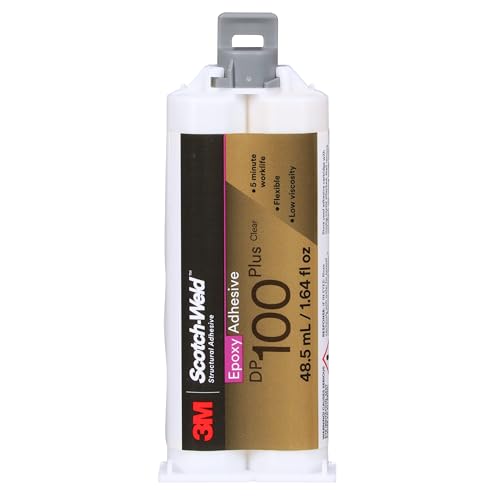
The professional-grade cartridge that sets fast and holds through thermal stress.
This is not a squeeze-and-mix tube — it is a 48.5 mL duo-pak cartridge designed for a dispensing gun, which mixes the two parts perfectly as you push the plunger. The result is zero guesswork on ratios and no air bubbles in the mixed epoxy, which is a big deal for knife handle joints where a void weakens the whole bond. The working time is just 2 to 5 minutes, so you must have your handle scales prepped, clamped, and ready before you squeeze. The reward is a full cure in just 1 hour, letting you move to shaping much faster than with overnight epoxies. Owners say it withstands engine heat — it was used to reattach spark-plug coil inserts on a Ford Explorer valve cover and held perfectly, which speaks to its tolerance under the kind of heat a grinder belt generates.
The clarity after cure is crisp, which matters for translucent handle materials like acrylic or stabilized wood where the glue line is visible. The adhesive quality is the second most-praised aspect after curing time. The main limitation for knife work is the short working window — if you are fitting a complex hidden-tang handle with multiple pieces, 5 minutes may not be enough to get everything seated and aligned before the epoxy stiffens.
production work: The fastest overall cure of any product here, paired with industrial-grade heat resistance that gives you confidence during grinding and finishing.
budget jobs: Anyone who needs more than 5 minutes to position and clamp a multi-part handle.
4. 5 Minute Epoxy Glue 8.45 fl oz, Fast Cure Clear
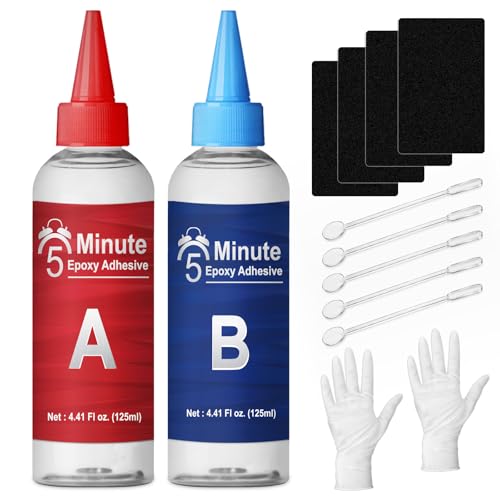
A fast-setting kit with serious heat resistance and all the accessories included.
If you have ever melted a clamp-line with a belt grinder, you will appreciate the heat spec on this one — it withstands temperatures up to about 300 degrees Fahrenheit (roughly 149 degrees Celsius). That 300°F ceiling gives you a comfortable buffer during handle shaping because most wood and epoxy dust generated by a grinder stays well below that threshold. The working time is roughly 5 minutes, and the epoxy reaches a functional cure in about one hour, with full cure at 24 hours. Owners coming from other brands note it cures clearer and with fewer bubbles, which makes for a cleaner handle finish when the glue seeps into grain or decorative liners.
The kit itself is generous: two bottles of epoxy resin and hardener, five small wooden mixing sticks, two pairs of gloves, and four mixing trays. That might sound like a small bonus, but it actually solves two annoyances — you do not need to hunt for a mixing palette, and the two-color bottle caps make it impossible to mix up the resin and hardener. The ease of use is the most-praised aspect by a clear margin. On the trade-off side, the 5-minute working time is tight for beginners or for handles with complex geometries, and the fast set means you must mix quickly and apply immediately.
emergency repairs: Makers who grind and shape aggressively after gluing — the 300°F heat resistance means fewer moments of panic near the belt sander.
structural use: First-time knife builders who need a longer working window to practice alignment and clamping steps.
5. West System 105-B Epoxy Resin

A modular epoxy platform that lets you dial in the exact working time and hardness for your build.
This is not a one-size-fits-all tube — it is the base resin in the West System 105 family, and you pair it with one of four hardeners (205 Fast, 206 Slow, 207 Extra Clear, or 209 Extra Slow) to control the cure speed, clarity, and working time. For knife handles, the 207 Extra Clear hardener is the standout choice: it cures to a crisp, blush-free finish that does not cloud in humid air, which matters if you are working with translucent handle materials or want a polished natural-wood look with no foggy residue. The ratio with 207 is 3 parts resin to 1 part hardener (by volume), and the calibrated pumps make dispensing as simple as counting pumps — no scale needed.
The adhesion is excellent on wood and fiberglass, and it is fully waterproof once cured, with high resistance to moisture vapor. That makes it a sound choice for a hunting or fishing knife that will see wet conditions repeatedly. Quality is the most-praised aspect by a large margin here. The full cure time is about 4 days, which is the longest in this lineup — you will need patience and a dedicated clamp setup. The 5-pound can is also a large investment for a single knife, so this is best suited for a maker who goes through epoxy regularly and wants the versatility of multiple hardener profiles.
boat builders: Serious makers with multiple projects who want to tune the cure speed per build — slow hardener for summer heatworking, fast hardener for quick turnarounds.
small projects: The 5-pound volume and need for a separate hardener purchase make it a bigger upfront commitment than a single mixed tube.
6. Vigor Jeweler’s Epoxy 2 Step 12.0451

The go-to for precision applications where a tiny dab does the work of a weld.
This two-step epoxy was originally formulated for jewelry repair, but its properties translate directly to certain knife-handle jobs — specifically, securing decorative inlays, fixing cracked scales, or bonding small guard components where you need pinpoint application. It is clear, colorless, and waterproof once cured, so a handle that gets wet or washed will not degrade the bond. The adhesion is the most-praised aspect here, with owners reporting it outperformed Hughes 330 on a jade bracelet repair and held well on metal and ceramic surfaces. It cures in 24 hours and sets in about 4 minutes, which is fast but offers a short window for adjustment.
For a full tang or a large hidden-tang handle, this is not the primary epoxy to use — the quantity is small, and the 24-hour cure time means a full build will sit in clamps overnight. Where it shines is as a secondary or repair epoxy: reseating a loose mosaic pin, bonding a cracked wood scale back together, or attaching a metal bolster that refuses to stay put. It also has very low odor, so it is comfortable to use indoors without a respirator.
delicate repairs: Small repairs, inlay work, and bolster or guard attachment where a big batch of epoxy would be wasteful.
heavy duty: Full handle installation on a large blade — the small tube and 24-hour cure are impractical for a primary structural bond.
Understanding the Specs
Working Time vs. Cure Time
Working time is the window you have to mix, apply, and adjust the handle scales before the epoxy becomes too thick to manipulate. Cure time is when the epoxy reaches full structural strength and can be sanded, drilled, or used. A 5-minute working time means you need everything ready before you mix; a 35-minute working time gives you breathing room. A 1-hour cure gets you back to shaping quickly, while a 4-day cure demands patience and stable clamping.
Flexible vs. Rigid Bond
A rigid epoxy holds its shape firmly and is excellent for fixed handles where the blade does not flex. A flexible epoxy (like the G/Flex) absorbs shock and expands and contracts with temperature changes, which is better for knives that see heavy outdoor use or are made with oily woods that move slightly over time. Neither is universally better — the choice depends on your handle material and the blade’s intended life.
FAQ
What is the best epoxy for knife handles?
Can I use regular 5-minute epoxy for knife handles?
Do I need a flexible or rigid epoxy for a knife handle?
How long should I let epoxy cure before shaping a knife handle?
Will standard epoxy work on oily woods like cocobolo or ironwood?
Is heat resistance important for knife handle epoxy?
What is the difference between G/FLEX and West System 105 resin?
Can I use a jeweler’s epoxy for knife handle repairs?
Does the color of the epoxy matter for knife handles?
Final Thoughts: The Verdict
For most buyers, the epoxy for knife handles winner is the G/FLEX EPOXY QT KIT because its flexible bond and 35-minute working time give you the best chance of a perfect handle without cracking under stress. If you want a faster, more affordable option that still delivers a strong bond, grab the Bob Smith Industries BSI-203H Mid-Cure. And for precision detail work or repairs where a tiny dab is all you need, the Vigor Jeweler’s Epoxy is the one to reach for.
How We Picked
We do not accept paid placement. Every pick is matched to a real buyer and a real use-case; we do not hands-on test units.
Sources & Methodology
Specifications: manufacturer listings and product documentation. Review insights: verified customer reviews, as of July 2026. Pricing: not shown on this page (it changes often); check the current price via the retailer link.
As an Amazon Associate, WellFizz earns from qualifying purchases. This does not affect which products we feature.
Related Guides

Mo Maruf
I created WellFizz to bridge the gap between vague wellness advice and actionable solutions. My mission is simple: to decode the research and give you practical tools you can actually use.
Beyond the data, I am a passionate traveler. I believe that stepping away from the screen to explore new environments is essential for mental clarity and physical vitality.