Our readers keep the lights on and my smoothie glass nicely filled. As an Amazon Associate, I earn from qualifying purchases.
Specs are compiled from manufacturer listings and verified buyer reviews and can change over time — please confirm the key details on the product page before buying.
A club head flying off mid-swing is a special kind of frustration — you are left holding a naked shaft, your best drive of the day is gone, and you are walking back to the cart wondering if you glued it wrong. The reality is that not every epoxy can handle the violent snap of a 125+ mph swing, the vibration through a graphite shaft, or the torque of a mis-hit out of the rough. This guide cuts through the noise to find the epoxy that actually holds — for your driver, your putter, and everything in between.
I’m Mohammad Maruf — the founder and writer behind WellFizz. This guide is built by comparing the manufacturers’ published specifications and the patterns across verified customer reviews, so you get each pick’s real strengths and trade-offs instead of marketing spin.
Whether re-shafting one iron or building a full set, the right adhesive matters more than any other tool on your bench. Here is everything you need to confidently choose the best epoxy for golf clubs for your next repair job.
Our Picks at a Glance
How To Choose The Best Epoxy For Golf Clubs
Picking the wrong epoxy is a fast track to a re-do — or worse, a broken club. The key is matching the formula to your exact job: a quick repair on a single club demands something very different than building a full set of irons. Here are the three factors that matter most.
Swing Speed Rating and Impact Resistance
Your swing speed dictates how much force hits that bond at impact. A slow-swinging weekend player can get away with a general epoxy, but if you swing over 100 mph — or use a driver — you need a formula explicitly rated for that. Many top-tier epoxies are engineered specifically for swing speeds over 125 mph, which means they absorb the shock without cracking. Look for this number on the label; it is the single best predictor of whether the bond will survive a full season.
Cure Time: Fast Repair vs Full Set Build
The trade-off is simple: speed versus strength. A quick-cure epoxy sets in 30 minutes and is ready to play within an hour — perfect for a single club repair when you want to hit the course tomorrow. A long-cure formula gives you 20 to 30 minutes of work time (so you can align multiple clubs) and demands a full 24-hour cure for maximum strength. If you are building an entire set, the long-cure route is safer because it lets you assemble each club methodically before the epoxy kicks off.
Mix Ratio and Consistency
Most golf epoxies use a simple 1:1 mix ratio by volume — equal parts resin and hardener — which is forgiving and easy to eyeball. Some professional-grade formulas use a 2:1 ratio, which gives higher shear strength but requires a special plunger or a scale to get right. The consistency also matters: a thixotropic gel (non-sag) stays exactly where you put it inside the hosel and won’t drip down the shaft, while a runny liquid is better for ferrule seating but messier to handle.
Quick Comparison
| Model | Best For | Cure Time | Swing Speed | Mix Ratio | Amazon |
|---|---|---|---|---|---|
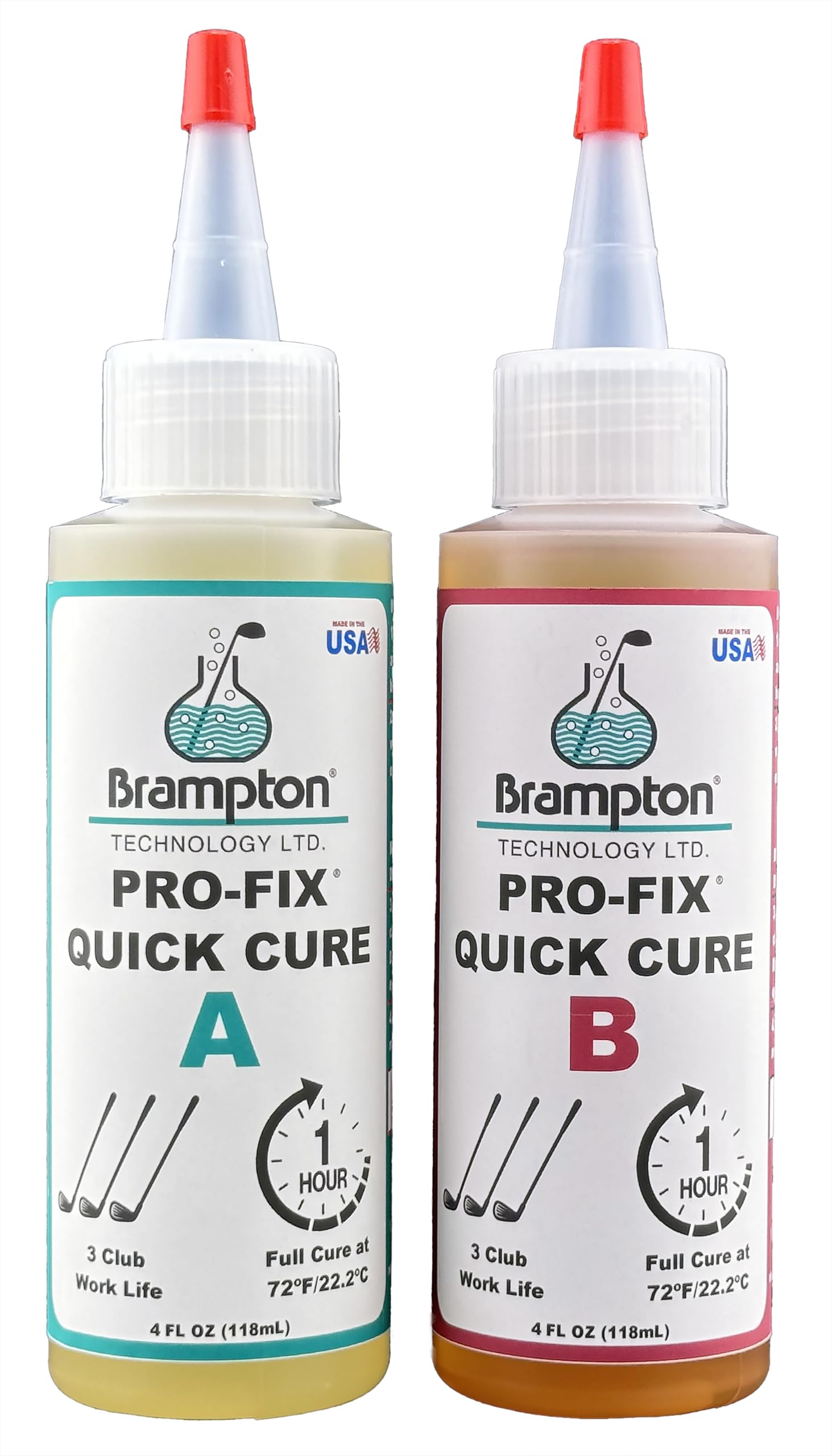
| Brampton PRO-FIX Quick Cure★ Best Overall | Fast single-club repair | 30 min | 125+ mph | 1:1 | Amazon |
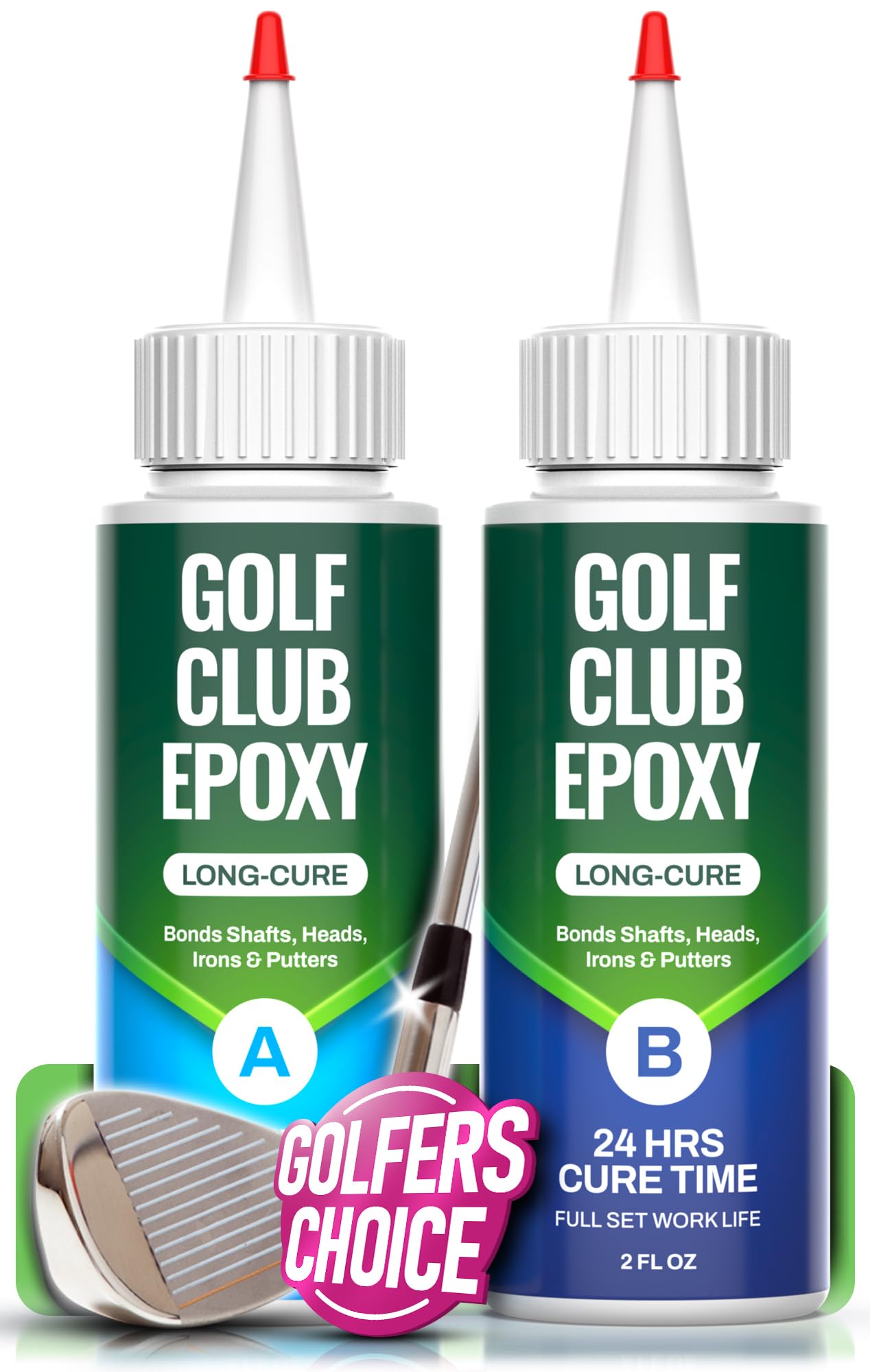
| FORTIVO Golf Club EpoxyBest Value | Full-set builds | 24 hr | 125+ mph | 1:1 | Amazon |
| DINGSEN Quick Cure | Waterproof outdoor play | 30 min | 125+ mph | 1:1 | Amazon |
| Birdie Bond by Maven | High-strength gap filling | 1.5 hr | 100+ mph | 1:1 | Amazon |
| The GolfWorks Max Strength | Pro-grade assembly | 20-30 min gel | — | 2:1 | Amazon |
| Hireko Dynacraft 32 oz | High-volume builds | 24 hr | — | 1:1 | Amazon |
In‑Depth Reviews
1. Brampton PRO-FIX Quick Cure Golf Epoxy
Our pick — 4.5★ from 450+ verified ratings; the strongest balance of quality and price.
The quickest bond in this roundup — full cure in just 30 minutes — from a formula designed by actual clubmakers and a chemical engineer.
You get a 5-minute work life (the time you have to mix and apply before it thickens) to assemble up to three clubs, and then a full cure in 30 minutes for swing speeds up to 125 mph. That means you can re-attach a driver head tonight and tee off with it tomorrow morning. Buyers report the bond holds strong even after repeated use — one owner used it on over a dozen clubs and noted the adhesion was excellent.
The quality wins people over here, with the material earning consistent praise as a versatile, reliable performer. The adhesion gets the most discussion — and while plenty of owners call it rock-solid, a few found it sets up brittle on very hard swings. The consensus is to work within 10 minutes rather than the 15 on the label to avoid premature thickening. If the bottle crystallizes from slow use, hot water re-thins it easily — a trick from the manufacturer that keeps the epoxy usable.
For the balance of speed, strength, and value, this is the crowd favorite. The crowd favorite — 4.5 stars across 400+ ratings — speaks to a product that simply works when you need it to, with a few caveats around timing.
What Owners Love
- Ready to swing in 30 minutes — the fastest full-cure time in this roundup.
- Engineered for swing speeds up to 125 mph, so it won’t crack on high-impact drives.
- Made in the USA with professional-grade quality that consistently reviews well.
The Honest Trade-offs
- Adhesion is mixed in reviews — some find it brittle rather than flexible.
- Can crystallize if you use the bottle slowly; needs hot water to re-thin.
- Only 5-minute work life means you can’t dawdle — plan your three clubs carefully.
Reach for it when: you need one club back in the bag tomorrow — driver, putter, or iron — and you trust an engineered formula from actual clubmakers.
Think twice if: you are building a full set in one session — the short work life makes it tight for more than three clubs at once.
2. FORTIVO Golf Club Epoxy
A 20-minute work life gives you the room to align a full set without rushing — then a 24-hour cure for a bond that the maker says resists cracking.
That is the opposite of the quick-fix approach, and that is exactly the point. The long window lets you assemble irons, woods, and putters in one uninterrupted session without rushing the alignment. It handles swing speeds over 125 mph and resists cracking because the cured bond stays non-brittle, which is a meaningful difference from some fast-cure epoxies that set glass-hard and then fracture under torque.
Durability and functionality both score highly across the reviews, with owners calling it easy to mix and work with. The makers designed it for all club materials — graphite, steel, titanium, and wood — and buyers confirm it bonds securely across the board. The honest trade-off is the packaging: the two parts come in one shared bag, which means you have to portion carefully to avoid contaminating the remaining epoxy. A 24-hour wait before play is the other reality, but the bond that results is described as “excellent hold.”
Perfect for the patient builder: If you are re-shafting a whole set of irons or extending graphite shafts, the 20-minute work life is a genuine advantage over the 5-minute quick-cure formulas. The slower approach also means no brittle surprises — just a strong, flexible bond that holds up on the course.
Grab this if: you want to build or re-shaft multiple clubs in one sitting without stress — the 20-minute window is a luxury.
skip it if: you need a club ready for tomorrow morning — plan for a full 24 hours before your first swing.
3. DINGSEN Quick Cure Golf Epoxy
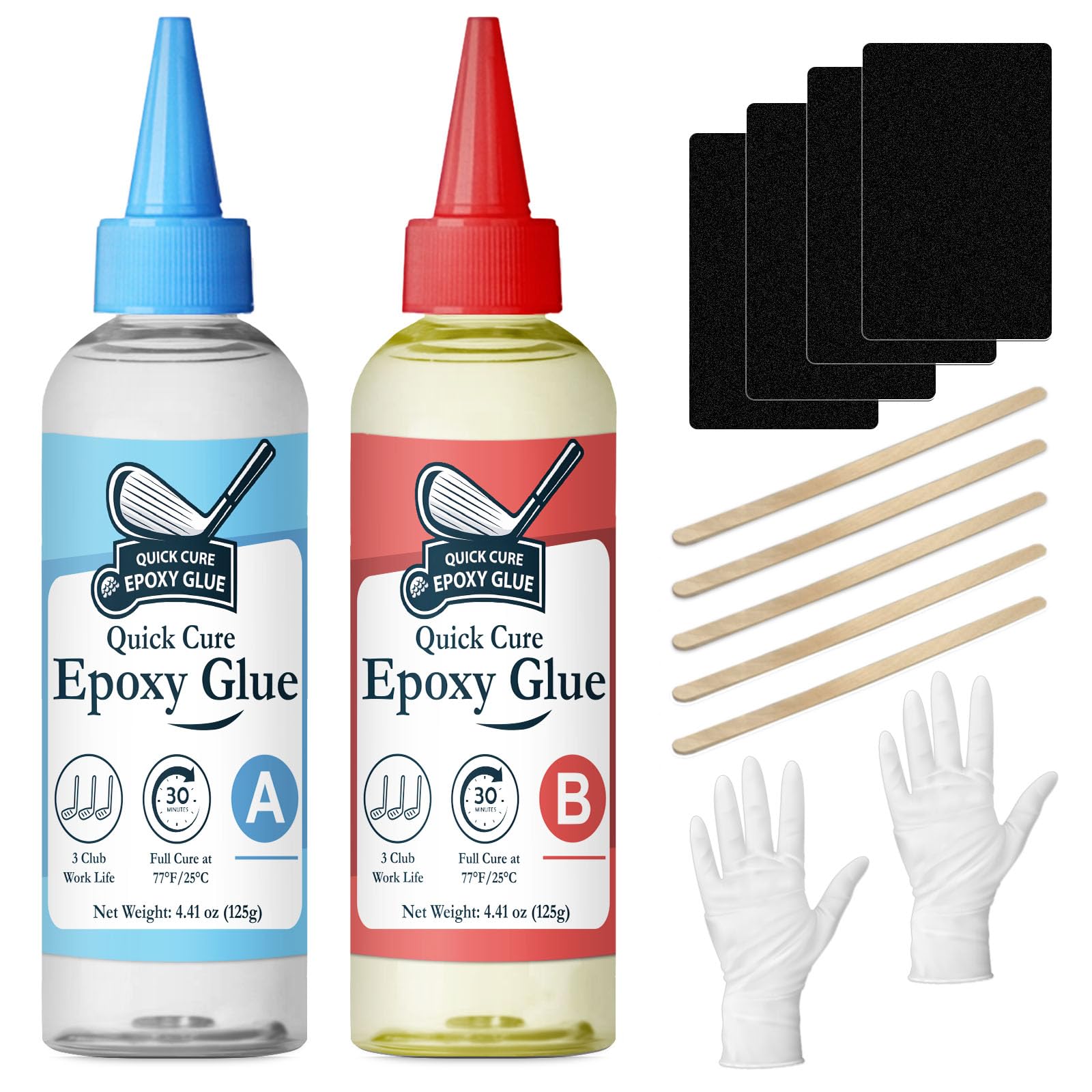
Cures clear and claims 100% waterproof protection — so your repair stays invisible and moisture can’t creep in over time.
This quick-cure formula matches the 5-minute work life and 30-minute cure time of the top pick, but adds two features that set it apart: it cures to a clear finish (so the repair is nearly invisible on the hosel) and it claims 100% waterproof protection. For anyone who plays in wet morning dew, humid coastal climates, or occasional rain rounds, that waterproofing matters — moisture intrusion is a common cause of bond failure over time. It handles swing speeds over 125 mph, just like the premium options.
The majority of buyers find it works well and sets up nicely, with many calling it easy enough for a novice to use. The clear bond is a genuine perk for ferrule repairs where you do not want a dark glue line showing. A small number of owners mention that the head can come loose on high-torque swings, which is a warning to mix the 1:1 ratio precisely and to rough up the shaft tip thoroughly before application. The consensus across the reviews is that when prep is done right, it holds fine; shortcuts are what cause re-dos.
Best for the cosmetic-conscious player: If you care about how the finished repair looks — or you are working on a putter or iron that shows bare metal at the ferrule — the clear, waterproof bond makes this a smart choice at a fair price.
Pick it when: you want the repair to disappear visually and you are playing in damp conditions regularly.
Be extra careful about: surface prep — sand the shaft and hosel thoroughly to avoid a loose bond under hard swings.
4. Birdie Bond 2-Part Golf Club Repair Epoxy by Maven
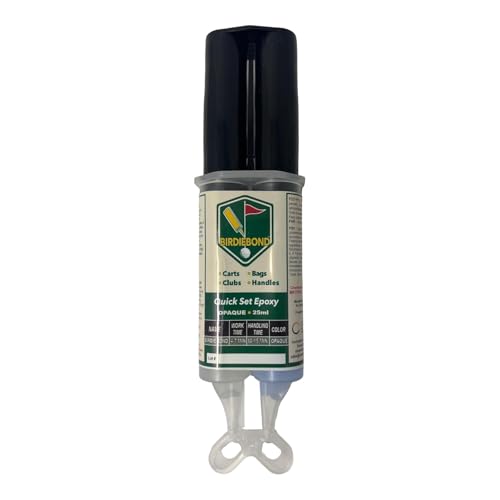
A thick gel formula (thixotropic means it does not sag or drip) that stays put in the hosel and fills gaps up to 0.250 inches — ideal for loose-fitting shafts.
When your shaft is slightly undersized for the hosel, or a worn ferrule leaves a visible gap, a runny epoxy will drip right out. This is where Birdie Bond earns its place — a thixotropic gel formula that stands up without sagging and fills gaps up to 0.250 inches. The tensile lap shear strength is 2,500 psi, which is a measured spec that gives you a real number (rather than a marketing claim) to compare against other structural bonds. It works on metal, graphite, ceramic, wood, and composite materials, making it genuinely universal for club repair.
The working time is 4 to 7 minutes, with a fixture in 10 to 15 and a functional cure in 1.5 hours — though the technical full cure is 48 hours for max strength. Customers note that the dual syringe can dispense unevenly at first, so a test squirt before you apply to the club saves frustration. The consistency is described as a stiff paste that is easy to control, and it cures to a rubberized matte finish rather than a glass-hard resin, which is unusual and may appeal to players who want some vibration damping in the bond.
The fixer for loose fits: If you are dealing with a shaft that has play inside the hosel, this gel formulation is the most forgiving option. It fills the void instead of flowing out, and the rubbery finish adds a layer of shock absorption.
Use it for: re-shafting older clubs where tolerances have widened, or for any repair where the bond needs to bridge a visible gap.
Note the learning curve: the syringe takes a gentle squeeze to get even flow, and you only have about 2 minutes of real workable time before the gel stiffens.
5. The GolfWorks Max Strength Tour Set Plus Beaded Epoxy

Pre-loaded with tiny glass beads that self-center the shaft inside the hosel, plus a shear strength of 4,500 psi.
This is the only option on the list that comes pre-loaded with shafting beads — tiny glass spheres mixed into the epoxy that ensure the shaft sits perfectly centered inside the hosel. That is a huge time-saver if you have ever fought with a shaft that wants to lean to one side as the epoxy cures. The shear strength is an impressive 4,500 psi, and it uses a 2:1 mix ratio (resin to hardener) that requires a compatible cartridge gun with a 2:1 plunger.
Owners are effusive about the bond — as buyers put it: “I’ve had other epoxies fail but never ever this one.” The effectiveness is the most praised aspect, and the beaded formula is credited with making alignment simple to use even for loose hosel fits. The clear drawback is that you need a special gun (the manufacturer’s VB1005 or any 50ml 2:1 cartridge gun) to dispense it. Without the gun, the dual cartridge is nearly impossible to use. It also cures to a rigid finish rather than a flexible one, which some pros prefer for pure power transfer.
The one for serious builders: If you are doing multiple builds per season and want a bond that consistently outperforms every general epoxy, this is it. The beads alone save enough alignment frustration to justify the price and the tool investment.
Buy it when: you already own (or are ready to buy) a 2:1 cartridge gun — the beads and 4,500 psi strength are worth the extra step.
pass on it if: you only glue a club once a year — the gun requirement adds cost and complexity for occasional users.
6. Hireko Dynacraft 24-Hour High-Strength Golf Club Shaft Epoxy
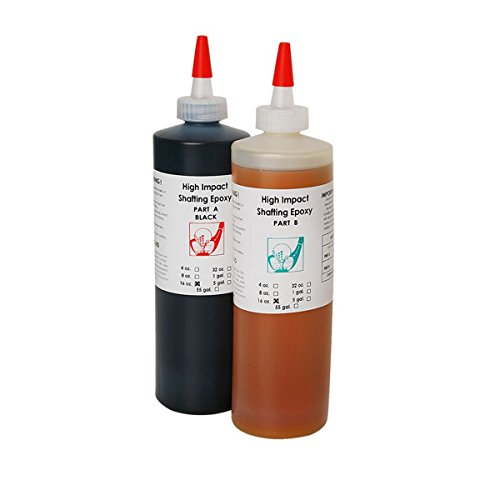
A 32-ounce kit the maker says builds over 400 clubs — the lowest per-club cost in this list by a wide margin.
This is the clear outlier in terms of volume — a 32-ounce kit with two 16-ounce bottles that the maker says is enough to build well over 400 golf clubs. The lap shear strength is 3,000 psi, and it uses a simple 1:1 mix ratio, so you do not need any special equipment. It dries black, which is a deliberate design choice: black hides the gap between the ferrule and the hosel, and it is especially useful for bore-through club heads where the glue line is visible through the sole.
Loyal users have been buying this epoxy for years, calling it “very strong” and praising that it does not shrink as it dries — a critical feature for keeping a shaft perfectly seated. The 20-minute set time and 24-hour full cure are standard for long-cure formulas. The catch, mentioned by several owners, is shelf life: if you buy a 32-ounce kit and use it slowly, the hardener can solidify after a year. That makes this epoxy a true volume play — great for a club builder or teaching pro, wasteful for the golfer who repairs one club every six months.
The Big Advantage
- 32 ounces builds over 400 clubs — the lowest per-club epoxy cost in this list by a wide margin.
- Dries black to hide ferrule gaps, which saves time on cosmetic finishing.
- 3,000 psi lap shear strength is a real measured spec for structural confidence.
The Real Catch
- Shelf life is limited — the hardener can harden after about a year if not used regularly.
- Requires a full 24-hour cure, so you need to plan builds a day ahead.
Ideal for: club fitters, driving range pros, or anyone building multiple sets per year — the economy of scale is real.
Not for: the casual golfer who needs one club fixed — you will waste most of the kit.
Understanding the Specs
Shear Strength (psi)
This number measures how much sideways force the glue joint can take before it slides apart — think of a fast-twisting swing where the shaft torques inside the hosel. A higher psi number (like 4,500 on the GolfWorks) means a more rigid, high-performance bond, while 2,500 to 3,000 psi is plenty for most amateur swings. The number really matters for fast-swing players; a lower-shear epoxy can twist and fail mid-round.
Work Life vs Cure Time
Work life is the window you have after mixing to apply the epoxy and align the club. Quick-cure formulas give you 4 to 5 minutes — enough for one or two clubs. Long-cure formulas give 20 to 30 minutes, which is a practical advantage for building a whole set in one session. Cure time is how long until the bond is full strength; a 30-minute cure sounds fast, but many long-cure epoxies need 24 hours to reach full hardness. Never swing a club before the full cure is done.
FAQ
Can I use regular hardware store epoxy on golf clubs?
Do I need shafting beads for every golf club repair?
How long should I let golf epoxy cure before playing?
Will golf epoxy work on both graphite and steel shafts?
Can I use golf epoxy for other repairs around the house?
What happens if I use expired or old epoxy?
Is a 1:1 mix ratio easier to get right than a 2:1 ratio?
How do I remove old epoxy from a golf club hosel?
Final Thoughts: The Verdict
For the majority of shoppers, the epoxy for golf clubs winner is the Brampton PRO-FIX Quick Cure because it delivers a fast 30-minute cure, professional-grade engineering from actual clubmakers, and a bond that handles 125 mph swings — all from a formula that tens of thousands of owners trust. If you are building a full set and need more work time, the FORTIVO Golf Club Epoxy gives you a generous 20-minute window at a fair price. And for the high-volume builder who wants to bring the per-club cost down to pennies, the Hireko Dynacraft 32-ounce kit is the bulk play that delivers 3,000 psi strength for over 400 clubs.
How We Picked
We do not accept paid placement. Every pick is matched to a real buyer and a real use-case; we do not hands-on test units.
Sources & Methodology
Specifications: manufacturer listings and product documentation. Review insights: verified customer reviews, as of July 2026. Pricing: not shown on this page (it changes often); check the current price via the retailer link.
As an Amazon Associate, WellFizz earns from qualifying purchases. This does not affect which products we feature.
Related Guides

Mo Maruf
I created WellFizz to bridge the gap between vague wellness advice and actionable solutions. My mission is simple: to decode the research and give you practical tools you can actually use.
Beyond the data, I am a passionate traveler. I believe that stepping away from the screen to explore new environments is essential for mental clarity and physical vitality.