Our readers keep the lights on and my smoothie glass nicely filled. As an Amazon Associate, I earn from qualifying purchases.
Specs are compiled from manufacturer listings and verified buyer reviews and can change over time — please confirm the key details on the product page before buying.
Concrete cracks happen — foundation settling, freeze-thaw cycles, a dropped corner, or just plain age. The difference between a repair that lasts a season and one that lasts a decade is the epoxy you choose. The wrong filler crumbles. The right epoxy bonds so strong the concrete itself gives way first.
I’m Mohammad Maruf — the founder and writer behind WellFizz. This guide is built by comparing the manufacturers’ published specifications and the patterns across verified customer reviews, so you get each pick’s real strengths and trade-offs instead of marketing spin.
This roundup cuts through the confusion to find the best epoxy for concrete repair for every type of job — from a hairline garage crack to a heavy structural anchor in a foundation wall.
Our Picks at a Glance

How To Choose The Best Epoxy For Concrete Repair
Not all concrete epoxies are the same. The one that fills a wide spalled step is useless for injecting a hairline foundation crack — and vice versa. Here is what you need to match to your job.
Paste vs. Liquid: Which Form for Which Job
A thick, non-sagging paste is built for overhead, vertical, and horizontal surfaces where you need the epoxy to stay put — filling missing corners, rebuilding a step edge, or sealing a crack on a wall. A thin, low-viscosity liquid is designed to flow deep into narrow hairline cracks, sometimes using injection ports, to fill every void from the inside out.
Working Time and Cure Time
Working time (or pot life) is how long you have to mix and apply the epoxy before it stiffens. You want at least 5-10 minutes for a simple dab repair and 20 minutes or more for a large patch or multiple anchors. Cure time is how long before you can load it — some epoxies allow light foot traffic in 12 hours, but full structural loads often take 24 hours to several days. Cold temperatures slow both.
Moisture and Temperature Tolerance
Some epoxies can be applied to damp concrete or even underwater. If you are repairing a basement wall with active seepage or an outdoor slab in a wet climate, choose a product rated for wet-surface application. Also check the ambient temperature range; many epoxies won’t cure properly below 35°F or above 115°F.
Quick Comparison
| Model | Best For | Form | Working Time | Cure Time | Amazon |
|---|---|---|---|---|---|
| PC Products PC-Masonry 8 oz★ Best Overall | General masonry patch & adhesion | Non-sag paste | ~5 min | 1-2 days | Amazon |
| PC Products PC-Masonry 32 ozBest Value | Large-volume masonry repair | Non-sag paste | ~15 min | ~4 hours | Amazon |
| Abatron Abocrete Kit 1.25 qtPremium Pick | Self-leveling floor & step repair | Self-leveling liquid | N/A | N/A | Amazon |
| Akona Epoxy Crack Repair 6 oz | Hairline crack injection | Thin liquid | N/A | 3.5 hours | Amazon |
| DRICORE PRO Adhesive Epoxy 16 oz | Bonding broken concrete pieces | Liquid | N/A | N/A | Amazon |
| DCP Quickmast Anchor E 20.2 oz | Heavy structural anchoring | Liquid cartridge | 3-20 min | 3-24 hours | Amazon |
| QuestMark 2105 Epoxy Mortar 1 Gal | Warehouse floor patching | Mortar | 20-30 min | 2-7 days | Amazon |
| PC Products PC-Concrete 102 oz | Large crack & anchor jobs | Paste | 20 min | 4 hours | Amazon |
| Polygem LCR Epoxy Kit | Structural foundation crack repair | Paste + liquid injection | N/A | 24 hours | Amazon |
In‑Depth Reviews
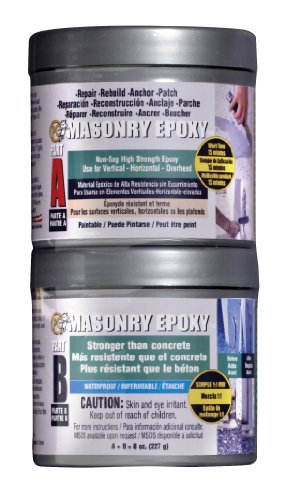
1. PC Products PC-Masonry Epoxy Adhesive Paste, Two-Part Repair, 8 oz
Our pick — over 4.5★ from 300+ verified ratings; the strongest balance of quality and price.
The repair that holds wet, holds overhead, and holds up for years.
This two-part paste is what you reach for when you need to replace a missing chunk of concrete or glue a broken piece back on. It is a non-sagging formula, meaning it stays on a vertical wall or an overhead surface without drooping — a lifesaver for fixing a broken stair nosing or a ceiling crack. You can apply it to both wet and dry surfaces, which opens up basement repairs and damp outdoor slabs.
The working time sits around 5 minutes, which is tight but manageable for small repairs — you shape it, then let it harden to a stone-like finish over one to two days. Buyers report it “excellent for repairing broken flagstone pavers” and note it held up underwater for two months without issue. At 10.24 ounces per kit, it is the compact hero that punches way above its size.
Why it wins the list
- Non-sag paste works on vertical and overhead surfaces
- Can be applied to damp concrete
- Sets hard enough to sand, paint, or machine
- Wide temperature range: 35°F to 115°F application
The trade-off
- Short working time means you must work fast
- Rough, gritty texture when cured — not a smooth finish
Reach for it if: you need a versatile, all-weather paste for patching, bonding, or rebuilding masonry indoors or out — it is the most trusted single repair in this lineup.
skip it if: you need a thin liquid for deep crack injection; you want that from a different product.
2. PC Products PC-Masonry Epoxy Adhesive Paste, Two-Part Repair, 32 oz
Same trusted paste, four times the quantity for bigger jobs.
If you need to fix multiple broken spots at once — like concrete planter corners, fieldstone pavers, or a brick staircase — this big-batch version gives you 32 ounces in two jars (four times the 8-ounce size of the standard PC-Masonry paste). It uses the same non-sag paste formula that sticks to wet surfaces and works in temperatures from 35°F to 115°F, so you can repair outdoors in cool or hot weather without the epoxy sliding off.
The working time is roughly 15 minutes, and users report it hardens into a “rock-like monolith” that does not crack or flake. The thing owners praise most is the adhesion — 43 buyers single it out — and the durability follows close behind at 30 mentions. The paste has a rough gritty texture, so a smooth finish requires extra effort. At about 16 ounces of actual material weight per kit (the jars hold 32 oz of epoxy), it gives you room to tackle a weekend’s worth of repairs.
Volume advantage
- Same formula as the top pick but 4x larger
- Adhesion is the most-praised feature — strong bond to concrete
- Can be painted, stained, or machined after full cure
Reality check
- Texture is gritty; not a smooth finish for visible repairs
- Some find the mixed paste hard to work with
Best for: anyone with multiple cracks, larger missing sections, or a series of masonry repairs — this is the cost-efficient way to buy the same paste.
Not ideal if: you only need a single small patch; the 8-ounce version is less wasteful.
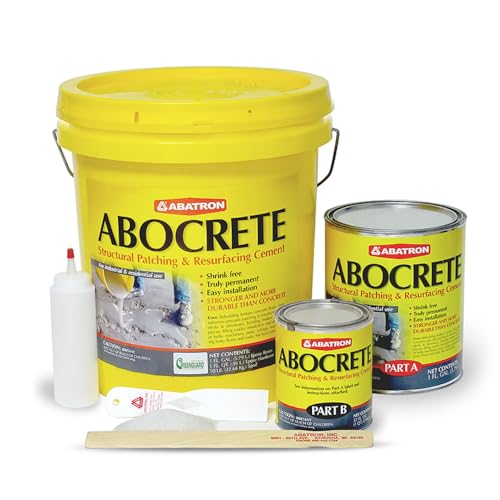
3. Abatron Abocrete Kit – Self-Leveling Concrete Epoxy Patching Compound, 1.25 Quarts
A low-odor, self-leveling compound that heals floors without the fumes.
If you are patching a concrete floor that needs to be smooth and level — not just filled — this kit is built for it. The Abocrete compound is a self-leveling liquid that you pour and trowel, and it finds its own flat surface. It is Greenguard certified, meaning it contains virtually no VOCs (volatile organic compounds — the harsh fumes you smell from standard epoxy), so you can use it indoors without gassing out the house. It also resists salt water, oil, and chemicals that would eat regular concrete.
This is a premium product at a premium price. The kit includes the epoxy and sand to mix yourself. One important note: the listed volume is mostly sand, with about 40 ounces of actual epoxy resin. If you use all the sand, the mix becomes thick and non-pourable — so reserve some sand if you want a thin, self-leveling layer. Buyers driving forklifts over the repaired area report it “still is holding strong” after continuous heavy traffic.
Why choose this
- Self-leveling — great for floors and steps
- Low odor, almost no VOCs for indoor use
- Chemical, oil, and salt-water resistant
- Shrink-free; can be applied at any thickness
What to watch
- Expensive; the cost is premium
- Color and texture don’t match concrete perfectly
- Easy to add too much sand and ruin the self-leveling property
One-liner verdict: the go-to for an indoor floor repair that needs to be smooth, strong, and fume-free — and where you can afford the investment.
Catch: the sand-to-epoxy ratio is tricky; follow the “keep it thin” advice from experienced owners.
4. DCP Quickmast Anchor E Concrete Anchoring Epoxy, 20.2 fl oz

The cartridge system that sets fast and holds a 9,000-pound lift.
This is a dual-cartridge system made for anchoring threaded rods, rebar, and heavy bolts into concrete. It is not a crack-filler in the paste sense — it is a fast-setting liquid epoxy that you inject into a drilled hole, then insert your anchor. The working time ranges from 3 to 20 minutes depending on temperature, giving you flexibility, and full cure takes between 3 and 24 hours. The bond is so strong that one owner anchored a 9,000-pound two-post car lift with 3/4-inch threaded rods and said “no way these are coming out.”
At 20.2 fluid ounces in a dual cartridge, it fits a standard caulking gun. It can also repair large cracks — one buyer sealed a big crack and reported the epoxy “worked great.” The trade-off is that the included caulking gun is poor quality, so plan on using your own. And because it sets fast in the mixing tube, you must use all the epoxy once you start dispensing.
Anchor strength
- 3-20 minute working time — flexible for multiple anchors
- Works in wet and dry concrete holes
- Fast-setting; can load fully in 3 hours in warmer conditions
The catch
- Needs a dual-tube caulking gun (not included)
- Cartridge hardens in the mixing tube between jobs
Grab this if: you are anchoring bolts, threaded rods, or rebar into concrete floors or walls — this is the structural specialist of the group.
pass on it if: you just need to fill a surface crack; a paste epoxy is simpler and cheaper.
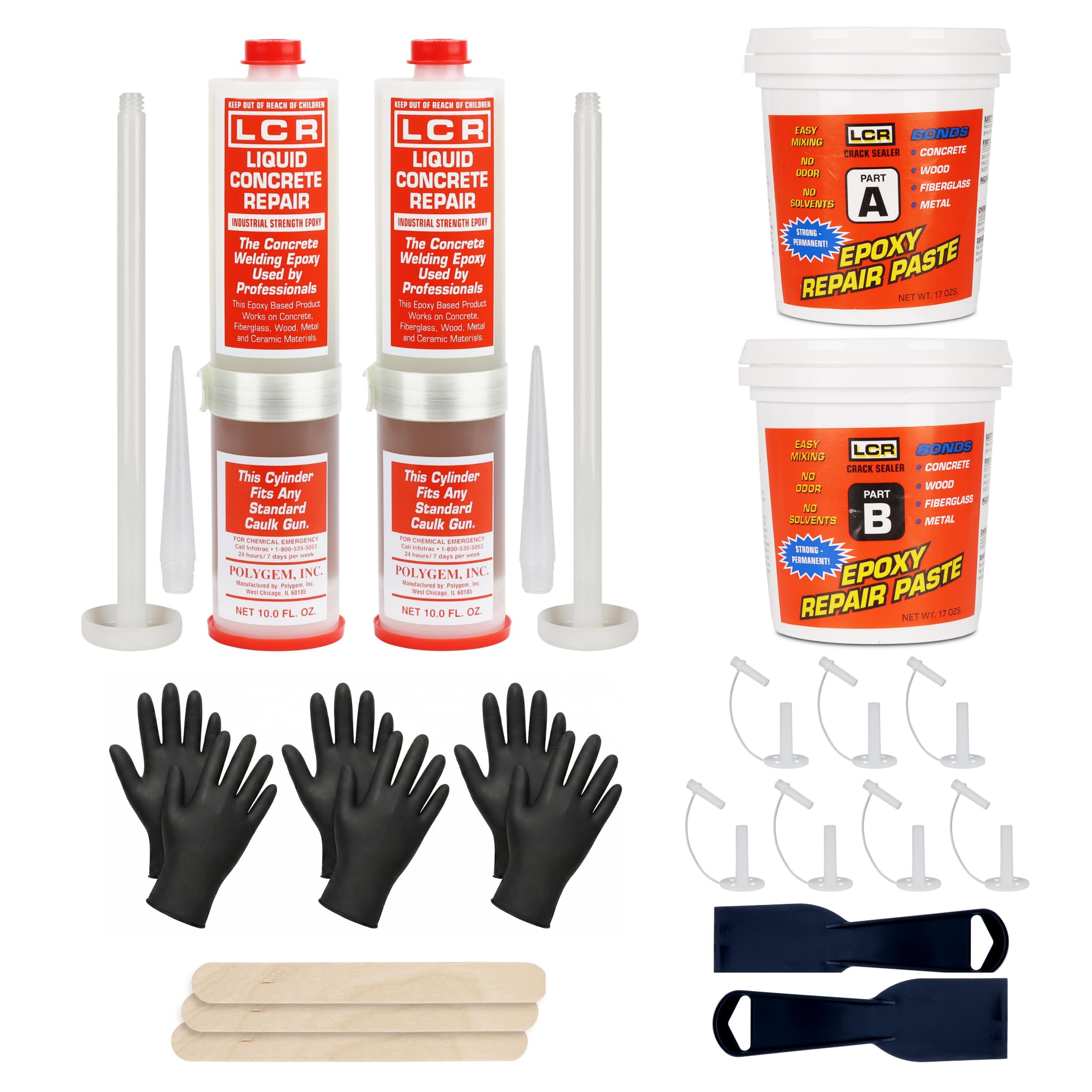
5. Polygem LCR Epoxy Concrete Crack Repair Kit
A professional-grade injection kit that permanently stops foundation leaks.
This is the full system for repairing structural cracks in foundations, basement walls, and slabs where water leaks through. It includes a two-part epoxy paste for adhering injection ports and covering the crack surface, plus two 10-ounce cartridges of liquid epoxy resin that you inject under pressure to fill the void from the inside. The kit is designed to repair an 8-foot crack between 1/16 and 1/8 inch wide, and it bonds to concrete, wood, fiberglass, and metal — so it works on more than just masonry.
The real strength here is stopping leaks permanently. The liquid epoxy flows deep into the crack and cures to a rock-hard seal that prevents further water penetration. Owners note it sealed a wall “great” and successfully slowed a basement leak. However, this is not a simple squeeze-and-go product — the process of seating and sealing injection ports, then applying the liquid at the right pressure, requires patience and careful prep.
Professional-level repair
- Complete system with paste, liquid epoxy, injection ports, and mixing tools
- Designed to stop water leaks permanently
- Versatile — works on wood, fiberglass, metal, and concrete
The difficulty
- Not beginner-friendly — proper prep is critical to success
- One tube covers roughly 4 feet; a large crack needs multiple kits
- Expensive; each kit is a significant investment
Ideal for: anyone with a leaking foundation crack who wants a permanent, structural fix and is ready to follow a careful multi-step process.
Not for: a quick dab repair or a first-time DIYer who wants a no-fuss product.
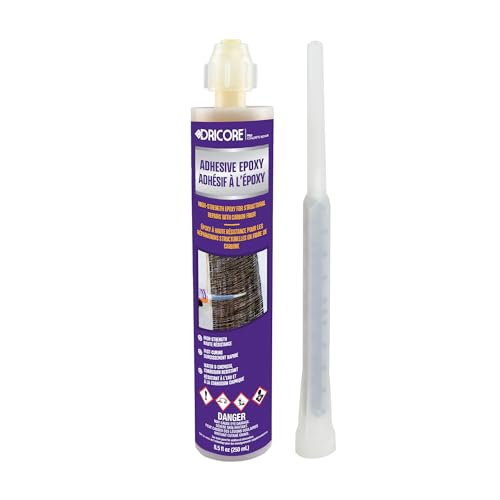
6. DRICORE PRO Concrete Repair Adhesive Epoxy, 16 oz
A self-mixing liquid that penetrates deep and bonds broken pieces with incredible strength.
This is a high-strength liquid epoxy from DRICORE that uses a self-mixing cartridge — you just attach the nozzle and squeeze. It is designed to work with carbon fiber reinforcement for structural repair, but it also performs as a standalone adhesive for bonding broken concrete, attaching threaded rods, or filling cracks. The 16-ounce cartridge (8.5 fluid ounces of actual epoxy) is enough for several medium repairs.
What stands out is the penetration. The liquid formula is thin enough to seep into deep, narrow cracks — one owner reported it “penetrated deep enough to hold it nicely” when used on a cement crack. It also bonded a concrete statue head back onto the body “like magic.” At 4.2 stars across 47 ratings, the crowd finds it effective, but the smaller review pool means a few bad experiences carry more weight. It is water-resistant after curing, so it handles outdoor use well.
Deep penetration
- Self-mixing cartridge — no manual mixing
- Penetrates deep into cracks for a strong internal bond
- Water-resistant after curing; good for outdoor repairs
- Can be used with carbon fiber for added structural strength
Limited data
- Fewer reviews than the top picks — less long-term feedback
- Specific use with DRICORE carbon fiber may not apply to everyone
Best for: a DIYer who wants a liquid epoxy that self-mixes and is strong enough for structural bonding and crack filling.
Think twice if: you need a thick paste for vertical or overhead repairs — this is a runny liquid.
7. Akona Epoxy Crack Repair, 6 Ounces

The thinnest epoxy here, designed to flow into hairline cracks and set clear.
When you have a hairline crack in stamped concrete, a foundation wall, or a brick joint, you need an epoxy thin enough to flow into that gap — not a paste that sits on the surface. This Akona repair is a low-viscosity liquid that comes in a tube with a fluid mixing nozzle, designed for cracks up to a 1/4-inch wide and 6 inches deep. It cures clear, so it blends into the surface visually.
You get a fast cure time of 3.5 hours, which is shorter than most epoxies in this guide. Buyers who used it on garage floor cracks report the seal held up “through winter summer and spring.” The trade-off is that this epoxy is very runny. On vertical cracks, it can drip out before it sets, and some owners say puddles on the ground took “weeks to harden.” So this epoxy works best on horizontal or near-horizontal cracks where gravity helps the flow, not fights it. it’s not for you if you need to repair a vertical wall or overhead surface.
For fine cracks
- Very low viscosity — flows deep into hairline cracks
- Cures clear, so the repair is less visible
- Fast 3.5-hour full cure
- Stronger than the concrete itself once cured
Honest limits
- Too runny for vertical cracks — leaks out before it sets
- Hardens in the nozzle if not used quickly
- Mixing ratio can be inconsistent between tubes
Reach for this if: you have thin, horizontal cracks in a patio, garage floor, or basement slab that need deep penetration and a fast cure.
Look elsewhere if: your crack is on a wall or overhead — the liquid will run right out.
8. PC Products PC-Concrete Epoxy Adhesive Paste, 102 oz

The big-bucket paste for anchoring and crack repair with a forgiving work window.
If you need to anchor threaded rods or bolts into concrete, grout-filled block, or masonry, this is the larger cousin of the PC Masonry paste — 102 ounces in a pail. It meets ASTM C881-99 (a standard for epoxy repair materials), so it is designed for structural bonding. You get a 20-minute working time and a 4-hour cure at 75°F, which gives you much more time to position bolts than the 5-minute window of the smaller PC-Masonry paste.
The high-tack formula resists moisture, so it works in damp environments. Owners have used it to stop active water seepage in foundation cracks — after widening the crack with a diamond grinder and applying this paste, two rain events later there were no leaks. Another buyer repaired concrete pool settling cracks and the pool held water all summer. The downside is the paste can sink and leave low spots in repairs, so you may need a second pass.
Generous work time
- 20-minute working time — plenty for large or complex repairs
- Meets ASTM C881-99 quality standard
- Moisture resistant; works in damp conditions
- Cures in 4 hours; full strength by next day
Finish challenge
- Paste tends to sink and leave pinholes or low spots
- Very large bucket — only makes sense for big jobs
Who it’s for: a contractor or serious DIYer with a major crack-filling or anchoring project — the 20-minute work window and 4-hour cure make it the most production-friendly epoxy here.
Who might skip it: anyone patching a single small crack; you will have a lot of leftover epoxy.
9. QuestMark 2105 Standard Epoxy Concrete Floor Patch, 1 Gallon

A zero-VOC epoxy mortar that patches warehouse floors and outdoor walkways with 6700 psi of tensile strength.
This is a 100% solids epoxy mortar — meaning it contains no VOCs, no solvents, and no water, which makes it safe for indoor use without strong fumes. It is designed specifically for floors that need patching or resurfacing but do not require extreme chemical resistance. The mortar consistency goes on like playdough and dries brick-hard in about an hour. Full cure for heavy traffic takes 2 to 7 days depending on temperature and thickness.
You get a smooth working time of 20-30 minutes at 70°F, and you can recoat it in 6-7 hours for thicker builds. One buyer used it to patch a warehouse floor and said it “holds up well with heavy use.” The biggest issue reported is inconsistent epoxy-to-hardener ratios between units — one out of four kits had 50% less epoxy, and the manufacturer was unreachable for support. That is a real risk for a product at this price, so check the contents before you start.
Floor repair specialist
- 100% solids, zero VOCs — safe for indoor use
- 20-30 minute working time
- 6700 psi tensile strength
- Can be used indoors and outdoors
Quality control
- Some units had mismatched epoxy/hardener ratios
- Manufacturer support was unresponsive in reports
- Full cure for heavy loads takes up to 7 days
Choose this for: a medium-to-large floor patching job in a workshop, garage, loading dock, or walkway where you need a strong, low-fume epoxy mortar.
Pass on it if: you cannot risk a defective batch or need responsive manufacturer support for a time-sensitive job.
Understanding the Specs
Paste vs. Liquid Form
Paste epoxy is thick, non-sagging, and stays where you put it. It is ideal for vertical or overhead repairs, rebuilding missing concrete, and filling wide gaps. Liquid epoxy is thin and runny. It flows into narrow cracks and uses injection ports to reach deep inside a foundation or slab. The wrong form for your crack angle is the most common mistake — paste on a hairline crack sits on top, while liquid on a vertical crack runs straight out the bottom.
Cure Time and Full Strength
Cure time is when the epoxy is solid enough for light contact or sanding. Full cure (or “full load” time) is when it reaches its maximum structural strength. A product might cure in 3.5 hours but not be ready for heavy foot or vehicle traffic for several days. Temperature dramatically affects both — cold slows the chemical reaction, heat speeds it up. Always check the product’s temperature range before applying.
FAQ
Can I apply epoxy to a wet or damp concrete crack?
How long does epoxy concrete repair last?
What is the difference between epoxy and hydraulic cement for concrete repair?
Can I use regular epoxy from a hardware store for concrete repair?
How do I prepare a concrete crack before applying epoxy?
Can epoxy concrete repair be painted or coated over?
What is the difference between a cartridge and a jar kit?
How much epoxy do I need for my crack repair?
Is epoxy concrete repair safe for indoor use?
Final Thoughts: The Verdict
For most people, the epoxy for concrete repair winner is the PC Products PC-Masonry 8 oz because it handles vertical, horizontal, and outdoor repairs with a moisture-resistant paste that just works. If you need to anchor heavy bolts into concrete, grab the DCP Quickmast Anchor E — its 3 to 20-minute working time and structural bond are class-leading. And for a leaking foundation crack that needs a permanent, pressure-injected seal, the Polygem LCR Epoxy Kit is the one to reach for.
How We Picked
We do not accept paid placement. Every pick is matched to a real buyer and a real use-case; we do not hands-on test units.
Sources & Methodology
Specifications: manufacturer listings and product documentation. Review insights: verified customer reviews, as of July 2026. Pricing: not shown on this page (it changes often); check the current price via the retailer link.
As an Amazon Associate, WellFizz earns from qualifying purchases. This does not affect which products we feature.
Related Guides

Mo Maruf
I created WellFizz to bridge the gap between vague wellness advice and actionable solutions. My mission is simple: to decode the research and give you practical tools you can actually use.
Beyond the data, I am a passionate traveler. I believe that stepping away from the screen to explore new environments is essential for mental clarity and physical vitality.