Our readers keep the lights on and my smoothie glass nicely filled. As an Amazon Associate, I earn from qualifying purchases.
Specs are compiled from manufacturer listings and verified buyer reviews and can change over time — please confirm the key details on the product page before buying.
You need an epoxy that grabs aluminum’s slick surface and stays, not one that peels off after a temperature swing or a bump. The wrong glue fails the moment the metal expands in the sun. This guide covers only epoxies made specifically for metal — ones that create a real chemical and mechanical grip that lasts.
I’m Mohammad Maruf — the founder and writer behind WellFizz. This guide is built by comparing the manufacturers’ published specifications and the patterns across verified customer reviews, so you get each pick’s real strengths and trade-offs instead of marketing spin.
Choosing the best epoxy for aluminum means deciding between flexibility for parts that vibrate and rigid strength for load-bearing repairs. Thousands of owners’ reports back these picks.
Our Picks at a Glance

How To Choose The Best Epoxy For Aluminum
Aluminum naturally forms a thin, invisible oxide layer that most glues cannot grip. You need an epoxy that either flexes with the metal or grabs it with a strong mechanical bond. Here are the key features to consider before you buy.
Flexibility vs. Rigidity
A flexible epoxy works on parts that expand and contract with temperature changes — think boat hulls, outdoor furniture, or engine components near heat. Stiffer epoxies are better for load-bearing repairs where any movement would crack the bond, such as fixing a broken bracket or filling a stripped thread.
Cure Time and Working Time
Fast-setting epoxies (5 to 10 minutes) work for emergency patches where you need to stop a leak immediately. Slow-curing epoxies (30 minutes or more) give you time to position clamps, align parts, and build up a repair layer by layer. The trade-off is patience for precision.
Temperature and Chemical Resistance
If your repair sits near an engine, exhaust, or under the hood, choose an epoxy rated for sustained high heat — some handle up to 392°F. For marine or outdoor use, waterproof and oil-resistant formulas keep the bond from softening when things get wet.
Surface Preparation Method
No epoxy works well on bare, greasy aluminum. Every successful repair starts the same: sand the surface with 60 to 80-grit paper, wipe clean with acetone or alcohol, and in some cases flame-treat to burn off the oxide layer. Some epoxies are designed to bond to weathered aluminum without flame treatment, but good prep still matters.
Quick Comparison
| Model | Best For | Cure Time | Work / Pot Life | Heat Resistance | Amazon |
|---|---|---|---|---|---|
| West System G/flex 655-8★ Best Overall | Flexible bonds on dissimilar metals | 24 hours | 46 min pot life / 60-75 min open | — | Amazon |
| AOJEL S300Structural Pick | Rigid structural repairs | At least 24 hours | 30 min | 392°F | Amazon |
| J-B Weld MarineWeldMarine Standard | Marine and underwater repairs | 15-24 hours | 4-6 hours set | — | Amazon |
| Brampton Extra Strength | Versatile household repairs | 24 hours | 20 min | — | Amazon |
| Metal Glue (Cerca de) | Fast, affordable fixes | 12 hours | 10 min set | — | Amazon |
| SprayMax 2K Epoxy Primer | Painting and corrosion protection | 12 hours | N/A (spray) | — | Amazon |
| STAR BRITE Aluminum Putty | Emergency boat patches | 60 min | 5-10 min set | High temp (exhaust systems) | Amazon |
| 3M Panel Bonding Adhesive | Automotive panel bonding | 24 hours | — | — | Amazon |
In‑Depth Reviews
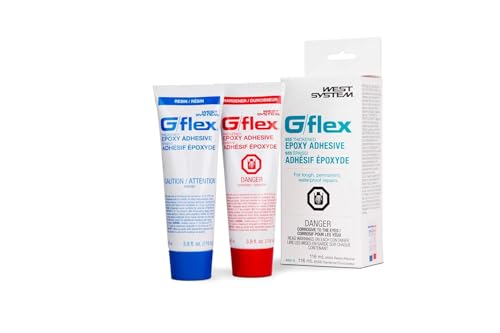
1. West System 655-8 G/flex Epoxy Adhesive
Our pick — over 4.5★ from 600+ verified ratings; the strongest balance of quality and price.
The epoxy that flexes where rigid glues crack and shatter.
This is the one that wins on versatility for tough-to-bond metals. The G/flex formula has a modulus of elasticity of 150,000 PSI, which in plain terms means it bends slightly under stress rather than snapping — exactly what you need on an aluminum boat hull that works and twists in the water or on an RV tank that expands with temperature shifts. It gives you a 46-minute pot life at 72°F and an open working time of 60 to 75 minutes, so you can take your time aligning parts. The initial cure hits in 3 to 4 hours, and the full cure settles at 24 hours.
What owners rave about matches that spec sheet perfectly. The strongest praise lands on effectiveness, with quality and durability close behind. One owner used it to repair a cracked polyethylene black tank and reported the bond held 30 gallons without leaks after careful prep including sanding, alcohol cleaning, and flame treatment. Another points out that the cured product is translucent gold-yellow rather than white as the packaging suggests — a minor visual surprise but zero impact on performance.
The catch is that it demands thorough surface prep. This is not a squeeze-and-forget adhesive; it rewards sanding, degreasing, and especially flame-treating the aluminum or plastic. For anyone willing to follow the prep steps, the bond becomes permanent in a way that cheaper hardware-store tubes cannot match.
Flexible epoxy bonding
- Flexibility absorbs vibration and thermal expansion without cracking
- Long working time lets you clamp and align carefully
- Bonds to notoriously difficult surfaces like polyethylene after flame treatment
Needs careful mixing
- Full cure takes a full 24 hours — not for quick fixes
- Cures translucent gold-yellow, not the white shown on the tube
- Requires thorough prep, including flame treatment for some plastics
For flexible repairs: You need a proven, flexible bond on aluminum in marine or high-vibration settings and have the patience for proper prep.
Not for rigid joints: You need a fast, grab-and-go repair that cures in under an hour.
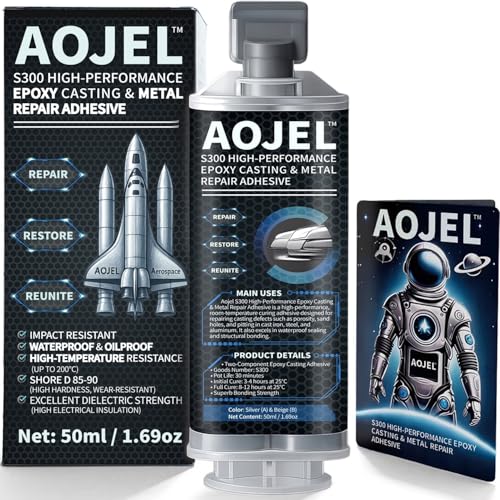
2. AOJEL S300 Structural Metal Epoxy
Liquid steel for brackets, housings, and engine parts when welding is not an option.
The AOJEL S300 is a metal-filled epoxy formulated for rigid load-bearing repairs. It follows what the maker calls a 30 / 3-4 / 24 system — up to 30 minutes of working time at 77°F, an initial set in 3 to 4 hours, and a full cure in at least 24 hours before you load or finish the part. Once cured, it is waterproof, oil resistant, and heat resistant up to 392°F, meaning it can sit on an engine crankcase or exhaust component without softening.
Owners consistently praise its effectiveness and durability, with one describing it as “effectively liquid steel” and another using it to fix a cracked crankcase on a 2003 Honda 450 Foreman where heat and vibration did not break the bond. The plunger mechanism in the dual cartridge can make it tricky to get even amounts of both parts on the first squeeze, especially for small repairs.
The honest limitation is the 1.69-ounce cartridge — this is for localized repairs, not gap-filling a large panel. The maker explicitly excludes flexible parts, fuel lines, and pressure-critical systems from its intended use, so respect that boundary.
Strong metal adhesion: This epoxy rebuilds stripped threads, cracked castings, and worn brackets with a hard, machinable finish that you can drill, tap, file, and paint right after full cure.
3. J-B Weld 8272 MarineWeld Marine Epoxy (3-Pack)
A cold-weld system designed to hold strong above and below the waterline.
J-B Weld is a household name in metal repair, and the MarineWeld formula is their specific answer for aluminum, metal, composites, and fiberglass in wet environments. It sets in 4 to 6 hours at room temperature and cures to a dark grey finish in 15 to 24 hours. Once fully cured, it can be shaped, tapped, filed, sanded, and drilled — and it retains its strength even when submerged. The three-pack gives you multiple repairs in one purchase, which is a practical edge over single-tube kits.
The owner feedback here is unusually emphatic. Not many products earn the line “this is the strongest epoxy I’ve ever used” from a lifetime technician who has tried every brand. Bonding performance is the most-cited positive by a wide margin, with durability running second. One owner used it to seal a hole in an outboard thermostat housing, and another relied on it for kayak repair. The 4 to 6-hour set time is the trade-off — it is not the fastest, but that slower cure contributes to the bond’s strength and gives you time to work.
If a repair needs to survive below the waterline on a boat or in a marine cooling system, this is the most trusted cold-weld option in this lineup.
For boat repairs: This epoxy delivers the strongest bond of any pick here, proven on aluminum and fiberglass in saltwater and freshwater conditions alike.
Not for quick fixes: At 15 to 24 hours to full cure, you need to keep the part undisturbed overnight before putting it back in service.
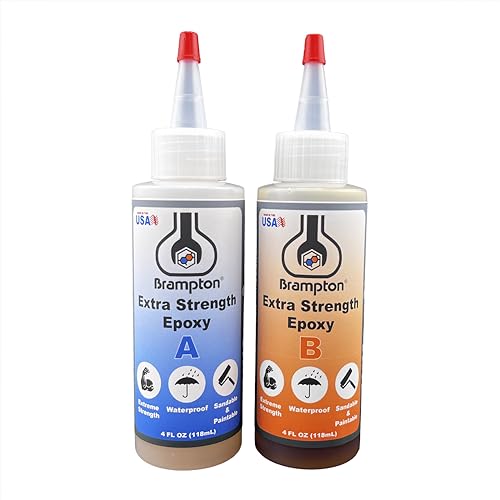
4. Brampton Extra Strength Epoxy, 20-Minute Work Life
A large-value bottle kit that dries crisp for visible repair areas.
This is the biggest value proposition in the list — an 8-ounce dual-bottle kit rather than the small syringe or tube format most competitors use. The 20-minute work life is the key rhythm: you mix a 1-to-1 ratio by volume, get a third of an hour to position and clamp, and then the epoxy thickens into a no-drip consistency suitable for vertical surfaces. The full cure arrives at 24 hours, and the result is an impact-resistant, waterproof bond that sands and paints like a solid surface.
The standout detail is that it dries absolutely clear. That matters on visible repairs like a reattached axe handle or a fiberglass ladder rung, where a dark grey or amber glue line would look messy. Owners note it is thinner than some expect when first mixed, but it thickens nicely after a moment and holds on vertical surfaces without sagging. The consensus calls it better value than the small tubes at hardware stores — “saves a lot of money” is a recurring line.
The catch is the 24-hour full cure — same as the West System G/flex but without the specialized flexibility. This is an excellent all-around household epoxy that bonds aluminum, but it is not the best pick for high-vibration or extreme-heat applications.
20-minute work time
- Large 8 oz kit gives you many repairs per purchase
- Dries completely clear — no ugly glue line on visible repairs
- No-drip consistency for vertical and overhead applications
Brittle when cured
- Thinner initial consistency may surprise you; let it thicken before applying
- Full 24-hour cure is standard but slow for urgent fixes
- Not formulated specifically for high heat or extreme vibration like the AOJEL or West System
5. Cerca de Metal Glue, Heavy Duty Waterproof Epoxy

Grab-and-go epoxy with metal powder for a fast, strong fix on steel and aluminum.
This tube is the entry-level wildcard that actually performs. It contains metal powder mixed into the epoxy, which means the cured bond behaves more like a welded filler than a simple glue — it sands, drills, and paints like the surrounding metal. The maker claims a 10-minute initial solidification and a 12-hour full cure, which is half the time of many competitors. Compare that to the Brampton epoxy’s 24-hour cure, and it is a clear speed advantage for a repair you need done by the next morning.
Owner reports back up the spec. The most vivid story is a cracked washing machine drum repaired with this epoxy, saving a replacement cost. Quality and durability dominate the feedback with over 45 owners each praising those traits. The dual-tube syringe includes a mixing spatula and sandpaper in the pack, so you do not need to buy extra tools for a first repair. The precise 1-to-1 mixing ratio is the main caution — stray from equal parts and the bond weakens noticeably.
At the compact 1.6-ounce size, it is enough for multiple small repairs but not a large panel or deep fill. Think of it as your go-to for cracked brackets, leaking pipes, and broken castings where you want the repair functional in 12 hours rather than a full day.
For metal gluing: You want a fast-curing metal-repair epoxy at a budget-friendly price and do not need more than a couple of small repairs per tube.
Avoid indoors: You need a large volume for a big repair area or require a flexible bond for high-vibration parts.
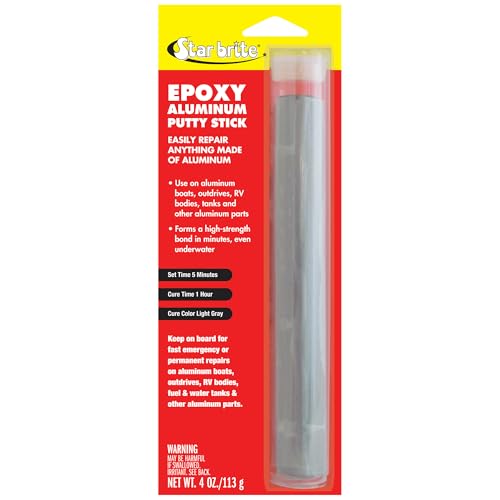
6. STAR BRITE Waterproof Epoxy Aluminum Putty Stick
Knead it, press it, and it stops a leak in under an hour.
This is the emergency kit you keep in the boat or RV toolbox. It is a putty stick — you cut off what you need, knead it with your fingers until the color is uniform, and press it into the damaged area. The formula is designed specifically for aluminum surfaces, with additives that help it bond to oxidized or weathered aluminum without aggressive prep. It sets in just 5 to 10 minutes and reaches full cure in 60 minutes, making it the fastest full-cure time in this entire lineup.
The most dramatic owner story is a 4-inch gash in a 1990 aluminum bass boat patched with just a quarter of the stick — the owner called it a “life and wallet saver.” Others have used it to fill screw holes and seal leaking seams on aluminum boats. The adhesiveness aspect receives mixed feedback, so the bond is best described as reliable for non-structural emergency patches rather than load-bearing permanent repairs. Once cured, it sands, drills, and paints like the base metal.
The trade-off is speed versus ultimate strength. At 60 minutes of cure, it is ready to go fast, but it is not the right choice for a structural bracket or a high-stress engine component. For its intended use — emergency aluminum repair where heat or welding is not an option — it is the fastest fix you can buy.
For quick patches: This is the stick you reach for when you put a hole in the boat on the water and need to get back to the ramp under your own power.
Not for structural use: The short cure cycle trades some long-term bond strength for convenience; use it for non-critical repairs.
7. SprayMax 2K Epoxy Primer Black
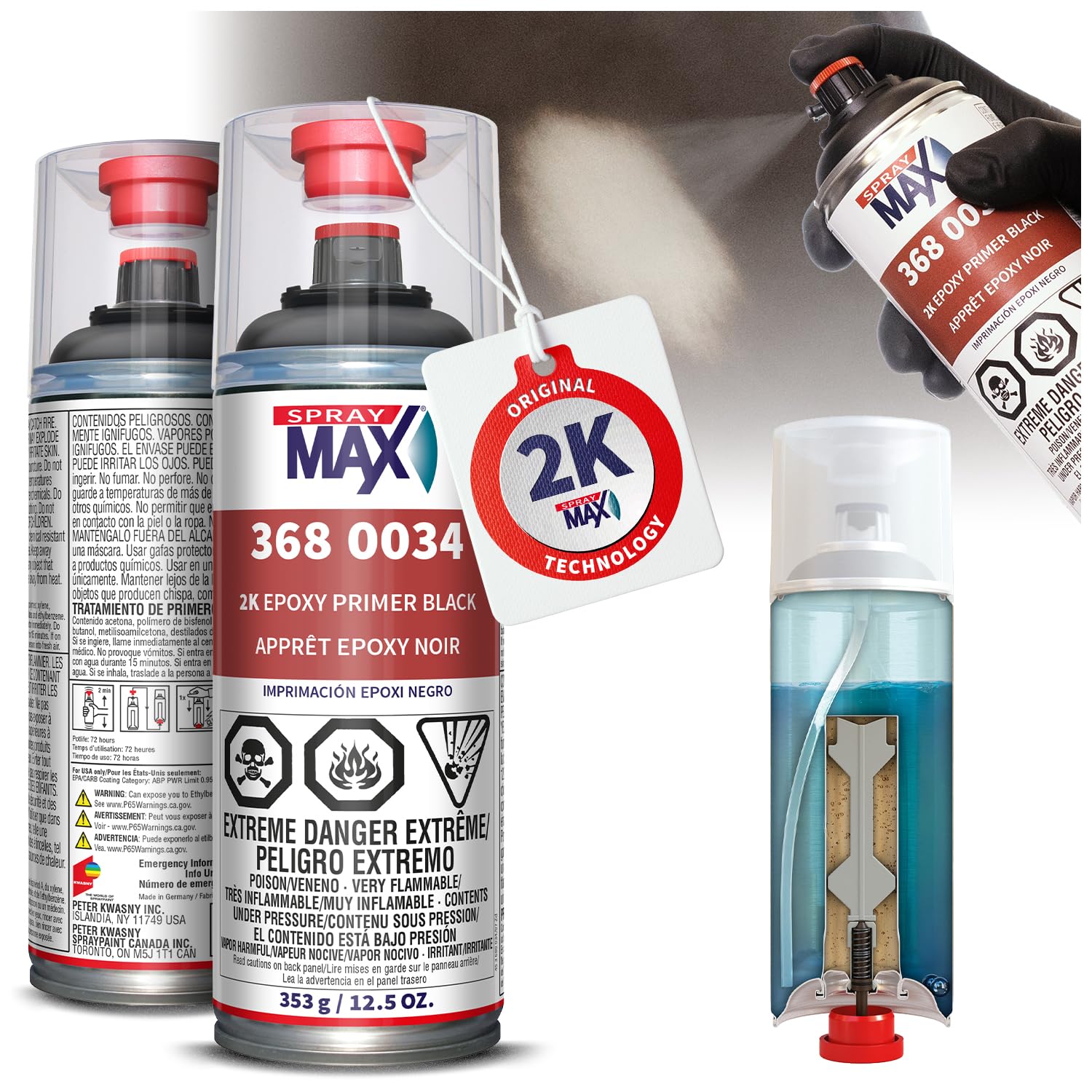
Professional 2K epoxy in a spray can for corrosion protection and paint prep.
This is a different category of epoxy — a spray-on primer rather than a bonding adhesive — but it belongs on this list because it provides the best corrosion-resistant foundation for painting aluminum, steel, and galvanized metal. The 2K technology means you activate a hardener inside the can before spraying, giving you a true two-part epoxy that cures into a tough, chemical-resistant barrier. It dust-dries in just 15 minutes and is ready to sand within hours, so you can move a project along quickly.
Owner feedback on quality and performance is strong, with 54 owners praising quality and 37 applauding overall performance. The spray performance is mixed — most report a smooth, even application with the adjustable nozzle, but some note sputtering toward the end of the can. Multiple owners used it for motorcycle and truck projects, describing it as the best spray-can primer they have experienced, with excellent adhesion to bare metal and a hard finish that still looks good after two years.
The real-world limitation is coverage: a 12.5-ounce can covers less than you might expect. Buyers report needing three cans for a motorcycle tank and fenders or two cans for a Jeep hood. Still, for a durable, sandable epoxy primer that seals aluminum against rust before your top coat, this is the pick.
Primer for paint: This is the most accessible way to get a true 2K epoxy primer on aluminum without a paint gun or compressor — just activate, shake, and spray.
8. 3M Panel Bonding Adhesive, 38315

OEM-grade epoxy used by body shops to bond steel and aluminum panels.
3M is a reference standard in automotive repair, and this two-part epoxy is specifically formulated for bonding steel, aluminum, SMC, and FRP (fiberglass) non-structural components. It uses glass bead technology to ensure a consistent bond gap and even stress distribution across the joint. It requires the 3M Performance Manual Applicator and a static mixing nozzle to dispense correctly, which are sold separately — a real factor for a first-time buyer.
Owner feedback leans heavily positive on effectiveness and adhesive quality. One owner used it to repair broken headlight mounting tabs and reports the bond holds up well. Another used it for customizing sport bike side fairings and found it worked perfectly, even if they wished it dried a little faster. The strongest praise is from a lifelong technician who uses it for fiberglass bonding and calls it “strong stuff.” The durability rating is mixed, meaning this is best for non-structural panel bonding and trim attachment rather than load-bearing chassis repairs.
The recurring complaint is the small size for the price. The 50 mL cartridge has a net fill of 47.5 mL, which feels tiny for the price point. This is a specialty adhesive for small, precise automotive repairs where you need the bond quality of a factory panel joint, not a budget-friendly filler for large gaps.
For body work: If you are bonding a replacement panel, reattaching a trim piece, or reinforcing a weld on a steel or aluminum car body, this is the professional-grade choice.
Budget alternative exists: The applicator and nozzles are sold separately, and the cartridge is small — this is a precision tool, not a value pack.
Understanding the Specs
Cure Time vs. Working Time
Cure time is how long until the epoxy reaches full strength and can be sanded, drilled, or loaded. Working time (also called pot life) is how long you have to mix, apply, and clamp the parts before the epoxy starts hardening. A 24-hour cure sounds long, but it often pairs with a generous working time of 30 to 60 minutes — worth every minute for complex alignments. Fast-setting epoxies with a 5-minute working time sacrifice your ability to reposition parts.
Flexibility and Bond Toughness
Aluminum expands and contracts with temperature far more than steel. A rigid epoxy can crack when the part heats up or cools down. Flexible formulas — measured in PSI of modulus of elasticity — absorb that movement. The trade-off is that flexible epoxies may not hold heavy loads as well as rigid ones. Match the epoxy’s flexibility to your part’s environment: exterior boat parts need flex; engine brackets need rigidity.
FAQ
Can I use regular epoxy on aluminum?
How long does epoxy for aluminum take to fully cure?
Will epoxy bond to aluminum underwater?
What is the strongest epoxy for aluminum?
How do I prepare aluminum for epoxy bonding?
Can I paint over cured epoxy on aluminum?
Is epoxy for aluminum heat resistant?
Can I drill through cured epoxy on aluminum?
What is the difference between cold weld epoxy and regular epoxy?
How much epoxy do I need for a repair?
Final Thoughts: The Verdict
If you want one dependable pick, the best epoxy for aluminum winner is the West System G/flex 655-8 because it delivers the flexibility needed for real-world expansion and vibration on aluminum without sacrificing bond strength. If you need a rigid structural repair that can handle an engine bay, grab the AOJEL S300. And for a fast budget fix that cures in 12 hours and saves a major appliance from the scrap pile, the Cerca de Metal Glue is the one to reach for.
How We Picked
We do not accept paid placement. Every pick is matched to a real buyer and a real use-case; we do not hands-on test units.
Sources & Methodology
Specifications: manufacturer listings and product documentation. Review insights: verified customer reviews, as of July 2026. Pricing: not shown on this page (it changes often); check the current price via the retailer link.
As an Amazon Associate, WellFizz earns from qualifying purchases. This does not affect which products we feature.
Related Guides

Mo Maruf
I created WellFizz to bridge the gap between vague wellness advice and actionable solutions. My mission is simple: to decode the research and give you practical tools you can actually use.
Beyond the data, I am a passionate traveler. I believe that stepping away from the screen to explore new environments is essential for mental clarity and physical vitality.