Our readers keep the lights on and my smoothie glass nicely filled. As an Amazon Associate, I earn from qualifying purchases.
Specs are compiled from manufacturer listings and verified buyer reviews and can change over time — please confirm the key details on the product page before buying.
Glue something to ABS plastic once, and you know the pain — nothing sticks. Most adhesives bead up or peel off because ABS is a low-energy surface that repels standard glues. The right epoxy solves that instantly, but picking the wrong one means a repair that fails under the lightest load. This guide cuts through the chemical talk to show you which formulations actually grab hold and stay there.
I’m Mohammad Maruf — the founder and writer behind WellFizz. This guide is built by comparing the manufacturers’ published specifications and the patterns across verified customer reviews, so you get each pick’s real strengths and trade-offs instead of marketing spin.
The right epoxy needs to bond chemically with ABS rather than just sit on top — and across hundreds of owner experiences, these four formulas prove they do. That is what makes this list of the best epoxy for abs plastic genuinely useful for your next repair.
Our Picks at a Glance
How To Choose The Best Epoxy For ABS Plastic
Finding the right epoxy for ABS means looking past the general-purpose labels. ABS is a thermoplastic, and many adhesives simply sit on its glossy surface without forming a chemical bond. You need a formula that explicitly lists ABS or common thermoplastics among its compatible materials.
Setting time vs. working time
Fast-setting epoxies (5–15 minute sets) get you back to work quickly, but they also give you a shorter window to position your parts. If you are repairing a complex shape or something that requires clamping and alignment, a slower cure (30 minutes) can save you from a rushed, crooked bond.
Tensile strength and flexibility
Tensile strength, measured in PSI, tells you how much pulling force the cured epoxy can resist before breaking. For ABS, you want at least 3000 PSI. But strength is not everything — a brittle bond cracks under vibration. A flexible epoxy absorbs movement and is better for car parts or anything that flexes in use.
Quick Comparison
| Model | Best For | Strength (PSI) | Set / Cure Time | Type | Amazon |
|---|---|---|---|---|---|
| J-B Weld PlasticBonder Tan★ Best Overall | High-strength structural repairs | 3770 | 15 min set / 30 min cure | Syringe liquid | Amazon |
| J-B Weld PlasticWeld Quick-Setting | Fast-mending translucent repairs | 3200 | 5 min set / 1 hour cure | Syringe liquid | Amazon |
| J-B Weld PlasticWeld Putty | Rebuilding missing plastic bits | — | Hand-mixable, fast cure | Putty stick | Amazon |
| Starbond 5 Minute Epoxy Pro Kit | General household with flexibility | 2600 | 5 min set / 24 hour cure | Bottle liquid | Amazon |
In‑Depth Reviews
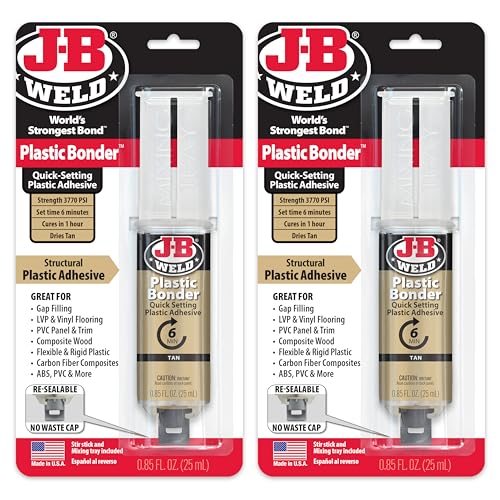
1. J-B Weld PlasticBonder Tan, 2-Pack
Our pick — over 4.5★ from 4,500+ verified ratings; the strongest balance of quality and price.
The strongest grab for ABS, with a tensile rating that outpaces the competition by a clear margin.
This two-part urethane adhesive hits 3770 PSI in tensile strength — a full 18% more than its quicker-setting sibling listed below. Owners confirm the bond often outlasts the parent material itself, and one repair turned a cracked ABS car panel and broken PVC trim into a single solid piece. The syringe design keeps the 1:1 mix ratio simple, and the resealable cap prevents the leftover epoxy from curing inside the tip for the next use.
It sets in 15 minutes and fully cures in 30 minutes, which gives you enough working time to position parts without feeling rushed. The cured bond is sandable and takes paint well, so if the repair is visible, you can blend it in with the surrounding material. Buyers report it also works on 3D print materials like PETG and PLA with no smell during mixing — a real bonus for indoor work.
What owners love
- Highest tensile strength of any pick here at 3770 PSI
- Sets in 15 minutes, sandable in 30 — fast turnaround
- Syringe gives clean, easy 1:1 mixing
- Works on ABS, PVC, polyurethane, polypropylene, and composites
Keep in mind
- Curing time can vary if the ambient temperature is cold
- Tan color may stand out on black or clear plastics without paint
Reach for this if: you need a structural hold on ABS — anything load-bearing, automotive, or that takes daily abuse.
Think twice if: you need a clear finish on a see-through part; the tan color is opaque.
2. J-B Weld 8237 PlasticWeld Plastic Repair Epoxy Putty

A moldable putty that rebuilds missing corners and fills deep gaps in rigid plastic.
Unlike liquid syringes, this is a hand-miscible epoxy putty that you knead with your fingers until the two parts activate. It gives you total control over shape and placement — perfect for rebuilding a broken dash panel, filling a gouge in vinyl siding, or restoring a snapped headlight bracket. After curing, it sands smooth and takes paint, which is why an owner used it on an old car dash and reported it “was amazing” after sanding and painting.
The volume is 56 ml per pack (two packs included), compared to 25 ml in the syringe formats above. That extra material matters when you are filling a gap or building up a missing section rather than just bonding two flat surfaces. It will not shrink or pull away as it dries, so you can apply it slightly proud and sand flush. One practical note from the review data: wear disposable gloves while mixing because the putty has a strong smell during kneading that fades once it sets.
Best move for: repairs that need to fill volume — broken mounting tabs, cracked housing corners, or anything missing a chunk of material. The putty texture makes it easy to shape before it hardens.
One honest trade-off: it is not a low-viscosity gap-filler; you need to be comfortable using your hands to mix and apply it.
Who this fits: you are rebuilding a broken part rather than just gluing two pieces back together — putty is class-leading for filling missing sections.
Who should look elsewhere: if you want a syringe-applied liquid that flows into hairline cracks, a thinner epoxy works better.
3. J-B Weld 50132 PlasticWeld Quick-Setting Epoxy Syringe

The fastest hardener here — sets in 5 minutes and dries translucent, not opaque.
Where the PlasticBonder above gives you a 15-minute window, this formulation cuts that to 5 minutes and cures in 1 hour — compared to Starbond’s 24-hour full cure It is ideal when you need the part back in service fast. One buyer repaired a 300-gallon spray tank that had split in a 90-degree area by drilling stop-holes, cutting a V-groove, cleaning with acetone and brake cleaner, and layering multiple epoxy coats. After a rough 4-mile test, the repair held water.
The dried epoxy turns a translucent yellow rather than tan or clear, which blends better into light-colored plastics. Tensile strength sits at 3200 PSI — still a very strong permanent bond for hard plastics, fiberglass, PVC, and glass. The cap screws on one way to stop accidental mixing in the nozzle, so the epoxy stays fresh between uses. Keep in mind the working time is tight; you need to have everything clamped and positioned before you mix, because once that 5 minutes starts, there is no pausing.
Why owners grab it
- Sets in 5 minutes, cures in 1 hour — fastest turnaround
- Dries translucent yellow, less visible on light plastics
- Cured bond stays flexible, good for vibration-prone repairs
- Compatible with ABS, fiberglass, PVC, and nylon
Things to watch
- Very short working window — no time for second-guessing alignment
- Resealable cap is single-use per syringe, not a multi-poise mechanism
Choose it for: emergency fixes and anything with a ticking clock — sprinkler pipes, vehicle trim, or tank repairs.
Skip if: you are a beginner who needs more than a few minutes to adjust the parts after applying the epoxy.
4. Starbond 5 Minute Epoxy Pro Kit

A big 8 oz bottle kit with a formula that bends instead of shatters under stress.
This is the only pick that comes as a bottled two-part system (not a syringe). You get 8 ounces total — far more epoxy than the small syringes, and enough for multiple large repairs or a whole set of projects. The flexible toughened formula is designed to absorb vibration and stress, so it works well on parts that see movement — think a cracked kayak hull, a vibrating tool housing, or a garden trimmer mount. It sets in 5 minutes for handling strength, but the manufacturer specifies a 24-hour full cure for maximum bond.
The pro kit includes screw-cap bottles (which do not leak or clog like some syringe tips), reusable mixing trays, and a spatula. The epoxy cures clear, so it blends into light-colored plastics and ceramics without a visible tan or yellow line. Owner experiences reinforce that it is easy to measure the 1:1 mix, and the clear finish is a plus for visible repairs. The trade-off is that the shear strength here is 2600 lb, which is lower than the PlasticBonder’s 3770 PSI, so for heavy structural loads on ABS, the J-B Weld option above holds the edge.
What stands out: the sheer volume — 8 ounces of epoxy at a fair price means this kit handles multiple jobs without needing a refill. The flexibility is also a real advantage on plastic panels that bend in daily use.
A fair caveat: the 24-hour full cure feels long if you want a same-day fix; you need to wait overnight before stressing the repair.
Pick it for: large-area repairs, crafts, and flexible parts where vibration is a concern — the 8 oz quantity and clear finish are the headline benefits.
Look at the others if: you need the absolute highest tensile strength for a load-bearing ABS joint.
Understanding the Specs
Tensile strength (PSI)
Tensile strength tells you how much pulling force a cured epoxy can handle before it snaps — think of it as the glue’s breaking point under tension. For ABS repairs, 3000 PSI (pounds per square inch) and above is the balance. The J-B Weld PlasticBonder leads here with 3770 PSI, meaning it can handle heavier loads than the 3200 PSI formulation in the quick-set syringe.
Set time vs. full cure
Set time is how long you have to adjust your parts before the epoxy starts to harden. Cure time is when it reaches its maximum strength. A 5-minute set is fine for simple bonds, but 15 minutes gives you room for tricky alignment. Full cure can range from 30 minutes to 24 hours, so check it before putting any weight on the repair.
FAQ
Will any epoxy work on ABS plastic?
Do I need to sand ABS before applying the epoxy?
Which is stronger: a syringe epoxy or a putty?
Can I paint over cured epoxy on ABS?
How long does a repaired ABS part last?
Is epoxy for ABS waterproof?
What is the difference between 5-minute set and 15-minute set epoxy?
Can I use epoxy on ABS in cold temperatures?
Final Thoughts: The Verdict
Across the board, the epoxy for abs plastic winner is the J-B Weld PlasticBonder Tan because it delivers the highest tensile strength at 3770 PSI, the most owner confidence with thousands of positive reports, and a practical 15-minute set that balances strength with usability. If you need a faster cure for an urgent fix, grab the J-B Weld PlasticWeld Quick-Setting Syringe. And for rebuilding broken plastic sections or filling large gaps, the J-B Weld PlasticWeld Putty is the one to reach for.
How We Picked
We do not accept paid placement. Every pick is matched to a real buyer and a real use-case; we do not hands-on test units.
Sources & Methodology
Specifications: manufacturer listings and product documentation. Review insights: verified customer reviews, as of July 2026. Pricing: not shown on this page (it changes often); check the current price via the retailer link.
As an Amazon Associate, WellFizz earns from qualifying purchases. This does not affect which products we feature.
Related Guides

Mo Maruf
I created WellFizz to bridge the gap between vague wellness advice and actionable solutions. My mission is simple: to decode the research and give you practical tools you can actually use.
Beyond the data, I am a passionate traveler. I believe that stepping away from the screen to explore new environments is essential for mental clarity and physical vitality.