Our readers keep the lights on and my smoothie glass nicely filled. As an Amazon Associate, I earn from qualifying purchases.
Specs are compiled from manufacturer listings and verified buyer reviews and can change over time — please confirm the key details on the product page before buying.
The biggest fear for new sewers is jamming, thread snapping, and frustration that ends with the machine shoved in a closet. A true entry-level machine should make that first project feel achievable, not like a test of patience. This guide separates real beginner-friendly workhorses from photo-friendly models that choke on a simple seam, so you can stitch with confidence.
I’m Mohammad Maruf — the founder and writer behind WellFizz. This guide is built by comparing the manufacturers’ published specifications and the patterns across verified customer reviews, so you get each pick’s real strengths and trade-offs instead of marketing spin.
From the 12.5-pound desk staple with 37 built-in stitches to the 5-pound portable starter kits, here is the honest breakdown of the entry level sewing machine options that actually hold up to real beginner use.
Our Picks at a Glance


How To Choose The Best Entry Level Sewing Machine
For a first machine, you want simplicity, durability, and a design that forgives mistakes. The most expensive model isn’t automatically the best teacher, and the cheapest one can quickly become a frustration. Here are the three decisions that matter most before you click buy.
Think About the Bobbin System First
The bobbin is the small spool of thread underneath the needle. A top drop-in bobbin (which you drop into a slot on top of the machine) is usually easier to load and less likely to jam than a front-loading one that you insert vertically into a case. If you want the smoothest first experience, a drop-in style removes a huge learning hurdle.
Match the Machine’s Power to Your Projects
An entry-level machine for light cotton and mending can be light and compact, but if you plan on denim or multiple heavy layers, you need more motor strength. A heavier machine with a metal frame will sit steadier on your table at high speed, while a 5-pound portable is genuinely easy to move but better suited to thin fabrics.
Check the Built-In Stitches You’ll Actually Use
You don’t need 200 stitches to start. Most beginners live on a straight stitch and a zigzag. A machine with 12 to 17 practical stitches, a buttonhole function, and a reverse lever to lock your seams gives you everything essential without the overwhelming dial clutter of a computerized model.
Quick Comparison
| Model | Best For | Built-in Stitches | Weight | Power Source | Amazon |
|---|---|---|---|---|---|
| Brother XM3700★ Best Overall | Best Overall / All-Round Learning | 37 | 12.5 lbs | Corded Electric | Amazon |
| Brother FB1757XBest Value | Best Value Mechanical Simplicity | 17 | — | Corded Electric | Amazon |
| SINGER 4432Heavy Duty | Heavy-Duty Power | 32 | 14.6 lbs | Electric | Amazon |
| Janome MOD-15 | Quiet, Dependable Stitching | 15 | 11.7 lbs | AC | Amazon |
| Janome 2212 | Modern Beginner Classic | 12 | 14.9 lbs | AC | Amazon |
In‑Depth Reviews
1. Brother XM3700 Sewing Machine
Our pick — over 4.5★ from 950+ verified ratings; the strongest balance of quality and price.
The 12.5-pound classroom favorite with 37 stitches turns first-timers into confident stitchers.
The XM3700 earns its top spot because it removes the two biggest beginner frustrations: threading the needle and loading the bobbin. An automatic needle threader pushes the thread through the eye for you, and the jam-resistant drop-in top bobbin slides in without wrestling a separate case. At 12.5 pounds, it’s heavy enough to stay planted on your desk while you sew but light enough to lift with one hand when you’re done.
The 37 built-in stitches give you room to grow, and the one-step auto-size buttonhole means you don’t have to wrestle with a four-step manual process for your first shirt. The free arm lets you slip cuffs and sleeves over the base for easier circular sewing. As buyers report, this machine was so dependable that One owner reported using it to make 30,000 masks before it gave out, a serious endurance record for a beginner model..
Brother backs it with free technical support via online, live chat, or phone for the life of the machine, which is a nice safety net when you are just learning. The included accessory pouch holds 5 sewing feet (zigzag, zipper, blind stitch, buttonhole, and button sewing), a 3-piece needle set, twin needle, and 4 bobbins, so you have everything needed for most starter projects right in the box.
Why it wins
- 37 built-in stitches cover everything a beginner needs to grow into
- Automatic needle threader saves the most frustrating step
- 12.5 pounds strikes a stable yet portable balance
- One-step buttonhole is a genuine ease-of-use win
What to know
- Auto-threading has a small learning curve before it feels natural
- Reverse stitch location takes a little adjustment to reach smoothly
- Meant for 120-volt US outlets — other use voids the warranty
Who it fits: The beginner who wants a forgiving machine with room to learn — a true all-rounder that handles everything from felt to silk.
The trade-off: Its 37 stitches and sturdy weight mean it’s a bigger unit than a 5-pound portable, so it’s not designed to travel.
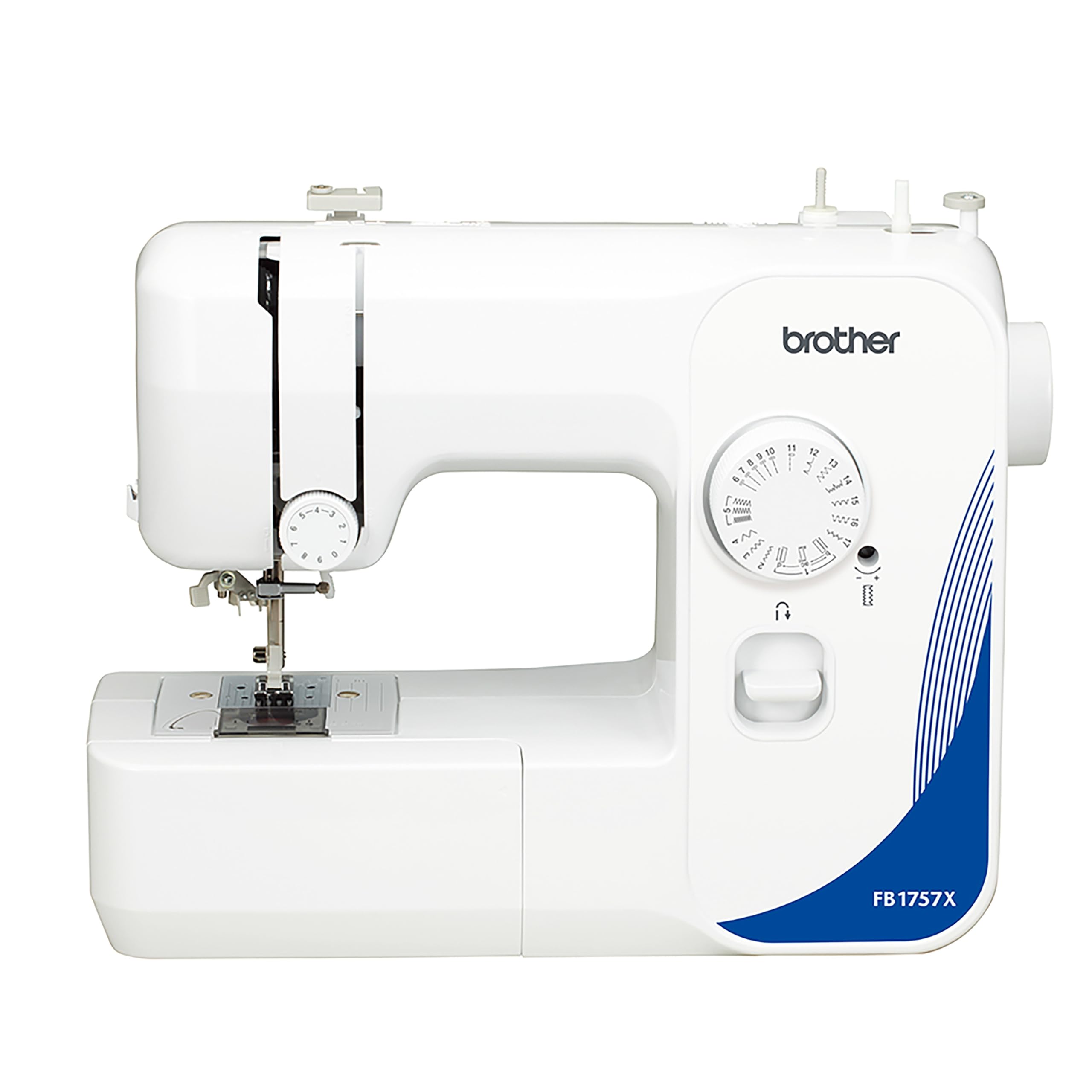
2. Brother FB1757X Mechanical Sewing Machine
A no-nonsense metal-frame workhorse that skips the bells and just sews beautifully.
You get the dependable build of a full-size Brother without paying for 37 stitches you may never use. The FB1757X is purely mechanical — you turn a dial instead of navigating a screen — so there are fewer parts to confuse a first-timer. Its 17 built-in stitches and 4-step buttonhole (a simple process for making buttonholes) handle everyday clothing repairs and small craft projects.
One of its most praised features is the automatic needle threader and jam-resistant drop-in bobbin, which owners mention makes setup surprisingly simple. The LED lighting on the work area is a small but meaningful upgrade — you can actually see your seam at night without straining. The free arm is there when you need to sew a sleeve or a pant hem.
The reviews consistently call it a “workhorse” for home projects, with one shopper noting it delivered a flawless zigzag stitch on the first try compared to a more complicated model they owned. The full metal construction gives it a reassuring heft that keeps it steady at speed, and the built-in extension table is included (though well-hidden in the box, so check the packaging carefully).
What makes it worth it
- 17 stitches cover the essentials without dial clutter
- Metal build offers a durable, stable sewing platform
- LED work light improves accuracy on dark fabrics
- A great choice for a teen learning or an adult returning to sewing
Worth knowing
- Mechanical dials mean fewer fancy stitch patterns than a computerized model
- Only a few accessories are included — you may want to order matching feet
Pick this if: You want a straightforward, dependable machine that teaches the fundamentals without a steep learning curve or a high price tag.
Choose something else if: You want dozens of decorative stitch options for creative projects — the XM3700 holds a 37-stitch advantage.
3. SINGER 4432 Heavy Duty Sewing Machine
The speed demon that chews through denim at 1100 stitches per minute without flinching.
This is the entry-level machine for someone who already knows they’ll be sewing jeans, canvas, and multiple thick layers — not just pillowcases. The SINGER 4432’s motor is 60% stronger than standard machines, letting it power through denim and canvas without stalling., letting it push through tough fabrics while keeping a pace of up to 1100 stitches per minute. It’s the machine to grab if you’ve been frustrated by a lightweight model stalling on a thick seam.
The 32 built-in stitches translate to 110 stitch applications for basic, stretch, decorative, and repair sewing. Beginners especially love the automatic needle threader — the review pages sum it up: no more poking yourself trying to thread the needle. The one-step buttonhole and free arm round out the practical features, and the included accessory kit (multiple presser feet, bobbins, needles, a seam ripper, quilting guide, and dust cover) protects your investment.
Weighing 14.6 pounds, it’s the heaviest pick here, which is a trade-off worth naming: it’s a desktop anchor, not a travel buddy. The auto-threader and a bobbin-winding quirk draw the most recurring mentions, and the instruction manual is digital rather than printed — so keep your phone handy. But the overwhelming consensus is that this is a durable workhorse that gets the job done.
The strengths
- 60% stronger motor for denim and canvas with ease
- 1100 stitches per minute is seriously fast for the class
- 32 stitches with 110 applications cover every project type
- Automatic needle threader is a favorite for new sewers
The honest catch
- 14.6 pounds is heavy — it’s built to stay on one table
- No paper manual; the instructions are digital only
- An occasional owner finds the auto-threader awkward to use
Reach for this if: You’re a beginner with ambitious projects — denim repairs and heavy crafts — who needs power over portability.
Look elsewhere if: You want a light machine to stash in a closet between light mending tasks.
4. Janome MOD-15 Sewing Machine

The whisper-quiet desk companion praised for its smooth, skip-free stitches on knits.
Janome has a reputation for smooth, quiet machines, and the MOD-15 fits that bill at an entry-level price. It’s a favorite for sewing stretchy knits — multiple customers note zero skipped stitches on t-shirt fabric, which is a common frustration on cheaper machines. The automatic tension and easy threading system mean less fiddling before you even start.
The 15 stitches (including a 4-step buttonhole) are the practical basics, and the adjustable stitch length and zigzag width give you control that many basic machines lack. The 5-piece feed dog system grips the fabric evenly from underneath, which helps prevent the bunching that beginners often see. It weighs 11.7 pounds — substantial enough to stay steady, light enough to move.
One owner summed it up simply in the reviews: “Love this sewing machine. It’s easy to work with and sews exceptionally well.” The 25-year limited warranty is a standout peace-of-mind feature for a beginner machine.. Just be aware that fleece can shed lint that needs brushing out, and the included screwdriver is a bit awkward to handle. Overall, this is a dependable machine for a sewist who values smooth, quiet stitching.
Why it stands out
- Quiet operation that doesn’t disturb the house
- Sews knits without skipped stitches
- 25-year limited warranty shows long-term confidence
- Adjustable stitch length and width for custom results
Keep in mind
- Fleece lint needs regular brushing to prevent thread breaks
- 15 stitches means fewer decorative options than larger models
The verdict: A reliable, quiet, well-built starter that’s especially strong for anyone sewing stretchy fabrics early on.
Who might pass: Those wanting decorative stitch variety will find the FB1757X offers more options at 17 stitches.
5. Janome 2212 Sewing Machine

A 14.9-pound classic that proves simple mechanics and clean stitches never go out of style.
If you want a machine that feels like the ones your grandmother used — sturdy, mechanical, and endlessly reliable — the Janome 2212 is it. This is the entry-level model that quilters and everyday home sewists have trusted for years. It sews through multi-fold denim without complaint, and Some reviewers point out over 100 hours of use, proving its long-term durability..
The 12 built-in stitches include straight, zigzag, and a 4-step buttonhole. The front-loading bobbin takes a bit more care when threading than a drop-in style, but the push-pull bobbin winder and extra-high presser foot lift make daily use convenient. The free arm and drop feed add versatility for sleeves and cuffs.
Shoppers say that it sews great every day, offering both straight and zigzag options without needing constant tension adjustments. The included accessories are generous: zipper foot, sliding buttonhole foot, blind hem foot, bobbins, needles, seam ripper, screwdriver, and more. It’s the machine to buy when you want a solid, dependable tool that won’t need replacing in a year.
What owners love
- Tackles multi-fold denim and quilting with ease
- Mechanical simplicity means fewer settings to master
- Generous accessory kit included in the box
- Extra-high presser foot lift handles bulky layers
Consider this
- At 14.9 pounds, it’s one of the heaviest beginner picks
- Front-loading bobbin requires more careful threading than drop-in types
- The pedal cord runs a bit short for some setups
Ideal for: Quilters and sewists who want a classic, sturdy mechanical machine that will hold up to years of daily use.
Not ideal for: Anyone who wants a lightweight, easily portable starter — consider a 5-pound option instead.
6. Stoigeld Sewing Machine for Beginners
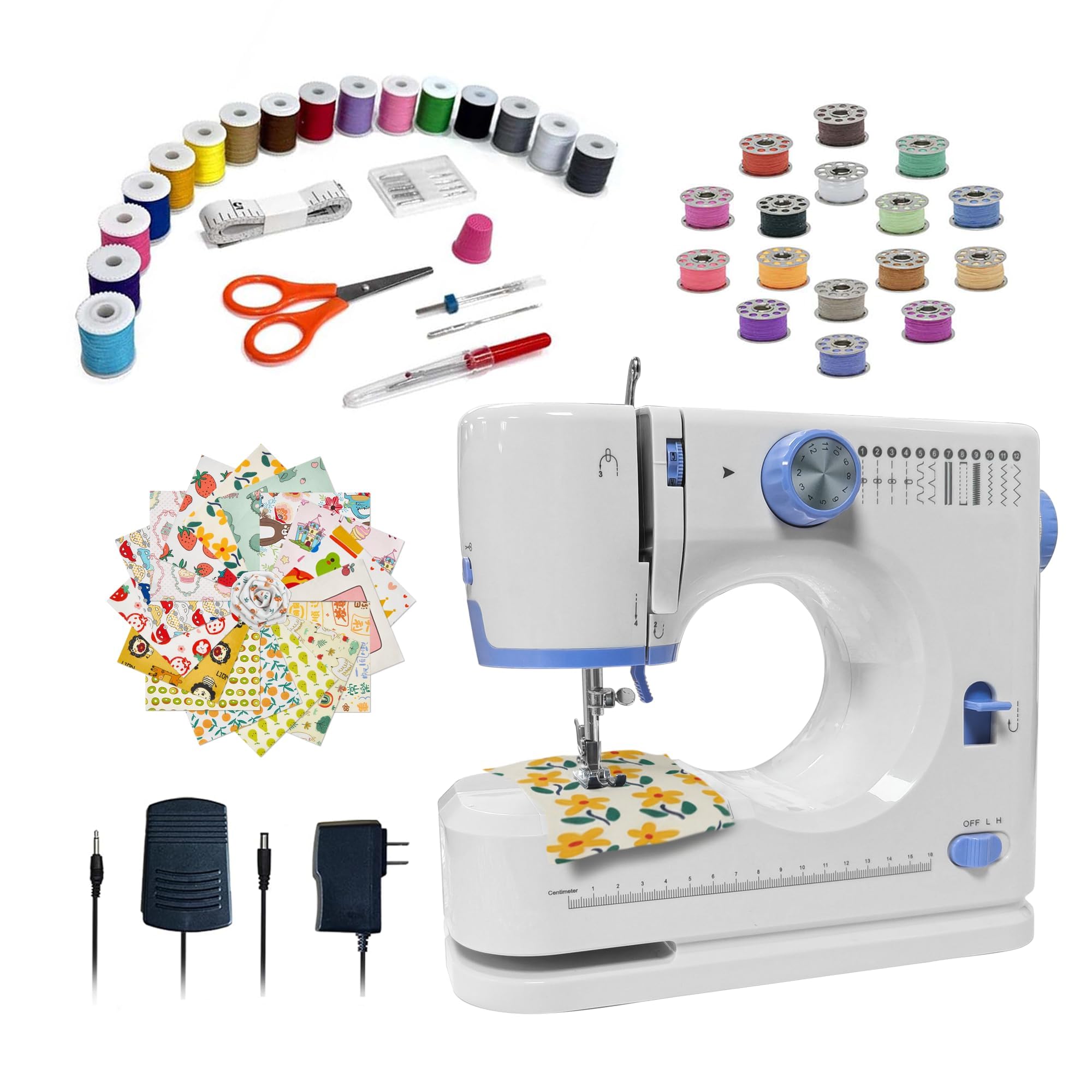
A complete 52-piece starter kit in a 5-pound frame that’s made for young learners and small repairs.
Sometimes the best beginner machine is the one that comes with everything you need to start immediately. The Stoigeld delivers a full kit: 32 sewing threads, 20 practice fabrics, bobbins, needles, and a threader — no extra purchases required. At just 5 pounds, it’s genuinely easy to carry between home and school, which is why it’s a popular pick for kids learning to sew in class.
This is a small machine designed strictly for light fabrics — thin cotton, linen, and light woven materials up to 4-6 layers. The brand is refreshingly honest about this: it says to avoid thick materials and notes denim is only suitable for 2-4 layers. The 12 built-in stitches, 4-step buttonhole, and reverse function cover basic mending, DIY crafts, and school projects.
The built-in light and sturdy little drawer for needles are thoughtful touches for beginners. One owner bought it for a 12-year-old grandson learning to sew in school, noting “it has all the stitches a beginner sewist needs and then some” and that it stores easily. The one-year warranty adds a bit of security, though some owners do report jamming if you push it past its light-fabric limits. It’s a charming, capable little machine — as long as you respect what it is.
Why it’s a great starter
- Complete kit: 32 threads and 20 fabrics included
- 5 pounds makes it truly portable for home and school
- Compact 10″D x 9″W x 5″H size stores in a small space
- Clear expectations for light-fabric use prevents frustration
Be aware
- Not built for thick fabrics or heavy denim
- Some buyers report jamming if overworked
- 12 stitches is on the lower end of the range
Perfect for: A child or teen learning the basics, or an adult who wants a compact mending machine for light repairs.
skip it if: You plan on sewing jeans or heavy layers — the 12.5-pound Brother XM3700 has 37 stitches and three times the weight for tougher work.
7. Dechow Electric Portable Mini Sewing Machine
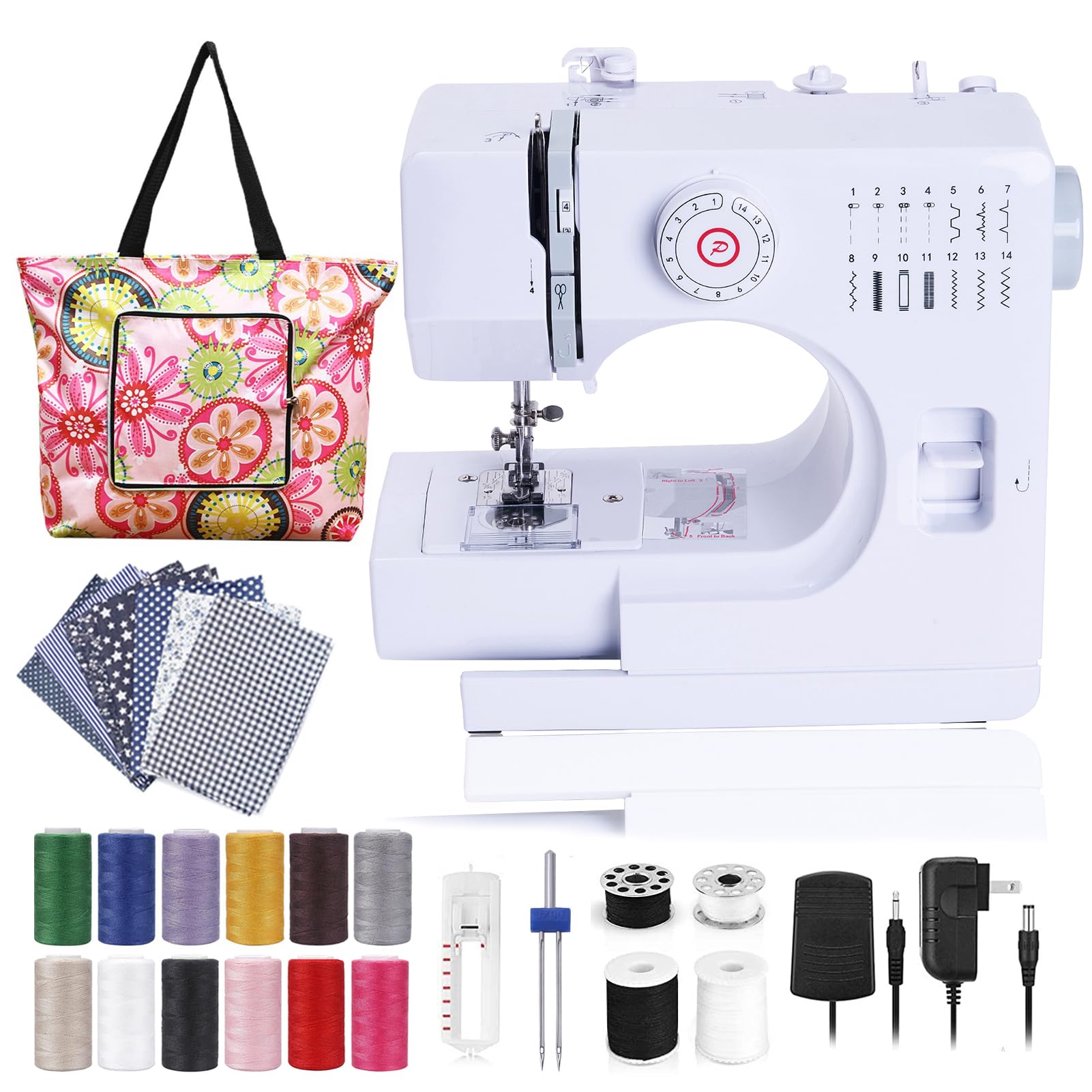
A full home set with a removable extension table and 12 thread colors in a 5.3-pound frame.
The Dechow arrives as a complete home sewing set, and it mostly delivers: the box includes a removable extension table, a foldable storage bag, fabric, and 12 thread colors, with the machine pre-threaded in white and pre-filled bobbins in black and white. For a beginner or a child, the “everything in one box” approach is genuinely appealing.
It offers 14 built-in stitches (basic, decorative, and stretch) and a reverse function to lock your seams. The new-generation motor claims greater piercing power for thicker fabrics, and the 2-speed control helps beginners go slow while they learn. The 4.7″D x 10.8″W x 10.2″H footprint makes it easy to store, though the 5.3-pound weight means it’s not as substantial as a full-size model.
This is where honest expectations matter. Owners who bought it for simple hemming and light mending are happy with the value. But the reviews carry a real split: some report it stops working or the needle gets stuck, especially on anything beyond very thin fabric. One owner described a machine that “stitched one 10 inch seam, then jammed up.” Buyers who already know how to sew note the motor is not strong enough for anything but thin material. It’s a fine starter for gentle use, but a frustrating choice if you push it hard.
Things to like
- Whole accessory set included: bag, table, threads, fabric
- Pre-threaded and ready to test right away
- Reverse sewing function for stronger seam ends
- 2 speeds let beginners learn at a gentle pace
Things to watch
- Motor struggles with anything but thin fabric
- Some owners mention jamming after light use
- Instruction book described as confusing by some
Best suited for: A young beginner or child doing simple crafts and thin-fabric projects with a complete starter kit.
Think twice if: You’re an adult planning real sewing — the Stoigeld offers clearer fabric expectations, and the Brother machines offer far more power.
8. SINGER Fashion Mate 3342

A lightweight Singer with a full metal frame and numbered threading guides built right on the machine.
The SINGER Fashion Mate 3342 is for the beginner who wants the reassurance of a full metal frame without the 14.6-pound weight of the heavy-duty 4432. The built-in numbered threading instructions on the machine body mean you don’t have to flip through a manual every time you re-thread — a small feature that saves real frustration. The top drop-in bobbin with a transparent cover lets you monitor your thread supply mid-project.
With 32 built-in stitches and a one-step buttonhole — you just place the button in the foot and the machine sews the perfect size — it offers serious versatility for crafts and mending. The five snap-on presser feet (General Purpose, Buttonhole, Button Sewing, Zipper, and a Sew Easy foot) snap on and off easily, expanding what you can tackle from straight seams to zippers to buttons.
Owners describe it as a “simple workhorse” that survived a fabric jam without any damage. It’s also a hit with experienced sewers — one replaced a 40-year-old Singer with this model and praised the quiet operation and the needle threader (a small hook that pulls thread through the needle eye) for aging eyes. The front storage compartment keeps all the tools organized and accessible. If you want a feature-rich but still approachable Singer that won’t break your back carrying it, this is the balance.
What stands out
- 32 stitches with a genuinely useful 1-step buttonhole
- Numbered threading instructions on the machine body
- Full metal frame for stability and durability
- Five snap-on feet included for varied projects
What to consider
- Some owners find the instruction manual on the lighter side
- Mixed feedback on long-term functionality in some reviews
The right fit: A beginner-adjacent sewist who wants 32 stitches and a metal frame in a lighter, more portable package than the heavy-duty 4432.
Not for: Those who need the extreme power for thick canvas and denim — that’s the 4432’s territory.
9. PooLin EOC02 Computerized Sewing Machine
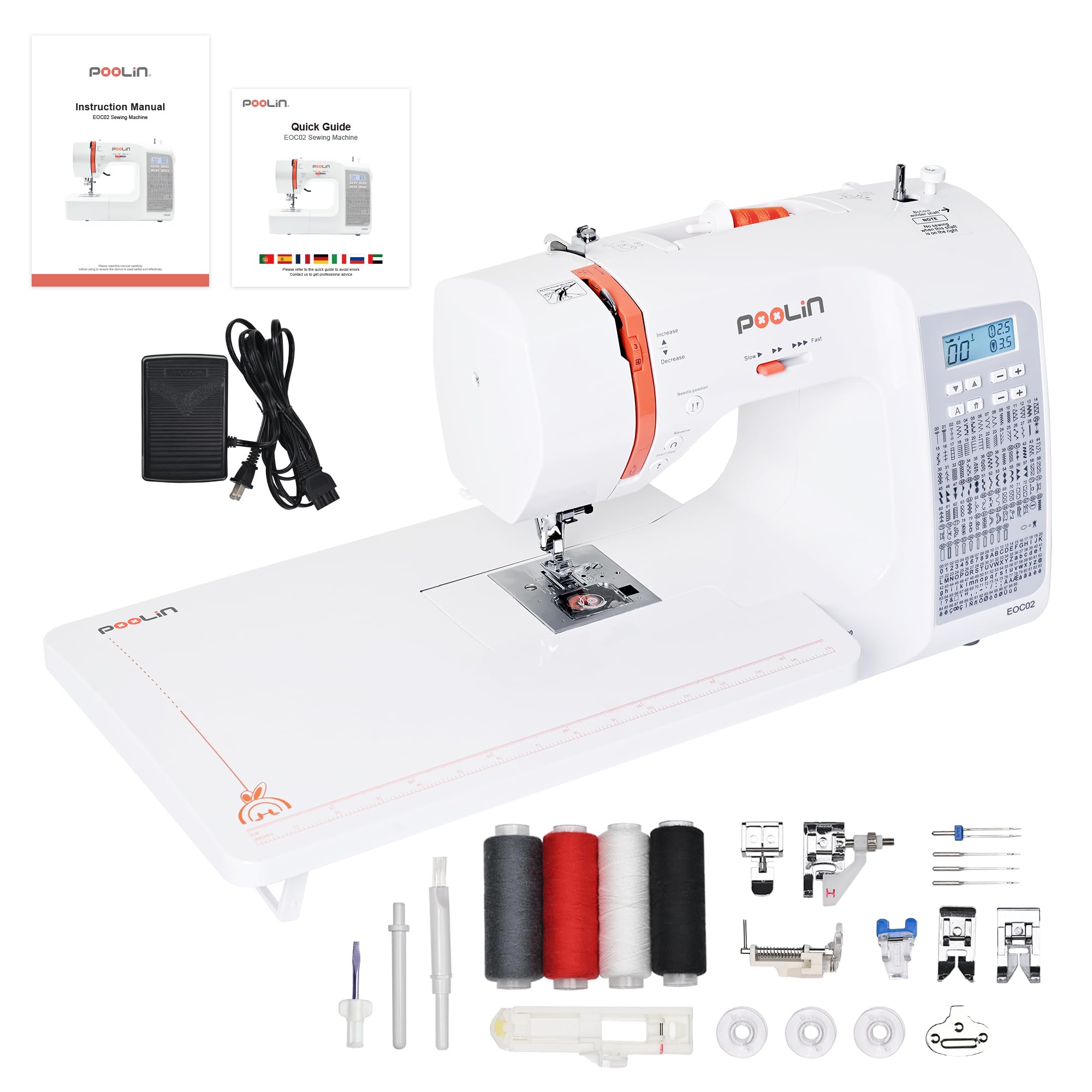
A computerized beginner machine with 200 stitches and an LCD screen that makes selection easy.
If you’re a beginner who likes the idea of a screen guiding you rather than a wall of dials, the PooLin EOC02 is the modern route. The LCD screen clearly displays your 200 built-in stitches — including utility, decorative, and alphanumeric patterns — so you can see exactly what you’ve selected before you sew. It’s a completely different experience from the mechanical machines above, closer to how a smartphone guides you than how a classic dial does.
The machine comes with 7 different presser feet, an automatic needle threader, a speed control slider, and a start/stop button for precise control without the foot pedal. The extra-wide table provides a generous workspace for quilts, and detaching the accessory compartment reveals a free arm for cuffs and sleeves. The one-click needle position button lifts the bobbin thread with a single press, and error prompts on the screen make troubleshooting easier than guessing.
New users report it’s quiet, smooth, and ready to sew right from the start, with a complete instruction book. It handles medium-weight fabrics like cotton and linen beautifully, and even heavier materials like denim and canvas for bags and jackets — just respect the 6mm thickness limit for layered quilting. The trade-off: it’s not a heavy-duty machine, and some customers note it struggles with three layers of fabric and can stop mid-seam. For everyday shirts, crafts, and home décor, it’s a joy; for constant denim stacking, you’d want the SINGER 4432.
What impresses
- 200 stitches with an easy-to-read LCD display
- 7 presser feet and an extra-wide table for quilting
- Push-button sewing plus foot pedal for control flexibility
- Quiet, smooth stitching with minimal tension fuss
Be realistic
- Not heavy-duty — struggles with 3+ thick layers
- 100% cotton thread can be finicky; blends work better
- Walking foot for quilting is not included
Choose this if: You’re a beginner drawn to technology who wants an LCD-guided machine for daily sewing, crafts, and home décor projects.
Pass if: Your primary goal is heavy denim or constant multi-layer fabric — save up for the heavy-duty SINGER 4432.
Understanding the Specs
Built-In Stitches
This number tells you how many different stitch patterns the machine can create without extra attachments. For a beginner, the practical needs are a straight stitch, a zigzag, and a buttonhole — usually covered by 12 to 17 stitches. Higher counts like 37 or 200 add decorative and stretch options you can grow into, but they don’t automatically make the machine easier to use.
Machine Weight and Frame
Weight affects two things: stability and portability. A heavier machine (12.5 to 14.9 pounds) with a metal frame sits steady on your desk and handles thicker fabrics at speed, but it’s harder to move. A 5-pound portable is easy to carry but may vibrate or struggle on tough material. Choose based on whether your machine lives on a table or travels with you.
FAQ
How many stitches do I really need as a complete beginner?
What is the difference between a drop-in bobbin and a front-loading bobbin?
Can an entry-level machine sew denim or thick fabric?
Is an automatic needle threader worth having?
How much should a beginner spend on a first sewing machine?
What is a free arm and why do I need one?
Should I buy a mechanical or computerized sewing machine?
Why does my sewing machine keep jamming?
How heavy should an entry-level sewing machine be?
Final Thoughts: The Verdict
For most people, the entry level sewing machine winner is the Brother XM3700 because it pairs a forgiving automatic needle threader and jam-resistant drop-in bobbin with 37 stitches and a steady 12.5-pound frame. If you want dependable, no-fuss mechanical basics with an LED light, grab the Brother FB1757X. And for those already planning denim and canvas projects, the SINGER 4432 is the heavy-duty one to reach for.
How We Picked
We do not accept paid placement. Every pick is matched to a real buyer and a real use-case; we do not hands-on test units.
Sources & Methodology
Specifications: manufacturer listings and product documentation. Review insights: verified customer reviews, as of August 2026. Pricing: not shown on this page (it changes often); check the current price via the retailer link.
As an Amazon Associate, WellFizz earns from qualifying purchases. This does not affect which products we feature.
Related Guides

Mo Maruf
I created WellFizz to bridge the gap between vague wellness advice and actionable solutions. My mission is simple: to decode the research and give you practical tools you can actually use.
Beyond the data, I am a passionate traveler. I believe that stepping away from the screen to explore new environments is essential for mental clarity and physical vitality.