Our readers keep the lights on and my smoothie glass nicely filled. As an Amazon Associate, I earn from qualifying purchases.
Specs are compiled from manufacturer listings and verified buyer reviews and can change over time — please confirm the key details on the product page before buying.
Stepping into in-ear monitors means navigating driver counts, tuning curves, and connector types. The real question is which pair delivers the clearest stage mix or most revealing home listen without emptying your wallet. This guide ranks six entry-level IEMs by real-world performance and verified owner feedback.
I’m Mohammad Maruf — the founder and writer behind WellFizz. This guide is built by comparing the manufacturers’ published specifications and the patterns across verified customer reviews, so you get each pick’s real strengths and trade-offs instead of marketing spin.
Whether you are a musician needing reliable stage monitoring or an audiophile chasing your first taste of high-fidelity sound, these are the best entry level in-ear monitors that balance performance, build, and cost for a confident first step into the hobby.
Our Picks at a Glance


How To Choose The Best Entry Level In-Ear Monitors
An entry-level IEM is not just a cheap earphone. It is your first step into a world where instrument separation, soundstage, and tuning matter. The right choice depends on a few key decisions that matter more than any spec sheet.
Driver Types: Balanced Armature vs. Dynamic vs. Hybrid
The driver is the tiny speaker inside each earpiece. A dynamic driver (DD) uses a moving coil and magnet, similar to a traditional speaker — it delivers natural, full-bodied bass and is very efficient. A balanced armature (BA) driver uses a tiny magnetic armature that pivots faster — it excels at producing crisp, detailed highs and mids, but often lacks deep bass on its own. Hybrid designs combine one or more BA drivers with a dynamic driver, aiming to get the punch of a DD and the detail of a BA in a single earpiece. Most entry-level hybrids use one DD for bass and a few BAs for everything above it.
Detachable Cables: The Durability Factor
A detachable cable determines whether your IEM lasts one year or five. The cable is usually the first part to fail on any wired earphone. A detachable design using a standard 2-pin connector (either 0.75mm or 0.78mm) lets you replace a broken cable for a few dollars instead of discarding the whole set. Every product on this list includes one, but the connector type and recessed vs. flush design vary — a recessed 0.75mm 2-pin (found on the KZ and CCA models) is more stable for stage use.
Impedance and Sensitivity: Can Your Phone Drive Them?
Impedance, measured in ohms, tells you how much electrical resistance the earphone presents to your source. Lower impedance (below 32 ohms) means easier to drive from a phone or laptop headphone jack — you get loud volume without a separate amplifier. Sensitivity, measured in decibels per millivolt (dB/mW), tells you how efficiently it converts that power into volume. A higher sensitivity number — above 110 dB — means more volume from less power. The TRUTHEAR ZERO:BLUE2 has an impedance of only 5.8 ohms, which is extremely low and easy to drive, but some buyers report needing a small USB dongle DAC (digital-to-analog converter) for best results. If you plan on plugging directly into a phone or a console controller, look for low impedance and high sensitivity.
Eartips and the Seal
The eartip is the single most influential component on sound quality. A poor seal lets outside noise in and drains the bass away; a proper seal transforms the same earphone completely. Every IEM comes with at least a few silicone tips, and many now include foam tips. Foam compresses before expanding in your ear canal, creating a tighter seal and improving passive noise isolation (the physical blocking of outside sound, not active electronics). If you buy a set and the bass sounds weak, the first fix is not EQ — it is trying the next larger eartip or switching to foam.
Quick Comparison
| Model | Best For | Driver Configuration | Impedance | Connector Type | Amazon |
|---|---|---|---|---|---|
| KZ AS10★ Best Overall | Stage vocal clarity | 5 Balanced Armature | — | 0.75mm 2-Pin | Amazon |
| SIMGOT EW300Premium Pick | Versatile tuning with metal build | 1DD + 1 Planar + 1 PZT | — | 0.78mm 2-Pin | Amazon |
| CCA C12 | Hybrid value benchmark | 5BA + 1 Dynamic | — | 0.75mm 2-Pin | Amazon |
| KZ ZS10 Pro X | Gaming and general listening | 4BA + 1 Dynamic (10mm) | — | 0.75mm 2-Pin Recessed | Amazon |
| TRUTHEAR x Crinacle ZERO:BLUE2 | Reference tuning enthusiasts | Dual Dynamic (10mm + 7.8mm) | 5.8 ohms | 0.78mm 2-Pin | Amazon |
| SENNHEISER IE 100 PRO | Trusted brand for pro monitoring | 1 Dynamic (10mm) | — | Proprietary detachable | Amazon |
In‑Depth Reviews
1. KZ AS10
Our pick — over 4.5★ from 800+ verified ratings; the strongest balance of quality and price.
Five balanced armature drivers packed into a clear shell at a price that still shocks owners.
The KZ AS10 is the pure-BA entry point that stage musicians and studio users keep coming back to. Unlike hybrid designs that use a separate dynamic driver for bass, this one deploys five balanced armature drivers — including a dedicated large low-frequency driver meant to match the texture you would expect from a traditional dynamic. The result, as owners describe it, is “tight, clean bass” with “crisp, non-fatiguing highs” and a “U-shaped” sound signature that keeps vocals present without piercing your ears during long sessions. People using them 2-3 times a week for live gigs report excellent clarity across frequencies after two months of regular use. The soundstage is described as wide if not especially deep, which keeps individual instruments separated during a dense mix.
The 0.75mm 2-pin detachable cable is the standard KZ recessed connector, so replacements are easy to find if the stock cable ever gives out. A few owners note that the pre-formed silicone ear hooks on the stock cable do not fit every ear shape — the left ear may slip off for some — but an upgraded cable solves both fit and sound. The durable clear plastic housing feels solid, though no carrying pouch is included. For the price, the AS10 regularly beats earphones with higher price tags, with one owner calling it “the best KZ earphone” for its kind and another declaring it “best value on the internet.” The recurring advice is to pair these with foam tips for a better seal; the firmness of the seal determines how much bass and isolation you actually get. A very light product at just over 6 grams per side.
This is the pick for anyone who wants to hear every layer of a live vocal mix or studio recording without the bass-first tilt of a consumer headphone. Think twice if you prefer a warm, full-bass tuning — this is an analytical, detail-forward monitor, not a fun listen. The fit can also be particular for outer-ear shape, so foam-tip investment is nearly mandatory.
Pure-BA precision: The five-driver array gives you separation and clarity that single-driver earphones cannot touch at this price — owners constantly praise the “clear vocals” and “instrument separation” during live use.
Fit is a variable: The outer-ear shape and the stock cable’s pre-formed hooks do not work for every ear; most owners recommend an upgraded cable and foam tips as a near-essential add-on to open up the full experience.
Reach for this if: you are a musician, a live performer, or a listener who wants maximum detail retrieval and vocal clarity from an all-BA setup without spending on multi-hybrid staging.
Think twice if: your priority is deep, punchy bass for genres like EDM or hip-hop, or if you want a plug-and-play fit with zero cable quirks right from the start.
2. Linsoul SIMGOT EW300
A triple-driver hybrid with swappable tuning nozzles and an all-metal shell that signals your first serious upgrade.
The SIMGOT EW300 is the most technologically ambitious pick in this list, and it lands in the premium tier because of it. Each earpiece packs three different driver types: a 10mm dynamic driver for bass foundation, a planar driver for speed and detail, and a piezoelectric ceramic (PZT) driver for extreme high-frequency extension. That tri-matrix architecture is normally found in earphones costing three times as much. What makes it genuinely useful for a beginner is the detachable nozzle system — you physically unscrew the nozzle (the metal tube that holds the mesh filter) and swap between two distinct tunings. One nozzle set targets the SIMGOT-Golden2023 reference curve; the other, marked by a gold copper nozzle and purple silicone ring, is tuned to the H-2019 curve specifically for gaming, where owners mention that “gunfire and footsteps are clearly distinguishable.”
The build quality here sets a different standard. The shell is CNC-machined high-density alloy with a mirror-plating finish that feels dense and premium in the hand — owners describe them as “heavy, well-constructed.” That weight is also the main trade-off: after long listening sessions, some experience tenderness on the upper ear. The included high-purity silver-plated oxygen-free copper cable is a 0.78mm 2-pin design that comes with a carrying case, a set of eartips, and a user manual. Sound-wise, the bass is “powerful and articulate,” but some owners note that the treble can sound “tizzy” with poor instrument separation from the start; a 50-hour burn-in period typically settles the drivers into a smoother presentation. Two owners with small ear canals specifically praise the fit as very comfortable, which is rare for a metal-bodied IEM. The cable is on the short side for desktop use, but standard for portable wear.
If you want the most driver technology and the ability to change the entire tuning character of your earphone by swapping a nozzle, this is the entry-level pick that grows with you. skip it if you prefer a light, unobtrusive shell — the metal build is dense and heavy compared to the all-resin competitors. Also note that swapping earplugs is not recommended by owners due to the nozzle design; stick with the included tips.
Versatile tuning system: The detachable nozzles let you switch between a reference music curve and a gaming-specific curve — a feature that usually starts at a much higher price bracket and gives you real options as you learn what you like.
Metal build, metal weight: The all-alloy shell feels premium but is noticeably heavier than resin IEMs, and some users report upper-ear tenderness after extended wear — not a 2-hour casual pick.
Choose this for: the tinkerer or aspiring audiophile who wants adjustable tuning and a premium build that will survive daily bag carry, all in a single package.
One real limitation: the upper-ear tenderness after long wear and the initial treble roughness require a burn-in period — not a straight-out-of-box instant-hit for every listener.
3. CCA C12

The hybrid that punches so far above its price that owners compare it to studio IEMs costing hundreds more.
The CCA C12 is the crowd favorite for sheer value-to-performance ratio. It uses a 5 balanced armature plus 1 dynamic driver hybrid configuration — technically a 6-driver-per-side setup — in a zinc alloy and resin shell that feels more expensive than it is. Owners consistently say the sound is “balanced and coherent,” with a “wide soundstage” and “warm tone” that works across genres from classical to heavy metal. One owner’s review sums up the consensus: “Sounds better than Shure and custom molded IEMs.” That is the level of confidence this budget hybrid inspires. The bass is described as “full” without being overpowering, the mid-range is “open” for vocals, and the high frequencies extend naturally without harshness. Sound quality is the aspect owners praise most — easily the top talking point at 91 mentions — followed closely by build quality (47 mentions) and value for money (44 mentions).
The 8-strand low-impedance detachable cable uses the standard 0.75mm 2-pin connector found on the KZ ecosystem, making replacements widely available. A consistent note from experienced owners is that “a perfect seal is more important with these than most other IEMs” — with the right fit you get “full bass, natural mids, and smooth treble,” but a poor seal drains the low-end noticeably. The only complaint repeated across reviews is the lack of a sliding cinch on the cable, which means the wire can hang loosely under the chin. Memory foam tips are frequently recommended as an essential upgrade to improve both isolation and fit. Comfort gets a positive grade (16 mentions), though fit is marked as mixed (33 mentions), meaning the ear hook shape does not suit every ear without tip experimentation. The gold color option is striking but the plastic resin body is lighter than it looks. Great for live gigs and digital piano practice per owners.
This is the pick if you want the most driver hardware for your money and a warm, versatile tuning that makes everything from pop to prog sound engaging. It does demand a good seal to perform — buyers who skip tip rolling may find the bass underwhelming. Also, the non-recessed connector is the older style, so some aftermarket “recessed” cables may not sit flush.
Hybrid bass-detail balance: The 5BA+1DD configuration delivers the punch of a dynamic driver and the clarity of multiple armatures in a single package — sound quality (91 mentions) is the most-praised aspect and the reason owners compare it to IEMs five times the price.
Seal-sensitive tuning: The entire frequency balance depends on getting a perfect fit; without a tight seal the bass disappears and the stage narrows, which makes foam tips more of a requirement than an optional accessory.
Grab this for: the listener who wants a versatile, warm, and detailed hybrid IEM that covers every genre credibly, and who is willing to spend a few minutes finding the right eartip.
Pass if: you want a plug-and-play sound that does not change much with fit, or if a sliding cinch on the cable is a deal-breaker for your jogging or stage use.
4. KZ ZS10 Pro X

The upgraded hybrid that went from a community standard to a gaming favorite with better high-frequency performance.
The KZ ZS10 Pro X is the evolved version of the earphone that arguably defined the budget IEM explosion. It upgrades the previous ZS10 Pro with four custom balanced armatures and a new 10mm dynamic driver that increases sensitivity for faster transient response. The sound signature is described as “rich low end” with “forward mids” in the 800Hz to 12kHz range and “shimmer highs” from 10kHz to 16kHz, which makes it particularly effective for gaming — one owner calls it “absolutely the best headphones I have used for gaming.” The soundstage is wide and defined, and the 4BA+1DD hybrid ensures good instrument separation for competitive audio cues like footsteps and directional gunfire. Sound quality is the most praised aspect (42 mentions), with quality (16 mentions) and value for money (16 mentions) close behind.
The ergonomic shape uses a classic alloy faceplate with a resin cavity — a combination that looks good and resists daily wear. The improved recessed 0.75mm 2-pin connector is more durable and stable than the older non-recessed type, which means aftermarket cables sit flush and do not wobble. Each wire strand is reinforced with 500D nylon to reduce the stethoscope effect (the noise of the cable rubbing against your clothes traveling to your ears). That said, comfort gets a mixed rating (7 mentions), and durability is a noted concern (7 mentions, all negative) — some customers note breakage within a month, though the detachable cable makes at least that part easy to replace. The stock ear tips are described as poor by multiple owners, who recommend foam tips for better seal. The cable is also on the short side, which is standard for stage IEMs but can be annoying for desktop use.
This is the hybrid for gamers and church sound techs who want a forward, detailed mid-range that makes vocals and cues cut through a mix. The build quality concerns around the shell and the mediocre stock tips are the main reasons it sits here instead of the top slot. If you are hard on your gear or need something that survives rough handling, this may not be the daily driver — but as a backup for custom monitors or a dedicated gaming IEM, it excels.
What wins owners over
- Forward mid-range (800Hz–12kHz) makes vocals and game audio cues clear and present
- Recessed 0.75mm 2-pin connector is more stable than older designs, reducing cable wobble
- Nylon-reinforced cable strands significantly cut down the stethoscope effect during movement
The honest trade-offs
- Durability reports are mixed — several owners experienced breakage within the first month of use
- Stock ear tips are universally panned; a foam tip replacement is nearly required for good isolation
- Low-end can break up at high volumes, limiting its use for bass-heavy genres at loud levels
Ideal for: competitive gamers and live sound volunteers who need clear directional audio and vocal intelligibility at a budget-friendly price.
One honest caution: the shell durability is not confidence-inspiring for heavy daily use; treat it as a dedicated gaming or backup IEM rather than a rugged travel companion.
5. TRUTHEAR x Crinacle ZERO:BLUE2

A collaboration-tuned dual-dynamic that delivers reference-level neutrality from a DLP-3D printed cavity.
The TRUTHEAR ZERO:BLUE2 represents a different philosophy from the multi-BA stacks above. Instead of piling on drivers, it uses two carefully tuned dynamic drivers — a 10mm solid silica gel suspension liquid crystal dome with an N52 magnet and a 7.8mm upgraded polyurethane suspension liquid crystal dome with an N55 magnet — arranged in a dual-cavity internal magnetic circuit. The cavity itself is manufactured using DLP-3D printing and a silicone capping technique normally reserved for high-end custom earphones, which means the internal geometry is highly precise. The sound is described as having “warm punchy bass” and a “wide soundstage,” with an overall signature that aims for the Harman target — a widely accepted reference curve. Sound quality is the most-praised aspect (83 mentions), with build quality (43 mentions) and comfort (30 mentions) also scoring high. Owners consistently note that the sound “improves significantly” when paired with a quality USB DAC (a small external digital-to-analog converter).
The included 0.78mm 2-pin cable is a two-strand 294-core copper silver-plated coaxial design that buyers call “premium” and “tangle-free.” The package includes 3 foam and 3 silicone eartip sets. Comfort is a standout for long sessions — reviewers point out “no ear soreness” even after hours of wear, which makes sense given the 30 mentions for comfort. However, the housing is described as bulky, and routing the cable behind the head becomes uncomfortable after about an hour (front routing over the ear is fine for extended use). A recurring wrinkle: the sound is thin without the included +5 ohm impedance adapter, which is unusual for a 5.8-ohm earphone. Some units have had quality-control issues — one owner reported a defective driver with resonant noise, and the manufacturer did not respond to support inquiries. The 3.5mm single-ended connection does not include a 1/4-inch adapter. The fit, while comfortable for many, receives a mixed rating (30 mentions). The IEM is water and sweat resistant, but not waterproof.
This is the pick for the buyer who values neutral, reference-style tuning and wants to learn what the Harman target sounds like. It is a learning tool as much as an earphone. The quality-control variability and the near-requirement of a DAC to sound its best put it in a more niche position — not a buy-and-go product for everyone.
Reference-grade tuning: The dual-dynamic configuration with Harman-target voicing gives you a neutral, bass-warm sound that owners say performs “well beyond their cost” — the 83 sound-quality mentions back this across genres and gaming use.
The DAC dependency: Users consistently report that a USB DAC is needed for proper volume and tonal balance; the 3.5mm output from a typical motherboard or phone leaves it sounding thin and quiet — a hidden cost of entry.
Best suited for: the aspiring audiophile who wants to experience a well-tuned reference IEM and already has or plans to buy a basic USB DAC dongle.
Consider alternatives if: you need a straightforward plug-and-play experience from a phone or game controller, or if quality-control consistency across units is a top priority for you.
6. SENNHEISER IE 100 PRO
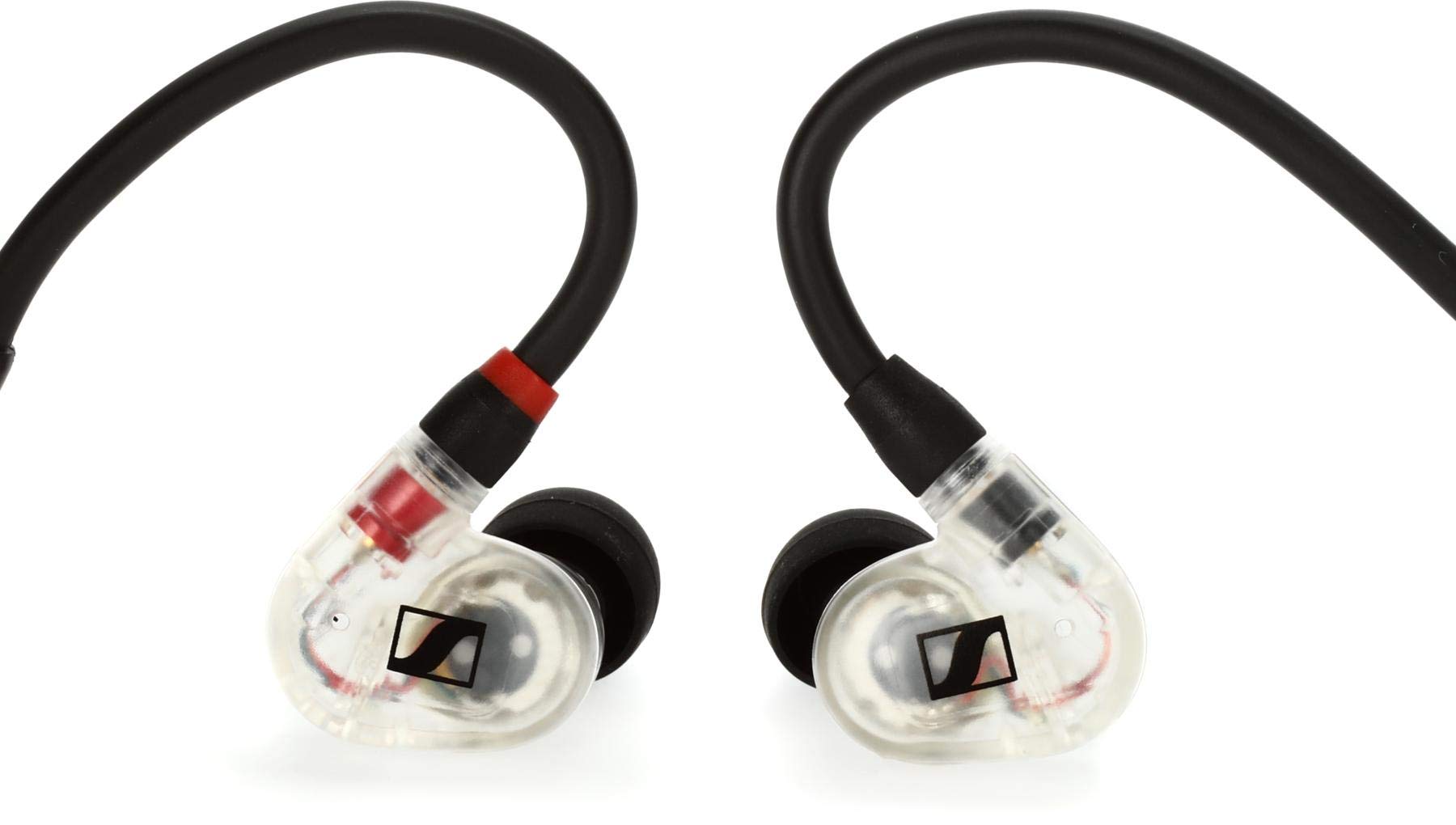
Sennheiser’s single-driver stage monitor that trades driver counts for proven live reliability and brand backing.
The Sennheiser IE 100 PRO is the odd one out in this list — and that is exactly its strength. While most entries here are Chinese-made multi-driver hybrids, the IE 100 PRO uses a single 10mm dynamic broadband transducer in a slim, ergonomic housing designed specifically for stage use. The dynamic driver approach reduces “acoustic stress factors” — the ear fatigue that can come from harsh BA treble during long monitoring sessions — by delivering “homogenous, distortion-free reproduction.” The result is a sound that owners describe as “balanced with a treble boost” that “reveals poor source quality” but handles bass in a “well-tuned, not muddy” way. Quality and value for money each get 36 positive mentions, making them the top praised aspects. Comfort scores 31 positive mentions — the slim design fits small ears well — and the ear hook is bendable for a custom fit. The cable is detachable with a proprietary connector, not the standard 2-pin found on the others.
What really matters here is the Sennheiser pedigree and the build designed for the rigors of stage use. The carrying case, cleaning tool, foam and silicone ear adapters are all included. Sound quality is the most-discussed aspect (121 mentions) — but it is marked as MIXED, which means not every buyer loves the tuning. Some find the treble “sibilant on ‘S’ and ‘T’ sounds,” while others call it “excellent sound quality near studio headphones” with “terrific frequency response and dynamic range.” The passive noise cancellation (19 positive mentions) works well with the included foam tips, but the IEM requires proper tip selection to open up its character. The default cups cover the ear canal for good noise reduction. One owner noted that the earphones “itch my ears after long wear,” and fit is marked as mixed (35 mentions). Reliability is mixed (21 mentions), and durability is also mixed (16 mentions). The proprietary cable means replacements must come from Sennheiser or a third-party maker of the specific connector type — not as flexible as the universal 2-pin standard.
This is the pick for the buyer who wants a recognizable pro brand, a neutral-to-bright monitor for stage or studio, and a compact, comfortable shell. The mixed sound-quality reception means it is less universally loved than the top-rated KZ AS10. If your priority is sheer driver count and community-tested tuning, the others offer more for less. But if you need a rugged stage tool from a company that supports its products, this is the safe call.
The professional advantage
- Single dynamic driver reduces ear fatigue compared to multi-BA designs during long stage sessions
- Compact, slim shell with bendable ear hook fits small ears and sits securely under stage headphones
- Excellent passive noise isolation with included foam tips — 19 mentions of noise cancellation working well
Where it trails the competition
- Proprietary detachable cable limits replacement options — not the universal 2-pin standard
- Sound quality reception is mixed (121 mentions across the board); treble sibilance on certain consonants bothers some listeners
- Fits a specific taste — the bright tilt is not the “fun” bass-forward signature many entry-level buyers expect
Best for: the stage musician or aspiring performer who wants a trusted pro brand with excellent comfort and a low-fatigue sound for monitoring.
Not for: the spec-driven buyer looking for the most drivers per dollar, or anyone who prefers a warm, bass-heavy tuning — this is a bright, analytical listen that rewards quality sources.
Understanding the Specs
Driver Configuration and Tuning
Driver count does not automatically mean better sound, but it tells you how the earphone builds the frequency spectrum. A single dynamic driver (DD) like in the Sennheiser IE 100 PRO is simple, efficient, and coherent across the range. Balanced armature (BA) drivers are smaller and faster, which lets you stack them — a 5-BA design like the KZ AS10 can handle low, mid, and high frequencies with separate dedicated drivers, improving detail retrieval. Hybrid designs (BA + DD) try to use the DD for natural bass impact and BAs for clean mids and highs. The SIMGOT EW300 adds a planar driver and a PZT ceramic driver to that mix, which pushes treble extension and speed but introduces tuning complexity that may need a burn-in period to settle. Tuning is the final voice: the frequency response curve that results from all those drivers working together. A neutral or “reference” tuning tries to reproduce the recording as accurately as possible, while a “warm” or “V-shaped” tuning boosts bass and treble for a more notable listen.
Impedance and Sensitivity
Impedance (measured in ohms) is how much the earphone resists electrical signal from your source — lower impedance means less resistance, so the earphone is easier to drive to loud volumes from a standard phone or laptop headphone jack. The TRUTHEAR ZERO:BLUE2 has a very low 5.8-ohm impedance, which in theory should be very easy to drive, but in practice owners find it sounds thin without a separate amplifier because of its unusual sensitivity tuning. Sensitivity (measured in decibels per milliwatt, or dB/mW) tells you how efficiently it converts that power into volume. A high-sensitivity IEM (above 110 dB) will get very loud from very little power. When both numbers are favorable — low impedance and high sensitivity — you get loud, clean sound from any device. Most entry-level IEMs are designed to be efficient, but if you plan to plug into a game controller or a phone dongle, prioritize earphones that multiple owners confirm work well without an external DAC.
FAQ
What is the difference between an IEM and regular earbuds?
Can I use entry-level IEMs for gaming?
What is the difference between a 0.75mm and a 0.78mm 2-pin connector?
Do I need a separate amplifier or DAC for entry-level IEMs?
How long do entry-level IEMs typically last?
What size eartips should I use?
Can I use IEMs for live music performance?
How do I clean and maintain my IEMs?
Is “burn-in” real for IEMs, or is it a myth?
Is a hybrid driver IEM always better than a single-driver IEM?
Final Thoughts: The Verdict
If you want one dependable pick, the best entry level in-ear monitors are the KZ AS10 because its five balanced armature drivers deliver the most detail, separation, and vocal clarity at a price that still surprises owners every day. For those who warm up their music collection with hybrid bass and a versatile sound signature, the CCA C12 offers incredible value. And for buyers who prefer a single-driver stage monitor from a brand with a professional service network, the SENNHEISER IE 100 PRO is a safe, comfortable, and durable choice. Between the KZ and the CCA, the AS10 holds the edge for outright detail — particularly for live vocal monitoring — while the C12 wins on fun, full-range tuning and sheer driver count per dollar.
How We Picked
We do not accept paid placement. Every pick is matched to a real buyer and a real use-case; we do not hands-on test units.
Sources & Methodology
Specifications: manufacturer listings and product documentation. Review insights: verified customer reviews, as of July 2026. Pricing: not shown on this page (it changes often); check the current price via the retailer link.
As an Amazon Associate, WellFizz earns from qualifying purchases. This does not affect which products we feature.
Related Guides

Mo Maruf
I created WellFizz to bridge the gap between vague wellness advice and actionable solutions. My mission is simple: to decode the research and give you practical tools you can actually use.
Beyond the data, I am a passionate traveler. I believe that stepping away from the screen to explore new environments is essential for mental clarity and physical vitality.