Our readers keep the lights on and my smoothie glass nicely filled. As an Amazon Associate, I earn from qualifying purchases.
Specs are compiled from manufacturer listings and verified buyer reviews and can change over time — please confirm the key details on the product page before buying.
You want full suspension (rear and front shocks) for trail riding without emptying your wallet. The trick is knowing where to cut corners and where not to. The best entry level full suspension mountain bike gives you an aluminum frame that lasts, suspension that actually soaks up bumps, and parts that shift reliably—all for a realistic budget.
I’m Mohammad Maruf — the founder and writer behind WellFizz. This guide is built by comparing the manufacturers’ published specifications and the patterns across verified customer reviews, so you get each pick’s real strengths and trade-offs instead of marketing spin.
After digging through owner experiences and spec sheets on four models, the clear winner is the Gravity FSX 1.0. It has an aluminum frame, disc brakes (brakes that use a rotor instead of the wheel rim), and adjustable suspension that holds up to real abuse, not just a driveway roll. Here is the honest breakdown of the best entry level full suspension mountain bike.
Our Picks at a Glance

How To Choose The Best Entry Level Full Suspension Mountain Bike
Moving to full suspension on a budget means you trade some nice components for a frame and shock package that works. Here are the three specs that separate a fun ride from a frustrating one.
Frame Material: Aluminum is the Standard
At entry level, aluminum is the only frame material that makes sense. It keeps the bike light enough to maneuver on climbs and durable enough to handle rough landings, without the price premium of carbon. Every bike on this list uses an aluminum frame, which is the right call for a first full-suspension bike.
Suspension Type and Adjustability
Full suspension means both front and rear shocks, but not all entry-level rear shocks are created equal—some feel like a pogo stick, as buyers of the Gravity FSX 2.0 note. Look for bikes where the front fork is adjustable (preload or rebound) so you can tune it to your weight and the terrain. The rear shock should have some adjustment too, even if basic, to avoid a wallowy or harsh ride.
Brakes: Disc, and Ideally Hydraulic
Disc brakes are standard on these bikes because they stop reliably when wet or muddy, unlike rim brakes that grab on the tire sidewall. Mechanical disc brakes (cable-actuated) are more common at budget entry points and are easier to adjust on the trail. Hydraulic disc brakes, which use fluid pressure, offer more stopping power with less hand effort—you see them on the Mongoose models here, and they are a notable upgrade for safety on steep descents.
Quick Comparison
| Model | Best For | Weight | Suspension Travel | Brakes | Amazon |
|---|---|---|---|---|---|
| Gravity FSX 1.0★ Best Overall | Overall value | ~40 lbs | Front & Rear Adjustable | Mechanical Disc | Amazon |
| Gravity FSX 2.0 | Lightest build | 20 lbs | Front & Rear Adjustable | Mechanical Disc | Amazon |
| Mongoose Salvo Sport | Trail performance | 40 lbs | 100 mm Front (Horst Link Rear) | Hydraulic Disc | Amazon |
| Mongoose Impassse | 1x drivetrain | — | 100 mm Front | Hydraulic Disc | Amazon |
In‑Depth Reviews
1. Gravity FSX 1.0 Dual Full Suspension Mountain Bike
Our pick — over 4★ from 400+ verified ratings; the strongest balance of quality and price.
The budget champion that punches above its weight with real adjustable suspension and an aluminum frame.
The Gravity FSX 1.0 nails the basics because it has a solid aluminum frame and a 24-speed drivetrain with Shimano trigger shifters (the levers you push with your thumb to shift gears) that change gears smoothly. The mechanical disc brakes (cable-actuated) give quiet, strong stopping power on both wheels. Reviewers call it an excellent entry-level bike for casual riders and beginners, noting the front suspension is great and adjustable while the rear shock, though slower, works fine for trail riding—so you can roll over roots and rocks more comfortably.
The honest trade-off is assembly. The instructions are poor and no tools are included, so expect to spend an evening with your own Allen wrenches. Tuning the front brake and the derailleurs (the mechanism that moves the chain between gears) takes some fiddling, but the bike includes a spare derailleur hanger—a good sign for a part that often bends in a crash or shipping. A few buyers report the stock tires go flat quickly and prefer replacing them for more traction, but the frame, fork, and drivetrain are praised as great for the money.
Gravity builds solid aluminum frames with Shimano parts at a competitive price. The FSX 1.0 is the clearest example here of getting the fundamentals right without a punishing budget. Unlike the Mongoose Salvo Sport, which weighs 40 pounds and has mixed reviews on value, the Gravity FSX 1.0 earns its spot with consistent owner satisfaction.
What Riders Love
- Strong aluminum frame and quality Shimano drivetrain components
- Front and rear suspension are both adjustable for tuning
- Mechanical disc brakes that are quiet and offer strong stopping power
What to Watch For
- Assembly is finicky with poor instructions and no included tools
- Tires hold air poorly and riders often replace them for better traction
- No kickstand mount is possible on this frame
Reach for it if: you want the most well-rounded entry-level dual suspension bike with Shimano parts and an aluminum frame that actually holds up on the trail while staying affordable.
Think twice if: you have zero interest in tuning brakes and derailleurs yourself—buying from a local shop pre-assembled would save frustration.
2. Gravity FSX 2.0 Dual Full Suspension Mountain Bike
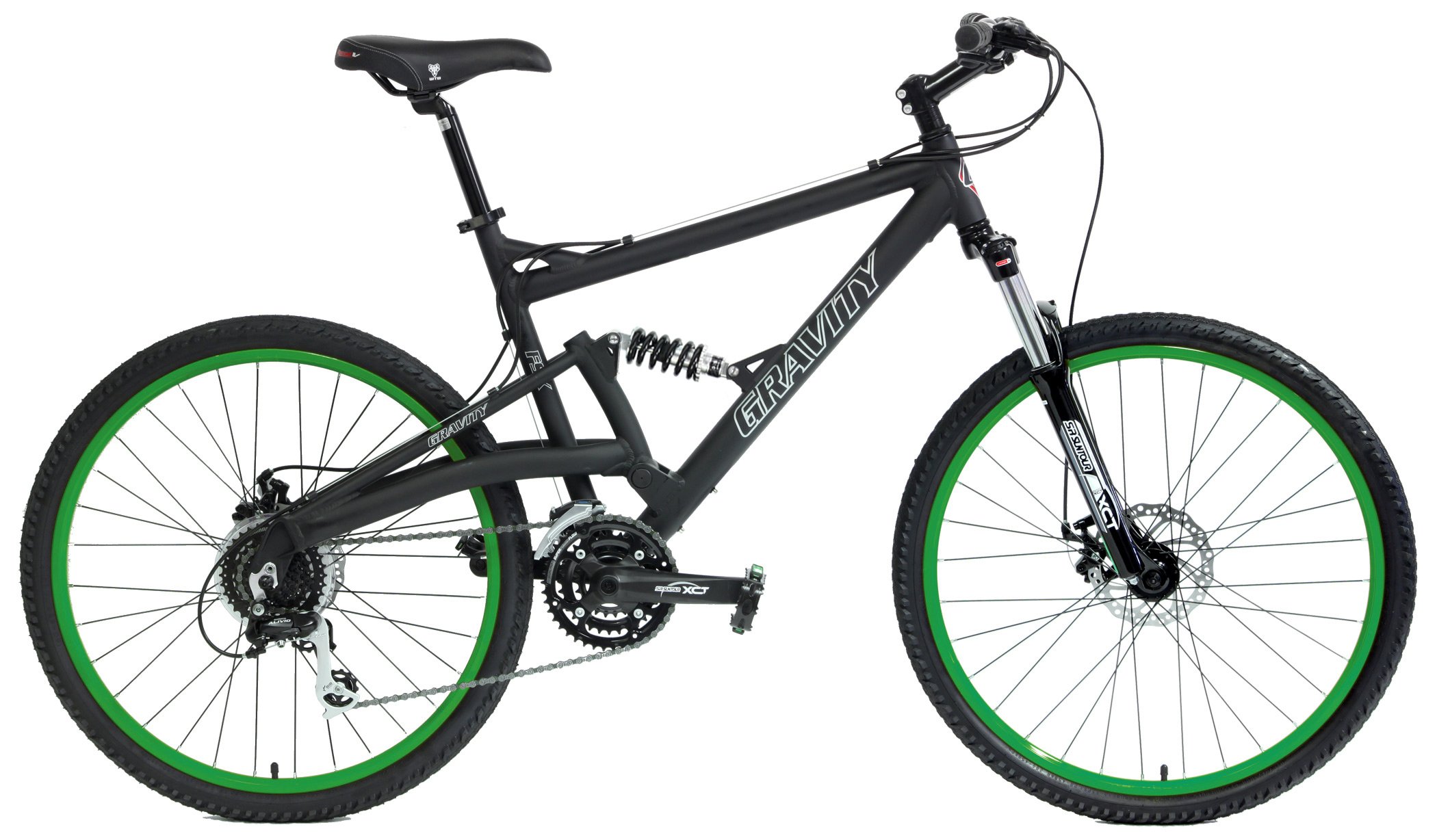
The featherweight that climbs without wheezing, tipping the scales at just 20 pounds.
The Gravity FSX 2.0 weighs a stunning 20 pounds, making it the lightest full suspension mountain bike on the list—weighing 20 pounds, while the Mongoose Salvo Sport weighs 40 pounds. That weight makes climbing and maneuvering through tight switchbacks feel dramatically easier. One 240-pound owner reports it handles rough, rocky roads comfortably and outperforms a carbon trail bike in comfort for the price. The Shimano Acera drivetrain (a reliable mid-range gear system from Shimano) and trigger shifters provide dependable gear changes, and the adjustable front and rear suspension (the ability to tune how the shocks compress) offers real tuning on the trail.
The catch is the rear shock. Several owners describe it as feeling like a pogo stick, and many upgrade to a DNM DV22AR shock for better rebound damping (how fast the shock returns after compressing) and geometry. The front fork is decent from the start, and the mechanical disc brakes work well, but the rear suspension reveals the budget. Assembly and shipping have spotty reports—owners mention that damage from FedEx handling is a recurring risk, and while the company fixes fork breakage fast, the initial disappointment is real. A kickstand is not available for this frame either.
You choose the FSX 2.0 over the FSX 1.0 if weight matters most. The 20-pound frame is a genuine outlier that makes climbing feel easy. The trade-off is a rear shock that may need an aftermarket upgrade to feel right, and a price that runs about a hundred dollars higher than the 1.0.
Standout Strengths
- Astoundingly light at 20 pounds
- Shimano Acera drivetrain with trigger shifters works reliably on the trail
- Strong aluminum frame with adjustable front and rear suspension
Real Trade-offs
- Rear shock rides like a pogo stick and many owners upgrade it immediately
- No compatible kickstand and no included tools for assembly
- Shipping damage from carriers is a common complaint
Grab it for: the lowest weight in the category — ideal if you climb frequently or need a bike that feels light and responsive underfoot.
Look elsewhere if: you want a ready-to-ride rear suspension without planning an upgrade; the FSX 1.0 offers a better out-of-box rear shock feel for less money.
3. Mongoose Salvo Sport Mountain Bike

The trail-focused Mongoose that brings hydraulic disc brakes and a purpose-built suspension linkage to the entry level.
The Mongoose Salvo Sport gives you two things the Gravity bikes lack: hydraulic disc brakes (fluid-powered brakes that stop with less finger effort) and a Horst-link suspension design (a rear pivot system that reduces brake jack—the feeling of the rear suspension locking up when you squeeze the brakes mid-corner). Mongoose calls this Free Floating Technology, and it helps the rear wheel track bumps more smoothly. The 100 mm of front suspension travel (the distance the fork compresses, measured in millimeters) and 2.25-inch knobby mountain tires give extra grip on loose terrain.
The honest reality is this bike has a split reputation. Buyers who focus on the frame geometry and upgrade potential call it a good foundation for cross-country fun, noting that swapping in a 120 mm fork, pedals, and a lighter headset makes it much better. The 18-speed trigger shifters and hydraulic disc brakes are genuinely decent. But the other camp finds the components subpar for the price, calling it bulky and overpriced, with one owner bluntly suggesting a used Siskiu or Marin from a local marketplace as a better value. At 40 pounds, the Salvo Sport weighs the same as the Gravity FSX 1.0 but is 20 pounds heavier than the FSX 2.0, and the drivetrain often needs upgrading to feel smooth.
The Salvo Sport leads on braking performance and suspension design compared to the Gravity models, but it trails them on weight and value-per-dollar. If you plan to upgrade parts over time and value a good frame and brakes now, this could suit you. If you want a ready-to-ride bike without modifications, the Gravity FSX 1.0 delivers better value at a lower weight.
Braking and Suspension Wins
- Hydraulic disc brakes offer superior stopping power with less hand effort
- Horst link suspension reduces brake lockup and smooths out trail bumps
- Frame is upgradeable with a 120 mm fork and lighter parts for better performance
Budget Reality
- Heavy at 40 pounds — a full 20 pounds heavier than the Gravity FSX 2.0
- Drivetrain components are entry-level and riders often replace them
- Mixed reviews on build quality and overall value compared to used alternatives
Ideal for: riders who prioritize hydraulic disc brakes and a frame worth upgrading over time, especially if you like tinkering with component swaps.
Pass if: you want a ready-to-ride bike with no planned upgrades—the Gravity FSX 1.0 offers better overall value at a lower weight without needing modifications.
4. Mongoose Impassse

The entry-level bike that upgrades you to a 1x drivetrain, simplifying shifting and reducing dropped chains.
The Mongoose Impassse brings something the other three bikes lack: a 1x drivetrain (a single front chainring with a wide-range 11-46 cassette in the back). This eliminates the front derailleur entirely, which means one fewer thing to adjust, fewer dropped chains on rough terrain, and simpler shifting. The 30-tooth narrow/wide chainring (a front ring designed to hold the chain securely) keeps the chain tension steady, and the Microshift 9-speed trigger shifter is praised by owners for shifting accurately right from the start. The RST Blaze suspension fork offers 100 mm of travel with a lockout (a switch that stops the fork from compressing) for climbing on pavement, plus an alloy crown and lowers to shed some weight.
This bike uses hydraulic disc brakes, and owners confirm the stopping power is crisp in all conditions, a step up from the mechanical disc brakes on the Gravity bikes. The aluminum frame fits riders from 5’7″ to 5’10”, and the bike arrives about 80 percent assembled—customers note finishing it in about an hour with basic tools. The wide tires handle loose sand and trails well, and the suspension absorbs bumps for a smooth ride on green and blue singletrack (the beginner and intermediate trail difficulty levels).
Here is the honest note: durability is a real concern. The Amazon summary flags that derailleurs break quickly, and individual reviews describe stripped pedal brackets, seized handlebar screws, and bent brake rotors. Some owners who got a good unit love the value, but the failure rate is higher than the Gravity bikes. If reliability is your top priority, the Gravity FSX 1.0 has a stronger track record for durability at a lower price point. The trade-off is that the 1x drivetrain and hydraulic brakes are genuinely nice specs for the price—you just need some luck and mechanical willingness.
Best fit if: the simplicity of a 1x drivetrain and hydraulic brakes appeals to you, and you are comfortable handling potential assembly and durability quirks yourself.
skip it if: reliability from the start is your top priority—the Gravity FSX 1.0 has a stronger track record for durability at a lower price point.
Understanding the Specs
Full Suspension vs Hardtail
Full suspension means the bike has a shock absorber on both the front fork and the rear swingarm, which keeps the rear wheel planted on bumpy descents and reduces fatigue on longer rides. A hardtail has only a front fork and no rear shock, which is lighter and more efficient for climbing but punishes your back on rough trails. For entry-level mountain biking on mixed terrain, full suspension is the more comfortable choice at the cost of some weight and price.
Disc Brakes: Mechanical vs Hydraulic
Mechanical disc brakes use a cable to pull the brake pads against the rotor, which is simpler to repair on the trail but requires more hand strength to stop. Hydraulic disc brakes use a sealed fluid line that multiplies your lever effort, giving you one-finger stopping power and consistent bite even when the pads get wet or muddy. At this price tier, hydraulic brakes are a notable upgrade for safety on steep terrain.
FAQ
Is a full suspension mountain bike worth it for a beginner?
How much should I spend on an entry level full suspension mountain bike?
What is a 1x drivetrain and do I need it?
Can I assemble an entry level mountain bike myself?
How heavy is an entry level full suspension mountain bike?
What does adjustable suspension mean?
Are hydraulic disc brakes worth the extra money on an entry level bike?
What size frame should I get for my height?
How long do entry level full suspension bikes last?
Can I upgrade an entry level full suspension mountain bike later?
Final Thoughts: The Verdict
Across the board, the best entry level full suspension mountain bike is the Gravity FSX 1.0 because it nails the core requirements—adjustable dual suspension, a solid aluminum frame, Shimano drivetrain, and disc brakes—while keeping the price realistic and the owner satisfaction high. If weight reduction is your priority and you are comfortable swapping a rear shock, grab the lightweight Gravity FSX 2.0 at just 20 pounds. And for the rider who wants hydraulic disc brakes and a 1x drivetrain without going to a premium price tier, the Mongoose Impassse offers the most modern component package, though durability is more of a gamble.
How We Picked
We do not accept paid placement. Every pick is matched to a real buyer and a real use-case; we do not hands-on test units.
Sources & Methodology
Specifications: manufacturer listings and product documentation. Review insights: verified customer reviews, as of July 2026. Pricing: not shown on this page (it changes often); check the current price via the retailer link.
As an Amazon Associate, WellFizz earns from qualifying purchases. This does not affect which products we feature.
Related Guides

Mo Maruf
I created WellFizz to bridge the gap between vague wellness advice and actionable solutions. My mission is simple: to decode the research and give you practical tools you can actually use.
Beyond the data, I am a passionate traveler. I believe that stepping away from the screen to explore new environments is essential for mental clarity and physical vitality.