Our readers keep the lights on and my smoothie glass nicely filled. As an Amazon Associate, I earn from qualifying purchases.
Specs are compiled from manufacturer listings and verified buyer reviews and can change over time — please confirm the key details on the product page before buying.
The moment you turn the key on a freezing morning, your engine’s fate is sealed by the oil you chose. Thick, sluggish oil means metal grinding against metal until it warms up — the single harshest wear your engine ever endures. This guide cuts through the marketing to the nine cold-weather oils that actually pour, protect, and keep your starter from groaning.
I’m Mohammad Maruf — the founder and writer behind WellFizz. This guide is built by comparing the manufacturers’ published specifications and the patterns across verified customer reviews, so you get each pick’s real strengths and trade-offs instead of marketing spin.
The right engine oil for cold weather protects your engine from the brutal wear of frozen starts, so your car survives the season without strain.
Our Picks at a Glance

How To Choose The Best Engine Oil For Cold Weather
Your engine’s worst enemy isn’t ice on the windshield — it’s what happens inside the block before the temperature gauge moves. When oil turns to cold honey, it can’t reach the top of the engine fast enough, leaving metal parts sliding against each other unprotected. The fix is choosing an oil whose low-temperature flow matches the coldest mornings where you live.
The “W” is for Winter — and it’s a promise
A grade like 0W-20 or 5W-30 carries a secret code. The number before the “W” tells you how thin the oil stays at freezing temperatures — a 0W flows far more easily than a 5W when the mercury drops. That means the oil pumps through your engine faster on a frozen start, cutting the seconds of unprotected metal-on-metal contact.
Full synthetic is non-negotiable for cold climates
Conventional oil thickens dramatically as temperatures fall, turning your cold start into a grinding session. Full synthetic oils, by contrast, are engineered at the molecular level to resist that thickening — which is why every serious cold-weather pick here is either a full synthetic or a synthetic blend. It’s the one feature you should never skip.
Check the approval stamps before you pour
Your owner’s manual lists exact specifications your engine requires — codes like API SP, ILSAC GF-7A, or GM dexos1 Gen3. These aren’t marketing badges; they guarantee the oil meets your engine’s design tolerances. Using an oil without the right approval can void a warranty or leave your engine under-protected, so always read the fine print.
Quick Comparison
| Model | Best For | Viscosity Grade | Cold Flow Rating | Approvals / Specs | Amazon |
|---|---|---|---|---|---|
| Valvoline Advanced Full Synthetic 5W-30★ Best Overall | Daily drivers seeking wear protection | 5W-30 | Excellent low-temp flow | ILSAC GF-7A, API SP, GM dexos1 Gen 3 | Amazon |
| Mobil 1 Truck & SUV 0W-20Cold-Start King | Hardworking trucks and SUVs | 0W-20 | To -40 degrees F | Universal fit | Amazon |
| Mobil 1 Truck & SUV 5W-30Towing Specialist | Towing and hauling reliability | 5W-30 | To -40 degrees F | Universal fit | Amazon |
| Pennzoil High Mileage 5W-30 | Vehicles over 75,000 miles | 5W-30 | Synthetic blend flow | Universal fit | Amazon |
| Castrol EDGE Extended Performance 0W-20 | Long oil-change intervals | 0W-20 | Low-temp flow | API SQ/SP, ILSAC GF-7, GM dexos1 Gen 3 | Amazon |
| K&N Premium Synthetic 0W-20 | All-weather daily performance | 0W-20 | Cold & hot temp protection | Universal fit | Amazon |
| Liqui Moly Molygen New Generation 0W-20 | Instant lubrication after cold start | 0W-20 | Instant cold-start lubrication | Vehicle specific fit | Amazon |
| Motul 8100 ECO-lite 0W-20 | Modern turbocharged engines | 0W-20 | Faster lubrication at startup | API SP, GM dexos1 Gen 3 | Amazon |
In-Depth Reviews
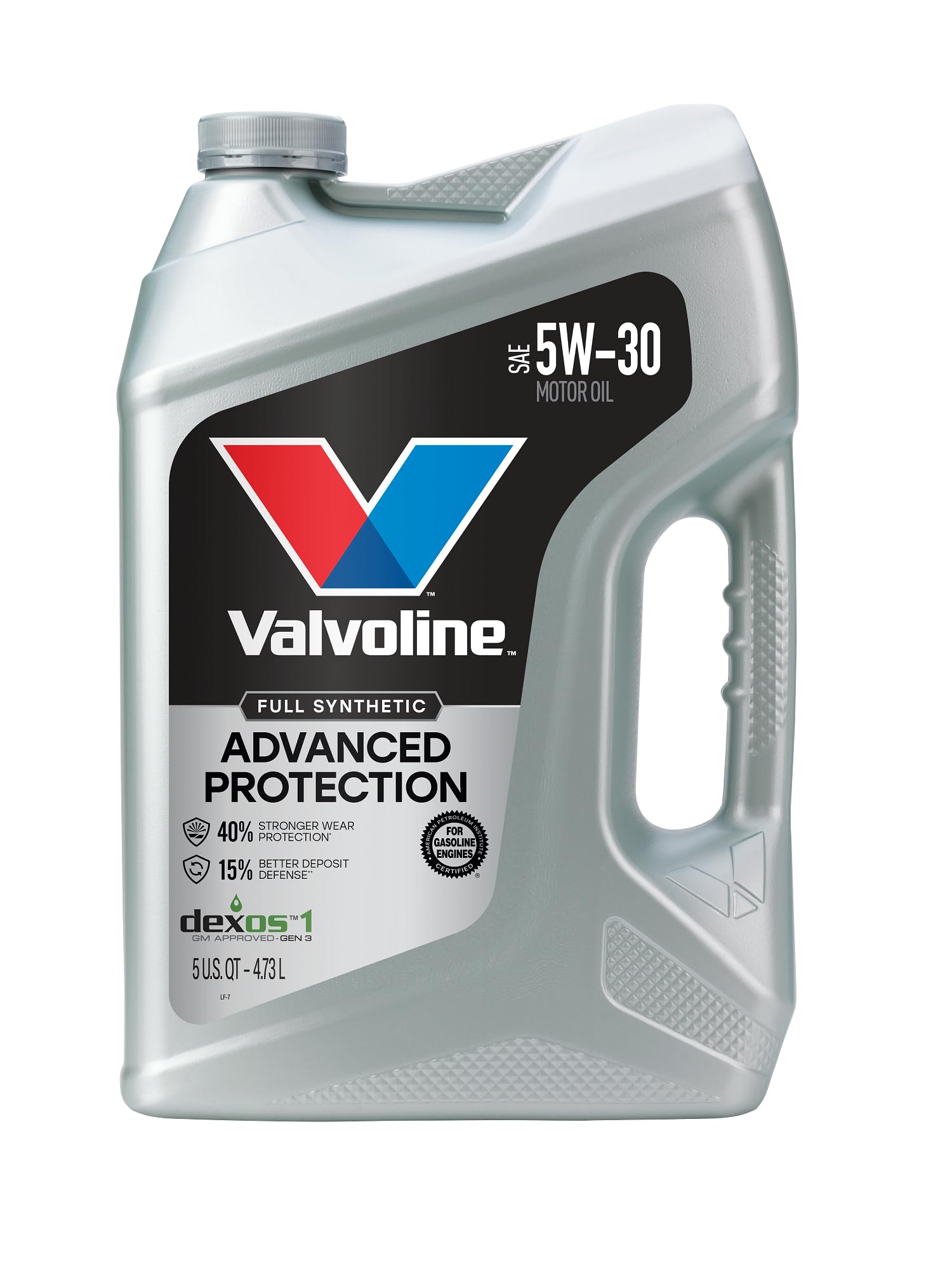
1. Valvoline Advanced Full Synthetic SAE 5W-30 Motor Oil 5 QT
Our pick — over 4.5★ from 13,500+ verified ratings; the strongest balance of quality and price.
The crowd-pleasing all-rounder that fights the four main causes of engine breakdown without breaking a budget.
Valvoline’s Advanced Full Synthetic takes aim at the four culprits that kill engines — wear, friction, heat, and deposits — and the numbers back it up. It delivers 40% stronger wear protection than industry standards, reducing metal-on-metal contact during freezing starts. The cold-start story is the real headline: it’s engineered for excellent low-temperature flow, reducing metal-to-metal contact during the exact moment when most engine wear happens.
Beyond the cold-start claim, this oil carries the full stack of modern approvals — ILSAC GF-7A, API SQ, API SP, and GM dexos1 Gen 3 — meaning it’s warranty-safe for nearly any modern gasoline engine. A Ford F-150 owner running it confirms it meets Ford WSS-M2C961-A1, calling it ideal for turbo engines needing thermal stability and deposit control. The 5-quart jug is the perfect amount for a standard car, as buyers report, with a clean, smooth pour and an engine that runs quieter after each change.
The value message is loud and clear across owner experiences — reliable, affordable, consistent performance that holds up between changes. The broad compatibility extends to cars and trucks alike, and the 394 °F flash point (the temperature at which the oil could ignite) gives a solid safety margin against overheating. As owners mention: “Works as i needed ty very good product.”
What wins owners over
- 40% stronger wear protection vs. industry standards for cold-start safety
- 15% better deposit defense keeps the engine cleaner
- Up to 2.5X better heat protection against sludge formation
- Full ILSAC GF-7A and API SP approval stack
Who should look elsewhere
- The 5W-30 grade isn’t the thinnest cold-weather option — 0W grades flow better in extreme cold
- Best suited to gasoline vehicles; diesel owners need a different spec
Reach for this if: you want a trusted, fully approved 5W-30 that protects daily drivers and turbo engines alike without premium pricing.
Think twice if: you live somewhere that hits below -20°F regularly — the 0W oils ahead pour even faster.
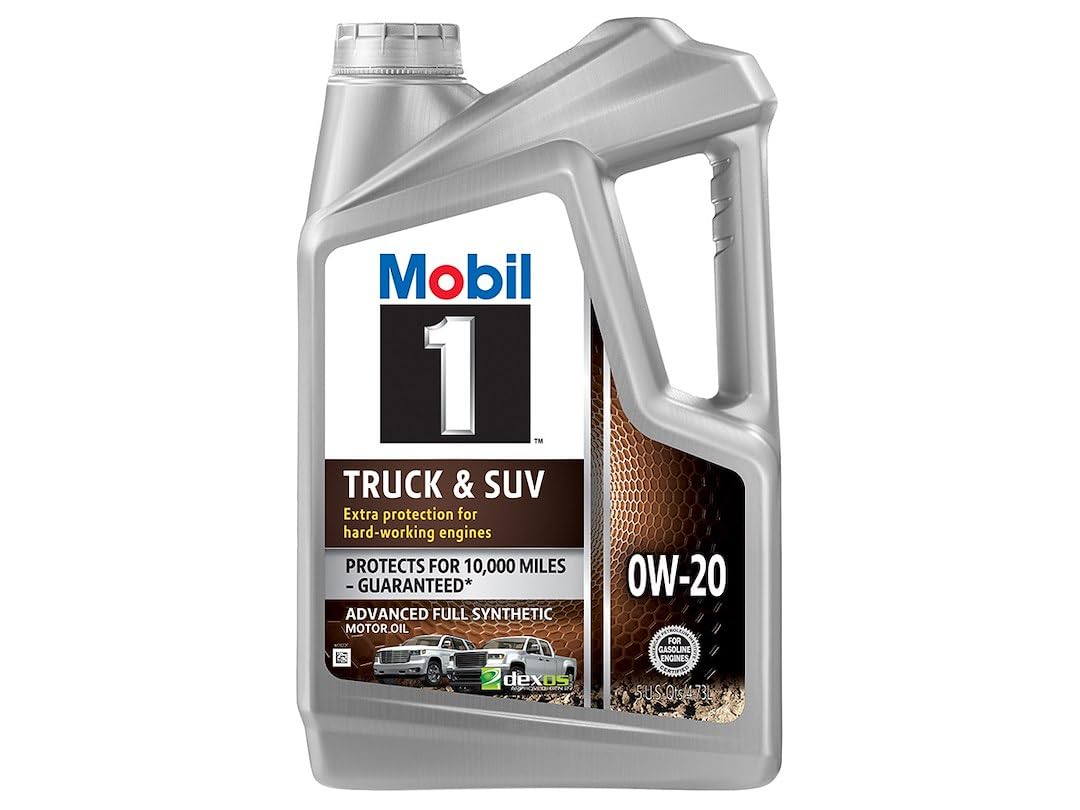
2. Mobil 1 Truck & SUV Full Synthetic Motor Oil 0W-20, 5 Quart
The 0W-20 workhorse for trucks and SUVs that refuses to thicken down to -40 degrees.
If your pickup earns its keep towing and hauling through brutal winters, this Mobil 1 formula is built exactly for that life. It’s a 0W-20 grade — the “0” meaning it stays remarkably thin when the thermometer plummets — and Mobil 1 rates its low-temperature protection down to -40 degrees F. On those days when your windshield is a sheet of ice, this oil is already pumping through your engine’s critical parts.
The protection story extends far beyond cold starts. Mobil 1’s Triple Action Formula delivers engine protection, cleanliness, and proven performance tested in a 10. towing test, with additives that prevent deposit formation. It also withstands internal heat up to 500 degrees F, crucial for a hardworking motor under load. The manufacturer backs the formula for up to 10,000 miles between oil changes, controlling oxidation to prevent breakdown.
The owner consensus is sharp: this oil beats the dealership stuff. As customers note, “Better than GM oil from dealership… the engine performance and the acceleration improved way better than before.” The quality stands out as the single most-praised trait among owners, with dozens calling out its value and its refusal to break down over time.
Built for the hard work
- 0W-20 grade flows easily at -40 degrees F
- Triple Action Formula tested in a 10. towing test
- Up to 10,000 miles between oil changes
- Withstands internal engine heat up to 500 degrees F
Keep in mind
- 0W-20 isn’t right for engines that specifically call for a thicker grade
- Owners note it’s not the cheapest option on the shelf
Grab this if: you run a truck or SUV in serious winter and want a 0W-20 that’s been torture-tested for towing.
skip it if: your engine manual requires 5W-30 — match the manual before the cold.
3. Mobil 1 Truck & SUV Full Synthetic Motor Oil 5W-30, 5 Quart
A 5W-30 that pairs the familiar winter grade with towing-rated toughness for serious haulers.
For owners whose trucks demand the 5W-30 grade, this Mobil 1 sibling delivers the same towing-tested pedigree as its 0W-20 brother. The “5W” rating means it flows well in cold weather, though not quite as instantly as a 0W — a fair trade-off for engines that run happier on the slightly thicker grade. Mobil 1 still guarantees low-temperature protection down to -40 degrees F.
Loyalty tells the real story here. Long-haul owners describe running this oil in GM and Ford vehicles for 20+ years with no engine lights, and one reported a valvetrain that looked new at 165,000 miles. Others note a quieter, smoother engine immediately after the change, with clean oil at 3,000 miles, good pressure, and no burn-off — even under towing strain. The wide spout gets a shout-out for clean, easy pours.
The engine-protection angle wins particular praise from high-mileage and towing owners, and the value-for-money is a close second in owner feedback. As buyers put it: “Best oil; used 20+ years in GM/Ford, no engine lights.” That’s the kind of track record that makes this the safe pick for a pickup you plan to keep.
Why owners stay loyal
- 5W-30 with low-temp protection to -40 degrees F
- Triple Action Formula for wear, cleanliness, and performance
- Clean combustion at 3,000 miles with no burn-off reported
- Easy wide spout for mess-free pouring
The honest trade-off
- 5W is slightly thicker than 0W at extreme cold, so a 0W still starts faster
- Owners warn that cheap synthetics can feel diluted by comparison
Pick this if: your truck or SUV calls for 5W-30 and you tow, haul, or just want decades-proven reliability.
Look elsewhere if: you’re in a region that regularly hits extreme subzero — a 0W grade will flow faster on those mornings.
4. Pennzoil High Mileage 5W-30 Motor Oil, 1 Quart (6 Pack)
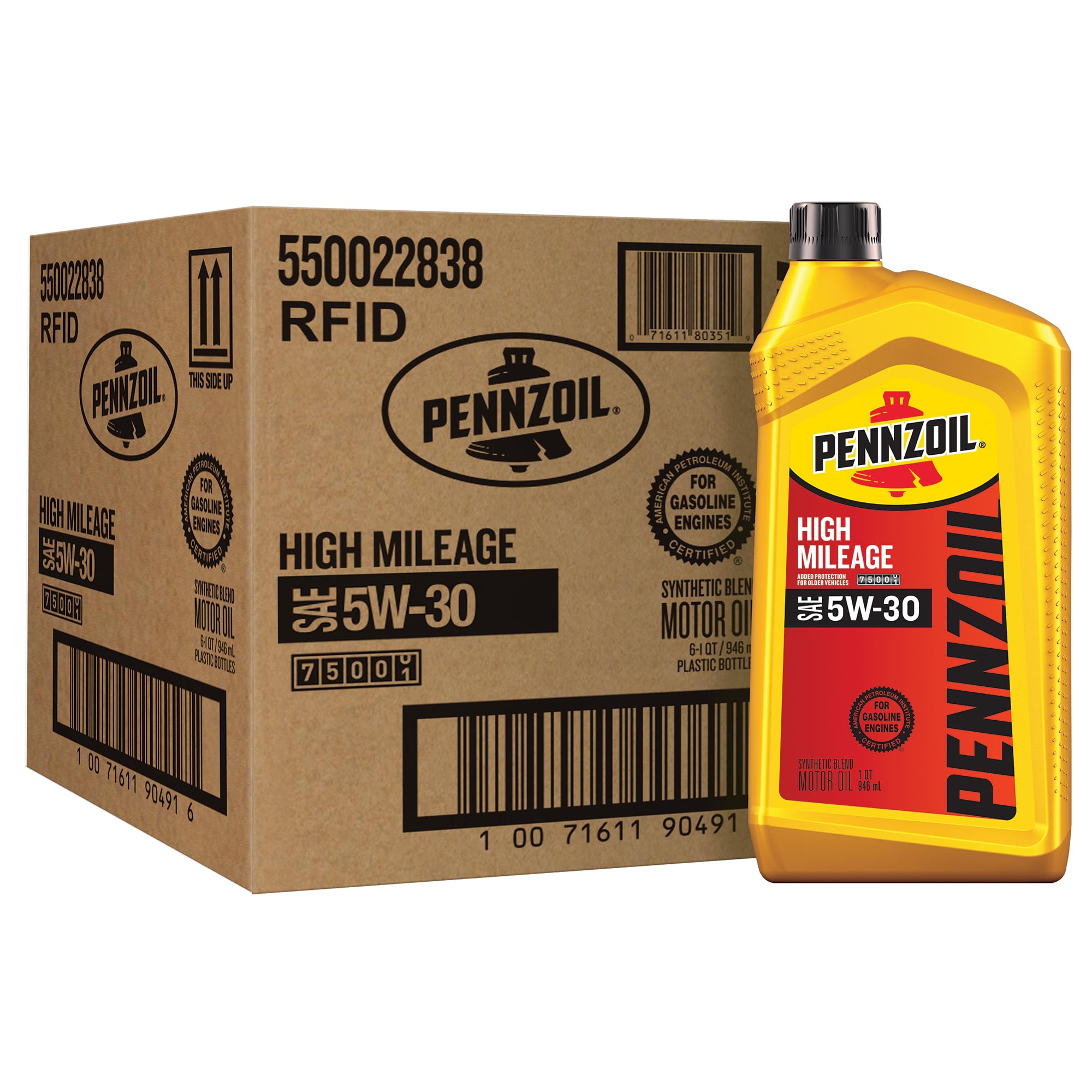
A synthetic blend that doubles as a seal-conditioner for engines past the 75,000-mile mark.
If your vehicle has crossed the 75,000-mile threshold, an ordinary oil leaves money on the table. Pennzoil’s High Mileage formula is a synthetic blend engineered to help stop leaks and reduce oil consumption in worn engines — the two most common frustrations of an aging motor. That’s not just comfort; it’s the oil actively working to condition aging seals.
Cold-weather buyers should note this is a 5W-30 blend, so it flows capably in winter but isn’t the thinnest cold-start option. What it gives up in extreme cold flow, it makes up for in targeted protection: it helps prevent sludge and damaging deposits, provides proven wear protection, and is rated for modern turbocharged engines that need low-speed pre-ignition protection. The six-pack of quart bottles means you’ll have the right amount for most cars without a second trip.
Real owners back this up. One Ford Explorer driver with roughly 230,000 miles reports the motor runs great and swears by it. Others describe smooth, leak-free, noiseless driving after the switch. The standout benefit isn’t flashy — it’s the confidence of an oil that treats an older engine with the care it needs.
The high-mileage argument: recommended for vehicles over 75,000 miles, this blend targets the leaks and oil consumption that plague aging engines while still offering winter-capable 5W-30 flow.
Where it fits: the ideal pick for a well-worn daily driver where seal conditioning matters more than absolute cold-flow speed.
5. Castrol EDGE Extended Performance 0W-20 Advanced Full Syn Motor Oil 5 Qt

The 0W-20 that stretches oil-change intervals to 25,000 miles while keeping cold-start flow instant.
Castrol’s EDGE Extended Performance is the oil for drivers who want to think about changes as rarely as possible. The headline claim is 25,000 miles between oil changes (or one year, whichever comes first) — nearly unthinkable for conventional oils. It backs that with a 3X-stronger viscosity resistance than the leading full synthetic, resisting breakdown and thinning over that long stretch.
Cold starts are a given strength here: as a 0W-20, the oil stays thin and pumpable in frigid conditions. But the deeper story is its 50X better high-temperature performance in the Seq IIH test versus API SQ limits — an edge for turbocharged engines that run hot. The approval list is thorough: API SQ/SP/SN PLUS/SN, ILSAC GF-7, ACEA C5, and GM dexos1 Gen 3, plus Ford WSS-M2C947-B1 and WSS-M2C962-A.
Owner feedback is straightforward — high quality, no issues, and genuine value for the money. One Volvo owner swapped from the dealer-specified oil and reported no problems whatsoever. The long interval is the differentiator, though: if you hate crawling under the car, this is the one to reach for.
The long-game play: a 25,000-mile interval with 3X-stronger viscosity resistance makes this the set-and-forget premium for busy owners.
The fit check: with a 0W-20 grade and GM dexos1 Gen 3 approval, it’s primed for modern gasoline cars and hybrids — but verify your engine calls for 0W-20 first.
6. K&N Motor Oil: 0W-20 Synthetic Engine Oil: Premium Protection, High Mileage, 5 Quarts

A premium 0W-20 that promises to keep the engine running like new in both deep cold and summer heat.
K&N brings its filter pedigree to engine oil with a 0W-20 full synthetic that leans on what it calls Advanced SynthAMAX Technology — a proprietary additive package aimed at protecting critical engine components. The brand’s all-weather claim is right in the product name: the formula is designed to keep your car running smooth in both cold and hot temperature conditions, which for winter drivers means reliable morning starts.
The protection pitch is about longevity. K&N says the oil minimizes harmful contaminants and sludge buildup while offering premium engine protection against wear and tear. One devoted BMW X1 owner at 135,000 miles reports the engine looks “really clean and almost ‘New’ still” — the kind of long-term evidence that earns brand loyalty. It’s positioned as a high-mileage-friendly option, so it suits both newer and well-aged engines.
The value angle is strong, with owners noting they saved money versus alternatives. It’s worth flagging one caution: for a 0W-20 oil, this is not a replacement for checking your specific vehicle’s requirement — as one motorcycle owner learned the hard way when the weight was wrong for their machine. For cars calling for 0W-20, it’s a premium all-weather choice.
The all-weather promise: a 0W-20 synthetic designed to flow smoothly in both deep cold and summer heat, with additive tech focused on component protection.
The honest note: the 5-quart jug is sized for car engines — verify your vehicle’s required grade before buying, as this is a 0W-20 only.
7. Liqui Moly Molygen New Generation SAE 0W-20 | 5 Liter | Fully synthetic engine oil

A German-engineered 0W-20 that boasts instant lubrication after cold start and a neat extra in its green dye.
Liqui Moly’s Molygen New Generation is engineered for one specific moment: the instant you turn the key on a freezing morning. The formula is built for “instant lubrication after cold start,” meaning the oil is already where your engine needs it before the grind can begin. It also maintains optimum oil pressure under all operating conditions, which keeps protection consistent from idle to full throttle.
The green color isn’t just branding — it’s a UV tracer that glows under ultraviolet light, making oil leaks far easier to spot. Owners genuinely love this feature, calling the green UV tracer a “super useful bonus.” The emissions angle is there too: the oil reduces pollutant emissions and is considered ideal with turbochargers and catalytic converters. It’s miscible with all commercially available motor oils, so a top-up won’t cause a chemistry clash.
The owner devotion is striking. A household running a Jeep Gladiator, Jeep Wrangler JL, and an Audi A4 uses Molygen in all three, noting it already contains friction modifiers others sell separately. Another reports quieter engines and very little burn-off between changes. The compatibility list is specific — Acura, Buick, Cadillac, Chevrolet, GMC, Holden, HSV, Opel, Pontiac, and Saturn models — so verify your car is covered before committing to the 5-liter bottle.
What makes it special
- Instant lubrication after cold start for frozen mornings
- Green UV tracer glows under UV light to spot leaks
- Miscible with all commercially available motor oils
- Reduces pollutant emissions for turbo engines
Before you commit
- Vehicle fit is specific — check the Acura through Saturn list
- Premium pricing reflects its German-engineered pedigree
Choose this if: you drive one of the listed GM-platform or Acura models and want instant cold-start lubrication with leak-spotting smarts.
Pass if: your vehicle isn’t on the compatibility list — the specific fit matters here.
8. Motul 8100 ECO-lite 0W-20 Full Synthetic Motor Oil – API SP & dexos1 Gen3, 5 Liter
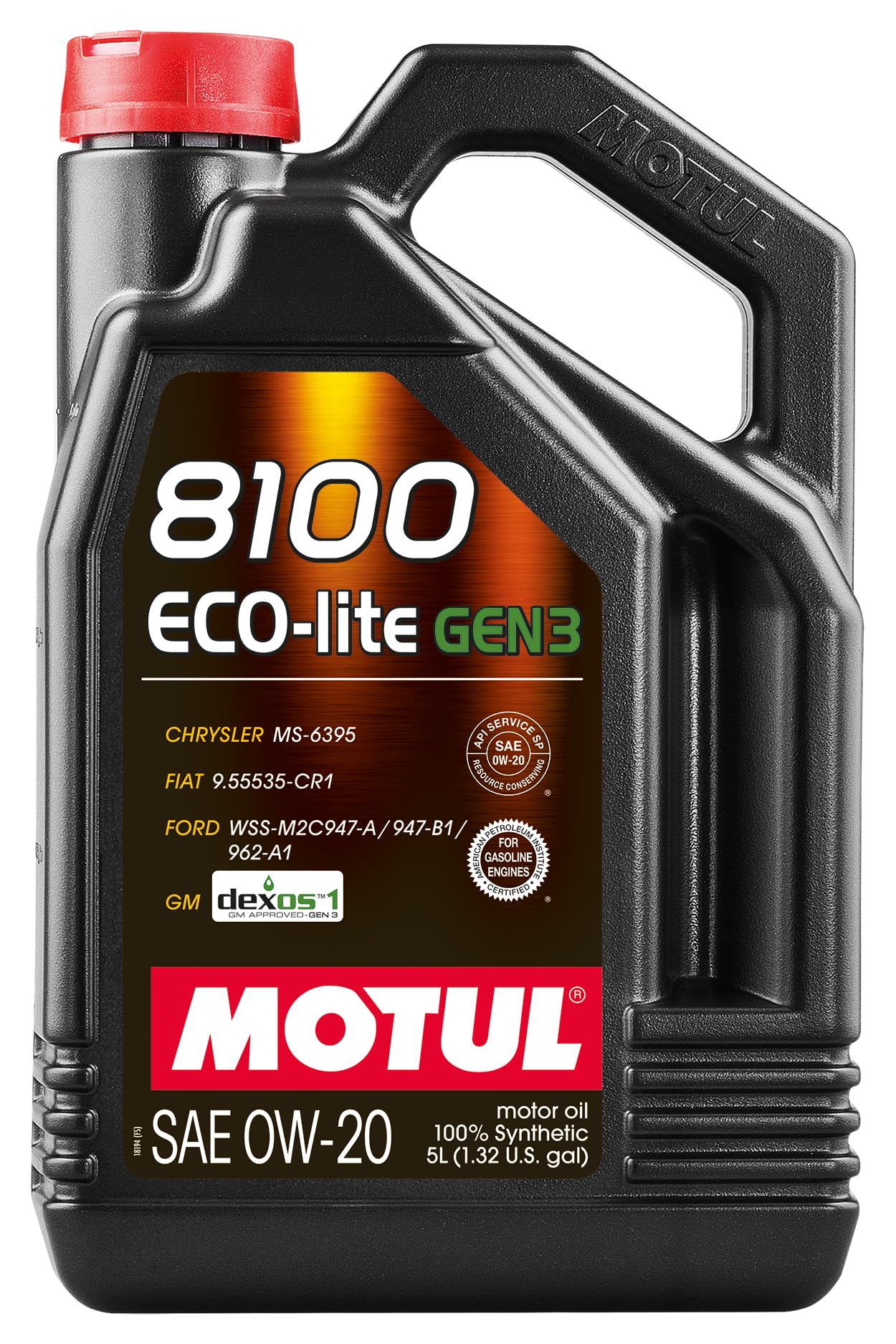
A 100% synthetic 0W-20 engineered to reduce internal friction and lubricate faster at startup for modern engines.
Motul’s ECO-lite is the enthusiast’s answer to modern engine complexity. Built as a 100% synthetic 0W-20, it’s specifically engineered to reduce internal friction and support faster lubrication at startup — exactly what a cold morning demands. The “ECO” in the name points to its fuel-efficiency focus: reviewers point out real gains, from a 3 MPG improvement in city driving to a Civic Si owner jumping from 33-34 mpg to 37-38 mpg after the switch.
The protection spec is current and complete. It’s API SP and GM dexos1 Gen3 certified, meaning it guards against low-speed pre-ignition (LSPI), timing chain wear, and deposit formation — the three biggest threats to modern turbocharged and direct-injection engines. The compatibility list is broad, covering Ford WSS-M2C947-A / 947-B1 / 962-A1, Chrysler MS-6395, and FIAT 9.55535-CR1, making it suitable for a wide range of Chevrolet, GMC, Cadillac, Buick, Ford, Lincoln, Chrysler, Dodge, Jeep, and RAM applications.
Owner enthusiasm runs deep — “the best in the world” is a recurring sentiment, with a Subaru Forester owner reporting a smoother-running vehicle. The noise reduction gets specific praise too: less knocking on idle, quieter operation. With a 5-liter jug, it’s sized for a single full change on most cars, and the premium price is justified by owners who report it’s worth it for the smoothness and mileage gains.
The modern-engine edge
- API SP and GM dexos1 Gen3 certified for LSPI and wear protection
- Shoppers say fuel gains from 3 MPG up to 37-38 mpg
- Faster lubrication at startup for cold mornings
- Broad OEM compatibility across GM, Ford, and Chrysler families
Know before you buy
- Premium-tier pricing for the 5-liter jug
- Requires a 0W-20 application — not for engines needing thicker grades
Reach for this if: you drive a modern turbocharged or direct-injection car and want maximum cold-start flow with the latest API SP and dexos1 Gen 3 protection.
Think twice if: your budget is tight — the premium price reflects the advanced additive technology, and a solid mid-range 0W-20 will also serve you well.
Understanding the Specs
Viscosity Grade: The “W” Decoded
The number before the “W” (for Winter) tells you how well the oil flows in cold. A 0W-20 flows faster and thinner at freezing temperatures than a 5W-30, meaning quicker protection on a cold start. The number after the W (like the 20 or 30) is the oil’s thickness at operating temperature — match that to your engine, because using the wrong one sacrifices protection or fuel economy.
Cold Flow Ratings: -40°F Claims
Premium full synthetics like the Mobil 1 picks advertise low-temperature protection down to -40 degrees F. That’s the temperature at which the oil still flows enough to protect the engine. A 0W-20 generally flows better in extreme cold than a 5W-30, which is why the thinnest grades are the favorites for severe winter climates.
FAQ
What does 0W-20 mean for cold weather driving?
Is 0W-20 better than 5W-30 for freezing temperatures?
Will full synthetic oil really protect my engine better in winter?
Can I use 0W-20 oil in an older high-mileage car?
What does API SP or dexos1 Gen 3 mean?
How often should I change oil in cold weather?
Is there a difference between oil for trucks and oil for cars?
Why is full synthetic oil more expensive than conventional oil?
Can I mix synthetic and conventional oil in winter?
What viscosity grade should I use if I drive a VW or Audi in winter?
Final Thoughts: The Verdict
For most people, the engine oil for cold weather winner is the Valvoline Advanced Full Synthetic 5W-30 because it pairs 40% stronger wear protection with a full approval stack at a price that suits daily drivers. If you want the thinnest cold-start flow for a truck or SUV, grab the Mobil 1 Truck & SUV 0W-20. And for modern turbocharged engines demanding the latest protection, the Motul 8100 ECO-lite is the one to reach for.
How We Picked
We do not accept paid placement. Every pick is matched to a real buyer and a real use-case; we do not hands-on test units.
Sources & Methodology
Specifications: manufacturer listings and product documentation. Review insights: verified customer reviews, as of August 2026. Pricing: not shown on this page (it changes often); check the current price via the retailer link.
As an Amazon Associate, WellFizz earns from qualifying purchases. This does not affect which products we feature.
Related Guides

Mo Maruf
I created WellFizz to bridge the gap between vague wellness advice and actionable solutions. My mission is simple: to decode the research and give you practical tools you can actually use.
Beyond the data, I am a passionate traveler. I believe that stepping away from the screen to explore new environments is essential for mental clarity and physical vitality.