Our readers keep the lights on and my smoothie glass nicely filled. As an Amazon Associate, I earn from qualifying purchases.
Specs are compiled from manufacturer listings and verified buyer reviews and can change over time — please confirm the key details on the product page before buying.
When the grid goes dark, the difference between a minor inconvenience and a full-blown crisis depends on one question: how much power did you store before the lights went out? This guide tackles exactly that — three complete home battery systems that keep your fridge running, your internet alive, and your sump pump working through the storm, each matched to a different home size and budget. For most buyers, the ECO-WORTHY Powermega 48V 314Ah is the one worth buying: it packs 16.1kWh of usable power into a single unit, which is the most capacity you can get without stacking multiple boxes.
I’m Mohammad Maruf — the founder and writer behind WellFizz. This guide is built by comparing the manufacturers’ published specifications and the patterns across verified customer reviews, so you get each pick’s real strengths and trade-offs instead of marketing spin.
Note: this list uses flexible matching for storage capacity — not every pick is the exact number you searched, but the nearest same-type size serves the same purpose. if you need a whole-home unit or a modular starter, the best energy storage systems here blend real-world backup power with smart monitoring and room to expand.
Our Picks at a Glance
How To Choose The Best Energy Storage Systems
Choosing a home battery is not about picking the biggest number on the box. It is about matching the storage capacity to the appliances you actually need during an outage, then checking that the inverter can handle the surge when your refrigerator compressor kicks on all at once.
Start with the watt-hours, not the brand
To avoid guessing whether your fridge will last the night, look at a battery’s capacity in watt-hours (Wh) — the total energy it can hold and dish out. A 5,120Wh unit can run a standard refrigerator for roughly a day and a half., while a 10,240Wh system doubles that headroom. List the essentials you want to keep alive, add up their running wattage, and multiply by the hours you want of coverage.
Check the inverter’s output power
Your inverter converts stored DC power (direct current, like a battery’s native output) into AC power (alternating current, what your home outlets use). Its wattage rating tells you the maximum load it can feed at once. If your well pump or AC unit draws more than the inverter can deliver, the system trips — so match the inverter to your biggest single appliance, not your average draw.
Quick Comparison
| Model | Best For | Battery Capacity | Inverter Output | Output Voltage | Amazon |
|---|---|---|---|---|---|
| ECO-WORTHY Powermega 48V 314Ah★ Best Overall | Whole-home backup with solar | 314Ah / 16.1kWh usable | 10,000W | 240V split-phase | Amazon |
| ECO-WORTHY 10kW + 10240Wh | Large homes, heavy appliance loads | 10240Wh (2x 100Ah) | 10,000W | 120V / 240V | Amazon |
| ECO-WORTHY 5000W + 5120Wh | Entry-level whole-home starter | 5120Wh (1x 100Ah) | 5,000W | 120V | Amazon |
In‑Depth Reviews
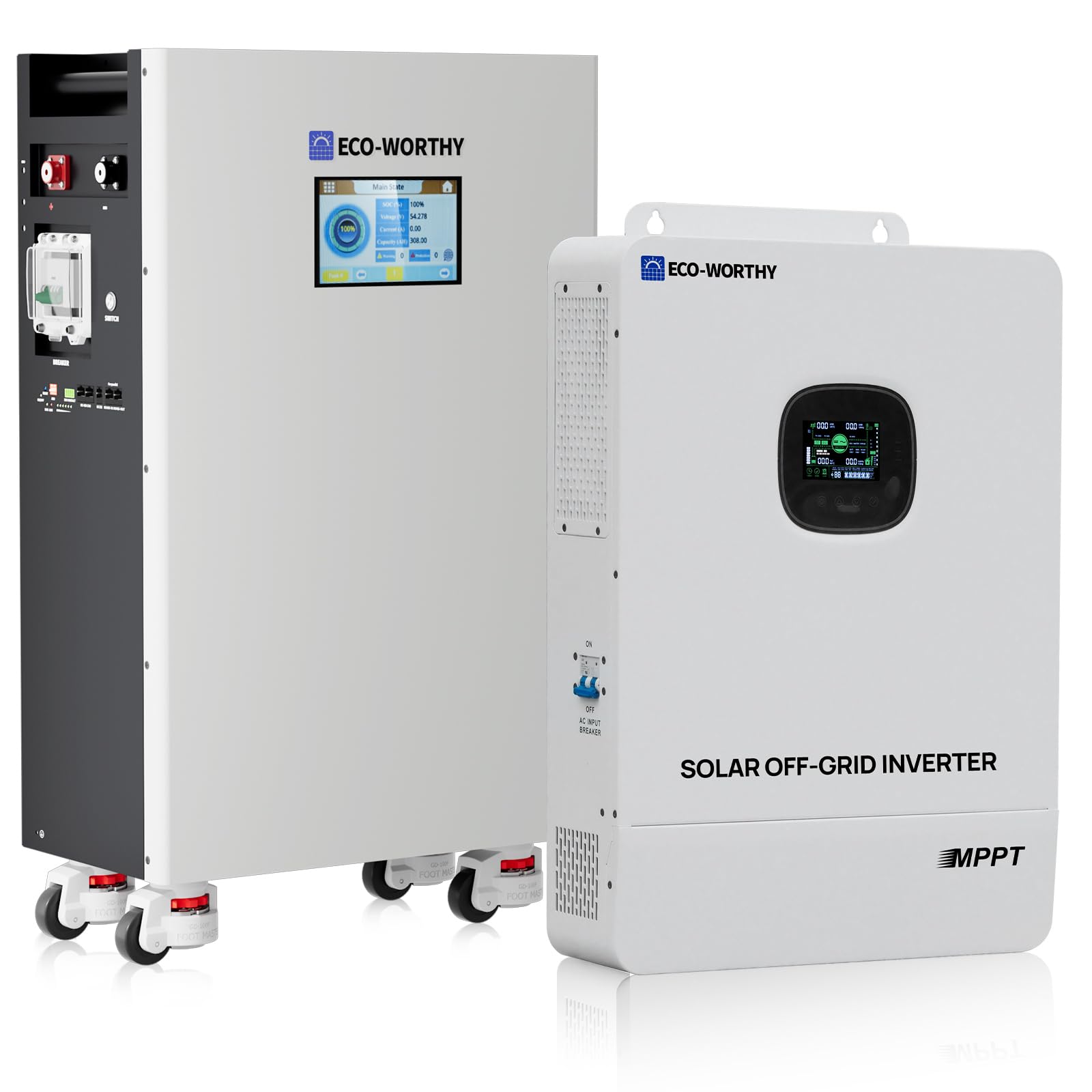
1. ECO-WORTHY Powermega 48V 314Ah LiFePO4 Energy Storage System with 10kW Hybrid Inverter
Our pick — over 4.5★ from 20+ verified ratings; the strongest balance of quality and price.
The heavyweight that runs a whole home on a single 314Ah battery
This is the system for the homeowner who wants one powerful setup rather than a stack of smaller units. It pairs a 48V 314Ah LiFePO4 battery with a 10kW hybrid inverter to deliver 16.1kWh of usable energy — enough to carry a full load of essentials through a long outage or power an off-grid cabin outright. The inverter handles both split-phase 240V and single-phase 120V output, so it can run a standard North American panel without extra conversion gear.
What wins people over is how the system behaves as a smart appliance rather than a dumb battery. Owners describe running it as a UPS (uninterruptible power supply) for their AC and computer, using peak-shaving to draw from the battery during expensive off-peak hours and recharge during cheaper ones. The built-in WiFi and Bluetooth connect to a mobile app for live status, and the battery speaks RS485, CAN, and RS232 protocols so it talks to most solar inverters on the market. Buyers also highlight the Active Balancing BMS (a battery management system that evens out charge across every cell), a built-in circuit breaker, and an aerosol fire suppression module for multi-layer protection.
Expect a delivery day that takes planning. At 293.2 pounds, this battery ships on a pallet by truck — about 2.3 times the weight of the 130-pound 5120Wh unit — so you need a driveway that accommodates freight delivery and help moving it once it arrives. The reinforced casters help, and the reviews confirm the effort pays off: the same owner notes the unit runs simple phone-app controls for peak discharge and off-peak charging. The trade-off is that a 10kW system is overkill if you only want to keep a fridge and lights on.
Smart-home ready: Home Assistant users can pull monitoring data into their dashboards, and the Solarman app handles the WiFi dongle — a genuinely polished monitoring experience for a system this size.
Setup reality: Its 9,000+ cycle life at 80% depth of discharge means over a decade of daily use., but the truck-freight delivery and multi-package arrival are logistics you must plan around.
Reach for this if: you want one max-capacity unit that can feed a whole home, integrate with your solar array, and last for years without adding more boxes.
Look elsewhere if: you have a small apartment or only need to back up a few devices — this is a 293-pound investment in serious power.
2. ECO-WORTHY Home Power Station Backup Power, AC 10000W Output + 10240Wh LiFePO4 Battery
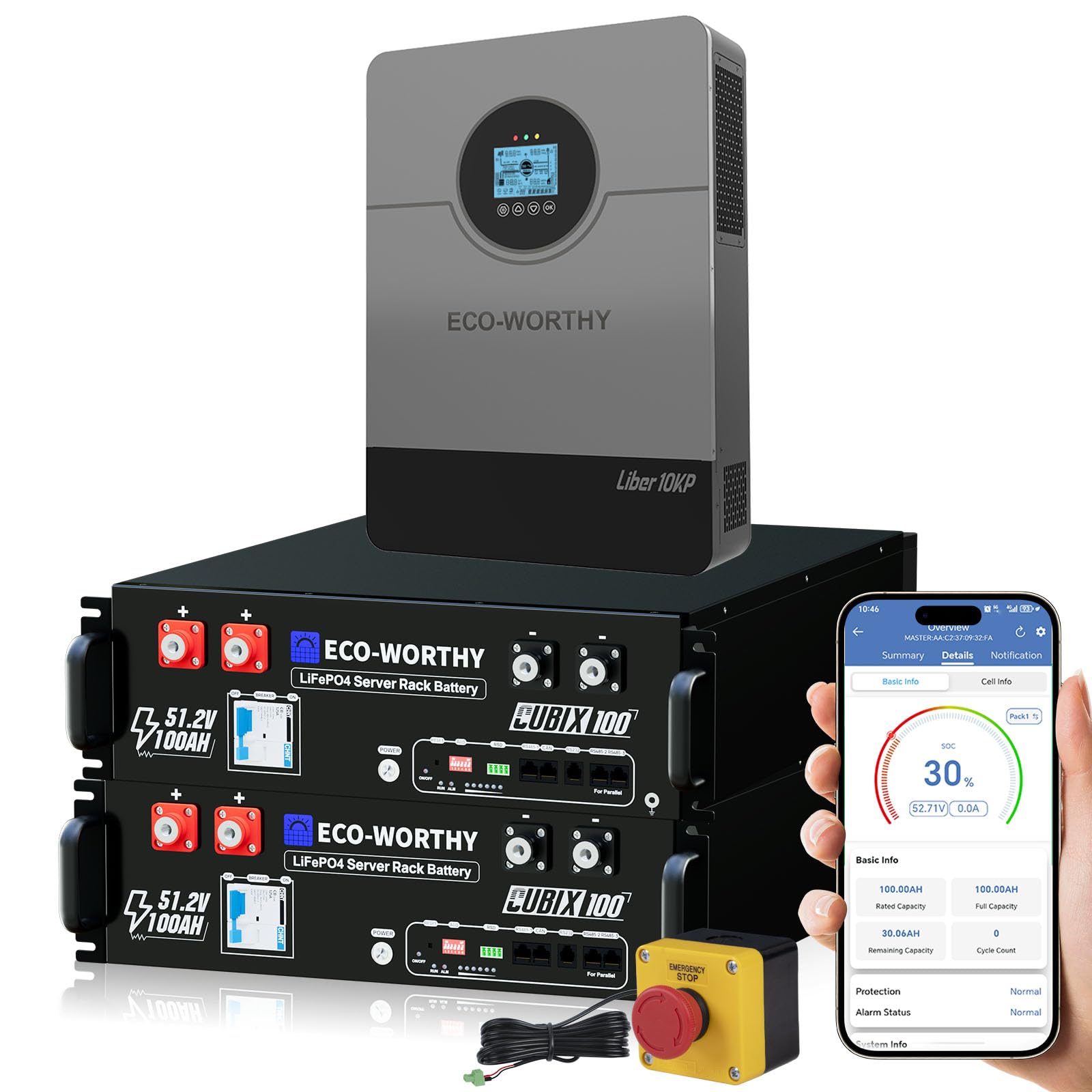
Double the battery, double the surge — a modular giant that swallows whole-house loads
Where the Powermega crams everything into one heavy battery, this kit spreads the same muscle across two 51.2V 100Ah LiFePO4 server-rack batteries for a combined 10240Wh with a 10000W hybrid inverter. That is exactly double the capacity of the 5000W entry kit, giving you roughly twice the runtime on the same footprint of rack-style modular hardware. The inverter outputs a pure sine wave (clean, stable power that electronics prefer) and supports 120V/240V split-phase, so it can feed a full house panel including larger 240V appliances.
The build quality gets consistent praise — owners describe it as well-packed and sturdy, with one buyer noting it “powers the entire house and all the appliances” while holding a charge for a long time. The dual MPPT controllers (maximum power point trackers that squeeze the best output from your solar panels) work independently, and the 3-in-1 design combines an inverter, an MPPT solar controller, and a battery charger capable of up to 200A. Safety is a headline here: The battery and inverter passed UL1973 and UL1741 safety testing by Intertek., covering electrical safety and thermal runaway management.
Plan your labor in advance. At this weight, owners explicitly warn to “plan your loading unloading very heavy” and get a truck big enough for the move. A separate review hit a snag communicating with customer service and self-resolved the setup via a jumper on L1/L2 for 115V grid operation — so some electrical comfort helps. The upside is expansion: Up to 6 hybrid inverters can parallel for 60kW AC output, and up to 32 batteries stack to 163.84kWh total storage..
Raw power first: 10000W rated output with 20000W peak means it can start heavy motors like well pumps and AC compressors without tripping.
The catch: zero-to-setup takes planning — the shipping splits into multiple packages, and the initial configuration may demand a YouTube search or a support call.
Pick this when: your home has both a big battery appetite and a big surge appetite — two batteries and a 10kW inverter handle both without breaking a sweat.
Think twice if: you want a single streamlined unit, since this kit’s modular shipping and heavier total weight demand more handling than the Powermega’s one-piece design.
3. ECO-WORTHY Home Power Station Backup Power, 5120Wh LiFePO4 Battery, AC 5000W Inverter
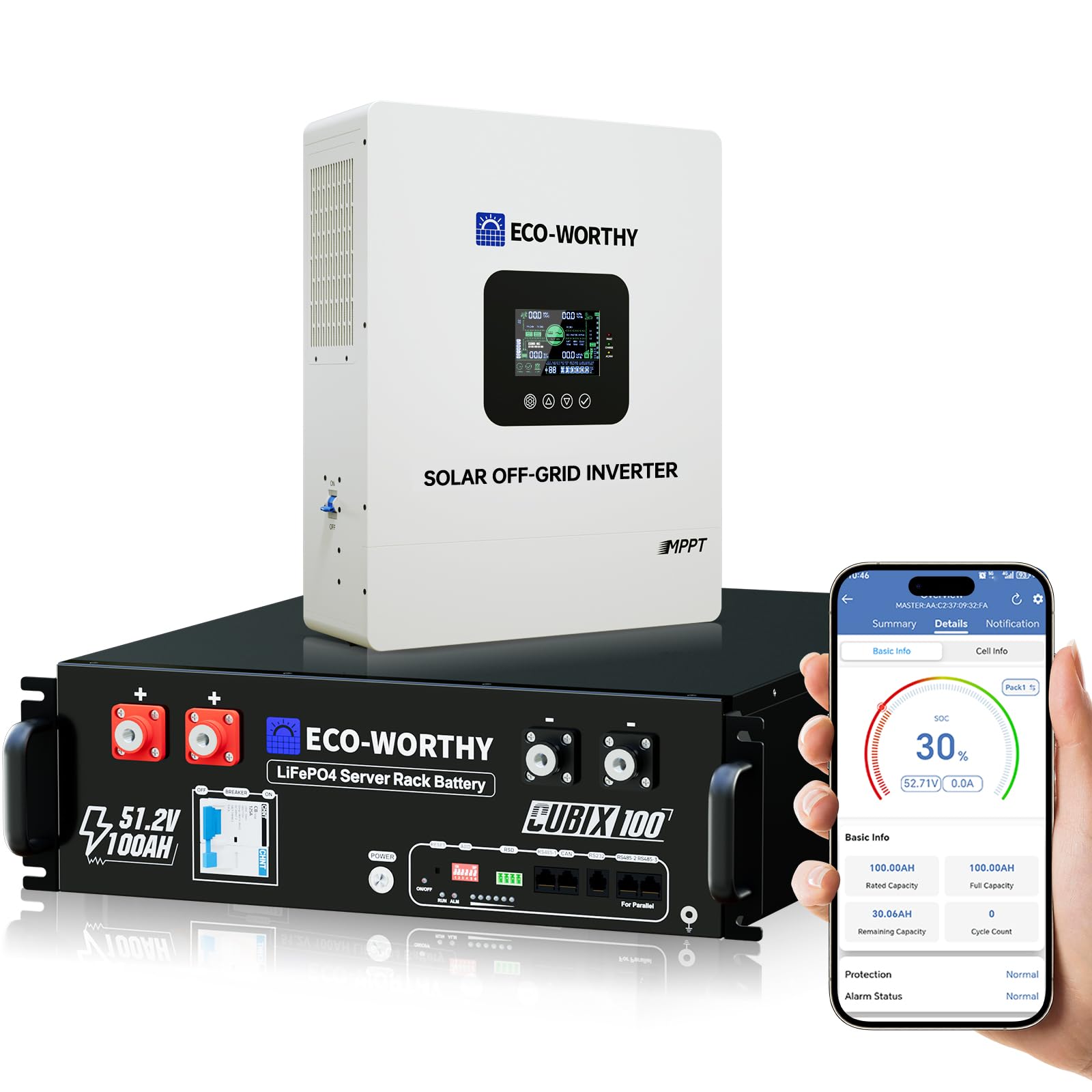
The sensible starter — a single battery, a 5000W inverter, and room to grow
This is the entry point that still acts like a real home-backup system rather than a glorified power bank. It combines one 51.2V 100Ah LiFePO4 battery with a 5000W MPPT inverter for 5120Wh of capacity and 5000W of output power — enough to keep essential appliances running through an outage. At 130 pounds, it is the lightest of the three by a wide margin, coming in at about a third of the Powermega’s weight, which makes placement and service far more approachable for a first-time owner.
The value story here is the satisfaction of owners who scaled their build around this exact unit. The most enthusiastic reviews describe buying multiple units — running 2x5000W inverters paired with 6x5120Wh batteries and 2x1600W solar arrays — which tells you the modular approach actually works in the field. The battery passed UL1973 and UL1741 testing by Intertek and meets California Energy Commission standards., and the closed-loop CAN/RS485 communication lets it coordinate with leading solar inverters. A 2.5-hour charge time on the battery itself means you can refill quickly between outages.
The realistic gripe is a physical one: feeding large gauge wires — 3/0 AWG for a 200A breaker, 2 AWG for a 100A breaker, plus grounds and solar wiring — through the unit’s three holes is genuinely tight. One owner hit a fan-error on the first unit, but the replacement worked after configuration and customer service earned top marks for responsiveness. For a home that wants backup without the freight-truck logistics, this lighter footprint is the practical balance.
Expand as you go: Add up to 6 inverters in parallel for 30kW output and up to 32 batteries for 163.84kWh. — you can start small and grow with your budget.
Plan the wiring: the tight conduit holes are the recurring field complaint; give yourself time and the right lube or adapter when running heavy cables.
Best for: budgets that want a certified, expandable backup now without committing to a 293-pound single-unit system.
skip it if: you need 240V output for a well pump or electric dryer — this inverter is single-phase 120V, so heavy appliances are out of reach.
Understanding the Specs
Battery capacity (Wh and Ah)
Watt-hours (Wh) tell you total stored energy — think of it as the size of your fuel tank. Amp-hours (Ah) matter when matching a battery to a specific-voltage inverter: a 48V 314Ah battery stores more energy than a 48V 100Ah one because Ah measures charge, and voltage × amps = watts. For home backup, look for a usable Wh figure, since most manufacturers quote the total but safety cutoffs reduce what you can actually draw.
Inverter output (W) and voltage
The inverter’s wattage is the maximum load it can feed at once — a 10000W unit runs a whole panel, while 5000W covers essentials only. Output voltage decides compatibility: 120V single-phase powers standard outlets, while 240V split-phase is required for large appliances like dryers and well pumps. Always match the inverter’s surge capacity to your biggest appliance’s startup draw.
FAQ
How much battery capacity do I need for a whole home?
What does the inverter wattage rating actually mean for me?
Why do these systems use LiFePO4 instead of regular lithium-ion batteries?
Can I connect these systems to my existing solar panels?
What does closed-loop communication between battery and inverter do?
How long will a 5120Wh battery actually last during an outage?
Is a 10kW inverter overkill for a small home?
How do these systems handle safety certifications?
Can I add more batteries later if my power needs grow?
How heavy are these systems and how do they ship?
Final Thoughts: The Verdict
If you want one dependable pick, the best energy storage systems winner is the ECO-WORTHY Powermega 48V 314Ah because it delivers 16.1kWh of usable power from a single battery with a 10kW hybrid inverter — the complete whole-home package in one unit. If you want maximum surge output for heavy appliances, grab the ECO-WORTHY 10000W + 10240Wh kit with its dual-battery design. And for a certified, expandable starter that keeps the logistics manageable, the ECO-WORTHY 5000W + 5120Wh system is the value pick that grows with your needs.
How We Picked
We do not accept paid placement. Every pick is matched to a real buyer and a real use-case; we do not hands-on test units.
Sources & Methodology
Specifications: manufacturer listings and product documentation. Review insights: verified customer reviews, as of July 2026. Pricing: not shown on this page (it changes often); check the current price via the retailer link.
As an Amazon Associate, WellFizz earns from qualifying purchases. This does not affect which products we feature.
Related Guides

Mo Maruf
I created WellFizz to bridge the gap between vague wellness advice and actionable solutions. My mission is simple: to decode the research and give you practical tools you can actually use.
Beyond the data, I am a passionate traveler. I believe that stepping away from the screen to explore new environments is essential for mental clarity and physical vitality.