Our readers keep the lights on and my smoothie glass nicely filled. As an Amazon Associate, I earn from qualifying purchases.
Specs are compiled from manufacturer listings and verified buyer reviews and can change over time — please confirm the key details on the product page before buying.
Getting a reliable, endless stream of hot water without watching your energy bills climb is the real goal here. The best energy efficient water heater isn’t just about the highest number on a sticker — it needs to match your home’s size, your climate, and how your family actually uses water throughout the day. This guide cuts through the noise to find the unit that genuinely saves you money and keeps your showers comfortable.
I’m Mohammad Maruf — the founder and writer behind WellFizz. This guide is built by comparing the manufacturers’ published specifications and the patterns across verified customer reviews, so you get each pick’s real strengths and trade-offs instead of marketing spin.
If you want to cut your monthly energy bills without running out of hot water, the Rinnai tankless heater is the one worth buying for its class-leading flow and efficiency. This guide covers the best energy efficient water heater for different home sizes and budgets, using real specs and honest owner feedback.
Our Picks at a Glance


How To Choose The Best Energy Efficient Water Heater
Picking the right unit starts with your home’s fuel source and your daily hot water demand. Here are the two most critical specs to focus on.
Flow Rate (GPM) vs. BTU Output
The flow rate, measured in gallons per minute (GPM), tells you how much hot water the unit can deliver at once. A 4 GPM unit is fine for a single shower and a sink, while a large family might need 7 GPM or more to run two showers and a washing machine simultaneously. This ability is powered by the BTU (British Thermal Unit) output — a higher BTU means the heater can raise the temperature of more water faster. You need to match both numbers to your home’s peak usage.
Energy Efficiency: The UEF Rating
The Uniform Energy Factor (UEF) is the industry standard for comparing efficiency. A higher UEF means more of the fuel is turned into usable heat and less is wasted. For gas tankless models, look for a UEF of 0.90 or higher. A unit with a 0.98 UEF, for example, is significantly more efficient than a standard tank heater, which typically scores below 0.70. This directly translates into lower monthly gas or electric bills.
Quick Comparison
| Model | Best For | Flow Rate (GPM) | UEF Rating | Fuel Type | Amazon |
|---|---|---|---|---|---|
| Rinnai RX199iN★ Best Overall | Best Overall | 11 gpm | 0.98 | Gas (Nat/Propane) | Amazon |
| Mizudo 90k BTUBudget Champion | Budget Pick | 4 gpm | 0.81+ | Propane | Amazon |
| GASLAND CS422BLPCompact Performer | Compact Value | 5 gpm | — | Propane | Amazon |
| ThermoMate ET270 | Electric Power | 5.27 gpm | 99.8% eff. | Electric | Amazon |
| CAMPLUX CA528 | Propane Efficiency | 6.4 gpm | — | Propane | Amazon |
| Mount Steel Pioneer | Adjustable Power | — | 99% eff. | Electric | Amazon |
| FOGATTI InstaGas | Outdoor Power | 7.5 gpm | — | Natural Gas | Amazon |
| Rheem RTG-70XLP-3 | Outdoor Propane | 7 gpm | — | Propane | Amazon |
| Rheem RTG-70DVLP-3 | Indoor Propane | 7 gpm | 0.82 | Propane | Amazon |
| Marey GA24CSALP | High-Capacity Value | 6.34 gpm | — | Propane | Amazon |
| ThermoMate RTC68iN | Condensing Savings | 9.38 gpm | 0.91 | Natural Gas | Amazon |
| Westinghouse HW199A0G-LP | Smart Large Home | 10.3 gpm | — | Propane | Amazon |
In‑Depth Reviews
1. Rinnai RX199iN Condensing Smart Sense Tankless Water Heater
Our pick — over 4.5★ from 100+ verified ratings; the strongest balance of quality and price.
The powerhouse that serves seven fixtures at once while sipping gas.
The Rinnai earns its top spot because it delivers an 11.1 GPM flow rate (gallons per minute — how much hot water it can produce at once), so you can run a shower, two sinks, a dishwasher, and a washing machine simultaneously without a temperature drop. That power comes from a 199,000 BTU heat output (British Thermal Units — a measure of heating capacity), which is 2.2 times more than the 90,000 BTU Mizudo, giving it the thermal muscle for any household. Its UEF 0.98 (Uniform Energy Factor — a standard efficiency rating, where 1.0 is perfect) means it wastes almost no fuel, and owners confirm real savings on monthly bills. One reviewer noted: “It’s been a year now so I can honestly say this water heater was worth every penny I paid for it.”
What wins people over is the rock-solid reliability — it ignites every time on demand, with 18 owners praising its reliability above all else. It is also remarkably quiet and compact for its output, weighing 55 pounds. The trade-off is that installation is a serious project; Rinnai strongly recommends a professional technician, and you will need a separate Controlr module (not included) for WiFi control. It also needs 120V power to operate, so no hot water during a blackout.
Why It Dominates
- Industry-leading 11.1 GPM flow rate handles a whole house running at once.
- Super-high efficiency (UEF 0.98) cuts energy waste and lowers bills.
- Doubles as a propane or natural gas unit thanks to Smart Sense gas control.
- Flexible install: indoor or outdoor with the Versa Vent system.
Installation Realities
- Requires professional installation — not a weekend DIY job.
- WiFi module (Controlr) is sold separately.
- Needs 120V power; no hot water during a power outage.
The Endless-Hot-Water Champion: If you have a larger home (3+ bathrooms) and want to never think about hot water again, this is the unit to build your system around. It beats smaller models like the 90k BTU Mizudo by a 2.8x gap in flow rate, but its true strength is the combination of extreme capacity and top-tier efficiency.
Who Should Take a Pass: A household with just one or two people won’t tap into its potential, and the premium cost — plus professional installation — is hard to justify for a small apartment or cabin.
2. MIZUDO 90,000 BTU Propane Tankless Water Heater
The entry-level propane unit that handles two showers and a sink.
This Mizudo delivers a solid 4.0 GPM flow rate from its 90,000 BTU burner, and buyers report it is a very effective solution for apartments or 1-2 bathroom homes. It uses its built-in chip and gas proportional valve to keep the output temperature within ±1°F, so you do not get those sudden cold blasts when someone flushes a toilet. For a camper or small house, owners mention that two 10-minute showers daily on max temp mean a 5-gallon propane tank lasts 2-3 weeks, making it an extremely efficient setup for low-demand scenarios.
The genuine value here is the price — it costs a fraction of premium models while still offering CSA certification and multiple safety protections like freeze protection and flame failure detection. However, a critical limitation is that the manufacturer does not recommend it for installations above 2,000 feet in elevation, a detail that caused a major issue for one buyer at 3,600 feet. The fit is also less ideal for very cold climates, as the freeze protection struggled in a Wisconsin basement, and the water temperature consistency can feel rough when kitchen sink flow is very low.
Perfect For Tight Budgets: Great for a cabin, tiny house, or small apartment where the hot water demand is modest — it heats instantly, has good safety features, and a propane tank lasts weeks. But skip it if you are in a high-elevation or severely cold climate, or if you need more than 4 GPM for a larger family.
3. GASLAND Gasmart C Propane Tankless Water Heater
A slim, wall-mountable unit that punches above its size for whole-home use.
The GASLAND steps up to 5.0 GPM (with a 113,000 BTU output), making it a strong fit for homes with 3 to 5 water outlets — like a master bath, kitchen, and laundry running simultaneously. It uses a smart water flow sensor and chip to hold the temperature within ±1°F, so you don’t get blasted with cold water when someone turns on a faucet. The unit itself is impressively compact at just 12.6″W x 19.88″H, freeing up floor space in a garage or utility closet.
Owners like the touch screen interface and the oxygen-free copper heat exchanger (a material that transfers heat better than standard stainless steel). It also resists Category 10 typhoon-force winds — a rare bonus for coastal or exposed homes. The catch: about half the users report a smooth installation, but others say performance can be intermittent. One owner described “unsteady hot water flow during shower” where the water cooled and then reheated after a delay, possibly a control algorithm bug from the smart chip. It also needs a 3-inch exhaust pipe, which comes in the box.
Solid Mid-Range Choice: The GASLAND is a great step-up for a family home that needs steady 5 GPM and appreciates the smart features and wind resistance. The biggest flag is the temperature consistency — a few owners experienced a cycling hot/cold issue that may be a unit defect or an algorithm quirk. If you are sensitive to temperature fluctuations, this could be frustrating.
4. ThermoMate Electric Tankless Water Heater 27kW
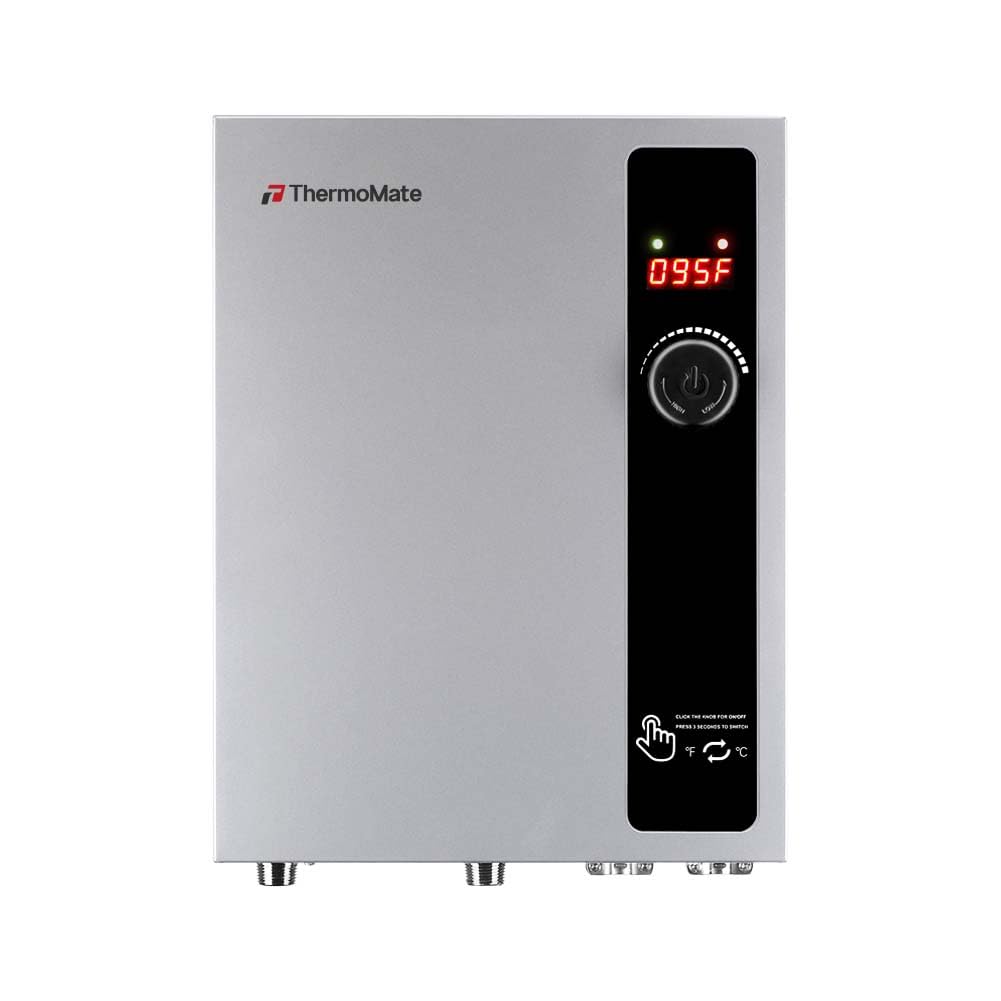
The all-electric alternative that ditches the gas line for 99.8% efficiency.
This ThermoMate is an electric powerhouse — at 27kW it can push 5.27 GPM at a 35°F temperature rise, meaning it can warm cold winter water up to a comfortable shower temperature. It does this with a self-modulating technology that adjusts energy use based on demand, hitting 99.8% efficiency. That means nearly all the electricity is turned into heat with zero standby loss, which customers note shows up directly on their electric bill — one owner noted saving a month after switching from a tank heater.
Installation is straightforward for those with the right electrical panel, and the design separates the heating element from the water tube, significantly reducing scale and mineral buildup — a major advantage in hard water areas. But this unit has a serious electrical appetite: it draws a maximum of 114 Amps, requiring three dedicated double-pole 40 Amp circuit breakers, each using 8 AWG wiring, and the manufacturer strongly recommends a 200 Amp household service. For many homes, this means an expensive panel upgrade before you can even use it. A few owners in cold climates also report random “ll” error codes shutting the unit down when incoming water is below 47-55°F, making it a poor fit for freezing regions.
Why It Excels
- 99.8% thermal efficiency turns almost all electricity into hot water.
- Compact and wall-mountable at only 3.12 inches deep.
- Excellent for hard water — separate heating element resists mineral scale.
The Electrician Call-Out
- Requires three 40A double-pole breakers and 8 AWG wiring; may need a 200A panel upgrade.
- Prone to error codes (“ll”) in cold climates with incoming water under 50°F.
- Maximum flow is lower than gas-powered counterparts in winter.
The Right Fit for: A home in a mild climate with a large electrical panel (or space to upgrade) where you want to eliminate gas. If you are replacing a gas tank and don’t want to run propane lines, this is the efficient electric alternative. pass on it if your incoming ground water drops below 50°F in winter, or if your home has a standard 100A or 150A panel.
5. CAMPLUX Climatech 5 Tankless Water Heater Propane
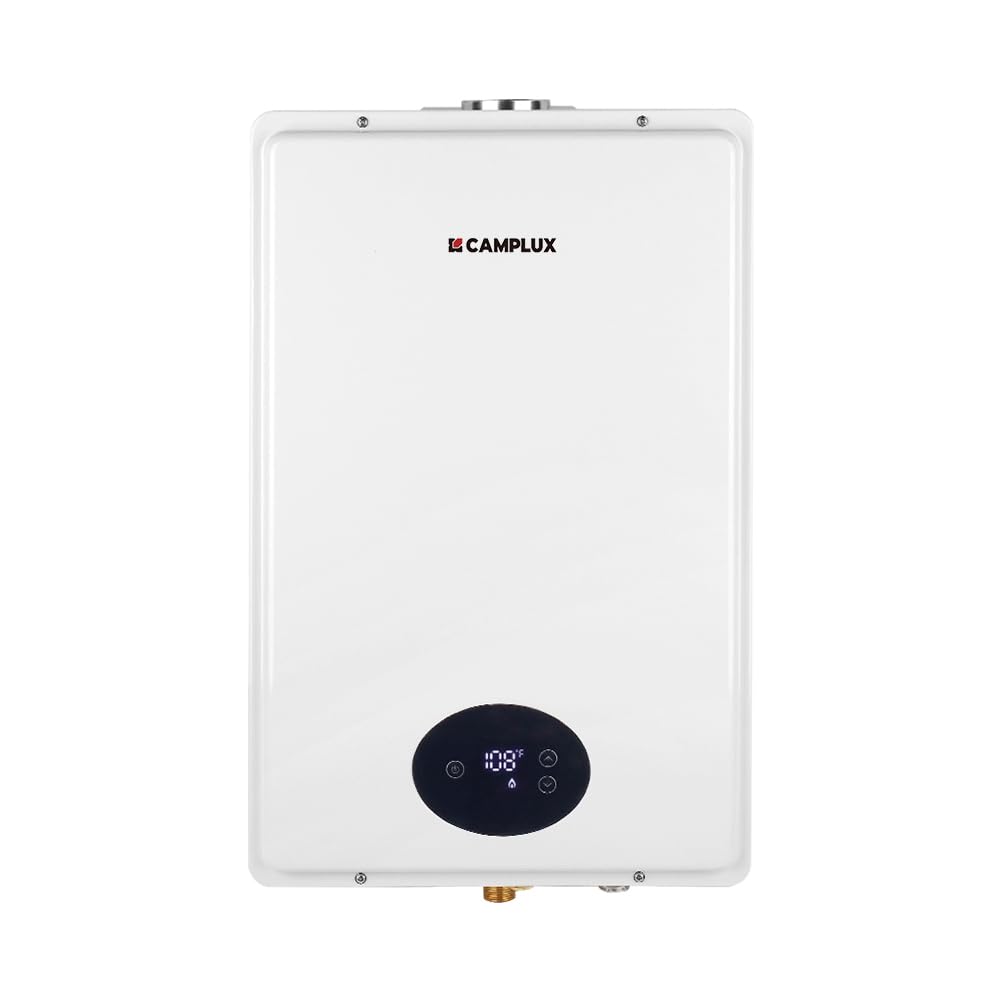
A gas-sipping unit that saves 18% on fuel while keeping temperatures rock-steady.
The CAMPLUX is built around precision: its water flow sensor and proportional gas valve auto-adjust the BTU output to keep the temperature within ±1°F, even when pressure changes from another faucet being opened or closed. That smart valve also saves 18% more fuel compared to standard tankless propane units, making it a standout for anyone running on bottled gas. It delivers up to 6.4 GPM from a 150,000 BTU burner — enough for an apartment or small home to run the shower and dishes without issues. The stainless steel construction and self-diagnostic system are designed to prevent mineral buildup for a lifespan over 10 years.
Owners praise the heating speed and the fact that it halves their gas bill compared to a standard 40-gallon standing tank. It is fairly lightweight at 31.3 pounds, making wall installation simpler than some rivals. The downsides are that it relies on system pressure (a plumber may require a holding tank), has a short 5-second delay on startup, and some found the wall mount bracket clumsy, requiring a DIY aluminum strip fix. It also needs a power outlet to run — no hot water if the power is out.
Terrific Gas Saver: If you already use propane and want an efficient, temperature-stable upgrade from a tank, this is a very strong choice. The 18% fuel savings are real and add up. Just know it needs a power outlet and the included mounting bracket might need a little creativity.
6. Mount Steel Pioneer Electric Tankless Water Heater

The flexible electric option that lets you dial back the wattage to match your panel.
This Mount Steel Pioneer is unique because its peak power is adjustable — it can be set anywhere from 12kW to 18kW, meaning you can lower the draw to fit an older electrical panel without a full upgrade. It uses “Dry-Heating” technology that separates the heating elements from the water, drastically reducing scale and mineral buildup that commonly plagues electric heaters. With a 99% thermal efficiency and self-modulating power, it only uses the energy needed at that moment, with zero standby waste.
Owners who installed it inside a cabinet near a vanity rave about the stable temperature even during simultaneous shower and sink use. At 18 pounds, it is incredibly light and compact (12.2″W x 18.5″H). The catch is that it is not a whole-house powerhouse for a large family — one owner noted the 1/4-inch internal passages limit flow to that of a low-flow shower. Some also found the wiring diagram and manual have translation errors that make professional install tricky. It works best as a rapid point-of-use heater for a bathroom or small apartment, not as a replacement for a massive gas tank.
Genius for Small Spaces: This is a brilliant solution for a small home, an addition, or a rental unit where you want instant hot water without a gas line. The adjustable power is a genuine safety net for older electrical systems. But its flow is limited; it’s not a fit for a house with four people running two showers and a dishwasher at once.
7. FOGATTI Tankless Water Heater Natural Gas

An outdoor natural gas unit that frees up garage space and delivers five times the performance of a tank.
This FOGATTI is designed for homes with natural gas lines, pumping out 170,000 BTU and delivering a 7.5 GPM flow rate. It is primarily an outdoor model, which is a huge space saver — freeing up the floor space in your garage or basement. It uses a four-stage combustion system and advanced water servo technology to maintain the water temperature within ±1°F, even as demand changes around the house. It is also built for low water pressure areas, operating smoothly between 15 and 150 PSI.
Reviewers point out it fires up immediately and produces genuinely hot water without delay. The build quality is praised, and it comes with a 5-year heat exchanger warranty. However, one buyer had a very bad experience with the igniter failing repeatedly (three times) and then being out of warranty. A few other owners found the installation instructions unclear and needed to call support for key specifics, like correct pressure regulator sizing. It also needs a 120V AC power source, and in freezing temperatures, you must drain the water to prevent damage.
Best for Natural Gas Patio Install: If you have a natural gas hookup on the side of your house and want to reclaim your garage, this outdoor unit is a strong performer. The flow rate (7.5 GPM) is ideal for a 2-3 bathroom home. The main risk is the ignition reliability — treat the warranty registration as a priority.
8. Rheem RTG-70XLP-3 Outdoor Propane Water Heater
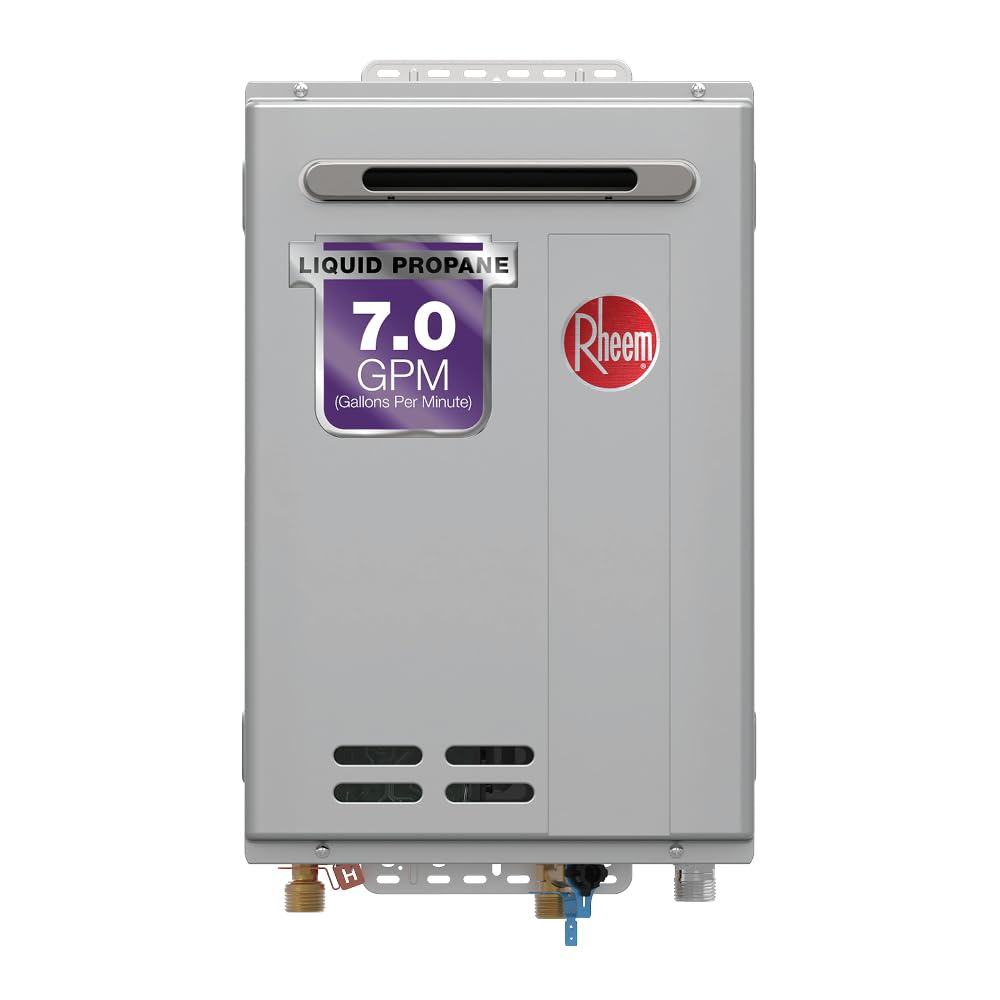
A trusted brand’s outdoor propane model, built to handle mountain-cold campgrounds.
Rheem’s RTG-70XLP-3 is a high-efficiency non-condensing unit that delivers 7.0 GPM and 160,000 BTUs, perfect for a 2-3 bathroom home running showers and laundry. Designed for outdoor installation, its durable metal cabinet resists the elements and the wall-mount design keeps it off the ground. A key feature is the hot-start programming that prevents cold water bursts between back-to-back showers — no more getting hit with a cold blast when someone else just finished.
One owner installed it at a mountain campground to serve a 4-stall shower house, and it “worked better than expected” at high altitude. The heat exchanger has a 15-year warranty, which shows Rheem’s confidence in its build. However, a different owner in South Carolina had a disastrous experience — the unit failed from freeze damage in temperatures that only dropped to the 20s°F, and Rheem refused the warranty, claiming its freeze protection only works down to 30°F. This is a major warning for anyone in a region with actual winter. Also, running it on a 40lb propane tank required upgrading to a 3/8″ ID hose (inner diameter) and a high-capacity regulator to avoid error codes on cold mornings.
Great for Mild Climates: For a home in the South, West Coast, or anywhere that rarely sees freezing temps, this is a reliable, well-supported outdoor unit. The build quality and warranty are genuine strengths. But if you face even mild freezes (20-30°F), the freeze protection limitation is a dealbreaker — the damage is not covered.
9. Rheem RTG-70DVLP-3 Indoor Propane Water Heater
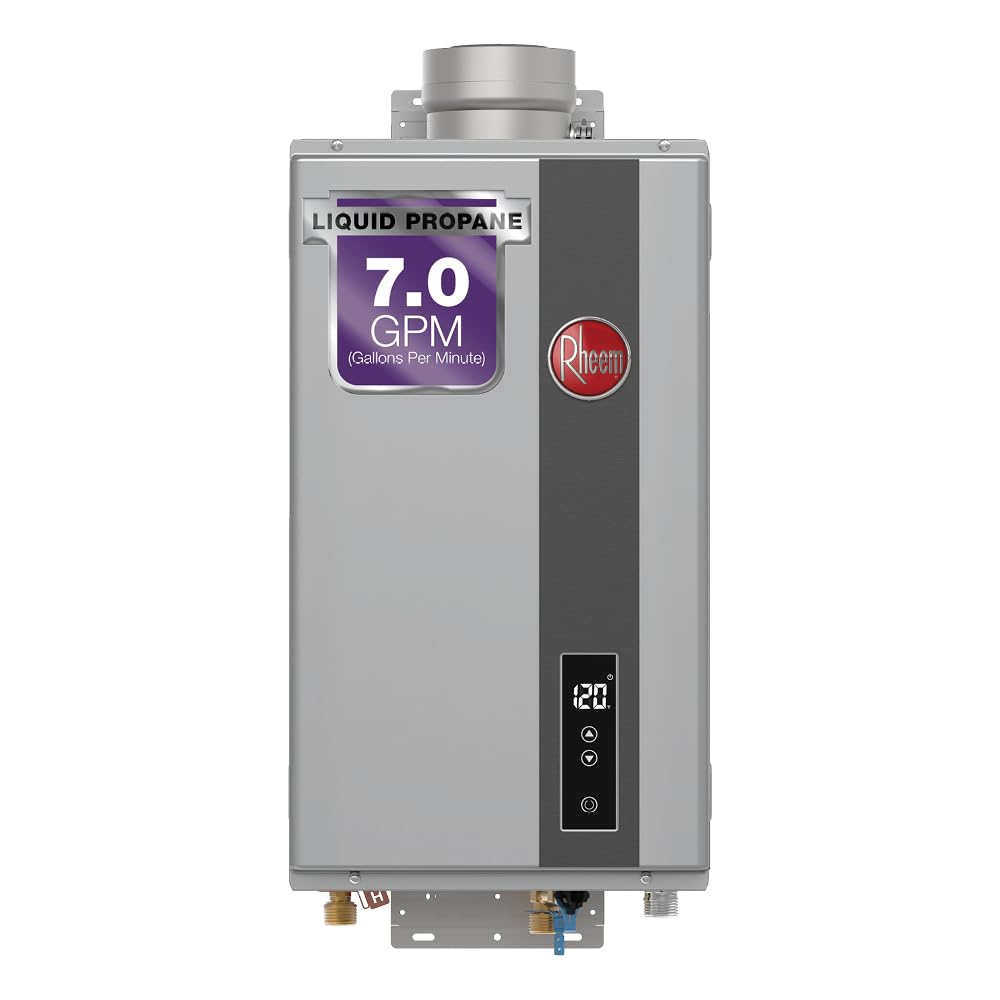
The indoor sibling of the RTG-70, offering the same power with a smaller footprint.
This is the indoor version of the Rheem RTG-70, providing the same 7.0 GPM flow and 160,000 BTU output but designed to be mounted inside your garage or utility room. Its compact metal cabinet helps reclaim floor space from a traditional tank. It also has the hot-start programming to prevent cold bursts and the same generous warranty: 15 years on the heat exchanger, 5 years on parts, and 1 year on labor.
Owners who did a DIY install with the Rheem vent kit report it works great, and a 100lb propane tank lasts about a month for a family of six. However, the positive experiences sit alongside some sharp criticism. One buyer called it “the biggest piece of junk I have ever bought,” citing “way too many cold spots” and excessive noise. Another had to return it because it could not be vented into an existing chimney. This unit requires a proper vent kit and a large house-type regulator (not a BBQ regulator) to get the correct gas pressure.
Good When It Works: A capable indoor propane unit with strong warranties, but there is a real split in owner experience. Some get a flawless, quiet unit that serves a large family for a month on a single tank, while others get a noisy, cold-spotted dud. Careful installation and proper venting are non-negotiable.
10. Marey Tankless Water Heater Gas 7.5 GPM

A 170,000 BTU beast that covers 3-4 use points at a price that undercuts the big names.
Marey brings a compelling value proposition: a 170,000 BTU unit with a flow rate of up to 6.34 GPM for running 3-4 water outlets simultaneously. It is CSA certified and features multiple safety layers including overheat and flame failure protection. The compact wall-mounted design saves space, and it uses a standard 3-inch exhaust vent, which simplifies installation for a professional.
The biggest applause from owners is the price — it “does the job at half the price” of other brands, with consistent hot water and easy install. However, this model has the highest rate of reported reliability issues on this list. After 7 months, multiple owners encountered persistent E1 and E8 error codes (exhaust restriction or general failure). One owner figured out that a cheap metal grate inside the exhaust port was the cause of the E8 error, and after removing it, the unit worked perfectly. This suggests a design flaw rather than a universal defect, but it is a significant gamble. Installation codes can also be tricky; some gas providers require a separate air intake/exhaust and an outdoor door.
Value Leader
- Very competitive price for a high-BTU, multi-outlet unit.
- Easy installation with standard 3-inch venting.
- Good for running two showers at once.
The Risk Factor
- Prone to E1/E8 error codes after a few months.
- A metal grate in the exhaust is a known cause of failures; not user-fixable for everyone.
- Not recommended above 2,000 ft elevation.
A Gamble on Value: The price is undeniably attractive for a 170,000 BTU unit, and when it works, it works great for a cabin or large home. But the error-code pattern is real and a headache. Only choose this if you are comfortable troubleshooting or have a flexible budget for potential repairs.
11. ThermoMate RTC68iN Condensing Tankless Water Heater
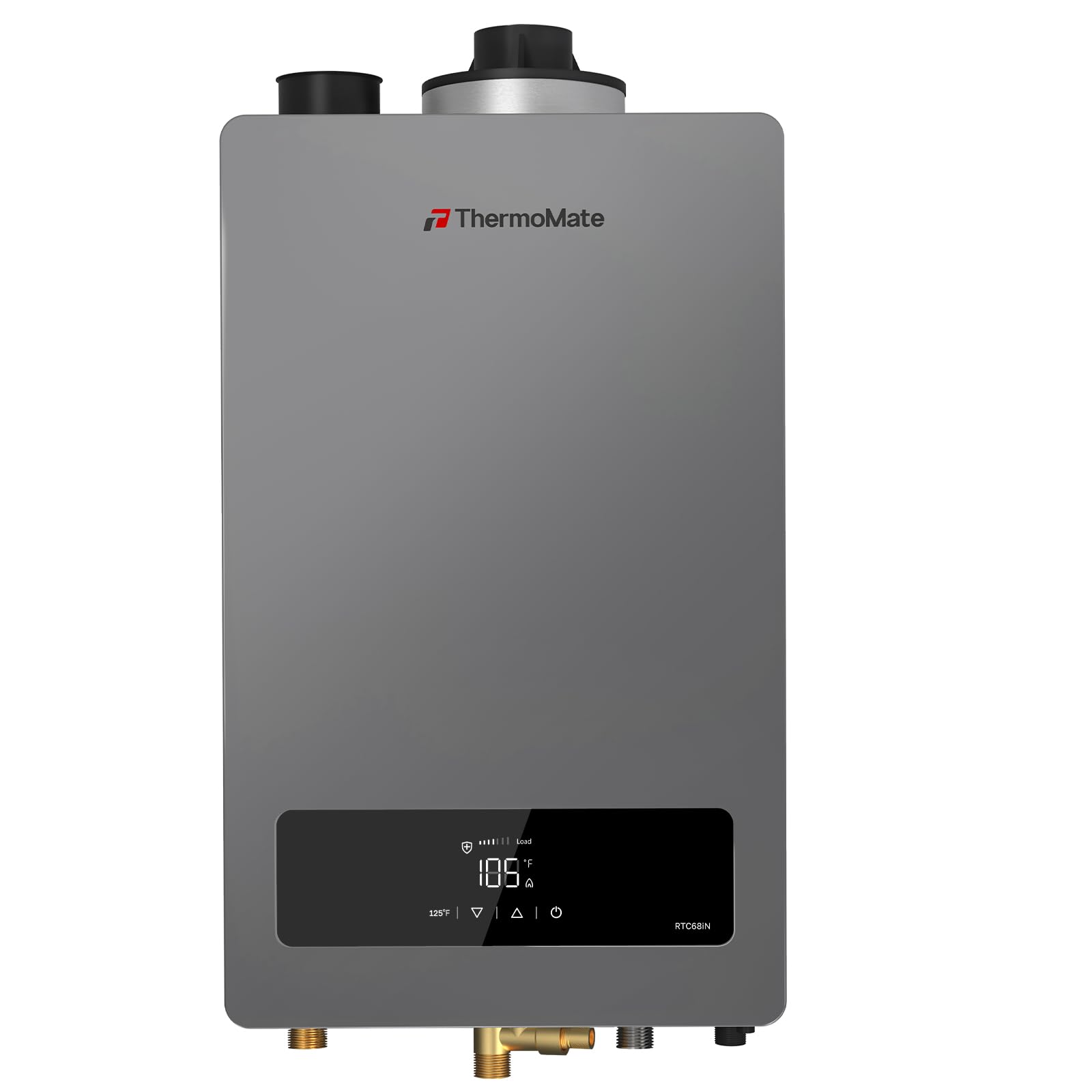
A condensing design that captures waste heat, squeezing 17% more savings from every cubic foot of gas.
This ThermoMate uses a dual heat exchange system — a stainless steel condensing heat exchanger paired with an oxygen-free copper heat exchanger — to capture and reuse waste heat that traditional models simply vent outside. This sophisticated process earns it a high-efficiency UEF of 0.91, cutting annual hot water costs by about 17% compared to standard tankless units. It delivers up to 9.38 GPM in warmer climates, and even in colder areas it can supply three 2 GPM showers at 105°F simultaneously.
The sealed combustion design keeps operating noise very low — a real advantage for an indoor installation where noise is a concern. The advanced water mixing valve technology aims for “zero fluctuation” in temperature. However, condensing units produce mildly acidic condensate that must be drained and neutralized. You will need to install a separate neutralizer kit (not included) to protect your pipes. A buyer noted the install “doesn’t come with everything you need to hook it up” and that switching from a tank to this system cost an extra for additional parts.
The Efficiency Enthusiast’s Pick: If your priority is maximizing energy savings and you have a natural gas line, the condensing technology here is the smartest long-term investment. The 0.91 UEF is excellent. But be prepared for a more complex installation, including the condensate neutralizer kit and possibly extra fittings, which adds to the upfront cost beyond the unit itself.
12. Westinghouse 10.3 GPM Propane Tankless Water Heater
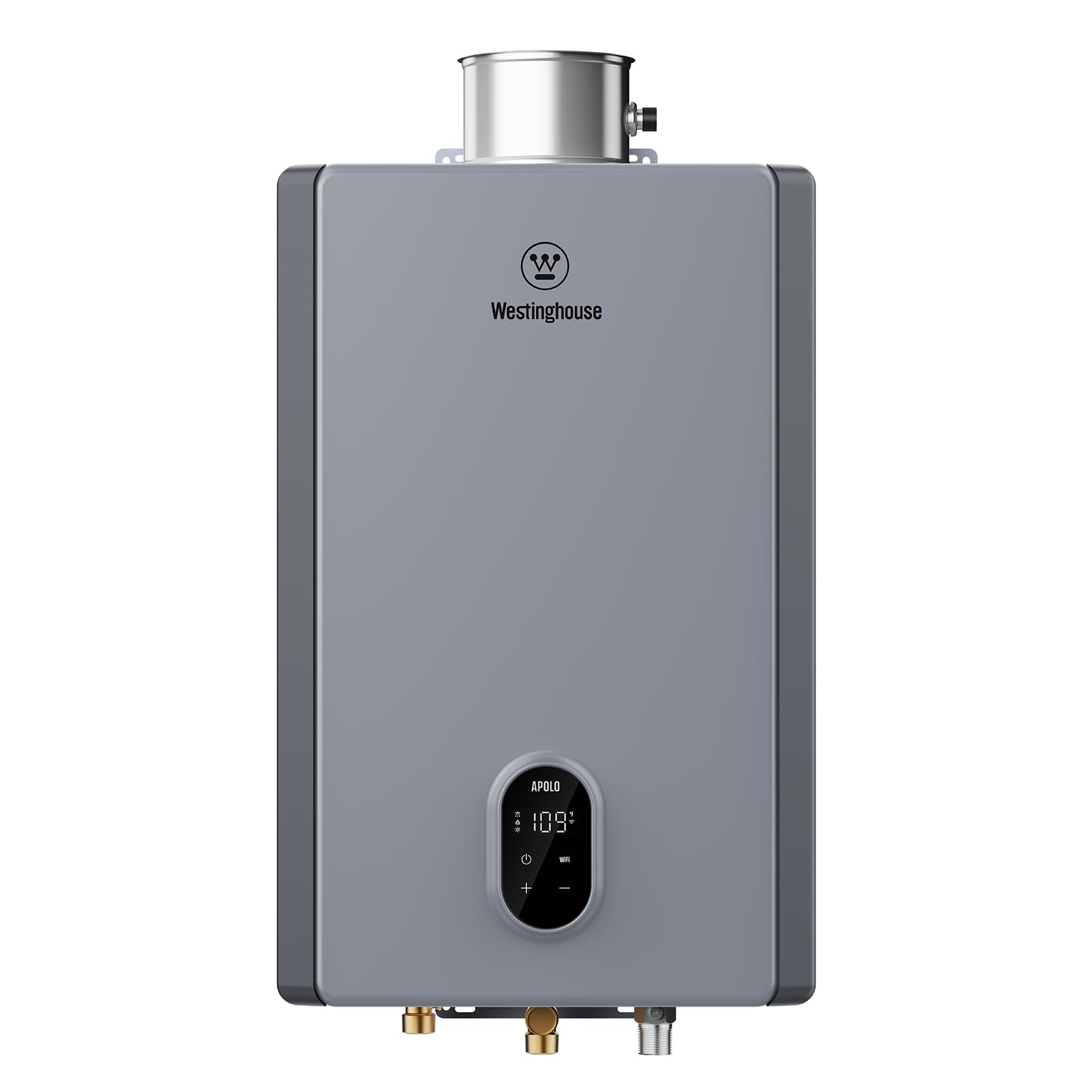
A high-flow smart unit that tracks your water usage and laughs at -13°F weather.
The Westinghouse is a near-peer to the Rinnai in raw capacity, pushing 10.3 GPM from a 199,000 BTU burner — enough to supply 4+ bathrooms and all appliances at once. Its standout feature is Wi-Fi and app control that lets you monitor temperature and track hot water usage from your phone, a practical tool for families wanting to manage energy consumption. It uses a wide 1:20 turndown ratio and a 6-stage combustion system to tune gas usage whether you are washing a single dish or filling a bathtub.
Critically for cold-climate buyers, it has integrated freeze protection down to -13°F, backed by a phosphorus-deoxidized copper heat exchanger (a corrosion-resistant material that lasts longer). Owners praise the easy installation with step-by-step instructions and the reliable temperature stability. One installer noted: “It has been working flawlessly for about 2 months now. Installation was easy and water temp/flow is working as it’s supposed to.” The catch: it needs a 120V AC power source, and like most tankless units, there is a slight delay of a minute or two for hot water to reach the tap from a cold start. A few users found it hard to find a contractor willing to install an unfamiliar brand.
The Tech-Forward Choice: This is the best pick for a large family that wants Rinnai-level capacity plus the convenience of an app. The extreme freeze protection (-13°F) makes it one of the few genuinely winter-ready options on this list. The slight hot-water delay is typical of this category, and finding a certified installer might take a few phone calls.
Understanding the Specs
UEF (Uniform Energy Factor)
This number, usually between 0.80 and 0.98, tells you how efficiently the unit converts its fuel into hot water. A higher number means less energy wasted. For example, a unit with a UEF of 0.98 is nearly twice as efficient as a standard tank heater, which often scores around 0.60. This directly reduces your monthly gas or electric bill.
Flow Rate (GPM)
Gallons per minute measures how much hot water the heater can deliver at once. A 4 GPM unit handles one shower (about 2 GPM) plus a sink. A 7 GPM unit can run two showers and a dishwasher simultaneously. To figure out your needs, add up the flow rates of the fixtures you might run at the same time — usually 3-4 GPM for a small home, 6-8+ GPM for a larger family.
Condensing vs. Non-Condensing
A condensing unit uses a second heat exchanger to capture exhaust heat that would otherwise go up the vent, reusing it to preheat the incoming cold water. This pushes UEF ratings to 0.90 or higher. The trade-off is that it creates acidic condensate that must be drained and neutralized, adding a step to installation. Non-condensing units are simpler to install but are slightly less efficient.
BTU (British Thermal Unit)
BTU represents the heating power of the burner. More BTUs mean the unit can raise the temperature of a larger volume of water faster. A 199,000 BTU heater can heat incoming cold water much quicker than a 90,000 BTU model, which is why large homes with high flow demands need higher BTU ratings to keep the water hot at multiple taps.
FAQ
Will a tankless water heater work during a power outage?
How does a tankless water heater save energy?
What size tankless water heater do I need for my home?
Can I install a tankless water heater myself?
What is a condensing tankless water heater?
How long does a tankless water heater last?
What does the E8 error code mean on a tankless water heater?
Is a tankless water heater better than a tank heater?
How much does it cost to operate a propane tankless water heater?
What is a good UEF rating for a gas tankless water heater?
Final Thoughts: The Verdict
For most people, the best energy efficient water heater winner is the Rinnai RX199iN because it combines an industry-leading 11.1 GPM flow with a super-high UEF of 0.98, offering both endless capacity and serious long-term savings. If you want an electric unit that sidesteps gas entirely and works well in mild climates, grab the ThermoMate 27kW. And for a large family running on propane who values smart controls and extreme freeze protection down to -13°F, the Westinghouse 10.3 GPM is the one to reach for.
How We Picked
We do not accept paid placement. Every pick is matched to a real buyer and a real use-case; we do not hands-on test units.
Sources & Methodology
Specifications: manufacturer listings and product documentation. Review insights: verified customer reviews, as of July 2026. Pricing: not shown on this page (it changes often); check the current price via the retailer link.
As an Amazon Associate, WellFizz earns from qualifying purchases. This does not affect which products we feature.
Related Guides

Mo Maruf
I created WellFizz to bridge the gap between vague wellness advice and actionable solutions. My mission is simple: to decode the research and give you practical tools you can actually use.
Beyond the data, I am a passionate traveler. I believe that stepping away from the screen to explore new environments is essential for mental clarity and physical vitality.