Our readers keep the lights on and my smoothie glass nicely filled. As an Amazon Associate, I earn from qualifying purchases.
Specs are compiled from manufacturer listings and verified buyer reviews and can change over time — please confirm the key details on the product page before buying.
If you are slicing onions and your board looks like a topographical map after a month, you have bought the wrong kind of wood. End grain cutting boards use the wood fiber like a brush bristle — the knife blade slides between the fibers instead of chopping through them. That means your knife stays sharp far longer, and the board itself heals its own cut marks. The trick is finding the right thickness, the right wood species, and the right warranty so you are not shopping again next year.
I’m Mohammad Maruf — the founder and writer behind WellFizz. This guide is built by comparing the manufacturers’ published specifications and the patterns across verified customer reviews, so you get each pick’s real strengths and trade-offs instead of marketing spin.
if you need a counter-weight for butchering or a charcuterie showpiece, these are the end grain cutting board options that actually outperform the edge-grain and bamboo alternatives the common kitchen store stocks.
Our Picks at a Glance


How To Choose The Best End Grain Cutting Board
End grain is the gold standard for serious cooks, but not every board built the same way delivers the same result. The wood species, the thickness, the finish, and the feet all matter more than the price tag. Here is what to watch for.
Wood Species: Hard Maple, Walnut, Teak, and Acacia
Hard maple is the traditional choice for professional kitchens because its tight grain resists moisture and odors better than almost any other wood. Walnut is softer and slightly more forgiving on knives, plus its rich chocolate color makes it a natural serving board. Teak has natural oils that fight water absorption and make it rot-resistant, which is why you see it on boats — but those same oils mean it takes oiling a bit differently. Acacia is dense and hard, though some buyers find the grain less consistent than maple or walnut.
Thickness: The 1.5-Inch Rule vs a Full 1.75 Inches
A board that is 1.5 inches thick is the industry entry point — thick enough to stay flat and absorb knife impact. Go thinner than that (like 1.1 inches) and you risk the board warping or splitting over time, especially if you do not oil it regularly. Boards that measure 1.75 inches or more are the premium tier: they resist cracking, hold their weight better during heavy chopping, and last years longer because there is more wood to plane down if it ever gets scratched.
True End Grain vs Stamped Patterns
Real end grain is made by gluing small blocks of wood together so the cut ends face upward. That is what gives the self-healing property — the knife parts the fibers. Some cheaper boards mimic a checkerboard pattern using edge-grain strips but call it “end grain” in the listing. A true end grain board costs more because it uses more wood and more labor, and that cost shows up in stability. If the price seems too low for a board that is 15 inches across, check the description carefully for the exact construction method.
Quick Comparison
| Model | Best For | Dimensions (Inches) | Weight | Thickness | Amazon |
|---|---|---|---|---|---|
| SHUMARU Mahogany★ Best Overall | Best Overall Value | 17 x 13 | 7 lb | 1.6″ | Amazon |
| Yes4All TeakBest Large Prep | Massive Prep Surface | 20 x 15 | 11.2 lb | 1.5″ | Amazon |
| Artistic Chef’s Kitchen WalnutArtisan Showpiece | Artistic Presentation | 15.5 x 11.5 | 5.6 lb | 1.1″ | Amazon |
| BABILONIA Walnut | Large Premium Walnut | 20 x 16 | — | 1.4″ | Amazon |
| BABILONIA Black Walnut | Smart Scoop Design | 15.7 x 10.2 | 6.8 lb | 1.7″ | Amazon |
| Cookaholic Acacia | Budget-Friendly Large | 20 x 15 | 9.1 lb | 1.5″ | Amazon |
| Bevel & Bond Maple | USA-Made Heirloom | 17 x 13 | 10 lb | 1.75″ | Amazon |
| Dalstrong Teak | Designer Serving Chops | 15.8 x 11.8 | — | 1.9″ | Amazon |
In‑Depth Reviews
1. SHUMARU Mahogany End Grain Cutting Board, 17×13×1.6 in
Our pick — over 4.5★ from 750+ verified ratings; the strongest balance of quality and price.
This board gives you the self-healing end grain benefit and a juice groove without the steep price of American-made maple — and at 7 pounds, it is about 60% lighter than the Yes4All teak, so you can move it easily.
Measuring 17 by 13 inches with a 1.6-inch thickness, the SHUMARU is spacious enough to break down a whole chicken but light enough at 7 pounds to carry from counter to table. The mahogany wood has a warm reddish-brown tone that buyers consistently call beautiful, and the built-in juice groove along the perimeter catches runoff from meats and fruit before it hits your countertop.
The end grain construction here is the real thing. Buyers report that after three months of daily use and regular mineral oil conditioning, the board shows no cracking or warping and only shallow cut marks that seem to fade back. The triple-sanded, pre-seasoned surface means you can start slicing right from the start. Four non-slip rubber feet on the bottom keep the board planted and allow airflow underneath so it dries faster after you wash it. The one thing buyers wish were deeper is the juice groove — it works, but a few owners would like a more generous channel for really wet roasts.
Real-world verdict: quality is the most-discussed reason owners bought this board, and 84 of them single it out — ahead of appearance at 68. At roughly half the cost of a comparable maple board, the SHUMARU delivers the same self-healing benefit and daily usability. If you need a board larger than 17 inches for serious holiday carving, look at the Yes4All instead.
Reach for this if: you want a low-maintenance, knife-friendly workhorse that looks good enough to leave on the counter and costs less than the Bevel & Bond.
Look elsewhere if: you specifically want a board made in the USA, or you need a 20-inch surface to handle a full turkey.
2. Yes4All Large Teak Cutting Board, 20″x15″x1.5″
The 20-by-15-inch work surface is wide enough to carve a turkey and still have room for stuffing — but the 11.2-pound weight means you will not want to move it much.
If your prep routine regularly involves large quantities of vegetables or a whole roast, this board gives you the square inches to spread out. At 11.2 pounds versus the SHUMARU’s 7 pounds, it is not one you sling around — but the heft means it stays planted on granite or quartz without needing a damp towel underneath. The teak is naturally dense and water-resistant, and after the first few mineral oil coats it develops a rich medium-brown tone that owners consistently call gorgeous.
The visual quality and build quality are the two most-praised traits here — 101 owners mention each — and the 1.5-inch thickness provides good impact absorption. A few owners do report slight warping in the middle after extended use, so it is important to dry the board on its edge after washing and oil it every 2-3 weeks to maintain flatness. The deep juice groove and built-in handles make it easy to pour off liquids and carry to a serving platter. If you need a board big enough for Thanksgiving prep on a budget, this is your pick.
Traded-off for size: the weight can be a real downside for anyone with limited hand strength or small kitchen space. And unlike the SHUMARU, the teak finish may have a light smoky smell when new that fades after a couple of oilings.
Grab it if: you prep large meals or batch-cook, and you want a board that handles a week’s worth of onions and peppers in one go.
Think twice if: you want to move the board from counter to table regularly — 11.2 pounds gets old fast.
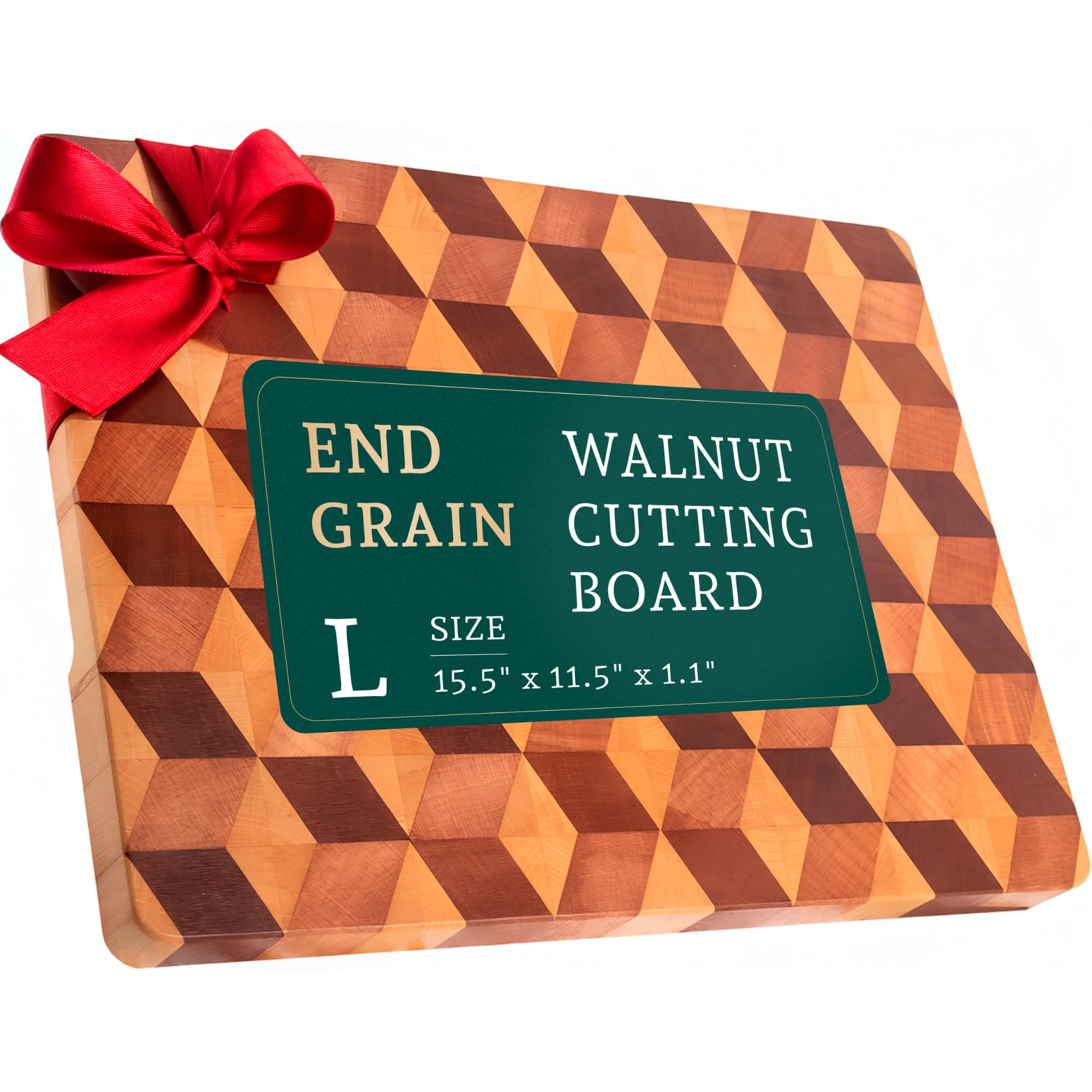
3. Artistic Chef’s Kitchen Walnut End Grain Board, 15.5″x11.5″
The 3D checkerboard pattern in walnut, ebony, and beech makes this board a conversation piece — but at 1.1 inches thick, it is more prone to bowing than the 1.5-inch or thicker boards.
At 15.5 by 11.5 inches and only 1.1 inches thick, the Artistic Chef’s Kitchen board is smaller and lighter than the other picks here — closer to a large appetizer board than a butcher block. That works in its favor for serving charcuterie or cheese, but the thin construction means it is more prone to bowing than the 1.5-inch or thicker boards.
Quality and appearance are the top praises — 20 and 18 mentions, respectively — and owners who use it daily report that the end grain fibers keep knife marks shallow. But the thinner profile plus a slick coating on some units has led a few owners to sand the surface and re-season with beeswax. The four rubber feet keep it stable on the counter, and the side handles make carrying easy. If you want a board that looks like art and you are gentle with your knives, this one delivers that at a great price point compared to similar patterned boards.
Best fit: small kitchens, charcuterie lovers, and anyone who wants a board that lives on the counter as decoration. Not the choice if you plan to chop heavy root vegetables daily.
Ideal for: serving and light-to-moderate chopping where aesthetics matter as much as function.
Less ideal for: heavy-duty butchery or cooks who prefer a thicker board that will not bow with moisture changes.
4. BABILONIA Walnut End Grain Cutting Board, 20″x16″x1.4″
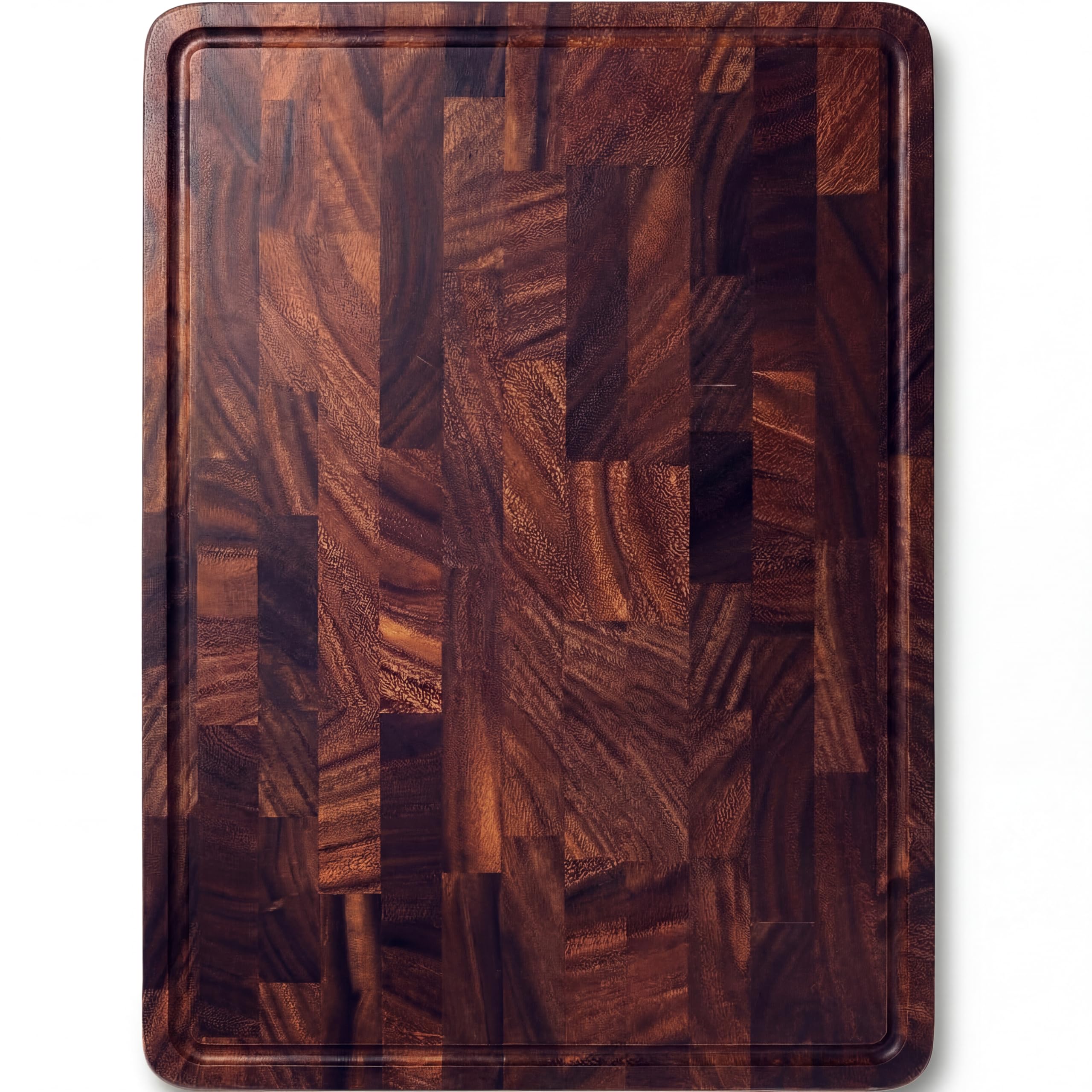
A massive 20-by-16-inch slab of solid walnut gives you 29% more surface area than the Artistic Chef’s Kitchen board — and it arrives pre-oiled with a free bottle of organic oil.
Walnut is among the most sought-after woods for cutting boards because of its natural antimicrobial properties, its softer feel on knife edges, and its rich dark color. This BABILONIA board gives you a 20-by-16-inch surface at 1.4 inches thick — that is 29% more surface area than the 15.5-by-11.5-inch walnut board above — and it arrives pre-oiled so you can start prepping immediately. The included organic oil bottle saves you a trip to the store for the first round of conditioning.
Build quality is the top praise from owners, with 15 single mentions and a clear consensus that the board is sturdy, well-crafted, and flat. The 20-inch length is especially useful for high-volume knife work — rolling out pie dough, chopping a whole bag of onions, or carving a standing rib roast. A few owners note that the board is heavy but that the built-in side handles make lifting manageable. The two-year warranty and money-back guarantee provide some confidence.
Real trade-off: at 1.4 inches, this is on the thinner side of the premium range compared to the 1.75-inch Bevel & Bond below. For most home cooks the difference is negligible, but if you are the type to really bear down on a cleaver, the extra quarter-inch provides noticeably more stability.
Best for: cooks who want the biggest walnut board they can get for the money, plus a brand that supports its product with a two-year warranty.
Consider instead the Bevel & Bond if: you demand a true 1.75-inch thickness and American-made construction.
5. BABILONIA Black Walnut End Grain Board, 15.7″x10.2″x1.7″
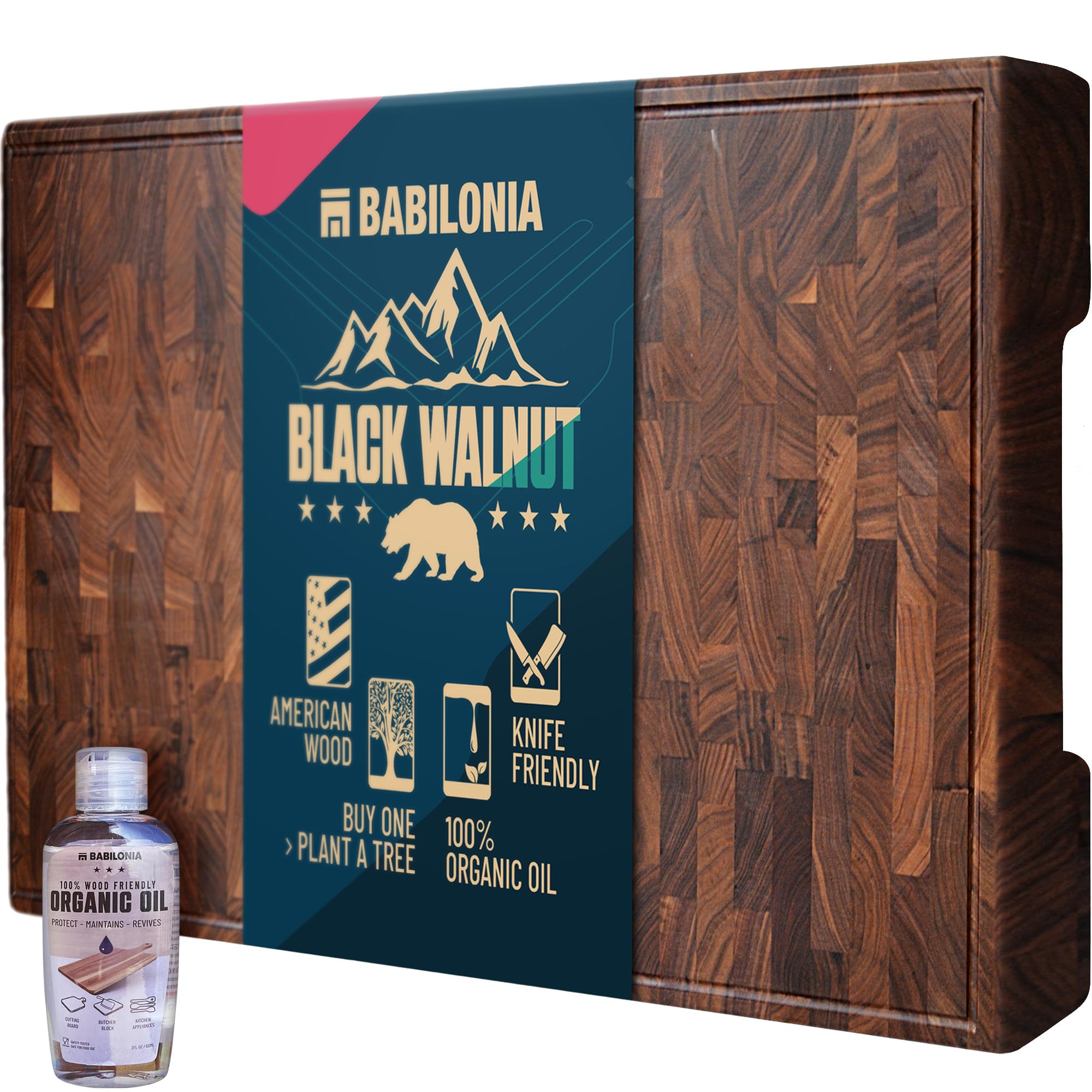
The 1.7-inch-thick black walnut board solves the “how do I get chopped food to the pan” problem with a cut-out underneath that holds a small plate.
The standout feature here is the “plate garage” — a cut-out underneath the board where you slide a small plate to catch your chopped ingredients. When you are done dicing, just sweep everything off the edge directly into the plate without lifting the board. Combined with the 1.7-inch thickness and black walnut construction, this is a board that thinks about workflow in a way few others do. The board measures 15.7 by 10.2 inches, so it is more compact than the 20-inch options but still big enough for two-person meal prep.
Quality is the most-cited reason owners buy this board — 106 mentions — and the thick American-grown black walnut feels dense and substantial. It comes pre-oiled with a free bottle of organic oil, and the reversible design means you can use the flat side for serving charcuterie. The main issue is that some units develop cracks, a complaint from a minority of buyers large enough for BABILONIA to have a responsive customer service system in place to handle replacements. The 2-year warranty covers that, and owners specifically praise the founder’s direct communication.
The catch: durability has mixed feedback — many owners have zero issues, but a few report splitting after two months. The brand’s customer service seems to address it quickly, but it is note if you want a zero-worry heirloom piece. The Bevel & Bond offers a 5-year warranty for that confidence.
Perfect for: anyone who does a lot of vegetable chopping and wants the scoop feature to speed up transfer to the pan.
Better suited by the Bevel & Bond if: you want the lowest possible chance of cracking and the security of a 5-year warranty.
6. Cookaholic Acacia End Grain Board, 20″x15″x1.5″

The acacia board offers the same spacious 20×15-inch dimensions as the Yes4All teak but at a fraction of the price — and the coconut oil cure gives it a pleasant scent when new.
Acacia is a dense, water-resistant hardwood that takes a beautiful finish, and this 20-by-15-inch board at 9.1 pounds sits in the same size class as the Yes4All teak above. The end grain checkerboard pattern gives it the same self-healing benefit — knife marks fade rather than scar. Cookaholic cures the board with coconut oil instead of mineral oil, which produces a pleasant coconut scent for the first few weeks and is food-safe from the start.
The deep juice groove catches liquid effectively, and the built-in handles make it easy to carry for serving duty. Quality and appearance are the most-praised aspects — 22 and 21 mentions — and owners who have used the board daily for a year report no cracking or warping. On the negative side, some owners mention acacia’s grain is less consistent than walnut or maple, and there are isolated reports of splitting after extended use. If you want a large board without spending over, this fits.
Worth noting: acacia is harder than maple or walnut, so it is slightly less forgiving on your knife edge over the long term. For most home cooks the difference is minor, but aficionados of Japanese knives may feel the board is harder than they prefer.
Best for: budget-conscious cooks who need a full-size prep surface and do not mind acacia’s rustic grain.
Look to the Yes4All teak if: you prefer a wood with more uniform appearance and the same 20×15 dimensions.
7. Bevel & Bond Maple End-Grain Board, 17″x13″x1.75″
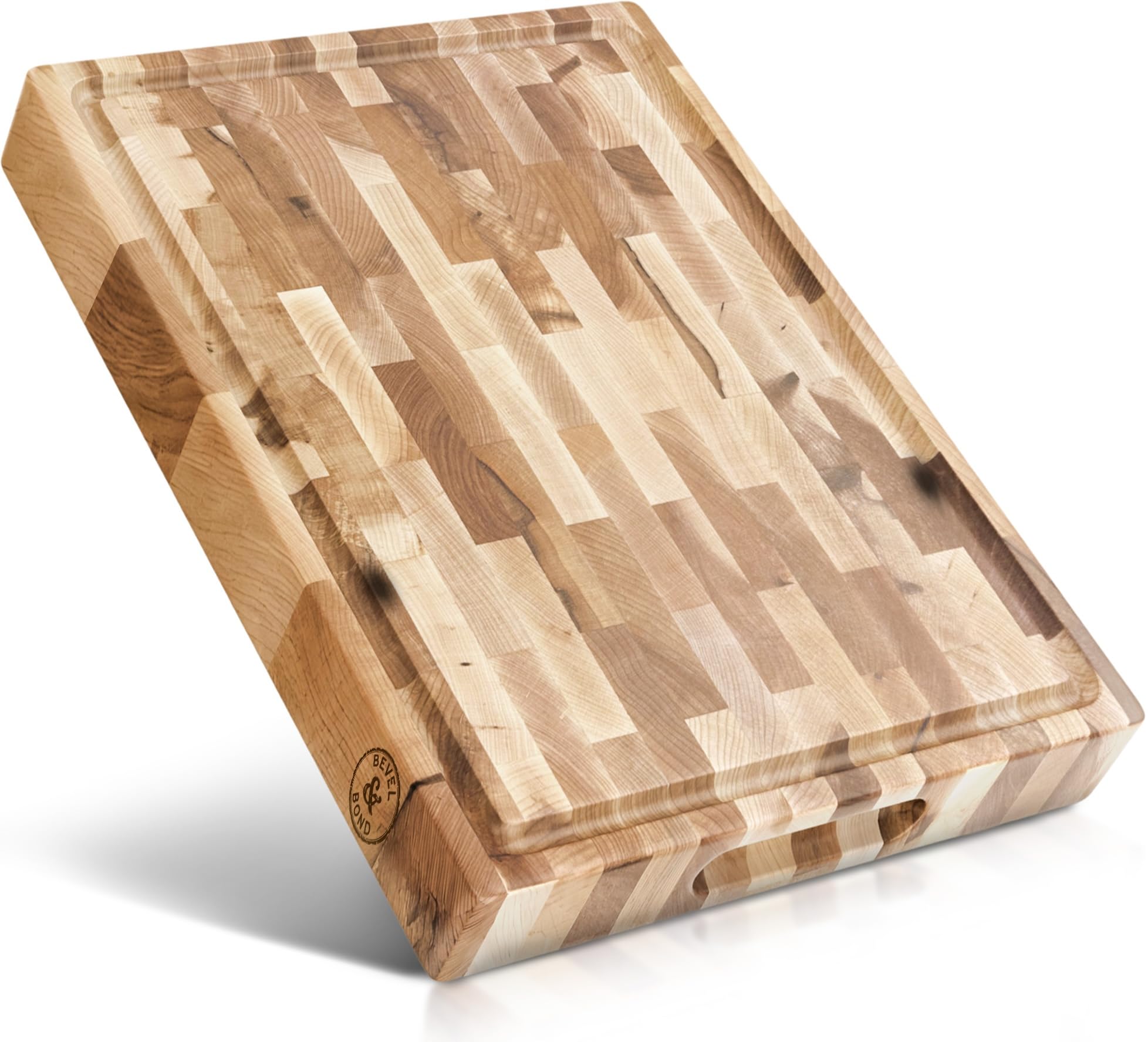
At 1.75 inches thick and made from North American hard maple by local woodworkers, this is the board that professional chefs keep for decades — with a 5-year warranty to back it up.
The hard maple end grain comes from North American wood, handcrafted by local woodworkers, and finished with food-safe mineral oil. At 1.75 inches, it is a quarter-inch thicker than the industry standard — that added mass provides more stability, longer life, and a noticeably more satisfying heft when you chop. The 10-pound weight keeps it planted even during heavy work, and the deep finger grips on both sides let you lift and carry it across the kitchen with one hand.
The juice groove is deep and wide, the non-slip feet are grippy, and the surface is sanded smooth enough that owners describe it as “buttery.” Quality is far and away the top talking point — 26 mentions — and the maple’s tight grain resists staining and odors better than walnut or teak. The board arrives in a premium gift box, and registering the 5-year warranty gets you a free tin of board balm directly from the owner, who writes a personal email to thank you. Owners specifically say it outperforms boards costing double.
The honest trade-off: this board costs more than any other here. But the 5-year warranty, American craftsmanship, and dense hard maple construction mean you will not need another board in this decade. If you want a kitchen investment that holds its value in use, this is the one.
Reach for this if: you are the sort of buyer who buys quality once and never thinks about it again — and you want a board your grandchildren might inherit.
Choose the SHUMARU if: you want end grain benefits today without the premium spend, even if it means upgrading in 4-5 years.
8. Dalstrong Teak End-Grain Board, 15.8″x11.8″x1.9″

At 1.9 inches thick — the thickest board in this lineup — the Dalstrong teak gives serious cut resistance and a stable chopping surface, but some buyers have experienced cracking within two weeks.
Dalstrong is known for premium kitchen tools, and this Lionswood board reflects that reputation. The two stainless steel handles on the sides make lifting and carrying to the table easy, and the half-moon cut-out underneath lets you slide a small plate under the board to catch scraps or prepped food smoothly. The 15.8-by-11.8-inch size is medium by large-board standards, but for daily prep and serving it feels perfectly proportioned.
Quality craftsmanship gets the most praise — 65 mentions — and the teak’s natural oils make this board naturally resistant to water and discoloration. On the downside, durability has mixed feedback across owners: while many report no issues, a notable number of buyers have experienced cracking within the first two weeks. Dalstrong’s customer service is responsive and has been known to replace cracked boards free of charge, but the inconsistency means this is not the most low-maintenance pick if you expect decades of use. The generous 1.9-inch thickness does give it structural advantages over thinner boards.
The bottom line: this is the most stylish and best-feeling board in the lineup when it arrives intact. The steel handles and plate garage are genuinely useful, and the teak end grain is beautiful after the first oiling. The durability lottery does mean you should inspect it promptly and register any warranty.
Ideal for: cooks who want a serving-focused board with premium looks and the versatility of the plate garage.
Better off with the Bevel & Bond if: you want guaranteed long-term durability and a 5-year warranty over aesthetic details.
Understanding the Specs
End Grain vs Edge Grain vs Face Grain
End grain means the board is made by gluing small blocks of wood with the cut ends facing up. Think of it like a handful of drinking straws standing on end — when your knife hits the surface, the blade slips between the fibers rather than cutting across them. This “self-healing” property means your knife stays sharp longer and the board shows fewer visible marks over time. Edge grain boards are made from long strips glued side by side; they are cheaper but do not self-heal. Face grain is a single slab of wood and shows every cut immediately. For daily use where knife sharpness matters, true end grain is the choice.
Thickness, Weight, and Stability
A cutting board that is 1.5 inches thick or less is fine for light prep but can warp over time with moisture changes, especially if you leave it lying flat to dry. Boards 1.75 inches and thicker provide more thermal mass — they stay flat longer, absorb chopping force better, and literally last years longer because there is more material to condition. Weight also keeps the board from sliding around on the counter: a 10-pound board rarely needs a damp towel underneath, while a 5-pound board may slide on smooth granite. Heavy boards are harder to move, but for stationary prep they are superior.
FAQ
How often should I oil my end grain cutting board?
Can I put an end grain cutting board in the dishwasher?
Is a heavier cutting board better?
Which wood is best for end grain cutting boards?
How do I know if a cutting board is real end grain?
Will an end grain board make my knives last longer?
What is the ideal thickness for a cutting board?
How do I fix a cutting board that has started to warp?
Is a juice groove necessary?
Can I use one end grain board for both meat and vegetables?
Final Thoughts: The Verdict
For most people, the end grain cutting board winner is the SHUMARU Mahogany because it delivers a real 1.6-inch end grain block with a juice groove, non-slip feet, and more than 760 reviews averaging near-perfect scores — all without breaking. If you want a massive 20×15-inch prep surface and do not mind the 11.2-pound weight, grab the Yes4All Teak. And for the buyer who wants a single heirloom board that outlasts the kitchen remodel, the Bevel & Bond Maple is the one to reach for — American-made, 1.75 inches thick, backed by a 5-year warranty, and hand-sanded silky smooth from day one.
How We Picked
We do not accept paid placement. Every pick is matched to a real buyer and a real use-case; we do not hands-on test units.
Sources & Methodology
Specifications: manufacturer listings and product documentation. Review insights: verified customer reviews, as of July 2026. Pricing: not shown on this page (it changes often); check the current price via the retailer link.
As an Amazon Associate, WellFizz earns from qualifying purchases. This does not affect which products we feature.
Related Guides

Mo Maruf
I created WellFizz to bridge the gap between vague wellness advice and actionable solutions. My mission is simple: to decode the research and give you practical tools you can actually use.
Beyond the data, I am a passionate traveler. I believe that stepping away from the screen to explore new environments is essential for mental clarity and physical vitality.