Our readers keep the lights on and my smoothie glass nicely filled. As an Amazon Associate, I earn from qualifying purchases.
Specs are compiled from manufacturer listings and verified buyer reviews and can change over time — please confirm the key details on the product page before buying.
You want less radiation from your phone, router, and laptop, but the market is stuffed with stickers and pendants that do nothing. Real EMF protection depends on one honest question: does the material physically block or absorb the signal? This guide sorts the genuine Faraday shielding from the wellness theater, using the only evidence that matters — the manufacturer’s own specs and what thousands of owners actually experienced with their own meters and their own bodies.
I’m Mohammad Maruf — the founder and writer behind WellFizz. This guide is built by comparing the manufacturers’ published specifications and the patterns across verified customer reviews, so you get each pick’s real strengths and trade-offs instead of marketing spin.
Whatever you need — a Faraday bag for travel, shielding fabric for DIY projects, or a router cover for your home — here is the honest breakdown of the best emf protection options that actually work.
Our Picks at a Glance


How To Choose The Best EMF Protection
EMF protection is not one-size-fits-all because the danger (if any) comes from different sources — your pocket phone, your bedside router, or the laptop on your thighs. Your first move is deciding what you actually want to shield against, then matching the product to that source.
Full block vs. exposure reduction
A Faraday bag is designed to cut your phone off from the network entirely — no calls, no texts, no GPS. That is perfect for digital detoxes, evidence preservation, or anti-tracking, but useless if you need to stay reachable. A shield sleeve, by contrast, uses a lined back panel to reduce exposure to your body while keeping your signal alive. Decide which behavior you want before you buy.
The dB number that actually matters
Attenuation, measured in decibels (dB), is how much signal a material stops — the higher the number, the better the block. A bag rated at -85 dB from 400MHz to 4GHz is genuinely shutting things down. A fabric rated at 85 dB across a wider 30MHz to 40GHz range is doing similar work. When a product lists no dB figure at all, you are buying on faith, not science.
Quick Comparison
| Model | Best For | Blocking Strength | Signal Behavior | Coverage | Amazon |
|---|---|---|---|---|---|
| Faraday Defense Jacket Pro★ Best Overall | Total phone isolation | -85 dB (400MHz-4GHz) | Full block | 4.5″ x 8″ | Amazon |
| Vehipa Faraday FabricBest Value | DIY shielding projects | Not stated | Full block when wrapped | 98.4″ x 43.3″ | Amazon |
| Amradield Copper FabricWide-Band Pick | Wide-band DIY shielding | 85 dB (30MHz-40GHz) | Full block when looped | 78″ x 43″ | Amazon |
| RadiArmor Phone Sleeve | Reducing pocket exposure | Blocks 99% of RF | Reduces, keeps signal | 7″ x 4.2″ | Amazon |
| TOMUM EMF Shield Sleeve | Budget 2-pack shielding | Up to 99% reduction | Reduces, keeps signal | 8″ x 4″ | Amazon |
| STARLENGET Faraday Blanket | Lap & body coverage | 80-120 dB (10MHz-40GHz) | Full block over body | 38″ x 40″ | Amazon |
| Fengind Router Cover | Cutting room-wide router EMF | Blocks ~90% of EMF | Keeps WiFi working | Fits large routers | Amazon |
| Dr. Valerie Nelson Neutralizers | Peel-and-stick device stickers | Not stated | No signal change claimed | 20-pack | Amazon |
| DefenderShield Laptop Pad | Lap heat & RF blocking | Up to 99% directional | Reduces, keeps signal | Fits laptops to 17″ | Amazon |
In-Depth Reviews
1. Faraday Bag Jacket Pro for Phones
Our pick — over 4.5★ from 550+ verified ratings; the strongest balance of quality and price.
The heavy-duty Faraday pouch that turns your smartphone into a brick the moment you close the flap.
The defining spec here is the -85dB attenuation across 400MHz to 4GHz — that covers your phone’s cellular, WiFi, Bluetooth, GPS, and RFID bands, which is the full sweep of consumer wireless signals. You get total isolation when you need it: slide your phone into the 4.5″ x 8″ interior and it vanishes from the network. Buyers report the test is instant — calls go straight to voicemail, texts stop arriving, and as one put it, “nothing worked while the other phone was in the bag, which is what you want!”
This is built for the field, not just the office. The outer shell is heavy-duty, water-resistant CORDURA nylon (the same fabric used in military gear) with double-stitched seams and a magnetic double-fold closure that snaps shut securely. That ruggedness is why owners use it for emergency comms gear on camping and hunting trips — stuffing a satellite messenger and phone inside for safe storage. The fit is on the tighter side, so it suits phones and small drives better than tablets.
It’s a full-block product, so avoid everyday carry if you need to stay reachable. And if you leave a phone powered on inside, the trapped signal can generate heat — the simple fix is turning the device off first. For travelers, security-conscious meetings, or anyone testing anti-tracking claims, this is the most complete phone Faraday solution here.
Where it shines
- -85 dB attenuation blocks all major phone signal bands
- Water-resistant CORDURA nylon survives rough travel
- Magnetic closure gives one-handed secure access
Know before you buy
- Interior is snug — tablets barely squeeze in
- Full signal block means no calls while stored
- Magnet strength varies slightly between units
Reach for it when: you travel, attend sensitive meetings, or want to prove your phone is truly off-grid.
Look elsewhere if: you want to reduce exposure but still receive calls — you need a shield sleeve instead.
2. Vehipa Faraday Fabric Military Grade
A roll of nickel-copper cloth that lets you build your own shielding for a fraction of retail cost.
The value here is the sheer size — a single 98.4″ x 43.3″ sheet of copper-nickel-polyester fabric is roughly 26% more material than the competing 78″ x 43″ Amradield roll, so you have room to experiment. Because it is easy to cut and sew, owners turn it into curtains, blankets, bags, phone cases, or laptop sleeves. Owners mention real results: “It knocked the readings down 80+ percent,” one confirmed after testing with a meter.
This is a DIY material, not a finished product, and it behaves like one. Owners who sewed with it learned the hard way that the metal threads ravel severely at the cut edges and can damage sewing machine equipment — you will want to finish seams immediately and consider Faraday tape over any joins. The effective use is doubling or gathering the fabric, since a single loose layer leaks signal at the edges.
The honest limitation shows up when you test it: wrapping a phone tightly blocks cell service, but a loose wrap lets signal through gaps, and it will not shield a strong nearby source like a router or a PEMF mat without multiple stacked layers. If you enjoy a weekend project and want maximum square footage for your money, this is the smart buy.
DIY balance: generous cut-and-sew sheet for custom shielding projects at a budget price.
Reality check: needs tight wrapping or doubled layers; raveling edges demand immediate seam finishing.
3. Faraday Copper Fabric EMI RFID Shielding
The science-grade copper sheet with a published 85 dB rating across a staggeringly wide frequency range.
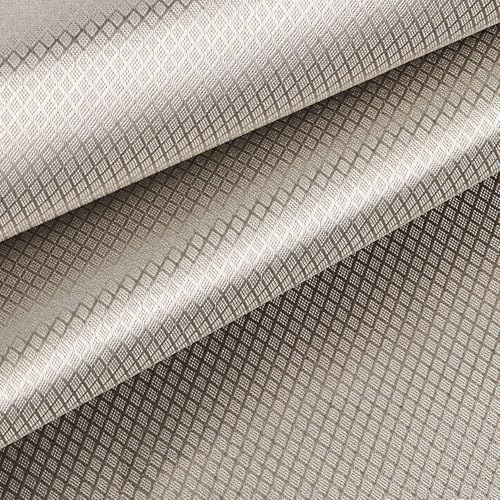
Unlike most DIY fabrics that hide their numbers, this Amradield material states its credentials openly: surface resistance below 0.03 ohm and an average attenuation of 85 dB from 30MHz to 40GHz. That ten-octave span covers everything from AM radio frequencies up into the microwave band, making it among the most versatile shielding textiles you can buy. The diamond-type weave creates a conductive grid that behaves like a Faraday cage in cloth form.
Owners verify it in practice. “The WiFi signal was blocked when I wrapped my phone in the material,” reported one builder who planned to stitch his own wallet. Others found the key trick: the fabric works best when the two ends are connected to form a closed loop — a car key, WiFi, and Bluetooth all disconnect that way, while an incomplete loop only partially blocks. One owner used multiple folded layers to shield a crib from a nearby cell tower.
Because it is thin, single-layer performance is modest, so plan to double up for serious reduction. Some use it as a grounding sheet rather than a signal block, which is a different function entirely — know which job you are asking it to do. For sewers and makers who want a fabric with actual published test numbers, this is the most trustworthy roll here.
What earns its keep
- Published 85 dB rating from 30MHz to 40GHz
- Surface resistance below 0.03 ohm
- Easy to cut, sew, and shape into custom gear
Handle with care
- Thin single layer needs folding for strong blocking
- Must be closed into a loop for full effect
Grab this for: makers who want a documented spec sheet and the flexibility to build wallets, curtains, or tents.
Think twice if: you want a ready-made product — this is a raw material that demands a bit of craft.
4. RadiArmor EMF Blocking Cell Phone Sleeve
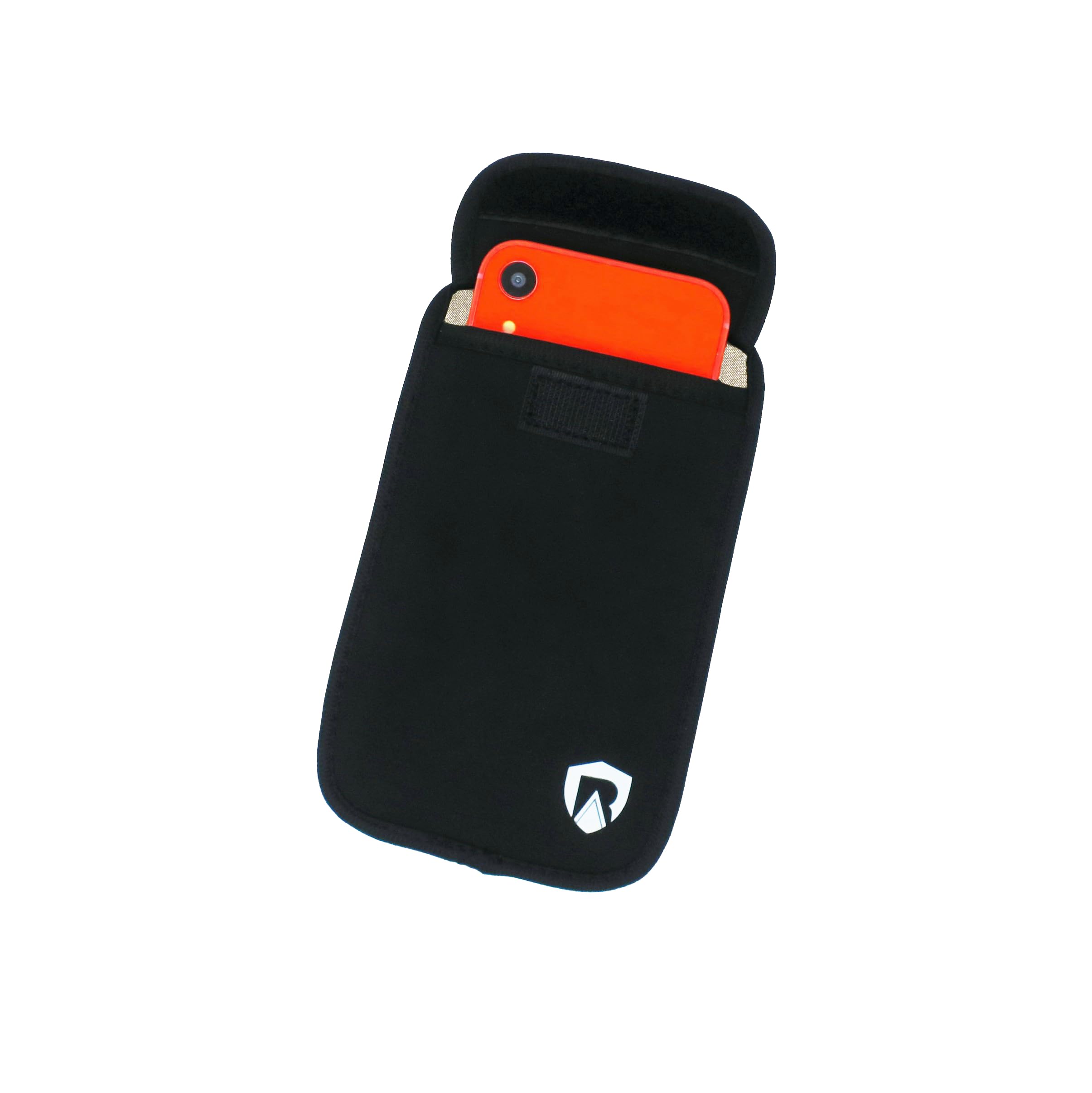
The smartly honest sleeve that cuts your exposure by up to 96% without cutting you off from calls.
This is the right pick if you want protection in your pocket but still need to be reachable. Only the back panel is lined with an EMF-blocking fabric, which means the barrier sits between your body and the phone while the front stays open to the network. RadiArmor is refreshingly upfront about what that does: it blocks over 99% of high-frequency RF and microwave radiation in the liner, and the effective reduction to your body lands between 91% and 96%.
The brand also calls out the industry’s worst trick — companies that sell stickers with a tiny patch of shielding and claim 99% reduction when the real number is near zero. That transparency matters. One owner said switching from a non-shielding clip-on holder resolved long-standing discomfort. The soft neoprene build is a relief after hard plastic holders, and the velcro closure keeps the phone secure.
The recurring gripe is the closure itself — velcro wears out over time, and some owners are on their second unit for that reason. It is also a one-sided shield, so if you want total isolation (like a Faraday bag gives), this will not deliver it. But for daily carry where you want a meaningful reduction without losing your connection, this is a well-considered choice.
Honest engineering: one-sided liner gives 91-96% body exposure reduction while preserving signal — a rare blend of real protection and usability.
The catch: velcro closure wears with heavy use; not designed to block all signals like a Faraday bag.
5. TOMUM EMF Shield Sleeve for Cell Phone
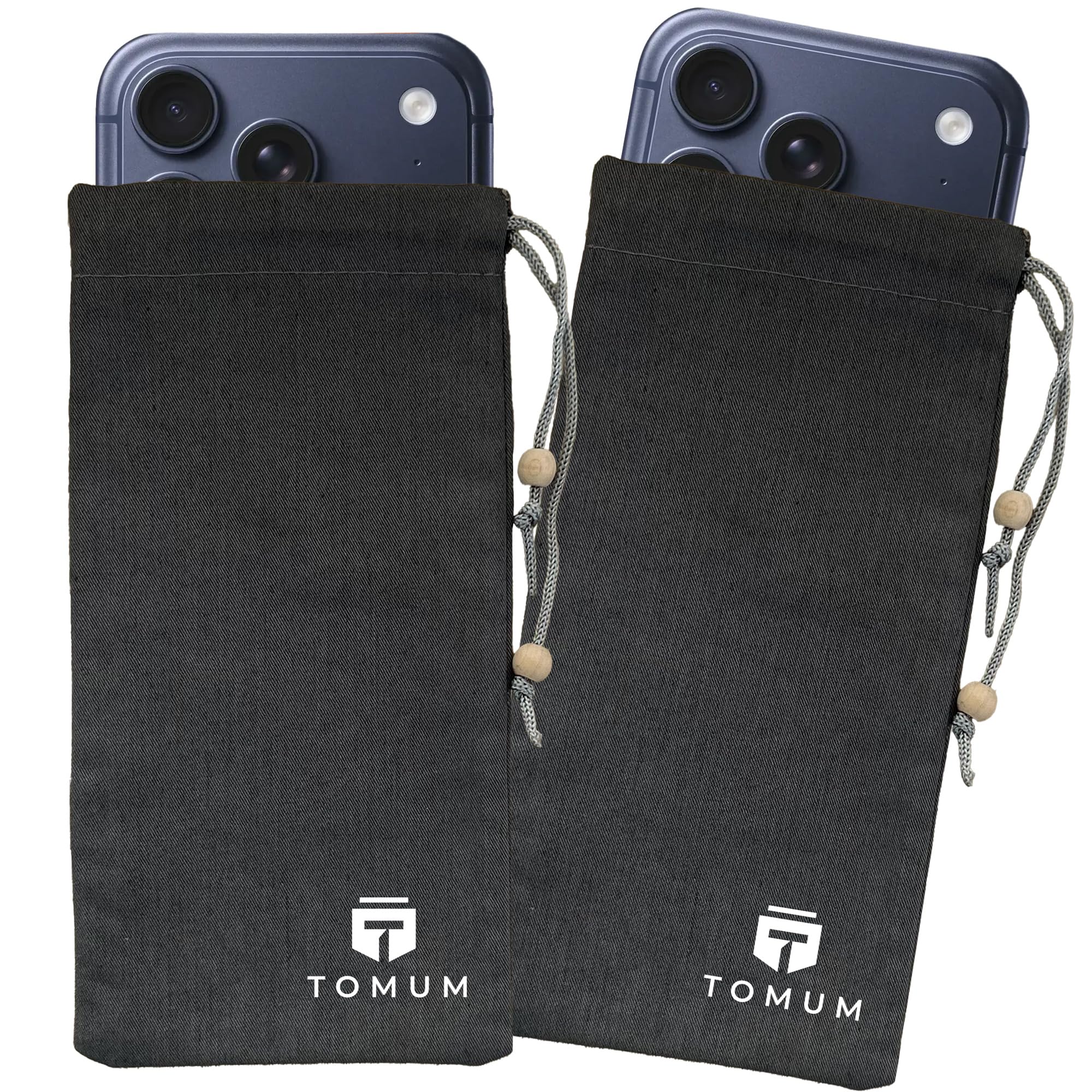
A two-pack of silver-lined sleeves that is designed to cut exposure while your phone keeps buzzing.
You get two sleeves for the price of most single units, and the interior is built with a high-purity silver composition that the maker claims reduces EMF exposure by up to 99% without fully blocking signals. That partial-block approach means calls and messages still come through in strong coverage areas, so it works for day-to-day carry rather than off-grid isolation. The 8″ x 4″ pouch with a drawstring closure fits current flagship sizes like the iPhone 17 Pro Max and Samsung Galaxy S25 Series.
Owners praise the build quality and the genuine signal reduction they measure. One buyer found that once the phone was inside, the signal was completely blocked — a stronger result than the “reduction only” claim suggests. Others note the fabric feels soft, the phone slides in easily, and the whole thing survives washing. It is a budget-friendly way to outfit two devices or keep a spare.
The mixed feedback centers on consistency: some customers note calls and texts still arriving while the phone is inside, meaning the drawstring seal is not always tight enough for full blocking. If your goal is complete silence, you may need to test and adjust the closure. But as a two-for-one daily reduction sleeve, it is hard to argue with the value.
Two-for-one value: silver-lined sleeves that measurably cut exposure for two devices at a budget price.
Variable seal: drawstring closure leaks signal for some owners — test yours to confirm the block level.
6. STARLENGET EMF Blanket for Pregnant and Babies

A two-layer silver Faraday blanket that drapes over your lap or your baby to tame surrounding wireless radiation.
What sets this apart is its attenuation spec — an average of 80dB to 120dB from 10MHz to 40GHz, which is among the strongest published figures in this whole lineup. Built with two layers of silver and Faraday fabric, the 38″ x 40″ blanket is sized for curling up on the couch with a laptop or covering a stroller. Owners with their own meters confirm the block, with one noting it significantly cut RF and electrical radiation on a Cornet Electrosmog meter test.
The softness draws consistent praise — one side is cool, the other soft — and it is lightweight enough to travel. Parents use it to calm babies on flights, and frequent flyers say it eases long-haul fatigue. The maker says it is lab-tested by engineers, which is a claim you cannot verify at home, but the owner-meter results back it up.
The main caveat is care: this is hand-wash only, in warm water with neutral detergent, so it is not a toss-in-the-machine blanket. And a single layer will not stop every source — one owner notes it needs to be positioned between you and the device. For a wearable shield that moves with you, this is the most versatile option in the list.
Why owners love it
- 80-120 dB attenuation across 10MHz-40GHz
- Soft, lightweight, and travel-friendly
- Verified by owner EMF meter tests
Care & limits
- Hand wash only — no machine cycles
- Best positioned between body and device
Choose this when: you want mobile body coverage for pregnancy, travel, or couch-and-laptop sessions.
skip it if: you need to shield a whole room — that is a router cover or curtain job.
7. Large WiFi Router Cover EMF Shielding Box

A Faraday cage for your router that cuts room-wide emissions by 90% without killing your internet.
The smart engineering here is the honeycomb design, which lets air flow through for cooling while the conductive polymer shell blocks roughly 90% of the EMF emitted by large WiFi routers, including newer 5G models. Measuring 12 inches long, 11 7/8 inches high, and 5 1/2 inches wide, it fits the big ISP routers from Comcast, Xfinity, and AT&T U-verse. You fold the whole modem inside, and your WiFi keeps working because the honeycomb vents let signals escape, just at much lower power.
Owners with EMF testers confirm the numbers drop considerably with the cover on. One reported their fastest download speeds ever with the router inside, calling it a clear win over a Faraday bag, which had cut speed by a third. Some reviewers point out desk-work headaches vanished after installation. It is built to sit on a desk or shelf and quietly do its job.
Placement matters: because it blocks 90% rather than 100%, the router’s range is preserved but you cannot hide the router in a corner and expect the same coverage as before. A few owners in larger homes found the signal weakened on far floors. If your router sits near where you sleep or work, this is a meaningful, measurable reduction for the highest-emission device in your home.
Targeted reduction: a 90% cut on your most constant home radiation source, with WiFi range intact.
Position it well: large homes may notice softer signal on distant floors — keep the router central.
8. Original EMF Neutralizer Trusted Since 2015
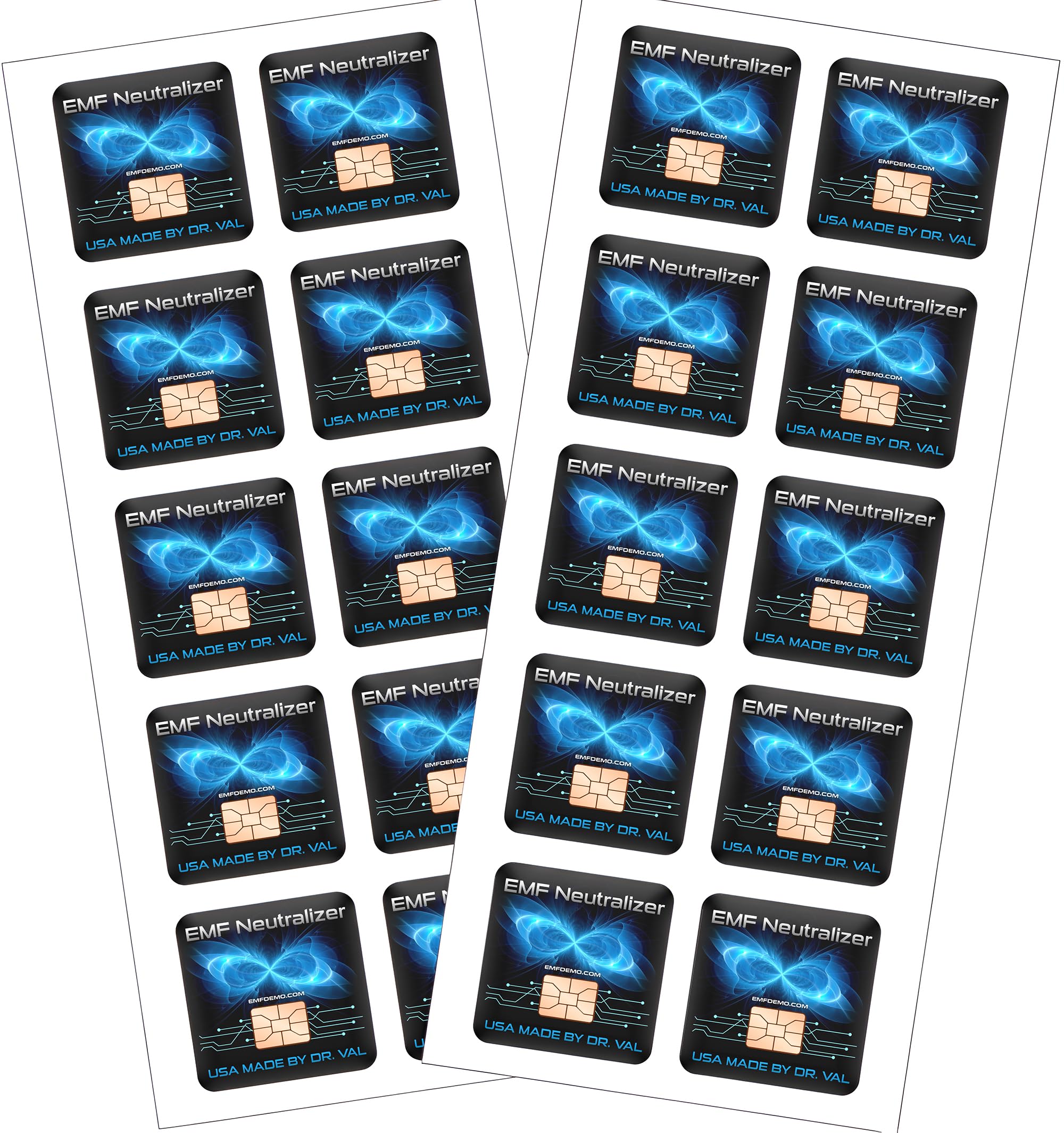
A 20-pack of ultra-slim peel-and-stick neutralizers from a doctor-founded brand with a decade of customer trust.
This is the outlier in the lineup — it does not block signals, it claims to neutralize them. Created by Dr. Valerie Nelson and made in the USA, these ultra-slim stickers apply to phones, laptops, tablets, smartwatches, routers, and any other electronics, using a mechanism the brand does not fully disclose. With 20 in a pack, you can cover every device in your house and still have spares for travel. Reviewers report better sleep, more daytime energy, and a calming effect after applying them.
What sets this product apart is its longevity and the doctor’s name behind it. Since 2015, it has built a following among wellness-focused users who use muscle testing (a method of gauging body response) to confirm the stickers are doing something. The brand markets it as a wellness aid, not a signal blocker—an honest stance versus fake “99% blocking” stickers.
The scientific reality is that an EMF detector shows no change in readings with or without the sticker — one owner measured 1.6-3.1 uT before and after and concluded it does nothing to fields. Another noticed their phone battery drained faster with the sticker on, which some interpreted as a sign of function. It’s a belief-based wellness product, not an engineering solution. If you want measurable signal reduction, choose a Faraday product; if you want the ritual and confidence, this delivers that.
The wellness angle: a doctor-branded, USA-made sticker ritual that owners swear by for sleep and calm — not a measured shield.
The honest limit: EMF meters show no field reduction; buy this for confidence, not measurable blocking.
9. DefenderShield Laptop Pad for EMF Protection

The premium lap pad that blocks up to 99% of directional EMF and keeps your legs cool during marathon work sessions.
If you work with a laptop on your lap for hours, this is the most substantial upgrade you can make. The DefenderShield pad uses lab-tested Ultra Armor+ technology to block up to 99% of directional EMF radiation — including 5G, Wi-Fi, and Bluetooth — while a silicone surface handles the heat. Owners with a Trifield TF2 meter measured the drop: from peaks above 50 mG down to about 1 mG on a gaming laptop. That is a real, verified reduction.
The non-slip textured surface grips your laptop securely, replacing that uncomfortable bounce of bare laps. At just 0.25″ thin, it slides into a backpack and travels to the office or a flight. The brand is also transparent about its limits: it blocks bottom radiation and heat only, not sides or top, so it is a directional shield, not a full cage. Designed by a US-based small business founded by a former telecom engineer, the engineering pedigree shows.
The trade-offs are real but manageable. A strong chemical glue smell took one owner one to two months to dissipate, and some units delaminated at the edges after about two years of use. It is also the priciest item here. But for anyone who lives on a laptop — students, writers, remote workers — the combination of heat relief and measurable EMF reduction makes it a compelling investment.
The payoff
- Owners measured a drop from >50 mG to ~1 mG
- Non-slip silicone grips the laptop and blocks heat
- 0.25″ thin, easy to travel with
What to expect
- Initial chemical glue smell fades over weeks
- Blocks bottom radiation only, not sides or top
- Delamination possible after roughly two years
Invest here if: you log long hours with a laptop on your lap and want both heat relief and verified EMF reduction.
Pass if: you mostly use a desk — the reduction is directional and only matters where the laptop touches you.
Understanding the Specs
Attenuation (dB)
This is the single most important number on any EMF product. Attenuation measures how much signal a material stops, in decibels (dB) — the higher the number, the stronger the block. A bag rated at -85 dB is shutting down nearly all signal in its covered range, which is why the Faraday Defense jacket is so effective. A fabric rated at 85 dB across a wider 30MHz-40GHz span is doing similar work. When a product lists no dB figure, you are buying on faith rather than a testable spec.
Frequency Range
EMF signals live on different bands, so a shield must cover the ones you care about. Cellular, WiFi, and Bluetooth sit roughly between 400MHz and 6GHz, while 5G pushes higher. The Faraday Defense bag covers 400MHz-4GHz, which handles most consumer signals; the Amradield fabric’s 30MHz-40GHz span is wider and future-proofs against new bands. Match the frequency range to the devices you want to block — a narrow range might miss higher 5G bands.
FAQ
Will a Faraday bag block all signals from my phone?
What is the difference between a Faraday bag and an EMF shield sleeve?
How can I test if my EMF protection actually works?
Will a router cover slow down my WiFi?
Is copper-nickel fabric safe to sew and handle?
Can EMF fabric be washed or cleaned?
Do EMF neutralizer stickers actually reduce radiation?
What size Faraday bag do I need for my phone?
Final Thoughts: The Verdict
For the majority of shoppers, the emf protection winner is the Faraday Bag Jacket Pro because it delivers the strongest published shielding in the lineup — -85 dB across all major phone bands — in a rugged, travel-ready build that owners confirm works the moment the flap closes. If you want to reduce exposure while staying reachable, grab the RadiArmor sleeve. And for the laptop-in-lap crowd, the DefenderShield pad is the one to reach for, with verified drops from 50 mG to 1 mG.
How We Picked
We do not accept paid placement. Every pick is matched to a real buyer and a real use-case; we do not hands-on test units.
Sources & Methodology
Specifications: manufacturer listings and product documentation. Review insights: verified customer reviews, as of August 2026. Pricing: not shown on this page (it changes often); check the current price via the retailer link.
As an Amazon Associate, WellFizz earns from qualifying purchases. This does not affect which products we feature.
Related Guides

Mo Maruf
I created WellFizz to bridge the gap between vague wellness advice and actionable solutions. My mission is simple: to decode the research and give you practical tools you can actually use.
Beyond the data, I am a passionate traveler. I believe that stepping away from the screen to explore new environments is essential for mental clarity and physical vitality.