Our readers keep the lights on and my smoothie glass nicely filled. As an Amazon Associate, I earn from qualifying purchases.
Specs are compiled from manufacturer listings and verified buyer reviews and can change over time — please confirm the key details on the product page before buying.
You know there is invisible radiation coming from your Wi-Fi router, your power lines, and your appliances. The problem is figuring out where the hotspots actually are, and a cheap meter can give you a number that jumps around meaninglessly — or miss a real danger zone entirely, leaving you with false confidence, because it cannot tell an electric field from a radio signal. This guide compares the published specs and patterns from real long-term owners so you know which meter gives you trustworthy data and which one will leave you guessing.
I’m Mohammad Maruf — the founder and writer behind WellFizz. This guide is built by comparing the manufacturers’ published specifications and the patterns across verified customer reviews, so you get each pick’s real strengths and trade-offs instead of marketing spin.
You need a tool that gives you repeatable, honest data whether you are checking a power line, a Wi-Fi router, or a smart meter. That is exactly what this roundup of the best emf meter options delivers — a clear look at what six top contenders actually do, and which one fits your specific situation best.
Our Picks at a Glance

How To Choose The Best EMF Meter
Not all EMF meters measure the same thing. Some only pick up magnetic fields, while others can track electric fields and radio frequencies at the same time. For most people, a 3-in-1 meter that covers electric field (EF), magnetic field (MF), and radio frequency (RF) is the smartest starting point. That one device lets you check your wiring, your appliances, and your router without buying separate tools.
Sensor Type and Accuracy
A tri-axis magnetic sensor (which measures all three directions at once) is a huge time-saver. With a single-axis sensor you have to rotate the meter in every direction to find the peak reading, whereas a tri-axis sensor catches the full field no matter how you hold it. Accuracy is where the reviews really separate the good from the average — look for consistent repeatable readings, not random numbers that jump around when you hold the meter still.
Display and Alarms
A clear backlit screen with a trend graph (a line that shows the signal strength changing over time) helps you locate the exact source of radiation, not just get a single number. Most meters now include a tri-color alarm system that flashes green, yellow, or red depending on how high the reading is, along with an audible beep. A mute function is important if you plan to use the meter in a quiet space or during a paranormal investigation.
Battery and Data Logging
A rechargeable battery (either built-in or a removable 18650 cell) saves you from constantly buying disposables. Data logging — the ability to record readings over time and export them to a computer — is a must if you want to track changes across hours or days, like proving a smart meter is cycling on at night or documenting readings for a report.
Quick Comparison
| Model | Best For | Detection Types | Weight | Battery / Power | Amazon |
|---|---|---|---|---|---|
| GQ EMF-390 (Advanced)★ Best Overall | Full data analysis & spectrum | EF / MF / RF up to 10GHz | 10.5 oz | Rechargeable (USB) | Amazon |
| GQ EMF-390 (Original)Pro-Grade | Professional-level features | EF / MF / RF up to 10GHz | — | Rechargeable (USB) | Amazon |
| PSB0H0 3-in-1 | Simple, quick spot-checks | EF / MF / RF | 11.3 oz | 1 x 9V (included) | Amazon |
| KAIWEETS KEMF-1 | Easy visual feedback | EF / MF / RF | 10.6 oz | Rechargeable (built-in) | Amazon |
| ERICKHILL RT-300 | Simultaneous tri-mode reading | EF / MF / RF | 9.9 oz | Rechargeable (USB-C) | Amazon |
| KENMIC K133 | Budget-friendly entry point | EF / MF / RF | 4.7 oz | Rechargeable (built-in) | Amazon |
In‑Depth Reviews
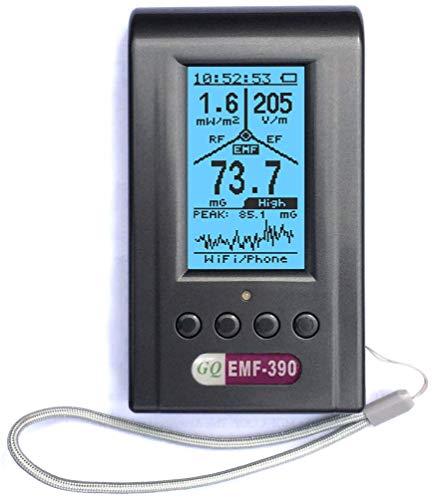
1. Advanced EMF Meter GQ EMF-390 3-in-1 EMF ELF RF Meter, Low-Band 5G Cell Tower Smart Meter WiFi Signal Detector RF up to 10GHz with Data Logger and 2.5Ghz Spectrum Analyzer
Our pick — over 4.5★ from 300+ verified ratings; the strongest balance of quality and price.
The undisputed champ for anyone who wants real data, not just a blinking light.
This is the meter that serious owners — from ham radio operators to paranormal investigators to concerned homeowners — end up recommending. It has a built-in RF (radio frequency) spectrum analyzer that displays up to 2.5GHz of the radio spectrum in real time, so you can actually see what frequencies are active instead of just reading a single number. It reads EMF (electromagnetic field), RF (radio frequency), and EF (electric field) all on the same screen at the same time, with an auto-identify feature that the brand says guesses the radiation source (power line, cell tower, microwave, smart meter). That is a level of diagnostic power you rarely find outside a professional tool.
The data logging feature is a standout — it saves a reading every second and stores up to 24 hours of history, which you can export to Excel on a Windows or Mac computer. The rechargeable battery is a removable 18650 cell (a common lithium-ion battery size) that sips power so slowly that buyers report it uses only 22% of its charge over 20 hours of continuous use. That is exceptional endurance for a device with a live spectrum display. The included belt case is practical, though the Velcro is tight enough that a few owners find it fiddly to open.
Over three dozen owners specifically call out how reliable the readings are, which is the highest count of any aspect across all the meters here. The only consistent complaint is that the written instructions are light, and some users end up hunting for tutorial videos on YouTube to open up the deeper features. But the tech support is quick, and the free PC software is genuinely useful.
Why owners love it
- Simultaneous EF/MF/RF display with auto source identification — no switching modes
- RF spectrum analyzer up to 2.5GHz reveals actual frequency activity
- Removable 18650 battery lasts over 20 hours on a single charge
- 24-hour data logging with USB export to Excel
The trade-offs
- Manual is sparse; new users will need to watch tutorial videos to open up advanced features
- Belt-case Velcro is very stiff, making one-handed removal difficult
Your call if: you want the deepest diagnostic capability — spectrum analysis, data logging, and the confidence that comes from 38 owners citing its accuracy.
Think twice if: you just want a quick pass/fail answer and do not want to learn a few menu screens — the simpler PSB0H0 is better for that.
2. EMF Meter EMF Detector GQ EMF-390 Tri-Field Electromagnetic Radiation Detector 3-in-1 RF meter 5G Cell Tower Wifi 10G & Data Log 2.5G Spectrum Analyzer Radio Frequency Detector Ghost Hunting Equipment
The same brilliant engine as the best overall, but a slightly different part number with a long track record.
This is the original GQ EMF-390, the meter that built the reputation before the V2 variant arrived. It is effectively the same core product: a 3-in-1 detector that measures electric fields, magnetic fields, and radio frequencies up to 10GHz, with a built-in RF spectrum analyzer that displays up to 2.5GHz. It also includes a 3-axis EMF sensor, a signal meter, and a digital RF activity mode that shows the actual digital bytes being transmitted in real time — a fascinating feature for anyone with a curious mind.
Where this one shines is its proven longevity. A career electronics technician with 52 years of experience bought this for his wife to check RF from her cell phone and microwave, and he calls it “very sensitive, user friendly, and durable.” Another owner used it daily for about two years before moisture discolored the screen (it still worked, just with gray blotches). The 4-button interface is intuitive enough that most people are scanning within minutes, though the manual is sparse here as well; owners turn to the GQ forum and free PC software for the deep stuff.
The data logging is the same 20-hour continuous record and USB export capability that makes the V2 so useful for time studies. Owners highlight that it can detect 410-420MHz signals at -70dBm (decibel-milliwatts, a measure of signal power). That is impressive sensitivity for a meter at this level. The crowd favorite feature is the all-in-one display that auto-identifies the radiation source — it can tell you if the spike is from a phone line, a Wi-Fi router, or a power line without you guessing.
The proven workhorse: This is the meter that established the GQ name, with a 550+ owner base and a track record of daily use lasting years. The only real downside is the lack of detail in the printed manual — but the online community and forum support fill the gap nicely.
Reach for this if: you want the same professional-grade diagnostics as the V2 but prefer a model with a massive, battle-tested owner community.
Look elsewhere if: you need a simple three-light alarm with no learning curve — this one rewards a little curiosity.
3. 3-in-1 EMF Meter for Electric Field (EF), Magnetic Field (MF), Radio Frequency (RF) Detection – EMF Radiation Tester for Home, Office, Outdoor, EMF Detector Meter
A compact, straightforward meter that does the basics well without the complexity of a spectrum analyzer.
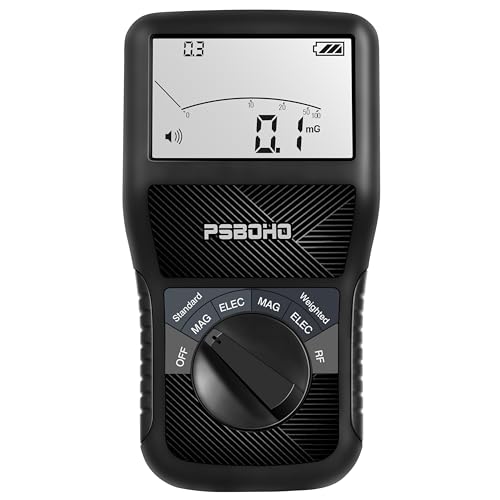
This PSB0H0 meter takes a simpler approach than the GQ models above, and for many buyers that is exactly what they want. It measures all three field types (EF, MF, and RF) with a tri-axis sensor, and it presents the data on a sizable LED display with an adjustable backlight and a fast indicator bar for pulse monitoring. The standout feature here is the dual measurement mode: you can switch between standard readings and weighted readings, where weighted mode emphasizes the higher frequencies that have a greater effect on the human body. That is a thoughtful touch you do not usually see at this level.
Owners consistently mention how responsive and easy to use it is, with swift readings and a peak tracking function that holds the highest value so you can walk around a room and check back later. The audio alert is loud enough to hear in a quiet room, making it useful for paranormal investigation — one owner reported using it to detect the 18.9Hz frequency often associated with ghost hunting. The controls for the audio and backlight are tucked inside the battery compartment, which keeps them out of the way but also means you have to open the compartment to adjust them.
It runs on a single 9V alkaline battery that is included in the box, so you can start scanning immediately. The build feels solid and the form factor is similar to the classic Tri-Field meter, which several owners noted as a positive — it is familiar and comfortable in the hand. The documentation is light, just like on the GQ meters, and a few owners wished for more guidance on interpreting the weighted mode results.
Simple, direct, and effective: This meter skips the data logging and spectrum analysis in favor of a clean, responsive interface with the unique bonus of a weighted measurement mode. It is the balance for anyone who wants accurate spot-checks without needing to export spreadsheets.
Your pick if: you want a no-fuss tri-field meter with clear readings and the science-backed weighted mode for body exposure — at a weight of 11.3 ounces it is one of the heftier portable options.
skip it if: you need data logging, a rechargeable battery, or a spectrum analyzer display — that is the GQ territory.
4. KAIWEETS EMF Detector, 3-in-1 Handheld EMF Meter Detects EF, RF, MF, WiFi Signal, Rechargeable Radiation Detector with 3 Color Backlight and Sound Alarm, Suitable for Home, Office, Ghost Hunting

A well-built meter with a vivid trend graph that makes EMF patterns easy to spot at a glance.
The KAIWEETS KEMF-1 is a strong mid-range contender that feels heavier and more solid in the hand than its 10.6 ounces might suggest. It measures all three radiation types simultaneously — magnetic fields (0.01-200µT), electric fields (1-2000V/m), and radio frequencies (0.001-200mW/m²) — and displays them on a clear screen with a real-time trend graph. That trend line is the killer feature here: instead of just showing a number that jumps around, you can watch the signal strength change over time as you move the meter closer to or farther from a source, which makes locating hotspots much more intuitive.
The tri-color backlight automatically shifts from green to yellow to red as radiation levels climb, and the audible alarm beeps when readings exceed safe thresholds. There is also a one-touch hold button that freezes the peak reading, which is very handy for documenting a measurement without having to write it down while holding the meter steady. Owners find it particularly useful for checking safe distances from microwaves (about 4 feet was the distance that showed safe levels) and for walking around a campus to identify which Wi-Fi access point is actively transmitting.
The built-in rechargeable battery is convenient, and the build quality gets consistent praise — six out of ten owners who mention quality call it solid. That said, accuracy is a mixed point, with about ten owners noting that the readings can feel inconsistent compared to a lab-grade meter. The consensus is clear: this is a consumer-grade tool that gives you reliable directional information (safe vs. not safe), but it is not a calibrated scientific instrument.
Visual feedback done right: The trend graph and auto-color backlight make this the easiest meter to read at a glance. It is a great choice for anyone who wants to quickly identify problem areas without having to interpret raw numbers.
Best for: concerned parents, home inspectors, and IT staff who need to spot-check areas fast and want clear visual warnings rather than deep data.
Not for: scientific-level documentation or environments where absolute accuracy down to the decimal matters — treat it as an excellent directional tool, not a lab instrument.
5. ERICKHILL 3-in-1 EMF Meter for Home, Simultaneous EF MF RF Detector, Electric Magnetic Field & RF Radiation Meter, Tri-Axis Sensor, LCD Trend Graph, Alarm Alert for WiFi Router & Appliances
A strong all-around performer that shows all three readings at once on a large, easy-to-read screen.
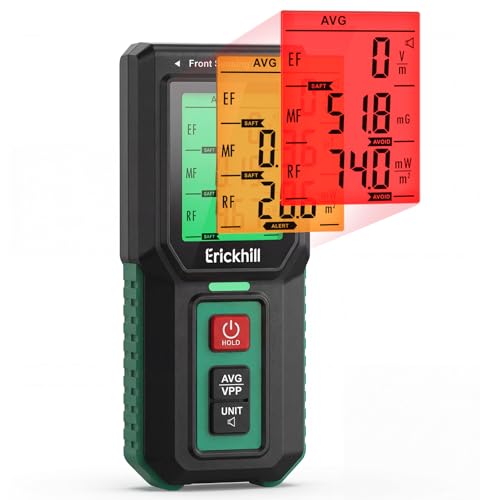
The ERICKHILL RT-300 is another tri-field meter that does simultaneous EF, MF, and RF detection without making you switch modes. The large backlit LCD (liquid crystal display) shows all three readings together with a real-time trend graph, and the color-coded indicators (green, orange, red) give you immediate visual feedback. A triple alert system — sound, screen color, and a light — makes sure you notice when radiation levels rise, and you can mute the audible alert while still watching the visual warnings.
What sets this one apart from the KAIWEETS KEMF-1 is the 3-axis magnetic sensor paired with advanced signal processing that the brand says reduces interference. Owners who tested it found it revealed surprising hotspots — one user discovered their indoor weather monitor was the highest emitter in the room, something they would never have guessed. The USB-C rechargeable battery is a nice modern touch, and the compact design (9.9 ounces) makes it easy to carry from room to room. The built-in rechargeable battery with a low-battery indicator means you are never caught off guard.
The sensitivity aspect gets the most discussion, with thirteen owners calling it out — some find it accurate and responsive, others report that it takes a little practice to get consistent readings when you are near very low-level fields. The manual power-off keeps the device behavior predictable, which is a small but appreciated detail for anyone who has accidentally left a meter running for a day. It comes with a carrying case that owners find surprisingly nice for the price point.
A very capable middle-ground choice: The USB-C charging, large simultaneous display, and 3-axis sensor make this a serious contender. The learning curve is real, but the payoff is a reliable meter that can reveal hidden EMF sources in your home.
Reach for this if: you want a modern meter with USB-C convenience, a big clear screen, and the ability to isolate electric, magnetic, or RF readings individually.
Look elsewhere if: you need instant point-and-shoot results with zero learning — this one benefits from a few minutes of practice to interpret the data correctly.
6. EMF Meter, 3-in-1 Electromagnetic Radiation Detector | EF, RF, MF Detection, WiFi Signal Detection, Suitable for Home, Office EMF Inspections, Ghost Hunting
The featherweight that punches above its price — a full 3-in-1 meter at a genuinely budget-friendly cost.
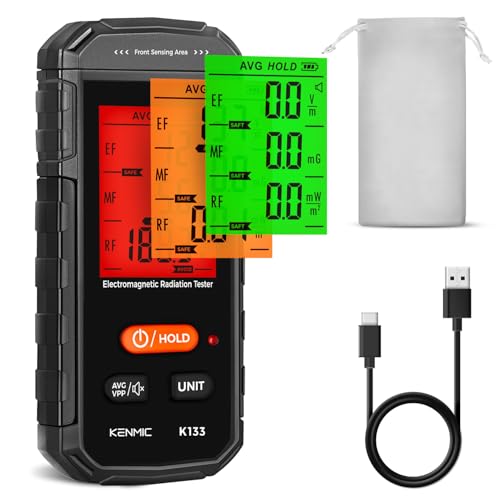
At just 4.7 ounces, the KENMIC K133 is the lightest meter in this roundup by a wide margin. It is more than 5.8 ounces lighter than the GQ EMF-390 (which weighs 10.5 ounces), making it the obvious choice if you plan to carry it around all day or stash it in a small bag. Despite the low weight, it still detects all three radiation types — electric field in V/m (volts per meter), magnetic field in mG/µT (milligauss/microtesla), and radio frequency in mW/m² (milliwatts per square meter) — with a tri-color LCD screen that changes from green to yellow to red as the radiation intensity increases.
The auto-alarm triggers when levels exceed safe thresholds, and the mute function lets you turn off the buzzer for quiet testing environments, which paranormal investigators particularly appreciate. An auto-shutdown feature turns the meter off after 10 minutes of inactivity to save battery, and the illuminated screen makes it usable in dark spaces. Owners say it works great for checking the electric field behind a bed, comparing fields from a phone versus a Wi-Fi router, and detecting microwave leakage (though the measurement is in V/m rather than the standard mV/cm — 46 V/m equals 460 mV/cm, a conversion that confused a few users initially).
Over two dozen owners specifically note that it works well across all the tests they have run. Accuracy gets mixed feedback, with about fourteen owners reporting inconsistent readings, especially with the temperature sensor (one owner reported it reading 81.6°F while their other thermometer showed 75°F). That temperature measurement is considered a gimmick even by fans of the meter. The included rechargeable lithium polymer battery is a nice bonus at this price point.
Why it earns its place
- Full 3-in-1 detection at a very accessible price — tough to top for the features offered
- At 4.7 oz it is genuinely lightweight and easy to carry in a pocket or small bag
- Tri-color LCD, audible alarm, and mute function cover all the usability bases
- Auto-shutdown prevents battery drain when you forget to turn it off
Honest limitations
- Accuracy is mixed — expect directional guidance rather than lab-precision readings
- The temperature sensor is a novelty, not a reliable measurement tool
Perfect entry point if: you are curious about EMF in your home and want a functional, lightweight meter that covers all three field types without spending premium-tier money.
Not the right fit if: you need highly repeatable, lab-calibrated readings for professional documentation — the accuracy variability is real here.
Understanding the Specs
Electric Field (EF), Magnetic Field (MF), and Radio Frequency (RF)
An electric field (measured in V/m) comes from voltage — it is present around any wire or appliance that is plugged in, even if the device is turned off. A magnetic field (measured in mG or µT) comes from current flow — it exists only when a device is actually running, like a motor or a transformer. Radio frequency (measured in mW/m²) is the wireless radiation emitted by things like Wi-Fi routers, cell phones, and smart meters. A true 3-in-1 meter checks all three, which is important because a single reading type can miss what is actually happening in the room.
Tri-Axis Sensor
A tri-axis (or 3-axis) sensor measures magnetic fields in all three spatial directions (X, Y, and Z) at once. A single-axis sensor only measures in one direction, meaning you have to physically rotate the meter to find the peak reading, which is slow and easy to get wrong. A tri-axis sensor gives you the full strength of the field no matter which way you hold the meter, which is why it is the standard feature on every meter worth buying today.
FAQ
Can an EMF meter tell me if a specific device is dangerous?
What is the difference between a single-axis and a tri-axis EMF meter?
Why does my EMF meter show a reading even when the appliance is turned off?
How accurate are consumer-grade EMF meters compared to lab equipment?
Can I use an EMF meter for ghost hunting?
How do I know if a reading is “safe” or “dangerous”?
Will an EMF meter also detect 5G cell tower signals?
How often should I replace the battery or recharge my EMF meter?
What does the “data logging” feature do and why would I need it?
Is it worth paying more for a meter with a spectrum analyzer?
Final Thoughts: The Verdict
If you want one dependable pick, the best emf meter winner is the GQ EMF-390 V2 because it packs a full RF spectrum analyzer (a display that shows the exact frequencies active), 24-hour data logging, and battery endurance measured in days of real use — all in a handheld device. If you want the same core engine at a slightly lower price with a massive owner community, the original GQ EMF-390 is the proven workhorse. And for a simple, lightweight, budget-friendly entry point that still covers all three field types, the KENMIC K133 is the most accessible way to start understanding the invisible world around you. Between those three, there is a meter for every level of curiosity.
How We Picked
We do not accept paid placement. Every pick is matched to a real buyer and a real use-case; we do not hands-on test units.
Sources & Methodology
Specifications: manufacturer listings and product documentation. Review insights: verified customer reviews, as of July 2026. Pricing: not shown on this page (it changes often); check the current price via the retailer link.
As an Amazon Associate, WellFizz earns from qualifying purchases. This does not affect which products we feature.
Related Guides

Mo Maruf
I created WellFizz to bridge the gap between vague wellness advice and actionable solutions. My mission is simple: to decode the research and give you practical tools you can actually use.
Beyond the data, I am a passionate traveler. I believe that stepping away from the screen to explore new environments is essential for mental clarity and physical vitality.