Our readers keep the lights on and my smoothie glass nicely filled. As an Amazon Associate, I earn from qualifying purchases.
Specs are compiled from manufacturer listings and verified buyer reviews and can change over time — please confirm the key details on the product page before buying.
When the lights go out, your phone is your lifeline. A reliable emergency power bank keeps your phone charged for calls, weather alerts, and GPS navigation. We compare top models—from solar radios to high-capacity banks—so you can match one to your outage scenario.
I’m Mohammad Maruf — the founder and writer behind WellFizz. This guide is built by comparing the manufacturers’ published specifications and the patterns across verified customer reviews, so you get each pick’s real strengths and trade-offs instead of marketing spin.
When the lights go out, an emergency power bank keeps your phone alive so you can call for help, check alerts, or stay in touch. Look for one with solar or crank charging (a hand-powered generator) and a high capacity (measured in milliamp-hours, or mAh) so you have enough juice for days, not just hours.
Our Picks at a Glance

How To Choose The Best Emergency Power Bank
Choosing backup power begins with assessing your worst-case outage scenario. A brief blackout demands a different device than a week-long camping trip. Identify which critical devices—phone, radio, laptop, or fan—you must keep running and for how long.
Capacity vs. Real-World Usage
The mAh rating on the box indicates the battery’s total charge capacity. A higher mAh means more stored energy for your devices. But the real-world story is about how that power translates: a 20,000mAh bank won’t fully recharge a 60,000mAh device. Plan for roughly one to two full phone charges per 10,000mAh of capacity.
Charging Methods and Recharge Speed
Consider how you will refill the bank itself. Wall charging is the fastest and most efficient, while a built-in solar panel is a true emergency feature — it’s slow, but it works when the grid is down. Hand-crank models are another lifeline, converting your physical effort into power. Look for a device that offers multiple ways to recharge.
Outputs and Power Standards
Check the ports and the charging standard they support. USB-C with Power Delivery (PD) is now standard for fast-charging phones and laptops. A standard AC wall outlet can open up the device to powering small appliances like a mini-fridge or a fan, which is a huge difference during an extended outage.
Quick Comparison
| Model | Best For | Capacity | Key Power Source | Outputs | Amazon |
|---|---|---|---|---|---|
| Mesqool Solar Radio★ Best Overall | Off-grid communication | 12000mAh | Solar / Crank / AAA | USB-A, USB-C | Amazon |
| Nuynix 49800mAhBest Value | Rugged multi-device charging | 49800mAh | Solar / Wall | 2x USB-A, USB-C | Amazon |
| MaiVoz 56800mAhMulti-Day Champion | Multi-day phone backup | 56800mAh | Wall | 2x USB-A, USB-C | Amazon |
| Sucrosey 50000mAh | Connector-free convenience | 50000mAh | Wall Plug | USB-A, USB-C | Amazon |
| BLASOUL 49800mAh | Wireless charging versatility | 49800mAh | Solar / Wall | USB-A, USB-C, Wireless | Amazon |
| mophie Powerstation XL | Everyday travel with style | 20000mAh | Wall | 2x USB-A, USB-C | Amazon |
| GENSROCK 24000mAh | Powering small appliances | 24000mAh | AC Outlet / Solar | 2x AC, USB-C, 2x USB-A | Amazon |
| DARAN 89.6Wh | Lightweight AC power on the go | 89.6Wh | AC Wall / Car / Solar | 2x AC, 2x USB-C, 2x USB-A | Amazon |
| Anker SOLIX C200 DC | Laptop-class fast charging | 192Wh | Wall / Car / Solar | 3x USB-C, 2x USB-A | Amazon |
In‑Depth Reviews
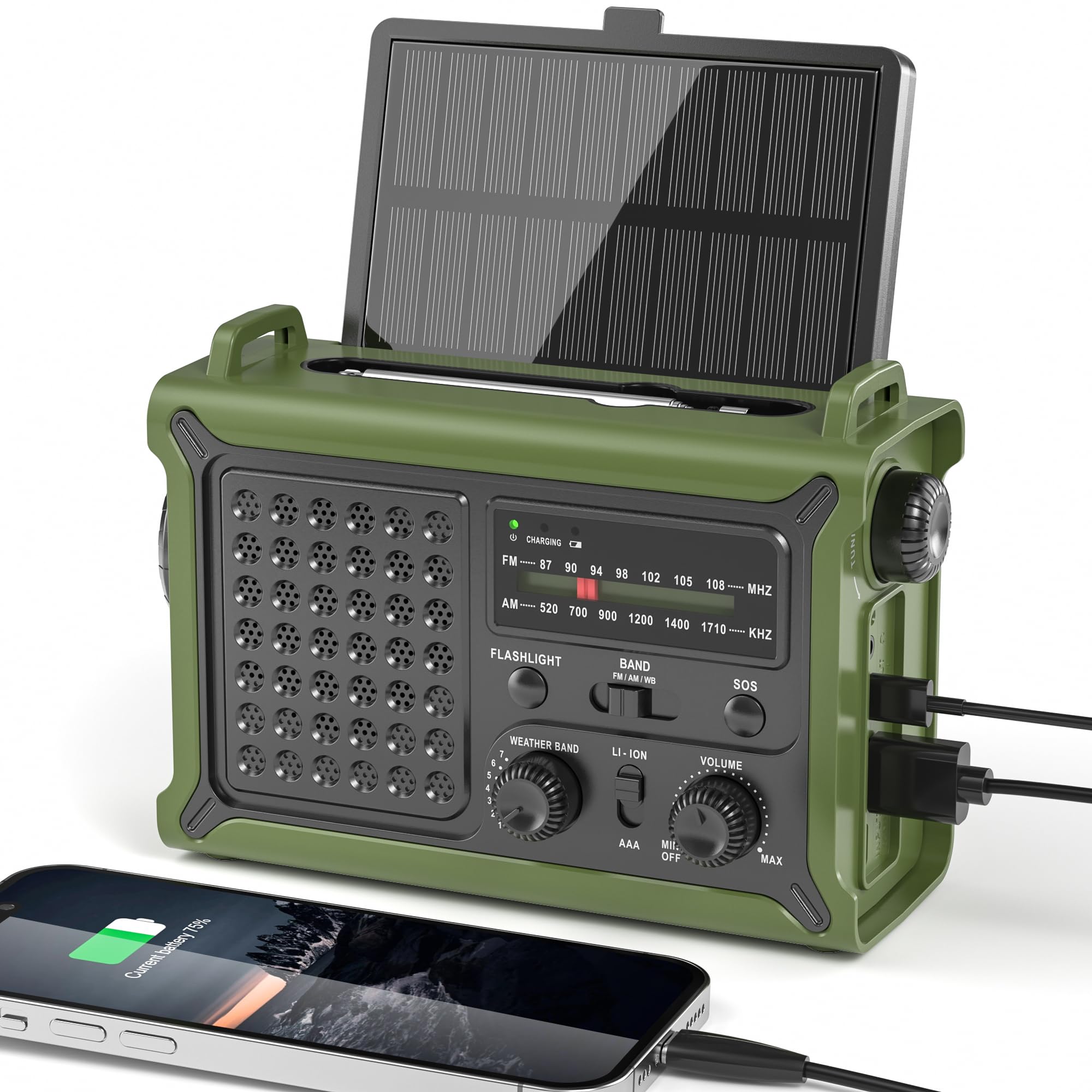
1. Mesqool Solar Radio Hand Crank 12000mAh
Our pick — over 4.5★ from 950+ verified ratings; the strongest balance of quality and price.
The all-in-one lifeline that keeps you informed and powered when the grid goes dark.
This device is the crowd favorite — 4.7 stars across 900+ ratings — and the reason is clear: it’s not just a charger, it’s a complete emergency hub. The standout feature is the radio that pulls in NOAA weather bands, AM, and FM with a clear signal. In a storm, that’s how you get official updates and instructions when cell towers are down, and you’ll hear them loud and clear thanks to a high-sensitivity signal chip.
Powering the phone is what makes this a power bank, and the 12000mAh battery is a real one. It recharges through a solar panel that is over 4× larger than the decorative panels on many competitors — a massive 8500mm² monocrystalline unit — so it actually captures meaningful sunlight in low-light conditions. You can also use the hand crank or standard AAA batteries, giving you five distinct ways to keep it running, which is the ultimate insurance policy. The built-in flashlight can cast a beam up to 260 feet, helping you navigate in the dark.
This is the pick that owners buy a second time as a gift. One detailed report described it as reliable for a 10-day camping trip, noting that it survived rain and that the flashlight and weather band were handy. The main trade-off is the lack of a battery level indicator, so you can’t always see exact remaining power. At 1.6 pounds, it’s also not the lightest bank here, but that weight speaks to its solid, rugged construction.
What wins owners over: buyers report the build quality is the top reason they chose it, with over 160 reviewers calling it out, and they also praise the crisp sound quality (so you can hear alerts or calls clearly in a noisy room).
Reach for it if: You want one device that handles radio, light, and phone charging during a prolonged outage.
Look elsewhere if: You need a thin, pocketable power bank for everyday commutes rather than a bulky emergency kit.
2. Nuynix 49800mAh Solar Power Bank
A rugged, high-capacity brick that shrugs off water and drops while charging three devices at once.
This is the budget-friendly workhorse for people who take their gear into the elements. It’s built with two LED flashlights and an IP67 waterproof rating, meaning it’s fully protected against dust and can survive immersion in water. It’s also drop-proof. For campers, hikers, or anyone who keeps a kit in the car, this durability is the headline feature.
The 49800mAh capacity is backed by a high-density polymer battery, and the 15W output can fast charge an iPhone to 50% in about 30 minutes. It has three ports — two USB-A and one USB-C — that support charging three devices at once, so your phone, earbuds, and a friend’s phone can all pull power simultaneously. The panel also features a carabiner so you can clip it to a pack.
The honest caveat, as owners mention, is that the solar panel is a trickle charger for such a massive battery. One owner summed it up: “Takes a very long time to charge plugged in.” Treat solar as an emergency top-up, not a primary recharge source. An occasional unit has also been reported to stop working after a few months, so it’s worth testing regularly.
Why it’s a steal
- Massive 49800mAh capacity in a compact, rugged shell
- IP67 waterproofing is rare at this price point
- Three ports let you share power with others
The honest catch
- Solar charging is very slow due to the large battery size
- Wall recharging takes a long time, too
- A few owners have had units fail within months
Perfect match if: You want maximum power and rugged protection without spending top dollar.
Weigh it first: You need a bank that recharges quickly from a wall outlet — this one demands patience.
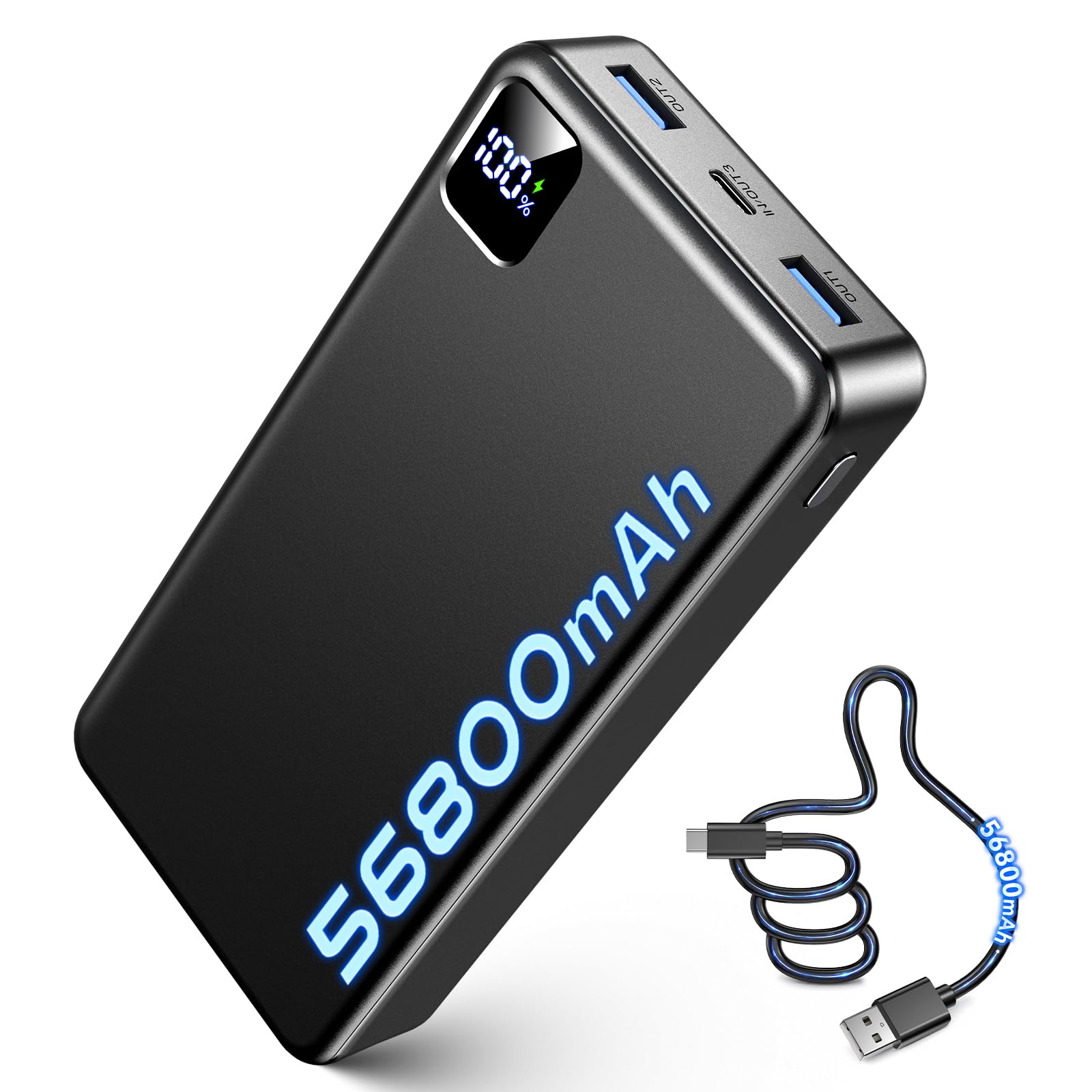
3. MaiVoz 56800mAh Portable Charger
The biggest battery on this list, built to power your phone for an entire week away from outlets.
With a 56800mAh capacity, this MaiVoz bank is the multi-day champion here. It can power an iPhone 17 or Galaxy S25 more than 10 times, which makes it the go-to for extended camping trips, long road trips, or as a family’s shared emergency backup during a multi-day outage. The LED display shows the remaining percentage so you always know what you’re working with.
It’s not just about size; it’s about speed. The 22.5W PD fast charging can get an iPhone 17 to about 60% in around 40 minutes, outpacing the Nuynix above (15W). The bank features two USB-A outputs and one two-way USB-C port, letting you charge three devices at once. It’s protected against overvoltage, overheating, short circuits, and overcurrent, which keeps your connected gadgets safe.
Owners consistently describe it as a powerhouse with fast charging and a sturdy build. The one recurring note is that recharging the whole battery takes a long time — about 12 hours with a standard charger — so plan ahead before a trip. It’s also not allowed on airplanes due to its battery capacity, so it’s strictly a ground-travel and home-outage companion.
Crowd verdict: Fast charging is the thing everyone raves about, with plenty of owners noting it delivers the promised speed from the start.
Choose this if: You need the absolute maximum number of phone charges before your next opportunity to plug in.
Note the limit: The slow refill time means you must charge it well in advance of when you need it.
4. Sucrosey 50000mAh Power Bank with Wall Plug
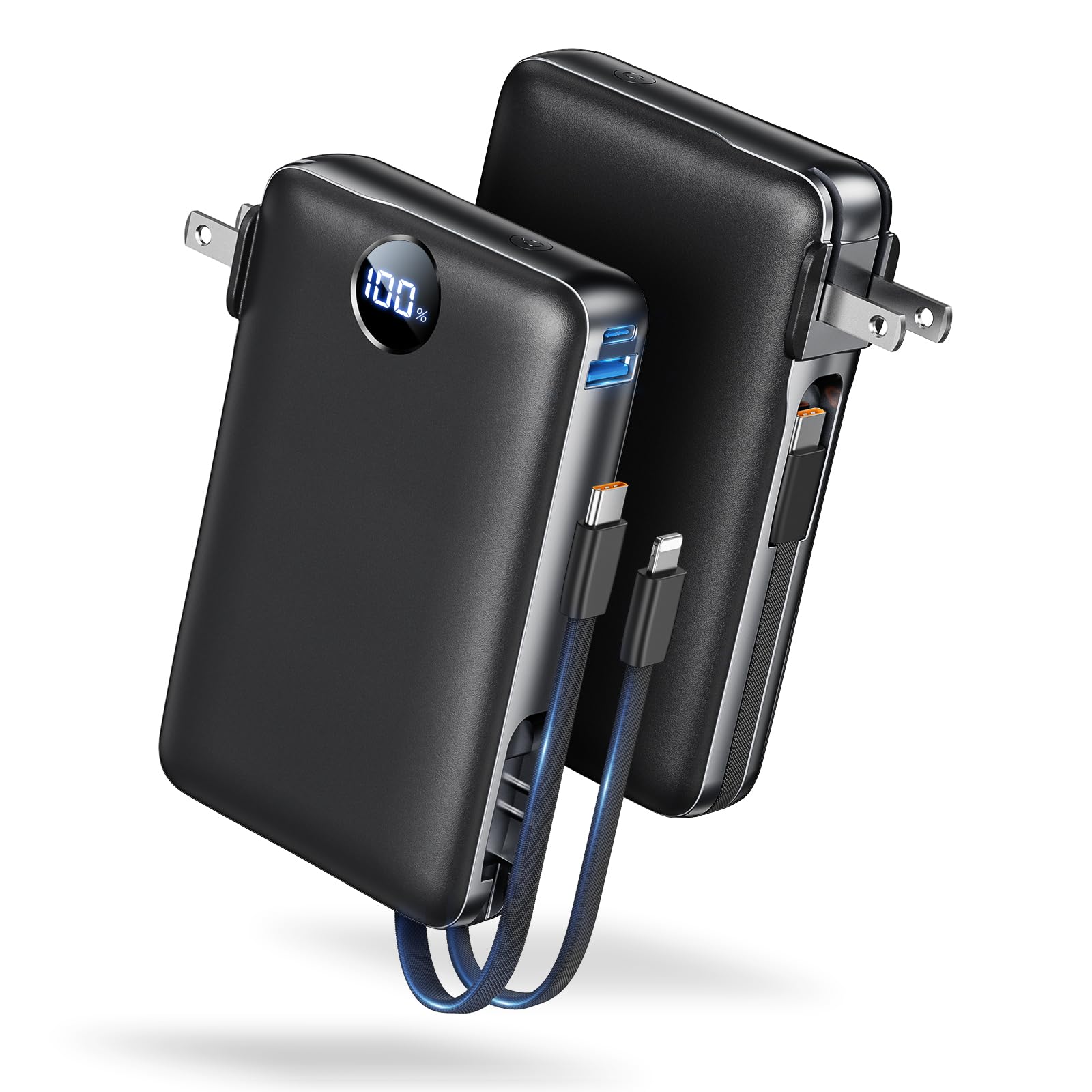
Forget digging for cables — this bank comes with its own built-in USB-C and iOS cords and a wall plug.
This Sucrosey is the pick for anyone who hates fumbling for the right cable in a dark room. It has built-in USB-C and iOS cables, so the connection is always there when you need it. It also features a wall plug, so you can refill it directly from an outlet without carrying a separate charger and cord.
Under the hood, it’s a 50000mAh bank with 22.5W PD and QC fast charging. That’s enough to charge an iPhone 17/16 Pro up to 10.6 times, an iPad Pro nearly 5 times, or a MacBook Air about 2.5 times. The USB-C port, built-in cable, and USB-A port each support up to 22.5W output, so you get fast charging no matter which port you use. One owner put it simply: “This is the best backup battery I’ve ever purchased,” noting it recharges to 100% in a couple of hours.
The charging speed is the most-praised feature, with over 100 owners calling it out. Buyers also love that it’s small enough to fit in a purse. The main recurring caveat is that the device runs warm while charging, so it’s best placed on a flat, open surface. It also comes with a 12-month warranty if anything goes wrong.
What makes life easier
- No need to carry separate cables or a wall adapter
- Fast 22.5W charging on all ports
- Compact size that slips into a purse or small bag
Keep in mind
- Runs warm during charging — avoid placing on soft surfaces
- Built-in cables are fixed length, so positioning is limited
Grab this for: A grab-and-go solution where you never want to remember a cable again.
Think twice if: You prefer the flexibility of choosing your own high-quality cables.
5. BLASOUL 49800mAh Solar Power Bank
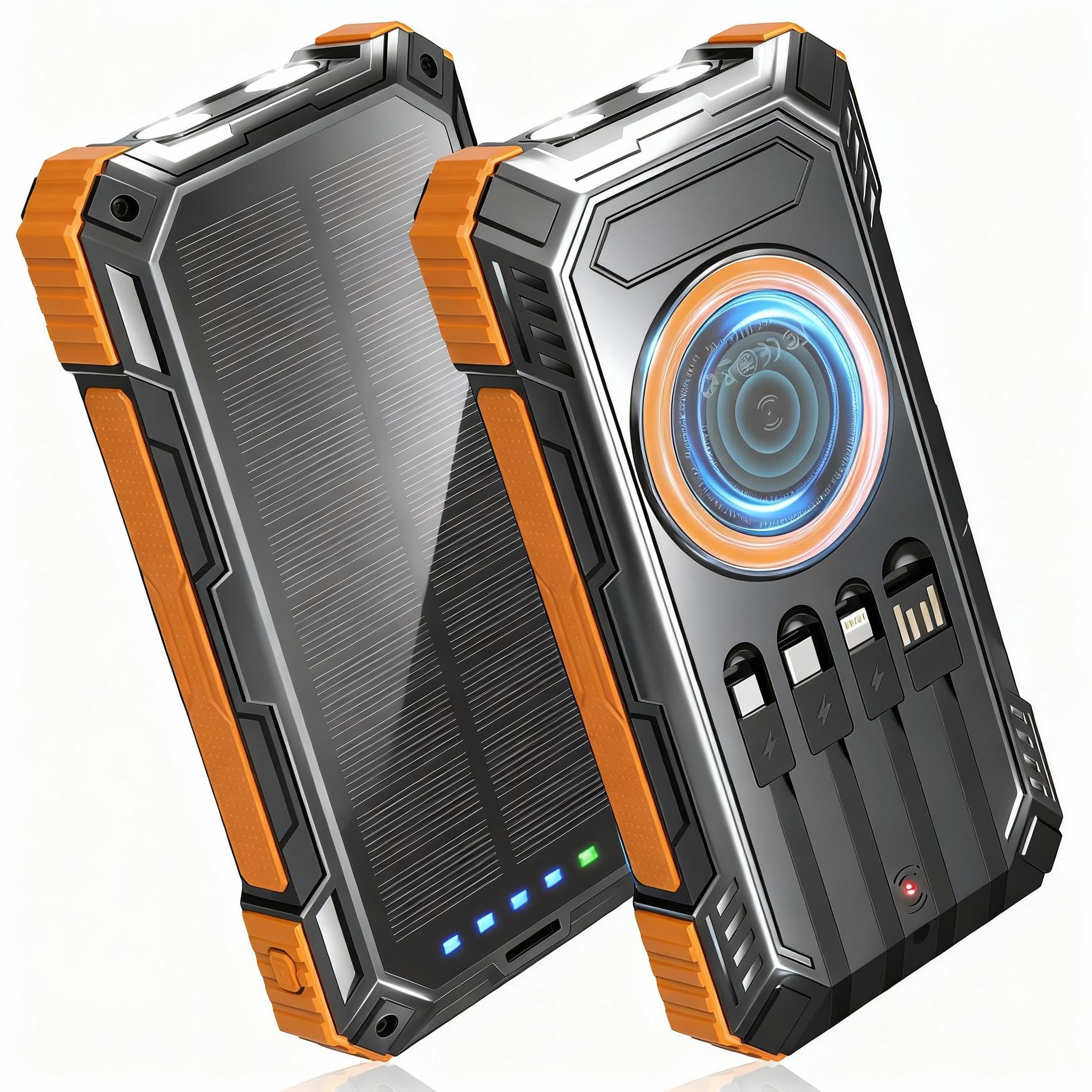
The jack-of-all-trades with four built-in cables, wireless charging, and a solar panel all in one.
This BLASOUL is the most feature-packed solar bank on the list. It has 3 built-in output cables (iOS, Type-C, Micro) and 1 built-in input cable, so it can charge nearly any device you own without a hunt for cords. On top of that, it supports 15W Qi wireless charging — just place a compatible phone on the pad and it powers up immediately.
The 49800mAh battery uses 22.5W PD 3.0 and QC 3.0 fast charging, delivering an iPhone 14 to 60% in 30 minutes. It’s built for the outdoors with an IP65 rating for water, shock, and dust resistance. An ultra-bright LED flashlight with three modes (steady, SOS, and strobe) makes it a genuine emergency tool. The package even includes a carabiner and a storage bag.
Owners love the built-in cables and the convenience, with one noting it kept all devices charged for an entire camping trip. Another verified buyer found it useful in a hospital, charging a phone three times from under 30% with capacity to spare. The honest trade-off, as customers note, is that the attached cables are short and charge more slowly than a dedicated high-speed cord. Solar charging is also slow, but that’s true for any unit of this size.
Standout strength: The wireless charging works well and the built-in cable setup eliminates the need for extra cords, which owners consistently praise.
Best fit for: A family with mixed devices — iPhones, Androids, and older Micro-USB gadgets all get covered.
Note the flaw: The short attached cables can be awkward for positioning larger tablets while charging.
6. mophie Powerstation XL 20000mAh

The sleek, reliable everyday companion from a brand owners trust for more than a decade.
If you want a power bank that looks good and lasts, the mophie Powerstation XL stands out. One buyer detailed that their previous mophie lasted over 11 years before they replaced it with this one — a track record that points to solid build quality you can rely on during an outage.
It packs a 20,000mAh battery with a 20W USB-C PD port that provides up to a 50% boost in 30 minutes. Two USB-A ports and the USB-C port let you charge three devices at once. The product is made with 50% recycled plastic and backed by a 2-year warranty. At 0.57 kg, it’s heavier and a bit bulkier than some competitors, but owners find it easily fits in a backpack or carry-on.
This is the mid-range pick that isn’t about massive emergency reserves — it’s about dependable daily power and travel readiness. One owner used it on a car trip from Ohio to DC, keeping the kids’ phones charged the whole way. The larger capacity is why it’s slightly bulkier, a trade-off most buyers find acceptable. It’s the one to reach for when you want premium build quality over raw capacity.
Why it earns trust
- Proven brand reliability with multi-year longevity
- Fast 20W USB-C PD charging
- Slim, soft-touch finish that resists scuffs
Trade-offs
- Less capacity than the budget banks above
- Heavier and bulkier than similar-capacity rivals
Ideal for: Travelers who want a well-built, everyday power bank for phones, tablets, and earbuds.
Not for: Multi-day off-grid camping where every last mAh counts.
7. GENSROCK 24000mAh Power Bank with AC Outlet

The bridge between a power bank and a generator, with real AC outlets for small appliances.
This GENSROCK steps up from phone-charging into appliance territory. It features 2 AC outlets with a 150W peak output (120W continuous), which means you can plug in a mini-fan, a laptop charger, a small TV, or a radio. That’s a huge leap in usefulness during a power outage, transforming it from a phone lifeline into a home comfort tool.
The 24000mAh capacity is paired with 8 output ports and 5 output methods: 2 AC outlets, 2 DC ports, 1 Type-C port, 2 QC 3.0 ports, and 1 USB port. A digital screen displays real-time energy levels. It recharges via an AC outlet, solar panel, or car outlet, and can be used while charging. The cycle life is rated at over 1500 times, so it’s built for long-term repeated use.
Owners rave about the charging speed and reliability — those are the two most-praised aspects. One detailed account noted it powered both phones and a fan all night. The main recurring trade-off is durability, with a few owners reporting failures after a short period. The handle placement also blocks the light if you use it as a lantern, a small design quirk to be aware of.
Biggest strength: The AC outlet is the feature that wins people over — it’s the difference between charging a phone and powering real devices.
Reach for it if: You want to power small appliances and multiple devices during a long outage.
Be aware: A few units have reported early failures, so test yours when it arrives.
8. DARAN 89.6Wh Portable Power Station
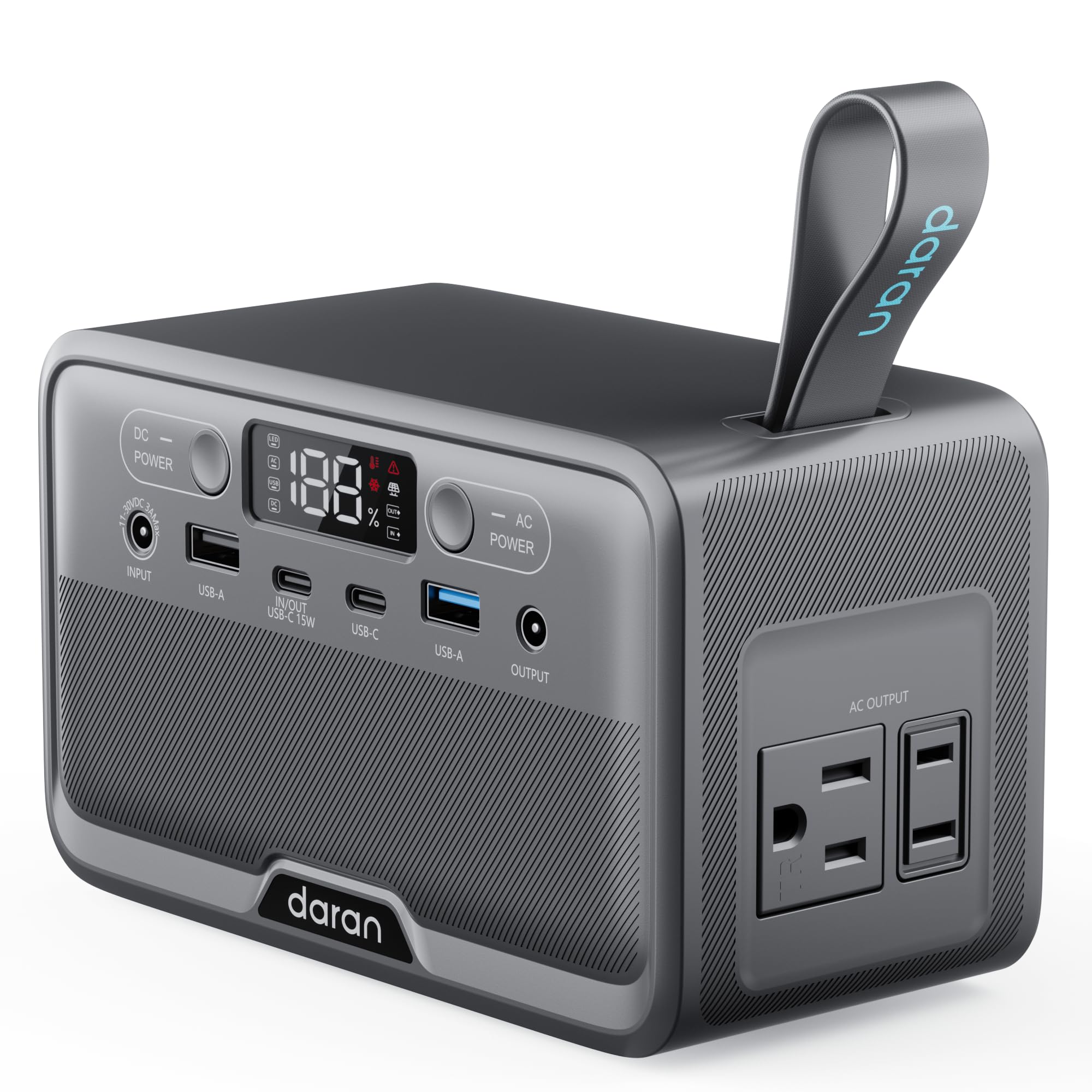
A pocketable power station with real AC outlets, silent operation, and a battery chemistry built to last.
The DARAN is about the size of a smartphone (6.5×3.3×4 inches) and weighs only 2.54 pounds, yet it’s a true power station. It uses a LiFePO4 (Lithium Iron Phosphate) battery, which is a major step up in safety and longevity — this chemistry lasts far longer than standard lithium-ion, with over 3500 life cycles. It’s also below the 100Wh limit, so it’s FAA-approved for airplane carry-on.
It features 7 output ports, including 2 AC sockets (100W), 2 USB-C ports (45W/15W), 2 USB-A ports (18W/15W), and DC5521 ports (60W). That’s enough to run a mini-fridge, a projector, or a Starlink Mini, as one owner confirmed. It charges from 0-80% in just 1.5 hours, and recharges four ways: AC wall socket, USB-C PD, car, and solar. A built-in 4-level LED flashlight with steady/SOS modes adds to its emergency value.
The reliability is the most-praised feature, with over 100 owners calling it out. It’s also celebrated for being ultra-quiet — there’s no fan, so it’s perfect for sleeping or working. One owner used it to run an aquarium pump for over 24 hours. The honest fit-note is around the charging speed, which gets mixed feedback in the reviews — expect solid but not instantaneous recharges.
Why it’s a premium pick
- Long-lasting LiFePO4 battery with 3500+ life cycles
- Silent, fanless operation
- Compact enough for a backpack, powerful enough for AC appliances
Notes on use
- Small display icons can be hard to read at a glance
- Charging speed (0-80% in 1.5hrs) has mixed owner feedback
- Not for high-watt appliances like toasters or microwaves
Best for: Anyone who wants a flight-safe, ultra-quiet power station for laptops, small appliances, and overnight camping.
skip it if: You need to power anything over 100W — this tops out right there.
9. Anker SOLIX C200 DC Power Bank Station

The premium powerhouse with laptop-class 140W charging and a 3000-cycle battery built for the long haul.
The Anker SOLIX C200 DC is the top-tier pick for serious power needs. With 192Wh of capacity and 200W output, it’s the most powerful bank here, but it’s cleverly designed to be 39% smaller than similar power stations. It’s the one for powering laptops, running a Starlink Mini on a fishing trip, or keeping a whole family’s devices charged for days.
The headline feature is the 140W two-way USB-C port. That’s not just for fast phone charging — it can rapidly charge a MacBook Pro or other high-wattage laptops. The bank has 5 charging ports total: 3 USB-C and 2 USB-A, so you can power everything at once. It recharges to 80% in just 1.3 hours via the 140W USB-C PD 3.1 port, or you can top it up with solar (100W input) or a car charger.
The LiFePO4 battery is rated for 3,000 cycles, meaning it will reliably serve you for years, and it’s backed by a 3-year warranty. Owners love it for Starlink Mini setups and for continuous PD charging of devices. As reviewers point out, one used it for 5-6 hours of Starlink use and still had 40% power left. The one catch to note: no wall charger is included, so you’ll need your own USB-C charger to refill it.
The standout feature: The fast 140W recharging — owners note it provides 10-12 hours of use on a single charge and recharges quickly when plugged in.
Choose this if: You need to power laptops or small devices with professional-grade reliability.
Plan ahead: Grab a 140W wall charger, since one isn’t included in the box.
Understanding the Specs
Capacity (mAh vs Wh)
Milliamp-hours (mAh) measures a battery’s charge capacity, commonly used for phone-size banks. Watt-hours (Wh) is a more accurate measure of total energy, often used for larger power stations. A higher value means more device charges before the bank itself needs refilling. For an emergency, look for at least 20,000mAh to get you through a full day of heavy phone use.
Charging Standards (PD & QC)
Power Delivery (PD) and Quick Charge (QC) are fast-charging protocols. They let the bank and your phone talk to each other and deliver the maximum safe power. A higher wattage, like 22.5W or 140W, means faster top-ups for your devices. PD is the standard for modern iPhones and laptops, while QC is more common with Android devices.
FAQ
Can an emergency power bank be taken on an airplane?
Is solar charging on a power bank actually useful?
How long does a LiFePO4 power station battery last?
What is the difference between a power bank and a power station?
How long does it take to recharge a large-capacity power bank?
How many times will a power bank charge my phone?
Can an emergency power bank charge a laptop?
What does the IP rating on a power bank mean?
Should I get a solar radio or a power bank for emergencies?
Are knockoff power banks safe to use?
Final Thoughts: The Verdict
For the majority of shoppers, the emergency power bank winner is the Mesqool Solar Radio because it’s the most complete emergency tool — it gives you weather alerts, flashlight, and phone charging in one rugged, well-rated package. If you want maximum multi-day phone backup power, grab the MaiVoz 56800mAh. And for powering real appliances or laptops during a longer outage, the Anker SOLIX C200 DC is the one to reach for.
How We Picked
We do not accept paid placement. Every pick is matched to a real buyer and a real use-case; we do not hands-on test units.
Sources & Methodology
Specifications: manufacturer listings and product documentation. Review insights: verified customer reviews, as of August 2026. Pricing: not shown on this page (it changes often); check the current price via the retailer link.
As an Amazon Associate, WellFizz earns from qualifying purchases. This does not affect which products we feature.
Related Guides

Mo Maruf
I created WellFizz to bridge the gap between vague wellness advice and actionable solutions. My mission is simple: to decode the research and give you practical tools you can actually use.
Beyond the data, I am a passionate traveler. I believe that stepping away from the screen to explore new environments is essential for mental clarity and physical vitality.