Our readers keep the lights on and my smoothie glass nicely filled. As an Amazon Associate, I earn from qualifying purchases.
Specs are compiled from manufacturer listings and verified buyer reviews and can change over time — please confirm the key details on the product page before buying.
The right elliptical for seniors prioritizes joint comfort over miles or heart-rate zones. It is about a smooth, controlled stride that keeps you active and pain-free daily. The best options prioritize easy access, gentle resistance, and stability for confident use.
I’m Mohammad Maruf — the founder and writer behind WellFizz. This guide is built by comparing the manufacturers’ published specifications and the patterns across verified customer reviews, so you get each pick’s real strengths and trade-offs instead of marketing spin.
From a seated stepper modeled on physical therapy equipment to compact motorized machines, this guide cuts through the noise to find the actual elliptical for seniors worth bringing into your home.
Our Picks at a Glance

How To Choose The Best Elliptical For Seniors
Match the machine’s design to the user’s physical needs. Three key decisions guide the choice.
Step-Through vs. Step-Over Access
The biggest safety concern is how you get on and off. A step-through frame lets you walk right into the seat with no high bar to lift your leg over — critical if balance or hip mobility is a concern. A recumbent design (with a low seat and forward-facing pedals) is generally safer and more comfortable than an upright elliptical for seniors, because the seat supports your back and you never have to stand during the workout.
Stride Length and Range of Motion
A longer stride (measured in inches) does not always mean better — it depends on the user’s leg length and flexibility. For a seated or recumbent machine, a comfortable stride keeps the knees from over-extending while still providing a useful range of motion. An 11-inch stride on a recumbent stepper feels different from a 15-inch stride on a motorized pedal exerciser; the first mimics a natural walking step, the second a longer gliding motion.
Weight Capacity and Build Stability
Heavier machines (150 pounds and up) are typically built with steel frames and resist wobble at any speed. Lighter models (under 30 pounds) are portable but can feel unsteady under heavy use. Check the maximum weight recommendation — a number like 350 pounds tells you the frame and bearings are built to handle repeated, vigorous use, while a 220-pound limit is adequate for lighter users or gentler daily movement.
Quick Comparison
| Model | Best For | Weight Capacity | Item Weight | Max Stride | Amazon |
|---|---|---|---|---|---|
| Teeter FreeStep LT7★ Best Overall | Full-body PT-style workout | 350 lb | 150 lb | 11 in | Amazon |
| xingerkang Electric Elliptical | Seated motorized rehab | 220 lb | 26.5 lb | 15 in | Amazon |
| ROYAXING Motorized Exerciser | Dual-motor chair exercise | 220 lb | 30 lb | 13.8 in | Amazon |
| Sunny Health & Fitness SF-RBE420049 | Budget recumbent trainer | 300 lb | 65 lb | — | Amazon |
In‑Depth Reviews
1. Teeter FreeStep Recumbent Cross Trainer Stepper, Zero-Impact Exercise Bike Alternative
Our pick — over 4.5★ from 200+ verified ratings; the strongest balance of quality and price.
The most joint-friendly home stepper available, built around a licensed physical therapy stride that is gentle on knees and hips.
This is not a typical elliptical. The Teeter FreeStep uses a patented forward-stepping motion licensed from commercial physiotherapy steppers, so your joints align naturally instead of grinding through a circular pedal path. The result feels more like a supported walking motion while seated — buyers report it is noticeably easier on the back and knees than a standard recumbent bike. At 150 pounds and a supported weight capacity of 350 pounds, the all-steel frame gives you zero wobble even during harder sessions.
The 9-inch color LCD screen tracks 7 metrics and holds 21 pre-programmed workouts, while the media rack with USB charging keeps a tablet or phone at eye level for following along with the free Teeter Move training app. The 20-level magnetic resistance adjusts instantly via console quick-keys, ranging up to 105 pounds of resistance. One thing owners consistently note: assembly takes about an hour and a half, and the instructions are clear. Make sure you set it up in its final location — at 150 pounds, it is not a machine you want to move often, though transport wheels help.
What wins owners over
- Patented stride feels like a PT session at home — smooth, quiet, and forgiving on sore joints
- Electronic Step Lock makes getting on and off safe, even with limited balance
- Extra-large ComfortMax seat with multiple adjustments fits users from 4 ft 11 in to 6 ft 6 in
The honest trade-offs
- Seat height adjustment can be tight — users 5 ft 4 in and under may need help lowering it
- Takes up a real footprint: 59 inches deep by 32.7 inches wide
Your best bet if: You want the closest thing to professional physical therapy equipment in your living room — the Teeter is built to last and backed by a brand with over 40 years in joint-friendly fitness.
Think twice if: You need a machine that tucks into a closet or is easy to move between rooms — this is a permanent-floor machine.
2. Electric Elliptical Machine, Arm & Leg Exerciser While Sitting for Seniors
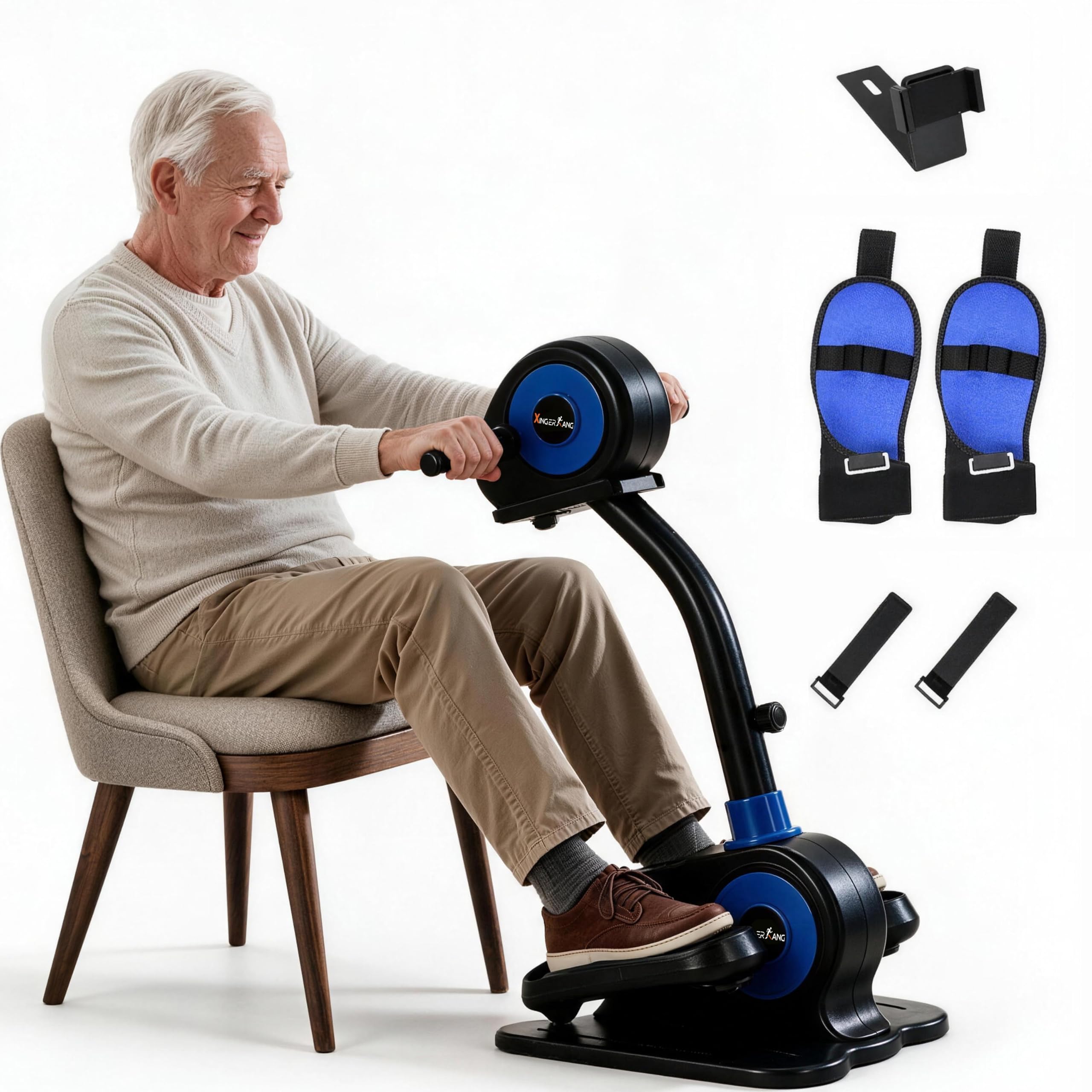
A compact, motorized pedal exerciser that lets you get a full workout from any sturdy chair without standing up.
Where the Teeter requires dedicated floor space, this xingerkang unit weighs just 26.5 pounds and measures 19.6 by 15.7 inches — small enough to slide under a desk when not in use. It runs on two independent 60W motors, so you can move your arms and legs together or separately, forward or backward. The 20 adjustable speed levels and 3 preset modes (P1-P3) let you start at a gentle crawl and build up over weeks.
The stride length here is 15 inches — longer than the Teeter’s 11 inches — but the motion is different: it is a seated gliding pedal action rather than a recumbent stepping stride. Owners mention the touch-screen and remote control make it simple to adjust mid-workout, and the LCD display keeps you updated on time, distance, speed, and calories. The included anti-drop grip gloves and foot straps help users with limited hand strength stay secure. One limitation? It is a quiet machine, but the bright blue indicator light on the control panel bothers some in a dark room.
Ideal rehab companion: The light weight (26.5 lb versus the Teeter’s 150 lb) and small footprint mean you can take it to a chair in the living room, bedroom, or even a sunroom. No assembly drama — most owners have it ready in 10 minutes.
Reach for this if: You are recovering from surgery, managing arthritis, or need a way to move your legs and arms while fully seated in your own chair.
Look elsewhere if: You want a heavy-duty machine for a full cardio sweat session — this is built for gentle rehab and daily mobility, not high-intensity training.
3. 2026 New Upgrade Elliptical Exercise Machine, Low-Impact Motorized Pedal Exerciser
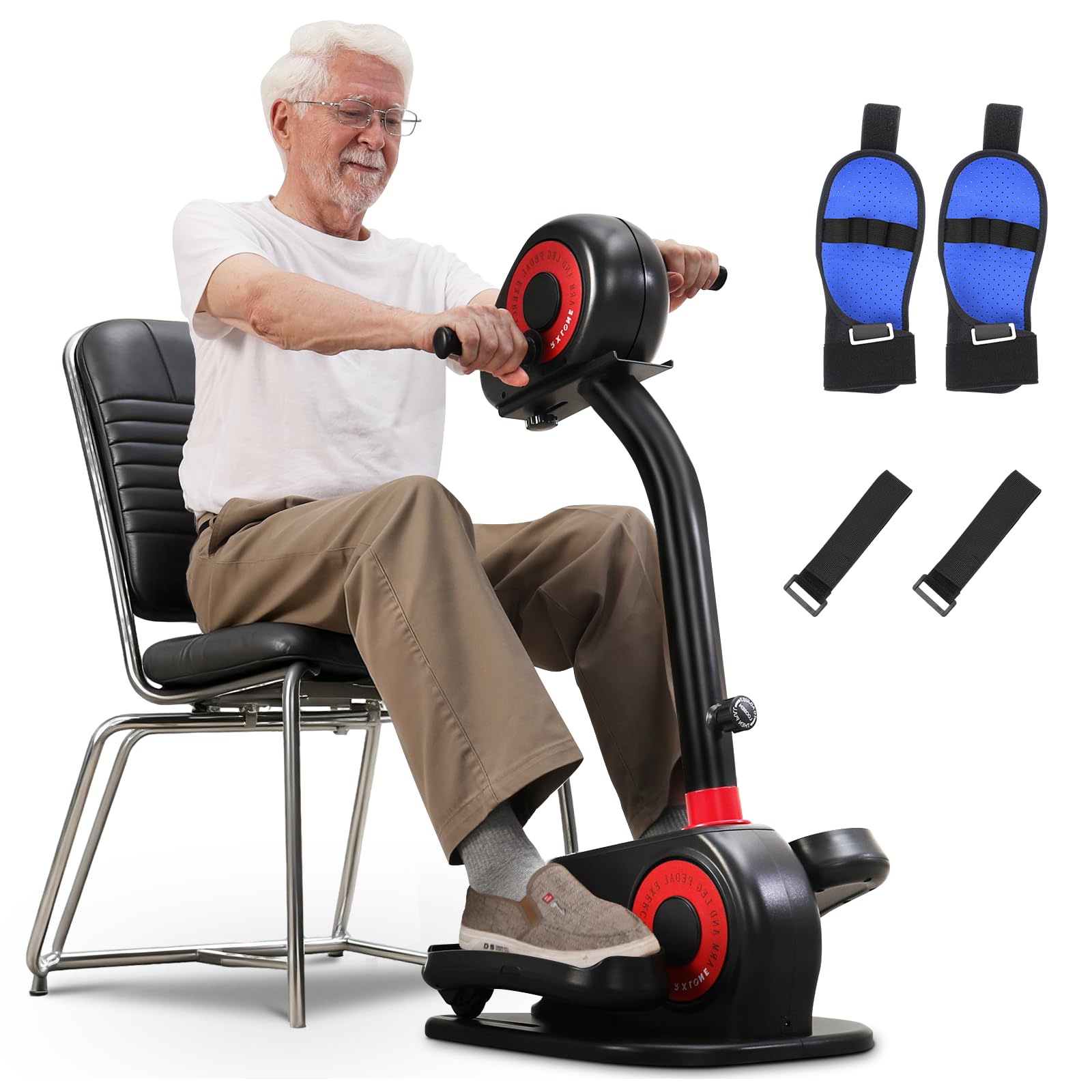
A capable alternative to the xingerkang, with dual motors and a slightly heavier build that some owners find more stable.
This ROYAXING model follows the same concept as the previous pick — motorized pedals for seated arm and leg exercise — but weighs in at 30 pounds versus the xingerkang’s 26.5 pounds. That extra weight comes from a steel frame blended with ABS materials, giving it a bit more rigidity during use. Like its competitor, it uses two independent 60W motors that can operate both upper and lower body simultaneously or isolate one side, with forward and reverse motion to target different muscle groups.
The stride length here is 13.8 inches, shorter than the xingerkang’s 15 inches but still generous for a seated machine. An owner using it for MS recovery reported it restored movement in stiff legs and arms. The same 20 speed levels and P1-P3 presets are present, and the LCD display tracks time, distance, speed, and calories. The biggest knock from owners is the control panel: the button layout and mode settings (P1-P3 and HR display) are not intuitive and require some trial and error to figure out. One owner summed it up: “the exerciser works great!… the only reason i gave it four stars instead of five is that there are no instructions on how to set the modes up.“
Why owners pick this
- Dual motors allow independent arm and leg motion — rare at this price tier
- Simple assembly, tool-free, and fits under most desks or tables
- Reviewers consistently praise how quiet the motors are at any speed
The main frustration
- No printed guide for the mode presets — plan to spend time figuring out P1-P3 and heart-rate display functions
- No transport wheels, despite being light enough to carry short distances
Grab it if: You want a motorized rehab machine with slightly more stability than the lightest options, and you are willing to learn the control panel by trial and error.
skip it if: You need a machine with a clear, simple interface you can use without a learning curve — the xingerkang is friendlier in that regard.
4. Sunny Health & Fitness Smart Recumbent Cross Trainer with Arm Exerciser

A step-through recumbent cross trainer that delivers a smooth, full-body workout at a fraction of the Teeter’s price.
This Sunny Health & Fitness model is the budget-friendly alternative to the Teeter. Instead of a patented PT stride, it uses a belt-driven elliptical path with 8 levels of magnetic resistance. The trade-off is clear: fewer resistance levels (8 vs. 20 on the Teeter) and no motor, but you get a step-through frame that makes getting on and off genuinely easy — owners with limited mobility call this the standout feature. The large seat is comfortable and adjustable, and the pulse sensors on the handlebars let you check heart rate without a separate chest strap.
At 65 pounds, this machine is a middle ground between the heavy Teeter and the lightweight motorized units. It is stable enough for a 300-pound user, and the 1000+ workout videos in the free SunnyFit app give you structured training programs to follow. The main complaint from owners is assembly: the instructions use small diagrams, the left pedal has a reverse-threaded bolt (a common trap), and parts are not always labeled clearly. But once assembled, it is a quiet, smooth machine that reduces the monotony of a treadmill. The display is battery-powered and lacks a backlight — a minor inconvenience for some.
Best for: Anyone who wants a recumbent elliptical experience without spending Teeter money, especially if you need a step-through frame and a generous 300-pound weight limit.
Not for: Buyers who want motorized assistance or a very long stride — this is manual-only and the stride is fixed by the belt path.
Understanding the Specs
Motorized vs. Magnetic Resistance
A motorized elliptical (like the xingerkang and ROYAXING models) uses an electric motor to move the pedals for you — you simply follow the motion. This is ideal if you have limited strength or are recovering from surgery. Magnetic resistance (on the Teeter and Sunny models) creates friction you push against manually, so you control the effort. Magnetic systems are quieter and last longer, but require you to provide the muscle power. For seniors with very low stamina, a motorized start is often safer.
Stride Length and Frame Height
Stride length (measured in inches) tells you how far the pedals travel in one revolution. A shorter stride (11 inches) is better for constrained hip motion — it keeps the knees from lifting too high. A longer stride (13.8 to 15 inches) gives more range for stretching the legs but may feel unnatural if your hips are tight. The item height (35 to 55 inches) matters too: a taller frame means you sit higher off the ground, which can be harder to step onto if you have knee or hip weakness.
FAQ
Is an elliptical or a recumbent bike better for a senior with bad knees?
Can I use a motorized pedal exerciser if I cannot walk at all?
How much floor space do these machines really take up?
Which machine is quietest for use during TV or conversation?
Do I need to assemble these myself, or can I pay someone?
What is the maximum user weight for each machine?
Can I use a motorized elliptical without plugging it in?
How do I choose between a 11-inch stride and a 15-inch stride?
What does “step-through frame” mean, and why does it matter?
Are the motorized models safe for someone with osteoporosis?
Final Thoughts: The Verdict
For most buyers, the best elliptical for seniors is the Teeter FreeStep Recumbent Cross Trainer because it delivers a patented physical-therapy-grade stride in a rock-solid frame, with the highest weight capacity and the smoothest, quietest operation of the group. If you need a motorized machine for seated rehab and portability, the xingerkang Electric Elliptical is the lightest, easiest-to-set-up option with the longest stride. And for the best value in a manual recumbent trainer that still offers a step-through frame and a generous 300-pound limit, the Sunny Health & Fitness Smart Recumbent Cross Trainer delivers strong performance at a fraction of the premium price.
How We Picked
We do not accept paid placement. Every pick is matched to a real buyer and a real use-case; we do not hands-on test units.
Sources & Methodology
Specifications: manufacturer listings and product documentation. Review insights: verified customer reviews, as of July 2026. Pricing: not shown on this page (it changes often); check the current price via the retailer link.
As an Amazon Associate, WellFizz earns from qualifying purchases. This does not affect which products we feature.
Related Guides

Mo Maruf
I created WellFizz to bridge the gap between vague wellness advice and actionable solutions. My mission is simple: to decode the research and give you practical tools you can actually use.
Beyond the data, I am a passionate traveler. I believe that stepping away from the screen to explore new environments is essential for mental clarity and physical vitality.