Our readers keep the lights on and my smoothie glass nicely filled. As an Amazon Associate, I earn from qualifying purchases.
Specs are compiled from manufacturer listings and verified buyer reviews and can change over time — please confirm the key details on the product page before buying.
You tuned your turbo car, but boost still drops at high RPM. An electronic boost controller fixes that by keeping the wastegate closed longer. Pick the wrong one, and you will chase settings that never hold. This guide covers seven real units that owners actually run on boosted builds daily.
I’m Mohammad Maruf — the founder and writer behind WellFizz. This guide is built by comparing the manufacturers’ published specifications and the patterns across verified customer reviews, so you get each pick’s real strengths and trade-offs instead of marketing spin.
To find the best electronic boost controller for your car, look at solenoid duty cycle (how long the solenoid stays open per engine cycle), gauge accuracy (whether the display matches what the turbo actually delivers), and how well the hardware holds up over a year of pulls.
Our Picks at a Glance

How To Choose The Best Electronic Boost Controller
An electronic boost controller uses a solenoid (an electrically controlled valve) to regulate the pressure signal sent to your wastegate actuator (the part that opens the wastegate to limit boost). This gives you precise control over boost levels that a manual bleed valve simply cannot match. The key is matching the controller’s capabilities to your turbo size, fuel system, and how much time you want to spend tuning.
Single solenoid vs gauge-integrated units
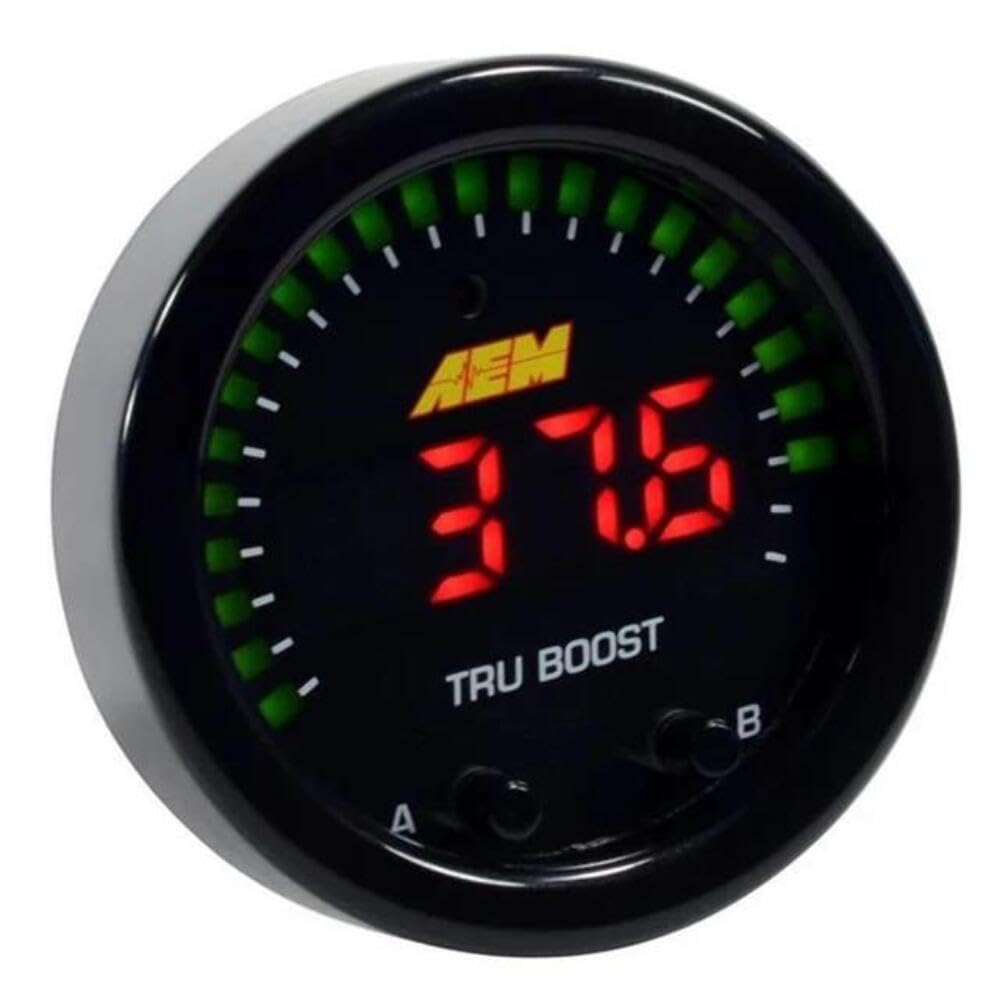
A separate solenoid kit (like the AEM 30-2400) is compact and usually cheaper, but it requires an external tuning interface or ECU (engine control unit — the car’s computer) to adjust. A gauge-integrated controller (like the AEM Tru-Boost or Innovate SCG-1) bundles the display, solenoid, and controls into one pod, so you can make on-the-fly adjustments without a laptop — useful for switching boost while driving.
Duty cycle and gain
Duty cycle is the percentage of time the solenoid stays open per engine cycle — a higher duty cycle means more boost, up to a point. Gain controls how aggressively the solenoid responds to changes. If your boost tapers at high RPM (the turbo loses pressure as revs climb), you likely need a controller with adjustable duty cycle mapping across RPM or gear position to keep boost flat.
Safety features matter
An overboost alarm or a programmable boost-cut safety can save your engine if the wastegate sticks or a hose pops. Units like the AEM Tru-Boost include two timed shutdown levels at 10% and 20% over the set boost — a meaningful safety net for a street-driven turbo car, because it cuts power before you bend a rod (a connecting rod that can break from too much pressure).
Quick Comparison
| Model | Best For | Boost Levels | Display Type | Max Pressure | Amazon |
|---|---|---|---|---|---|
| GReddy Profec★ Best Overall | Street/daily tuning | Multiple graph modes | OLED | — | Amazon |
| AEM 30-0352 Tru-Boost KitComplete Kit | Complete gauge + controller | 2 user-selectable + peak memory | 24 LED + programmable center LED | 29 psig onboard (75 psia optional) | Amazon |
| AEM 30-2400 Solenoid Kit | Minimalist / ECU-controlled setup | ECU-defined | None (solenoid only) | — | Amazon |
| AEM X-Series Tru-BoostX | Ultra-compact gauge mount | 2 + scramble boost | 24 green outer LED + larger center LED | 80 psig onboard MAP | Amazon |
| Turbosmart e-Boost Street | Affordable street performance | 2 groups + external switch | Turn-and-push button | 40 PSI | Amazon |
| Innovate SCG-1 | All-in-one safety + wideband | Programmable solenoid + gain | OLED user-configurable | 43.5 PSI (4 BAR MAP) | Amazon |
| Turbosmart e-Boost2 | Advanced gear-based mapping | 6 levels + gear-based | Auto-dimming | — | Amazon |
In‑Depth Reviews
1. GReddy (15500214) Profec Electronic Boost Controller
Our pick — over 4.5★ from 100+ verified ratings; the strongest balance of quality and price.
Buyers report this is the controller that holds boost where others fall off — and they back it with near-perfect scores.
The GReddy Profec is the pick most turbo owners land on after trying cheaper units, and the consensus backs it. Quality gets the most praise: the matte plastic body feels solid, and the OLED display (a type of screen with bright, sharp pixels) is clear enough to read in direct sun. Where this controller really earns its keep is in the graph-based display modes: you can watch boost in three different visual representations on the fly — like a line graph, a bar chart, or a digital number — which makes dialing in duty cycle far less guesswork than scrolling through menus.
The trade-off is the learning curve. The Profec demands a few pulls and some patience to understand how its settings interact. As owners put it: “it takes a little bit of knowing to figure it out.” Some call it “comparable, if not better, than the Turbosmart Eboost 2 controller,” specifically praising the build quality and the redundant sensor safety (a backup sensor that catches a failure). It is the complete package for someone who wants a controller that grows with their tuning skill.
Why owners stick with it
- OLED screen with three boost graph views — see your curve in real time
- Solid build and genuine GReddy parts at a better price than specialty auto sites
- Reliable hold — once tuned, it stays where you set it pull after pull
The one honest caveat
- Initial tuning takes time — not a plug-and-play unit for beginners
Best for: The enthusiast who values precise control and a clear display and is willing to spend a couple hours dialing it in.
Think twice if: You need a set-and-forget solenoid that works with your ECU — the Profec is a standalone controller, not a pass-through unit.
2. AEM 30-0352 Tru-Boost Controller Gauge Kit
One pod does it all — gauge, controller, and safety system in a single 2-1/16th-inch package.
This is the most complete single-package solution on the list. The kit includes the boost solenoid, harness, pressure sensor, gauge display, and all fittings — nothing else to buy. It measures up to 30 lbs of boost with the onboard 29 psig sensor (a sensor that reads pressure relative to atmosphere, so 29 pounds per square inch gauge), and it supports an external 75 psia sensor for high-boost builds (a sensor that reads absolute pressure, useful for race setups). The 24 scalable outer LEDs give you a quick glance at where you sit, while the two user-selectable boost settings let you switch between a conservative street tune and a higher target at the push of a button.
The standout feature is the overboost alarm with two shutdown levels at 10% and 20% over your set limit. If your wastegate hangs or a coupler blows, the controller cuts power before you bend a rod. Owners highlight its accuracy and the fact that all controls and settings are entered through just two buttons — tricky at first, but intuitive once set. It holds a 4.6 rating across 100+ reviews on Amazon, with quality and boost control getting the most frequent praise.
What makes it a complete system
- Everything in one box — gauge, solenoid, harness, hose, and fittings included
- Two boost levels switchable while driving plus peak boost memory
- Overboost alarm with dual timed shutdown levels protects your engine
Understanding the interface
- Two-button programming requires several tries to dial in boost precisely
- Gauge pod is 5.5 x 5.25 x 5.25 inches — measure your mounting space first
Reach for this if: You want a single gauge-pod solution with real safety features and do not mind learning a two-button menu.
Look elsewhere if: You already have a boost gauge and only need a standalone solenoid — the AEM 30-2400 kit is a fraction of the size.
3. AEM 30-2400 Boost Control Solenoid Kit

A tiny plastic box, no frills, and one job — pass ECU duty-cycle commands to your wastegate.
This is the solenoid-only solution if your ECU (engine control unit — the car’s computer) already handles boost control strategy. At just 1.57 x 1.18 x 1.18 inches and 5.28 ounces, it hides almost anywhere in the engine bay. Do not confuse it with the full Tru-Boost kit — this is a single solenoid (an electrically controlled valve) that connects to your existing ECU or standalone controller. Owners mention it working flawlessly for over 10,000 miles at 22 psi on a TO4E 50-trim turbo (a specific model of turbocharger). The computer does the thinking; you just install it with quality hoses and forget it.
The catch is that it ships with zero mounting hardware. Customers note it works exactly as intended, but you will need to source your own screws or a bracket to remote-mount it. A few call it overpriced, noting it is essentially a MAC valve (a type of industrial solenoid) with an AEM sticker. If you need a separate boost controller with a display and on-the-fly changes, this is not the right part — but for an ECU-tuned build where you just want a reliable solenoid, it gets the job done.
Best for: Tuners running a standalone ECU that already has boost control logic — this is the plumbing.
Not for you if: You need an integrated gauge and controller; buy the AEM 30-0352 kit instead.
4. AEM 30-0352 X-Series Tru-BoostX Gauge

The slimmest gauge AEM has ever made — 0.825 inches of depth for tight pods and unusual mounts.
If gauge pod depth is your limiting factor, this is the controller built for you. The X-Series measures just 0.825 inches overall depth with a 0.200-inch cup depth (the recess where the gauge sits inside the pod), meaning it fits in pods where standard 52mm gauges bottom out. The center programmable LED is 87% larger than the original AEM gauges — easier to read at a glance — and the 24 green outer LEDs provide quick visual feedback. It packs an onboard 80 PSIg MAP sensor (a sensor that reads manifold absolute pressure, accurate up to 80 pounds per square inch gauge), so there is no separate upgrade needed even for high-boost applications. Two boost level settings plus a scramble boost setting give you on-demand power without digging into menus, letting you jump to a higher boost target instantly for passing or highway merging.
The honest reality is that the reliability data is thin and concerning. A small number of reviewers point out the gauge dying after 14 months — just past the 12-month warranty — and AEM customer support refusing repair. The same feature set in the AEM 30-0352 gauge kit (the Tru-Boost) has a far larger sample of long-term positive reviews. For a daily-driven turbo car, this one carries an unproven longevity risk that the standard Tru-Boost does not.
Reach for this if: You need the thinnest possible gauge depth for a tight mounting location and are comfortable with a shorter track record.
Think twice if: You want a proven long-term daily driver — the standard AEM Tru-Boost gauge kit has years more positive owner history.
5. Turbosmart TS-0302-1002 e-Boost 40 PSI STREET Boost Controller

The affordable street controller that solved a specific high-RPM boost-drop problem for owners.
The e-Boost Street is aimed squarely at the street performance market, and its real-world application shows exactly why. One owner running a custom turbo RX8 (a Mazda with a rotary engine) was losing boost above 5,500 RPM — the e-Boost Street held flat all the way to 9,000 rpm after installation. The unit supplies two boost groups selectable via the turn-and-push button, and it supports an external switch for changing between groups. It ships with the solenoid, mounting bracket, vacuum fittings, hose, and clamps — everything you need besides the wiring run.
Installation feedback is mixed. Some find it very easy, while others report a moderately complicated setup, mostly related to routing the wiring and vacuum lines through the firewall. The scramble button feature is a genuine plus: it lets you switch from a low street boost to a higher setting mid-pull. The price is notably lower than competitors, and the controller comes with a generous array of adapters to fit different vehicles. It is a strong budget entry that prioritizes function over display flashiness.
What owners love
- Holds boost at high RPM — multiple shoppers say fixing taper past 5,500 rpm
- Scramble button gives instant low-to-high boost switching mid-drive
- Supplied with mounting bracket, vacuum fittings, hose, and clamps
The installation reality
- Setup can be complicated — routing wiring and vacuum lines through a firewall takes time
Best for: Street turbo builds experiencing high-RPM boost drop — this controller has a proven track record fixing it.
Not ideal for: Anyone wanting a display gauge in the cabin; this is a controller-only package with no integrated display.
6. Innovate Motorsports SCG-1 Boost Control KIT
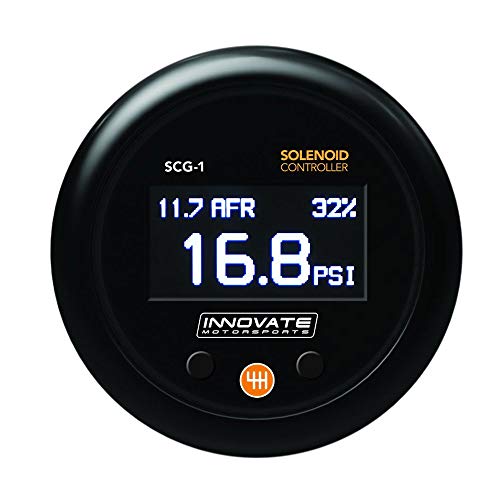
A boost controller, wideband AFR gauge (air-fuel ratio, which tells you if the engine is running too rich or too lean), and shift light in one 52mm pod — the definition of consolidation.
The SCG-1 packs a lot of hardware into a small space. It includes a 4 BAR MAP sensor covering -29 inHg (inches of mercury, a measure of vacuum) to 43.5 PSI, a user-configurable OLED display, a programmable shift light, and a boost controller all running from one gauge. It also has a user-programmable boost cut safety that references both air/fuel ratio and pressure — meaning if your wideband reads lean under boost, the controller can cut power before damage happens. The solenoid ramping provides a smooth boost curve that owners compare to units like the Blitz DSBC ID3 (another boost controller brand).
The catch is the mixed reliability record on the wideband controller portion. While the boost control and solenoid receive strong praise — one owner achieved a consistent 15 PSI on a 7 PSI spring (a low spring rate for the wastegate, meaning the controller did all the work) — the AFR reading side has occasional drift issues. A few buyers report erratic wideband readings after 8 months, and Innovate’s tech support receives criticism. If you want a combined gauge for simplicity, the SCG-1 is compelling; if you already have a separate wideband, a dedicated boost controller with fewer integrated functions may be a safer long-term bet.
Why the all-in-one approach wins
- Combines boost controller, wideband AFR, boost gauge, and shift light in one 52mm gauge
- Programmable boost cut safety uses both AFR and pressure references
- OLED display is user-configurable without a PC
The honest trade-off
- Wideband AFR sensor reliability has mixed feedback over longer ownership periods
Reach for this if: You want to clean up your gauge pod by combining boost control, wideband, and shift light into one unit.
Look elsewhere if: You already have a separate wideband gauge and want the most proven long-term reliability in boost control alone.
7. Turbosmart TS-0301-1003 e-Boost2 Black/Black 60 mm Sport Compact Boost Management System
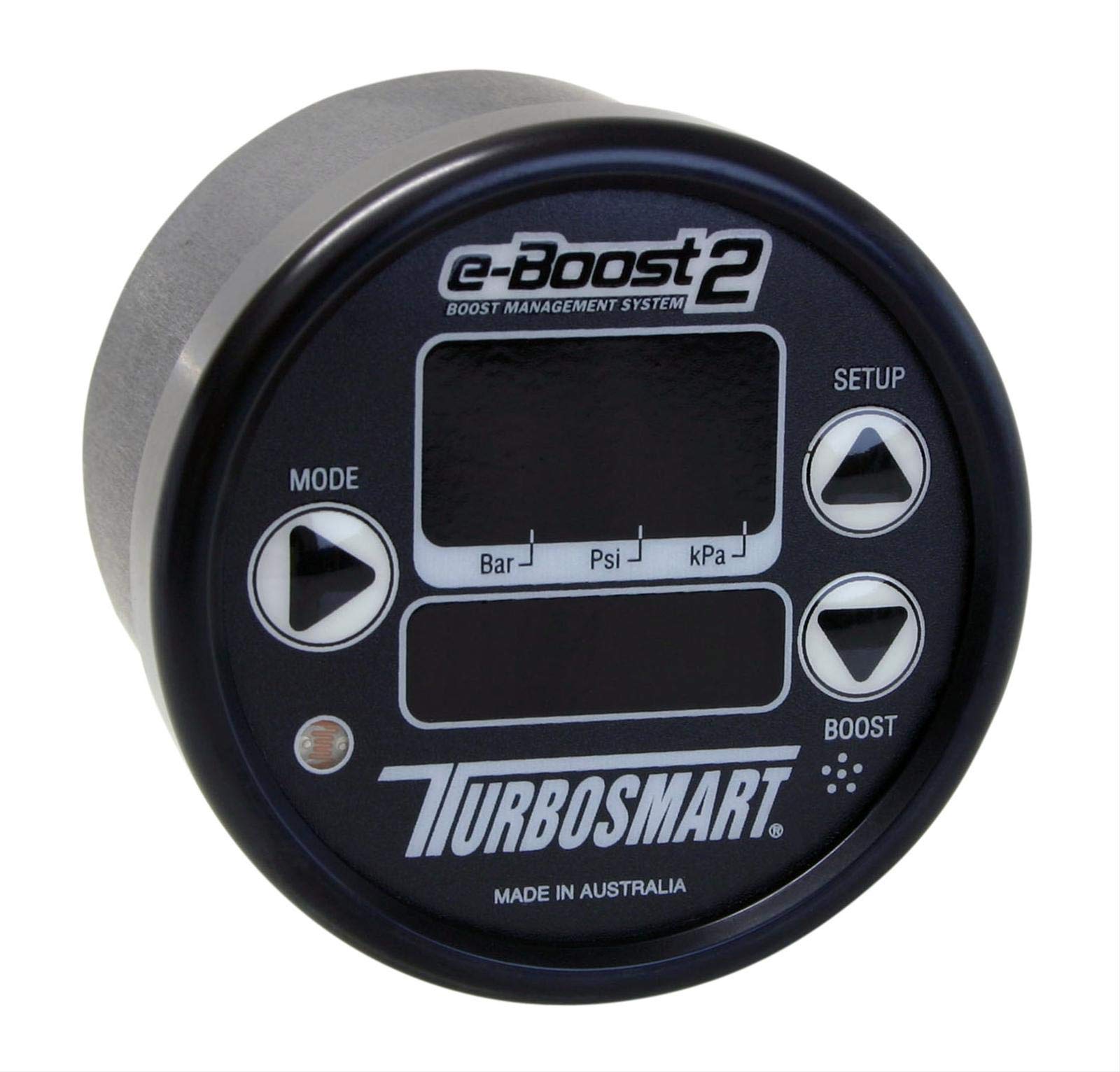
The most advanced feature set in the list — six boost levels, gear-based mapping (setting different boost targets for different gears, so you can run lower boost in first gear for traction), and a fully programmable auxiliary output.
The e-Boost2 is built for the tuner who wants the maximum possible adjustability. It offers up to six levels of boost that can be mapped against time or engine RPM, and it supports gear-based mapping — meaning you can run more boost in third gear than you do in first, for example. The auxiliary output is fully programmable, enabling features like methanol injection triggering at a specific boost threshold. The auto-dimming display works well across all lighting conditions, and the 60mm diameter housing gives a large, readable face.
The trade-offs are real. The 60mm size does not fit standard 52mm gauge pods — several owners had to trim their pod or drill a panel. More critically, there are reports of defective units that trigger an over-boost safety (OBS) warning at idle due to a faulty internal boost sensor, and the seller’s warranty window is tight. The feature set is genuinely advanced for the money, but the quality-control variance means you should verify the unit works immediately upon receiving it. It is a high-risk, high-reward pick compared to the more consistent GReddy Profec or AEM Tru-Boost kit.
What you get with the extra adjustability
- Six programmable boost levels with gear-based mapping
- Fully programmable auxiliary output for methanol or other accessories
- Auto-dimming display readable in all light
Watch for these issues
- 60mm housing does not fit standard 52mm gauge pods without modification
- Inconsistent quality control — some units arrive with defective internal sensors
Best for: The advanced tuner who needs gear-specific boost mapping and auxiliary outputs — and can test the unit immediately on arrival.
skip it if: You want a standard 52mm pod fit or need guaranteed reliability from the start; the GReddy Profec or AEM Tru-Boost kit offer better consistency.
Understanding the Specs
Duty Cycle and Gain
Duty cycle is the percentage of time the boost control solenoid stays open during each engine cycle. A higher duty cycle generally sends more pressure signal to the wastegate actuator, raising boost. Gain controls how aggressively the solenoid responds to changes in boost — think of it as sensitivity. If your boost overshoots then dips, lowering gain often fixes it. Tuning these two parameters is the core of getting any electronic boost controller to hold a flat curve, so you maintain steady power all the way to redline.
MAP Sensor Range
The Manifold Absolute Pressure (MAP) sensor inside the controller determines the maximum boost it can read and control. Units like the Innovate SCG-1 use a 4 BAR MAP sensor that reads up to 43.5 PSI, which covers moderate street builds. The AEM X-Series Tru-BoostX has an 80 PSIg sensor, meaning it handles high-boost race applications without a separate sensor upgrade. Always match the MAP range to your target boost level plus a 20-30% safety margin so the controller never runs out of ability to measure pressure.
Scramble Boost and Dual Settings
A scramble boost feature lets you jump from a lower street-friendly boost setting to a higher target instantly, usually triggered by a momentary switch or button press — useful for passing or highway merging. Dual boost settings allow you to store two different boost targets (low and high) and toggle between them while driving. Some controllers, like the Turbosmart e-Boost2, take this further with up to six gear-based levels, letting you fine-tune boost for traction in each gear.
Overboost Protection
An overboost safety (OBS) is a programmable threshold where the controller cuts boost or triggers an alarm if boost exceeds your set limit by a certain percentage. The AEM Tru-Boost kit offers two timed shutdown levels at 10% and 20% over the target. This is a critical safety net — if a wastegate hose pops or the solenoid sticks, the controller can save your engine from a pressure spike before you even notice it, preventing a bent connecting rod or blown head gasket.
FAQ
Will an electronic boost controller work with my factory ECU?
Can I install an electronic boost controller myself?
What is the difference between a manual and an electronic boost controller?
How do I know which boost controller fits my car?
What does the scramble boost button do?
Can a boost controller fix boost drop at high RPM?
How long do electronic boost controllers last?
Do I need a boost controller if I have a supercharger?
Is the AEM Tru-Boost gauge kit the same as the X-Series Tru-BoostX?
Final Thoughts: The Verdict
For most owners, the best electronic boost controller is the GReddy Profec because it combines a high-quality OLED display, proven reliability, and enough tuning depth to grow with your build — all at a price that beats the specialty auto part websites. If you want a complete gauge-pod solution with integrated overboost safety, grab the AEM Tru-Boost Kit. And for someone on a tighter budget who just needs a solenoid for an ECU-tuned setup, the AEM 30-2400 is the one to reach for.
How We Picked
We do not accept paid placement. Every pick is matched to a real buyer and a real use-case; we do not hands-on test units.
Sources & Methodology
Specifications: manufacturer listings and product documentation. Review insights: verified customer reviews, as of July 2026. Pricing: not shown on this page (it changes often); check the current price via the retailer link.
As an Amazon Associate, WellFizz earns from qualifying purchases. This does not affect which products we feature.
Related Guides

Mo Maruf
I created WellFizz to bridge the gap between vague wellness advice and actionable solutions. My mission is simple: to decode the research and give you practical tools you can actually use.
Beyond the data, I am a passionate traveler. I believe that stepping away from the screen to explore new environments is essential for mental clarity and physical vitality.