Our readers keep the lights on and my smoothie glass nicely filled. As an Amazon Associate, I earn from qualifying purchases.
Specs are compiled from manufacturer listings and verified buyer reviews and can change over time — please confirm the key details on the product page before buying.
If you have ever pulled apart a corroded battery terminal or watched a wire connection spark and overheat, you already know the pain of a bad electrical joint. The right electrically conductive grease prevents corrosion while keeping current flowing freely through the connection. This guide ranks the best electrically conductive grease by volume resistivity, temperature range, and value.
I’m Mohammad Maruf — the founder and writer behind WellFizz. This guide is built by comparing the manufacturers’ published specifications and the patterns across verified customer reviews, so you get each pick’s real strengths and trade-offs instead of marketing spin.
Whether you are fixing a car’s ground strap, sealing aluminum wiring in a junction box, or stopping a flickering flashlight, the right compound here is the best electrically conductive grease for your specific job and budget.
Our Picks at a Glance

How To Choose The Best Electrically Conductive Grease
Not all greases on a terminal are electrically conductive. Many are dielectric — they insulate the joint intentionally. For a connection to pass current, you need a compound that contains conductive particles (zinc, copper, or carbon) suspended in a non-conductive carrier.
Conductivity vs. Protection: The Volume Resistivity Number
Volume resistivity, measured in ohm-centimeters (Ω·cm), tells you exactly how well a grease passes current. A lower number means better conductivity. Products like the MG Chemicals 846-80G list a resistivity of 117 Ω·cm, while the Lubree carbon paste lists 20 Ω·cm — meaning the Lubree is theoretically more conductive. For low-voltage sensor contacts, a low resistivity is critical. For high-voltage lugs, the connection itself carries the load and the grease is there mainly to stop corrosion.
The Metal Match: Zinc, Copper, or Carbon
The conductive filler defines the grease’s purpose. Zinc-based compounds (like Ideal Noalox or Gardner Bender OX-800) are the standard for aluminum wire termination — the zinc particles mechanically cut through the tough oxide layer that forms on aluminum, restoring a clean path for current. Copper-based greases (like Caig DeoxIT L260-DC1) also assist in breaking up corrosion and are favored for large disconnect switches and battery posts. Carbon-based pastes (like Lubree or MG Chemicals) are the best low-voltage, high-precision choice for circuit boards, switches, and sensor pins, but they stain everything black and are extremely messy.
Temperature Range: Where Will This Grease Live?
Look at the upper and lower temperature limits. A typical zinc-oxide compound like Ideal Noalox is rated from -40°C to 150°C, which handles attic heat and outdoor winter cold. A copper-loaded grease like DeoxIT L260-DC1 stretches to 260°C, making it a smart choice near engine heat or high-current breakers. If the grease will sit against a hot exhaust manifold or a transformer, check that the flash point or upper rating matches the environment.
Quick Comparison
| Model | Best For | Volume Resistivity | Temp Range | Container Size | Amazon |
|---|---|---|---|---|---|
| Ideal Noalox 30-030★ Best Overall | Aluminum wiring & lugs | Not specified | -40°C to 150°C | 8 fl oz | Amazon |
| Truck-Lite NYK-77Heavy Duty Pick | Heavy equipment & truck electrical | Not specified | Not specified | 2 oz tube | Amazon |
| Lubree 100 mLBest Value | Low-voltage contacts & sensors | 20 Ω·cm | Not specified (60-mo shelf life) | 100 mL | Amazon |
| NO-OX-ID A-Special | Battery terminals & marine use | Not specified | Not specified | 2 fl oz (two tubs) | Amazon |
| Caig DeoxIT L260-DC1 | Disconnect switches & relays | Not specified | -40°C to 260°C | 1 oz tube | Amazon |
| Caig DeoxIT L260-C1 | General electrical & corrosion protection | Not specified | Not specified | 1 oz tube | Amazon |
| Gardner Bender OX-800 | Large-quantity aluminum wiring jobs | Not specified | Not specified | 8 oz tube | Amazon |
| Burndy Penetrox P8A | Fleet maintenance & heavy-duty connections | Not specified | Not specified (store under 100°F) | 8 oz bottle | Amazon |
| MG Chemicals 846-80G | Automotive sensors & chassis grounds | 117 Ω·cm | -68°C to 200°C | 80g tube (2.58 fl oz) | Amazon |
In‑Depth Reviews
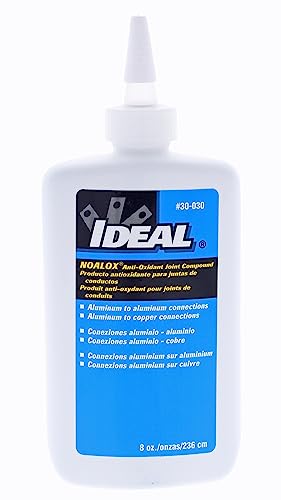
1. Ideal Electrical 30-030 Noalox Anti-Oxidant
Our pick — over 4.5★ from 350+ verified ratings; the strongest balance of quality and price.
The electrician’s standard for safe, cool aluminum-to-copper connections.
This is the crowd favorite for a reason — 4.9 stars across hundreds of owners who use it in commercial and industrial settings. The suspended zinc particles are the secret: they physically penetrate the tough oxide layer that forms on aluminum wire, cutting through the oxidation so the connection passes current instead of building heat. The carrier material then seals out air, preventing new corrosion from forming. Buyers report it is “essential for aluminum wiring; reduces oxidation at termination points, making junctions safer, more dependable, and longer lasting.”
You can coat dozens of terminations with the 8 fluid ounces this bottle holds, and the squeeze-bottle tip lets you lay a bead directly onto the wire or fill a wire nut. The 600V rating covers standard service panels, and the temperature range of -40°C to 150°C means it can sit in a hot attic or a freezing crawlspace without breaking down. This is a step up in size and proven performance from smaller tubes — the Liquid Volume is 8 fluid ounces, a full 4x the 2 fluid ounces of the NO-OX-ID A-Special tubs, giving you a serious advantage for large jobs.
Proven in the field: The top praise from owners is the quality and wiring protection — the thing everyone raves about is how it stops overheating and meltdown at aluminum terminations. A light coating on the bare wire before tightening the lug or wire nut is all it takes.
The honest trade-off: This is a dedicated anti-oxidant compound — it does not list a volume resistivity spec because it relies on mechanical particle contact within a bolted joint, so it is not ideal for bare sliding contacts or low-voltage sensor pins where a carbon-based paste would be better.
Reach for this if: you are terminating aluminum wire, connecting aluminum to copper, or doing any serious panel work where a cool, safe, long-lasting joint is non-negotiable.
Look elsewhere if: you need a grease to restore conductivity on a corroded circuit board pad, sensor pin, or sliding switch contact — a carbon-based paste is the right tool for that job.
2. Truck-Lite 97944 NYK-77 Compound
The 0.8-ounce tube that heavy equipment mechanics keep in their pocket.
This is a no-nonsense corrosion preventive compound aimed squarely at the heavy-duty crowd — truck electrical systems, junction boxes, switches, and anything that lives through a salty winter. Owners who work in heavy equipment maintenance say it “slows electrical connection corrosion when the DOT puts corrosion juice on the highways,” a real-world survival test for any exterior electrical part. You are paying for portability and purpose, not bulk volume.
What wins people over here is simplicity — it works exactly as expected on battery terminals, light connections, and trailer plugs. There are no exotic conductive additives listed, so its strength is in sealing out moisture and oxygen rather than relying on particle-to-particle conduction. For a heavy equipment mechanic who needs to smear something on a pin and walk away, that is exactly the right trade-off.
Toolbox essential: If you maintain farm machinery, a diesel truck, or any equipment that sleeps outside, this tube costs less than a fast-food meal and saves you from chasing intermittent electrical faults.
The honest trade-off: There is no published temperature or volume resistivity spec, and the 2-ounce tube goes fast if you are coating a whole junction bank. For large-scale aluminum wiring projects, step up to the 8-ounce Noalox.
Best for: the mechanic or fleet manager who needs a small, reliable tube of corrosion-fighting grease for heavy equipment, truck lights, and winter-exposed connections.
skip it if: you are doing high-volume residential or commercial aluminum terminations where the 8 oz bottles from Ideal or Burndy give you far more for the money.
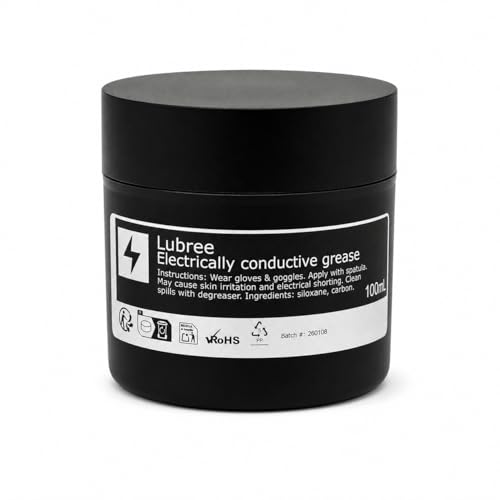
3. Lubree Electrically Conductive Grease 100 mL
The carbon-contact fix that revived a dead Roomba dock for pennies.
This thick, carbon-based paste is built for the low-voltage world — circuit board contacts, sensor pins, charging pogo pins, and corroded battery terminals in gadgets. The volume resistivity of 20 Ω·cm is the lowest published figure in this entire comparison, meaning this grease genuinely passes current rather than just blocking corrosion. Owners mention it “fixed Roomba i7 charging contact issues after years; solid connection now,” and used it on American Flyer model trains to restore conductivity for smooth running. The thick viscosity (above 50,000 cPs at 25°C) prevents it from running or dripping, so it stays exactly where you put it.
The honest trade-off is the mess. This is black, greasy, and stains fabric and carpet instantly. The feedback on effectiveness is mixed — some find it works great, others report it did not work for their specific application, which is typical for a carbon grease that depends on physical contact pressure. At 100 mL you get a generous bottle, but a very small dab is all any single repair needs.
Gadget-saver: The 100 mL bottle is plenty for a decade of small electronics repairs, and the 0% VOC content and 60-month shelf life mean it will not degrade in your drawer.
The honest trade-off: It stains everything it touches and the mixed effectiveness feedback means it is not a guaranteed fix for every corroded contact — especially if the mating surfaces do not apply enough pressure.
Reach for this if: you are fixing charging docks, battery contacts, model train tracks, or any low-voltage connection where the surfaces are pitted or corroded and the parts press together firmly.
Look elsewhere if: you need a clean, non-staining grease for visible connections inside a home panel — the carbon residue is not what you want on a bus bar.
4. NO-OX-ID A-Special Electrical Contact Grease

The two-tub kit that tackles corrosion from battery posts to light bulb bases.
This grease uses a calcium sulfonate and copper blend, so it is designed to enhance conductivity while preventing oxidation across a very broad range of uses — automotive batteries, marine terminals, CB antennas, and even light bulb sockets. The inclusion of two small application brushes in the tubs is a thoughtful touch for getting into tight spots without finger-smearing everything. Customers note it “prevents corrosion on flashlight battery ends, end cap threads, motor vehicle battery terminals (reveals bare metal), outdoor lighting wire nuts, and light bulb bases; aids future removal.”
The catch is that this is not a true “conductive” grease in the same way a carbon paste is. It reveals bare metal and enhances contact by blocking oxygen, but pure conductivity is not its advertised strength — some owners note it is “not electrically conductive like carbon greases; effectiveness over time uncertain.” That said, as a corrosion-blocker and future-removal aid, it is fantastic. You get 2 fluid ounces per tub (two tubs total), which is a good amount for the garage or boat toolbox.
Shop-favorite protection: The corrosion resistance and suitability for coating electrical connections get consistent praise. For battery terminals, it is tough to top the convenience of the tub-and-brush system.
The honest trade-off: If you truly need the grease itself to pass current (such as a sliding switch or a press-fit connector where the metal surfaces barely touch), a carbon-based paste will outperform this. Clean the terminal first — this grease does not remove existing oxidation.
Best for: the DIYer with a mix of battery terminals, outdoor light sockets, and boat electrical connections who wants one grease that does it all and comes with brushes. Great for a household kit.
Look elsewhere if: you need a high-conductivity carbon or zinc paste for a specific low-voltage repair where the connection depends on the grease carrying current.
5. CAIG DeoxIT L260-DC1 Lithium Grease

The copper-loaded lithium grease that handles engine-bay heat up to 260°C.
This is a premium technical grease from Caig Laboratories, a brand known among electronics repair professionals. The copper particles are there to assist in breaking up oxide and corrosion on large contacts while providing excellent lubrication, excellent wear resistance, and excellent oxidation protection. The operating temperature range of -40°C to 260°C is the widest in this lineup — it can sit right next to an engine manifold or a high-current relay without melting or evaporating. Owners have used it on power window motor regulators, VFO capacitor shafts for radio stability, and xenon arc lamp holder threads carrying 100-250A DC.
The squeeze tube is small — 1 fluid ounce — and it is on the expensive side per ounce. But the feedback is consistent: a light coating suffices, and the tube lasts a long time. The lithium base also means it stays put under high pressure without dripping, making it ideal for disconnect switches or large connectors where two contacts slide against each other.
High-heat specialist: The 260°C upper rating and copper-particle conductivity make this the right choice for any connection that lives near heat or carries very high current. It also cleans as it lubricates, reducing resistance and preventing premature part wear.
The honest trade-off: You pay a premium for the small 1-ounce tube. For general aluminum wiring or battery terminal protection, a larger tub of NO-OX-ID or zinc compound gives you more volume for less money.
Reach for this if: you need a conductive grease that survives extreme heat — exhaust manifold grounds, high-current breaker contacts, or inside a hot transformer cabinet. The copper particles also make it effective on heavily corroded switch gear.
pass on it if: your use is standard 120V/240V residential wiring in a cool panel — you will get more value from an 8-ounce bottle of Noalox or Penetrox.
6. CAIG DeoxIT L260-C1 Grease

The copper-loaded grease that fixed a DJ controller and a Roomba in the same week.
This is the sibling of the L260-DC1 without the lithium cleaner/deoxidizer additive, but it still packs copper particles for conductivity and excellent galvanic corrosion protection. The effectiveness earns the most praise from owners — it fixed a GFCI outlet that was tripping under a 10A load, restored charging to a Roomba, and even resolved a DJ controller’s jog wheel skipping issue by restoring capacitance touch. The corrosion protection rating is equally strong: owners use it on battery terminals, HVAC compressor connections, and house breakers with consistent results.
The 1-ounce tube is compact, and the feedback warns that dielectric greases (insulators) are not the same as this conductive product — an important distinction if you are reading labels at the hardware store. It is formulated for medical, mechanical, and electrical uses, giving it a broader certification than most of the picks here.
Versatile performer: The copper particles make it effective for cleaning and protecting a wide range of connections, from sensitive electronics to high-current breakers. Multiple owners confirm it is “perfect for improving electrical contact and reducing corrosion of electrical parts.”
The honest trade-off: Like the DC1 version, the 1-ounce tube is expensive per ounce compared to bulk zinc compounds. If you need to coat dozens of aluminum lugs, a larger bottle will serve you better.
Best for: the electronics hobbyist or technician who wants a high-quality copper grease for general electrical work, corrosion protection, and contact restoration — especially where current must pass through the grease layer itself.
Look elsewhere if: your primary job is terminating aluminum wire with wire nuts or split-bolts; the zinc-based compounds are purpose-built for that application and cost less per use.
7. Gardner Bender OX-800 Anti-Oxy Compound
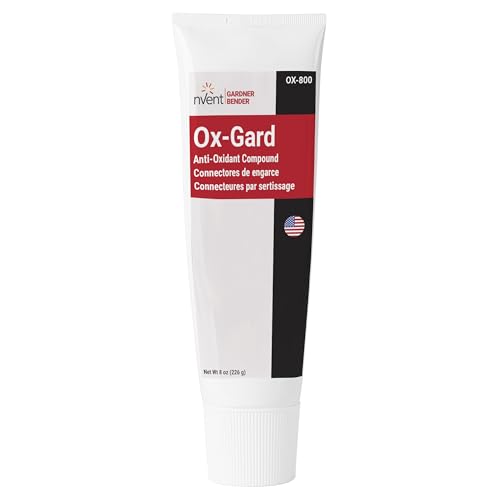
The 8-ounce tube that lasts a lifetime for the working electrician.
The Gardner Bender OX-800 is the budget-conscious electrician’s version of the Ideal Noalox. It uses zinc particles to cut through aluminum oxide and protect connections from corrosion, and it specifically mentions making connections more weatherproof and reducing temperature rise. The 8-ounce tube is huge — owners routinely report it “lasts several lifetimes” and that a 1-ounce amount is sufficient for a typical homeowner. The feedback emphasizes quality and effectiveness: it is praised for preventing light bulb seizing in sockets, eliminating erratic operation from corrosion, and working on torch lights and ignition control modules.
There is a notable caveat: the tube itself. Some reviewers point out the tip cracks at the base due to the cap design, causing the paste to leak from the side when squeezed. The paste works very well and lasts long, but the packaging could be sturdier — expect to store it upright or decant into a smaller container if the tip fails.
Huge value: 4.8 stars and strong praise across hundreds of owners. The effectiveness and quality are the top mentions, and the low sulfur content makes it suitable for sensitive equipment. It is the same category of product as the Noalox at a lower entry point.
The honest trade-off: The tube durability is mixed — some get a perfect tube, others find the cap design leads to cracking. Also, the paste can separate in storage; knead the tube before each use to re-mix the liquid and zinc particles.
Reach for this if: you need a large quantity of zinc-based anti-oxidant for a big wiring project or a fleet of vehicles and want to spend less per ounce than the brand-name competitors.
it’s not for you if: you need a grease for electronics or low-voltage sensor pins — stick with a carbon-based paste for those applications.
8. Burndy P8A Penetrox A Joint Compound

The petroleum-based classic that fleet maintenance has trusted for decades.
Burndy is a known name in heavy-duty electrical connectors, and the Penetrox P8A is its oxide-inhibiting joint compound. It is a non-water soluble petroleum-based polymer grease that prevents galvanic corrosion and enhances electrical connections by sealing out oxygen and moisture. It is UL listed to 600V and CSA certified, so it meets the standards for commercial and industrial installations. The 8-ounce squeeze bottle is easier to dispense than a tube, though the feedback notes that the grease is thick and can be hard to squeeze out, especially in cooler temperatures.
What makes this stand out is the adhesion rating — the #1 positive aspect owners mention is adhesion, specifically how well it stays on the connection and does not wash away. It goes on gray and stains fabrics, so it is strictly a workbench product. Owners use it on pickup truck ground connections, antennas, and general plant maintenance. The temperature storage spec (below 100°F) means you should not leave it in a hot car or direct summer sun.
Shop-grade protection: The 13.92-ounce item weight makes this the heaviest bottle in the lineup, and the petroleum base means it stays put in wet or high-vibration environments where water rinses other greases away.
The honest trade-off: It is messy and stains everything it touches. The squeeze bottle can be frustrating to use in cold weather when the grease thickens. It also lacks the zinc particles of the Noalox, so it relies purely on sealing rather than mechanically breaking through existing oxidation.
Best for: fleet maintenance, industrial ground connections, and antenna installations where the connection is bolted and the main enemy is moisture penetration — and where UL listing matters for inspection.
Look elsewhere if: you want a compound with zinc or copper particles to actively cut through oxide on aluminum wire — the Noalox or Gardner Bender OX-800 is a better fit for that specific job.
9. MG Chemicals 846-80G Carbon Conductive Grease
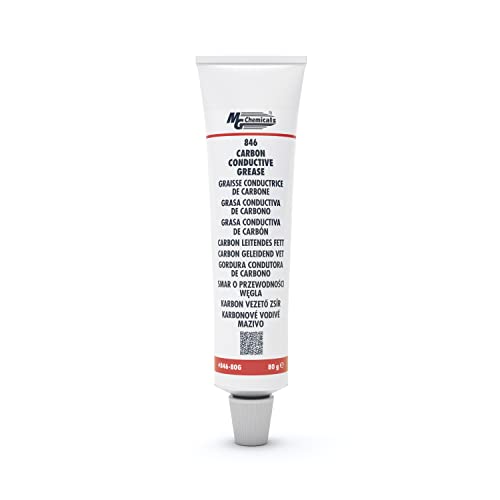
The carbon-paste reference standard for electronic connections and chassis grounds.
MG Chemicals is the most-reviewed conductive grease in this comparison, with over 450 ratings and a 4.5 average. This is a silicone-based, carbon-filled paste with a published volume resistivity of 117 Ω·cm, designed to improve electrical connections between irregular or pitted surfaces and ensure contact between loose or vibrating parts. It is specifically engineered to prevent arcing, pitting, hot spots, and welding on moving contacts. The service temperature range of -68°C to 200°C is the widest cold-end spec here — it stays workable in extreme Arctic-like conditions.
Shoppers say using it on automotive chassis grounds, solenoid contacts, Garmin heart-rate monitor contacts, and roller bearings carrying 60-70 VAC. The recurring advice is to apply a tiny drop with a toothpick and wipe the excess, because the carbon base is black and notoriously messy — messiness is the #3 most-mentioned aspect by a wide margin (23 mentions). The tube is huge at 80 grams and owners say it lasts a lifetime for personal use.
Electronic standard: The effectiveness and quality are the top praised aspects — 38 and 29 mentions respectively — and the low resistivity means it genuinely passes current. For sensor pins, ground connectors, and any low-voltage contact that needs both conductivity and lubrication, this is the gold standard.
The honest trade-off: It is the most expensive tube here and it is extremely messy. The carbon grease stains fabric and skin instantly. It is also not recommended for automotive electrical connectors where bridging pins could cause shorts — use dielectric grease for those.
Reach for this if: you are restoring sensor performance in a car, fixing intermittent electrical contacts, or building a custom ground setup where the grease must carry current and stay put across a huge temperature range.
Look elsewhere if: you need a clean, non-staining solution for visible connections under a hood or in a panel — the carbon residue will make everything black, and dielectric grease is safer for many automotive connectors.
Understanding the Specs
Volume Resistivity (Ω·cm)
This is the spec that tells you exactly how well the grease passes electric current. A lower number means the grease is more conductive. Carbon-based pastes (like Lubree at 20 Ω·cm or MG Chemicals at 117 Ω·cm) are designed for applications where the grease itself must carry the current — corroded sensor pins, sliding switch contacts, charging pads. Zinc and copper-based compounds often do not publish this number because their conductivity relies on the metal-to-metal contact in a bolted joint, not the grease itself. If you are coating a lug that gets torqued down, the spec matters less than the grease’s ability to block oxygen.
Temperature Range
The temperature rating tells you where the grease will survive and where it will melt, evaporate, or solidify. A standard zinc compound like Ideal Noalox is good from -40°C to 150°C — fine for any residential panel, attic, or underground conduit. A copper-loaded grease like DeoxIT L260-DC1 extends to 260°C, which is essential near an engine exhaust manifold, a high-current breaker, or a transformer. For extreme cold, the MG Chemicals 846-80G drops to -68°C. Pick a grease whose range brackets the actual environment where the connection lives — an attic in Arizona is different from a freezer room.
FAQ
Can I use electrically conductive grease on aluminum wiring?
What is the difference between conductive grease and dielectric grease?
Will electrically conductive grease cause a short circuit?
How much does an 8-ounce bottle of conductive grease cover?
Can I use conductive grease on battery terminals?
Is carbon conductive grease the same as anti-seize compound?
How long does electrically conductive grease last once applied?
Can I use zinc-based anti-oxidant compound on copper wire?
Why is the MG Chemicals 846-80G more expensive than other greases?
What voltage rating do I need for household electrical work?
Final Thoughts: The Verdict
If you want one dependable pick, the best electrically conductive grease winner is the Ideal Noalox 30-030 because it has the highest average rating in the category, a proven track record for aluminum wiring safety, and the 8-ounce bottle gives you real value for the money. If you need a carbon-based paste for sensitive electronics and sensor work, reach for the MG Chemicals 846-80G — it is the most-reviewed carbon grease here and has a published resistivity spec you can trust. And for a cheap, effective, small-quantity tube that lives in a toolbox for heavy equipment connections, the Truck-Lite NYK-77 is the one to grab.
How We Picked
We do not accept paid placement. Every pick is matched to a real buyer and a real use-case; we do not hands-on test units.
Sources & Methodology
Specifications: manufacturer listings and product documentation. Review insights: verified customer reviews, as of July 2026. Pricing: not shown on this page (it changes often); check the current price via the retailer link.
As an Amazon Associate, WellFizz earns from qualifying purchases. This does not affect which products we feature.
Related Guides

Mo Maruf
I created WellFizz to bridge the gap between vague wellness advice and actionable solutions. My mission is simple: to decode the research and give you practical tools you can actually use.
Beyond the data, I am a passionate traveler. I believe that stepping away from the screen to explore new environments is essential for mental clarity and physical vitality.