Our readers keep the lights on and my smoothie glass nicely filled. As an Amazon Associate, I earn from qualifying purchases.
Specs are compiled from manufacturer listings and verified buyer reviews and can change over time — please confirm the key details on the product page before buying.
Picking the right electrical wire for your house wiring means choosing between a few straightforward specs: wire gauge, number of conductors, and the length you actually need. But the real pain for most DIYers and homeowners isn’t the spec sheet — it’s the hassle of driving to a big-box store, waiting for someone to open up the cage, and paying a markup for the privilege. This guide cuts through that by focusing on the wire that arrives at your door, cuts cleanly, and meets the National Electrical Code (NFPA 70) for standard residential work, so you can get your outlets, switches, and lights live without the runaround.
This guide is built by comparing the manufacturers’ published specifications and the patterns across verified customer reviews, so you get each pick’s real strengths and trade-offs instead of marketing spin.
Running a new 20-amp circuit or wiring up a ceiling fan means matching gauge, conductor count, and length to your project with a brand you can trust.
Our Picks at a Glance

How To Choose The Best Electrical Wire For House Wiring
House wiring is all about matching the wire to the load and the environment. You need the right gauge for the circuit breaker, the right number of conductors for your switch or appliance, and a jacket that handles the space you are running it through.
Matching Gauge to Circuit Ampacity
The most important decision is the wire gauge (AWG number, which stands for American Wire Gauge, a standard for wire diameter). A 14-gauge wire is rated for 15-amp circuits — standard for most lighting and general outlet circuits. A 12-gauge wire handles 20-amp circuits, which is what you need for kitchens, workshops, and spaces with heavier loads. The data shows that a 12-gauge wire is a very common choice for 20-amp setups, with buyers noting it is the correct size for their plug outlets.
Counting Conductors: 2-Wire vs. 3-Wire
Standard 120-volt circuits use a 2-wire cable with ground (one black hot wire, one white neutral wire, plus a bare ground). You need a 3-wire cable with ground (adding a red hot wire) for applications like 3-way switches (where you control a light from two locations), split receptacles, or 240-volt appliances like dryers and water heaters. The number of wires in your cable must match the circuit’s needs.
Length and Installation Flexibility
Buying the exact length you need saves money and avoids excess coil taking up space. Shorter 25-foot rolls are perfect for a single circuit run or a small project, while 100-foot coils are better for wiring an entire room or running multiple branches. Consider the stiffness of the wire — solid copper wire is durable but less flexible than stranded wire, which can make pulling through tight corners or studs more challenging.
Quick Comparison
| Model | Best For | Gauge | Length | Conductors | Amazon |
|---|---|---|---|---|---|
| Arizona 12/2 NM-B 25ft★ Best Overall | Compact 20A Runs | 12 AWG | 25 ft | 2 + Ground | Amazon |
| Southwire 10/3 Romex 25ftHeavy-Duty Performer | Heavy 30A Appliance Circuits | 10 AWG | 25 ft | 3 + Ground | Amazon |
| Arizona 12/2 NM-B 50ftSmart Mid-Range Pick | Medium 20A Wiring Projects | 12 AWG | 50 ft | 2 + Ground | Amazon |
| Energeaster 12/2 NMB 100ft | Big 20A Home Runs | 12 AWG | 100 ft | 2 + Ground | Amazon |
| Arizona 12/2 NM-B 100ft | Value 20A Bulk Wire | 12 AWG | 100 ft | 2 + Ground | Amazon |
| Southwire 12/3 Romex 50ft | 3-Way Switches 20A | 12 AWG | 50 ft | 3 + Ground | Amazon |
| Energeaster 14/2 NMB 25ft | Budget 15A Lighting Runs | 14 AWG | 25 ft | 2 + Ground | Amazon |
| Southwire 14/3 Romex 100ft | Long 15A 3-Way Circuits | 14 AWG | 100 ft | 3 + Ground | Amazon |
| Arizona 14/2 NM-B 100ft | Economy 15A Lighting | 14 AWG | 100 ft | 2 + Ground | Amazon |
In‑Depth Reviews
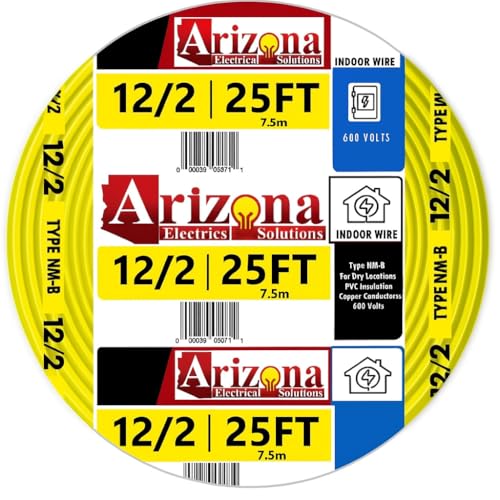
1. 25 FEET 12/2 Type NM-B. Copper #12 AWG, 2 Conductor with Ground Insulated Jacket Yellow
Our pick — over 4.5★ from 400+ verified ratings; the strongest balance of quality and price.
For a single 20-amp circuit run, this 25-foot spool delivers big-box quality to your door without the hassle, earning outstanding reviews.
This is the go-to for anyone who needs a precise 25-foot run for a new outlet or a small lighting circuit. The 12-gauge solid copper core handles 20-amp residential loads comfortably, and the quality is the thing people praise most — over two dozen owners call it out specifically. The consensus among buyers is that the quality matches what you get from the big box stores, but it shows up at your door without the hassle of finding someone to open up the cage. As owners put it: “25′ 12/2 NM-B: quality matches Lowe’s.”
The wire is ASTM B-3 and B-8 compliant and meets the National Electrical Code (NFPA 70), so you are not sacrificing safety for convenience. It also meets REACH/RoHS standards, meaning it is free from certain hazardous materials. The yellow PVC jacket makes it easy to identify as 12-gauge, and the 600-volt rating covers any standard residential branch circuit.
The only real limitation here is the short 25-foot length — it is perfect for a single, straightforward run but not enough for wiring a whole room. If you are running wire across a basement or through multiple stud bays, you will need a longer coil.
Perfect Circuit Size: 25 feet is the balance for a single 20-amp outlet or switch run without buying 100 feet of excess coil you will have to store.
Reach for this if: you have a single 20-amp circuit to run and want a door-delivered price that beats the local store.
Look elsewhere if: you need a longer continuous run for a large room or a workshop — grab the 50-ft or 100-ft version instead.
2. Southwire 63948421 25′ 10/3 with ground Romex brand SIMpull™ residential indoor electrical wire type NM-B; Orange
The 10-gauge workhorse built for 30-amp appliances like dryers and water heaters.
When you need to power a 240-volt, 30-amp appliance — think a heat pump water heater or a new dryer — this is the exact wire the crowd picks. It is a genuine Southwire Romex product with the patented SIMpull jacket, which makes the cable noticeably easier to pull through studs and corners without snagging. The 10-gauge, 3-conductor setup (black, red, white, plus ground) is the standard for 240V circuits that require a neutral wire, and buyers confirm it works flawlessly for that purpose.
The quality and value-for-money are the two most-praised aspects, with dozens of buyers calling it a better price than local hardware stores. One owner summed up the convenience perfectly: purchasing it on Amazon avoids the frustration of stores locking everything in a cage.
The trade-off is the premium required for 10-gauge wire — it is thicker, heavier, and costs more per foot than 12- or 14-gauge. The 25-foot length is also short, so make sure your appliance run fits before buying.
Appliance-Ready: 3 conductors with ground support 240V, 30-amp setups for water heaters, dryers, and EV chargers without needing a separate neutral.
Buy this for: a single 30-amp appliance circuit where you want the confidence of the Southwire brand and the SIMpull jacket.
Skip if: your project is standard 15-amp or 20-amp — you will pay for capacity you do not need.
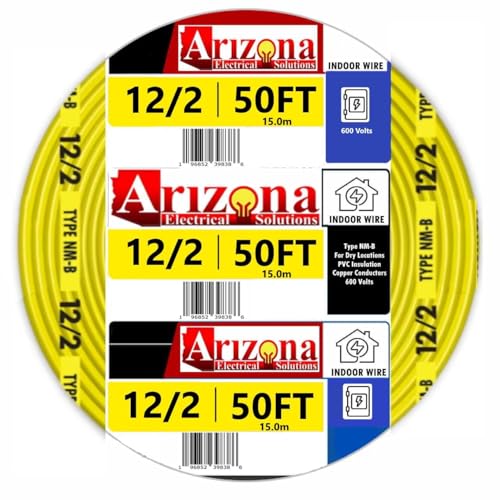
3. 50 FT 12/2 Type NM-B Copper Wire, #12 AWG, 2 Conductors with Ground, Insulated Jacket Yellow
The 50-foot balance of reach and cost that fits most mid-sized projects.
This 50-foot roll of 12/2 NM-B from Arizona Electrical Solutions splits the difference perfectly between a short 25-foot run and a bulky 100-foot coil. It uses 12-gauge solid copper with three strands per conductor, making it well-suited for 20-amp general-use circuits like outlets and switches in a single room or small shop. The quality is the most-discussed feature, and buyers consistently say it cuts easily, bends smoothly, and arrives unmarred — exactly what you want from wire that will be hidden in your walls for decades.
The temperature rating goes up to 90°C for the conductor, though the ampacity is restricted to 60°C per the National Electrical Code. That is standard for NM-B cable and means you simply match the wire to the correct 20-amp breaker. The wire meets ASTM B-3 and B-8, Federal Specification A-A-59544, and NFPA 70 — all the important boxes are checked.
One buyer called it “perfect for updating wiring in tiny home,” and another noted the price was half what they would pay elsewhere. The value-to-quality ratio here is strong.
Why owners buy it
- 50 feet is long enough for a bedroom or small workshop circuit
- Solid copper bends smoothly and strips cleanly
- Beats big-box pricing by a noticeable margin
A note on stiffness
- Solid 12 AWG is noticeably stiffer than smaller 14 AWG — plan for firm pulls through tight bends
Ideal for: the DIYer wiring a single room, a small home addition, or a workshop that needs a 20-amp branch circuit.
Not for: whole-house rewiring or projects needing 100+ feet of continuous run — step up to the 100-foot coil.
4. Energeaster Solid Indoor 12/2 W/G NMB Cable 100ft, Electrical Wire, Yellow
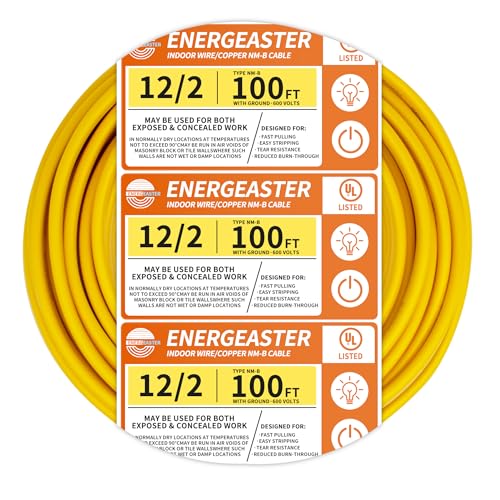
The 100-foot 12/2 that the largest group of owners praise for its quality.
This is the wire you grab when you are setting up the electrical for an entire room or an outdoor bar project. The 100-foot length gives you plenty of slack to run a 20-amp circuit across a basement or up to a second floor without splicing. The Energeaster cable uses solid 12-gauge copper with three strands per conductor, and the yellow jacket is 12-gauge standard — making it easy to pick out of your tool bag. Buyers specifically note the outer jacket feels more sturdy and cut-resistant than what they find at the local home improvement store.
Owners praise the quality and value for money most, with dozens calling it a solid, dependable 12-gauge NM-B cable that is perfect for home use. One electrical engineer gave it a 9 out of 10, citing true gauge, solid copper, and compliance with UL and NEC standards. The fire-retardant paper wrapping on the ground wire adds an extra layer of safety.
There is a catch: this wire is stiffer than some name-brand alternatives like Southwire. That is common for solid copper 12 AWG, but if you are pulling through a series of tight corners, be prepared for some wrestling. The jacket also does not have the patented SIMpull coating, so a straight pull is fine, but complex routing takes more effort.
What wins owners over
- 100 feet covers a full-room or multi-branch circuit without a joint
- UL-listed and NEC-compliant for indoor use
- Jacket feels tougher than standard retail NM-B
Where it demands more
- Noticeably stiffer than Southwire Romex — pulling through tight studs takes more muscle
- Indoor use only; not rated for damp or wet locations
Go with this for: a large circuit run where durability and value per foot are the top priorities.
Think twice if: you need maximum flexibility for a complex, multi-bend pull — the Southwire SIMpull line will be easier to handle.
5. Southwire Romex Brand Simpull™ Solid Indoor 12/3 W/G NMB Cable 50ft coil – SW 63947622

The trusted 12/3 Romex for 3-way switches and split receptacles from a brand everyone knows.
When you need a third conductor for your 20-amp circuit — for 3-way light switches, split receptacles, or a ceiling fan with separate fan and light controls — this Southwire cable is the clear pick. It is a 50-foot coil of 12/3 NM-B with ground, meaning you get black, red, and white insulated conductors plus a bare ground wire. The SIMpull jacket is the same patented coating that makes the cable easier to strip and pull through framing without tearing the jacket.
Buyers overwhelmingly praise the quality and value for money, with one noting it worked well for ceiling fans and another confirming it handled a 3-way switch setup in their kitchen without any issues. The coil weighs 5.4 pounds and is neatly packaged, though some owners mention the coil can be tricky to manage in tight spaces after unwrapping.
The 50-foot length is generous enough for most residential rooms. The 10/3 version is better suited for 30-amp circuits. This is strictly for 20-amp, 120/240V applications.
Three-Wire Ready: The extra red conductor lets you wire 3-way switches or split a receptacle’s top and bottom outlets — something 2-wire cable cannot do.
Pick this if: you are wiring a room with 3-way switches or need to run a separate switch leg for a ceiling fan.
Choose a 2-wire cable if: you only need standard single-pole switches and outlets — the extra conductor adds unnecessary cost.
6. 12/2 NM-B Electrical Wire with Ground, 100 ft Coil – 12 AWG Solid Copper, Yellow Non-Metallic Sheathed Cable for Indoor Residential Wiring
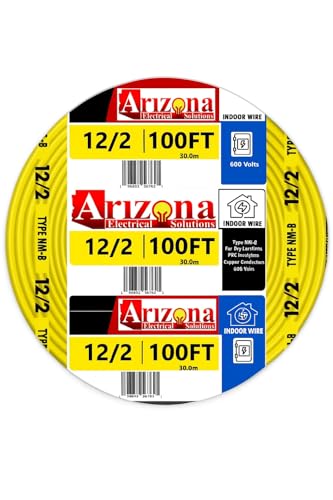
A 100-foot coil of 12/2 that gives you the length without the brand-name markup.
This is another excellent 100-foot option from Arizona Electrical Solutions, competing directly with the Energeaster above. It uses a single solid strand per conductor (rather than multiple strands), and the yellow jacket makes gauge identification instant. The wire is designed for the same dry indoor applications — outlets, switches, lighting — and is rated for 600 volts and 20 amps. Buyers report it works well for pancake lights and feels like good caliber wire, performing as well as the name-brand alternatives from the big box store.
What stands out here is the value-for-money aspect, which owners call out more than any other feature. The consensus is that it is slightly cheaper than the local home improvement store, and it arrives fast in compact packaging. The wire is also the correct gauge from the start — no surprises when you go to make your connections.
The trade-off, similar to other budget-friendly options, is the stiffness of the solid core. It is also a single-strand conductor, which some electricians find less flexible than stranded equivalents, though for residential NM-B this is standard.
Cost-Effective Coverage: At 100 feet for a 20-amp circuit, you can wire a large master bedroom or a home office without needing a junction box for a splice.
Best for: homeowners who want a full 100 feet of 12/2 for one project and want to save a few dollars over the big-box price.
Not for: those who prefer the proven SIMpull jacket of Southwire — the jacket here is standard PVC without the patented coating.
7. Southwire Romex Brand Simpull™ Solid Indoor 14/3 W/G NMB Cable 100ft coil – SW 63946828
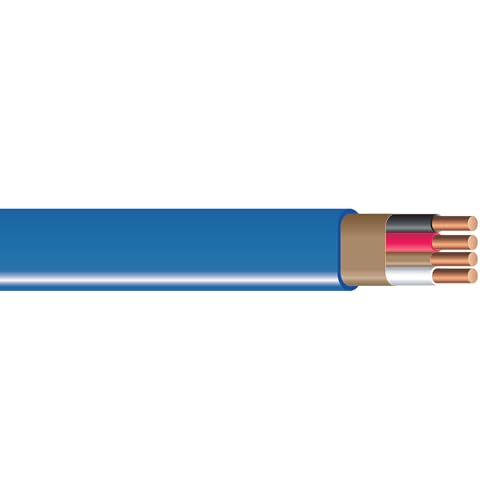
The 100-foot, 3-wire Southwire for running 3-way switches across a whole level.
If you need to wire a 3-way switch system over a longer distance — say, running control from one end of the basement to another — this 100-foot coil of 14/3 Romex is purpose-built for that job. The third conductor (red wire) lets you run traveler wires for multi-switch setups, and the 100-foot length means you can snake it through studs and joists without splicing. The Southwire SIMpull jacket is a real advantage here: it unspools smoothly and resists tangling during long pulls.
Buyers consistently highlight the value for money and quality, with one noting the price on Amazon was significantly lower than the local home improvement store. The wire delivers reliable power with no voltage drop over the 100-foot span, and the insulation quality gets specific praise. Owners also mention it strips easily and terminates cleanly into electrical boxes.
The coating on this 14/3 differs slightly from standard Romex — it is not rated for exterior or underground use. It also chafes more easily when pulled through sharp lumber holes if you are not careful. Use a pulling lubricant for long, tight runs.
Long-Distance 3-Way: 100 feet of 14/3 is the right call when you are controlling lights from two locations that are far apart, like a hall and a garage.
Reach for this: when you are running a 3-way or 4-way switch circuit over 50+ feet and want Southwire’s reliable performance.
Grab a 14/2 instead: if you only need a standard 2-wire switch loop — the third conductor would just sit unused.
8. Energeaster Solid Indoor 14/2 W/G NMB Cable 25ft, Electrical Wire, White
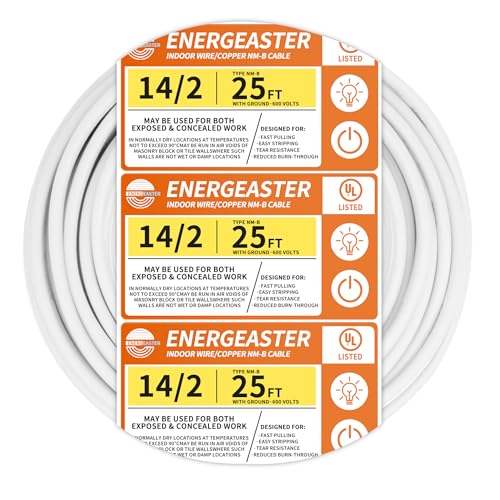
The 25-foot, 14-gauge entry point for budget-friendly 15-amp lighting circuits.
For standard 15-amp residential lighting and outlet circuits, 14/2 NM-B is the workhorse, and this 25-foot Energeaster coil is priced aggressively. The wire uses solid copper conductors with a white PVC jacket, and the ground wire is wrapped in fire-retardant paper — a nice safety touch for the price. The cable is UL listed and rated for 600 volts, so it meets code for indoor branch circuits.
Buyers praise the quality and value for money, with many saying it is as good as big-box store wire but at a better price. The wire is described as rigid, which some owners actually prefer because it makes running it up and down walls easier. Others found the outer jacket challenging to strip — use a sharp utility knife and score carefully. One owner noted the length felt a little short, so measure twice if you need a precise 25-foot run.
This is a straightforward, no-frills option for a small project. It arrived in a simple ziplock bag, so do not expect fancy retail packaging.
Where it shines
- Solid 14-gauge copper at a noticeable discount to the big names
- Rigid jacket that makes vertical runs in walls easier
- Fire-retardant paper on the ground conductor
Where it cuts corners
- Jacket can be tough to strip — patience and a sharp blade are required
- Packaging is plain (ziplock bag), no retail box
Grab this for: a quick, budget-friendly 15-amp circuit for a single light or outlet where you do not need the brand name.
Choose the Southwire 14/2 SIMpull instead if: the jacket-stripping frustration is a dealbreaker for you.
9. 100 Feet 14/2 Type NM-B Copper Electronic Wire, #14 AWG, 2 Conductors with Ground, Insulated Jacket, White
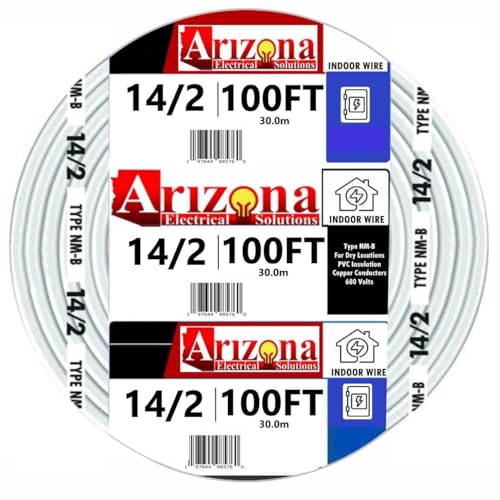
The 100-foot roll of 14/2 for anyone wiring a whole level of 15-amp circuits.
When you have multiple 15-amp switches and outlets to wire across a floor, this 100-foot Arizona Electrical Solutions coil gives you the bulk length at a cost that divides down nicely per foot. It is 14-gauge solid copper with a white jacket, rated for 600 volts and a 90°C conductor temperature. The wire is ASTM B-3 and B-8 compliant and meets the National Electrical Code, so it is fully code-ready for residential branch circuits in dry locations.
Value for money is the single most-praised aspect here, with owners noting the price is much better than the big-box store for essentially the same product. Buyers also report it is easy to pull through two stories and fish to outlets, which is impressive for a 100-foot length of solid-core wire. The packaging is compact, so it arrives without a huge box taking up space.
The only real consideration is that 14-gauge is limited to 15-amp circuits. If you are working on a kitchen or a workshop that needs 20-amp capacity, you need the 12-gauge version instead.
Bulk Value: 100 feet of 14/2 is the economical choice when you are wiring several 15-amp lights or outlets in one session, compared to buying multiple short rolls.
Buy this if: you are wiring an entire floor’s worth of 15-amp general-purpose lighting and outlets and want the best per-foot value.
Go with 12 AWG if: any of your circuits will serve a kitchen, a workshop, or a space heater — 14-gauge is not rated for 20-amp loads.
Understanding the Specs
Wire Gauge (AWG) and Ampacity
The gauge number tells you the thickness of the copper conductor. A smaller number means a thicker wire that can carry more current. For house wiring, 14 AWG is the minimum allowed for 15-amp circuits (standard lighting and outlets). 12 AWG is required for 20-amp circuits (kitchens, workshops, and spaces with higher electrical demand). 10 AWG is needed for 30-amp circuits (dryers, water heaters, EV chargers). Matching the gauge to the circuit breaker is critical — a 20-amp breaker needs 12 AWG wire; a 15-amp breaker uses 14 AWG. Using a thinner wire than the breaker allows is a fire hazard.
Conductors: 2-Wire vs. 3-Wire (with Ground)
The “2” or “3” in the cable name tells you how many insulated conductors are inside. A 2-wire cable (like 12/2) has a black hot wire and a white neutral wire, plus a bare ground wire. This is the standard for most single-pole switches and outlets. A 3-wire cable (like 12/3) adds a red hot wire, giving you a black, red, and white set. You need this for 3-way switches (lights controlled from two locations), split receptacles, and 240-volt appliances that need a neutral wire. Always count your conductors before buying — the wrong count means a return trip.
FAQ
What does NM-B stand for on electrical wire?
Can I use 14-gauge wire for a 20-amp circuit?
What is the difference between 12/2 and 12/3 NM-B wire?
Can NM-B wire be run outdoors or underground?
What does it mean when a spec says “600 volts, 90°C conductor, 60°C ampacity”?
Is it safe to use NM-B cable in an attic or wall cavity?
How do I strip NM-B cable properly?
What is the SIMpull jacket on Southwire Romex?
Final Thoughts: The Verdict
For the majority of shoppers, the electrical wire for house wiring winner is the 25 FT 12/2 NM-B because it delivers the most trusted 12-gauge size for 20-amp circuits at a price that beats the hassle of the hardware store, all with a 4.9-star consensus from hundreds of buyers. If you need a 30-amp circuit for an appliance, grab the Southwire 10/3 Romex. And for a long 15-amp 3-way switch run, the Southwire 14/3 Romex 100ft is the one to reach for.
How We Picked
We do not accept paid placement. Every pick is matched to a real buyer and a real use-case; we do not hands-on test units.
Sources & Methodology
Specifications: manufacturer listings and product documentation. Review insights: verified customer reviews, as of July 2026. Pricing: not shown on this page (it changes often); check the current price via the retailer link.
As an Amazon Associate, WellFizz earns from qualifying purchases. This does not affect which products we feature.
Related Guides

Mo Maruf
I created WellFizz to bridge the gap between vague wellness advice and actionable solutions. My mission is simple: to decode the research and give you practical tools you can actually use.
Beyond the data, I am a passionate traveler. I believe that stepping away from the screen to explore new environments is essential for mental clarity and physical vitality.