Our readers keep the lights on and my smoothie glass nicely filled. As an Amazon Associate, I earn from qualifying purchases.
Specs are compiled from manufacturer listings and verified buyer reviews and can change over time — please confirm the key details on the product page before buying.
Choosing an electrical panel is the kind of purchase you make once and hope you got right — because swapping it out later means rewiring and a lot of downtime. The real question is which panel fits your specific current load, circuit count, and mounting location. This guide cuts through the confusion by comparing nine purpose-built panels — from compact spa disconnects to whole-house 200-amp centers — so you match the right box to your project without overpaying or undersizing.
I’m Mohammad Maruf — the founder and writer behind WellFizz. This guide is built by comparing the manufacturers’ published specifications and the patterns across verified customer reviews, so you get each pick’s real strengths and trade-offs instead of marketing spin.
You need an electrical panel that safely handles your home’s power demand without tripping breakers or running out of space for new circuits. The right panel matches your amperage, circuit count, and environment (indoor or outdoor). Here is how to pick yours based on real specs.
Our Picks at a Glance


How To Choose The Best Electrical Panel
Buying an electrical panel is about matching three numbers: the maximum current your utility or sub-feed provides (measured in amps), the number of circuits you need to run, and the physical space where the box will live. Get those three right and the panel works perfectly for decades. Get one wrong and you risk a costly swap or an unsafe setup.
Amperage — the big number that defines everything
The amp rating of a panel tells you the maximum current it can safely handle. A 100-amp panel is fine for a typical garage, a small workshop, or a sub-panel feeding a detached building. A 125-amp or 200-amp panel is what a modern house needs — especially one with electric heat, an EV charger, or a tankless water heater. A panel with too low an amp rating prevents adding circuits later without upgrading the entire box.
Circuit spaces — your room to grow
Circuit spaces are the slots where breakers snap in. A 20-space panel gives you 20 places for full-size breakers, but you can double up using tandem breakers in many models to reach 40 circuits. For a simple renovation with a dozen circuits, an 8-space panel might be enough. For a whole-house setup, you want at least 20 to 30 spaces so you are not forced into crowded wiring or expensive sub-panels down the road.
Indoor vs outdoor — the enclosure matters
Panels are rated by their enclosure type. NEMA 1 is for indoor use only — it has no weather sealing. NEMA 3R is built for outdoor installation, with gaskets and a rain-tight design. If you are mounting the panel on the side of a house, near a hot tub, or beside an RV pedestal, you need a 3R-rated box. Putting an indoor box outdoors leads to corrosion, moisture, and eventual failure.
Quick Comparison
| Model | Best For | Max Current | Circuits | Enclosure | Amazon |
|---|---|---|---|---|---|
| Siemens W0816ML1125CU★ Best Overall | Compact outdoor sub-panel | 125 A | 16 | Outdoor | Amazon |
| PN Series PN2020L1125CTop Performer | Wire-first indoor sub-panel | 125 A | 20 | Indoor | Amazon |
| SN Series SN2040B1100Most Circuits | High circuit count, 100A main | 100 A | 40 | Indoor | Amazon |
| Square D HOM816M100PC | Garage or small shop sub-panel | 100 A | 16 | Indoor | Amazon |
| Square D HOM1224M100PC | Value-minded whole-house main | 100 A | 24 | Indoor | Amazon |
| Leviton LP210-BPD | Modern sub-panel with clean wiring | 100 A | 20 | Indoor | Amazon |
| Siemens W0408L1125SPA60 | Hot tub / spa disconnect | 125 A | 8 | Outdoor | Amazon |
| Leviton LP420-BPD | Large whole-house 200A main | 200 A | 42 | Indoor | Amazon |
| Midwest U075CTL010 | RV / EV outdoor pedestal | 50/30/20 A | 3 | Outdoor (NEMA 3R) | Amazon |
In‑Depth Reviews
1. Siemens W0816ML1125CU 125 Amp, 8 Space, 16 Circuit, Outdoor Load Center
Our pick — over 4.5★ from 500+ verified ratings; the strongest balance of quality and price.
The outdoor-focused 125-amp panel that buyers call a perfect fit for sheds and RVs.
If your project lives outside — a detached garage, an RV hookup, or a storage building — this Siemens panel is built for it. The 125-amp rating handles a substantial sub-feed, and the 16-circuit capacity is enough for lights, outlets, a welder, and a small HVAC unit without feeling cramped. The interior offers 5.3 inches of width inside the box, giving you decent bending space for the incoming 2 AWG or 1 AWG wires. Owners consistently praise the build quality here; nearly two dozen reviews single out the solid construction. The box uses heavy tack welds on the knockouts, which is a mark of a well-made enclosure that won’t rattle loose over time.
The catch is the size: at just 8 spaces and 16 circuits, this panel fills up fast if you plan to add many more branches later. One reviewer noted it is “perfect for RV power” while another flagged that the side knockouts are on the small side for some conduit fittings. That trade-off is real for a compact outdoor box. For a dedicated sub-panel feeding a specific zone — and not a whole-house solution — it is exactly what you need. The clean outdoor rating means it is sealed against rain, so you can mount it on an exterior wall and walk away.
Owners sum it up: “This electrical box is a great size; it fits a few breakers and keeps them dry.” The panel is lighter than the comparable Square D indoor model — 13 pounds vs 14 pounds — which matters when you are mounting it solo on a wall stud.
Why it wins
- 125-amp capacity handles heavy sub-feeds like welders or EV chargers
- Grey weatherproof enclosure for direct outdoor mounting
- Buyers praise the quality consistently across hundreds of reviews
Know before you buy
- Only 8 spaces limit future expansion
- Side knockouts are tight for some conduit sizes
Grab this for: an outdoor sub-panel where you need a solid 125-amp feed in a compact, weather-sealed box.
skip it if: you need more than 16 circuits — go with a larger interior panel like the SN Series or a Leviton 42-space instead.
2. PN Series 125 Amp 20-Space 20-Circuit Main Lug Plug-On Neutral Load Center
The indoor main-lug panel that makes adding a sub-panel feel like a plug-and-play project.
This Siemens PN series panel is a main lug design — meaning it has no main breaker built in — so it is intended as a sub-panel fed from a main disconnect elsewhere. The 125-amp maximum current matches the outdoor Siemens model above, but here you get 20 spaces and 20 circuits. The standout feature is the plug-on neutral system, which eliminates the need to pigtail neutral wires to a separate bar. You simply snap the AFCI or GFCI breaker onto the neutral bar directly. That saves time and reduces clutter inside the box. The interior also provides over 4 inches of wire bending space, which makes routing 6 AWG or thicker copper much less frustrating.
The main-lug design (no built-in main breaker) is a deliberate choice: if you are running a sub-panel for a tankless water heater, as one buyer did, the 125-amp feed gives you the headroom to power that high-draw appliance without worrying about nuisance trips. The same buyer noted they “learned how to do it from YouTube” and that it “works like it’s suppose to.” Two factory-installed ground bars come included, saving you a separate purchase. The box uses a copper bus, which offers slightly better conductivity than aluminum over decades of thermal cycling.
Because this is an indoor only (NEMA 1) enclosure, you cannot mount it on an exterior wall exposed to weather. Also, since it is a main lug panel, your main disconnect must be upstream — typically at the meter or a separate main breaker panel. For anyone wiring a basement workshop, an addition, or a second structure fed from the house, this is the right shape.
Why it stands out
- Plug-on neutral simplifies wiring and cleanly accommodates AFCI/GFCI breakers
- Copper bus is a step up in long-term reliability
- 125-amp capacity is a 25% increase over the 100-amp SN Series, matching the outdoor panel
One thing to know
- Indoor only — cannot be mounted in exposed outdoor locations
- Main lug design requires a separate upstream disconnect
Reach for this if: you need a 125-amp sub-panel with room for 20 circuits and want the cleaner wiring that plug-on neutral provides.
Look elsewhere if: you need a main breaker in the panel itself, or you are mounting the box outdoors.
3. SN Series 100 Amp 20-Space 40-Circuit Main Breaker Plug-On Neutral Load Center
The 100-amp workhorse that squeezes 40 circuits into a compact indoor footprint.
Here is where circuit density matters most: this Siemens SN panel gives you 20 full-size spaces but accepts tandem breakers to reach 40 circuits — that’s double the circuit count of the outdoor panel above. The 100-amp main breaker is built in, so it can serve as a main panel in a small home or a big sub-panel in a workshop with many branch circuits. The plug-on neutral design is carried over from the PN series, making it fast to land AFCI and GFCI breakers. The box itself measures 14.25 inches wide by 21 inches tall, and weighs about the same as the smaller Siemens outdoor panel despite holding far more circuits. Owners note it is “ideal for small jobs” and “works great for basement rewiring.”
The trade-off is the 100-amp current limit. That is enough for a typical 2,000-square-foot house or a well-equipped shop, but you cannot add a high-draw tankless water heater or a Level 2 EV charger alongside a full house load without risk of overloading the main breaker. The SN series also has an interrupt rating of 22,000 AIC (amperes interrupting capacity — the maximum fault current it can safely stop), compared to the PN series’ 100,000 AIC — meaning it handles less extreme fault current. That is fine for most residential settings but note if you are close to a utility transformer. One buyer summed it up: “using the panel as a sub panel. Just needed to get another bus bar for separate grounding as per NEC code.”
At 100 amps, this panel delivers a 2.5x circuit-count advantage over the 40-circuit SN vs the 16-circuit outdoor Siemens panel — more than enough room to grow into.
The big advantage: 40 circuits in a single 100-amp box means you can wire a whole basement or addition without needing a second sub-panel.
The honest limit: 100-amp main breaker means no space for heavy-draw appliances beyond lights and normal outlets — plan your loads carefully.
Best for: basements, finished attics, or workshops where you need many circuits but not a massive amp feed.
Not for: whole-house setups that already run an electric range, dryer, and AC — you want a 200-amp panel for that.
4. Square D HOM816M100PC Homeline 100 Amp 8-Space 16-Circuit Indoor Main Breaker Load Center

The compact 100-amp panel that garage renovators and workshop owners keep buying.
This Homeline panel is a classic for a reason: it is compact enough to fit between studs in a garage wall, but still offers 16 circuits (8 full-size spaces plus tandem compatibility — where two breakers share one slot) at a 100-amp rating. The main breaker is built in, so you can run it as a main panel if you feed it directly from the meter. The plug-on neutral system (a bar that accepts breakers without separate neutral wires) lets you snap Homeline combination arc fault breakers onto any space without extra pigtails. Buyers report it is a “sturdy little panel box” that has “more than enough circuits for any garage or small shop application.” One project was a full garage renovation, and the owner was “quite pleased” with the fit and finish.
The weight is 14 pounds — a pound heavier than the comparable Siemens outdoor panel above — which reflects the solid steel enclosure and the included combination flush/surface cover. The aluminum bus bar is tin-plated for corrosion resistance, and the ground and neutral bars each accept up to three 0-14 AWG equipment grounds. A state electrical inspector noted to one buyer that he “only uses Square D,” which speaks to the brand’s reputation for consistent build quality. The value for money is the second most-mentioned positive, and buyers consistently note that the panel “accepts all the latest Square D breakers.”
The limitation is similar to the small Siemens outdoor panel: 8 spaces for breakers means you need to use tandem breakers if you want more than 8 circuits, and some electricians prefer not to pack a small can that tightly.
The no-brainer use case: a garage sub-panel or small workshop where you need a 100-amp feed and 16 circuits in a compact, wall-friendly package.
The catch: eight spaces fill fast — if you think you will add more than a dozen circuits later, step up to a 12-space or 20-space model.
Reach for it when: you are finishing a garage or a small outbuilding and want a proven, code-compliant panel that electricians respect.
Pass on it if: you need 20+ circuits — the Homeline 12-space or 20-space versions fit the same brand breakers with more room.
5. Square D HOM1224M100PC Homeline 100 Amp 12-Space 24-Circuit Indoor Main Breaker Load Center
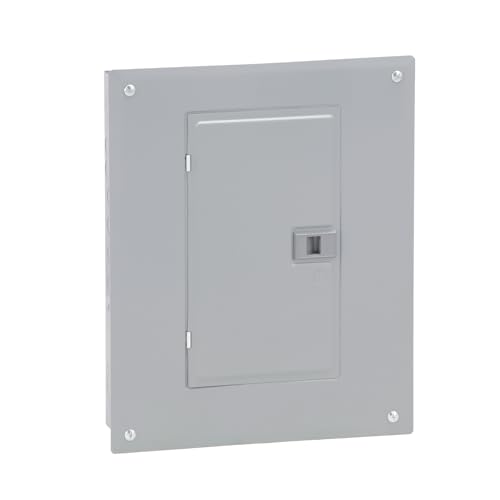
The 100-amp indoor panel that strikes the best balance between price, space, and quality.
Moving up from the 8-space panel, this Square D Homeline offers 12 spaces and 24 circuits — enough for a typical small-to-medium home or a well-equipped workshop. The 100-amp main breaker is built in, and the plug-on neutral design is compatible with Homeline combination arc fault breakers. The enclosure is constructed from welded sheet steel with a baked enamel gray coating, and the bus bar is tin-plated aluminum. Weight comes in at 18.3 pounds, which is noticeably heavier than the smaller Homeline model, reflecting the larger interior and the sturdy main breaker assembly.
Buyers highlight the quality and the value above everything else. One noted it is “high quality break” and another said the “Homelite brand breakers help cut costs” — meaning the Square D ecosystem is affordable to populate as you add circuits. The box dimensions (14.25 inches wide, 17.92 inches tall) allow it to fit between standard stud spacing. One owner did report the door latch needed 30 minutes of filing to close properly, which seems to be an occasional fitment issue rather than a pattern. For a panel that costs the same as many 8-space models but gives you 50% more spaces, the value proposition is strong.
The 100-amp limit holds the same caution as the SN series above: you cannot stack big loads. But for a house without electric heat or a tankless water heater, this is plenty.
the balance: 24 circuits give you room for lights, receptacles, appliances, and a few future additions without needing a sub-panel.
The warning: the door latch issue pops up in a minority of units — check the alignment during installation and adjust the strike plate if needed.
Best for: a modest home or a workshop that needs more than a dozen circuits but not a massive amp feed.
Not the right fit if: you plan on an EV charger, electric tankless water heater, or central AC — those need 125 to 200 amps.
6. Leviton LP210-BPD 20 Space, 20 Circuit Indoor Load Center with 100 Amp Main Breaker

The modern panel that lets you wire the entire box before snapping in a single breaker.
Leviton’s approach is genuinely different: you land every circuit wire onto the panel’s bus bars at rough-in, then snap the breakers onto the wires later. That means no juggling breakers while wiring, and no risk of dropping a live breaker onto a hot bus. The tin-plated copper bussing is standard — not an upcharge — and provides better conductivity than the aluminum bus found in many budget panels. The LP210-BPD is a 100-amp, 20-space, 20-circuit indoor panel with a clean white powder-coated finish that stands out from the universal grey. Buyers call it “superior to other residential panels” and note that it is “easy to install and get wired up.” The white finish looks much cleaner in a finished basement or utility room than the typical battleship grey.
The trade-off is that the door and cover are sold separately — the LP210-BPD includes only the enclosure and interior. That is uncommon among panels at this tier and adds to the total cost if you want a finished look. The breakers are also Leviton proprietary, so you cannot mix in cheap generic replacements. Owners mention that the panel is “pricier than grey” and that “screws strip easily with 6 AWG wire.” The weight of 25.8 pounds makes it one of the heavier 100-amp panels, reflecting the solid build and copper bus. It is the sort of panel you buy for a long-term home where you want clean wiring, expandability, and the ability to swap a breaker in seconds without tools.
The quality is praised by 7 reviewers, and installation is the second most-discussed positive with 6 mentions.
The clear win: wire-first installation and tin-plated copper bus for superior long-term conductivity.
The real cost: you need to budget for the separate door, and you are locked into Leviton’s proprietary breaker ecosystem.
Choose this if: you value a clean, future-friendly wiring layout and are willing to pay a little more for the Leviton ecosystem.
Stick with Square D or Siemens if: you want breakers available at every hardware store and a lower total cost with door included.
7. Siemens W0408L1125SPA60 125 Amp, 4-Space, 8-Circuit Main Lug Outdoor Spa Panel with 60 Amp GFCI Breaker

The dedicated spa disconnect that electrical contractors use because it just works.
This panel is built specifically for hot tubs, spas, and swimming pools — applications that need a GFCI-protected disconnect within sight of the water. The 60-amp, 2-pole GFCI breaker (model QF260) is included and pre-installed, saving you the cost and hassle of sourcing one separately. The box is a main lug design rated for 125 amps, and it includes two extra spaces for branch circuits — handy for a landscape lighting transformer or a sump pump outlet near the spa pad. The steel enclosure is rated for outdoor use and is described by owners as “the most spacious electrical box in the market” for its class. An electrical contractor who has installed roughly 60 of these panels reports zero callbacks, and that he replaces other brands with this Siemens unit when they fail.
The catch is that the plastic clips securing the GFCI breaker are fragile — a handful of units arrive with the 60A breaker’s tab broken loose. One buyer received a panel with the breaker bouncing around inside the box. That is a shipping packaging issue rather than a design flaw, but it matters if you cannot inspect the panel immediately upon delivery. The breaker itself is a known workhorse: the same QF260 that Siemens has been making for years, and you can find replacements at any electrical supply house. At 7.6 pounds, it is the lightest panel in this roundup, which reflects its compact 4-space interior.
The functionality is the top praised aspect, with 32 buyers calling it out, and the quality is second with 28 mentions. The durability score is the mixed note, tied to the plastic clip issue.
What is great
- 60-amp GFCI breaker included and pre-wired — ready for spa hookup
- Compact 4-space design leaves room for two extra branch circuits
- Proven reliability — electrical contractors favor it for long-term use
What to watch for
- Fragile plastic clips inside the box can break during shipping
- Only 4 spaces total — little room for expansion
Buy this for: any hot tub, spa, or above-ground pool that needs a code-compliant GFCI disconnect within sight.
pass on it if: you need more than 8 circuits for a general outdoor sub-panel — this is purpose-built for spa duty.
8. Leviton LP420-BPD 42 Space, 42 Circuit Indoor Load Center with 200 Amp Main Circuit Breaker

The 200-amp whole-house foundation for anyone who wants smart breakers and a clean white panel.
This is the biggest panel in the roundup — 42 spaces, 42 circuits, and a 200-amp main breaker that can handle a typical single-family home plus an EV charger, electric range, dryer, and central AC. Like the smaller Leviton panel above, it uses the revolutionary wire-first design: all circuit conductors land on the panel’s bus bars, and you snap the breakers on after rough-in. The tin-plated copper bussing is standard. The white powder-coated finish is a visual upgrade over grey, and the notches stamped into the enclosure for cable ties keep the wiring tidy. Owners call it “clean design” and praise the “smart breakers” that let you monitor and control individual circuits from your phone. As one buyer put it, The smart-breaker monitoring lets you track power usage and prevent peak-hour appliance use..
The biggest shock is that the door and cover are sold separately — and they cost roughly extra. That is frustrating for a panel that already sits in the premium price tier, especially since big-box stores sometimes include the door in their bundle. The breakers are Leviton proprietary, so you cannot save money by using Square D or Siemens breakers. But the sheer capacity — 42 spaces at 200 amps — means you could wire an entire house, a detached garage, and a shop off this single panel without needing sub-panels. The quality is the top praised aspect with 8 mentions, and the appearance is second with 6 — buyers clearly notice and appreciate the clean look.
If you are building a new home or doing a full service upgrade and want the latest in smart monitoring, this panel is the long-term play.
The top-tier advantage: 200 amps at 42 circuits with Leviton’s smart breaker ecosystem for whole-house energy monitoring.
The price of entry: door sold separately, proprietary breakers, and a higher upfront cost than traditional grey panels.
Ideal for: whole-house service upgrades, new construction, or anyone who wants smart circuit monitoring baked into the panel.
Not for: budget builds or quick sub-panel jobs — the Leviton ecosystem premium is only worth it for a main panel.
9. Midwest 50/30/20 amp U075CTL010 RV/EV Panel w/ 20 AMP GFCI

The all-in-one outdoor pedestal that serves RV, EV, and general 120V needs from one box.
This Midwest panel is less of a traditional load center and more of a pre-wired power pedestal. It gives you a 50-amp RV receptacle, a 30-amp RV receptacle, and a 20-amp GFCI-protected outlet — all in a single NEMA 3R weatherproof enclosure. The G90 galvanized steel construction and polyester powder coat finish are designed to survive years of sun and rain without rusting. Because everything is factory wired, your installation is down to connecting two power wires, a neutral, and a ground. One buyer called it “easy to install and great value” and is using it as an outdoor power supply for a welder. Another RV owner says it “works as expected” for a 50-amp RV and that all the plugs work properly.
The downside is the lack of flexibility: you get exactly these three circuits, with no extra spaces for adding more breakers. The breakers are GE brand and available at any hardware store, but if your needs change — say you want a 60-amp EV circuit alongside the RV plug — you are buying a different panel. The packaging is basic; a few units arrive with the breakers loosened from shipping because there is no foam between the cover and the breakers. It is an easy fix — just tighten the screws — but worth checking on delivery. The build quality is the most-praised aspect, with 18 buyers mentioning it, and the functionality is well regarded.
For anyone with an RV pad who also wants a standard 120V outlet for maintenance tools, this panel delivers in a compact, all-weather package.
The one-box solution: 50A, 30A, and 20A GFCI in one outdoor box — no separate sub-panel or outlet needed.
The limitation: no open spaces for future breakers — this is a fixed-configuration pedestal, not a general-purpose panel.
Buy this for: an RV pad, a boat dock, or a construction site where you need a GFCI-protected outdoor power center.
Pass on it if: you need to wire multiple different loads — a standard 8-space outdoor panel with individual breakers gives you more room.
Understanding the Specs
Amperage and Interrupt Rating (AIC)
Amperage (A or amps) tells you the maximum current the panel can handle continuously — 100A is standard for residential sub-panels, 125A for larger feeds, and 200A for whole-house main panels. The interrupt rating (AIC — Amps Interrupting Capacity) tells you how large a fault the panel can survive without welding shut. Residential panels typically have 22,000 AIC, while premium models with higher fault capacity (100,000 AIC) are needed near utility transformers where fault current is higher.
Circuit Count and Plug-On Neutral
Circuit count is the number of breaker slots — more circuits mean you can feed more rooms and appliances without daisy-chaining or adding a sub-panel. Plug-on neutral (PoN) is a modern design where AFCIs and GFCIs snap directly onto a neutral bar instead of needing a separate pigtail wire. This saves time and reduces wiring clutter inside the box. If your local code requires AFCI on bedroom circuits, a PoN panel makes compliance much easier.
FAQ
Can I install an indoor electrical panel outdoors?
What is the difference between a main breaker panel and a main lug panel?
How many circuits do I need for a typical home?
Should I buy a 100-amp or 200-amp panel for my house?
What does “plug-on neutral” mean and why does it matter?
Can I mix Square D and Siemens breakers in the same panel?
What does the NEMA rating on an electrical panel mean?
How long does a residential electrical panel last?
Final Thoughts: The Verdict
The electrical panel that works for most people is the Siemens W0816ML1125CU because it brings a 125-amp rating and a weatherproof outdoor enclosure at a price that beats comparable panels, and buyers consistently praise its build quality. If you need a 125-amp sub-panel with clean plug-on neutral wiring and a copper bus, grab the PN Series PN2020L1125C. And for a whole-house 200-amp upgrade with smart breaker capability, the Leviton LP420-BPD is the one to reach for.
How We Picked
We do not accept paid placement. Every pick is matched to a real buyer and a real use-case; we do not hands-on test units.
Sources & Methodology
Specifications: manufacturer listings and product documentation. Review insights: verified customer reviews, as of July 2026. Pricing: not shown on this page (it changes often); check the current price via the retailer link.
As an Amazon Associate, WellFizz earns from qualifying purchases. This does not affect which products we feature.
Related Guides

Mo Maruf
I created WellFizz to bridge the gap between vague wellness advice and actionable solutions. My mission is simple: to decode the research and give you practical tools you can actually use.
Beyond the data, I am a passionate traveler. I believe that stepping away from the screen to explore new environments is essential for mental clarity and physical vitality.