Our readers keep the lights on and my smoothie glass nicely filled. As an Amazon Associate, I earn from qualifying purchases.
Specs are compiled from manufacturer listings and verified buyer reviews and can change over time — please confirm the key details on the product page before buying.
Standing at a breaker panel with a phone in one hand, yelling “Is it off yet?” to someone across the house is the oldest, most frustrating electrical chore. A good circuit tracer cuts that cycle completely — you work alone, walk straight to the right breaker, and flip it with confidence. The trick is picking the one that actually works on your home’s wiring without false alerts or constant recalibration.
I’m Mohammad Maruf — the founder and writer behind WellFizz. This guide is built by comparing the manufacturers’ published specifications and the patterns across verified customer reviews, so you get each pick’s real strengths and trade-offs instead of marketing spin.
Whether you own an older home with a mystery panel or you are wiring a new workshop, this breakdown of the best electrical circuit tracer options helps you match the tool to the real job waiting at your breaker box.
Our Picks at a Glance

How To Choose The Best Electrical Circuit Tracer
An electrical circuit tracer is a two-part system: a transmitter that plugs into an outlet (or clips onto a wire) and a receiver that you sweep across the breaker panel. The transmitter injects a signal onto the circuit, and the receiver beeps, flashes, or shows a bar graph when it passes over the matching breaker. Choosing the right one means understanding the wiring in your home and the features that matter for your type of work.
Signal Injection and Accuracy
Most tracers use signal injection technology — the transmitter sends a specific frequency down the wire, and the receiver is tuned to pick that exact signal up. The cleaner the signal injection, the fewer false positives you get on neighboring breakers. Higher-end models add adjustable sensitivity levels so you can dial down the range when the panel is crowded, which helps prevent multiple breakers from seeming to carry the same signal.
Wiring Compatibility and Voltage Range
Standard tracers work on energized 90-120V AC (Alternating Current) circuits found in most North American homes. If your home is older or uses 135V systems, you need a tracer with a matching maximum operating voltage. A built-in GFCI outlet tester in the transmitter is also valuable — it lets you check outlet wiring and test GFCI (Ground Fault Circuit Interrupter) trip time without a separate tool, so you can verify safety at the same time you find the breaker.
Type of Use: DIY vs. Professional
For occasional home use—labeling an unmarked panel or finding the breaker for a single new outlet — a simple one-button tracer works fine. For frequent use, look for features like a non-contact voltage (NCV) detector in the receiver (it senses live wires without touching them), a backlit display for dim panels, a flashlight, and rechargeable batteries. Professional electricians often value build quality and warranty terms over added frills.
Quick Comparison
| Model | Best For | Voltage Range | GFCI Test | Extra Feature | Amazon |
|---|---|---|---|---|---|
| Klein Tools ET310★ Best Overall | Homeowner Reliability | 90–120V | Built-in | Receiver dock storage | Amazon |
| INSTRODOTS CBF01Best Value | Best Value Bundle | 90–135V | Built-in | Color LCD, carrying case | Amazon |
| KAIWEETS KT301 | All-in-One Diagnostics | 30–150V | Built-in | NCV test, flashlight | Amazon |
| NOYAFA NF-824 | Rechargeable Versatility | 90–120V | Built-in | 7 sensitivity levels, Type-C | Amazon |
| Ideal 61-535KIT | Kit with Adapters | 120V | Built-in | Light socket & alligator adapters | Amazon |
| Fluke BK120 SmartTrace | Pro-Grade Accuracy | 110V | Built-in | Dual-sensitivity NCV, flashlight | Amazon |
| TEMPO 701K-G | Wire Tracing Through Walls | Up to 150V | No | Proximity LED, warbling tones | Amazon |
In‑Depth Reviews
1. Klein Tools ET310 AC Circuit Breaker Finder
Our pick — over 4.5★ from 24,000+ verified ratings; the strongest balance of quality and price.
The crowd favorite that makes unlabeled panels a thing of the past.
This is the tool that owners of older homes reach for first. It operates on 90-120V AC circuits, which covers nearly every standard household outlet and fixture in North America. The transmitter plugs directly into the outlet and sends a signal, while the receiver scans the panel and provides both visual and audible cues — a flashing indicator and a beep — when you have landed on the correct breaker. The whole process takes minutes, not the hours of back-and-forth flipping that owners of unlabeled panels are used to.
The transmitter doubles as a GFCI (Ground Fault Circuit Interrupter) outlet tester, so you can inspect wiring conditions and test GFCI devices without a second tool. Owners consistently call it an essential time-saver, with the common refrain being that the paid-for-itself quickly through saved legwork. A clever storage detail: the transmitter docks directly into the receiver, keeping the pair together so you never hunt for one half before a job.
Why It Wins
- Quick, accurate breaker identification with both visual and audible alerts
- Integrated GFCI outlet tester adds safety value without extra cost
- Transmitter docks in receiver for compact, tangle-free storage
One Trade-Off
- Not always 100% accurate on the first pass — following the instructions and sweeping slowly is key
Your best bet if: You are a homeowner or DIYer who wants a trusted brand with a proven track record — the thousands of positive experiences speak to its reliability on standard household circuits.
Think twice if: You need to trace circuits through walls or find wires in a bundle; this is a breaker finder, not a full wire tracer.
2. INSTRODOTS CBF01 Circuit Breaker Finder
Packs a color screen and a full kit without the premium price tag.
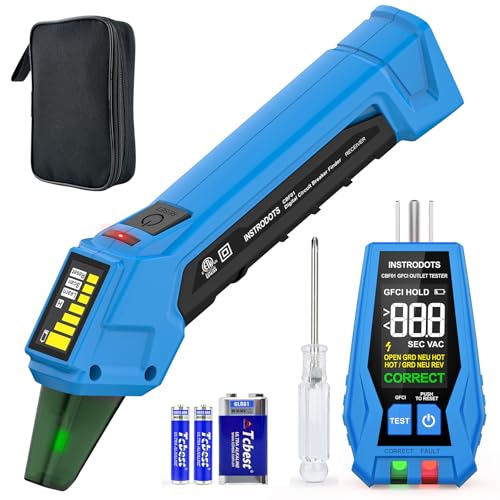
Where the Klein sticks to a simple beep-and-light approach, the INSTRODOTS CBF01 brings a large VA (Vertical Alignment) reverse display color screen on the transmitter that makes wiring-status reading far more intuitive, especially in dimly lit rooms. It handles a wider voltage range — 90-135V AC 50/60Hz — which gives it a small edge over the Klein’s 120V ceiling. More importantly, the system comes with a carrying case and batteries included (2 AAA for the transmitter, one 9V for the receiver), so you open the box and start working immediately.
The two-part system uses signal-injection technology without requiring manual sensitivity dials — just plug in, scan, and the analog bar display on the receiver guides you. The transmitter also tests GFCI trip time in seconds and diagnoses 6 common wiring conditions. What most owners find compelling is the sheer completeness: a color LCD, a carrying bag, and a price that undercuts many simpler models. As one electrician with 28 years in the trade put it, this tool saves serious time on troubleshooting.
Why It Stands Out
- Color LCD display on the transmitter makes wiring conditions easy to read at a glance
- Wider voltage range (90-135V) compared to the standard 120V limit
- Complete kit with carrying case and all batteries included
The Trade-Off
- No adjustable sensitivity on the receiver — works best on standard panels without dense wiring
Reach for this if: You want a modern, full-featured kit with easy-to-read visuals and everything needed to start tracing on day one.
skip it if: You need fine-grained sensitivity tuning for crowded commercial panels.
3. KAIWEETS KT301 Circuit Breaker Finder
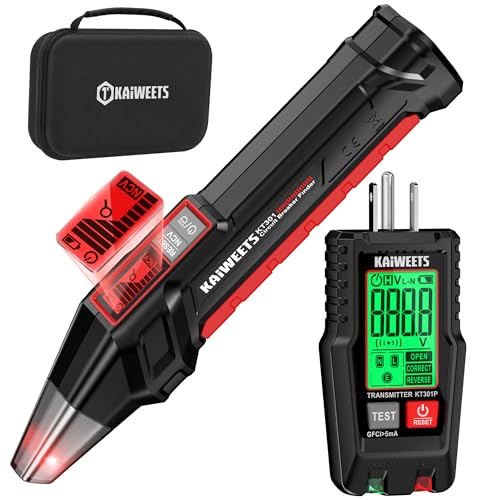
One tool that finds breakers, checks wiring, and detects live voltage without contact.
The KAIWEETS KT301 folds three functions into one compact unit: a circuit breaker finder, a GFCI outlet tester, and a non-contact voltage (NCV) detector (which senses live wires without touching them) built right into the receiver. The large backlit LCD screen shows real-time voltage (30-150V), outlet wiring status, and signal strength, which makes reading the results straightforward even in dark breaker panels or tight crawlspaces. The transmitter doubles as an GFCI outlet tester with automatic trip testing and red/green LED indicators to diagnose 7 common wiring faults.
Where this tool really pulls ahead of others in the same price bracket is the NCV feature — you can scan for live wires before you touch anything, adding a genuine safety layer that standalone breaker finders lack. The receiver also includes a flashlight, so you are not fumbling for your phone when the panel is in a dim basement corner. Owners who work in facility maintenance report that it holds up well under regular use and speeds up what used to be a guesswork-heavy task. The main point of caution: accuracy on some panels gets mixed feedback, so sweeping slowly and following the scanning instructions is essential for consistent results.
What Gives It an Edge
- Non-contact voltage detection in the receiver for quick safety checks
- Large backlit LCD displays voltage and wiring status clearly in low light
- Diagnoses up to 7 common wiring faults with the built-in GFCI tester
One Consideration
- Accuracy can vary depending on the panel’s wiring complexity — patience and a slow sweep matter
Grab this for: A true all-in-one diagnostic tool when you want breaker finding, outlet testing, and live-wire detection without carrying three separate devices.
Look elsewhere if: You need a wire tracer that can identify individual cables inside a wall or conduit.
4. NOYAFA NF-824 Circuit Breaker Finder

Rechargeable and packed with sensitivity options for tricky panels.
The NOYAFA NF-824 is one of the few circuit tracers in this range that ditches disposable batteries for a built-in 390mAh (milliamp-hour) 3.7V lithium battery charged via Type-C, giving you up to 5 hours of run time. That alone saves the hassle of buying 9V batteries. But the standout feature here is the 7 levels of adjustable sensitivity on the receiver — you start with a broad scan, and then dial in the sensitivity to zero in on the correct breaker, which is particularly helpful in older homes where wiring can make multiple breakers appear to carry the same signal.
The unit covers 90-120V AC 50/60Hz circuits and includes a GFCI test function, a large LCD screen with real-time voltage display, and a flashlight for dark panels. The complete accessory kit adds a 3-prong to 2-prong adapter, a light socket adapter, and alligator clip adapters — useful for testing fixtures and exposed wires. Owners find it reliable and accurate for the price, especially appreciating that it is a true multi-tool with the rechargeable feature. One note from those with 1960s wiring: the broad signal may highlight 3-4 possible breakers before you narrow it down, so patience is part of the process.
Why It Works
- Rechargeable via Type-C — no more buying 9V batteries for the receiver
- 7 sensitivity levels let you fine-tune scanning on complex or older panels
- Complete accessory kit with adapters for light sockets, 2-prong outlets, and alligator clips
Keep in Mind
- On very old wiring, it may signal several breakers at once — the sensitivity adjustment helps but requires practice
Best for: Homeowners and DIYers working on older houses where the panel is a mess and rechargeability is a priority.
Not ideal for: Anyone who wants a dead-simple one-button trace — the sensitivity tuning adds a learning step.
5. Ideal 61-535KIT Circuit Breaker Finder Kit
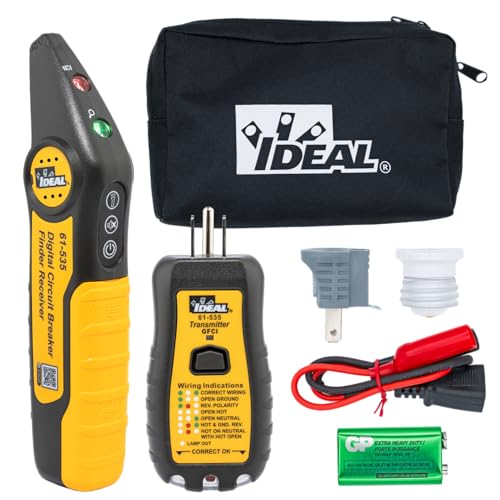
A pro-grade kit that finds breakers and tests GFCI without cutting power.
The Ideal 61-535KIT is built for jobsite speed: it identifies breakers on energized 120V AC circuits without requiring you to shut anything down first. The integrated GFCI outlet tester lets you inspect wiring conditions and test GFCI receptacles, which is valuable for remodel work where you need to confirm outlet safety before a rewire. What sets this kit apart from the others in the list is the included light socket adapter and alligator clip lead — you can identify breakers protecting lighting fixtures or exposed wires, not just standard outlets.
It operates on 120V AC circuits and comes with a soft zippered pouch that keeps the receiver, transmitter, adapters, and a 9V battery organized. The build quality gets consistent praise, and the 2-year manufacturer warranty adds confidence for frequent use. One area where it falls slightly short of the Fluke BK120 below is accuracy on densely packed panels — a few owners note that a “rat’s nest” of wiring inside the panel can make the identification less precise than they would like. Still, for the price and the included adapters, it is a strong contender for pros and serious DIYers.
What You Get
- Includes light socket adapter and alligator clip lead for non-outlet connections
- Built-in GFCI tester for inspecting outlet wiring and receptacle safety
- 2-year manufacturer warranty and soft zippered pouch for transport
The Catch
- On panels with very messy wiring, the breaker identification may be less definitive than higher-end models
Reach for it when: You need to trace circuits connected to light fixtures and exposed wires, not just outlets — the adapters make it more versatile than a basic plug-in tracer.
Pass if: You work on densely packed commercial panels where absolute precision on the first pass is critical.
6. Fluke BK120 SmartTrace Breaker Finder

The Fluke name means serious accuracy, and this 4-in-1 tool delivers.
Fluke’s BK120 SmartTrace operates on 110V circuits and consolidates four functions into a single receiver: circuit breaker finder, non-contact voltage (NCV) detector, socket tester, and an LED flashlight. The standout engineering choice is the dual-sensitivity NCV mode, which lets you detect voltage on both terminal strips and supply cords — a feature you do not get on the Klein or INSTRODOTS models. The transmitter is AC-powered (no batteries needed for the transmitter half), and the receiver runs on standard batteries.
What owners consistently highlight is the accuracy — the tool never gives false readings when used correctly, which saves the frustration of flipping the wrong breaker. The recommended technique is a two-pass scan: the first pass auto-adjusts sensitivity and you ignore the beeps, then the second pass zeros in on the exact breaker. One experienced owner noted that a cheaper scanner had failed at tracing circuits, but the Fluke handled the same job on the first try. The main durability note is that the plastic housing feels lighter than some expect from Fluke, but the performance benchmarks are what justify the premium position.
Why It Leads
- Dual-sensitivity NCV mode for detecting voltage on terminal strips and supply cords
- AC-powered transmitter means no battery changes in the sending unit
- Two-pass scanning system delivers very high accuracy on the second sweep
The One Thing
- The plastic housing feels lighter than the rugged Fluke reputation — store it in the case for longevity
Choose this for: Maximum accuracy on complex panels where false readings waste time — the Fluke name and dual-sensitivity NCV justify the extra investment for regular use.
pass on it if: You only need to find a breaker once a year; a simpler, more affordable tracer will serve you fine.
7. TEMPO Communications 701K-G Wire Tracer Electrical

The industry-standard tone-and-probe kit for tracing wires through walls.
This is not a conventional breaker finder — the TEMPO 701K-G is a tone generator and probe kit built for tracing voice, data, and video wiring (though it works fine on electrical circuits too). The 77HP-G tone generator sends a distinctive warbling tone down the wire, and the 200EP-G probe picks it up through non-conductive materials like wood and drywall. What makes this kit different from the other six picks is that it can identify a single wire within a bundle, trace a path through walls and ceilings, and even detect breaks in a circuit. The proximity LED on the probe gets brighter as you near the correct wire, which gives a visual confirmation alongside the audio.
It handles up to 150 volts, which is the highest maximum operating voltage in this roundup — at 150V versus the INSTRODOTS CBF01’s 135V limit — making it suitable for a wider range of commercial and industrial circuits. Owners who have used it to find a broken wire inside a wall report that it solved problems no other tool could touch. The kit includes alligator test leads, RJ11/45 and modular plug adapters, and a sturdy nylon carrying case. The trade-off is that there is no GFCI testing or non-contact voltage detection, because it is a tone tracer, not a breaker finder. Build and sound quality get mixed notes from some users, but the tracing capability through walls is where this tool has no direct competitor in this list.
Why It Is Unique
- Finds and traces individual wires through wood, drywall, and ceilings
- Proximity LED on the probe gets brighter as you get closer to the correct wire
- Handles up to 150V — the highest voltage ceiling in this comparison
Keep in Mind
- No GFCI outlet testing or NCV detection — this is strictly a tone tracing tool, not a multi-function breaker finder
Get this for: Tracing wires that are hidden inside walls, identifying individual cables in a bundle, or locating a broken wire that no standard breaker finder can detect.
Choose something else if: You need an all-in-one breaker finder with outlet testing — the TEMPO is a specialist tool for a specific job.
Understanding the Specs
Maximum Operating Voltage
This is the highest voltage the tracer can safely handle. Most home circuit tracers top out at 120V or 135V. A higher limit (like the TEMPO 701K-G’s 150V) means the tool can work on commercial and industrial circuits where voltage may run higher. Choosing one that matches your environment prevents damage to the tool and inaccurate readings.
Signal Injection Technology
A transmitter sends a specific frequency onto the wire, and the receiver is tuned to detect that exact signal. This is how the tracer distinguishes the correct breaker from the neighboring ones. Simpler models use a fixed signal, while more advanced tracers offer adjustable sensitivity so you can dial in on the right breaker when the panel is crowded or the wiring is messy.
FAQ
Will an electrical circuit tracer work on an unlabeled panel in an old house?
Can I use a circuit tracer to find a broken wire inside a wall?
What is the difference between a circuit tracer and a non-contact voltage tester?
How does adjustable sensitivity help when finding a breaker?
Do all circuit tracers work with GFCI outlets?
Is a digital display better than a simple beep-and-light indicator?
What voltage range do I need for a standard US home?
Will a circuit tracer work on a two-prong (ungrounded) outlet?
How long do the batteries last in a typical circuit tracer?
Does a higher price guarantee better accuracy?
Final Thoughts: The Verdict
If you want one dependable pick, the electrical circuit tracer winner is the Klein Tools ET310 because it combines a trusted brand, straightforward operation, and a built-in GFCI tester at a price that makes sense for any homeowner. If you want a color display and a complete kit with a carrying case, grab the INSTRODOTS CBF01. And for tracing wires through walls or finding a broken cable, the TEMPO 701K-G is the one to reach for — it does something no breaker finder in this list can match.
How We Picked
We do not accept paid placement. Every pick is matched to a real buyer and a real use-case; we do not hands-on test units.
Sources & Methodology
Specifications: manufacturer listings and product documentation. Review insights: verified customer reviews, as of July 2026. Pricing: not shown on this page (it changes often); check the current price via the retailer link.
As an Amazon Associate, WellFizz earns from qualifying purchases. This does not affect which products we feature.
Related Guides

Mo Maruf
I created WellFizz to bridge the gap between vague wellness advice and actionable solutions. My mission is simple: to decode the research and give you practical tools you can actually use.
Beyond the data, I am a passionate traveler. I believe that stepping away from the screen to explore new environments is essential for mental clarity and physical vitality.