Our readers keep the lights on and my smoothie glass nicely filled. As an Amazon Associate, I earn from qualifying purchases.
Specs are compiled from manufacturer listings and verified buyer reviews and can change over time — please confirm the key details on the product page before buying.
Walking 18 holes is the heart of golf, but hauling a 30‑pound bag or wrestling a manual push cart up a steep incline can drain the fun out of the round. An electric walking golf cart does the heavy lifting — a quiet motor turns the wheels while you stroll, putter in hand, enjoying the walk. The hard part is picking the right one: battery life claims, remote control quirks, and real‑world hill performance vary widely between models.
I’m Mohammad Maruf — the founder and writer behind WellFizz. This guide is built by comparing the manufacturers’ published specifications and the patterns across verified customer reviews, so you get each pick’s real strengths and trade-offs instead of marketing spin.
if you want a basic hands‑on caddy or a full follow‑me robot, these electric walking golf carts deliver useful battery range, stable hill climbing, and reliable controls — so you can walk more and push less.
Our Picks at a Glance


How To Choose The Best Electric Walking Golf Cart
Picking the right electric caddy depends on matching the motor strength, battery stamina, and control style to the courses you usually play. A cart that feels great on a flat, dry muni can struggle on a hilly, wet course.
Battery Range and Real‑World Capacity
Manufacturers often quote a “36‑hole” battery, but that number assumes a perfectly flat course with ideal conditions. A hilly 18‑hole round can easily consume half the battery or more. Look for a lithium‑ion pack that gives you a comfortable margin — if you play hilly terrain, a 36‑hole rated battery might only deliver a reliable 27 holes. Pay attention to how owners describe real battery life on their local course, not just the marketing number.
Motor Power and Hill Climbing
The motor’s wattage is the direct measure of climbing ability. A dual‑motor setup (like two 200W motors) provides noticeably more torque on steep slopes than a single motor of similar total wattage. Also consider whether the cart has downhill speed control, which prevents it from running away on the back side of a hill. If your home course has significant elevation changes, a higher‑wattage motor and electronic braking are far more important than top speed.
Control Style: Remote, Follow, or Manual
You have three main options. A remote control lets you send the cart ahead or steer it from a distance, which is great for walking quickly between shots. A follow‑me mode uses sensors to track you automatically — very cool in theory, but it can lose connection on bumpy ground or when the receiver is out of sight. Manual push mode (with the motor disengaged) is a useful backup for when the battery runs low or you want a quieter stroll. Think about which mode you’d use most and whether the cart can switch between them easily during a round.
Quick Comparison
| Model | Best For | Motor Power | Battery Range | Weight | Amazon |
|---|---|---|---|---|---|
| Wingscaddy Max300★ Best Overall | Best Overall / Value | Dual 200W | 36 holes | 34.4 lb | Amazon |
| MGI Zip X1Best Value Hand Control | Lightest Hand‑Controlled | 230W | 36 holes | 26.7 lb | Amazon |
| Alphard Club Booster V2Pro + OmniBest Wide Stance | Remote Control Stability | Brushless Motors | 36 holes | — | Amazon |
| CaddyTrek R2 | Follow‑Me Autonomy | Single Motor | 18 holes | 39 lb | Amazon |
| MGI Zip X5 | Premium Hand‑Controlled | 230W | 36 holes | 30.6 lb | Amazon |
| KVV Compact Remote | Compact Storage | Single Motor | 18+ holes | 27.9 lb | Amazon |
| tianhong G5 | Longest Battery Range | Single Motor | 45 holes | — | Amazon |
| Bag Boy Volt | Lightweight Remote Cart | Single Motor | 36 holes | 28.6 lb | Amazon |
| Alphard Cybercart | High‑End Remote Stability | Single Motor | 36 holes | — | Amazon |
In‑Depth Reviews
1. Wingscaddy Max300 (Electric Golf Push Cart with Remote Control)
Our pick — 4.5★ from 50+ verified ratings; the strongest balance of quality and price.
The dual‑motor powerhouse that delivers remote control, hill‑climbing grunt, and a compact lithium battery without the premium price tag.
Most electric carts in this price range use a single motor and struggle on the second nine when the hills start. The Wingscaddy Max300 takes a different approach with two 200W motors — one for each rear wheel — giving it noticeably more torque on steep climbs. Owners consistently report it handles hilly courses without tipping, thanks in part to the standard anti‑tip wheel. The lithium battery is small and light, with quick‑charging connectors that screw in securely. And it weighs 34.4 pounds package weight, which is manageable for most trunks.
The three‑mode operation (remote, manual trolley, and free‑wheel) means you are never stuck. Use the remote to send the cart ahead 10, 20, or 30 meters at nine adjustable speeds, or push it manually when the battery runs low. The included accessories — umbrella holder, scorecard holder, drink holder, and tool kit — cover everything you need for a round. One recurring note from the review pages is that the USB port on the remote can cause control glitches, so some owners plug their phone charger directly into the battery instead.
A few owners mention the scorecard holder slides around, and there is no follow‑me mode. But for the combination of dual motors, remote range, and lithium battery at a price that undercuts most competitors by a wide margin, the Max300 is the crowd favorite. It earns its Best Overall spot by delivering what matters most: reliable hill‑climbing power and genuinely useful battery life across a full 36‑hole day.
Why It Wins
- Dual 200W motors provide excellent hill‑climbing torque
- Lightweight lithium battery with screw connectors and quick charge
- Three operation modes (remote, trolley, free‑wheel) for versatility
- Comes with umbrella, drink, and scorecard holders plus tool kit
The Trade‑Offs
- USB port on remote can cause control issues — owners bypass it
- No follow‑me mode — remote control only
- Scorecard holder slides under heavy use
Pick it if: You want genuine hill‑climbing power from dual motors, a lightweight lithium pack, and remote control — all at a price that beats most single‑motor competitors by a mile.
Think twice if: You need a true hands‑free follow‑me function or rely on the remote’s USB port for phone charging on the course.
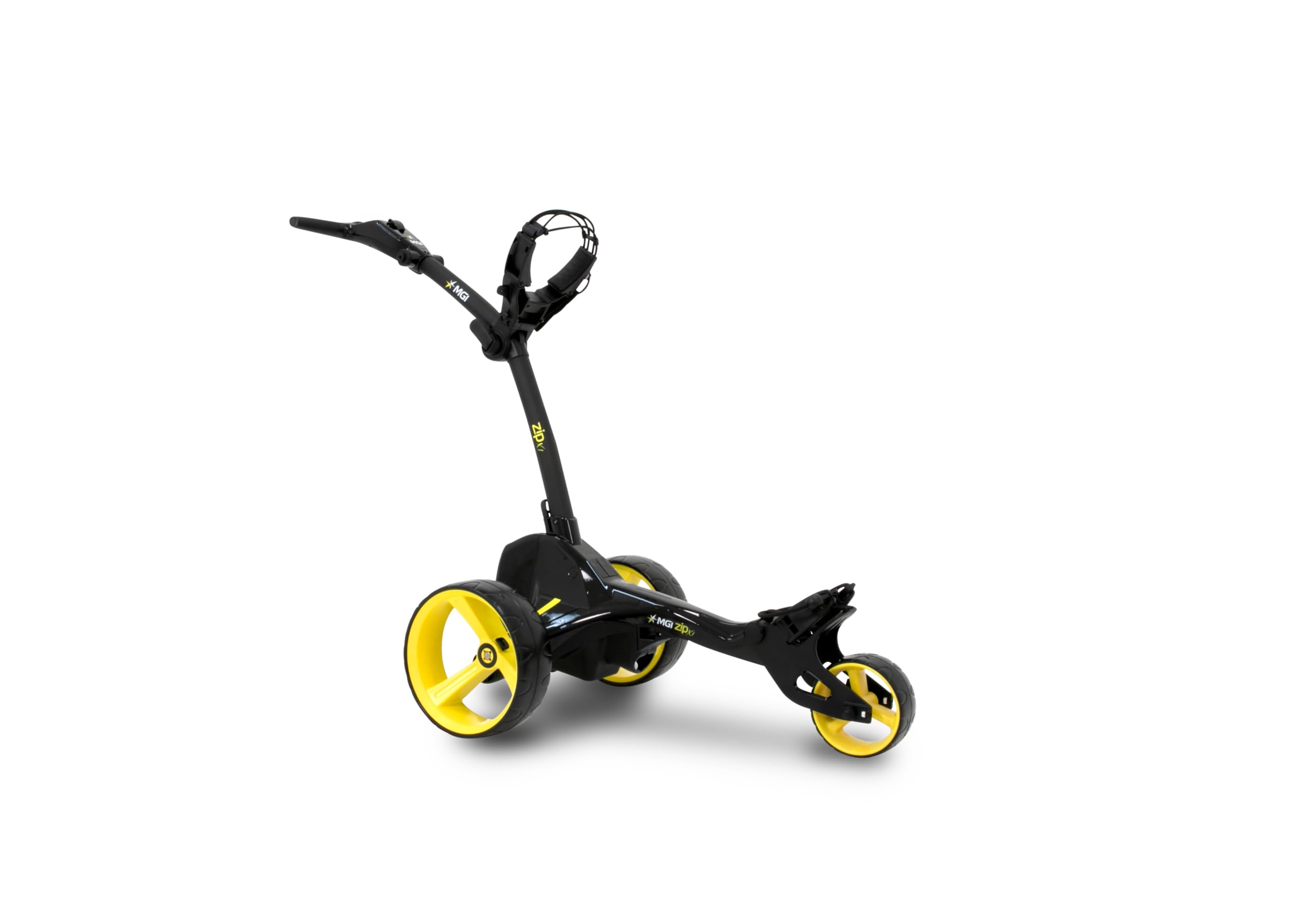
2. MGI Zip X1 Electric Golf Cart
The featherweight that climbs without wheezing — 26.7 pounds and a 230W motor that sips battery on hilly rounds.
At just 26.7 pounds with the battery installed, the MGI Zip X1 is one of the lightest electric caddies you can buy. That low weight makes a real difference when you lift it in and out of the trunk — especially compared to the 34‑pound Wingscaddy above. But light doesn’t mean weak. The 230‑watt motor handles steep hills with surprising ease; buyers report using only 12% of the battery for a full nine hilly holes, which suggests the 36‑hole rating is genuinely achievable on most courses.
The control is purely hands‑on — no remote, no follow‑me. You steer via the handle and set your pace with a speed dial from 1 to 20, displayed on a 2.5‑inch LCD screen. A USB port on the dash lets you charge your phone or GPS during the round. The folding mechanism is straightforward: rear wheels tuck inward, and the whole thing fits into most car trunks. A 3‑year manufacturer warranty backs it up, which is longer than most competitors offer. One owner at 5’2″ called it a perfect fit, noting the self‑propelled action meant no more shoulder pain after a round.
The main trade‑offs are the incremental speed settings (some wish for a smooth rotary dial instead of preset speeds) and the lack of a parking brake — the cart can roll backward on steep slopes if not held. A few also note the rearward center of gravity can cause tipping on very steep inclines if the bag is loaded heavy. For anyone who prefers a simple, walk‑along caddy without remote complexity, the Zip X1 delivers exceptional value at a weight that is tough to top.
What Stands Out
- Extremely lightweight at 26.7 lb with battery — easiest to lift
- 230W motor climbs steep hills; uses only 12% battery for 9 hilly holes
- 3‑year manufacturer warranty — strongest in this class
- USB port charges phone or GPS during the round
The Drawbacks
- No remote control or follow‑me mode — hands‑on only
- No parking brake — can roll on steep slopes when stopped
- Rearward weight distribution can cause tipping on very steep inclines
Best for: Golfers who want the lightest possible electric caddy with strong hill‑climbing performance and don’t need remote control.
Look elsewhere if: You need a remote to send the cart ahead or a parking brake for hilly courses with frequent stops.
3. Alphard Golf Electric Caddy Bundle (Club Booster V2Pro + Omni Cart)
A wide rear stance and 6‑axis gyroscope make this remote‑controlled bundle feel planted on side hills where others wobble.
The Alphard bundle combines the Club Booster V2Pro drive unit with the Omni Cart frame, and the first thing you notice is the wide base. Owners say it feels stable on side hills, which is a common weak point for narrower carts that feel tippy when the ground tilts. The 6‑axis gyroscope automatically detects terrain changes and adjusts the motor speed to keep the cart tracking straight — a genuine help on rolling fairways. The brushless motors are virtually silent, so you can hear the birds and your playing partners.
Remote control is the primary mode. You can send the cart 15 or 30 yards ahead with a single button press, and the electronic parking brake holds it in place on hills. A smartphone app provides backup control. The V2Pro comes with permanently attached wheelie bars (anti‑tip wheels) that pivot out during setup. Assembly takes about an hour, according to owners, and the cart breaks down easily for transport. One reviewer noted they tackled 500+ feet of elevation over 6–7 miles, and the battery barely used 2 of its 5 power dots after 18 holes. The wide rear stance also helps on rough ground where narrower carts dig in.
The flip side: on very steep slopes the cart can lose traction and need a light push to get going again. The aluminum frame is sturdy but heavy — it fits an SUV more naturally than a compact car trunk. And a few owners found the umbrella holder low for golfers over 6 feet tall. If your course has dramatic side hills and you prefer remote control over hands‑on steering, this is the most stable option in the guide.
Stability King: The wide rear stance and gyroscope keep the cart tracking straight on side hills where many carts require constant correction.
Worth Noting: The brushless motors are genuinely quiet, and the electronic parking brake holds securely on steep inclines — a rare combination in this price range.
Reach for this if: Your home course has pronounced side hills or uneven terrain and you want remote control with a wide, stable footprint.
Skip if: You need a lightweight cart for a small trunk or are under 6 feet tall and want the umbrella at standard height.
4. CaddyTrek R2 Electric Golf Follow Cart

The only cart in this guide that truly follows you hands‑free using ultrasound and RF signals — like a loyal caddy on wheels.
All the other carts here require a remote or a handle. The CaddyTrek R2 is different: it uses a combination of ultrasound and radio frequency signals to track your position and follow you automatically, either in front or behind. You clip a small transmitter to your belt or carry it in your pocket, and the cart calculates distance, speed, and angle to stay a few feet behind you. It can also operate in remote control mode, marching mode (follows at a set distance), and manual push mode if the battery dies.
The aluminum alloy frame folds down quickly for transport, and the total weight is 39 pounds — heavier than the MGI options, but the trade‑off is the unique tracking capability. Owners mention it saves both cart fees and back strain, and the battery reliably lasts a full 18 holes. The package includes five accessories: cup holder, scorecard holder, cell phone holder, umbrella holder, and a CaddyBelt for the transmitter. The fold is compact enough for most trunks.
The follow‑me feature is impressive when it works, but it has limitations. The ultrasound signal can lose connection on bumpy ground or when the receiver is briefly out of sight — the cart may spin in circles before re‑acquiring you. The march mode requires wide turns to keep up. A few owners found the included accessories (phone holder, cup holder) flimsy and replaced them. Still, for the experience of walking completely hands‑free — no remote in your pocket, no handle to steer — the R2 is the only game in town at this price.
The Breakthrough
- True follow‑me mode using ultrasound and RF — no remote needed
- Four modes: follow, march, remote control, and manual push
- Five accessories included (cup, phone, umbrella, scorecard holders + belt)
- Aluminum alloy frame folds compactly for transport
The Limitations
- Follow mode can lose connection on bumpy terrain and spin
- Heavier than most rivals at 39 lb
- Included accessories are flimsy — many owners upgrade them
Ideal for: Golfers who want the purest hands‑free experience — no remote, no handle — and play on relatively smooth, open courses.
Not for: Very hilly or bumpy courses where the follow signal may drop, or anyone who prioritizes low carrying weight.
5. MGI Zip X5 Electric Golf Cart
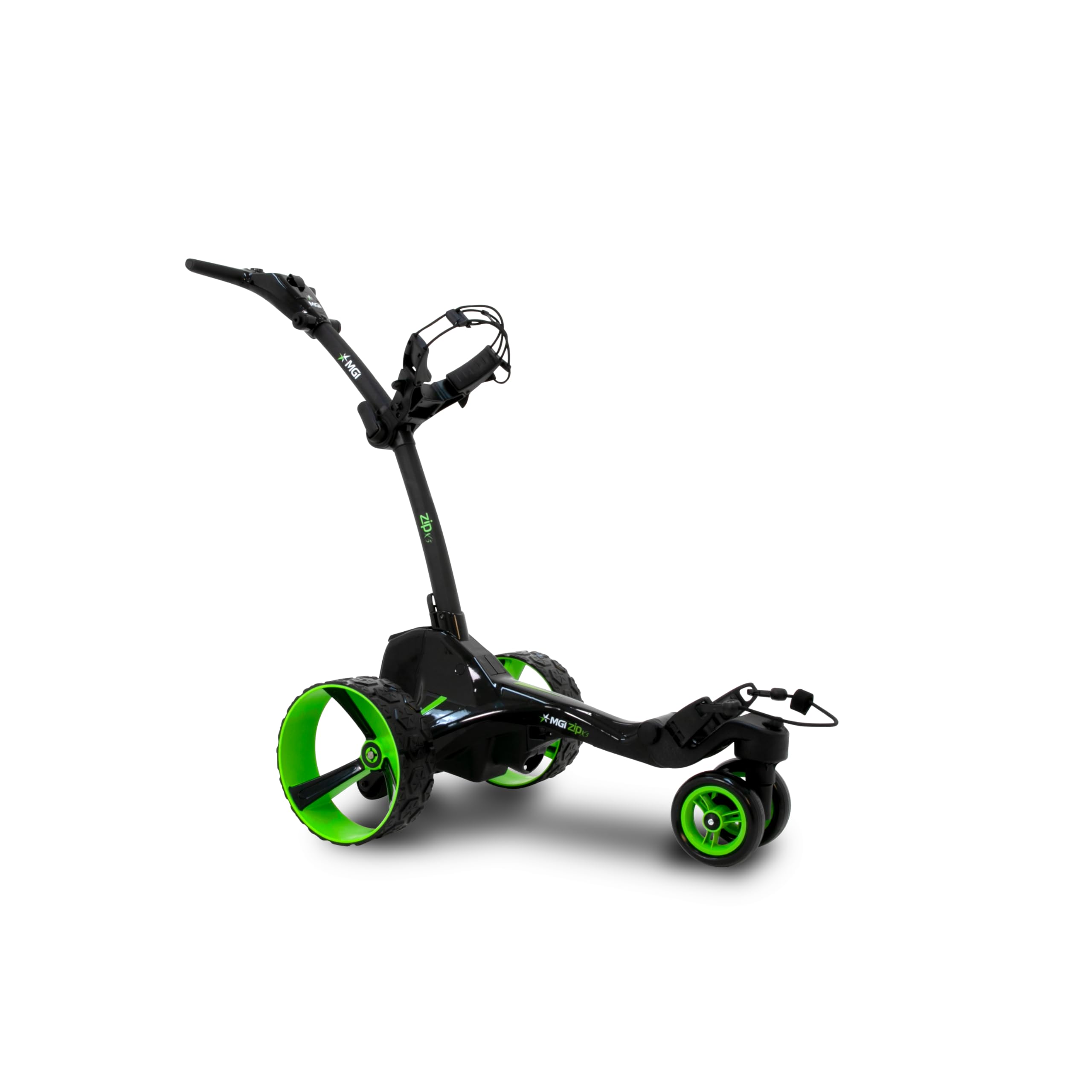
The upgrade that adds a swivel front wheel, downhill speed control, and an electronic parking brake to the proven MGI platform.
If the Zip X1 is the lightweight entry point, the Zip X5 is the fully loaded version. It keeps the same 230W motor and 36‑hole lithium battery but adds three significant upgrades: a swiveling front wheel for tighter turns, downhill speed control that prevents the cart from running away on steep descents, and an electronic parking brake that holds it securely when you stop. A 5th wheel stabilizer at the rear provides extra balance on uneven ground, which addresses the tipping concern some owners reported on the X1.
The 2.5‑inch LCD display shows speed, battery level, and mode. The speed dial ranges from 1 to 20, and the cart includes a USB port for charging devices. Buyers praise the battery life: it charges in about four hours and easily covers 18 hilly holes with plenty to spare. The folding mechanism is the same easy setup as the X1, with rear wheels tucking inward for storage.
The downsides are minor but worth noting. The speed dial can feel too sensitive — a small turn makes a big difference. The included phone holder is near useless, and the plastic display cover is fragile and can crack if handled roughly. One owner noted the cart needs a steady hand on steep slopes despite the downhill control. Still, for anyone who wants the best hand‑controlled MGI with all the stability features, the X5 is the clear choice over the X1.
Upgrade Highlights: The swivel front wheel makes a real difference in tight spaces, and the electronic parking brake is a genuine safety feature on hilly courses that the X1 lacks.
Minor Annoyance: The phone holder is widely considered useless, and the plastic display is fragile — treat it gently.
Pick this if: You want the best hand‑controlled MGI with downhill speed control, a parking brake, and a swivel front wheel for maneuverability.
Stick with the X1 if: You prefer the lighter weight and don’t need the extra stability features or parking brake.
6. KVV Electric Golf Push Cart with Remote Control

The smallest folding electric cart on the list — 17.5 by 18.7 inches folded — so it slips into the tiniest trunks.
Storage space is a real constraint for many golfers, especially those with small sedans or crowded garages. The KVV solves that with a folded size of just 17.5 x 18.7 x 22 inches — smaller than any other powered cart in this guide. It weighs 27.9 pounds, so it’s light enough to lift with one hand. The aluminum frame feels durable without being bulky, and a carry bag keeps everything organized in the trunk.
The remote control works at nine speeds and includes a straight‑line tracker to help the cart hold its course on uneven ground. A 360‑degree swivel front wheel improves maneuverability around tight corners and between carts. The battery is rated for 18+ holes, and when it runs low you can switch to manual push mode. The package is generous: an insulated cooler bag, umbrella holder, drink holder, remote control holder, and a carry bag are all included. Owners consistently report the remote is responsive and the cart handles hills well for its class.
Where it falls short is smoothness. Several owners note the left/right steering can feel jerky rather than fluid, and the cart occasionally needs help on steeper slopes. The back wheels must be locked into position for electric mode, which adds a small step during setup. A few found the turning radius wider than expected. For anyone with a tight trunk who wants remote control in a genuinely compact package, the KVV is the best fit — just don’t expect the refined handling of a heavier, more expensive cart.
Storage Champion
- Folded size 17.5 x 18.7 x 22 inches — smallest in the guide
- 27.9 lb weight makes it easy to lift and store
- Includes insulated cooler bag plus drink, umbrella, and remote holders
- 360° swivel front wheel aids maneuverability
The Compromise
- Steering can feel jerky — not as smooth as pricier models
- Needs help on very steep slopes despite motor power
- Back wheel lock step required for electric mode adds small setup friction
Perfect for: Golfers with small trunks who need a remote‑controlled cart that folds tiny and weighs under 28 pounds.
Not ideal if: You play very hilly courses and want smooth, fluid steering on every turn.
7. tianhong G5 Electric Golf Cart
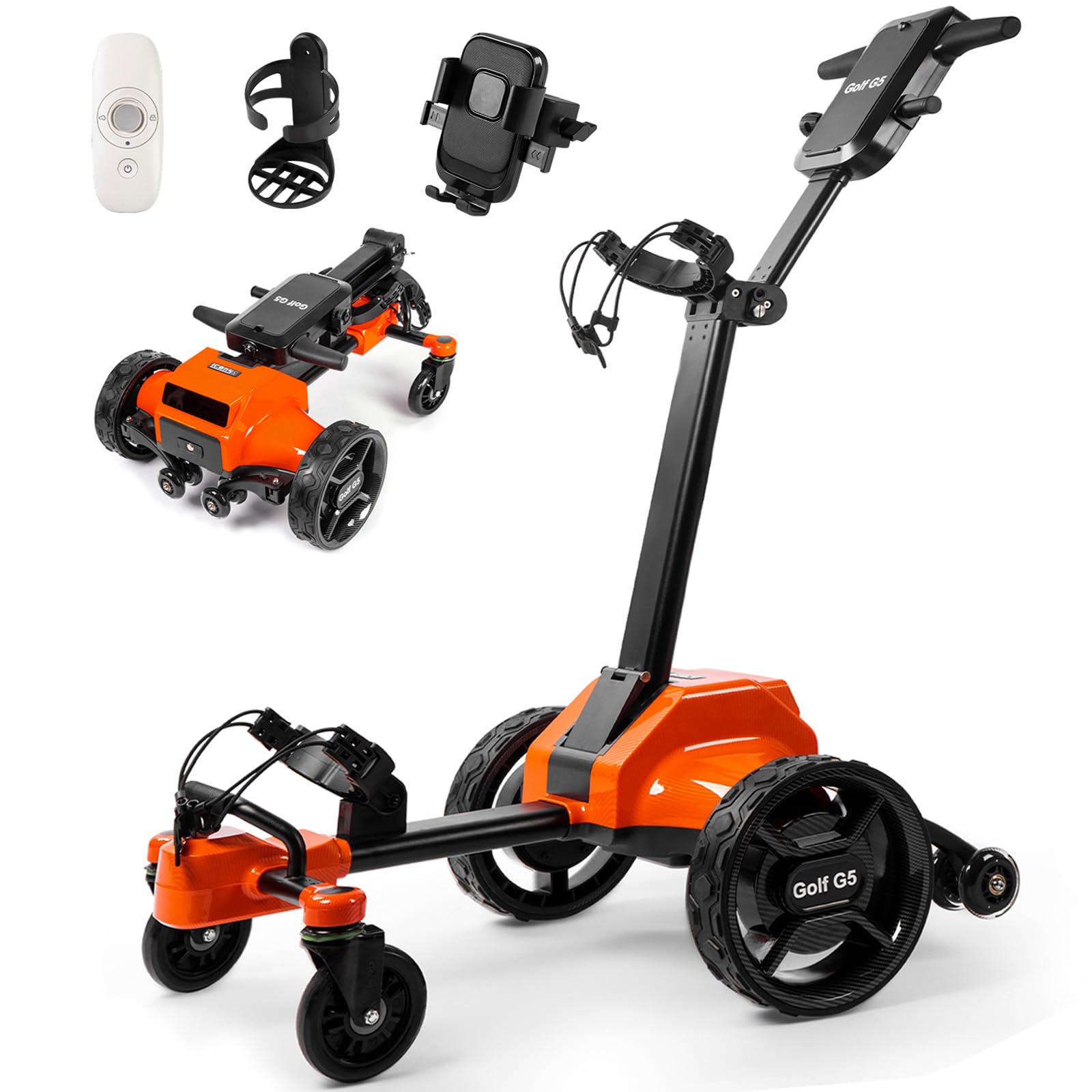
A 45‑hole lithium battery that genuinely covers a full weekend — the longest range in this lineup by a clear margin.
Most “36‑hole” batteries deliver about 27 holes on a hilly course. The tianhong G5 goes further with a rated 45‑hole capacity from its lithium‑ion pack. Owners confirm it handles two full rounds without recharging, which eliminates battery anxiety for multi‑day trips or long practice sessions. The cart also includes an auto‑follow feature that uses sensors to track you hands‑free, plus remote control, app control, manual push, and a constant‑speed cruise mode — five ways to operate it.
The build is sturdy with a plastic frame that feels solid. The all‑terrain tires and dual anti‑tip wheels keep it stable on 30‑degree slopes, and the IPX5 waterproof rating means rain won’t stop your round. A color LED display shows speed, battery level, mode, and mileage in real time. The fold is compact at 28.7 x 24.8 x 14.1 inches, and 90% of the parts come pre‑assembled — setup takes about ten minutes. Several owners who played 50+ rounds report the cart handles rough terrain well and has never tipped over.
The downsides are real. The remote needs an overnight charge and only lasts about 27 holes — after that, the cart malfunctions when the remote battery drops below 10%. The phone app is reportedly useless for control. The hub covers can fall off after extended use, and the rear wheel frame is not the most sturdy. A few owners had parts break on the second round, though seller support was responsive. If raw range is your top priority and you can work around the remote battery quirk, the G5 delivers class-leading endurance.
Range Champ: The 45‑hole battery is the real deal — confirmed by owners who play two rounds without recharging. No other cart here matches that.
Watch Out For: The remote battery drains fast (27 holes) and the phone app is useless. The hub covers can fall off over time.
Choose this for: Maximum battery range — two full rounds without charging, plus auto‑follow and remote modes for versatility.
Think twice if: You’re not willing to charge the remote every night or want a more polished phone app experience.
8. Bag Boy Volt Electric Golf Push Cart

A feathery 28.6‑pound remote cart with TrueLine tracking that keeps the wheels straight on uneven ground.
The Bag Boy Volt is designed for golfers who want a remote‑control cart without the usual 35‑pound+ weight penalty. At 28.6 pounds, it competes directly with the KVV on portability but adds a feature called TrueLine Tracking — a course‑correction algorithm that automatically adjusts the front wheel to keep the cart tracking straight on uneven terrain. It also includes a Distance Control feature that sends the cart up to 30 yards ahead with a single button press, handy for walking quickly between shots.
The lithium battery charges in four hours and is rated for 36 holes, with an option to disengage the motor and use the cart as a manual push cart when the battery runs out. The fold is compact at 29 x 16.5 x 14.5 inches. A generously sized storage console with dedicated slots for phone, beverage, tees, pencil, scorecard, umbrella, and golf balls keeps everything organized. Owners who had a good experience praise the smooth operation, hill‑climbing ability, and the rear stabilizer wheel that adds confidence on steep slopes.
Reliability is the Volt’s weak spot. The most‑discussed aspect is reliability itself, and the feedback is mixed. Several customers note the remote control failing repeatedly — one went through three units in nine months. The battery barely lasts 18 holes for some, despite the 36‑hole claim. The speed control knob can be erratic without the remote, and the umbrella holder is poorly attached. If you get a good unit, the Volt is an excellent lightweight remote cart. But the risk of a dud is higher here than with more established models like the MGI or Alphard.
Lightweight Remote
- 28.6 lb — one of the lightest remote‑control carts available
- TrueLine Tracking keeps the cart straight on uneven ground
- Lots of built‑in storage for phone, beverage, tees, and balls
- Disengage motor for manual push mode when battery runs low
The Risk
- Reliability is the most‑discussed aspect — and it’s mixed
- Some units have remote failures and battery life short of claims
- Umbrella holder poorly attached; speed knob can be erratic
Reach for it if: You want a lightweight remote cart and are willing to gamble on reliability for the weight savings and TrueLine tracking.
Choose a different pick if: Consistent reliability is your top priority — the MGI or Wingscaddy are safer bets.
9. Alphard Cybercart Electric Golf Caddy
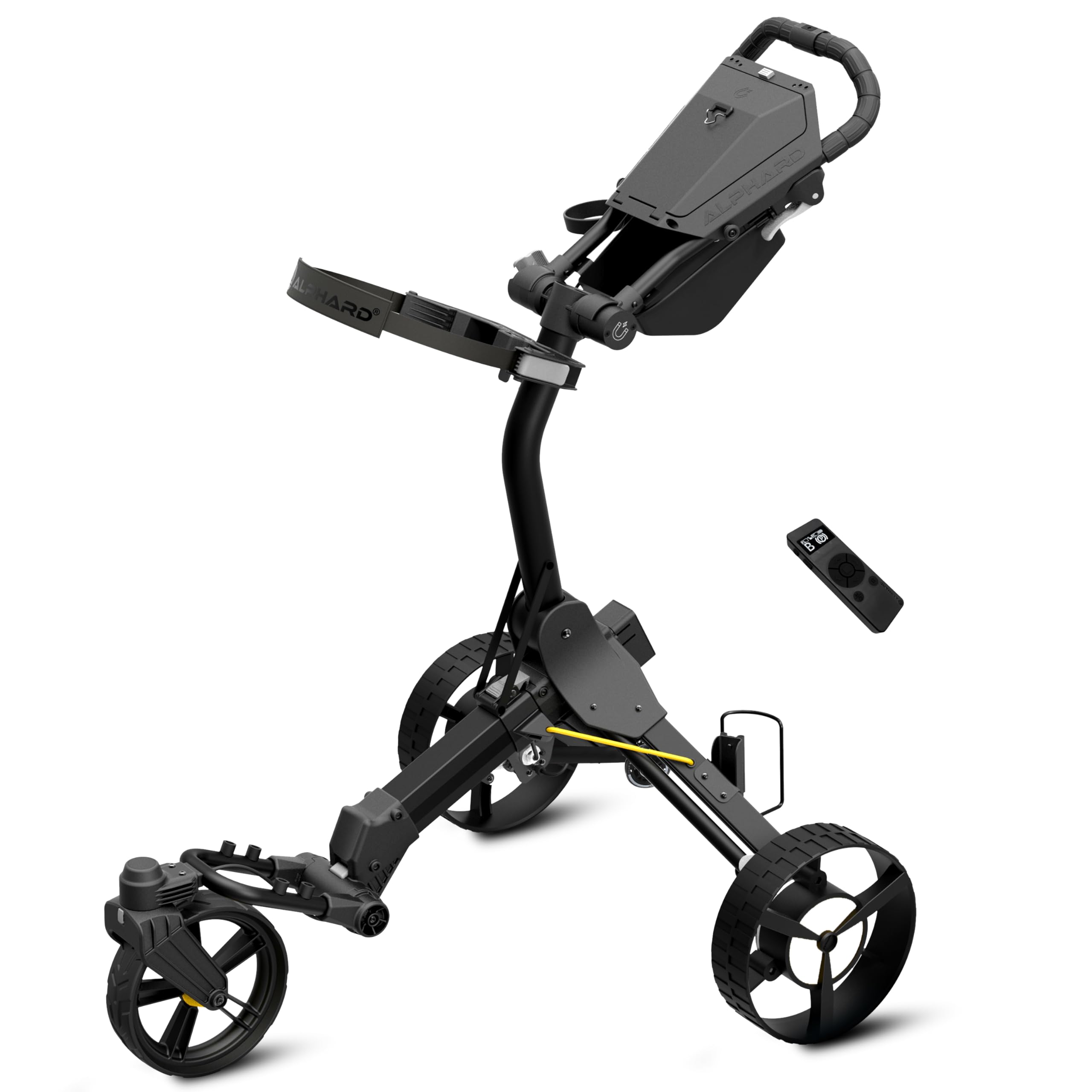
An LCD‑equipped remote with out‑of‑range auto‑stop and a low center of gravity that makes tipping nearly impossible.
Alphard’s Cybercart sits at the top of the price range, and the extra investment buys refinement. The LCD remote shows battery level, speed, and mode, and includes an auto‑stop feature if the cart gets too far away — a genuine safety net on busy courses. The 6‑axis gyroscope works with a low center of gravity and anti‑tip bars to keep the cart stable on slopes. A 360‑degree swivel front wheel provides smooth turns, and the freewheel mode lets you push it manually without resistance.
The battery is rated for 36 holes, and owners confirm it has plenty of power remaining after a full 18‑hole round. The fold is compact and quick — one‑click folding that fits easily into a trunk. The package includes a cup holder, umbrella holder, scorecard holder, sand bottle holder, a magnetic landing pad (a neat storage touch), and an automatic parking brake. The cart is designed and assembled in the US. Reviewers consistently praise the high‑quality materials and super‑responsive remote. One owner summarized it as “could not be more stable.”
The downsides are modest but real. The cart is heavy — several owners note it can be hard to lift out of a trunk. A few report a constant high‑pitched DC whine from the motor, even when stopped, which ruins the quiet walking experience. The gyroscope doesn’t always track perfectly straight, and the steering can feel jerky on uneven ground. The included accessories are flimsy for the price point. If you want the most refined remote experience with US assembly and strong stability, the Cybercart delivers — just check the motor noise before committing.
Refined Remote: The LCD remote with out‑of‑range auto‑stop is a step above basic remotes, and the low center of gravity provides genuine stability.
Noise Note: Some units emit a constant high‑pitched whine that owners found distracting — it’s worth testing if quiet operation matters to you.
Best for: Golfers who want the most polished remote‑control experience with US assembly, LCD remote, and anti‑tip stability.
Skip if: You are sensitive to motor noise or need the lightest possible cart for easy trunk loading.
Understanding the Specs
Motor Power and Configuration
The motor’s wattage determines how steep a hill the cart can climb. A single 230W motor (like the MGI Zip X1 and X5) handles most course inclines with ease, but a dual‑motor setup — two 200W motors working independently — provides noticeably more torque on very steep slopes because each wheel gets its own power. Brushless motors (Alphard) are quieter and more efficient than brushed motors. If your home course has serious elevation changes, prioritize total wattage and dual‑motor configuration over other features.
Battery Capacity and Real Range
A “36‑hole” rating is measured on a flat course with a standard bag. On a hilly course, you can expect roughly 75% of the rated range — so a 36‑hole battery might deliver 27 holes. Lithium‑ion batteries are lighter and charge faster than older lead‑acid types. Look for a battery that is removable (for charging indoors) and has a clear charge indicator. The tianhong G5’s 45‑hole rating is the highest in this guide, while most competitors offer 36‑hole or 18‑hole batteries that still cover a full day of golf.
FAQ
How long does a typical electric golf cart battery last?
Can I use an electric golf cart in the rain?
What is the difference between a remote‑controlled cart and a follow‑me cart?
How much does an electric golf cart weigh?
Can I switch between electric and manual push mode?
Will an electric golf cart fit in my car trunk?
What does the 6‑axis gyroscope do?
How important is the electronic parking brake?
Can I charge my phone or GPS from the cart?
What warranty do these electric golf carts come with?
Final Thoughts: The Verdict
For most buyers, the best electric walking golf cart winner is the Wingscaddy Max300 because its dual 200W motors, lithium battery, and remote control deliver genuine hill‑climbing power at a price that undercuts most competitors. If you want the lightest possible hand‑controlled caddy with a strong warranty, grab the MGI Zip X1. And for the most stable remote‑controlled ride on side hills, the Alphard Club Booster V2Pro bundle is the one to reach for.
How We Picked
We do not accept paid placement. Every pick is matched to a real buyer and a real use-case; we do not hands-on test units.
Sources & Methodology
Specifications: manufacturer listings and product documentation. Review insights: verified customer reviews, as of July 2026. Pricing: not shown on this page (it changes often); check the current price via the retailer link.
As an Amazon Associate, WellFizz earns from qualifying purchases. This does not affect which products we feature.
Related Guides

Mo Maruf
I created WellFizz to bridge the gap between vague wellness advice and actionable solutions. My mission is simple: to decode the research and give you practical tools you can actually use.
Beyond the data, I am a passionate traveler. I believe that stepping away from the screen to explore new environments is essential for mental clarity and physical vitality.