Our readers keep the lights on and my smoothie glass nicely filled. As an Amazon Associate, I earn from qualifying purchases.
Specs are compiled from manufacturer listings and verified buyer reviews and can change over time — please confirm the key details on the product page before buying.
Forget wrestling with gas engines, pull cords, and oil changes. The best electric power washers plug into a standard wall outlet and deliver serious cleaning muscle for driveways, siding, cars, and patio furniture — with none of the fumes or maintenance. The real question is which one has the right combination of pressure (PSI), water flow (GPM), and hose reach to actually finish your jobs without frustration.
I’m Mohammad Maruf — the founder and writer behind WellFizz. This guide is built by comparing the manufacturers’ published specifications and the patterns across verified customer reviews, so you get each pick’s real strengths and trade-offs instead of marketing spin.
We break down nine corded models, from a 3000 PSI workhorse to compact 1800 PSI units, so you can confidently choose among the best electric power washers for your home.
Our Picks at a Glance

How To Choose The Best Electric Power Washers
You need an electric power washer that matches its output to the dirt you actually fight. Cleaning a car demands a gentle touch, while stripping mildew off a concrete driveway needs raw force and volume. These four specs decide everything.
Pressure (PSI) isn’t the whole story — water flow (GPM) matters as much
PSI, or pounds per square inch, tells you how hard the water hits a surface. GPM, or gallons per minute, tells you how much water is moving. The two together determine cleaning units — and surface area cleaned per hour. A high-PSI machine with low GPM still takes forever on a big driveway. Look for a balanced pair.
Hose length and power cord reach determine your radius of action
Every foot of hose means you move the machine that much less. A 25-foot hose with a 35-foot cord lets you wash a car without dragging the unit around. A 100-foot retractable hose, like some wall-mounted models offer, can reach your whole property from one spot. Count the total reach before you buy.
Motor type predicts how long the unit will last
Induction motors are the heavy-duty choice found on premium models — they run cooler and survive longer than the universal motors on budget units. A Total Stop System (TSS) also extends pump life by automatically killing the motor when you release the trigger. Both features mean fewer repairs down the line.
Nozzles and extras change what you can actually do
A five-nozzle set (0°, 15°, 25°, 40°, and soap) lets you switch from a razor-thin jet for stubborn stains to a wide fan for rinsing. A soap tank — sometimes two — lets you apply detergent without switching tools. Check what’s included so you don’t have to buy a separate foam cannon right away.
Quick Comparison
| Model | Best For | Pressure (PSI) | Flow (GPM) | Hose Length | Amazon |
|---|---|---|---|---|---|
| Westinghouse WPX3000e★ Best Overall | Heavy home cleaning | 3000 | 1.76 | 25 ft | Amazon |
| Greenworks 3000 PSITop Performer | Top-tier power | 3000 | 2.0 | 25 ft | Amazon |
| Giraffe Tools Wall MountedSpace Saver | Garage convenience | 2900 | 2.2 | 100 ft | Amazon |
| Westinghouse WPX2700e | Deck & siding | 2700 | 1.76 | 25 ft | Amazon |
| Sun Joe SPX3000 | Versatile home use | 2030 | 1.2 | 20 ft | Amazon |
| CAT 1800 PSI | Car washing | 1800 | 2.0 | 20 ft | Amazon |
| Kärcher K1800PS | Patios & driveways | 1800 | 1.2 | 20 ft | Amazon |
| RYOBI 1800 PSI | Light-duty tasks | 1800 | 1.2 | 20 ft | Amazon |
| Greenworks 1800 PSI | Budget entry point | 1800 | 1.1 | 20 ft | Amazon |
In-Depth Reviews
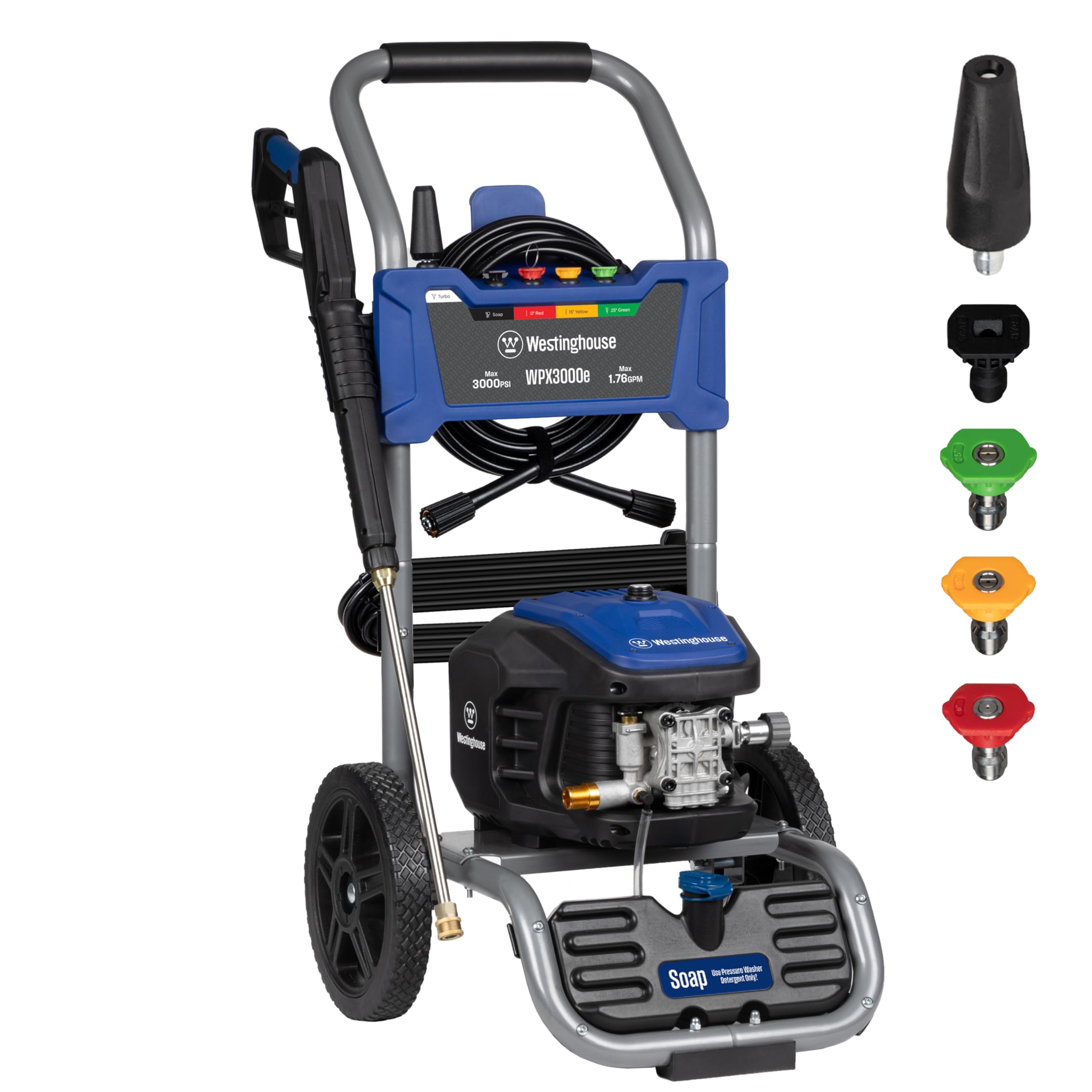
1. Westinghouse WPX3000e Electric Pressure Washer
Our pick — over 4.5★ from 3,000+ verified ratings; the strongest balance of quality and price.
The 3000 PSI workhorse that makes a gas-powered engine feel like a luxury you no longer need.
This is the machine you want when a 1800 PSI unit leaves you staring at a dirty driveway. It pushes out 3000 max PSI and 1.76 max GPM (at lowest pressure), at 3000 PSI versus the Greenworks 1800’s 1800 PSI — the kind of jump that turns a two-hour scrubbing session into a 30-minute rinse. That force comes from a heavy-duty AC 120V induction motor driving a maintenance-free axial 3-piston pump, so it keeps working without the upkeep of a gas engine.
You rarely have to stop and reposition, because the 25-foot abrasion-resistant hose and 35-foot GFCI cord give you a wide radius from one spot. The rugged steel frame rolls on high-profile 10-inch never-flat wheels that handle grass and gravel without sinking. Owners note it’s easy to assemble — most have it running in about 20 minutes — and one called out that it outperforms a Ryobi 2300 that lasted four years.
The.45-gallon onboard soap tank means you can apply detergent without a separate applicator, and the five quick-connect nozzles (0°, 15°, 25°, soap, and turbo) cover everything from a pinpoint jet to a foamy clean. Buyers report it strips mildew from siding and leaves dirty stone pavers looking new, all while staying quieter than gas alternatives. The trade-off is physical: at 36.8 pounds, it’s a heavy machine and demands storage space.
Why owners praise it
- Assembly tops the list — over a thousand owners highlight how simple the setup is
- The build quality gets near-unanimous praise, with buyers calling it solid and durable
- Effectiveness on concrete, siding, and decks is a recurring theme in reviews
The honest trade-offs
- At 36.8 pounds, it’s a heavy machine to haul up stairs or lift into a truck bed
- Its footprint is larger than the compact Greenworks 1800 — plan your garage space
Best for: homeowners with big concrete areas, decks, fencing, or siding who want gas-level results without gas maintenance.
Think twice if: you need something you can lift into a small car or store in a tight closet — this one needs floor space.
2. Greenworks 3000 PSI (2.0 GPM Max) Brushless Electric Pressure Washer
The brushless 14-amp motor delivers 3000 PSI that owners say rivals a gas unit.
Greenworks grabbed the top-tier electric slot with a TruBrushless 14 Amp motor that generates 3000 PSI and 2.0 GPM — numbers verified by an independent lab, so what you see is what you actually get. That combination yields roughly 3300 Cleaning Units, the true gauge of cleaning speed. Owners mention it hits 3100 PSI at full pressure, matching the performance of their old gas unit.
The JETTFLOW technology is the hidden hero here — it helps you reach higher areas and rinse quicker without dragging the machine closer. It comes with a rugged metal gun and a 25-foot Uberflex kink-resistant hose that stays flexible in use. The 15°, 25°, and 40° tips plus soap and turbo nozzles cover most home jobs from the start.
There’s less noise than you’d expect from a machine with this much output. One owner ran it 10 hours straight and called it indestructible. — and even a leaky soap dispenser was fixed by the company sending a whole replacement machine. The recurring note is that a 14-inch surface washer pairs perfectly with it, letting you clean a driveway standing upright rather than hunched over.
Who it beats: it outflows the Westinghouse WPX3000e on water volume — 2.0 GPM versus 1.76 GPM — which means faster rinsing on large flat areas.
The one caveat: durability gets mixed feedback in reviews, and its huge 35.43-inch width footprint takes up serious garage real estate.
Reach for this if: you want verified 3000 PSI power and the fastest rinsing flow available in an electric unit.
Look elsewhere if: you have a compact storage space — this is a wide machine that needs a dedicated corner.
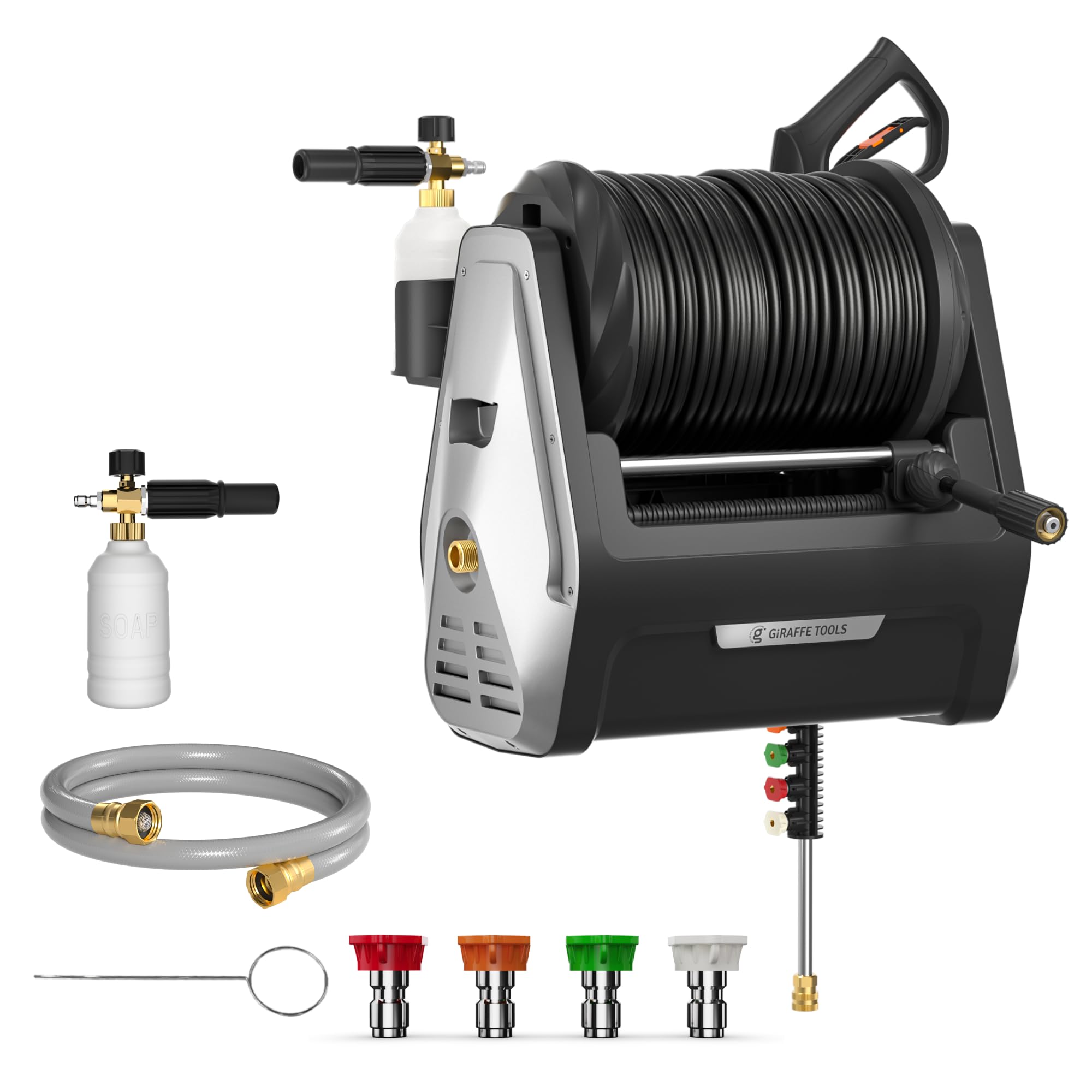
3. Giraffe Tools Wall Mounted Pressure Washer Essential 100FT
Mount it on the wall, pull out 100 feet of hose, and never drag a machine around your property again.
This is the most different design on the list: a wall-mounted washer that means no assembly, no rolling a heavy cart out of the garage, and no tripping over a hose. The 1800W induction motor produces up to 2900 PSI and 2.2 GPM — the highest flow rate here, tied with no one — for stubborn grime like tar, grease, and oil stains. The retractable 100-foot pressure hose is the headline feature: it rewinds automatically, comes from three layers of explosion-proof composite material, and stays flexible in extreme temperatures from 32°F up to 104°F.
Owners are most vocal about hose quality — the 100-foot line is heavy-duty, leak-proof, and ends in durable brass connectors that thread easily and don’t leak. The Total Stop System (TSS) automatically shuts the pump off when you release the trigger, which saves energy and extends the pump’s life. It ships with 4 quick-connect nozzles (0°, 15°, 25°, 40°) and a foam cannon for a rich lather on cars or verandas.
The catch is that you need a wall to mount it on, ideally near a water source and outdoor outlet. One owner noted the unit feels a bit cheap in places, and the pressure doesn’t quite match the advertised number. But the convenience of a permanent setup — versus unpacking and hooking up a portable unit every time — won over most reviewers. At 46.7 pounds mounted, it’s not going anywhere once installed.
The winning move: the 100-foot retractable hose is the longest anywhere on this list — at 100 feet versus the Westinghouse 3000e’s 25-foot hose, with built-in storage that prevents kinking.
The honest limit: reviews are split on whether the pressure matches the 2900 PSI claim, and the inexpensive supply line is a common complaint.
Best for: homeowners with a permanent garage setup who wash cars, fences, and patios frequently and hate unpacking gear.
skip it if: you rent and can’t mount anything on the wall — this isn’t a move-around machine.
4. Westinghouse WPX2700e Electric Pressure Washer

A 2700 PSI sibling to our top pick that trims the price without gutting the power.
If the WPX3000e is the flagship, this is the smart-money version of the same idea. It delivers 2700 max PSI and 1.76 max GPM driven by a high-performance 13A induction motor — the same durable motor family as its bigger sibling, at a slightly lower peak pressure. Owners find it plenty strong for decks, siding, cars, and concrete, with one noting it beats an old 20-year gas model on both ease and storage. Assembly runs about 10-15 minutes from the start.
The built-in.42-gallon soap tank and 25-foot super-flex hose mean you apply detergent and rinse from the same station. Five quick-connect nozzles (0°, 15°, 25°, turbo, and soap) give you the range to go from a fine mist to a heavy blast. The rugged steel frame and 10-inch never-flat wheels roll over grass and rocks easily, and the cart handle removes without tools when you want to tuck it away.
There is a real durability theme in the reviews — owners describe it as sturdy and heavy-duty, with assembly being the single most praised aspect. One careful note: the yellow 15° nozzle is powerful enough to splinter wood if you hold it too close or at an angle, so slow, perpendicular passes at a few inches are the trick on soft surfaces. The 3-year limited warranty with nationwide service is the same backing you get on the bigger unit.
What wins people over
- Assembly is the most-praised feature — setup takes roughly 10 to 15 minutes
- Quality and build draw strong praise, with owners calling it solid and durable
- Performance on patio pavers, sidewalks, and porches is a recurring highlight
What to watch
- One owner wished the soap dispenser had a valve to switch to plain rinse without draining it
- Re-rolling the pressure hose onto its hanger is reportedly the hardest part of the day
Reach for this if: you want 2700 PSI versus our top pick’s 3000 PSI for a lower sticker price.
Consider the 3000e instead if: max PSI is your priority — this one caps out 300 PSI lower.
5. Sun Joe Pressure Washer SPX3000
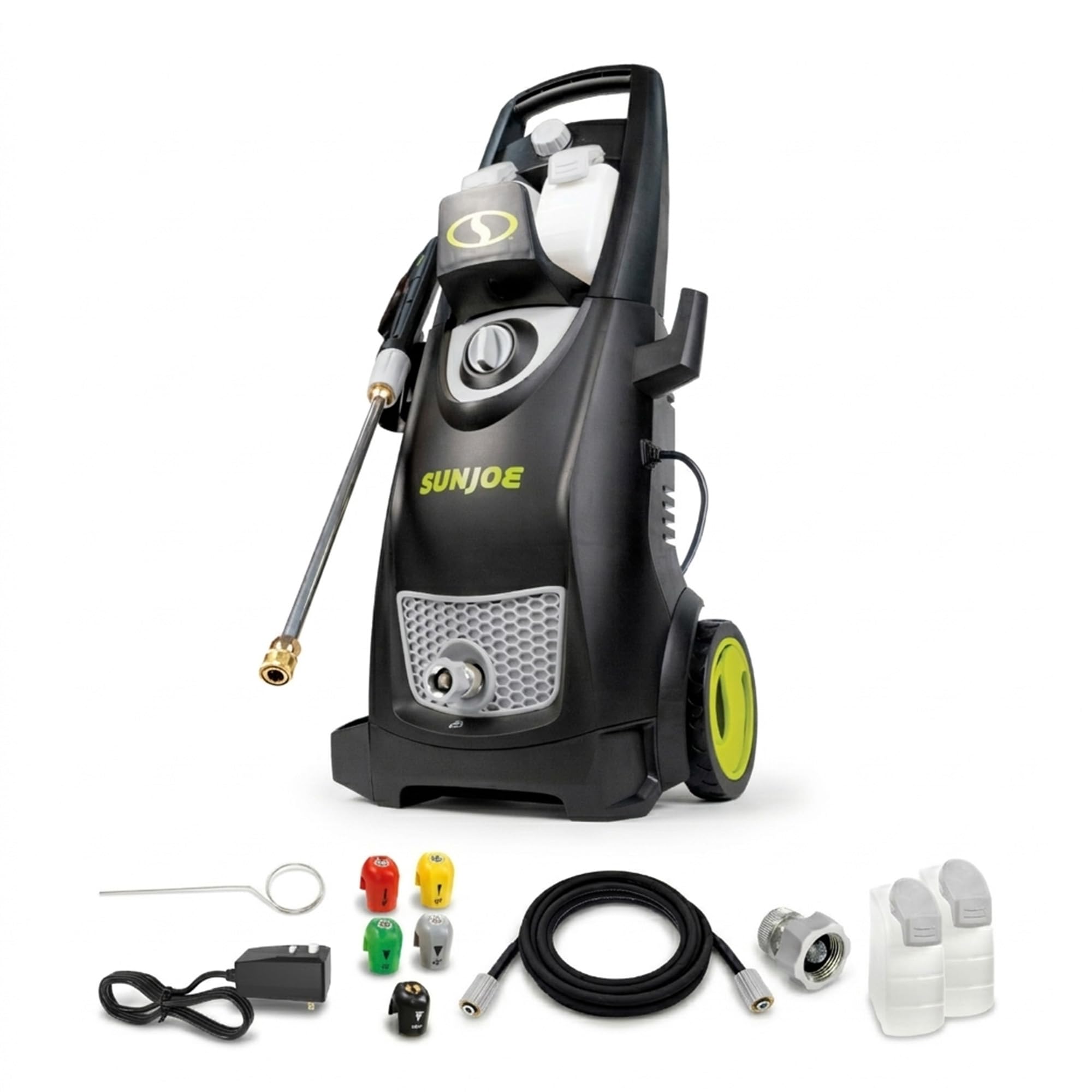
The crowd-favorite Sun Joe that owners call near-gas on concrete — at a fraction of the price and noise.
Few electric washers have the track record of this one. The SPX3000 delivers up to 2030 PSI working pressure (a PWMA-rated number, more honest than a max-PSI claim) with 1.2 GPM flow, and owners say it’s powerful enough to clean concrete slabs and strip mildew from fences. The Total Stop System shuts the motor off when you release the trigger, saving wear, and the GFCI cord keeps you protected. It’s quiet enough that a 5-hour run feels entirely normal.
The defining feature is the dual 0.9L detergent tank system — two onboard tanks that let you store separate cleaning solutions and switch between a degreaser and a car soap without emptying anything. The 34-inch stainless steel spray lance with brass fittings feels tougher than the plastic wands on cheaper units, and the 20-foot hose plus 5 quick-connect tips (0°, 15°, 25°, 40°, soap) cover almost any task. At 24.3 pounds it’s still light enough to haul around a yard.
Customers note it still runs strong after three years, though some note the front water connection can leak and needs re-tightening. The stiff hose is hard to roll up, and the assembly diagrams have been called confusing — a 30-minute job for first-timers. But for general home use — cars, light concrete, siding — the value is tough to top, and the 2-year warranty backs it.
Why it’s a legend: performance is the single most-discussed aspect by a wide margin — thousands of owners confirm it handles patios, sidewalks, and fences with ease.
The caveat: at 2030 PSI, it can’t match the sheer stripping power of the 3000 PSI Westinghouse units above — so it’s best for general cleaning, not heavy paint or stain removal.
Best for: owners who want one machine that does everything from car washes to fence cleaning without a big investment.
Think twice if: you need maximum pressure for stubborn concrete stains — the Westinghouse 3000e hits higher PSI.
6. CAT Electric Pressure Washer 1800 PSI

An 1800-watt motor with a patented 5-piston pump that car detailers rave about.
This CAT-branded unit is built around one unusual spec: a patented aluminum 5-piston pump instead of the standard 3-piston design. The maker claims a power boost, better cleaning efficiency, and less vibration versus a standard 3-piston pump — and owners describe it as noticeably smoother and quieter. An 1800-watt motor pushes it to a peak of 1800 PSI with a high water flow of 2.0 GPM, which gives it roughly 3600 cleaning units of output.
That flow rate is the real strengths — it’s the same 2.0 GPM you get on the premium Greenworks, at a fraction of the price. Car detailers are the typical happy owner: the included 600ml detergent foam blaster and the 4 quick-connect nozzles (0°, 15°, 25°, 40°) make soap-and-rinse cycles quick. The 20-foot real rubber hose (M22-15mm) resists kinking, and the metal lance and gun feel tougher than the plastic wands on budget units. A 35-foot electric cord with GFCI gives good reach.
Owners note a few quirks: the GFCI plug needs a reset before each use, the soap drains fast, and the output connections can seize when hot. One long-term owner called it reliable for two years and perfect for preserving vehicle paint, while admitting it won’t strip paint or heavy equipment — you’d need gas for that. There’s a 2-year residential warranty backing the full unit and all accessories.
Why it stands out
- Its 2.0 GPM flow matches the premium Greenworks 3000 for fast rinsing at a lower price
- Fits small trunks — a rare portable detailer’s machine
- Owners describe it as quiet, compact, and ideal for vehicle paint preservation
Owner notes
- GFCI plug needs a reset before every use, per multiple buyers
- Pressure is weaker than some hoped — adequate for electric but not gas-level
Reach for this if: you’re a car enthusiast who wants a portable, quiet machine with generous water flow for foam-and-rinse washes.
Look elsewhere if: you’re tackling stubborn concrete stains — 1800 PSI is a light-to-medium duty ceiling.
7. Kärcher Electric Pressure Washer K1800PS

A German-engineered 1800 PSI washer with an on/off foot switch that saves your back.
Kärcher is a name that commands respect in the cleaning world, and the K1800PS earns it with thoughtful touches. The 1800 PSI TruPressure output is CETA certified (independently tested by the Cleaning Equipment Trade Association), so the number is verified, not marketing. Its 1.2 GPM flow is modest, but owners find it adequate for patios, driveways, and trucks. The standout usability feature is an on/off foot switch — you kick the machine on and off without bending down, a genuine back-saver.
The unit automatically stops when you release the trigger, and the 0.5-gallon detergent tank makes soap application easy. Three nozzles (15°, turbo, and 65°) cover the range from a precise jet to a wide, gentle fan. Never-flat wheels roll across varied terrain, and at 24.1 pounds it’s not a burden to move. It stores compactly, which owners frequently mention as a selling point over bulkier machines.
Reviews are warm on both ease of use and value — one owner replaced an Harbor Freight unit and called the 5-minute assembly and cleaning results a clear upgrade. The recurring caveats: it’s not designed for large spaces (one owner cleaned an algae-heavy carport in sections over days), and heavy stains need a degreaser. There was also a note about the input water connector leaking on one unit. The 2-year limited warranty covers it.
The smart touch: the foot switch and auto-stop trigger are the features owners single out as most convenient — no bending, no wasted energy.
The fair warning: 1.2 GPM is light on flow, so it’s best for medium jobs like a carport or patio, not a whole-house marathon.
Best for: buyers who value ergonomics and verified performance over raw PSI numbers.
Consider a higher-PSI unit if: you’re facing years-old concrete stains that need maximum stripping force.
8. RYOBI 1800 PSI Electric Pressure Washer

A compact 16-pound RYOBI that makes car detailing and light concrete work easy.
At just 16 pounds, this is one of the lightest machines on the list, and it fills a specific niche: light-duty residential work where convenience beats raw power. It pushes 1800 PSI at 1.2 GPM, which owners find ideal for car detailing, cleaning bins, sidewalks, and siding. One detailer noted it outperforms the bucket method on heavy patio stains, and another praised it for removing bird poop and leaves from cars and siding without drama.
The convenience contrast with gas is the thread running through nearly every review — no pull cord, no fuel mix, no noise complaints. Buyers repeatedly mention how compact it is, with the 20-foot hose and corded-electric power source (CSA certified) keeping setup simple. It comes with a 15° nozzle, soap nozzle, and turbo nozzle plus a spray wand, enough to get started without extra purchases.
The honest trade-off: it delivers the advertised 1800 PSI, but owners admit it lacks power for tough, stuck-on grime. One reviewer called it “excellent, if underpowered,” ideal for light tasks but not for professional or heavy-duty use. The foam cannon and wand draw mixed opinions — some buyers swap in quick connects for easier tool changes. Durability gets mixed feedback too, with a small number reporting early failures, so the optional extended warranty is worth considering.
Why it earns its spot: reliability is the most-mentioned aspect, and the sheer convenience over gas — “nonpareil,” as one owner put it — wins people over.
The limit: for stripped paint, heavy machinery, or years of ground-in grime, this isn’t the tool — that’s a job for 2700+ PSI.
Reach for this if: you want a featherweight washer for cars, bikes, bins, and light sidewalk work.
pass on it if: your driveway looks like a construction site — you need more pressure and flow.
9. Greenworks 1800 PSI (1.1 GPM) Electric Pressure Washer

A 16-pound pocket rocket that runs 3 hours straight without overheating or struggling.
The recurring review theme is endurance: “3hr continuous use no overheating/struggle” is a real owner quote., and it sums up the appeal of this little Greenworks. At 1800 PSI and 1.1 GPM, it’s the entry point of the lineup, but it’s far from weak. Owners have used it to clean houses, walkways, and decks effectively, with one noting it delivered “crazy value” across a driveway, fence, and cars. The push-button start and no-maintenance design (no gas, oil, spark plugs, or pull cord) make it genuinely zero-fuss.
The 35-foot power cord with a built-in GFCI plug auto-shuts off power for safety, and the 20-foot tangle-free hose gives a decent working radius. The 1/4-inch universal quick-connect system means you can swap in third-party accessories like a soap bottle or sprayer extension — one owner ran it successfully with a 100-foot hose. It comes with a 40° nozzle for gentle cleaning, a turbo nozzle for heavy-duty work, and a soap applicator.
It’s not without flaws: durability gets mixed feedback, with a few owners reporting breakage after a few months of use. One reviewer noted a constant leak at the water inlet and plastic components that feel less premium. The 3-year limited warranty offers some protection, and the lightweight 16-pound design with a carry handle makes it easy to haul anywhere. Buyers describe it as “very powerful for its size” — a fair summary of this budget champ.
What impresses
- Functionality is the top-praised aspect — owners call it “small and amazing”
- Its 3-hour continuous run without overheating is a standout for a budget unit.
- Portability and compact size are consistently praised
Where it cuts corners
- Durability draws mixed reviews, with some units failing after a few months
- Plastic hose and wand feel less sturdy than metal components on pricier models
Best for: first-time buyers who want a cheap, capable machine for light home cleaning and don’t need heavy-duty power.
Think twice if: you expect years of weekly heavy use — step up to the Westinghouse 2700e for a sturdier build.
Understanding the Specs
PSI vs GPM: the cleaning math
PSI (pounds per square inch) is the force of the water — it’s what strips dirt off. GPM (gallons per minute) is the volume of water — it’s what rinses and covers area. Multiply them together and you get Cleaning Units, the real measure of speed. A 3000 PSI machine with 1.1 GPM cleans slower than a 2000 PSI machine with 2.0 GPM on a big flat driveway, because the water volume sweeps dirt away faster.
Induction vs universal motors
The motor type is the biggest predictor of lifespan. Induction motors (found on premium models like the Westinghouse units) run cooler, vibrate less, and typically last far longer than the universal motors on budget machines. They’re heavier, but they’re the reason some electric washers still work after years of heavy use. A Total Stop System (TSS) also helps — it kills the motor when you release the trigger, reducing wear and saving energy.
Hose length and wheels: your reach and mobility
Hose length determines how far you can clean from a fixed machine position. A 25-foot hose with a 35-foot cord means a 60-foot working radius without moving the unit — ideal for a full car wash. Wheels matter too: 10-inch never-flat wheels roll over grass and gravel, while small plastic wheels get stuck. If you plan to move the washer around a large yard, wheels are not an afterthought.
Nozzles and soap systems
The right nozzle makes the difference between a clean surface and a damaged one. A 0° nozzle is a razor jet for stubborn grime — it can cut into wood if held too close. A 40° nozzle spreads water for gentle rinsing. Soap tanks are the unsung hero: an onboard tank lets you apply detergent without swapping tools, and dual tanks let you switch between solutions, like a degreaser for the driveway and a car soap for the vehicle.
FAQ
Is an electric pressure washer as powerful as a gas one?
What PSI do I need to clean a concrete driveway?
Can I use an extension cord with my electric pressure washer?
How long does an electric pressure washer last?
What is a GFCI plug and why does it matter?
What is the difference between 1800 PSI and 3000 PSI?
Do I need a foam cannon or soap tank?
Can a pressure washer damage my car paint?
What does wall-mounted mean and who should buy one?
How much water does an electric pressure washer use?
Final Thoughts: The Verdict
Across the board, the best electric power washers winner is the Westinghouse WPX3000e because it combines 3000 PSI power, a rugged build, and a 3-year warranty that few rivals match. If you want absolute top-end flow and verified specs, grab the Greenworks 3000 PSI. And for the cleanest garage setup, the Giraffe Tools Wall Mounted — with its 100-foot retractable hose — is hands-down the easiest machine on this list.
How We Picked
We do not accept paid placement. Every pick is matched to a real buyer and a real use-case; we do not hands-on test units.
Sources & Methodology
Specifications: manufacturer listings and product documentation. Review insights: verified customer reviews, as of August 2026. Pricing: not shown on this page (it changes often); check the current price via the retailer link.
As an Amazon Associate, WellFizz earns from qualifying purchases. This does not affect which products we feature.
Related Guides

Mo Maruf
I created WellFizz to bridge the gap between vague wellness advice and actionable solutions. My mission is simple: to decode the research and give you practical tools you can actually use.
Beyond the data, I am a passionate traveler. I believe that stepping away from the screen to explore new environments is essential for mental clarity and physical vitality.