Our readers keep the lights on and my smoothie glass nicely filled. As an Amazon Associate, I earn from qualifying purchases.
Specs are compiled from manufacturer listings and verified buyer reviews and can change over time — please confirm the key details on the product page before buying.
Swinging a maul leaves you sore, and gas splitters bring fumes, noise, and carburetor headaches. An electric log splitter delivers hydraulic muscle to bust through oak rounds without exhaust, pull-cord frustration, or earplugs. The right model delivers the force, speed, and durability for the wood you burn without introducing new headaches.
I’m Mohammad Maruf — the founder and writer behind WellFizz. This guide is built by comparing the manufacturers’ published specifications and the patterns across verified customer reviews, so you get each pick’s real strengths and trade-offs instead of marketing spin.
These nine models cover the range of what a homeowner needs, from the value-driven 6.5-ton crowd-pleaser to the 8-ton vertical behemoth — the right electric log splitter for your yard is the one that matches the wood you split and the space you store it.
Our Picks at a Glance

How To Choose The Best Electric Log Splitter
Electric log splitters are simpler than gas models, but tonnage, cycle time, and log length determine if yours is a trusty tool or a frustrating toy. Start with the wood you typically burn and how much of it you process each season.
Splitting Force (Tonnage)
The tonnage rating tells you how much hydraulic pressure the ram pushes against the log. A 5-ton unit handles softwoods and smaller rounds (up to about 8 inches across). Jump to 6.5 or 7 tons, and you can crack seasoned oak, maple, and elm up to 10 or 12 inches in diameter. Go much beyond that — knotty wood, large-diameter rounds — and an 8-ton vertical splitter becomes a real help.
Cycle Time and Log Length
Cycle time is the seconds it takes the ram to extend, split, and retract. Faster cycles (around 12–15 seconds) keep you moving without long pauses. Max log length is another gate: most electric models accept up to 20.5 inches, but a few stretch to 21.2 inches. If you cut your firewood longer, check this number first.
Portability and Setup
Weight ranges from roughly 98 to 169 pounds, so wheels are essential. Look for never-flat tires and a pull handle that does not feel flimsy. A sturdy stand raises the splitter to a comfortable working height — without it, you are bending over each time, which defeats the purpose of ditching the axe.
Quick Comparison
| Model | Best For | Splitting Force | Max Log Length | Item Weight | Amazon |
|---|---|---|---|---|---|
| WEN 56208★ Best Overall | Best Overall Value | 6.5 ton | 20.5 in | 118.7 lb | Amazon |
| PROYAMA 7T7-Ton Power | 7-Ton Power on a Budget | 7 ton | 20.5 in | 110 lb | Amazon |
| PowerSmart 6.5-TonBuddy Light | Light-Duty Portability | 6.5 ton | 20 in | 97.7 lb | Amazon |
| YARDMAX YS0650 | Speed & One-Handed Use | 6.5 ton | 20.5 in | 104.7 lb | Amazon |
| VEVOR ELS106S | Compact & Quiet Green Power | 6 ton | 20 in | 99.2 lb | Amazon |
| BILT HARD 6.5T | Heavy Home-Use Performer | 6.5 ton | 20.5 in | 114.6 lb | Amazon |
| PPOLB PPWS-0001 | 7-Ton Oversized Logs | 7 ton | 21.2 in | 108 lb | Amazon |
| Boss EC5T20 | One-Handed Operation | 5 ton | 20 in | 104 lb | Amazon |
| Powerhorse 8-Ton | Heavy & Vertical Splitting | 8 ton | — | 169.4 lb | Amazon |
In‑Depth Reviews
1. WEN Electric Log Splitter (56208)
Our pick — over 4.5★ from 650+ verified ratings; the strongest balance of quality and price.
The 118.7-pound workhorse that owners call “the grace of a ballerina and the power of a wrestler.”
This is the crowd favorite for a reason — 6.5 tons of splitting force through a 15-amp motor that walks right through dry ash and apple wood, even busting through knots that would stop a lesser machine. You get a removable 34-inch stand so you can work at a comfortable height or drop the unit down for storage under a bench. The 5.5-inch never-flat wheels and pull handle make it genuinely mobile despite its weight, and the electric motor means zero gas fumes and near-silent operation compared to a gas splitter.
The WEN handles 20.5-inch logs and 10-inch diameters, with buyers reporting it “splits logs well except knotty ones” with twisted grain. A few owners note the retaining stop can loosen during use; checking it every few splits keeps things running smoothly. At 118.7 pounds it is the heaviest 6.5-ton unit on this list, but that heft also means a sturdy, planted feel when you are feeding it rounds.
Real-world muscle: For most homeowners processing a few cords of mixed hardwood a year, this splitter delivers the right balance of power, price, and portability — no gas can needed.
Reach for this if: you want the most-proven, highest-rated 6.5-ton electric splitter on the market, with over 660 owners backing its performance.
Think twice if: you split mostly twisted, knotty elm or green oak — a 7-ton unit may push through those easier.
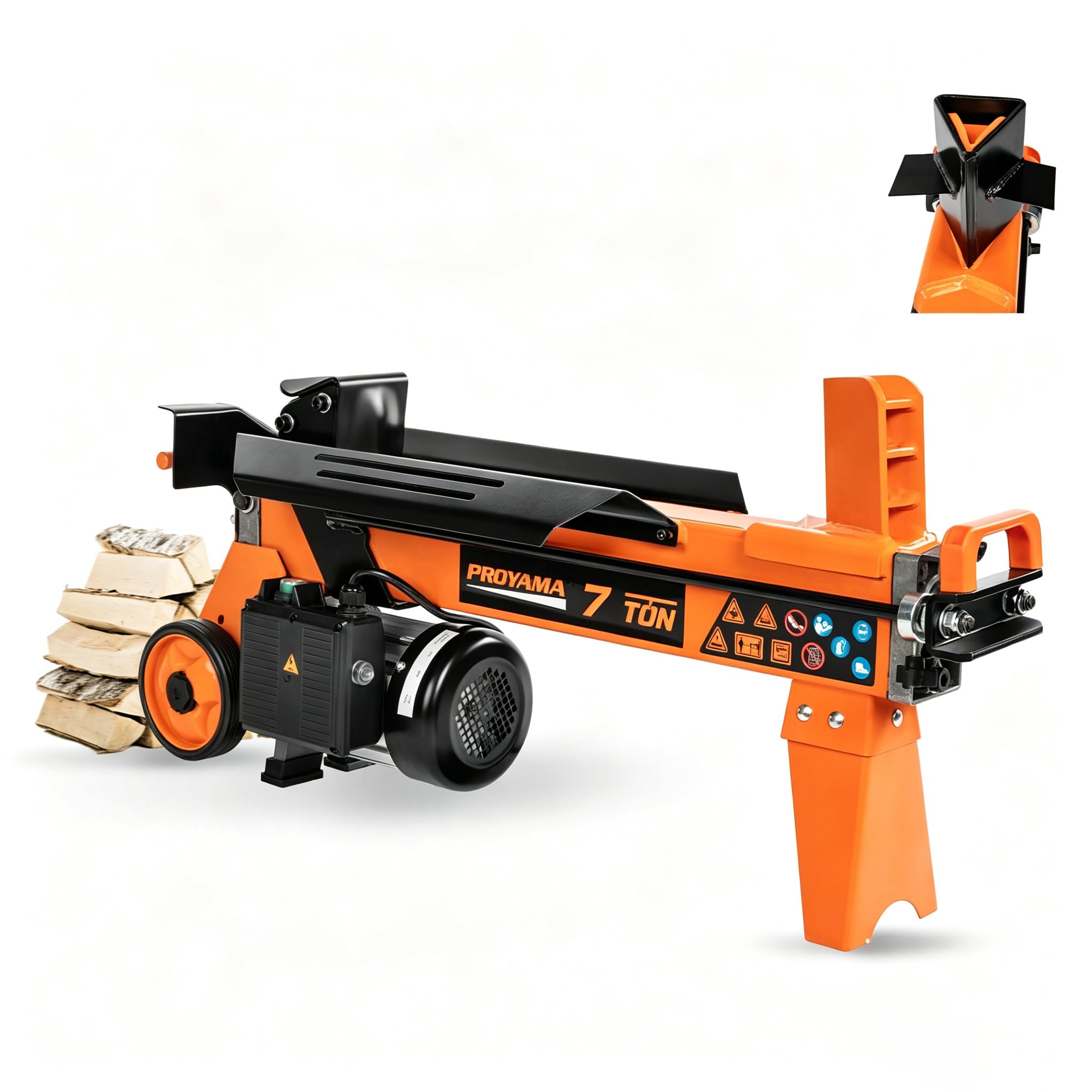
2. PROYAMA 7T Electric Log Splitter
The 7-ton firecracker that quarters 12-inch logs in under a minute.
Where the WEN delivers 6.5 tons, this PROYAMA jumps to a full 7 tons from a 2700-watt (essentially 15-amp) motor — that matters when you hit stringy oak or knotty maple. Owners are blunt: “12 inch logs quartered in a minute.” The electric operation means no smog, no fumes, and it is quiet enough to run without earplugs. The two-hand safety controls are a real comfort, preventing accidental starts while you load.
The stand improve the splitter to 34 inches, which saves your lower back during long sessions. At 110 pounds it is about 9 pounds lighter than the WEN, and the 5.5-inch never-flat wheels make rolling across grass manageable. A handful of owners flag that the narrow base can feel tippy on uneven ground — a pair of homemade stabilizer legs solves it. Performance is the clear star here, not portability.
Fast and strong: If you split mostly hardwoods and want the extra ton of force without jumping to a premium price, this is the better-value 7-ton pick.
Best for: homeowners who face tough oak, maple, and elm regularly and want a 7-ton machine that does not cost like one.
skip it if: you need the widest, most stable footprint — this one benefits from a flat, level worksite.
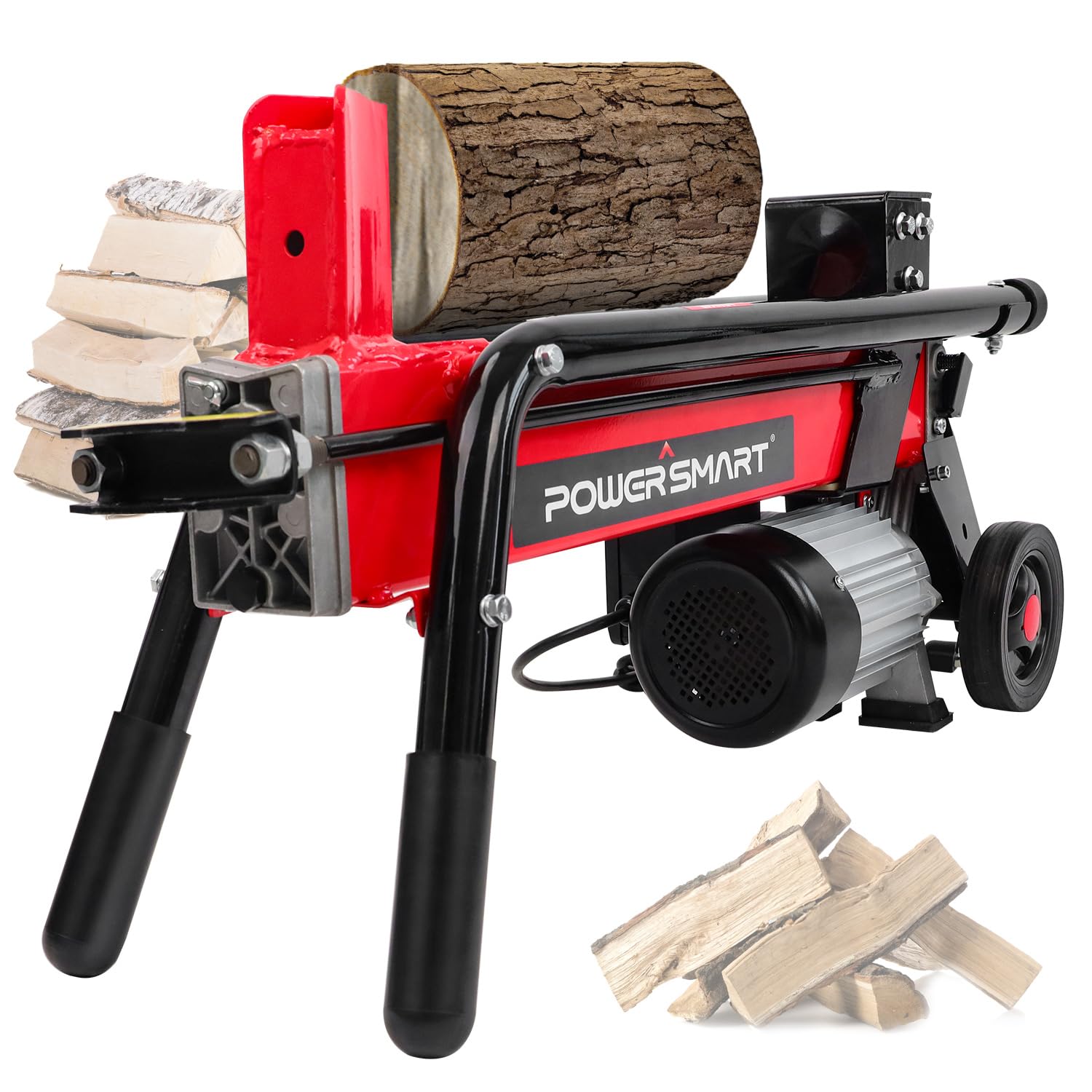
3. PowerSmart Electric Log Splitter
The lightest 6.5-ton splitter on the list at just 97.7 pounds, built to move.
The cycle time runs about 20 seconds per split, which is on the slower side but still faster than swinging a maul 20 times. Buyers praise its straightforward, no-assembly-required setup.
The honest trade-off: a small number of buyers report the motor stopping prematurely (one wrote “log splitter motor run only 45 minutes and stopped running”), which makes the two-year warranty worth noting. For light-duty home use — splitting a cord or two of seasoned wood per season — the PowerSmart works flawlessly for most. It is plainly designed for intermittent duty, not marathon weekend sessions.
Why it wins
- Lightest 6.5-ton unit at 97.7 lb — easiest to move and store
- No assembly needed, ready to use from the start
- Wide rear wheels handle sand and mud well
The catch
- 20-second cycle time is slower than the 12–15 sec of some competitors
- Motor longevity is a question mark for heavy use — a few owners hit trouble early
Take it if: you need a 6.5-ton splitter you can easily haul to a remote woodpile or store in a tight garage.
Look elsewhere if: you plan to run it all weekend splitting several cords — the WEN or BILT HARD handle sustained use better.
4. YARDMAX YS0650 6.5 Ton Electric Log Splitter

An 18-second cycle time that turns a cord of oak into firewood in 30 minutes flat.
YARDMAX packs a 6.5-ton ram and a 15-amp motor into a 104.7-pound package that buyers describe as “deceptively powerful.” Where the PowerSmart takes 20 seconds per split, the YARDMAX resets in 18 seconds, and owners mention clearing a week’s worth of hardwood in a single afternoon. It handles logs up to 20.5 inches long and 10 inches in diameter — one owner split 18-inch-diameter maple with zero trouble. The one-handed operation is a real advantage: you can cradle the log with your free hand while the ram does the work.
The splitter ships pre-filled with hydraulic oil (a nice time-saver), and the manual recommends a change at 150 hours of use. A few owners note that logs can kick out sideways if the grain is irregular, so you learn to place each round with the grain aligned. The dipstick is hard to read, but that is a minor detail on an otherwise fast, capable machine.
Fastest cycle for the class: If throughput matters — you want to process wood quickly, not spend the whole day at it — the YARDMAX is one of the speediest 6.5-ton electric splitters you can buy.
Grab this for: high-volume home splitting where every minute counts.
Hold off if: you prefer a splitter with a more durable stand — the included unit gets mixed reviews for stability.
5. VEVOR Electric Log Splitter (ELS106S)
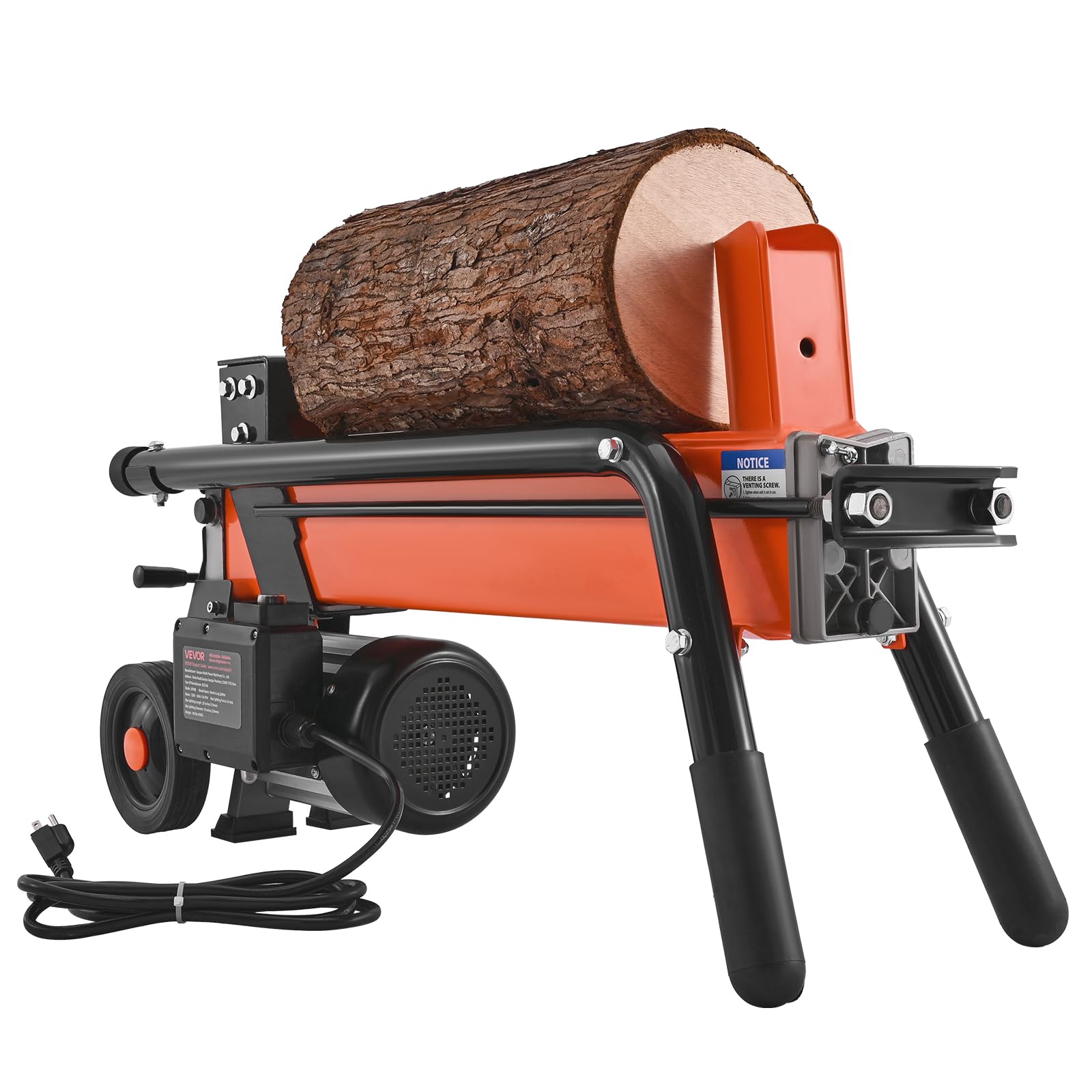
Zero-emission splitting with a 15-amp motor that runs clean and quiet.
The VEVOR steps in as the most eco-friendly option — a 1500-watt (15-amp) motor with no carbon monoxide or fumes, quiet enough for suburban lots where noise matters. It delivers 6 tons of splitting force (a tick below the 6.5-ton standard) and accepts logs up to 20 inches long and 9.8 inches in diameter. The 6-inch transport wheels and 99.2-pound frame make it easy to roll across a yard. Owners call it “tough” and say it cuts “very well for its size.”
The catch is heat management. One owner reported the unit overheating after 20 minutes in direct sunlight, then working again after a cool-down. That suggests the VEVOR is best for smaller batches — splitting a few wheelbarrow loads — rather than all-day sessions. The two-hand safety control and 50-foot extension cord guideline (3.3 mm² cross-section minimum) are smart design touches that keep operation safe.
Clean and compact: For light splitting in a garage or close to the house where fumes and noise are real concerns, this is the quietest, greenest pick.
Best suited for: occasional splitting of seasoned softwoods and modest hardwood rounds, with breaks for the motor to cool.
Not for: marathon sessions — the VEVOR needs rest where heavier units keep chugging.
6. BILT HARD 6.5 Ton Electric Log Splitter

The 114.6-pound “beast” that runs 6 hours a day for four weekends straight.
BILT HARD built this 6.5-ton splitter for endurance. The 15-amp motor and hydraulic ram handle logs up to 20.5 inches long and 9.8 inches in diameter, and owners regularly report splitting 95% of their maple and oak without complaint — one owner ran it for four straight weekends, 6 hours a day, with only routine hydraulic oil checks. The included stand raises the work surface to 33 inches, so you are not crouching. The 5.7-inch wheels roll over grass and gravel reasonably well.
What sets this apart from the WEN and YARDMAX is the build feedback: reviews say “heavy-duty,” “strong and smooth,” and “paid for itself with one face cord.” Like the WEN, it uses a two-hand safety control and a standard 120V household outlet. The recommended 40-amp circuit breaker is overkill — a 15-amp circuit works fine — but the instruction covers its bases. A few owners note that super-knotty or oversized logs can stall it, which is true of any 6.5-ton splitter.
Built for volume: If you process multiple cords each season and want a splitter that does not flinch after hour three, this is the most endurance-tested 6.5-ton unit here.
Choose this over the WEN if: you want the stand (33 vs. 34 inches) and the proven 6-hour-day track record.
Pass if: you only split a cord a year — the lighter PowerSmart or VEVOR will save your back on the move.
7. PPOLB 7 Ton Electric Log Splitter
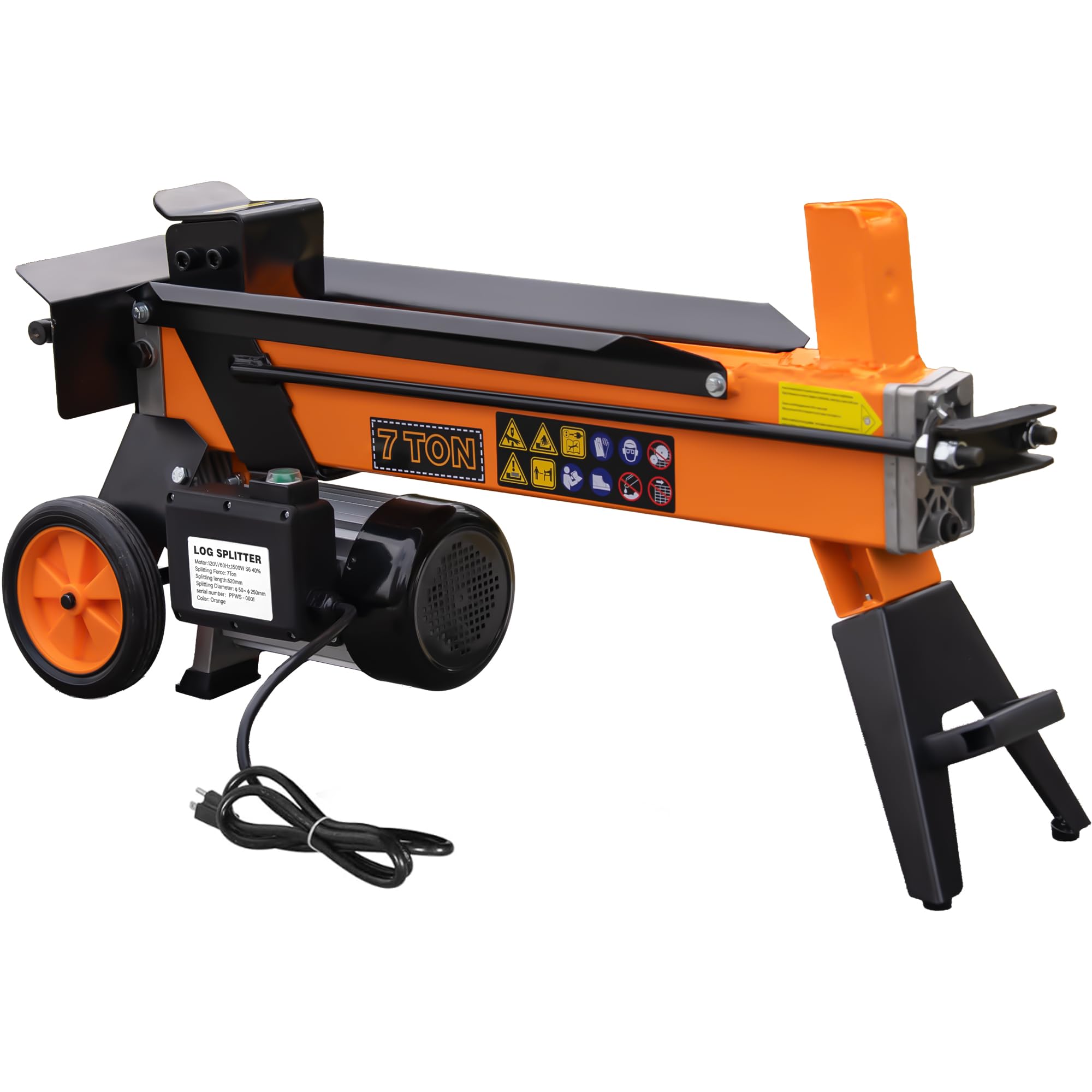
The 7-ton brute that accepts logs up to 21.2 inches — the longest in the lineup.
While most electric splitters cap out at 20 or 20.5 inches, the PPOLB stretches to 21.2 inches, meaning you can feed in slightly longer rounds without pre-cutting. The 1500-watt copper motor delivers smooth torque, and the reinforced steel frame handles logs up to 12 inches in diameter. A 75-year-old owner called it “easy to set up and use,” and another said it “beats using an axe.” That feedback matches the consensus: this is a user-friendly machine for anyone who cannot swing a maul all day.
The weak link is the wheel hardware. A few customers note that the supplied snap rings (which hold the rear wheels on) are missing or too small to install without a special tool. Some users swapped in spring clips, which is a 15-minute fix. The instructions are minimal with small diagrams, so expect to use a bit of common sense during assembly. Once running, the 7-ton ram splits even knotty wood reliably.
Long-log specialist: that extra 0.7 inch of log-length capacity makes the PPOLB the pick for anyone who cuts their firewood a bit longer than standard.
Ideal for: older homeowners or anyone who wants 7 tons of force with minimal physical effort — as one 75-year-old buyer put it, it “works great.”
Gripe to know: check the wheel snap rings at setup; some units need a quick hardware-store fix.
8. Boss Industrial EC5T20 Electric Log Splitter

One-handed operation and automatic ram return — the easiest splitter on the list to operate.
Where most electric splitters require a two-handed safety press, the Boss EC5T20 runs with a single lever — you push it forward to split, and the ram automatically returns when you let go. The single-lever operation is ideal for users with limited mobility or when your hands are full. The 1.8 HP motor delivers 5 tons of force, which is enough for 6- to 8-inch limbs and smaller rounds; one owner even split a 34-inch-diameter ash log (though that is the exception, not the rule).
The durability feedback is mixed: the unit is rugged and well-made, but a few reviewers point out the ram stopping short after a year or the power cord strain relief breaking early. Boss Industrial backs it with a 2-year residential warranty, and several owners praise their customer service for replacing parts quickly. At 104 pounds with narrow wheels, it is not the most agile on uneven ground — plan to use it on a flat driveway or patio.
Easiest operation: For anyone with arthritis, back pain, or just a desire to split wood with one hand, the Boss EC5T20 is uniquely convenient.
Reach for it if: ease of use matters more than raw tonnage — you can process a cord of mixed softwood and small hardwood without ever gripping with both hands.
pass on it if: your wood pile is mostly 10-inch-plus oak rounds — the 5-ton force will struggle where a 6.5-ton machine walks through.
9. Powerhorse Horizontal/Vertical Electric Log Splitter (8-Ton)
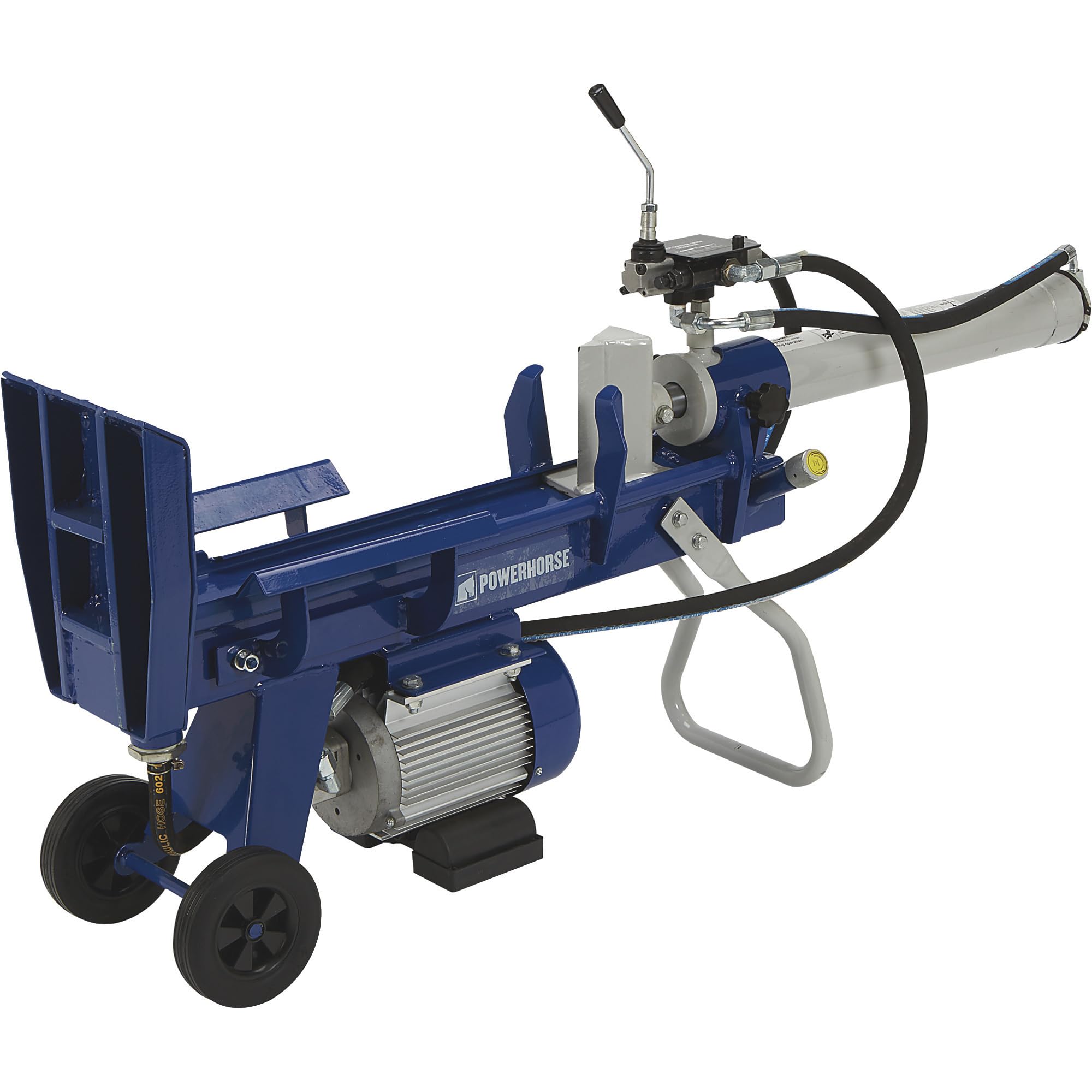
The only electric splitter here that pivots to vertical — no more lifting 24-inch rounds onto a table.
The 8-ton Powerhorse is the only electric splitter here that pivots to vertical for massive logs. It switches from horizontal to vertical mode, meaning you can roll a heavy round onto the wedge instead of hoisting it. The 15-amp, 2300-watt motor delivers enough force to split 24- to 27-inch oak logs (with some edge shaving), and one owner in Colorado uses it vertically to split rocks from their mine. The built-in log cradle catches each piece, so you are not bending over to pick up splits.
The downsides are real. At 169.4 pounds it is the heaviest splitter here by a wide margin. The plastic wheels are narrow and terrible on grass — several owners replaced them with a hand truck. Build-quality reports are split: some say “very good quality” and “splits large rounds without hesitation,” while others report bent guide rails and a control valve that arrived upside-down. The 8-ton force is class-leading in the electric category, but the execution has some rough edges that matter at this price tier.
class-leading force: If you regularly split 20-inch-plus rounds that a 6.5-ton machine would stall on, the Powerhorse is the only electric that can handle them — but expect to work through some assembly quirks.
Buy it for: the vertical-split capability that saves your back on monster logs and the 8-ton force that gas splitters have.
Pass if: you want a plug-and-play experience — this one requires patience with setup and after-sale support.
Understanding the Specs
Splitting Force (Tonnage)
The ton rating measures the hydraulic pressure the ram pushes against the log. Think of it as the machine’s muscle. A 5-ton splitter handles softwoods and small-diameter rounds (up to 8 inches), while 6.5 to 7 tons covers most seasoned hardwoods like oak and maple up to 12 inches. Move to 8 tons, and you can tackle oversized, knotty, or green wood that would stall a smaller unit. The rule is simple: if you split mostly hardwood, do not go below 6.5 tons.
Cycle Time
Cycle time is the number of seconds it takes the wedge to drive through the log and return to starting position. An 18-second cycle (like the YARDMAX) processes roughly 200 logs per hour. A 20-second cycle (like the PowerSmart) does about 180. The 18-second and 20-second cycles add up over a full cord. Faster cycles save your afternoon. If you process a lot of wood in one session, prioritize a cycle time under 20 seconds.
Max Log Length
This is the longest single log the splitter can accept before the ram pushes through. Most electric splitters stay around 20 to 20.5 inches, which matches standard firewood length. The PPOLB stretches to 21.2 inches, giving you a bit of extra room if you cut long. If the log is longer than the splitter’s rated max, you must cut it down first — a dealbreaker if you receive pre-cut wood that is 24 inches.
Portability (Weight & Wheels)
Electric splitters range from about 98 to 170 pounds. The lighter units (PowerSmart at 97.7 lb, VEVOR at 99.2 lb) roll easily across a yard with their wheels. The heavier ones (WEN at 118.7 lb, Powerhorse at 169.4 lb) are more stable during splitting but harder to move, especially over grass or gravel. Look for never-flat or wide wheels — narrow plastic tires sink into soft ground. A sturdy handle that extends past the frame helps you steer around obstacles.
FAQ
What size electric log splitter do I need for hardwood?
Can I use an extension cord with an electric log splitter?
Is an electric log splitter as fast as a gas model?
How long does an electric log splitter last?
Can I use an electric log splitter in the rain or snow?
What is the difference between horizontal and vertical log splitters?
Why do some splitters require two-hand operation?
Can I split green (unseasoned) wood with an electric splitter?
How much space do I need to store an electric log splitter?
Final Thoughts: The Verdict
For most buyers, the electric log splitter winner is the WEN 56208 because it combines proven 6.5-ton force, the highest owner satisfaction, and a removable stand for under. If you want a faster cycle time to process wood quicker, grab the YARDMAX YS0650 — its 18-second splits turn a cord of oak into firewood in half an hour. And for those who face oversized rounds and need vertical splitting, the Powerhorse 8-Ton is the one to reach for, despite its rough edges, because nothing else in the electric class matches its 8-ton force.
How We Picked
We do not accept paid placement. Every pick is matched to a real buyer and a real use-case; we do not hands-on test units.
Sources & Methodology
Specifications: manufacturer listings and product documentation. Review insights: verified customer reviews, as of July 2026. Pricing: not shown on this page (it changes often); check the current price via the retailer link.
As an Amazon Associate, WellFizz earns from qualifying purchases. This does not affect which products we feature.
Related Guides

Mo Maruf
I created WellFizz to bridge the gap between vague wellness advice and actionable solutions. My mission is simple: to decode the research and give you practical tools you can actually use.
Beyond the data, I am a passionate traveler. I believe that stepping away from the screen to explore new environments is essential for mental clarity and physical vitality.