Our readers keep the lights on and my smoothie glass nicely filled. As an Amazon Associate, I earn from qualifying purchases.
Specs are compiled from manufacturer listings and verified buyer reviews and can change over time — please confirm the key details on the product page before buying.
A dull kitchen knife is not just frustrating — it is genuinely dangerous. Slipping off a rounded edge is how most home cooks get cut, and the real fix is not a steel rod or a pull-through hand tool that works for a week. You want a machine that puts a proper, lasting edge on any blade in under a minute, with no guesswork or technique.
I’m Mohammad Maruf — the founder and writer behind WellFizz. This guide is built by comparing the manufacturers’ published specifications and the patterns across verified customer reviews, so you get each pick’s real strengths and trade-offs instead of marketing spin.
You do not need to be a chef to want a sharp knife — a dull blade makes every cut harder and more dangerous. These electric sharpeners range from a pro-grade machine that converts a standard 20-degree factory edge into a sharper 15-degree bevel down to compact units that fit in a drawer and also handle scissors.
Our Picks at a Glance


How To Choose The Best Electric Knife Sharpener
Buying an electric sharpener means choosing between speed, precision, and durability. Here is what actually matters when you read the specs.
Stages: 2 vs 3
A 2-stage sharpener has a coarse slot to grind a new edge and a fine slot to hone it. A 3-stage adds a stropping or polishing stage, which refines the edge further for a razor-like finish. If you own good German or Japanese steel, a 3-stage system gives you better long-term results. For basic kitchen knives and scissors, a good 2-stage will still make a noticeable difference.
Abrasive Type: Diamond vs Stone
Diamond abrasives are harder and cut faster than traditional corundum or stone wheels. They also run cooler, so they are less likely to overheat and ruin the temper of a thin blade. If the product data says “100% diamond abrasives”, that is a serious point in its favor for speed and longevity.
Sharpening Angle: 15-Degree vs 20-Degree
Most Western knives leave the factory with a 20-degree edge per side. Japanese knives and some premium sharpeners cut to 15 degrees, which makes the blade sharper but also slightly more delicate. Some machines let you convert a 20-degree knife to 15 degrees — a useful upgrade if you want a finer cut, but it removes more metal the first time.
Safety and Stability
A sharpener that slides across the counter is frustrating and dangerous. Look for non-slip feet or suction cups. Spring-loaded guide rods that hold the blade at a fixed angle also prevent the most common mistake — tilting the blade mid-pass and scratching or rounding the edge.
Quick Comparison
| Model | Best For | Stages | Abrasive | Edge Angle | Amazon |
|---|---|---|---|---|---|
| Chef’sChoice 15XV★ Best Overall | Pro-grade home kitchens | 3 | 100% Diamond | 15° (converts 20°) | Amazon |
| Chef’sChoice UltraHonePremium Build | All-around household use | 2 | 100% Diamond | 20° | Amazon |
| VIDOME Champagne Gold | Quick fixes & ceramic knives | 3 | 100% Diamond | 15° (converts 20°) | Amazon |
| Homly Professional | Value-focused families | 3 | 100% Diamond | 20° | Amazon |
| Enutogo 2-Stage | Basic kitchen maintenance | 2 | 100% Diamond | 20° | Amazon |
| BLACKBADGE 3-Stage | Budget-conscious cooks | 3 | 100% Diamond | 20° | Amazon |
| PREMIUS 3-in-1 | Scissors & tool sharpening | 2 | Stone | — | Amazon |
In‑Depth Reviews
1. Chef’sChoice 15XV Professional Electric Knife Sharpener
Our pick — over 4.5★ from 900+ verified ratings; the strongest balance of quality and price.
The 5-pound countertop monster that turns a 4-year-old dull blade into a razor in 5 minutes flat.
This is the sharpener serious cooks graduate to. The 15XV uses a 3-stage EdgeSelect system with 100-percent diamond abrasives on stages 1 and 2, and a patented flexible abrasive system on stage 3 to polish and prolong serrated edges. It reshapes standard 20-degree factory edges into a Trizor XV 15-degree bevel — sharper than factory on most Western knives. First-time sharpening takes about one minute; a quick touch-up takes around 10 seconds.
What wins people over is the effectiveness — it is the most-discussed aspect by a wide margin, with sharpness and sharpening performance close behind. Buyers report that it “restored a 4-year-old knife in 5 min; blunt butcher’s knife took 30 min.” The brushed metal housing (the unit weighs 5 pounds) stays cool during extended use, and the flexible spring guides hold the angle automatically so you cannot mess up the geometry. The honest trade-off is the price and size — at 12 inches long by 6.25 inches wide by 6 inches tall, it needs permanent counter space, and the investment is real. The mixed durability feedback in reviews suggests treating the diamond wheels carefully; as owners put it, this is for home use, not a commercial line.
What makes it the pro pick
- Converts 20-degree factory edges to sharper 15-degree XV edge
- 100% diamond abrasives on first two stages
- 5-pound metal construction stays put and dissipates heat
- 10-second resharpen for quick maintenance
What to consider
- Large footprint — needs 12 x 6.25 inches of counter space
- Heavier than any other pick here at 5 lb
- Manual notes 14° per side — not 15° — so check your knife’s geometry
Who this is for: Home cooks with quality steel who want a near-professional edge without learning whetstone technique and are willing to dedicate counter space.
Think twice if: You sharpen infrequently and want a quick, compact machine — the size and weight are overkill for basic maintenance, and a simpler 2-stage is cheaper and smaller.
2. Chef’sChoice Professional Electric Knife Sharpener UltraHone (2-Stage)
A lighter, simpler Chef’sChoice that still uses 100-percent diamond abrasives to beat factory sharpness.
While the 15XV above is the heavyweight, the UltraHone is the sensible middle sibling. It is a 2-stage sharpener with precision angle guides for a 20-degree straight edge and serrated knives, using 100-percent diamond abrasives in both stages. The second stage uses advanced micron-size diamonds to refine the edge further. At 16 ounces and measuring 11.81 x 3.94 x 4.25 inches, it is dramatically smaller than the 15XV — light enough to store in a drawer and pull out when needed.
What owners praise most is the sharpening performance — it handles German stainless steel (Wusthof, Henckels) with no trouble, leaving “the cutting edge as smooth as glass.” Several longtime users mention it works well for arthritic hands because there is no manual pressure or technique. The honest caveat is that durability feedback is mixed, and a number of owners mention that the guides can scratch blade sides if you are not careful. It is not a replacement for professional sharpening on high-end knives, but for weekly maintenance on everyday blades, it delivers better-than-factory results with zero learning curve.
The same brand, a different job: Unlike the 15XV, this one stays at a 20-degree edge — no angle conversion — and weighs 4.3 pounds less (16 oz vs 5 lb). Pick this if you value portability and simplicity over the 15XV’s pro-grade angle conversion.
Best suited for: Anyone who owns good stainless knives, wants a simple no-fuss electric sharpener, and needs something light enough to store in a drawer.
Look elsewhere if: You want to convert your knives to a 15-degree edge, or you are concerned about scratches on expensive German blades — use the 15XV with its metal guides instead.
3. VIDOME Electric Knife Sharpener, Champagne Gold (3-Stage)
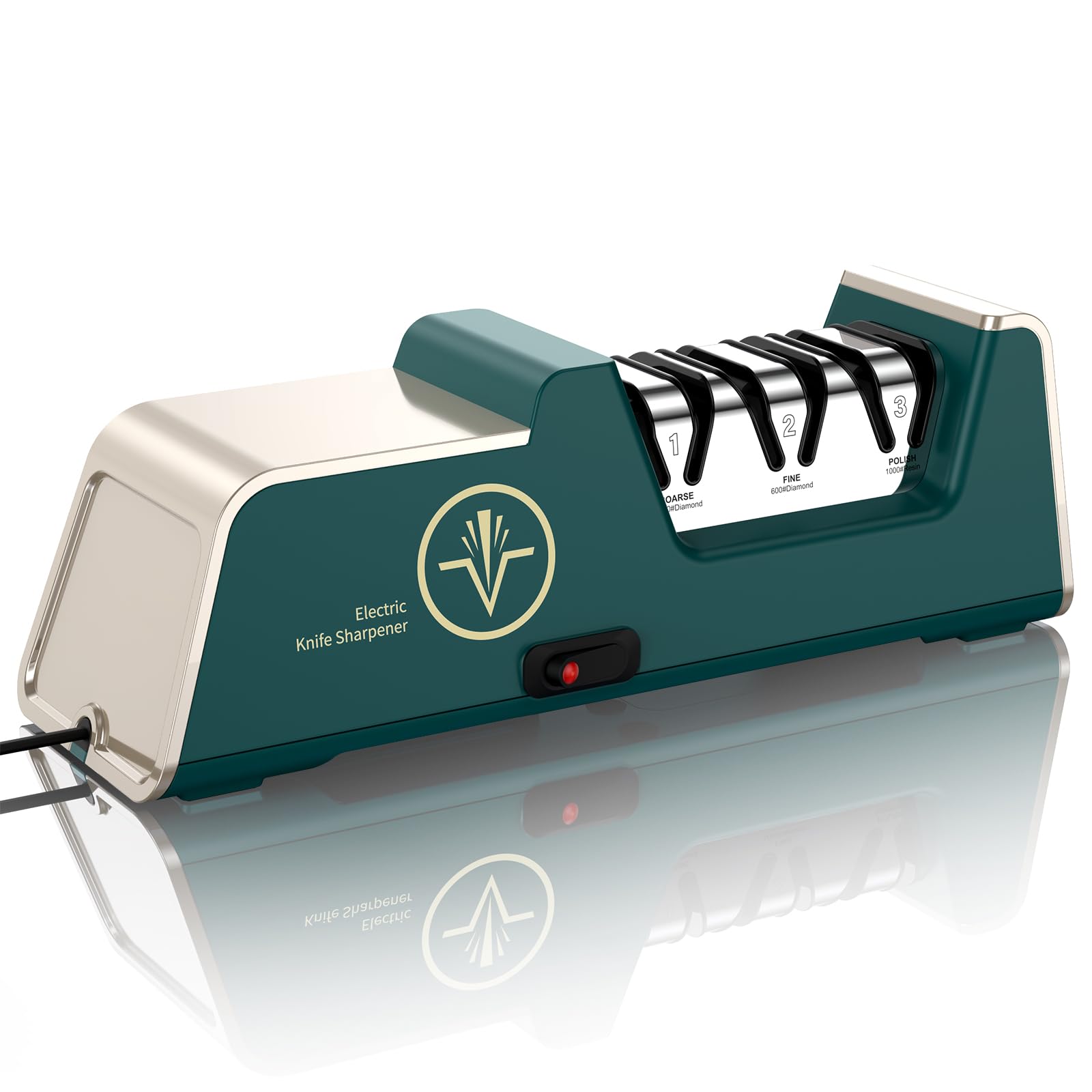
The three-stage machine that sharpens ceramic knives and looks good doing it — in about 60 seconds.
VIDOME packs a 3-stage system into a compact 3-pound frame with a champagne gold finish that stands out on the counter. Stages 1 and 2 use 100-percent diamond abrasives; stage 3 uses stropping disks to polish the blade. It creates a 15-degree edge and can convert a 20-degree knife down. The company claims a first-time sharpening time of roughly 30 seconds and a resharpen of about 10 seconds, and buyers confirm that dull German knives come back to near-like-new sharpness “in under a minute, nearly passing the paper test.”
The big surprise here is the ceramic-knife compatibility. The data explicitly states it works for ceramic knives, and reviewers confirm it revived a ceramic chef’s knife — though it struggled with a short ceramic paring knife. Effectiveness is the top-praised aspect (158 mentions), followed closely by quality (155 mentions). The catch is a design quibble: the slot layout at stage 3 is tight, making it awkward for larger blades to slide through cleanly. One owner called it “a pretty decent sharpener for kitchen knives” but noted better options exist at a similar price for pure steel-knife performance.
Strong points
- 3-stage with diamond abrasives and stropping polish
- Works on ceramic knives (unique for this list)
- Compact 3-pound build fits in a drawer
- Converts 20° edges to sharper 15°
Watch for
- Stage 3 slot is cramped for larger blades
- Did not sharpen short ceramic paring knives in testing
- Not razor-sharp — good but not pro-grade
Perfect for: Cooks who own a mix of steel and ceramic knives and want one machine that handles both without switching systems.
Not for: Anyone who needs razor-sharp edges comparable to the Chef’sChoice 15XV — this is convenient and effective, not the sharpest in class.
4. Homly Professional Electric Knife Sharpener (3-Stage)

A 3-stage diamond sharpener that outperforms more expensive machines — according to a sharpener with 60 years of experience.
The Homly offers 3-stage sharpening with 100-percent diamond abrasives on stages 1 and 2, and a polishing stage 3. It applies a 20-degree edge, suitable for most Western household knives. At 3 pounds and 12.2 x 4.8 x 4.8 inches, it is comparable in size to the Chef’sChoice UltraHone but heavier and sturdier. The double-layer shell paint and electroplating finish is purely cosmetic, but the powerful motor and noise-reducing design are genuine selling points.
Performance is the most-discussed aspect here — 161 mentions, all positive. Customers note that it sharpens “better than a more expensive device I have used up until this purchase.” A sharpener with six decades of experience gave it high marks for holding the knife firmly and producing a clean, scratch-free edge on both sides. The spring guide rods keep the blade at a consistent angle, so there is very little risk of the indent scratches that cheaper machines cause. The main trade-off is speed — moving the blade too slowly or pressing too hard can leave a slight indent. Reviews also note it works best every 4 months for maintenance, not as a daily sharpener.
Value check: At a mid-range price, you get a 3-stage diamond system with performance that reviewers point out beats pricier competitors. The only real downside is that it requires light practice to avoid blade marking on the first few uses.
Who this suits: Value-conscious cooks who want a real 3-stage diamond sharpener without paying premium-brand prices — and who don’t mind a short learning curve.
Skip if: You need a sharpener that works perfectly the very first time with zero technique — the spring guides help but some users still mark blades early on.
5. Enutogo 2-Stage Electric Knife Sharpener

A straightforward 2-stage diamond sharpener that revives dull knives without taking over your counter.
The Enutogo is a 2-stage system using 100-percent diamond abrasives for a 20-degree edge. It measures just 4.2 x 3.7 x 10.4 inches and weighs 2.7 pounds — small enough to store vertically in a cabinet. The simple on/off switch and pull-through design mean there is almost nothing to learn: insert the blade obliquely, pull through slot 1 three to six times, then repeat in slot 2. It works on straight-edge knives including chef knives, slicing knives, santoku, and paring knives.
Sharpness gets the most praise — 35 mentions — followed by sharpening performance at 29 mentions. “Bought this to make it easier to sharpen knives and it did exactly that,” one owner wrote, noting that the old hand sharpener was leaving knives duller. The honest weakness is motor performance, which received mixed marks. Some owners also note that the stone leaves tiny grooves on the blade surface that a finer stone would need to polish out. It is a solid entry-level machine, but the 2-stage limitation means you do not get the stropping polish that a third stage provides.
Why it works
- Compact vertical design — smallest footprint in this list
- 100% diamond abrasives on both stages
- Suitable for hunting knives and thicker blades
Limitations
- 2-stage — no stropping/polishing stage
- Motor performance is mixed in reviews
- Leaves small grooves that need a fine stone to remove
Reach for this if: You want a small, affordable diamond sharpener for basic kitchen maintenance without any complexity.
Think twice if: You want a polished, scratch-free edge on good knives — the 3-stage Homly or VIDOME will give you a better final finish.
6. BLACKBADGE Professional 3-Stage Electric Knife Sharpener

A 20-degree 3-stage sharpener with diamond abrasives that deliver razor results at a no-frills price.
The BLACKBADGE is among the most affordable 3-stage sharpeners on the market, using 100-percent diamond abrasives on stages 1 and 2 and resin disks on stage 3 for polishing. It applies a traditional 20-degree edge and uses flexible spring guides to hold the blade at the correct angle along its full length. The DC motor is designed to run without overheating, and the unit measures 10.43 x 3.54 x 2.76 inches, weighing 1.2 kg (roughly 2.6 pounds).
What buyers praise is the sharpening performance — 26 mentions — and the ease of use, with 12 mentions. “Makes knives sharp as a razor,” one owner wrote. The three coarseness stones provide fast, accurate results, though shoppers say that “keeping the blade edge properly oriented to the spinning stones due to blade curve” takes a little practice. For the price, it is tough to top: a full 3-stage system with diamond abrasives for less than many 2-stage models. The drawback is the build quality — the plastic and diamond-abrasive construction feels less durable than the metal-housed Chef’sChoice options.
Bottom line: The best cheap 3-stage sharpener here. It does not have the metal housing or the 15-degree conversion of the premium picks, but if you are on a budget and want three stages, this is the one.
Who this is for: Budget-minded cooks who want a 3-stage diamond system and are willing to practice a bit on the blade angle.
Not for: Anyone who wants a premium metal housing or the precision of a 15-degree edge — this is a good-value entry point, not a pro tool.
7. PREMIUS 3-in-1 Electric Knife Sharpener System

The tiny sharpener that also tackles scissors and screwdrivers — at just 5.5 x 5.5 x 3.5 inches.
The PREMIUS 3-in-1 is the most compact sharpener in this guide. It weighs only 1.5 pounds and has a retractable cord, making it easy to stash in a drawer. It uses a 2-stage system with premium grinding stones (not diamond) and has dedicated slots for knives, scissors, and screwdrivers. The non-slip suction cup base keeps it stable during use.
Buyers report that it “repaired chipped knives from a faulty built-in sharpener; restored to original sharpness” and that the scissor slot works well. The compact size and ease of use get consistent praise. The honest limitation is that it uses stone wheels rather than diamond abrasives, so it is slower and less effective on very dull or high-hardness steel. “Good for a quick honing but that’s really it,” one reviewer noted. Several units also arrived with damaged packaging, though the machine itself was undamaged. For the price, it is a capable multi-tool for a casual cook who also needs scissor sharpening, but it cannot match the diamond-based machines for speed or edge quality.
What makes it useful
- Sharpens knives, scissors, and screwdrivers in one unit
- Smallest footprint on this list (5.5 x 5.5 x 3.5 in)
- Retractable cord for easy storage
- Suction cup base holds it steady
Real trade-offs
- Stone wheels are slower than diamond abrasives
- 2-stage only — no polishing stage
- Best for quick honing, not heavy restoration
Best for: Someone who needs a single small appliance for kitchen knives, household scissors, and screwdrivers — and does not need razor-sharp edges.
Look elsewhere if: You want a serious knife sharpener for good steel — the stone wheels and 2-stage design will leave you wanting more, especially compared to the CHEF’SCHOICE 15XV or the Homly above.
Understanding the Specs
Sharpening Stages
A 2-stage system uses a coarse wheel to grind a new edge and a fine wheel to hone it. A 3-stage adds a stropping or polishing wheel for a razor-like finish. For most home cooks, a good 2-stage is enough to keep knives sharp. If you own high-end steel and want a polished edge, go with 3-stage.
Diamond Abrasives
Diamond abrasives are the hardest natural substance on earth — they cut faster and stay cooler than traditional stone wheels. This means less heat buildup, which protects the temper of thin blades. Any sharpener that says “100% diamond abrasives” will generally outperform one with standard grinding stones.
Sharpening Angle (15° vs 20°)
Most Western knives have a 20-degree bevel per side. Japanese knives and premium sharpeners often cut to 15 degrees, which creates a sharper but more delicate edge. Some machines can convert a 20-degree knife to 15 degrees, but this removes more metal the first time. Stick with 20 degrees for heavy-duty or budget knives; use 15 degrees for precision cutting on quality steel.
Spring Guide Rods
Flexible spring guide rods hold the blade at a fixed angle during sharpening. This prevents the most common mistake — tilting the blade and rounding the edge. Machines without spring guides rely entirely on your hand steadiness, which is why cheaper sharpeners often produce uneven or scratched results.
FAQ
Will an electric sharpener ruin my expensive German knives?
Can I sharpen serrated bread knives with an electric sharpener?
How often should I sharpen kitchen knives with an electric sharpener?
What is the difference between 15-degree and 20-degree sharpening?
Can I sharpen ceramic knives with an electric sharpener?
Why does my knife have scratches after using an electric sharpener?
Is a 2-stage or 3-stage electric sharpener better for home use?
How long do the diamond abrasives last on an electric sharpener?
Final Thoughts: The Verdict
For most people, the winner among the best electric knife sharpeners is the Chef’sChoice 15XV because it combines professional-grade 3-stage diamond sharpening with a durable metal housing and the ability to convert standard 20-degree edges into finer 15-degree edges — and it does it in about a minute. If you want a lighter, simpler machine that still uses diamond abrasives and works on serrated blades, grab the Chef’sChoice UltraHone. And for the budget-conscious cook who wants a full 3-stage system without the premium price, the Homly Professional is the one to reach for — it outperforms its price point and earns consistent praise from experienced sharpeners.
How We Picked
We do not accept paid placement. Every pick is matched to a real buyer and a real use-case; we do not hands-on test units.
Sources & Methodology
Specifications: manufacturer listings and product documentation. Review insights: verified customer reviews, as of July 2026. Pricing: not shown on this page (it changes often); check the current price via the retailer link.
As an Amazon Associate, WellFizz earns from qualifying purchases. This does not affect which products we feature.
Related Guides

Mo Maruf
I created WellFizz to bridge the gap between vague wellness advice and actionable solutions. My mission is simple: to decode the research and give you practical tools you can actually use.
Beyond the data, I am a passionate traveler. I believe that stepping away from the screen to explore new environments is essential for mental clarity and physical vitality.