Our readers keep the lights on and my smoothie glass nicely filled. As an Amazon Associate, I earn from qualifying purchases.
Specs are compiled from manufacturer listings and verified buyer reviews and can change over time — please confirm the key details on the product page before buying.
Tools feel like ice blocks, cars take forever to start, and any project turns into a shivering chore. A standard 120-volt outlet is all you have out there, so the search is on for a heater that actually delivers meaningful warmth without requiring a dedicated 240-volt circuit or a complete electrical rewire.
I’m Mohammad Maruf — the founder and writer behind WellFizz. This guide is built by comparing the manufacturers’ published specifications and the patterns across verified customer reviews, so you get each pick’s real strengths and trade-offs instead of marketing spin.
After digging into the specs and thousands of owner experiences, one thing is clear: a well-chosen electric heater for garage 120v needs to convert every watt into usable heat you can actually feel, not just wasted electricity humming in a corner.
Our Picks at a Glance

How To Choose The Best Electric Heater For Garage 120V
Picking a garage heater on 120 volts means accepting a hard ceiling on how much raw power you can deliver — roughly 1500 watts is the max for a standard 15-amp circuit. The trick is choosing a heater that makes the absolute most of that wattage rather than wasting it.
Radiant vs Forced Air — Which Reaches You First
Radiant (infrared) heaters warm people and objects directly, like the sun. This is ideal for an uninsulated or drafty garage because you feel heat right away even if the air is still cold. Forced-air heaters use a fan to warm the air — great for a tightly sealed, insulated space, but they can stir up dust and take longer to change how you feel.
Mounting Matters — Floor, Wall, or Ceiling
A garage floor is precious real estate. A wall-mounted or ceiling-mounted heater keeps the unit out of the way of cars, tools, and walking paths. Ceiling-mount units often use radiant heat so they warm you from above without blowing sawdust around, and wall-mounted units with a slim profile can sit flush against the studs.
Circuit Load — 120V Means 12.5 Amps at 1500W
Most 1500-watt heaters draw 12.5 amps. That leaves very little headroom on a typical 15-amp garage circuit if other lights or tools are running. If your garage shares a circuit with a freezer or a power tool outlet, consider a heater with a lower power mode (like 750W) to avoid tripping the breaker.
Quick Comparison
| Model | Best For | Heating Method | Max Output | Coverage (Supplemental) | Mount Type | Amazon |
|---|---|---|---|---|---|---|
| Heat Storm HS-1500-PHX-WIFI★ Best Overall | Smart, efficient zone heating | Infrared | 1500W / 5200 BTU | 750 sq. ft. | Wall | Amazon |
| Heat Storm Sedona WiFiSmart Zone | Quiet infrared with stylish wall mount | Infrared | 1500W / 5200 BTU | 750 sq. ft. | Wall | Amazon |
| Brightown Smart Wall HeaterBest Value | Smart control and precise temperature | Forced Air (PTC) | 1500W | 200 sq. ft. | Wall | Amazon |
| Givebest 1500W Wall Mount Heater | Wide oscillation and quick room heating | Forced Air | 1500W | — | Wall / Floor | Amazon |
| Shinic 2-Pack Ceiling Mount | Budget two-pack for multi-zone garages | Radiant (Quartz) | 1500W | 400-600 sq. ft. | Ceiling | Amazon |
| BEYOND HEAT 2-Pack | Durable ceiling units with halogen light | Radiant | 1500W | — | Ceiling | Amazon |
| DR. INFRARED HEATER DR218 | Greenhouse and workshop frost protection | Forced Air | 1500W | 150 sq. ft. | Floor / Cabinet | Amazon |
| Danluke 1500W Hanging Patio Heater | Outdoor covered areas and spot heating | Radiant (Carbon Fiber) | 1500W | — | Ceiling | Amazon |
In‑Depth Reviews
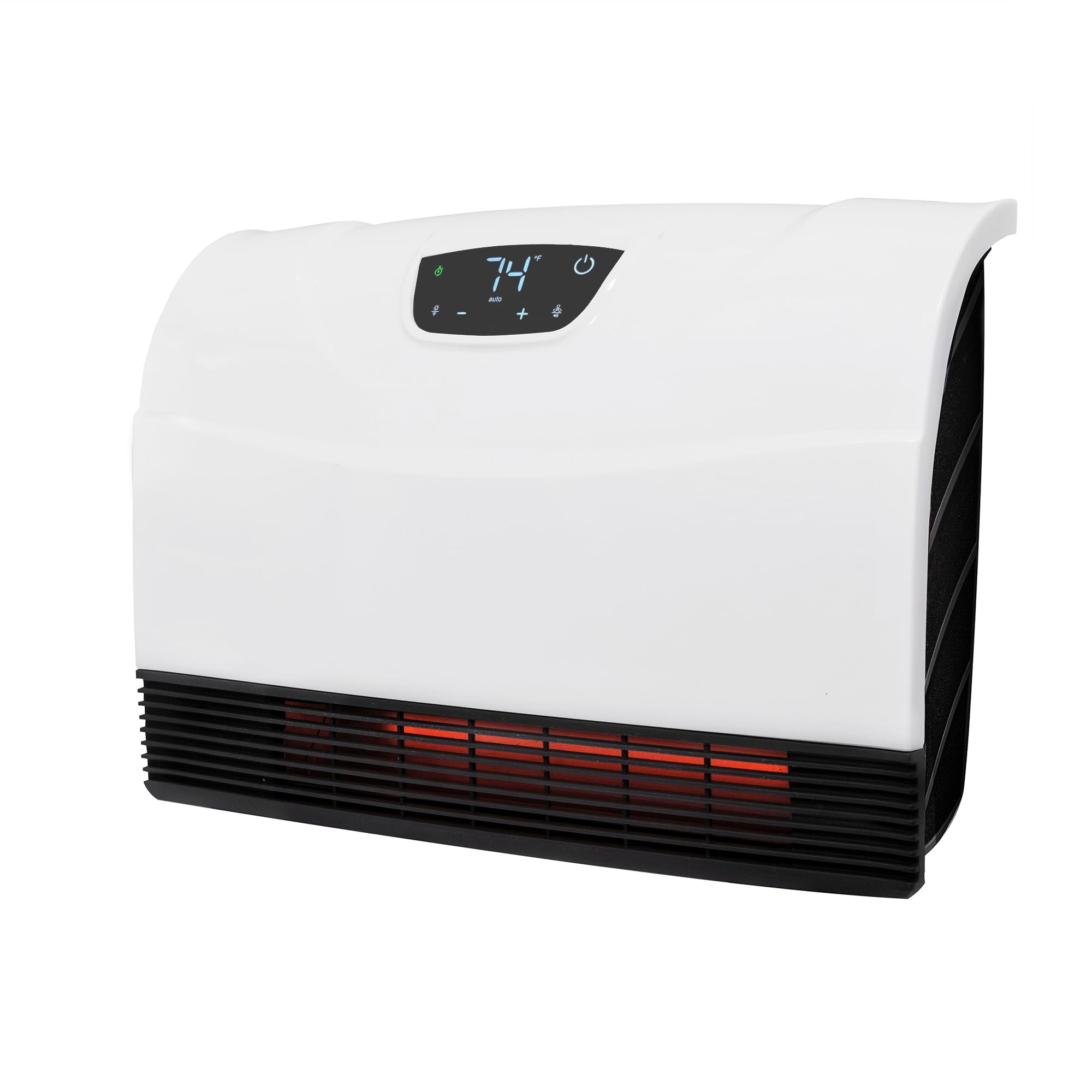
1. Heat Storm HS-1500-PHX-WIFI Infrared Heater
Our pick — over 4★ from 13,500+ verified ratings; the strongest balance of quality and price.
The wall-mounted smart heater that turns your phone into the thermostat for your garage.
You get infrared heat that travels directly to your body rather than just warming the air, which is exactly what a drafty garage needs. At 5200 BTUs output from a standard 120V plug, it handles two distinct jobs: as a primary source it covers 150 square feet in a well-insulated room, and as a supplemental source it reaches up to 750 square feet depending on your insulation. A real-world test in a Michigan basement roughly 23 by 14 feet saw the room hit 64°F within 15 to 40 minutes, which is quick enough to pre-heat the space while you pull in the driveway.
What wins people over is the sheer volume of positive owners. The heat output is the most-discussed perk by a wide margin — about a thousand owners single it out — and the effectiveness runs a close second. The entire unit sits just 4 inches deep on the wall, and when mounted over an outlet you can hide the cord inside the heater body. The exterior stays cool to the touch, and the grill is safe to brush against, so kids or pets bumping into it aren’t a burn risk.
Buyers report it as an “effective zone heater” that warms reliably without drying out the air or creating a burning smell. The WiFi app pairs with Alexa and Google for voice control, and the remote and touchscreen on the unit give you three ways to adjust the thermostat without walking over to it. A 750-watt low mode is available when you just need a chill taken off without maxing out your circuit.
WiFi infrared focus
- Wall mount saves floor space — only 4 inches deep on the wall
- Infrared heat feels immediate on your skin, not just in the air
- WiFi, remote, and touchscreen give you three control options
- Cool-to-touch exterior and safe grill for garages with kids or pets
- Tested to heat a 23×14 basement to 64°F in 15-40 minutes on 120V
Limited room coverage
- App scheduling can be unreliable — one owner reports it ignores the programmed schedule and needs manual override
- Timer setting is only available via the unit, remote, or voice, not in the app
Smart home: Anyone with an insulated or semi-insulated garage who wants smartphone-controlled, zone-specific warmth without sacrificing floor space.
Small spaces: The scheduling quirk means you should be ready to tap manually or use an Alexa routine if you rely on a daily schedule.
2. Heat Storm Sedona WiFi Infrared Heater
The sleek wall-hugger that doubles as a summer fan and a winter infrared radiator.
This is the Sedona version of the Heat Storm family, and it keeps the core formula that owners love — 1500 watts and 5200 BTUs of infrared heat from a wall-mounted body that sits 4.75 inches deep. The headline difference is the one-touch Bluetooth WiFi setup that skips the usual app-fumbling. You tap a button, connect via Bluetooth, and the heater links to your home network in seconds rather than forcing you to join its own WiFi hotspot first.
A clever addition is the fan-only mode, which turns the unit into a simple air circulator during warmer months. That means the heater earns its wall space all year long rather than gathering dust from April to October. Owners who run two units in a 660-square-foot insulated shop report the garage hitting 69°F when it is 28-30°F outside. They note that high mode (1500W) can trip a breaker if other appliances share the circuit, but the 750W low mode runs smoothly even on a shared 120V line.
The digital thermostat is responsive, and the remote control works well even when the unit is mounted high on the wall. The quartz heating element is the same proven infrared tech as the HS-1500, so your body feels the warmth directly without the fan blowing dust around your workspace.
Sedona style heat
- One-touch Bluetooth WiFi setup is genuinely easier than most smart heaters
- Fan-only mode extends usefulness into summer as an air circulator
- Two units heat 660 sq ft shop to 69°F in near-freezing weather
- Slim 4.75-inch depth is discreet and wall-friendly
Noisy fan operation
- High mode (1500W) may trip a shared breaker on the same circuit as power tools or lights
- Some owners note a rattle on the low fan setting, though most call it quiet overall
Quiet rooms: You want a future-proof wall heater with summer utility and a setup process that does not require a PhD in app configuration.
Open areas: Your garage has zero insulation — the infrared spot-heating works best when the space holds at least some of the warmth.
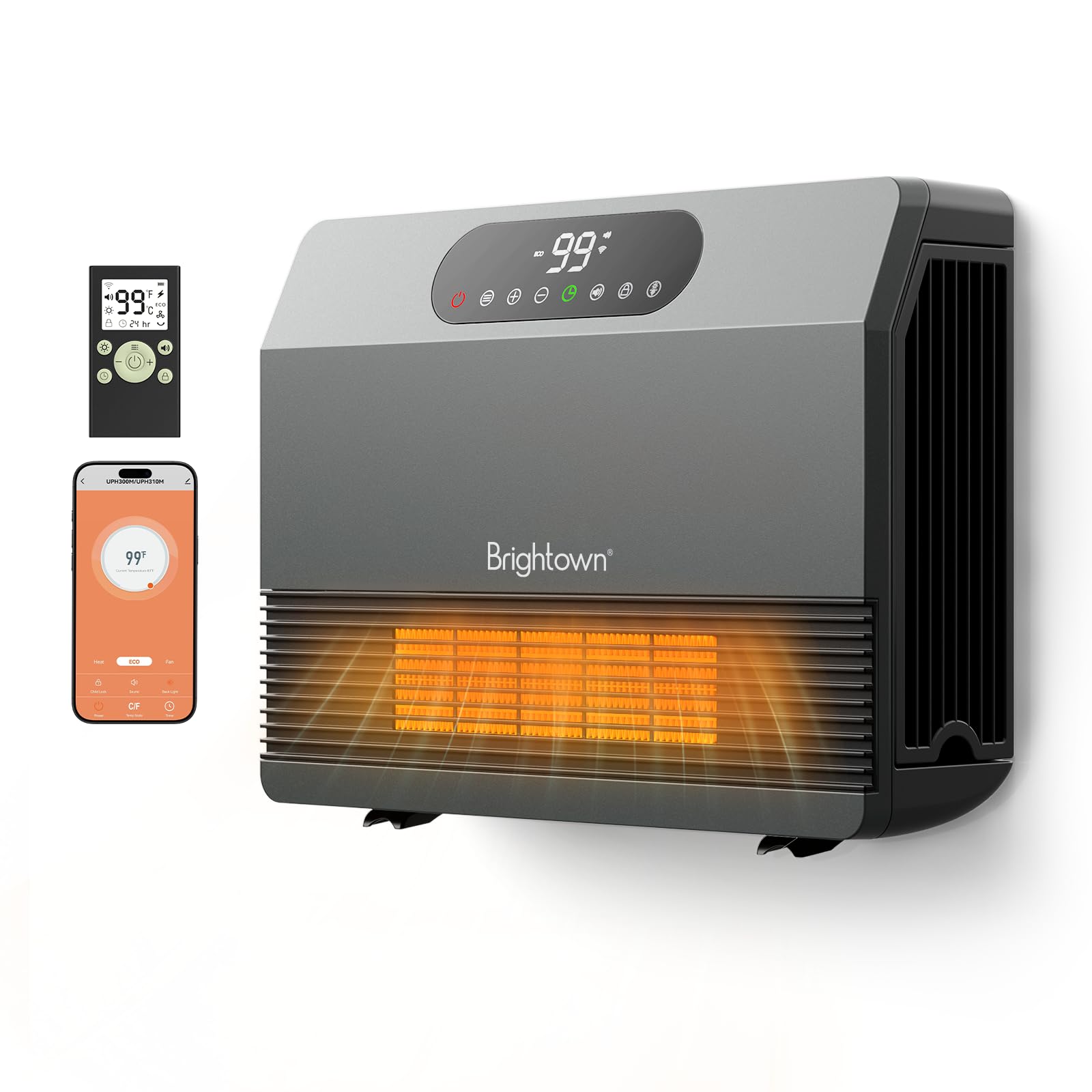
3. Brightown Smart Wall Heater
The compact wall furnace that heats a 2-car garage without hogging floor space or your electric bill.
This is a forced-air PTC ceramic heater, which means it uses a fan to push warm air into the room very quickly. The maker claims you feel heat within 2 seconds of switching it on, and owners back that up — the consensus is that it warms a two-car garage effectively and “heats up fast.” At 1500 watts with a coverage of 200 square feet, this is geared more toward a well-defined zone than a massive open shop.
The real differentiator here is the 5-mode system: ECO, three power levels (P1 at 600W, P2 at 1000W, P3 at 1500W), and a fan-only setting. You can dial in exactly how much juice you need rather than running flat-out all the time. The temperature range stretches from 40°F to 99°F with a claimed accuracy of plus or minus 1°F. Owners running it in a basement apartment confirm it heats the entire living space, and they especially like the ability to change the temperature from their phone without walking over to the wall.
On the safety front, this unit is ETL-listed and uses V-0 flame-retardant materials along with overheat protection. The wall-mount is straightforward, though it spans only 16.1 inches across, which is slightly too short to hit two studs — you will want to anchor one side into a stud and use a good drywall anchor for the other.
Smart wall control
- PTC ceramic heating delivers fast warm air — owners say 2 seconds
- 5 power modes including ECO let you fine-tune energy use
- Temperature control down to 1°F accuracy over a 40-99°F range
- Smart Life app, Alexa, and remote give flexible control
Weak heat output
- At 16.1 inches wide, it does not span two studs for a perfect mount
- P1, P2, and P3 modes run continuously at the set wattage without thermostat cycling — they do not stop when the room hits your target temp
Desk warming: A well-insulated garage or basement where you want spot-on temperature control and a phone app for pre-heating.
Large rooms: You expect it to cover a large, uninsulated space — the 200-square-foot rating is honest and should guide your expectations.
4. Givebest 1500W Wall Mount Space Heater
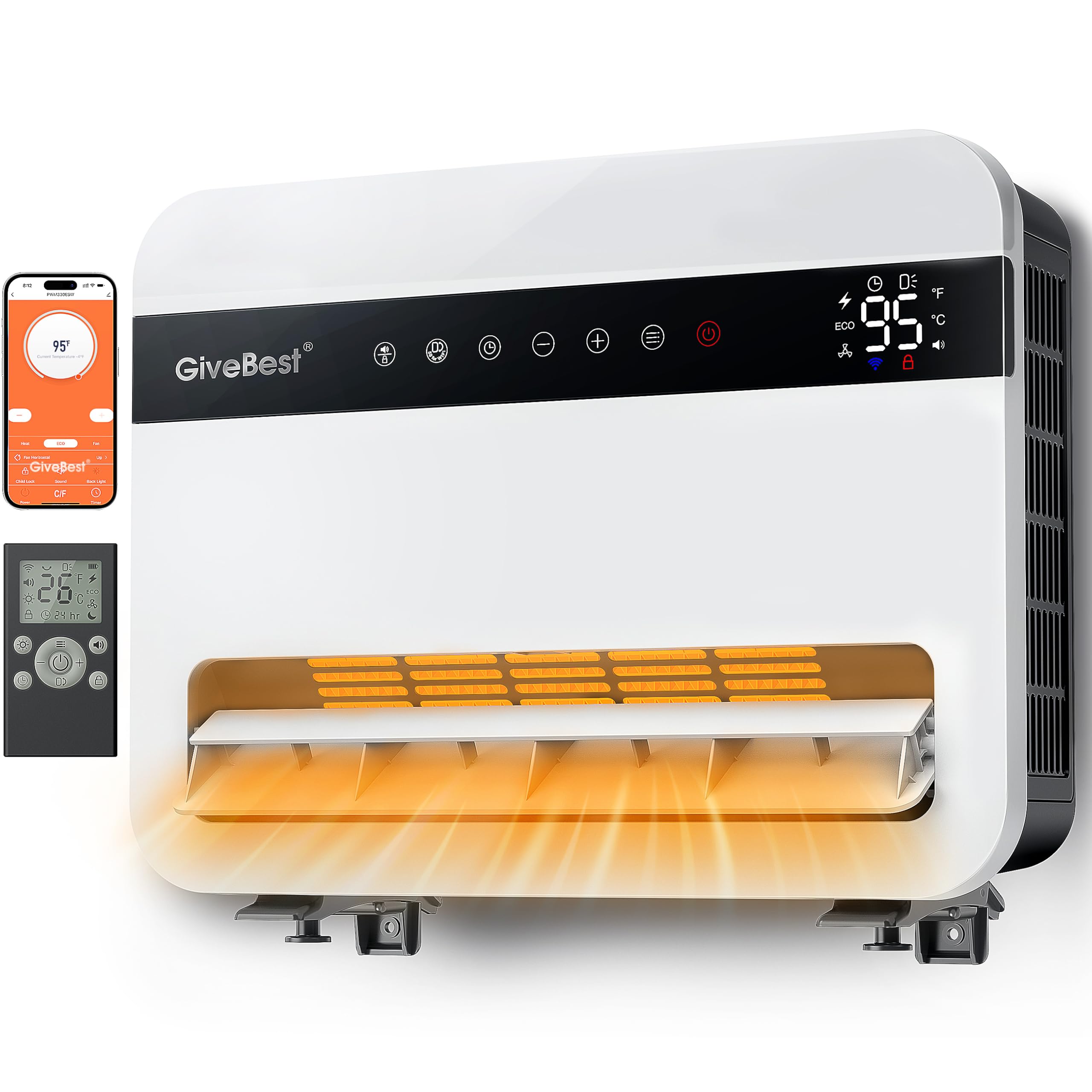
The oscillating wall unit that spreads warmth corner to corner without the roaring fan noise.
The Givebest takes a different approach — it oscillates up to 120 degrees to push warm air across a wide arc rather than blasting a single spot. In a garage with a workbench on one side and a tool chest on the other, that sweep covers both zones without needing a second unit. The forced-air fan is upgraded from typical designs, and owners consistently note the quiet operation is good enough for a bedroom or a TV-watching space.
It runs on standard 120V and draws 12.5 amps at full power, but the energy-saving ECO mode adjusts power output based on the surrounding temperature. That is especially useful for a garage you keep at a frost-protection level all week and only bump up when you are actually working. Owners running it in smaller spaces say a single-digit-degree room warmed up to “too hot” within one hour, so it is clearly not lacking in output.
The flexibility here is notable — you can either wall-mount the unit or use the included standing base to place it on the floor. That is a big plus if you are renting or plan to move the heater between the garage and a workshop. The ETL certification covers overheat protection and flame-retardant materials, and the child lock adds safety for homes with small children or pets that might reach the controls.
Wall mount compact
- 120° oscillation spreads heat across a wider area than fixed-direction units
- ECO mode adjusts power to save energy without constant manual tweaking
- Dual mount design — wall included; standing base works for portable use
- Nearly silent operation means it does not interfere with conversation or sleep
Plastic housing
- Noise level is described as “noticeable for light sleepers” by one owner, so not completely silent in a dead-quiet room
- Height of 16 inches means you need to mount it at the right elevation for best oscillation coverage
Garage use: A garage where you move between work zones and prefer a gentle, wide heat blanket rather than a directional blast.
Living rooms: You want the option to take the heater indoors or to a workshop — the floor-standing base makes it genuinely portable.
5. Shinic 2-Pack Electric Garage Heaters

A two-pack of quick-heating quartz units with a built-in work light for late-night projects.
This is a radiant quartz heater that uses dual quartz tubes to heat people and objects directly, not the air around them. The 5-mode pull-chain switch lets you choose low heat (750W with one bulb lit), high heat (1500W with both bulbs lit), or each of those combined with a halogen work light. That light is genuinely useful — it projects enough illumination to see what you are doing at a workbench without pulling out a separate floodlight.
The 90-degree adjustable tilt lets you angle the heat exactly where you need it. Owners using it for woodworking projects report that the pair keeps a garage nice and warm, and the heat is instant and quiet since there is no fan to whir. The metal housing and ETL listing provide overheat and tip-over protection, and the 3-prong grounded plug means no adapters are needed for a standard 120V outlet.
The honest catch is durability. The most-discussed negative by count is the pull string — some owners mention it breaks after a few months, which leaves the heater stuck on one setting. A handful also note that the bracket attachment point can fail. That said, the reliability score among owners is actually positive (77 mentions) overall, and heat output is still the number-one praise. If you treat the pull string gently and mount it securely, the value of getting two heaters for the price of one competitor is tough to top.
Two-pack value
- Two heaters in one box — place one at each end of a double garage for even heat
- Halogen work light adds useful illumination without a separate fixture
- 90-degree adjustable tilt directs heat right where you are working
- Instant, silent heat with no fan to blow dust around
Basic thermostat
- Pull string switch is a reported weak point — some customers note it breaking within months
- High setting automatically turns on the light; you cannot run full heat with the light off
Workshop pair: Anyone heating a multi-zone garage on a budget — two independent units cover both bays for less than the cost of a single premium model.
Precise zones: You mount it securely with good hardware and use the pull string gently, because that is the part most likely to give trouble.
6. BEYOND HEAT Electric Garage Heater 2-Pack

The ceiling-mounted twin pack with an upgraded pull string that is built for rough workshop use.
The BEYOND HEAT pair is clearly designed to address the most common complaint about budget ceiling heaters — the flimsy pull string. The manufacturer specifically improved this part to resist fraying, and the metal safety grille adds another layer of protection against accidental contact with the quartz tubes. At 24 inches long and 12.2 inches tall, each unit is compact enough to mount between ceiling joists in most garages.
Each unit runs at 1500 watts on a standard 120V plug, and the radiant heat works well for targeted warmth. Owners who use them in an insulated garage find that two units hold the temperature at a steady 70°F even when it is freezing outside. The halogen light integrated into each heater adds overhead illumination without needing a separate wiring run, which is handy for a dim garage.
The honest read from the review data is split. Heat output is the most consistent praise, with two dozen owners calling it effective. But the reliability results are mixed overall — roughly a third of the feedback mentions quality concerns. Some reviewers point out the bulb failing immediately or the heater stopping after just a few uses. This is the one pick where the value of the two-pack is offset by a higher than average chance of a defect slipping through, so check the unit thoroughly when it arrives and keep the packaging until you know it works.
Durable garage heat
- Improved pull string is reinforced to resist fraying — a direct fix for a common pain point
- Two heat settings (low and high) with a separate halogen light switch
- Compact 24 x 12.2 inch frame fits between standard ceiling joists
- ETL approved for US use with metal safety grille and overheat shut-off
Bulky design
- Reliability is a mixed bag — some owners receive units with broken bulbs or internal failures after a few uses
- Radiant heat does not travel far; you need to be within a few feet for the most effective warmth
Shop heating: You accept a slightly higher QC risk for the convenience of two complete heaters in one box at a mid-range price.
Small garages: Reliability is your absolute deal-breaker — a more expensive single-unit approach from a brand with stronger build consistency may suit you better.
7. DR. INFRARED HEATER DR218-1500W

The 1500-watt workhorse that keeps a small greenhouse above freezing on the coldest nights.
This one is built with a specific mission — protecting plants and small workshops from frost. The forced-air design blows warm air directly from a compact 10 by 10 by 15 inch cabinet, and the IPX4 splash-proof structure means it can handle the damp environment of a greenhouse without shorting out. It covers 150 square feet as a primary heat source, and owners confirm it held a 6 by 8 foot greenhouse at 42-48°F when the outside temperature dropped to 22°F.
The appeal here is simplicity: a single 1500-watt setting, a pull-chain on-off switch, and a straightforward analog thermostat that you dial by trial and error. Owners who use it in a 4 by 7 by 7 greenhouse report it maintains 60°F when it is 28°F outside, which is enough margin to keep most tropical plants alive through a winter snap. The forced-air fan is not silent but is described as tolerable, and a 12-gauge extension cord is recommended if the outlet is far from the heater location.
A caution to be fair about: the thermostat is analog and requires fine-tuning with an external thermometer. More importantly, a small number of owners operating units at 220V report the internal wiring from the thermostat can burn out over time, leading to a fire hazard. The 120V 1500W version runs at lower current (12.5 amps), but buyers should still check the wiring condition periodically and never leave it running unattended near flammable materials.
Infrared efficiency
- IPX4 splash-proof rating makes it genuinely suitable for damp greenhouse environments
- Compact 15-inch tall cabinet sits on a shelf or floor without taking over the space
- Verified to maintain 42-48°F in a 6×8 greenhouse during a 22°F freeze
- One-setting simplicity — no mode confusion, just on or off
Narrow beam
- Analog thermostat is imprecise — expect to adjust it and check with a separate thermometer
- A small number of shoppers say thermostat wiring failures that can be a fire risk; inspect periodically
Spot heating: A greenhouse, seedling shed, or small workshop where the goal is frost protection, not balmy comfort.
Whole room: Pair it with an external thermostat or a timer to limit runtime, and inspect the cord and wiring periodically for any signs of overheating.
8. Danluke 1500W Hanging Infrared Heater
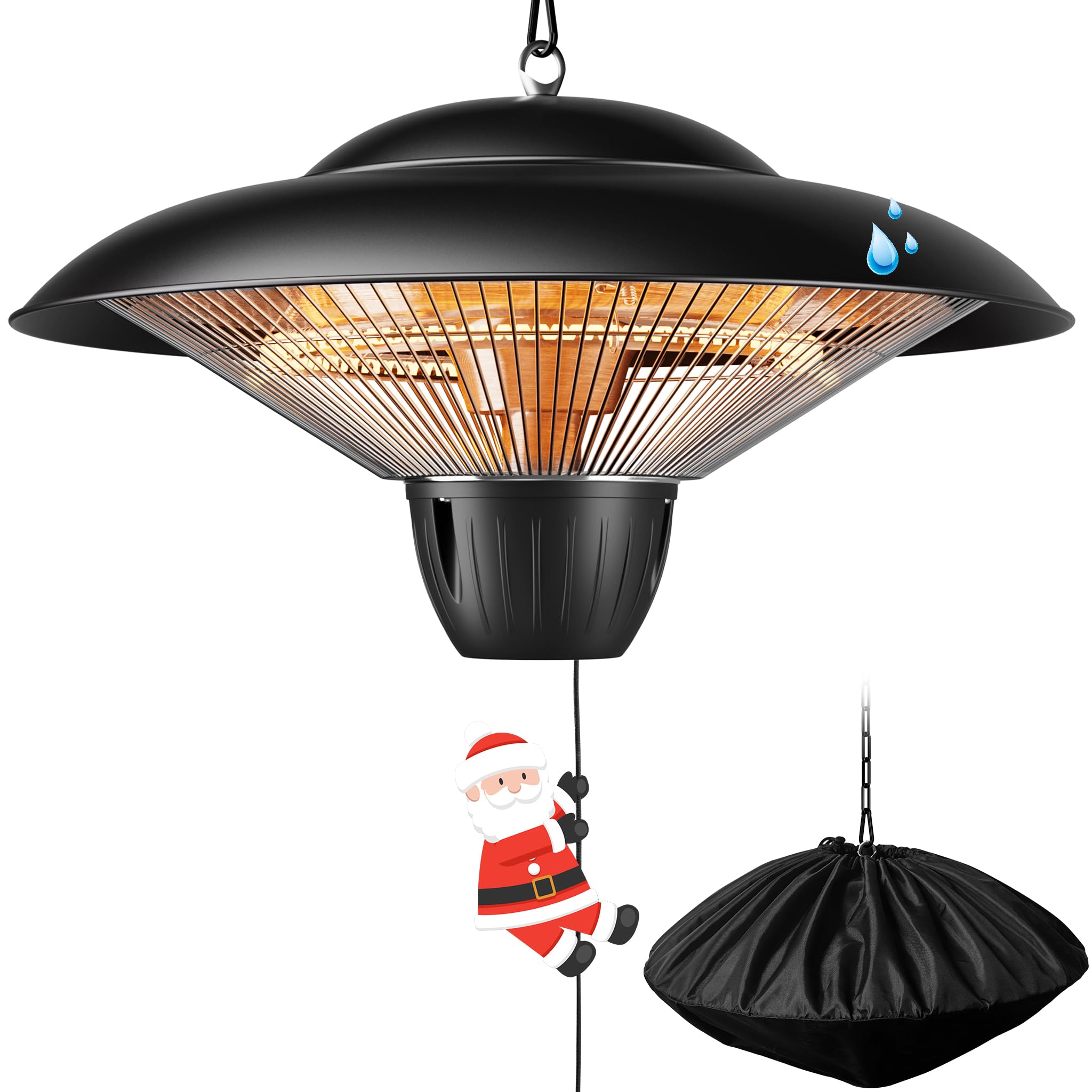
The lightweight 3.7-pound hanger that delivers instant radiant heat right beneath it.
This is the most affordable entry on the list, and it makes a single clear promise: if you stand or sit directly under it, you will feel heat within 1 second. The carbon fiber heating element produces infrared warmth that radiates in a 360-degree circle, making it effective for covering a small defined area like a workbench, a desk, or a camping tent. The body is compact at 16.73 inches in diameter and weighs only 3.7 pounds, so the included two 20-inch adjustable chains are more than sufficient to suspend it from any ceiling beam or gazebo frame.
The indoor-outdoor versatility is a unique angle here. The unit has weather-resistant construction and comes with a dust cover, so it can hang in a covered patio, gazebo, or porch without worrying about light rain or snow. Owners using it in a covered patio for plant freeze protection confirm it provides enough warmth for potted plants even when the outside temperature is in the high 20s Fahrenheit. The fanless operation means zero noise and zero dust blowing around — just silent radiant heat.
The catch is significant: the reliability data is mixed at best. The most-mentioned aspect is reliability, and the sentiment is split, not positive. Two owners specifically report that their units failed within weeks due to a defective switch that caused internal melting, and the seller was unresponsive. The heat output is also considered low for the claimed coverage area — one owner on a 16 by 18 foot deck reports it would take four units to actually feel warm. This is a heater to buy only if you accept a higher defect rate for the lowest price point and the convenience of a lightweight, silent overhead unit.
Hanging mount stable
- Weighs only 3.7 pounds — easy to install on any ceiling or beam
- Carbon fiber infrared heat is instant and silent with no fan noise
- Weather-resistant design with a dust cover for covered outdoor spaces
- 360-degree radiation warms everything directly underneath evenly
Short cord
- Reliability is a real concern — reports of defective switches causing internal damage and melting
- Heat does not travel laterally; you need to be directly under it for it to work
- Coverage claims are unrealistic for a single unit in a large open area
Ceiling install: A targeted spot-heating job where you are sitting or standing still right below it, such as a desk, a camping chair, or a single plant shelf.
Portable use: You want to heat a full garage bay or you need a heater you can rely on through multiple winters without issue — the failure rate is too high for that role.
Understanding the Specs
1500 Watts / 12.5 Amps — The 120V Limit
Every standard 120V outlet in a typical US garage is on a 15-amp or 20-amp circuit breaker. A 1500-watt heater draws about 12.5 amps — which is already 83 percent of a 15-amp circuit. That means you cannot run the heater at the same time as a shop vacuum, a table saw, or a space heater in the adjoining room without tripping the breaker. If your garage shares a circuit with a freezer or always-on lights, look for a heater with a lower 750W mode so you can run the heater without killing the lights every time you flip a switch.
BTU Output — How Much Real Heat
While watts measure electricity consumption, BTUs (British Thermal Units) measure actual heat output. One watt equals approximately 3.41 BTUs, so a 1500-watt heater delivers about 5115 BTUs. Some manufacturers round this to 5200 BTUs. This tells you how much heating capacity you are really getting. The common rule of thumb is that standard construction needs roughly 10 watts per square foot as a primary source. For a 120V heater at 1500 watts, that covers about 150 square feet as primary heat, or up to 750 square feet when you are just taking the edge off a larger, well-insulated space.
Infrared vs Forced Air — How The Heat Reaches You
Infrared (radiant) heaters warm people, tools, and floors directly without heating the air in between. This is ideal for a drafty or high-ceiling garage because you feel warmth immediately even if the air is still cold. Forced-air (convection) heaters use a fan to blow air over a hot element. They raise the overall room temperature more evenly but lose effectiveness in a leaky garage because the warm air escapes faster. They also stir up dust.
ETL Certification — Safety You Can Actually Rely On
ETL (Intertek) is a Nationally Recognized Testing Laboratory, just like UL. An ETL listing means the heater has been independently tested to meet US safety standards for overheating, fire resistance, and electrical shock. If a heater claims ETL certification, it has passed real tests — not just a self-declaration. This is especially important in a garage environment where dust, moisture, and flammable materials (gas cans, paint thinner) might be present.
FAQ
Can a 120V garage heater really warm an entire two-car garage?
Will a 1500W garage heater trip my circuit breaker?
Is it safe to leave a 120V garage heater on overnight?
What is the difference between a quartz heater and a carbon fiber heater?
Can I use a regular extension cord with a 1500W garage heater?
How often should I clean or maintain a 120V garage heater?
What size heater do I need for a 20×20 garage on 120V?
Should I get a heater with a thermostat or just plug it in and turn it on?
Is a ceiling-mounted heater better than a wall-mounted one for a garage?
What does the ECO mode do on a smart garage heater?
Final Thoughts: The Verdict
For the majority of shoppers, the single best electric heater for garage 120v is the Heat Storm HS-1500-PHX-WIFI because it combines smart WiFi control, genuine infrared comfort, a safe cool-to-touch body, and the kind of real-world testing — a Michigan basement hitting 64°F in under 40 minutes — that proves it actually works on a standard outlet. If you want the convenience of fast ceramic warmth with phone-based precision temperature control, the Brightown Smart Wall Heater is a close runner-up. And for a two-zone garage where radiant spot heating is the game plan, the Shinic 2-Pack delivers two functional heaters for the same price as a single premium unit.
How We Picked
We do not accept paid placement. Every pick is matched to a real buyer and a real use-case; we do not hands-on test units.
Sources & Methodology
Specifications: manufacturer listings and product documentation. Review insights: verified customer reviews, as of July 2026. Pricing: not shown on this page (it changes often); check the current price via the retailer link.
As an Amazon Associate, WellFizz earns from qualifying purchases. This does not affect which products we feature.
Related Guides

Mo Maruf
I created WellFizz to bridge the gap between vague wellness advice and actionable solutions. My mission is simple: to decode the research and give you practical tools you can actually use.
Beyond the data, I am a passionate traveler. I believe that stepping away from the screen to explore new environments is essential for mental clarity and physical vitality.