Our readers keep the lights on and my smoothie glass nicely filled. As an Amazon Associate, I earn from qualifying purchases.
Specs are compiled from manufacturer listings and verified buyer reviews and can change over time — please confirm the key details on the product page before buying.
Heating a basement is a different beast than warming a bedroom. Cold concrete floors pull the warmth right out of the air, and a heater that works perfectly upstairs can struggle down here. A 1500-watt unit is the minimum needed to overcome the cold concrete and make a basement feel livable. This guide focuses on electric heaters that meet that 1500-watt bar or higher, so you are never stuck with a unit that merely blows lukewarm air.
I’m Mohammad Maruf — the founder and writer behind WellFizz. This guide is built by comparing the manufacturers’ published specifications and the patterns across verified customer reviews, so you get each pick’s real strengths and trade-offs instead of marketing spin.
For a cold, drafty space, the electric heater for basement you pick must balance raw wattage, oscillation, and noise to make the room feel lived-in rather than just slightly less cold.
Our Picks at a Glance
How To Choose The Best Electric Heater For Basement
Basements leak heat faster than any other room because the walls and floor sit against cold ground. Before you shop, measure the square footage and note whether the space is finished or open. A 1500-watt heater is the minimum you want for anything beyond a small office nook down there.
Wattage and Your Breaker
A 1500-watt heater draws roughly 12.5 amps on a standard 120-volt circuit. That means it will run fine on its own breaker, but you cannot plug a second high-draw appliance into the same outlet. Some basements have older wiring, so check your panel before committing to a unit that needs constant full power.
Heating Method: Forced Air vs Radiant
Forced-air ceramic heaters push warmth out with a fan, spreading it fast but creating some noise. Radiant or infrared heaters warm objects and people directly, feeling more natural but covering a smaller area unless they have a fan too. Oil-filled radiators are silent and hold heat long, but they warm up slowly, which can feel inefficient in a cold basement.
Oscillation and Coverage
If your basement is wide rather than long, a heater that oscillates is crucial. A unit that sweeps horizontally across 80 degrees will push warm air into more corners than a static box ever could. Vertical oscillation is a bonus for rooms with high ceilings, as it pushes heat down to floor level where you actually sit.
Quick Comparison
| Model | Best For | Heat Output | Noise Level | Oscillation | Amazon |
|---|---|---|---|---|---|
| DREO Whole Room Heater★ Best Overall | Large drafty basements | 1500 watts | 34dB | 3D (60° V / 90° H) | Amazon |
| Sunnote Space HeaterBudget Champion | Small to mid rooms on a budget | 1500 watts | 40dB | 80° Wide | Amazon |
| JNDRO Wall-MountedWall Saver | Saving floor space | 1500 watts | Quiet (not stated) | 60°/90°/120° | Amazon |
| Lasko 751320 Tower | Quick warmth, trusted brand | 1500 watts | Quiet (not stated) | Widespread | Amazon |
| GiveBest Wall Heater | Smart home integration | 1500 watts | Low noise | None (fixed) | Amazon |
| GiveBest Smart Wall Heater | Sunrooms and small offices | 1500 watts | 34dB | None (fixed) | Amazon |
| Air Choice Infrared Tower | Natural radiant heat | 1500 watts | 35dB | 70° Oscillation | Amazon |
| DREO Radiator Heater | Silent overnight use | 1500 watts | Silent (not stated) | None (radiant) | Amazon |
| Heat Storm HS-1500 | Zone heating without oxygen loss | 5200 BTU | Quiet (not stated) | None (radiant) | Amazon |
In‑Depth Reviews
1. DREO Whole Room Heater
Our pick — over 4.5★ from 800+ verified ratings; the strongest balance of quality and price.
The gold standard for pushing warm air into every corner of a cold basement.
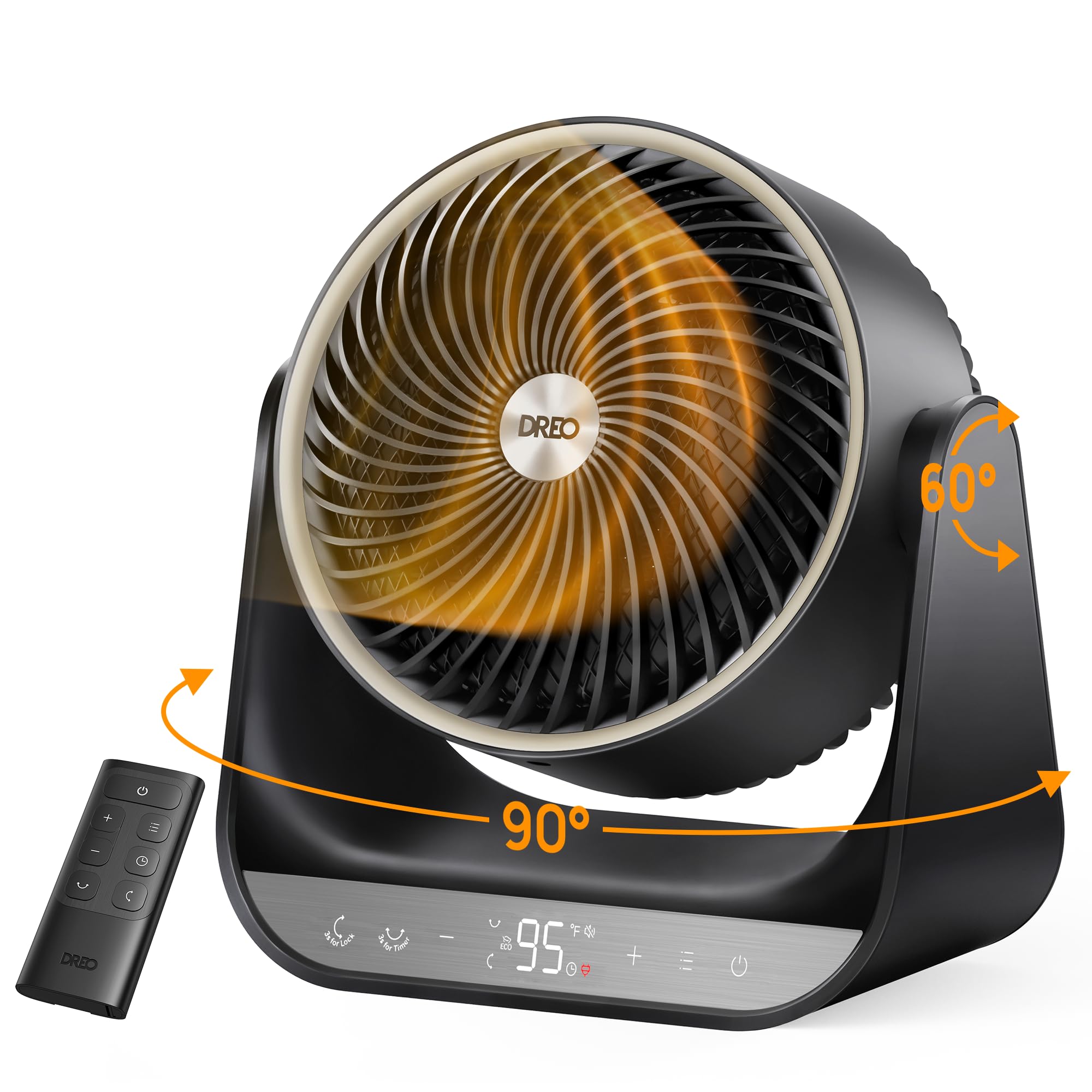
This is the one that makes a drafty basement feel genuinely livable. Its defining trick is 3D oscillation — it sweeps 90 degrees horizontally and 60 degrees vertically at a 12 ft/s airflow, so heat reaches floor level and high corners instead of pooling near the ceiling. Buyers report it is “great for cold basements,” which is exactly the scenario this guide is built around.
Power comes from a 1500W PTC ceramic element that delivers heat within 2 seconds and moves 120CFM of air. The brushless DC motor keeps things whisper-quiet at just 34dB — noticeably quieter than the Sunnote’s 40dB, a real advantage if your basement doubles as a bedroom or home office. The ETL-listed housing adds overheat shutoff and tip-over protection, so leaving it on while you are upstairs is far less nerve-wracking.
It weighs 6.5 pounds and stands 12.4 inches tall, compact enough to tuck beside a couch. The included remote and 12-hour timer let you schedule warmth before you even head downstairs. One honest trade-off: the heat output is the most-praised feature by a wide margin, but this unit lacks smart-app control, so you cannot switch it on from your phone on the way home.
Why owners love it
- 3D oscillation spreads heat evenly in every direction.
- 34dB noise level is genuinely quiet for a forced-air unit.
- ECO mode holds steady comfort from 41-95°F to cut energy use.
- Buyers praise the remote and money-saving operation.
Know before you buy
- No WiFi or app for remote scheduling.
- Not designed to warm very large open basements alone.
Grab it if: you want the most complete coverage — heat that swings up, down, left, and right to reach every corner.
Think twice if: you need app control to preheat from your phone; this one relies on its remote and timer.
2. Sunnote Space Heater
A compact tower that punches far above its size for small basements.
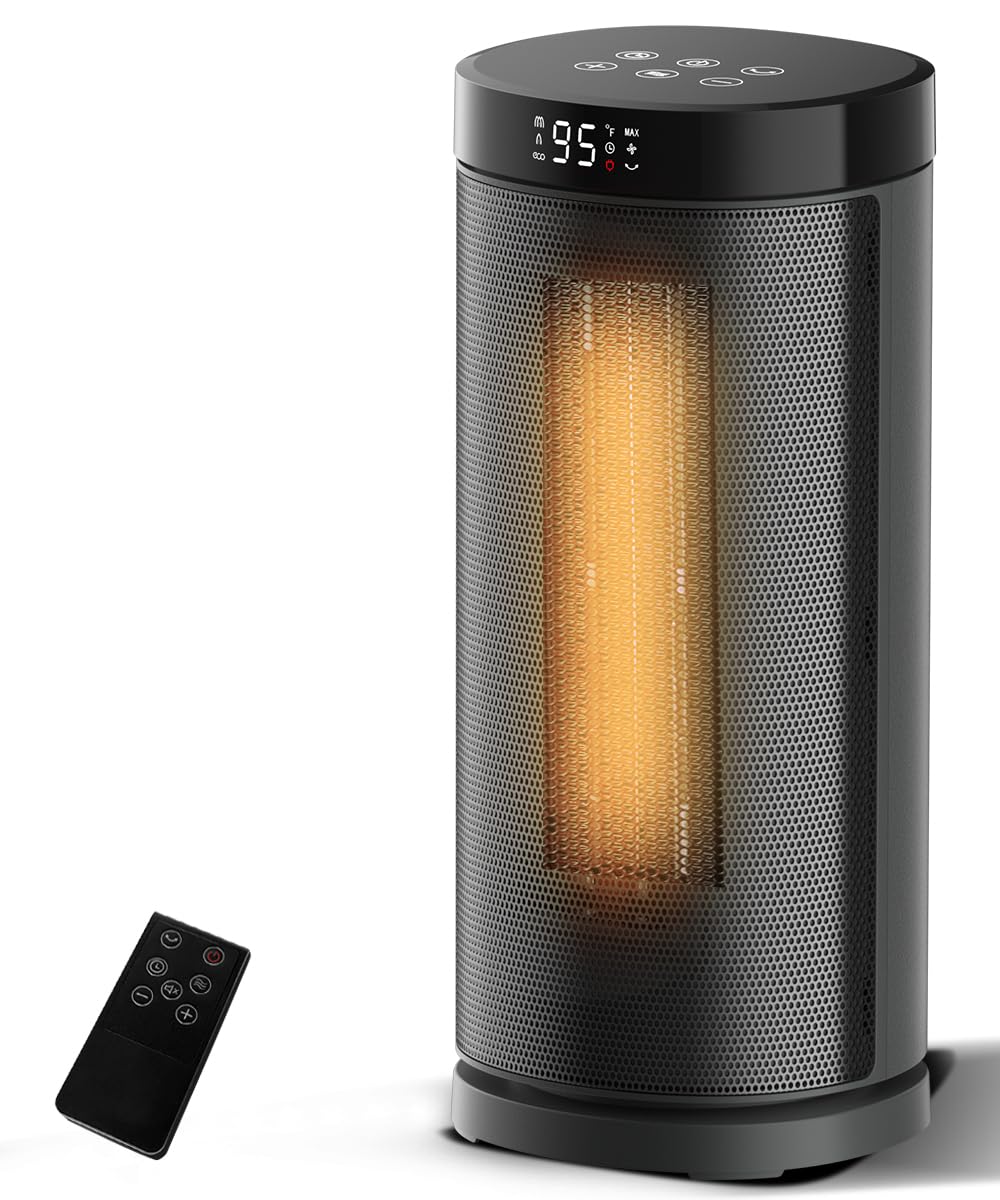
For a small basement workout corner or office, this value pick stops the shivering without emptying your wallet. Buyers call it “a small space heater that packs a punch.” Its 1500W PTC element (a ceramic heating core that warms up quickly) uses a 3,000 rpm wind wheel to push heat out fast, so you feel warmth within seconds. The 80-degree wide-angle oscillation spreads that heat across the room, not just at one spot, so your whole workout area stays comfortable.
You get three heating modes plus an ECO setting that dials back output to save electricity, and the digital thermostat adjusts from 41-99°F in 1°F steps. The remote and 24-hour timer are rare at this tier, letting you schedule basement warmth for when you actually use the space. Safety is covered with overheat protection and a tip-over switch, all behind an ETL-certified V0 flame-retardant housing.
The one thing to weight: some owners find it very quiet from the start, while a few report it becomes noisier over time. At 15 inches tall and 7 inches wide, it steals almost no floor space and looks sleek doing it. For the money, the heat output and feature list are hard to argue with for a smaller footprint.
What stands out
- Heats small rooms fast with 1500W and a 3,000 rpm fan.
- Remote plus 24-hour timer for set-and-forget comfort.
- Compact tower fits tight basement corners.
Watch out for
- Noise reports are split — quiet for some, louder over time for others.
- Not enough output for a large, open basement.
Reach for this if: you have a smaller space and want strong heat, a remote, and a very modest spend.
Look elsewhere if: you need a whisper-silent unit for a bedroom — this is best where a bit of fan hum is fine.
3. JNDRO Wall-Mounted Heater
Gets the heat off the floor and onto the wall, freeing your basement entirely.
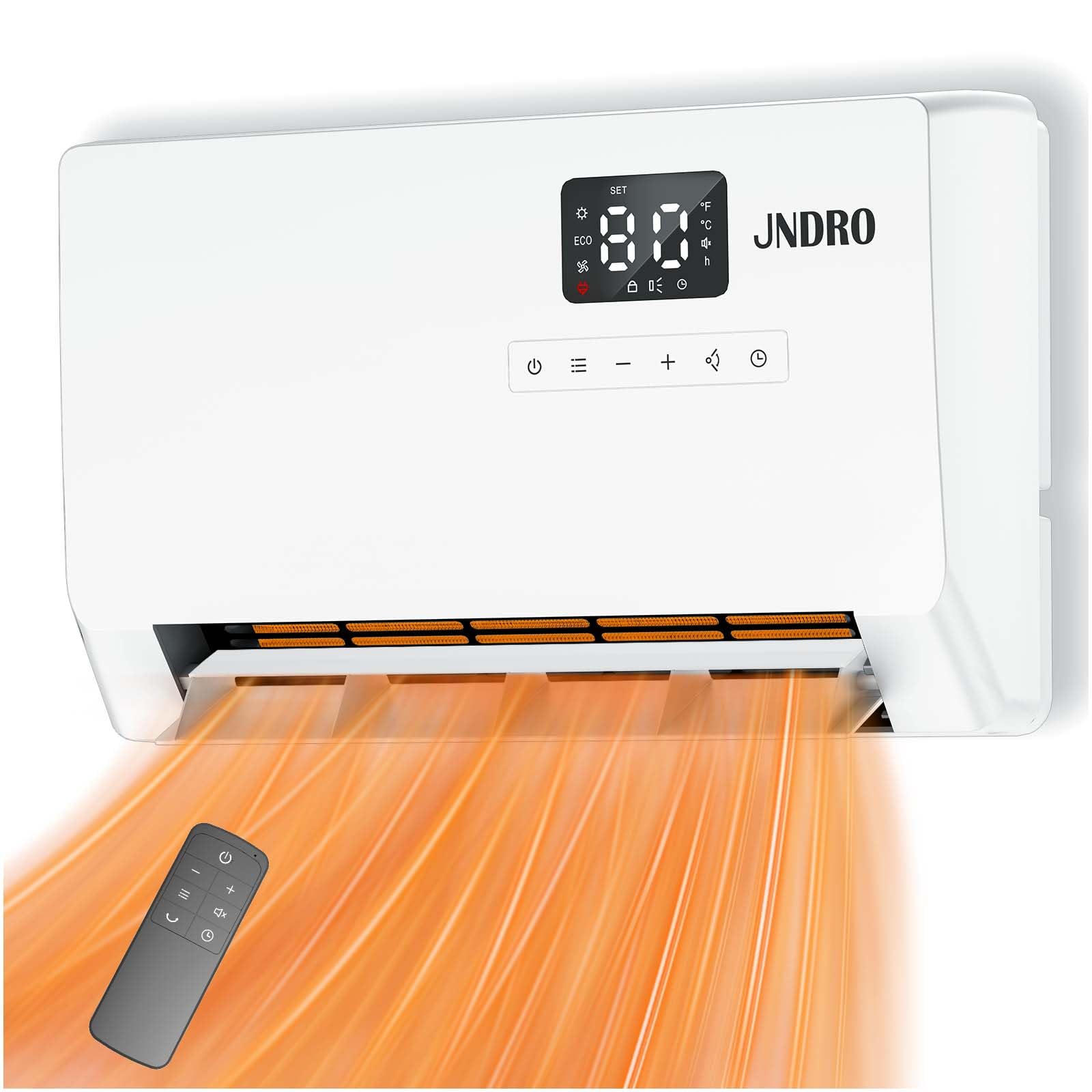
Basement floors are precious real estate — for a workshop bench, gym mats, or storage bins. This wall-mount unit lifts the heater entirely out of the way while still covering 200 sq. ft. of space. Installation is the star here: owners mention a handy stencil for drilling, and the included remote lets you adjust temperature, timer, fan speed, and oscillation angle from across the room.
The headline feature is the three oscillation angles — 60°, 90°, or 120° — so you choose how wide the warmth sweeps based on your layout. The ECO mode automatically adjusts power based on ambient temperature, keeping comfort between 41°F and 95°F while trimming energy bills. A child lock prevents curious little hands from changing your settings, a thoughtful extra for family basements.
One owner notes it kept a garage heated through winter, and another says its low setting warms an entire master bedroom. The honest caveat: this is a radiant-style heater, so it works best in smaller or well-insulated spaces rather than a huge, drafty, unfinished basement. At 16.54 inches deep, it protrudes enough to feel present, but being off the floor solves the biggest basement annoyance.
The big wins
- Wall mounting frees up all floor space.
- 3 oscillation angles give layout-specific coverage.
- Child lock and ECO mode boost safety and savings.
Fair warning
- Radiant heat struggles in large, uninsulated basements.
- Remote needs 2 AAA batteries you must supply.
Best suited to: finished basements or garages where floor space matters more than max heat output.
Not the pick if: your basement is wide open and poorly insulated, where a forced-air tower will cover more ground.
4. Lasko 751320 Ceramic Tower

The tower heater tens of thousands trust to knock the chill off a room fast.
This Lasko tower is a bestseller because its 1500W ceramic element reliably warms small to medium rooms. The 1500-watt ceramic element delivers fast, effective warmth for small to medium rooms, and the slim tower design with a built-in carry handle makes it easy to move from the basement to the bedroom as the day demands. Owners mention it replaced central heat in two rooms and cut their electricity bill.
The widespread oscillation circulates warm air throughout the room rather than just baking one spot. You get high heat, low heat, or an automatic thermostat mode, all controlled by a multi-function remote that stores right in the unit so you never misplace it. Across thousands of reviews, the consensus is a dependable, no-frills heater that gets the job done.
On the downside, feedback on the thermostat is genuinely mixed — some find it works perfectly, others say temperature control is not its strong suit. Some units have also been reported to stop working after heavy use. The remote does not come with batteries, so factor that in. For a mid-priced, trusted-brand tower, this is a safe pick for a basement used regularly.
Why so many pick it
- Reliable 1500W ceramic heat that warms rooms quickly.
- Built-in handle makes moving floors easy.
- Remote with on-board storage keeps the controls handy.
Keep in mind
- Thermostat accuracy gets mixed reviews.
- A few units report stopping after limited use.
- Remote needs 2 AAA batteries not included.
Go with this if: you want a proven, portable tower that moves between rooms and just works.
Pick something else if: precise temperature holding is your top priority, since controls here feel more basic.
5. GiveBest Wall Mounted Heater

A wall-mounted smart heater you can command with your voice before you hit the stairs.
This is the pick for the basement you want warm before you even get there. The 1500W unit heats a 100-300 square foot area, and its 5 modes — ECO, P3 full power, P2, P1, and fan-only — let you match output to the moment. The smart part is the big draw: you can control it by touch, WiFi app, remote, or Alexa voice commands, so you can start preheating from your phone while you are still out.
The adjustable thermostat spans 41-99°F with 1°F accuracy, and ECO mode automatically lowers power once the room hits your target temperature. For overnight use, the LED display can be switched off and operation set to a silent mute, which owners in bedrooms genuinely appreciate. Wall mounting keeps it out of the way, and the compact size does not compromise the heat output, as customers note it delivers fantastic warmth for its footprint.
Reviewers point out easy WiFi setup and solid integration with smart home systems, along with a very quiet fan. The trade-off is that being fixed to the wall, this unit has no oscillation — it throws heat in one direction, so you will want to place it opposite the seating area. Also, the mounting requires drilling, which is a permanent change to your basement walls.
Why smart owners choose it
- Alexa, app, remote, and touch give four ways to control it.
- Five modes including a fan-only setting for summer air.
- Display-off and silent mute suit overnight use.
Before you commit
- No oscillation — heat coverage is directional.
- Requires drilling for wall mount.
Choose this for: a home-automation setup where voice or phone control is a daily habit.
Move on if: you want a heater to sit on the floor and swing heat side to side across a wide room.
6. GiveBest Smart Wall Heater
A whisper-quiet wall heater that turns a cold sunroom into a year-round retreat.
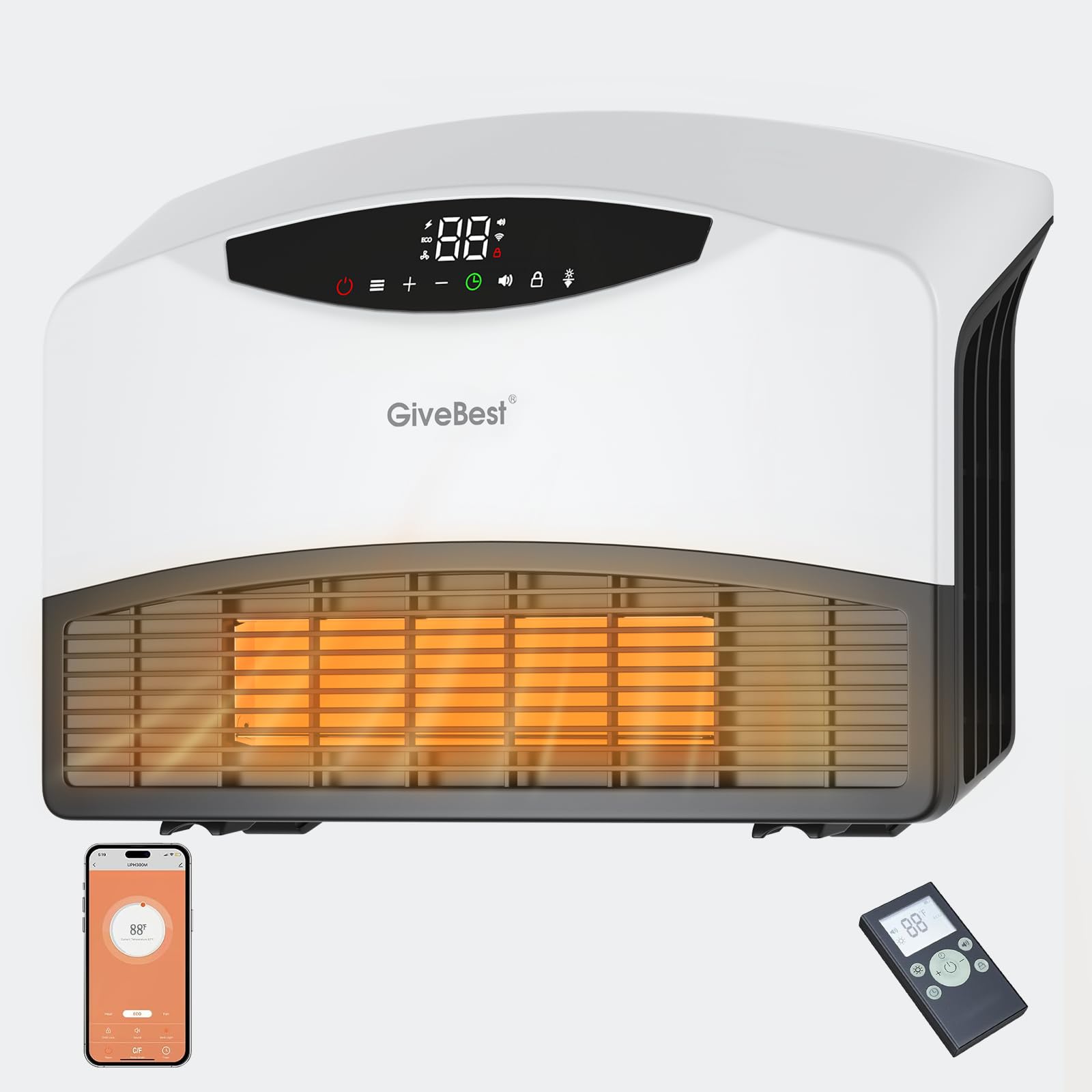
If your basement has a walkout section that feels like a sunroom — all glass, all cold in winter — this is the unit owners specifically call out for that job. The 1500W PTC system with tune airflow delivers fast warmth at just 34dB, quiet enough that owners note it settles down to near-silence within minutes. One buyer saw their electric bill drop within a month of switching to this heater.
It offers three modes — Heat for constant warmth, ECO for energy savings, and Fans for air circulation without heat. The wall-mounted design frees the floor, and the included template makes installation straightforward. Control comes via remote, a user-friendly app, or Alexa voice, and you can even dim the display brightness without leaving your chair.
The catch: it only works on 2.4 GHz WiFi, not 5G, so older or dual-band routers need a quick setting change. It is rated as a primary heat source for rooms up to 150 sq ft, or a supplement in spaces up to 750 sq ft. One owner notes mounting holes can be slightly misaligned, and the displayed temperature sometimes reads higher than the actual room temp. For a small, well-insulated basement zone, this is a strong, quiet performer.
What impresses
- 34dB operation — genuinely quiet for continuous overnight use.
- Shoppers say measurable energy savings.
- App, Alexa, remote, and touchscreen control options.
Heads up
- 2.4 GHz WiFi only — 5G networks not supported.
- Displayed temp can read higher than the actual room.
- Best for small spaces under 150 sq ft as primary heat.
Ideal for: a small, insulated basement room or sunroom where silence and energy bills matter most.
Skip if: you need to heat a wide-open, drafty basement — this one shines in compact spaces.
7. Air Choice Infrared Tower
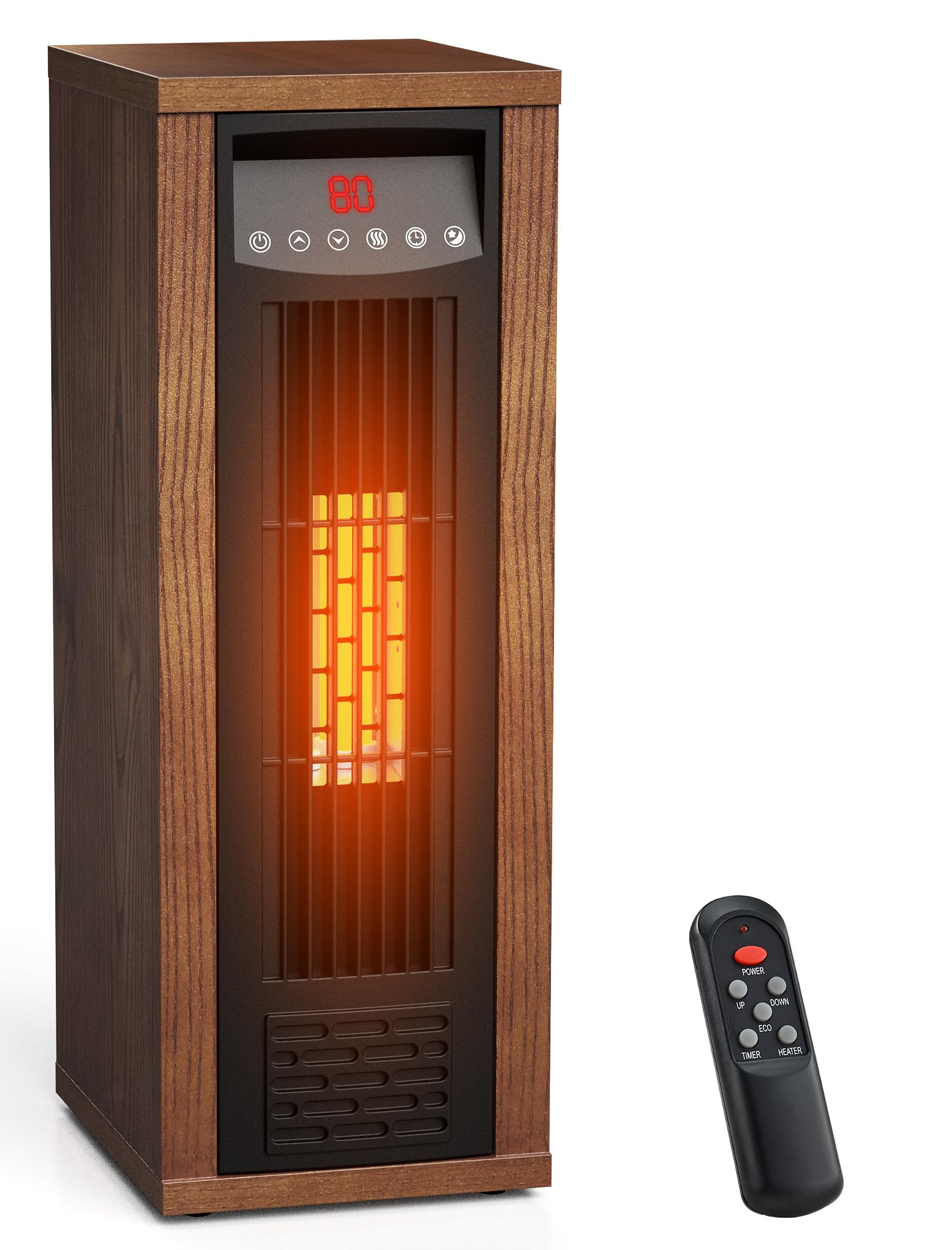
Infrared quartz warmth that feels like standing near a fire, minus the noise.
This is the heater for people who hate the dry, blown-air feeling of a fan heater. It uses 6 infrared quartz tubes with a 3000 rpm fan to deliver rapid, even heat across up to 200 sq. ft. in about 2 seconds. The heat warms objects and people directly, so you feel comfortable faster even in a slightly drafty basement corner. The 35dB quiet fan makes it one of the softer forced-air options.
The walnut wood-touch exterior stays cool even after hours of use, which is a genuine safety plus if kids or pets roam the basement. You get ECO, Low (1000W), and High (1500W) modes, plus a digital thermostat adjustable from 59-86°F in 1°F steps. A 12-hour timer and remote that works from up to 26 feet away round out the convenience. ETL certification adds child lock, tip-over protection, and overheat shut-off.
The balanced take: owners love the heat output and quality feel, but reliability has mixed feedback — some report units failing after a couple of months. There is also a beep on every button press with no mute option, which can get annoying. At 18.2 pounds and 25.59 inches tall, it is a substantial tower, though a hidden carry handle makes moving it manageable.
The appeal
- Infrared heat warms objects directly, not just the air.
- Wood-touch exterior stays cool for safe family use.
- 35dB fan keeps operation library-quiet.
Consider this
- Some units reported failing after a few months.
- Button-press beep cannot be muted.
- Heavier tower at 18.2 pounds.
Pick this for: a natural, radiant warmth that does not dry the air, in a room up to 200 sq ft.
Pass if: you cannot tolerate a beep on every press, or you want a heater you never have to think about for years.
8. DREO Radiator Heater

Silent, steady radiant heat that keeps a room cozy without ever blowing dry air.
This is the anti-fan-heater for basement dwellers who want consistent warmth without the noise. The oil-filled radiator uses 8 M-shaped fins that deliver a 59.5% higher heat dissipation area, spreading warmth evenly while the surface stays at a safe temperature — no burning if you brush against it. Owners note it keeps a 3-season sunroom cozy and handles a 10 x 20 insulated shed with ease.
It offers three wattage settings — 600W, 900W, and 1500W — plus a smart ECO mode that adjusts power between 41-95°F to trim energy bills. A dedicated thermal sensor and dynamic compensation algorithm keep temperature accurate within ±4%, so the room stays where you set it. Since there is no fan, operation is totally silent, and the sturdy 20.6-pound build with wheels rolls easily across carpet.
The honest limits: it warms up gradually rather than instantly, so it is a “turn it on early” kind of heater. Some owners note an initial oil smell that needs ventilation for the first few hours. Safety feedback is mixed — the unit carries 8 built-in protections including tip-over and triple overheat, but a small number of reports mention electrical concerns. For a quiet, steady, premium-feeling heat source, this is outstanding.
Why it earns its place
- Silent operation — no fan, no hum, no dry air.
- Three wattage settings prevent breaker overload.
- Surface stays safe to touch while heating 250 sq ft.
Be patient with
- Slow warm-up — it takes minutes, not seconds, to feel heat.
- Initial oil smell can last a few hours at first use.
Choose this if: you value silence and steady heat over quick blasts, especially for overnight basement living.
Look away if: you need instant warmth the moment you walk in — this rewards planning ahead.
9. Heat Storm HS-1500

A compact cabinet that delivers 5200 BTU and keeps pipes from freezing.
This compact unit is built to keep a basement above freezing, protecting pipes and gear. Owners specifically mention it keeps pipes from freezing, which says everything about its real-world role. The 1500 watts produce 5200 BTU — a proper chunk of heat for zone heating up to 300 sq ft as a primary source, or 1000 sq ft as a supplement in a well-insulated area.
Its patented heat exchanger with HMS Technology combines with room humidity to provide soft, safe heat without reducing oxygen or drying the air. The built-in thermostat with LED display shows the ambient temperature and can be calibrated, so buyers report it maintains room temperature within 1°F. An Energy-Efficient mode drops the wattage from 1500 to 750 when full power is not needed.
At 10 pounds, 15 inches tall, and 13.5 inches wide, this heater is compact enough to tuck beside a desk, and its flat top holds your coffee mug or phone. Optional casters let you roll it from room to room. One owner calls it a “little heater that packs some HEAT,” and liked it enough to buy a second. The trade-off: it uses infrared quartz, which heats objects more than air, so it warms large, high-ceiling basements slowly — but once up to temperature, it holds steady. The 1-year manufacturer warranty covers you for the first year.
Its superpowers
- 5200 BTU warms up to 300 sq ft as primary heat.
- Calibratable thermostat holds temperature within 1°F.
- Compact, sturdy cabinet with a usable flat top.
Know the limits
- Heats objects, not air, so it is slow for high ceilings.
- Optional casters sold separately for portability.
Best for: keeping a basement above freezing point — pipes, tools, and gear — with steady, safe radiant heat.
Not for: instant whole-room warmth in a big, drafty space; this rewards patience and insulation.
Understanding the Specs
Wattage vs BTU
Wattage tells you how much electricity a heater consumes — 1500 watts is the standard max for a plug-in unit on a normal household circuit. BTU (British Thermal Units) tells you how much heat it actually produces. A higher number means more heating muscle, so a 5200 BTU unit like the Heat Storm can cover a larger primary area than a standard 1500W fan heater, even though both draw the same power.
Decibels and Fan Type
Noise is measured in decibels (dB). A unit at 34dB is about as loud as a quiet library, while 40dB is closer to a soft conversation. Forced-air heaters use fans, so they make some noise — look for brushless DC motors like the DREO for the quietest operation. Oil-filled radiators and some infrared units have no fan at all, so they run totally silent but warm up more slowly.
Oscillation and Coverage
Oscillation means the heater swivels to push warm air in different directions. A unit that swings 80° or 90° horizontally covers far more of a wide basement than a static box. Vertical oscillation pushes heat down to floor level, which matters in a basement with high ceilings where warmth tends to rise and pool overhead.
Safety Ratings
Look for tip-over protection, which shuts the unit off if it falls, and overheat protection, which cuts power if the internal temperature gets dangerous. ETL certification means an independent lab verified the safety claims. Flame-retardant housing (often rated V-0) adds another layer of protection if something nearby catches fire.
Thermostat and ECO Mode
A thermostat lets the heater maintain a set temperature instead of blasting full power forever. ECO mode automatically lowers the heat output once the room reaches your target temperature, which is the biggest lever for keeping your electricity bill in check. Look for a wide temperature range — most of these units cover roughly 41°F to 95°F in 1°F steps.
Heating Element Type
PTC ceramic elements heat up fast and self-regulate, making them efficient and safe. Quartz infrared tubes (like those in the Air Choice and Heat Storm) heat objects and people directly without drying the air. Oil-filled radiators run silently and hold heat long after turning off. Each has a trade-off between instant warmth, air quality, and noise.
FAQ
What size heater do I need for a basement?
Can a space heater be left on overnight in a basement?
Is a 1500 watt heater enough to heat a garage?
What is the difference between a ceramic heater and an oil-filled radiator?
Why does my basement feel colder even with a 1500W heater running?
What does a space heater with a thermostat actually do?
Can I run a 1500W heater on a regular wall outlet?
Should I buy a heater with oscillation for a basement?
Are infrared heaters good for basements?
Final Thoughts: The Verdict
Across the board, the electric heater for basement winner is the DREO Whole Room Heater because its 3D oscillation moves 1500W of warmth into every corner at just 34dB — the most complete package for a drafty basement. If you want a smart heater you can preheat by voice or phone before heading downstairs, grab the GiveBest Wall Heater. And for a silent, steady overnight warmth that holds temperature without blowing dry air, the DREO Radiator Heater is the one to reach for.
How We Picked
We do not accept paid placement. Every pick is matched to a real buyer and a real use-case; we do not hands-on test units.
Sources & Methodology
Specifications: manufacturer listings and product documentation. Review insights: verified customer reviews, as of August 2026. Pricing: not shown on this page (it changes often); check the current price via the retailer link.
As an Amazon Associate, WellFizz earns from qualifying purchases. This does not affect which products we feature.
Related Guides

Mo Maruf
I created WellFizz to bridge the gap between vague wellness advice and actionable solutions. My mission is simple: to decode the research and give you practical tools you can actually use.
Beyond the data, I am a passionate traveler. I believe that stepping away from the screen to explore new environments is essential for mental clarity and physical vitality.