Our readers keep the lights on and my smoothie glass nicely filled. As an Amazon Associate, I earn from qualifying purchases.
Specs are compiled from manufacturer listings and verified buyer reviews and can change over time — please confirm the key details on the product page before buying.
An electric fuel pump is the heartbeat of your engine—when it stops, your ride stops. The real battle isn’t just picking a pump that flows; it’s picking one that primes instantly, holds steady pressure, and doesn’t whine like a stuck pig. This guide sorts the reliable workhorses from the noisy paperweights by comparing the specs that actually matter: flow rate in gallons per hour (GPH), pressure in PSI, and the build quality that survives years of heat and vibration.
I’m Mohammad Maruf — the founder and writer behind WellFizz. This guide is built by comparing the manufacturers’ published specifications and the patterns across verified customer reviews, so you get each pick’s real strengths and trade-offs instead of marketing spin.
Find the right electric fuel pump for your car, truck, or diesel rig without wasting money on a dead-on-arrival part.
Our Picks at a Glance


How To Choose The Best Electric Fuel Pump
Before you click buy, you need to know what your engine actually needs. A pump that flows too little starves your motor; one that flows too much overwhelms your carburetor’s needle and seat. Match the pump to your fuel delivery system, not the other way around.
Match Flow Rate to Horsepower
Flow rate, measured in gallons per hour (GPH), is the single most important spec. A stock carbureted engine needs far less than a built motor with nitrous. Look at the pump’s rated GPH and PSI together — a pump that claims massive flow but low pressure won’t feed a fuel-injected system that demands constant 40+ PSI.
Inline vs. In-Tank Placement
Inline pumps (mounted on the frame or firewall) are the classic choice for carbureted engines and custom builds, and they’re far easier to service. In-tank pumps (which live inside the fuel tank) are what modern fuel-injected cars use, and they stay cool by being submerged in fuel. The Denso pick here is in-tank; most others on this list are inline.
Know Your Fuel Type
Not every pump handles every liquid. Some are spec’d for gasoline only, while others are built to survive E85, diesel, or biodiesel. Pumps like the SEACHOICE and Holley Mighty Mite explicitly cover a wide fuel range; check the pump’s listed compatibility before using anything other than pump gas.
Quick Comparison
| Model | Best For | Flow Rate | Pressure | Mount Type | Amazon |
|---|---|---|---|---|---|
| Denso 951-0001★ Best Overall | OEM Toyota replacement | — | — | In-Tank | Amazon |
| Mr. Gasket 12SBest Value | Classic carb swaps | — | — | Inline | Amazon |
| Holley 12-427 Mighty MiteTop Performer | Mechanical-to-electric swaps | 32 GPH | 4-7 PSI | Inline | Amazon |
| Walbro GSS342 | High-flow fuel injection | 255 LPH | — | In-Tank | Amazon |
| QFS HFP-342 Kit | Universal performance upgrade | 255 LPH | — | In-Tank | Amazon |
| SEACHOICE Dura-Lift | Diesel lift & transfer | 33 GPH | 11.5-9 PSI | Inline | Amazon |
| Walbro GSL392 Kit | High-performance inline builds | 255 LPH | — | Inline | Amazon |
| Holley 12-802-1 Blue | Muscle car street/strip | 110 GPH | 14 PSI max | Inline | Amazon |
| Fill-Rite FR4204H | Bulk fuel transfer | 20 GPM | — | Bung-Mount | Amazon |
In‑Depth Reviews
1. Denso Electric Fuel Pump – 951-0001
Our pick — over 4.5★ from 650+ verified ratings; the strongest balance of quality and price.
The drop-in factory twin that fixes misfires without a single bracket cut.
If you drive a Toyota, this is the pump that ends the guessing game. It’s an exact match for the factory original, so it drops into the tank with no modifications—owners fitted it to 2003 RAV4s, 2001 Tacoma TRDs, and 2001 Camrys with zero fuss. The metal body and barbed hose connector mean it’s built to the same standard as the part Toyota installed at the factory.
The proof is in the miles: one Camry owner racked up 20,505 miles after the install with flawless running, and another cured persistent startup misfires and acceleration hesitation that had nothing to do with the old pump itself. It primes in about 2 seconds and fires on the first or second crank. The one caution is the fuel gauge float—install it carelessly and you can knock the gauge out, so take your time with the tank drop.
Performance is what buyers praise most, with quality a close second. It runs roughly 4.1x more compact than the bulky Holley Mighty Mite, which keeps the in-tank installation simple. The only real downside is that the filter isn’t included—you’ll want to pair it with a fresh Denso strainer to keep debris out of that precision-built pump.
What Owners Love
- Identical to the factory Toyota part, so fitment is guaranteed
- Fixes misfires and hesitation with a simple swap
- Compact 2.8 x 3 x 6.8-inch footprint for easy tank install
Install Notes
- Filter sold separately—order a fresh one
- Fuel gauge float is fragile during install
- Plan 2 hours for a first-timer, under 1 hour if you’ve done it before
Grab it if: you own a Toyota or Honda and want a true OEM-grade part with a verified 20,000+ mile track record.
Think twice: if you need an inline pump for a custom carb build—this is an in-tank unit only.
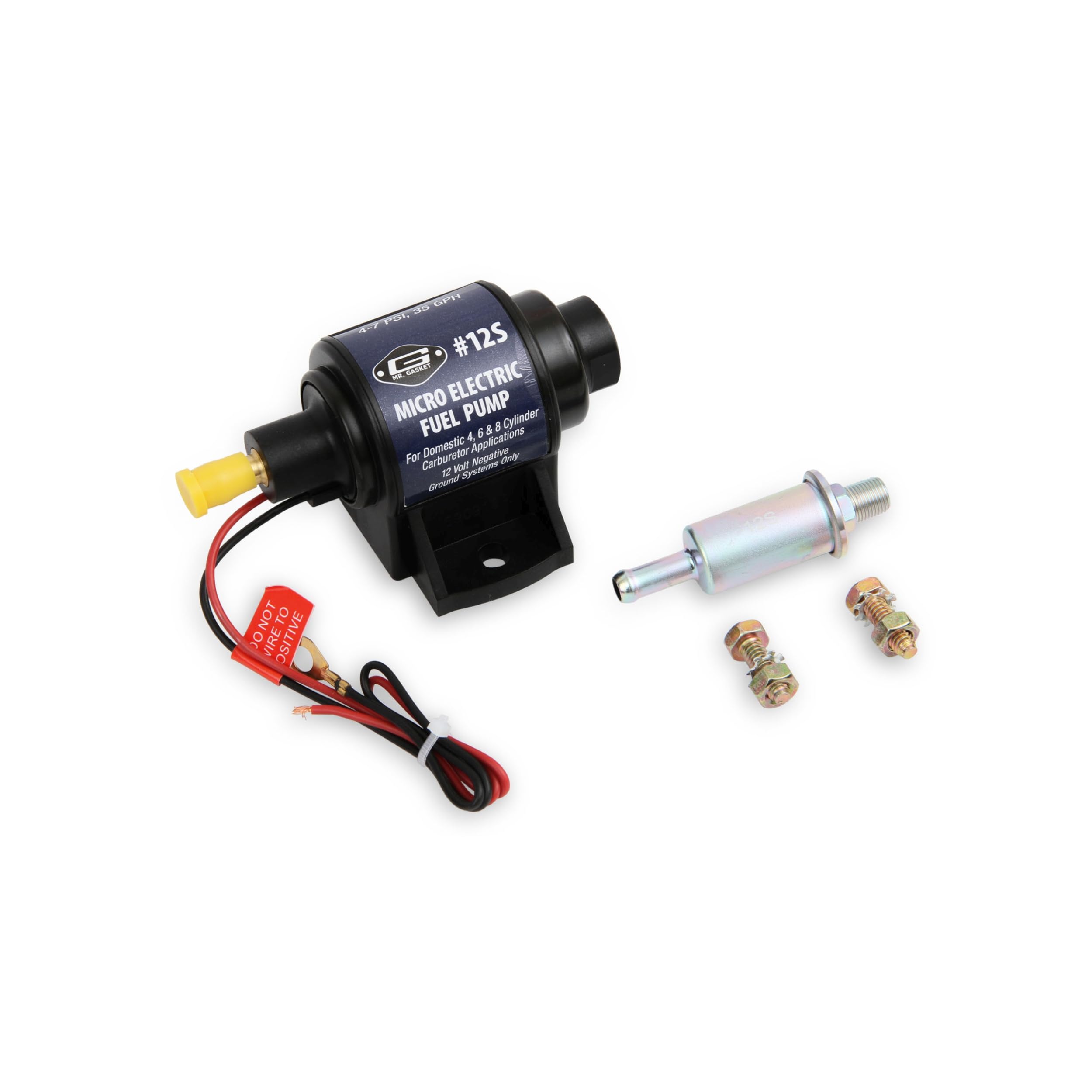
2. Mr. Gasket 12S Micro Electric Fuel Pump
A tiny 1-pound inline pump that banishes vapor lock on old carbureted iron.
The 1-pound polymer body hides a legitimate fix for classic-car fuel delivery problems. It eliminates vapor lock and flooding—the two curses of hot-running carbureted engines—and it’s a self-priming design, so it pulls fuel up to the carb without you hand-priming the bowl. Owners use it as a fuel transfer pump and as a permanent replacement on rigs like the 1975 Chevy Vega.
The longevity story is remarkable: buyers report running it 8+ years on diesel, biodiesel, and SVO (straight vegetable oil) despite the diesel warning. The trick is a 10-micron pre-filter to keep junk out and rubber isolators to quiet the ticking. Quality is the top praise, with easy installation right behind it—it comes with fittings and mounting hardware in the box.
Reliability is genuinely mixed here, so protect yourself. One unit failed within a week on a 1969 Corvair, and another stripped its barbed inlet ring when the filter was over-tightened. Treat the fittings gently and it’s a bargain that outlasts the car. The key is pairing it with a proper pre-filter.
Best for: a budget-friendly inline fix for classic cars and simple fuel transfer, not for harsh daily abuse.
Protect your install: never over-tighten the barbed inlet—the housing can strip.
Pick it if: you want a cheap, easy vapor-lock cure for a weekend cruiser.
Look elsewhere if: you need guaranteed 24/7 reliability—defects do slip through.
3. Holley 12-427 32 GPH Mighty Mite Electric Fuel Pump
A 32 GPH solid-state pump that ends the mechanical pump mess for good.
When your mechanical pump blows fuel into the crankcase, this is the clean electric answer. The Mighty Mite flows 32 gallons per hour at 4-7 PSI, which is enough for engines up to 400HP naturally aspirated. It’s a pass-through design, so fuel flows freely even when the pump is off—a lifesaver on a 1951 truck where a dead pump would otherwise strand you.
The solid-state internals are the selling point: no points to burn, no diaphragm to tear, just a reliable 2-wire hookup that primes in seconds. Owners swapped out failed mechanical pumps on 71 Chevy trucks and old Fords with a noticeably easy install. It self-primes and self-regulates, and it can dry-lift from 12 inches, which helps when the tank sits low.
The honest trade-off is noise. It’s rated at 65 dB—about as loud as a normal conversation—but frame-mounted, it pulses and throbs. One buyer had a unit fail from the start, noisy and refusing to pump fuel after 2 weeks of troubleshooting. Mount it on rubber isolators and keep a pre-filter in line, and most owners mention it runs strong for months.
Why it wins: the all-fuel compatibility (gas, diesel, E85, blended alcohol) makes it a universal swap-in that no mechanical pump can match.
Reality check: buy it understanding some units arrive dead; the 4.2-star crowd is happy once installed properly.
Ideal for: carbureted trucks and classics converting from mechanical to electric without rewiring the whole car.
Skip if: you need a silent pump for a daily driver—this one talks to you.
4. Walbro GSS342 Fuel Pump

The 255 LPH fuel-injection workhorse that import tuners trust for engine mods.
This is the pump you bolt in when you’ve outgrown the stock unit. It flows a massive 255 liters per hour—enough to feed serious horsepower on Acura, Honda, and import builds. The stainless steel body and hose barb connector make it a genuine Walbro, and owners were relieved to confirm it’s the real deal, not a knock-off “Walboro,” especially on a Hayabusa with engine mods.
It’s a plug-and-play drop for many stock fuel hangers, which is exactly what owners praise. The install is easy, the fit is perfect, and it connects straight to the stock plug without adapters. The one missing piece is a wiring adapter in the kit—a minor annoyance when you’re mid-install.
The grumbles are real: a high-pitch whine at highway speed that gets louder in heat, and one unit arrived with a broken electrical plug while another failed intermittently after a few key turns. For the 4.3-star consensus, the fuel delivery is the star; the noise is the price of admission for high-flow performance.
The take: a genuine high-flow upgrade that wakes up modified engines, sold without the fake-brand anxiety.
Know this: buy from a trusted seller so you don’t get a counterfeit in a Ziploc bag.
Reach for it if: you’re building an import for power and need the flow to match.
Be aware: a slight whine comes with the territory at 255 LPH.
5. QFS 255LPH Performance Fuel Pump Kit

A 255 LPH upgrade that ships with every hose, clamp, and screen you need.
This one stands out for what’s in the box, not just what’s in the pump. The complete kit includes the pump, strainer, fuel hose, hose clamps, wiring harness, foam sleeve, and rubber boot—everything for a full installation. That’s a huge relief when you’re knee-deep in a custom build and don’t want to source 10 small parts. It’s engineered with a turbine-style impeller to keep pressure steady under high demand.
You get a smoother throttle response and a silent, vibration-free ride, according to owners. One buyer with a 2011 Crown Vic Police Interceptor installed it first-time without dropping the tank, needing only a 2-wire rewire; another fitted it directly into a 98 Ranger with no cutting. The lifetime warranty from a US-based business backs it up.
The catch is universal fitment—it’s not a perfect drop-in for every car. One buyer found it 0.75″ longer than OEM and had to trim the bracket with a Dremel; a few others had to cut, grind, or deal with a filter sock clip that’s hard to attach. It’s best for tinkerers, not bolt-and-go shoppers.
Why it’s a value pick: the complete kit and lifetime warranty beat buying a bare pump and hunting down fittings.
The reality: expect minor fabrication on some models—it’s a universal pump, not an OEM match.
Best for: DIY builders who want a full kit, a quiet turbine, and a safety-net warranty.
Not for: anyone who wants a guaranteed bolt-in with zero cutting.
6. SEACHOICE Dura-Lift Electronic Fuel Pump

A solid-state diesel lifter with a 120-inch pull that wakes up old IDI trucks.
Built for heavy lifting, this pump pulls fuel from a staggering 120 inches down and delivers it at 11.5-9 PSI, moving 33 GPH. That makes it the go-to for converting old 6.9 and 7.3 IDI diesel trucks from mechanical to electric fuel delivery. On a turboed 6.9 IDI, customers note a huge power gain and smoother running—”feels like a new truck.” It’s a universal fit that also handles marine generators, refrigeration trucks, and diesel filtration systems.
The solid-state construction is the headline: self-regulating with an internal check valve, a 4-hour dry run capability, and voltage spike protection. Owners praise the reliability—it pumps from both tanks on an F250 and transfers diesel between an auxiliary and main tank with ease. The included 80-micron stainless steel filter keeps impurities out of your injection system.
The trade-off is noise and fittings. The constant ‘clickclickclick’ sound is easily masked by a diesel engine, but it’s there. The ports are small 1/8 inch NPT, so you’ll want 3/8-inch nipples and 3/8-inch fuel line for a clean install on a turbo diesel. Buyers call the build quality sturdy and reliable, which matters when your rig depends on it.
Standout spec: the 120-inch lift is double what most inline pumps manage, making it a true diesel workhorse.
Setup note: plan for 3/8-inch fittings and a rubber mount to tame the click.
Pick this for: diesel trucks, marine use, or any high-lift fuel transfer that needs constant pressure.
Pass if: you’re on a gas carburetor that only needs 4-7 PSI—this overshoots that target.
7. Walbro GSL392-400-939 Fuel Pump Kit

A quieter, smaller 255 LPH inline pump that high-performance builders swear by.
This is the inline brother of the GSS342, and it’s a favorite for fuel-injected engines that need a frame-mounted pump. At 255 LPH, it feeds serious builds—one owner runs it on a 650 whp land-speed car, another on a 460ci Big Block Ford with great pressure. The universal kit includes the pump and install hardware, so you have what you need to get going.
The sizing is a real advantage: it’s quieter and smaller than both the Holley counterpart and the Bosch 044, while supplying roughly 58 PSI. Owners note it starts a dormant ’99 Ford Taurus Duratec immediately after years idle, using a marine tank rig, with no tank removal needed. The electrical posts are smaller, so a washer or two helps the connection.
Quality control is the shadow here. The dreaded 1-star review: a unit arrived soaked in lubricant, whined, died after 10 minutes, and the stud broke on removal. Another failed within 1500 miles. For the 4.2-star majority, it’s a “very serious pump” that delivers—just inspect yours on arrival and consider AN fittings for a permanent install.
The edge: Bosch-beating quietness at a lower price point with enough flow for 650+ whp.
The gamble: a small chance you get a dud; test yours before a full install.
Choose this if: you’re building a high-performance fuel-injected car and want a compact, quiet inline pump.
Be cautious: verify the unit works from the start—some arrive damaged.
8. Holley 12-802-1 110 GPH Blue Electric Fuel Pump
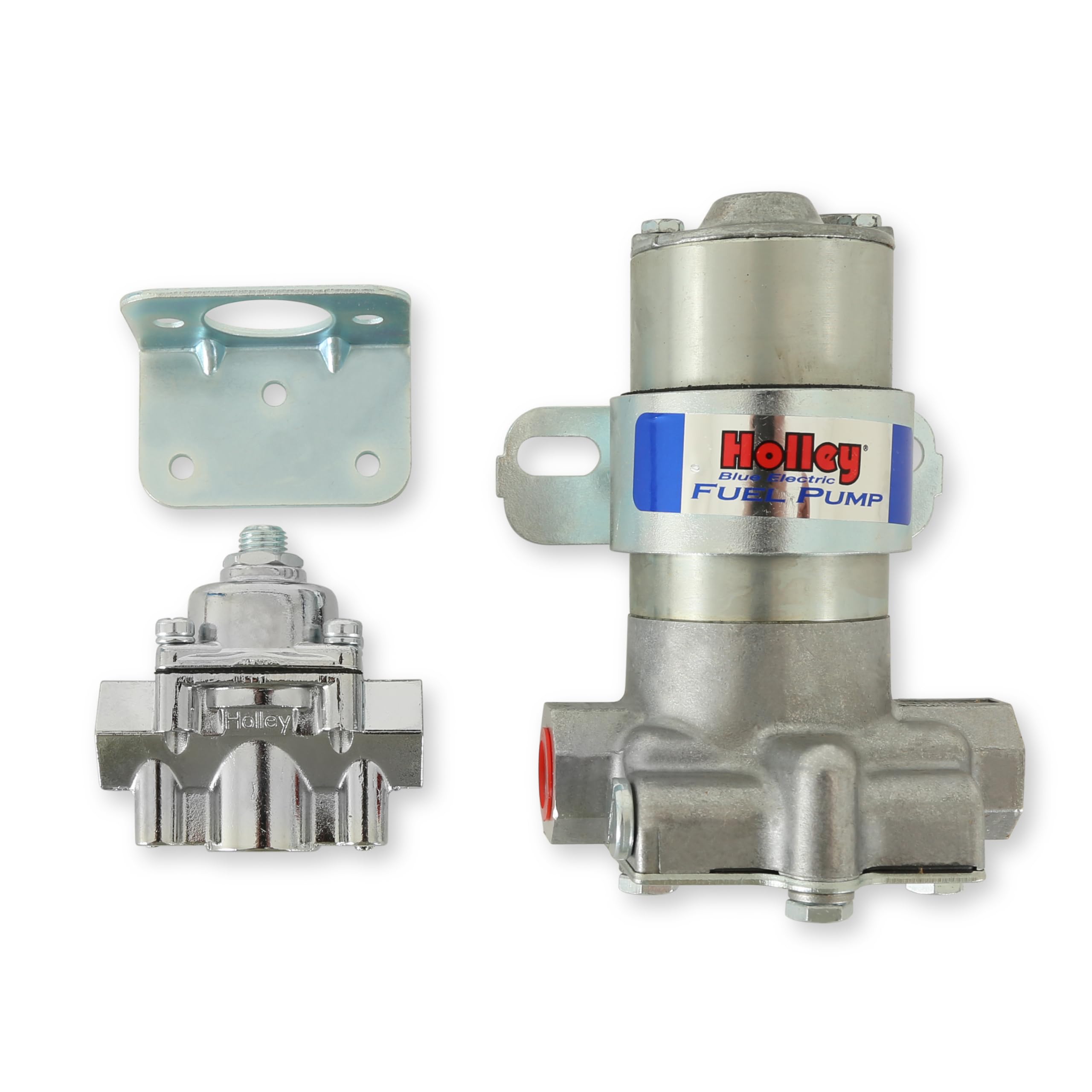
The iconic blue pump that feeds 400-cube muscle cars with 110 GPH on tap.
You’ve seen this blue anodized pump on a thousand hot rods, and for good reason. It flows a massive 110 GPH free-flow (88 GPH at 9 psi) with a maximum pressure of 14 psi—enough to feed a 1967 Pontiac 400ci with a Quadrajet and plenty of headroom. The tumble-polished billet look is iconic, and the motor draws only 3 amps, keeping wiring simple.
It shines as a pusher pump: one owner runs it behind the factory lift pump on a 24-valve Cummins and holds 20-25 psi at all times, even at wide-open throttle. You can hear it running when you switch it on, which is part of the muscle-car charm. For a carbureted street/strip build, it delivers 7 lbs of pressure easily.
The caveats are practical. It’s a plastic body, not billet aluminum, so mounting vibration needs good rubber padding. The included regulator is redundant if you already run one, and its mount only fits the firewall or fenderwell. Quality is praised, but functionality is genuinely mixed—some units work flawlessly, others don’t work at all from the start, so test it before the full install.
The legend: 110 GPH at 14 PSI max makes it the benchmark for street/strip muscle.
Smart move: buy a relay kit (P/N 12-753) and a 7.5-amp fuse to protect it.
Reach for this: if you’re building a classic muscle car or want a high-flow pusher for a diesel with a factory lift pump.
Source it well: the build quality is praised, but verify a working unit on arrival.
9. Fill-Rite FR4204H 12V 20 GPM Fuel Transfer Pump

A cast-iron transfer monster that empties a fuel cell twice as fast as your old 15 GPM pump.
This isn’t an engine feed pump—it’s a bulk fuel mover built for trailers and trucks. The FR4204H cranks out 20 gallons per minute, which is enough to empty an 85-gallon diesel fuel cell in half the time of a 15 GPM unit with a 3/4-inch hose. The secret is the 1-inch outlet, which lets the fuel flow like a fire hose. The cast iron body is built to take a beating, and it comes with a limit lifetime warranty.
The rotary vane technology keeps flow consistent even as parts wear, and the thermal overload protection prevents the motor from cooking itself during heavy use. Reviewers point out using one daily to fuel heavy machinery—about 300-500 gallons a day for 5 years—and it’s still going. It’s designed for bung-mounted transfer from tanks, pulling from depths of 8 feet and discharging up to 37 feet high.
The install is straightforward: a removable junction box rotates 180 degrees for easy wiring in tight spaces. The 1-inch female NPT threads and included 5-foot ground wire simplify hookup. The minor gripe is that a replacement pump doesn’t always include a new power wire, so keep your old one. A 4-star owner confirmed it performed great after replacing a 5-year-old unit that shorted at the switch.
The machine: 20 GPM with a 1-inch hose makes it the fastest way to move bulk fuel on a job site.
Plan ahead: keep your previous pump’s power wire, as a new one isn’t always in the box.
Get this for: farming, trucking, or any heavy-duty fuel transfer where speed and durability rule.
Don’t buy it for: feeding an engine—use a low-pressure inline or in-tank pump instead.
Understanding the Specs
GPH / LPH Flow Rate
This tells you how much fuel the pump can move in an hour, measured in gallons (GPH) or liters (LPH). A stock carbureted engine needs only 30-40 GPH, while a high-horsepower fuel-injected build wants 255 LPH or more. Bigger isn’t always better—too much flow overwhelms a carburetor, so match it to your build.
PSI Pressure Output
This is the force pushing fuel to the engine. Carburetors like low pressure (4-7 PSI), while fuel injection demands high, constant pressure (40+ PSI). A pump rated for 14 PSI max works fine on a carb but won’t feed a fuel injector rail. Always match the pump’s PSI to your fuel delivery system.
FAQ
Will an electric fuel pump work with my carburetor?
Can I use a gas pump for diesel fuel?
What’s the difference between an inline and in-tank fuel pump?
How long should an electric fuel pump last?
Is there a difference between a fuel pump and a fuel transfer pump?
Does a fuel pump need a relay or special wiring?
Can I replace a mechanical fuel pump with an electric one?
Why is my fuel pump making a loud noise?
Will a universal fuel pump fit my car without cutting?
What pressure should my electric fuel pump put out?
Final Thoughts: The Verdict
For most people, the electric fuel pump winner is the Denso 951-0001 because it’s a verified OEM-grade part with a flawless 20,000+ mile owner track record and a guaranteed Toyota fit. If you want a high-flow 255 LPH upgrade for a modified import, grab the Walbro GSS342. And for diesel trucks needing a strong lift, the SEACHOICE Dura-Lift with its 120-inch lift is the one to reach for.
How We Picked
We do not accept paid placement. Every pick is matched to a real buyer and a real use-case; we do not hands-on test units.
Sources & Methodology
Specifications: manufacturer listings and product documentation. Review insights: verified customer reviews, as of August 2026. Pricing: not shown on this page (it changes often); check the current price via the retailer link.
As an Amazon Associate, WellFizz earns from qualifying purchases. This does not affect which products we feature.
Related Guides

Mo Maruf
I created WellFizz to bridge the gap between vague wellness advice and actionable solutions. My mission is simple: to decode the research and give you practical tools you can actually use.
Beyond the data, I am a passionate traveler. I believe that stepping away from the screen to explore new environments is essential for mental clarity and physical vitality.