Our readers keep the lights on and my smoothie glass nicely filled. As an Amazon Associate, I earn from qualifying purchases.
Specs are compiled from manufacturer listings and verified buyer reviews and can change over time — please confirm the key details on the product page before buying.
Finding the right electric fuel pump for a carburetor means matching the exact low pressure your engine needs — too much and you flood the float bowl (the chamber inside the carburetor that holds fuel), too little and you starve it at highway speeds. This guide covers seven pumps built for that balance, from simple inline boxes to heavy-duty rotary vane units, ranked by real owner feedback and published specs.
This guide compares manufacturers’ published specifications and patterns across verified customer reviews, so you get each pick’s real strengths and trade-offs instead of marketing spin.
Whether reviving a barn-find classic, upgrading a tractor, or converting a boat to electric, these seven pumps have been tested and trusted by real owners.
Our Picks at a Glance

How To Choose The Best Electric Fuel Pump For Carburetor
Choosing the right electric pump for a carburetor is different from picking one for fuel injection. Carburetors need low, steady fuel pressure — typically between 3 and 7 PSI (pounds per square inch, a measure of how hard the pump pushes fuel) — not the high pressure (40-60 PSI) that EFI (electronic fuel injection) systems demand. Get the pressure wrong, and you will deal with flooding, hesitation, or outright stalling. Here is what actually matters when you are shopping.
Pressure (PSI) is the non-negotiable
Every carburetor has a float valve (a small needle-and-seat valve that opens and closes to control fuel level inside the carb) designed to hold back fuel at a specific pressure. Most standard carburetors work happily in the 3-6 PSI range. Performance or high-flow carburetors may want as much as 7 PSI. If the pump delivers more than the valve can hold, fuel overflows — that is flooding. If it delivers less, the engine runs lean (not enough fuel), stumbles under load, or stalls on hills. Check your carburetor’s spec before buying.
Flow rate (GPH) needs to match your engine
Flow rate, measured in GPH (gallons per hour), tells you how much fuel the pump can move in ideal conditions. A small four-cylinder engine may be perfectly happy with 28 GPH. A big V8 at wide-open throttle can consume 30-35 GPH. Buying a pump with huge flow and no pressure regulator can overwhelm the carburetor. A pump with too little flow starves the engine at high RPM (revolutions per minute). Match the GPH to your engine’s maximum fuel demand.
Inlet size and mounting style
The pump’s inlet and outlet size must match your existing fuel line — common sizes are 5/16 inch and 1/4 inch. Most universal pumps come with barb fittings (ridged connections that rubber hose slides over) for rubber hose, but some use threaded NPS (National Pipe Straight) or NPT (National Pipe Tapered) fittings for hard line. Also decide between an inline pump (plumbed anywhere along the fuel line) and a pre-assembled unit on a bracket that mimics a mechanical pump’s footprint. The mounting location matters: mount the pump close to the fuel tank, and make sure it is lower than the tank outlet so gravity helps priming.
Quick Comparison
| Model | Best For | Pressure (PSI) | Flow Rate (GPH) | Inlet Size | Amazon |
|---|---|---|---|---|---|
| TREXFLOW TF P4070★ Best Overall | Full-time replacement for older vehicles | 4-6 | 72 | 0.25 in | Amazon |
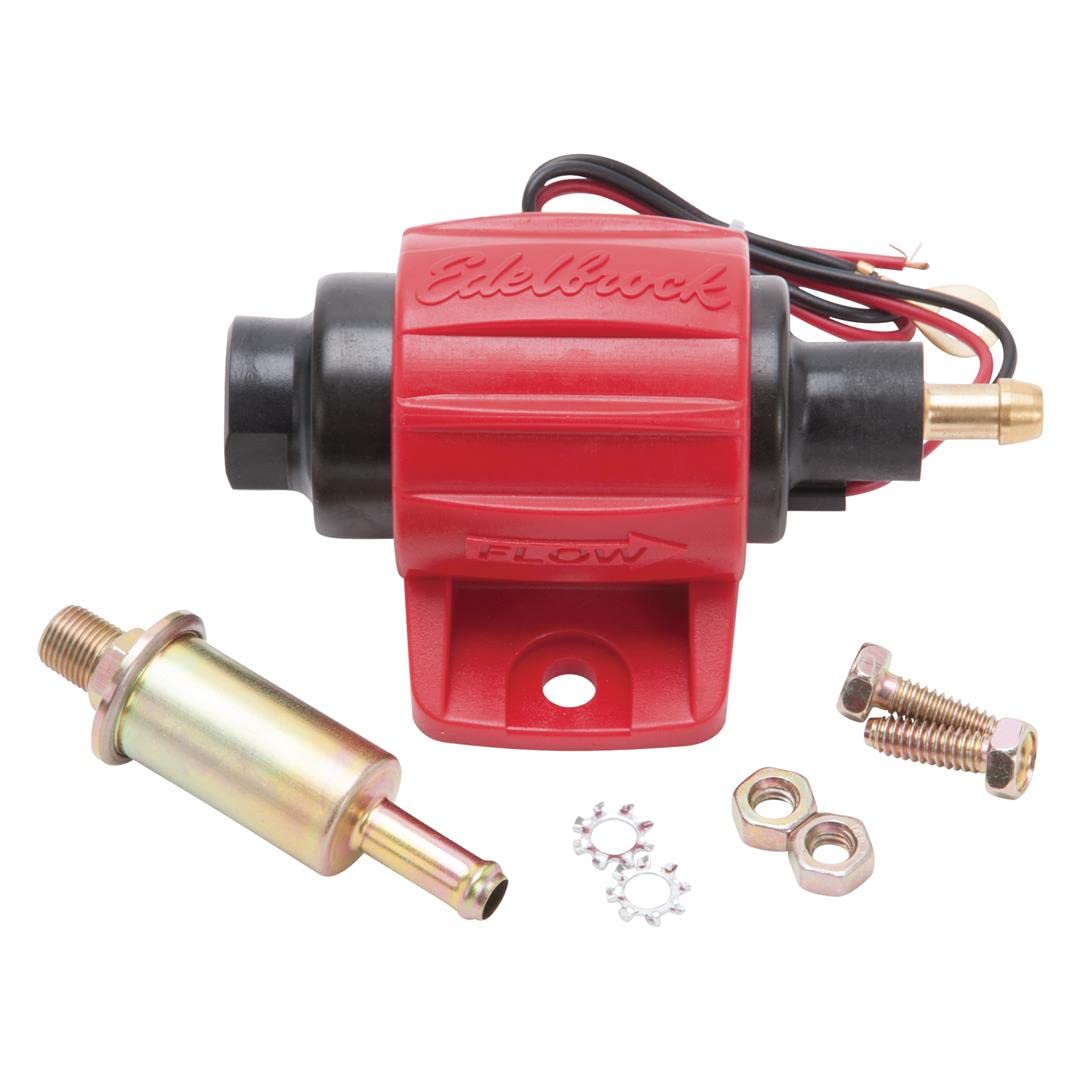
| Edelbrock 17301High-Flow | Performance street/strip gravity-fed | 7 | — | 0.5 in barb | Amazon |
| ENGINEMAN 106092 | Budget inline swap | 2-3.5 | 28 | 0.32 in | Amazon |
| ENGINEMAN HEP02A Kit | DIY kit with all hardware | 3-6 | 30 | 5/16 in barb | Amazon |
| AUTOKAY E8011 | 6-volt classic car systems | 5-8 | — | 5/16 in barb | Amazon |
| Yeoflagtrade 861155A3 | MerCruiser marine replacement | Low Pressure | — | Hose Barb | Amazon |
| Holley 12-427 Mighty Mite | Solid-state swap for up to 400HP | 4-7 | 32 | 0.31 in barb | Amazon |
In‑Depth Reviews
1. TREXFLOW TF P4070 Electric Fuel Pump
Our pick — over 4★ from 100+ verified ratings; the strongest balance of quality and price.
The rotary vane that flows 72 GPH and stays quiet enough to forget it is there.
This is the pump that suits someone replacing a worn mechanical unit on an older vehicle, a tractor, or a classic truck — and who wants one-and-done reliability. The rotary vane design (a spinning rotor with sliding vanes that push fuel in a smooth, continuous stream) means it pushes fuel in a continuous stream instead of pulsing like a diaphragm pump (a pump that uses a flexible disc moved by a solenoid to push fuel in bursts), so the carburetor sees a steady supply. The pressure stays in the safe 4-6 PSI range for most carburetors, and the flow rate hits 72 GPH, while the ENGINEMAN pump produces 28 GPH.
The pre-assembled metal bracket has multiple mounting hole positions, letting you place it virtually anywhere in the engine bay, as owners note. Quality is the most-discussed aspect across reviews, and the consensus is crisp: this pump feels solid, the threaded NPS (National Pipe Straight) fittings seat well, and the improved worm-clamp wiring posts eliminate the loose-connection headache earlier versions had. Buyers report it as “a nice replacement for an old vehicle with a carburetor” and find it “perfect for a tractor that keeps up at any RPM.” The single caveat is that the 0.25-inch inlet size; the budget pick has a 0.32-inch inlet, so you may need an adapter if your fuel line is 5/16 inch.
Standout reliability: Quality and reliability are the two most-mentioned strengths, each with ten owner callouts — the ISO 9001 (an international quality management standard) and IATF 16949 (a quality standard specifically for automotive parts) certification backs up a pump that simply works from day one.
The honest trade-off: The smaller 1/4-inch inlet means you may need a reducer bushing (an adapter that steps down a larger hose to a smaller fitting) to connect to standard 5/16-inch hose; check your line size before ordering.
Reach for this if: you want a heavy-duty pump that flows 72 GPH with rotary-vane quietness and a mounting bracket that fits many chassis layouts — it is the top-rated pick for a reason.
Think twice if: your fuel line is 5/16-inch hard line and you want a direct barb connection without adapters.
2. Edelbrock 17301 Fuel Pump
The street-performance classic with a 7 PSI fixed output for gravity-fed inline setups.
If you are building a hot-rod, a big-block Pontiac, or a high-compression small-block that needs fuel kept steady at high RPM, the Edelbrock 17301 brings a name that carries decades of aftermarket trust. It is a self-priming (it can pull fuel into the pump on its own without manual help), regulating (it controls its own output pressure) inline pump with a cast-iron body and a 0.5-inch hose barb inlet — the largest inlet on this list, useful for high-volume systems where you want zero restriction on the suction side. The specified output is 7 PSI minimum, which suits performance carburetors that need a firmer fuel signal. Owners mention it pulls fuel from a tank mounted 10 inches below the pump without trouble.
Installation draws positive notes — it mounts with simple hardware, and the inline design lets you tuck it anywhere in the frame rail. The catch, and it is the elephant in the room, is reliability. Reliability is the most-discussed aspect with 31 mentions, and Amazon marks the sentiment as Mixed: while some owners say it works “fantastically,” a notable number report failures within a short period — one owner described two units failing, first at 10 miles, then at home. Quality feedback leans negative, with 15 owners expressing disappointment. This pump is not the right pick if you want fit-and-forget for a daily driver. It belongs on a weekend project where you are comfortable carrying a spare or adding a relay (an electrical switch that uses a small current to control a larger current, ensuring clean power to the pump) to ensure clean power.
Large inlet, big potential: The 0.5-inch barb inlet (other pumps’ inlets are 0.25-0.32 in.), making it ideal for gravity-fed systems (where fuel flows from the tank downward to the pump) that need maximum draw from the tank.
Honest durability concern: The reliability feedback is split far enough that this pump is best treated as a performance upgrade on a monitored system, not a daily-driver replacement.
Reach for this if: you are building a performance engine that needs a full 7 PSI and you have the mechanical space to mount it near the tank with a relay for clean power.
Look elsewhere if: you need a daily-driver pump you can install and forget — the mixed reliability record points to better options.
3. Holley 12-427 Mighty Mite Electric Fuel Pump

The solid-state Mighty Mite that handles up to 400HP and works with any fuel including E85.
Holley is a household name in carburetion, and the 12-427 Mighty Mite delivers the practical middle ground: a solid-state design (no brushes to wear out) that pushes 4-7 PSI and 32 GPH. The maker says it supports naturally aspirated (non-turbocharged, non-supercharged) engines up to 400HP, which covers the vast majority of street cars and trucks. It is self-priming and regulating, able to dry-lift (pull fuel from a dry line without needing gravity to start) from 12 inches above the tank, so you are not chasing priming issues every time the vehicle sits.
Owners love the ease of installation. A common story is replacing a leaking mechanical pump on a classic truck — the two-wire hookup and included fittings make the swap straightforward. The sound gets mixed reactions: some call it quiet while others clock it as loud with a pulsing beat when frame-mounted. One owner uses it with a momentary switch (a button you press and hold, releasing to turn off) to prime a carb after a few days of sitting, letting the mechanical pump take over afterward — a smart workaround. A recurring negative is that a few units arrived non-functional or produced only about 3 PSI instead of the rated range, so bench-testing (testing the pump on a workbench with a battery and a jar of fuel) before final installation is a wise move.
Fuel flexibility: Compatible with gasoline, diesel, blended alcohol, ethanol, and E85 (a fuel blend of 85% ethanol and 15% gasoline) — the widest fuel compatibility in this lineup, critical if you run flex-fuel or seasonal blends.
Noise caveat: The pump pulses audibly when mounted to a metal frame rail; owners suggest rubber isolation pads to quiet it down.
Reach for this if: you want a trusted brand with solid-state internals for a street car or truck up to 400HP and you do not mind the audible tick of an inline pump.
skip it if: absolute silence matters (the rotary-vane TREXFLOW is quieter) or you prefer a pump with a higher flow ceiling for a serious race build.
4. Yeoflagtrade 861155A3 Electric Fuel Pump

The MerCruiser direct swap that brings a 1950s boat back to life without chasing old mechanical parts.
This pump is a direct-fit replacement for a narrow but passionate group: owners of Mercury MerCruiser carbureted marine engines in the 4.3L V6, 5.0L V8, and 5.7L V350 families, covering model years from the mid-1990s into the early 2000s. If your boat’s mechanical fuel pump has given up, the 861155A3 bolts on with the same dual-line (two fuel line connections, supply and return) footprint and gets fuel flowing again. It is a low-pressure pump built specifically for carbureted marine engines, not MPI (multiport fuel injection).
Customers note it as a perfect fit that solved hard-starting and fuel-starvation issues. The maker claims an engineering target of 10,000 hours or 100,000 miles — impressive longevity on paper. One owner bought a second unit as a backup after a year of reliable service, which tells you the confidence level. The honest downsides: an occasional housing crack has been reported on delivery (one owner caught it during startup, avoiding a fuel spray hazard), and the included brass fittings can be fragile — owners advise reusing the original fittings where possible. This is a niche marine pump, not something you buy for a car, but for the right MerCruiser it is a home run.
Year-matched fit: Specific to 1998 4.3L/262, 2000 5.0L/305, and 2000 5.7L/350 MerCruiser engines — if you have one of these, the double ports line up perfectly.
Reuse old brass: Several owners caution that the included brass threaded inserts can break; use the fittings from your old pump.
Reach for this if: you own a MerCruiser 4.3L, 5.0L, or 5.7L carbureted boat and want a bolt-on pump that is much cheaper than a dealer part.
Not for you if: you run a car, truck, or any non-MerCruiser engine — this pump is a strict marine fitment.
5. ENGINEMAN Universal Electric Fuel Pump Kit
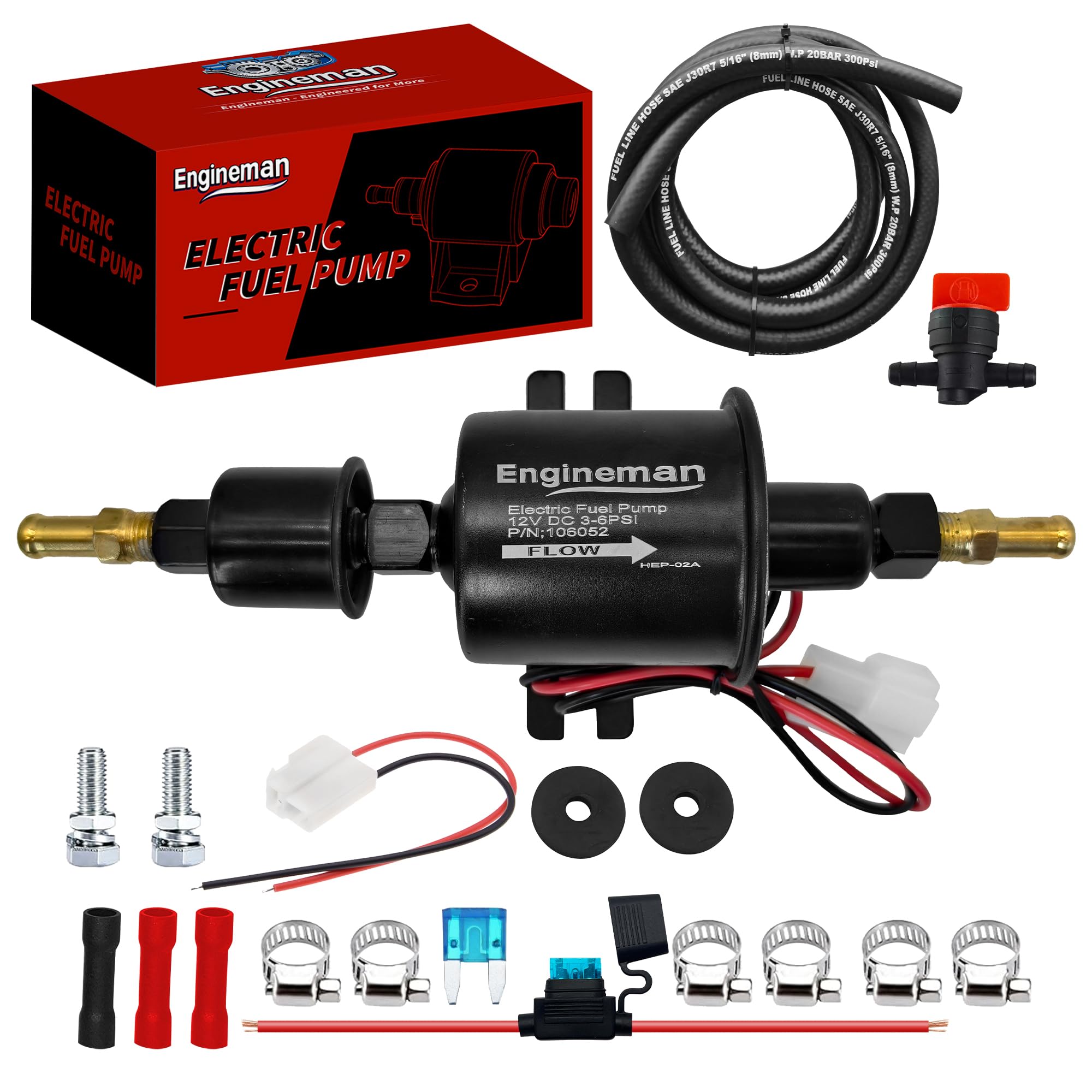
The complete kit with filter, hose, and clamps that makes a first-time electric conversion a 30-minute job.
This ENGINEMAN pump is the all-in-one answer for someone converting a tractor, small-block Ford, or side-by-side (a small off-road utility vehicle) from a failing mechanical pump to electric. The kit supplies everything: the pump itself, a 6.56-foot length of 5/16-inch fuel hose, a fuel filter, hose clamps, mounting screws, wire connectors, a 15-amp inline fuse, and even two shut-off valves. Performance is the most-praised aspect with 23 positive mentions — owners describe it as a pump that outperforms vacuum-stock units on modified engines and keeps fuel pressure steady for months on end.
The 3-6 PSI output and 30 GPH flow hit the balance for most carbureted small-block and four-cylinder engines. It handles both gasoline and diesel, but the maker excludes alcohol-based fuels like E85. The included hardware is generous, though the fittings themselves draw Mixed feedback (6 mentions) — some owners find the included positive/negative wire connectors cheap. That is a minor gripe for a kit that lets you run a 1978 Ford 4.9L inline-6 or a Club Car golf cart with a Predator motor swap without hunting for extra parts.
Everything included: A 2-meter fuel hose, filter, 6 clamps, a 15A inline fuse, and shut-off valves mean you do not need a second trip to the auto parts store.
Fittings feel cheap: The included wire connectors are the main owner complaint — swapping them for quality ring terminals is a ten-cent upgrade.
Reach for this if: you are doing a first-time electric conversion or need a complete bolt-in kit for a small engine, tractor, or classic truck — the included hardware saves hours of sourcing.
Look elsewhere if: you need a high-flow pump for a high-horsepower V8 or you want top-shelf connectors straight from the start.
6. ENGINEMAN Gasoline Electric Fuel Pump Universal 5/16 Inline
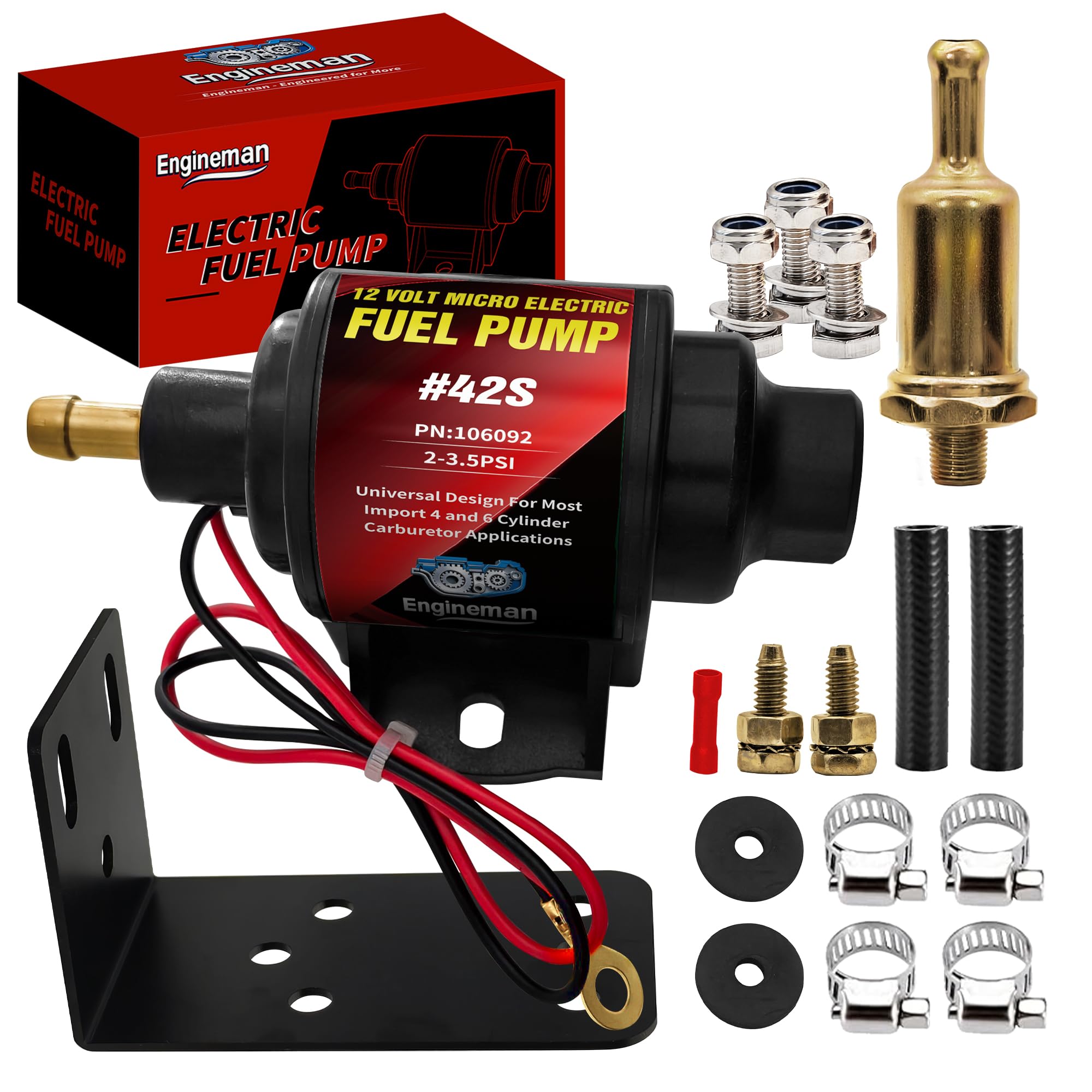
The low-PSI entry pump that delivers a gentle 2-3.5 PSI for small engines and test stands.
This ENGINEMAN pump sits at the budget end of the spectrum, but it fills a narrow and important role: engines that genuinely need very low fuel pressure — think lawn mowers, generators, VW engine run stands, and small carburetors that flood easily.
Reliability is the most-discussed aspect, with 14 positive mentions — owners find it a reliable primer (a pump used to fill the carburetor with fuel before starting) or transfer pump. One VW enthusiast reports it works perfectly on an engine run stand (a stand that holds an engine for testing or break-in outside a vehicle) that needs only 2 PSI. The 5/16-inch inlet and outlet (0.32 inches) match common small-engine fuel hose directly without adapters. The included mounting bracket angles the pump 45 degrees upward, which helps keep fuel inside the pump between starts for instant priming. The catch? A small number of reviewers point out the motor failing before it ever picks up fuel — an occasional quality miss at this price point — plus it is not compatible with E85, ethanol, methanol, or race fuel.
Ultra-low pressure specialist: At 2-3.5 PSI it is the only pump here that suits a vintage VW or a generator carb without needing a pressure regulator.
Fuel-type limits: This pump is strictly for pure gasoline — no E85, no ethanol blends, no methanol, no race fuel, which limits its use in flex-fuel vehicles.
Reach for this if: you need a cheap, reliable low-pressure pump for a lawn tractor, generator, or VW engine test stand that runs on standard gasoline.
Not for you if: your engine requires more than 3.5 PSI or you run any alcohol-based fuel — this pump cannot handle it.
7. AUTOKAY Universal 6 Volt Electric Fuel Pump
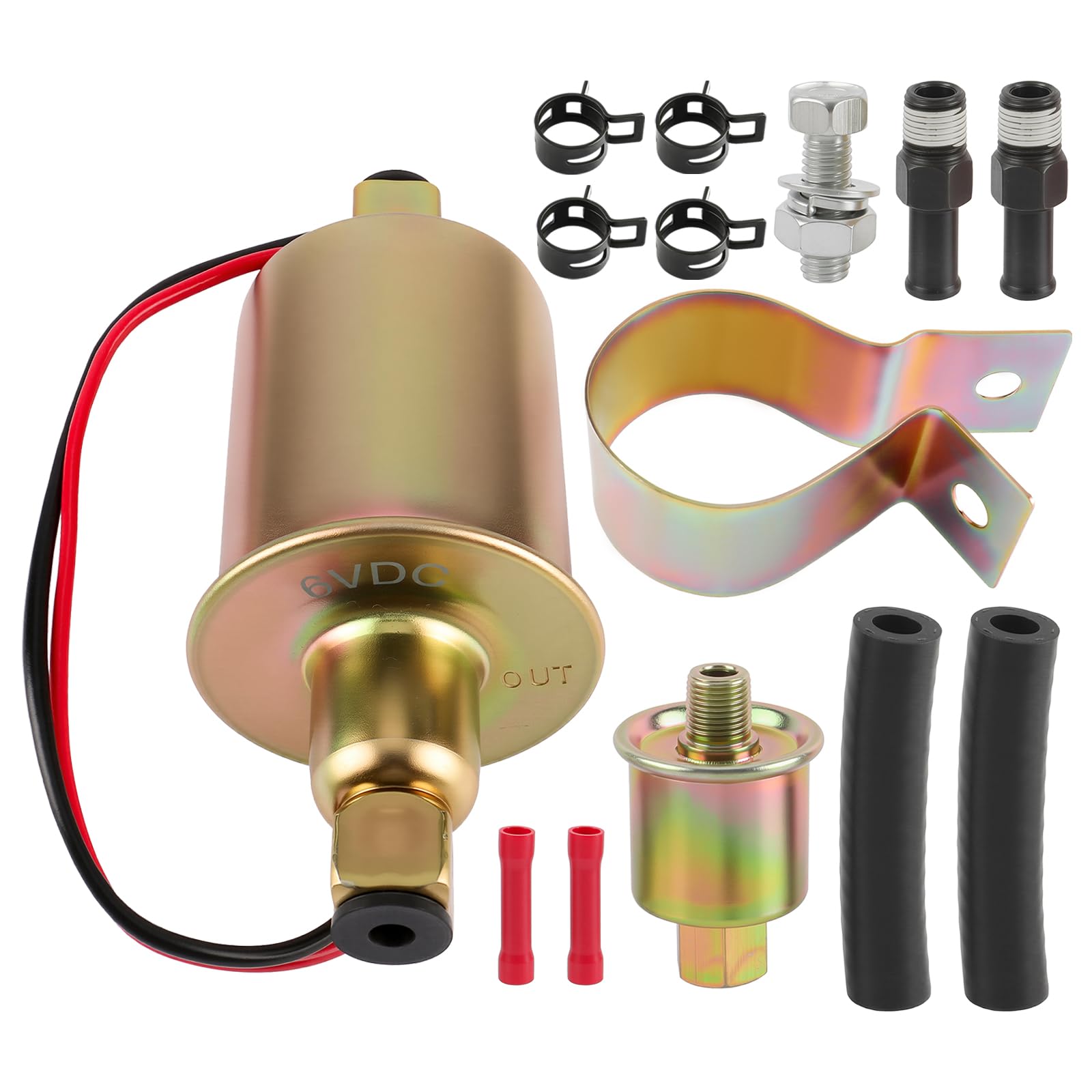
The 6-volt pump that keeps pre-1955 Buicks, Chryslers, and straight-eights on the road without rewiring.
If you own a classic that still runs a 6-volt electrical system — a 1949 Chrysler straight-eight, a 1950 Buick, or any car built before the 12-volt standard took over — your options for an electric fuel pump are extremely limited. The AUTOKAY E8011 clone fills that narrow gap. It runs on a true 6-volt system, works with both positive and negative ground configurations (the electrical grounding system of the car — positive ground was common in older 6-volt vehicles, negative ground is the modern standard), so it adapts to older chassis wiring, and delivers 5-8 PSI through standard 5/16-inch barb fittings. The compact inline design fits neatly on a frame rail without looking out of place in a vintage engine bay.
Owners call it a must-have for old-car guys. One uses it as a primer pump — switch it on to fill the carb, then switch it off during driving — which is a common trick to avoid heat soak vapor lock (when fuel in the line boils from engine heat, creating a vapor bubble that blocks flow) on straight-eight engines. The included installation kit makes wiring simple. The mixed feedback is real, though: a handful of shoppers say the pump making noise but delivering zero fuel, or failing within a short distance. Buyers advise bench-testing the pump with a jar of gasoline before installing it in the car, and being aware that returns to Amazon for a heavy item like this can involve a long trip to a drop-off center.
6-volt solution: Designed specifically for 6V positive or negative ground systems — almost no other pump on this list works at 6 volts.
Bench-test before install: An occasional pump arrives dead; owners strongly recommend testing it on a battery before bolting it in place.
Reach for this if: you own a 6-volt classic car that needs a low-pressure electric pump for cold starts or vapor lock prevention.
Not for you if: your vehicle runs a 12-volt system (do not buy a 6V pump for a 12V car) or you need a daily-driver-grade pump with zero failure reports.
Understanding the Specs
Pressure (PSI)
Pounds per square inch (PSI) measures how hard the pump pushes fuel toward the carburetor. Most carbureted engines need between 3 and 7 PSI. Too much pressure forces the float valve open, causing flooding. Too little pressure makes the engine lean out and hesitate under load. A pump with adjustable pressure or a separate regulator gives you tuning flexibility.
Flow Rate (GPH)
Gallons per hour (GPH) tells you how much fuel the pump can move at its rated pressure. A small four-cylinder needs roughly 15-20 GPH at full load. A typical V8 needs 30-35 GPH. A high-performance engine can consume 50+ GPH. Oversizing flow without a return-style regulator can overwhelm the carburetor.
Rotary Vane vs. Inline Diaphragm
Rotary vane pumps use a spinning rotor with sliding vanes, producing a smooth, continuous fuel flow with less noise than mechanical pumps. Inline diaphragm pumps use a solenoid (an electromagnetic coil that moves a core back and forth) to push a diaphragm back and forth, creating a pulse that some drivers find audible. Rotary vane pumps tend to last longer under continuous use, while inline pumps are cheaper and simpler to replace.
Inlet Connection Size
The inlet and outlet fitting diameter determines what size fuel hose you can connect. Common sizes are 1/4 inch, 5/16 inch, and 3/8 inch. Most older carbureted vehicles use 5/16-inch hose. A pump with a 1/4-inch inlet (like the TREXFLOW P4070) needs a reducer if your line is larger. Always confirm the fitting type (barb, NPT, NPS) matches your existing connection.
FAQ
Can I use a high-pressure EFI pump on a carbureted engine?
What PSI does my carburetor need?
Should I mount the pump near the tank or near the engine?
How quiet is a rotary vane pump vs. an inline pump?
Do I need a fuel pressure regulator with an electric pump?
Can I use an electric pump with my stock mechanical pump?
What size fuel line do I need for the pump inlet?
How long does an electric fuel pump typically last?
Can I use an electric fuel pump with diesel fuel?
What does GPH mean and how much do I need?
Final Thoughts: The Verdict
For most users, choosing the best electric fuel pump for carburetor depends on matching pressure and flow to your specific engine. The TREXFLOW TF P4070 wins the top spot because its rotary vane design delivers a quiet 72 GPH with proven reliability that owners consistently praise — and it is backed by ISO certification. If you want a complete bolt-in kit that includes everything from hose to fuse, the ENGINEMAN Universal Kit offers unbeatable value for small engines and classic trucks. For owners of 6-volt classics, the AUTOKAY 6V pump is the only practical option that keeps vintage cars running without an electrical conversion.
How We Picked
We do not accept paid placement. Every pick is matched to a real buyer and a real use-case; we do not hands-on test units.
Sources & Methodology
Specifications: manufacturer listings and product documentation. Review insights: verified customer reviews, as of July 2026. Pricing: not shown on this page (it changes often); check the current price via the retailer link.
As an Amazon Associate, WellFizz earns from qualifying purchases. This does not affect which products we feature.
Related Guides

Mo Maruf
I created WellFizz to bridge the gap between vague wellness advice and actionable solutions. My mission is simple: to decode the research and give you practical tools you can actually use.
Beyond the data, I am a passionate traveler. I believe that stepping away from the screen to explore new environments is essential for mental clarity and physical vitality.