Our readers keep the lights on and my smoothie glass nicely filled. As an Amazon Associate, I earn from qualifying purchases.
Specs are compiled from manufacturer listings and verified buyer reviews and can change over time — please confirm the key details on the product page before buying.
Deer can turn a prized garden or orchard into a buffet overnight, and the only real solution is a boundary they respect — not a visual fence they can clear. Electric fencing delivers a memorable correction that trains deer to stay away, but with so many voltage claims, coverage distances, and solar-or-AC options on the shelf, picking the one that actually holds up through a wet season and keeps the herd out is the trick. This guide breaks down the top performers by real-world output and honest owner experience, so you buy a system that protects your land, not your patience.
I’m Mohammad Maruf — the founder and writer behind WellFizz. This guide is built by comparing the manufacturers’ published specifications and the patterns across verified customer reviews, so you get each pick’s real strengths and trade-offs instead of marketing spin.
The crowd favorite here holds a 4.2-star rating across hundreds of owners, and when you narrow it down by coverage, solar reliability, and genuine deer deterrence, one unit stands clearly apart. Here is the straight truth on the electric fence for deer that delivers every time.
Our Picks at a Glance


How To Choose The Best Electric Fence For Deer
Deer are creatures of habit, and an electric fence works because it breaks that habit with a short, memorable shock. Before you buy, three factors decide whether your fence becomes an effective barrier or a frustrating project.
Match the energizer’s range to your fence length
Energizers are rated by the maximum miles of fence they can power — but that number assumes clean wire, no weed contact, and moderate animal pressure. You will lose some distance to vegetation touching the wire or to multiple strands that split the current. A good rule is to buy an energizer rated for a distance longer than the actual fence length you plan to run, so you still get a solid jolt through weeds or damp grass.
Solar autonomy matters more than peak wattage
Most solar fence chargers include an internal battery that runs the fence at night and through cloudy days. The key spec is the “days without sun” number printed on the box. Units that claim 10 days or more of battery autonomy give you a real buffer during winter’s short days or a string of overcast weather, while lower-capacity units may go dead after just a few gray afternoons, leaving your fence silent.
Voltage is not everything — the pulse shape matters
A fence that reads 7,000 volts on a voltmeter can still feel weak if the energizer delivers a short, low-energy pulse. Deer respond to the “punch” of the pulse — measured as stored joules — not just the peak voltage. Look for at least 0.1 stored joule for a small garden fence; go above 0.15 joule for longer runs or heavy deer pressure.
Quick Comparison
| Model | Best For | Coverage | Stored Joules | Weight | Amazon |
|---|---|---|---|---|---|
| MINI160 2 Mile Charger★ Compact Pick | Small gardens / food plots | 2 miles | 0.16 J (0.11 output) | 8.95 lb | Amazon |
| 10 Mile Solar ChargerAlso Great | Large properties / orchards | 10 miles | 0.18 J | 3.1 lb | Amazon |
| 5 Mile Solar EnergizerTop Performer | Moderate coverage / horses | 5 miles | 0.10 J | 3.72 lb | Amazon |
| OULUU Netting 35.4″ | Small livestock / gardens | 164 ft | Energizer sold separately | — | Amazon |
| PPOLB Netting 47.2″ | Goats / larger animals | 164 ft | Energizer sold separately | 16.17 lb | Amazon |
| TMEE Netting 49.6″ | Deer / multi-species | 164 ft | Energizer sold separately | 17.11 lb | Amazon |
| VEVOR Netting 50″ | Large livestock / tough terrain | 164 ft | Energizer sold separately | 15.21 lb | Amazon |
| LMRSTOO Netting 49.6″ | Poultry / light rotation | 164 ft | Energizer sold separately | 22 lb | Amazon |
In‑Depth Reviews
1. MINI160 2 Miles Solar Fence Charger, 0.16 Joule Day/Night Mode
Our pick — over 4★ from 150+ verified ratings; the strongest balance of quality and price.
The heavy-duty budget box that covers a small food plot while staying affordable
If your deer problem is limited to a quarter-acre garden or a small food plot, this 2-mile solar energizer is a sensible entry point. Its 0.16 stored joules (0.11 output joules) is enough to power a few strands of wire or polytape, and the internal 12V/4.5AH sealed lead-acid battery keeps the fence running up to 28 days without any sunshine — the longest autonomy in this lineup. The Night Mode extends battery life by spacing pulses further apart after dark, from every 1.5 seconds during the day to every 2.9 seconds at night.
The big caveat is weight: at 8.95 pounds versus the 3.1-pound 10-mile charger, it is less convenient to move between zones. The thicker build houses that large battery, but it means mounting it on a T-post requires a sturdy bracket. Owners mention that it charges up quickly even after sitting in a box for a year, though a troubling number note the unit stopped working around the two-month mark — the seller often replaces those, but the pattern is worth knowing.
For a small, stationary setup — say, a fenced-off berry patch or a single row of raised beds — this charger does the job at a mid-range price. It is less suited if you need to rotate the fence weekly across a large property, where the lighter 10-mile unit would save your back.
Compact 2-mile: Pair this with a short run of polywire and a single ground rod for a protected garden bed that runs nearly a month on battery alone.
Small 0.16J jolt: The battery connection arrives unplugged by design — you must open the cover and connect the red/black cables to the battery terminals before use, and a few owners missed that step and thought the unit was dead.
2. 10 Miles Solar Powered Electric Fence Charger, 0.18J Day/Night Protection
The lightweight solar unit that punches far above its size for deer control
This is the energizer that truly balances coverage, portability, and real-world voltage. It delivers 5,700 to 10,200 volts along up to 10 miles of fence — a massive reach compared to the smaller 2-mile units — yet it weighs only 3.1 pounds, making it easy to move between grazing areas or around an orchard. The internal battery runs 10 full days without any sunlight, so you are not stuck recharging after a few cloudy afternoons.
Reliability is the aspect owners praise most — over 80 buyers highlight it — and the fence is widely described as effective for keeping deer away from citrus groves and gardens. Buyers report that the unit delivers 7,000-plus volts in real use and that the connectors grip fence wire quickly and solidly. The 0.18-stored-joule output provides a strong pulse without needing a separate AC adapter, thanks to the built-in solar panel and intelligent battery system.
The honest trade-off is that some users found the internal battery drains faster than expected after several cloudy days, and a few units arrived with water intrusion issues. The fence works best when you invest in a good ground rod — at least a few feet of copper driven deep — because without solid grounding, even 10,000 volts won’t travel through the animal effectively. Think of it as the best all-rounder for anyone fencing a half-acre garden or a multi-acre orchard who wants one unit that does not require mains power.
Sun-powered 10-mile
- 10-mile coverage, at 10 miles versus the MINI160’s 2 miles,, letting you fence a large property with one energizer
- Weighs just 3.1 lb — far lighter than the 8.95-lb MINI160, so moving it between pastures is easy
- 10-day battery autonomy means you do not panic after a stretch of gray weather
Low 0.18J output
- Reports of water collecting inside the housing if left exposed to heavy rain — consider mounting it under a small roof
- Battery life varies; some owners needed to supplement with an external 12V charger during long overcast spells
reach for this if: you need to protect a large garden, orchard, or multiple paddocks and want a portable solar unit that outruns the 2-mile chargers (10 miles vs 2 miles).
look elsewhere if: your fence is under 2 miles and you prefer a heavier unit with a sealed lead-acid battery that is less sensitive to moisture.
3. Solar Electric Fence Charger 5 Mile, Low Impedance, Panasonic Battery
A mid-range solar pack with a Panasonic lithium battery that lasts years for the moderate fence runner
This 5-mile energizer splits the difference between the small 2-mile units and the long-range 10-mile charger, making it ideal for a horse pasture, a medium orchard, or a deer-prone vegetable garden that runs about a quarter-mile of fenceline. The 2.3W solar panel is designed to charge fast even in low light, and the premium Panasonic 7.4V/3.4AH lithium-ion battery keeps the fence running up to 10 days without sun — the same autonomy as the 10-mile unit but at a slightly lower investment.
Functionality is the trait owners praise most — 34 buyers call it out — and the unit reliably deters deer from flower beds and protects beehives from bears. Customers note it works well for horse fencing, lasting roughly two weeks without sunlight before needing a cord recharge. The heavy-duty polycarbonate housing resists rust and corrosion, so it can sit out in rain and snow without degrading.
The catch is power output: some owners found the shock surprisingly mild — one described it as comparable to a low-setting tens unit — so for heavy deer pressure or large predators like bears, the 0.10-joule output may feel underpowered. The ground wire cable is also notably short, which forces you to position the charger very close to a deep ground rod. This unit is a strong pick for moderate fence runs where you want lithium reliability over lead-acid weight, but pair it with a 0.5-joule unit if you have a long, brushy fence line.
best for: medium-sized properties where a 5-mile range covers the entire boundary and you value a lithium battery that holds charge over several seasons.
think twice if: you have heavy deer pressure on a fence over 1,000 feet that is heavily vegetated — the low impedance here may not overcome weed contact reliably.
4. OULUU Electric Fence Netting, 35.4″ x 164ft, Portable Mesh
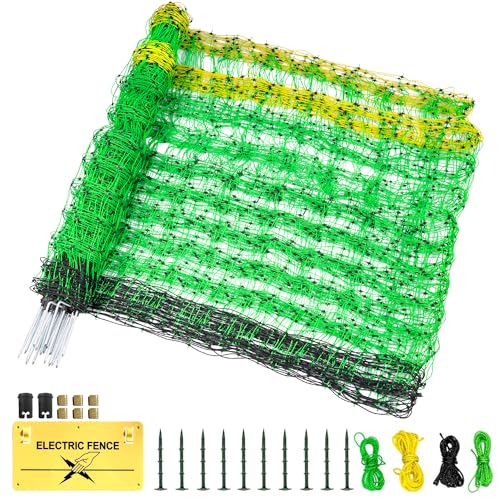
The no-tools netting roll that creates an instant deer perimeter in 15 minutes
This is a complete netting solution — not a stand-alone energizer — so you will need to pair it with a solar or AC fence charger (the brand recommends its own OULUU model). The netting stands 35.4 inches tall and runs 164 feet long, with 9 horizontal strands, 8 of which carry the electric current. The mesh is pre-assembled: you unroll it, stake the included fiberglass posts into the ground, connect your energizer, and the fence is live. Owners call it easy to install (5 mentions) and functional (5 mentions), with one describing solo setup in about 15 minutes.
The construction uses triple-braided stainless steel wire for the conductive strands, which resists breaking better than plain copper. The double-spiked steel stakes grip well on uneven ground, and the whole roll is light enough to move for rotational grazing. A buyer noted that the taller design (35.4 inches) beat their previous shorter fence for keeping deer out, and the black bottom strands help prevent shorts against tall weeds.
The quality feedback is mixed — the most-discussed aspect is actually quality (10 mentions), but Amazon flags it as mixed, not positive. Some reviewers point out that the fiberglass posts break easily, especially when pulled from dry or rocky soil, and a few had sheep escape because the charge was not reaching the top strands consistently. This is a budget-friendly netting option for short-term or temporary deer exclusion, but the posts demand gentle handling during moves.
perfect for: quick seasonal fencing around a vegetable patch or flower bed where you can store the netting over winter and re-deploy each spring.
not for: permanent year-round fences or areas with large, aggressive animals that will lean into the netting and snap the posts.
5. PPOLB Electric Fence Netting, 47.2″ x 164ft, Portable Livestock Netting
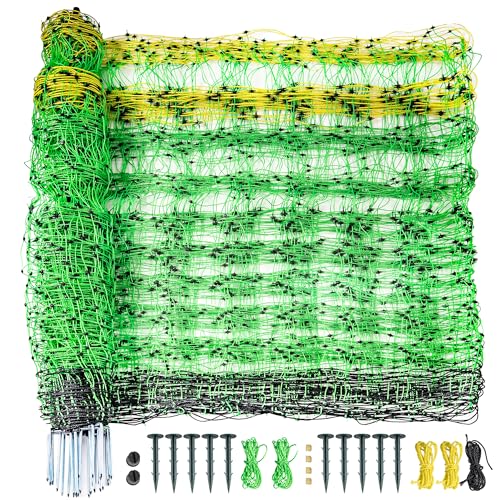
The taller netting that keeps deer from jumping over and larger predators from pushing through
At 47.2 inches, this netting stands a full foot taller than the OULUU roll, which makes a real difference when deer decide to test a barrier — many will clear anything under 42 inches, so the added height here is a meaningful deterrent. The net includes 11 horizontal strands (9 conductive), with fiberglass rods spaced every 12.5 to 13.1 feet to hold the mesh upright. The triple-braided stainless steel wire carries current reliably, and the maker recommends a 0.25-joule solar or AC/DC energizer (not included) to power it.
Effectiveness is the top praise among owners — 17 call it out — and the netting is described as excellent for goats, with one buyer noting that non-electrified bottom rungs prevent shorting out on wet grass. A long-term owner reported the netting held up through months of storms and daily moves, with no broken strands. The portability factor is strong: at 16.17 pounds, one person can carry and reposition the roll between paddocks.
The negative feedback centers on the posts: several owners found them too far apart, causing the netting to sag in the middle, and the base spikes are shallow enough that goats or deer can push under. Smaller chickens can slip through the mesh spacing, so this is not a poultry solution. If you need a tall, durable deer net that works with a mid-range energizer, this is a solid choice — just budget for extra T-posts to eliminate the sag between the included fiberglass stakes.
reach for this if: your deer are taller than average or you run goats alongside deer protection and need a net that reaches above typical jump height.
look elsewhere if: your soil is rocky or hard-packed — the shallow base spikes may not penetrate deeply enough for a secure hold without extra stakes.
6. TMEE Electric Fence Netting, 49.6″ x 164ft, 14 Posts, Double-Spiked

The netting with 14 posts that keeps the fence taut even on rolling, uneven terrain
This is the most post-dense netting in this roundup — 14 fiberglass posts spaced about 12.5 to 13.1 feet apart — and each one uses a double-spiked carbon steel stake that grips better on slopes than single-spike designs. The net is 49.6 inches tall and runs 164 feet, with 9 horizontal strands (7 conductive). The bottom two strands are intentionally insulated so they do not ground out against wet vegetation, a smart design detail that improves voltage retention in damp conditions.
Functionality is the top praised aspect (14 mentions), and owners consistently report that it keeps deer out of tomatoes and gardens, and contains goats and livestock effectively. One buyer described a second year of use with no UV damage or frayed wires, storing the net over winter and redeploying each spring. The mesh spacing is tighter near the bottom, which helps keep smaller animals in without snagging their legs.
The major negative is durability — 9 owners flagged it, and Amazon rates it negative. Posts break at the base when pulled from hard ground, and one buyer had a goat get its head caught in the non-energized bottom strands, which is a safety concern. The netting also tangles easily during takedown if you are not meticulously coiling it. This net is best for rotational grazing on softer soil where you can sink the double-spiked stakes without pre-digging.
pick this for: multi-species use — goats, sheep, deer, and dogs — on level ground with decent topsoil where the double spikes can sink fully.
skip it if: your ground is rocky, hard, or you need to move the fence weekly — the post stakes bend and snap under frequent relocation.
7. VEVOR Electric Fence Netting, 50″ x 164ft, Livestock Net Fencing
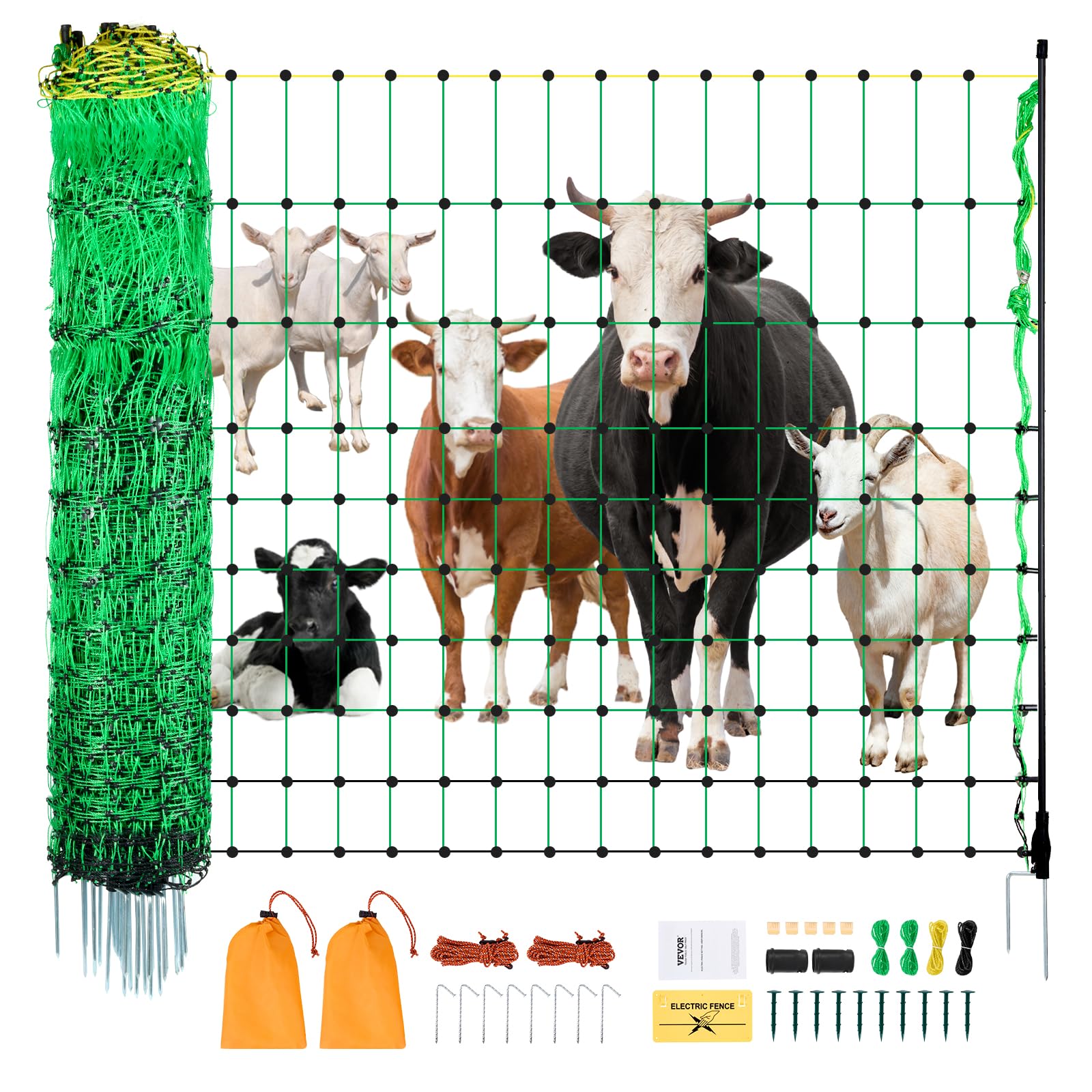
The tallest roll in the test with a built-in repair kit for farm-ready longevity
At 50 inches, this VEVOR netting is the tallest option here, giving you the best chance of stopping deer that are willing to clear a 4-foot fence. The net includes fiberglass posts with double-spiked steel stakes, a warning sign, and a repair kit — small but practical touches that save you from sourcing spare components later. The manufacturer says it is compatible with AC 110-240V, solar panels, and DC power sources (all sold separately), so you can power it with almost any energizer you already own.
Ease of setup and functionality each get 11 positive mentions, and the net is widely described as effective for Dorper sheep, pet pigs, and general deer exclusion. One long-term owner reported having a separate VEVOR fence that is still holding 9kV after five years of consistent use — a durability data point that stands out against the mixed durability scores of competing nets. The netting weighs 15.21 pounds, which is manageable for one person to carry but not as portable as lighter polywire alternatives.
The durability rating is negative (14 mentions), and many owners find the stakes bend and snap after a few setups. The netting also tangles aggressively if you take it down hastily — “be very careful not to twist it” warns one experienced buyer who owns around 1,000 feet of it. If you install it as a semi-permanent fence around a deer-prone orchard and only move it once or twice a season, the sturdy build and tall profile are real advantages. If you rotate weekly, the tangling and stake fragility become frustrating.
best for: one-season or semi-permanent deer fences where the extra 50-inch height provides a real jump deterrent.
skip for: frequent rotational grazing — the net tangles quickly, and the spikes bend after a few moves on hard ground.
8. LMRSTOO Electric Poultry Netting Fence, 49.6″ x 164ft
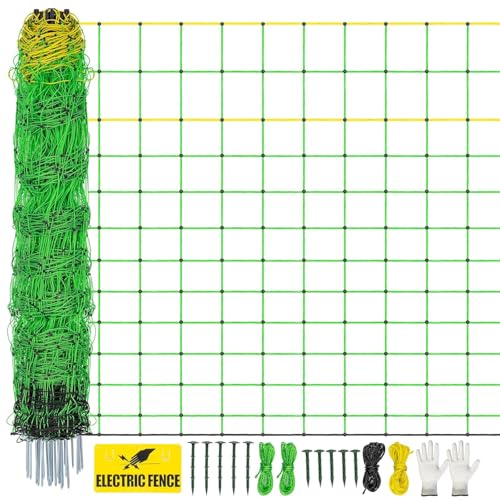
The densest grid netting that keeps smaller animals from slipping through the strands
Every grid cell on this netting measures just 3.5 inches wide by 6.2 inches tall — the tightest spacing in the group — which means it can contain chickens, ducks, lambs, and smaller goat breeds alongside deer. The net stands 49.6 inches tall and extends 164 feet, with stainless steel conductors woven into nylon wires for a flexible but durable mesh. At 22 pounds, it is the heaviest netting here, but the denser construction makes it a true multi-species fence rather than just a deer barrier.
Functionality leads the positive mentions (23), and owners consistently describe it as effective for goat rotation, with one buyer noting that large Boer goats only nose-test it without pushing through. The included rubber gloves are a thoughtful touch for handling the hot wire during connection. Mobility gets 7 positive mentions — the net is light enough for one person to carry across a paddock, though the 22-pound weight means you feel it over longer distances.
Installation and durability each get 21 mentions, both rated mixed. The fiberglass posts with double-spiked stakes grip well in soft ground, but the netting feels flimsy to some, and a few owners had chickens walk right through it despite the current being live. The mesh density is not quite small enough to stop determined small poultry from squeezing through if the net sags. This is a great choice if you run mixed livestock including deer control, but the lightweight construction demands careful handling during moves to avoid snags and tears.
pick this if: you need one net that works for both deer and smaller animals like sheep or poultry, and you prefer a tight grid over taller height.
pass on it if: your paddock is rough terrain with rocks or roots — the stakes may not hold deeply enough to keep the mesh taut.
Understanding the Specs
Stored Joules vs. Output Joules
Stored joules measure the energy held in the energizer’s capacitor — think of it as the potential punch. Output joules measure what actually reaches the fence after the internal circuitry and any resistance in the wire. A unit might advertise 0.16 stored joules but only deliver 0.11 output joules, like the MINI160. The output figure matters more because it determines the bite the deer feels. For deer, anything above 0.1 output joule on a clean fence is adequate; below that, deer may not respect it.
Coverage Distance in Miles
Coverage ratings assume perfect conditions — clean wire, no weed contact, dry climate, and a well-grounded rod. Real-world effective range is usually about half the printed spec if your fence runs through grass or brush. A 10-mile-rated charger may only power 4 to 5 miles of weedy fence adequately. If your property has heavy vegetation, size up to the next coverage tier to maintain a strong voltage at the far end of the line.
Day / Night Mode
Some solar chargers, like the MINI160, use a slower pulse at night — every 2.9 seconds instead of every 1.5 seconds — to conserve battery power when the solar panel is not recharging. This is valuable if you rely on the internal battery to last through multiple overcast days. The trade-off is a slightly less deterring pulse at night, though deer are primarily active at dawn and dusk, so the impact is minimal.
Low-Impedance Design
Low-impedance chargers are built to maintain voltage even when vegetation touches the fence wire. Standard chargers drop in voltage drastically as soon as a weed brushes the strand; low-impedance models sacrifice some peak voltage to deliver a more consistent pulse through moderate weed contact. For deer fencing around overgrown field edges, a low-impedance energizer (like the 5-mile model with the Panasonic battery) is a better bet than a high-voltage unit that loses its bite to the first stem of grass.
FAQ
Will a 35-inch-tall electric fence stop deer?
How many joules do I need for an electric deer fence?
Do electric fences hurt deer permanently?
Can I use a solar fence charger on a cloudy day?
How do I ground an electric fence properly for deer?
Will an electric fence for deer also keep out raccoons or bears?
How often do I need to mow under an electric deer fence?
Is it better to buy a separate energizer and netting, or an all-in-one solar charger?
How long does a solar fence charger’s battery last before needing replacement?
Can I use electric netting on a hillside?
Final Thoughts: The Verdict
If you want one dependable pick, the electric fence for deer winner is the 10 Miles Solar Powered Electric Fence Charger because it delivers the widest coverage, a strong 0.18-joule pulse, and genuine portability at just 3.1 pounds — making it the best balance of power and real-world practicality. If you want a dedicated solar unit for a medium orchard or horse pasture, the 5 Mile Solar Energizer with Panasonic battery is a close second with excellent lithium-ion longevity. And for a complete netting system that you can unroll, stake, and power in under 20 minutes, the TMEE 49.6-inch netting offers the most post support for keeping the fence tight on uneven ground.
How We Picked
We do not accept paid placement. Every pick is matched to a real buyer and a real use-case; we do not hands-on test units.
Sources & Methodology
Specifications: manufacturer listings and product documentation. Review insights: verified customer reviews, as of July 2026. Pricing: not shown on this page (it changes often); check the current price via the retailer link.
As an Amazon Associate, WellFizz earns from qualifying purchases. This does not affect which products we feature.
Related Guides

Mo Maruf
I created WellFizz to bridge the gap between vague wellness advice and actionable solutions. My mission is simple: to decode the research and give you practical tools you can actually use.
Beyond the data, I am a passionate traveler. I believe that stepping away from the screen to explore new environments is essential for mental clarity and physical vitality.