Our readers keep the lights on and my smoothie glass nicely filled. As an Amazon Associate, I earn from qualifying purchases.
Specs are compiled from manufacturer listings and verified buyer reviews and can change over time — please confirm the key details on the product page before buying.
Picking the right electric fence charger means deciding between a plug-in workhorse for heavy weed conditions and a solar-powered unit that goes where there is no outlet. The single biggest mistake new buyers make is choosing a charger with too little energy output — measured in joules — for the animal and the vegetation on their property. A weak unit struggles to push power through grass touching the wire, and that leaves your fence line ineffective. This guide breaks down the nine best models on the market, from 0.06-joule lightweight solar units for a chicken run to 3-joule monsters that power through 10 miles of dense brush.
I’m Mohammad Maruf — the founder and writer behind WellFizz. This guide is built by comparing the manufacturers’ published specifications and the patterns across verified customer reviews, so you get each pick’s real strengths and trade-offs instead of marketing spin.
You need an electric fence charger that keeps your animals in and pests out, so the right one depends on your fence length and local weather. The best electric fence charger for you matches its voltage and stored energy (measured in joules) to how many miles of fence you run and how much wet vegetation or weeds touch it.
Our Picks at a Glance


How To Choose The Best Electric Fence Charger
An electric fence charger — also called an energizer — sends brief, high-voltage pulses down the fence wire to deliver a memorable but harmless shock. The two numbers that matter most are the stored energy (measured in joules) and the output voltage. A higher joule rating means the charger can keep delivering strong shocks even when weeds or tall grass touch the wire. Voltage tells you how much potential the pulse carries, but if the fence is shorting out on vegetation, voltage alone will not hold up without enough joules behind it.
Joule Output and Weed Conditions
Think of joules as the charger’s work capacity. A 0.25-joule unit is fine for a dry city garden with no vegetation touching the wire. For pastures with heavy weeds, you need a low-impedance design — like the Zareba EAC50M-Z — that sacrifices voltage under load to still deliver a punishing shock at the far end of the fence. The same charger rated for 50 miles on bare wire might only reach 12 miles through heavy weeds. Buy your charger rating based on the worst-case vegetation, not the ideal spring day.
AC-Powered vs Solar vs Battery
Plug-in units (110V AC) deliver the most consistent power and require no battery replacement, but they must be mounted near an outdoor outlet. Multi-powered units accept AC, 12V battery, and solar panel input, giving you the most options for remote sites. Pure solar chargers are portable and easy to relocate, but their stored energy is limited — usually under 0.5 joules — so they work best for smaller fences and light-duty animal control. Battery-powered units without solar need periodic recharging or replacement, so they tend to be the least convenient for permanent fences.
Quick Comparison
| Model | Best For | Stored Energy | Fence Range | Power Source | Amazon |
|---|---|---|---|---|---|
| Zareba EAC50M-Z★ Best Overall | Large livestock, heavy weeds | 2.0 Joules | 50 miles | 110V AC | Amazon |
| Electric Fence Charger 110VBudget Champion | Chickens, small gardens | 0.25 Joules | 2 miles | 110V AC | Amazon |
| ATMOREA 12kVTri-Power Pick | Multi-power remote setups | 3 Joules | 10 miles | AC / 12V / Solar | Amazon |
| Patriot PE10 | Compact, weather-tested unit | 0.30 Joules | — | 110V AC | Amazon |
| ANDMON MINI160 | Solar, remote garden | 0.16 Joules | 10 miles | Solar / 12V Battery | Amazon |
| ANDMON MINI400 | Larger solar pastures | 0.4 Joules | 20 miles | Solar / 12V Battery | Amazon |
| Zareba EAC25M-Z | Mid-size pastures, heavy weeds | 1.0 Joules | 25 miles | 110V AC | Amazon |
| Gallagher S6 | Light-duty solar, backyard | 0.06 Joules | — | Solar / LiFePO₄ | Amazon |
| Gallagher S12 | Small pastures, solar | 0.12 Stored Joules | 4 miles | Solar / Lithium | Amazon |
In‑Depth Reviews
1. Zareba 50 Mile AC-Powered Low Impedance Electric Fence Charger (EAC50M-Z)
Our pick — over 4.5★ from 550+ verified ratings; the strongest balance of quality and price.
The farm-proven workhorse that chews through heavy weeds and still shocks at the far end.
With 2.0 joules of stored energy, this Zareba energizer powers up to 50 miles of fence in ideal conditions — and it laughs at the stuff that kills weaker chargers. Its low-impedance design keeps voltage punishing even when vegetation touches the wire, maintaining effective performance up to 12 miles through heavy weeds and 25 miles through light weeds.
Buyers report it works great on 10-acre fenced properties, pulling 13,000 to 14,000 volts at the wire. The rugged metal cabinet protects internal circuitry from weather extremes, and the unit carries a 2-year limited warranty that covers lightning damage — extendable to 3 years with online registration. The recurring owner nitpick is the tiny blinking pulse light, which is hard to spot unless you walk right up to the box.
What Owners Swear By
- 2.0 joules powers through heavy weed loads reliably
- 50-mile rating handles large cattle, horse, and pig operations
- Lightning damage included in the 2-year warranty
- Made and full-load tested in the USA
The Honest Trade-Offs
- Indicator light is faint — need to walk up to the charger
- Wing-nut connections instead of color-coded knobs some prefer
- Heavier at 3.2 pounds than smaller plug-in units
Reach for this if: you have large livestock, weeds that grow tall, or a fence line over 10 miles — this is the most reliable AC charger at this power level.
Look elsewhere if: you only need a mini charger for a chicken coop under 2 miles; the 0.25-joule plug-in unit will save you a lot of money and space.
2. Electric Fence Charger – Powerful 110V AC Plug-in Fence Energizer (Happy Henhouse FX5AC)
A tiny, affordable plug-in that keeps raccoons out and chickens safe without draining your wallet.
This 0.25-joule, 14-ounce unit powers up to 2 miles of single-wire fence and is built by a Missouri family who raises birds through Midwest storms. It uses steady 110V AC power — no batteries, no solar — so your fence runs day and night as long as an outlet is nearby. Buyers have had it running for three months with zero problems, using it to stop raccoons from using a roof as a latrine and to keep squirrels from digging up potted plants on a deck.
The weather-resistant housing mounts indoors or out, but one owner pointed out the 2-foot power cord is short — you will likely need an extension cord for outdoor mounting. The majority of buyers call it effective for its modest power level, and customer service gets high marks for responsiveness. For a small garden or poultry pen, this is the cheapest dependable option that still delivers a real deterrent.
Why It Works for Small Spaces
- Compact 7.38 x 4.75 x 2.75-inch size with 14 oz weight
- 0.25 joules provides solid deterrent for raccoons, squirrels, rabbits
- American company with responsive customer support
- No batteries to replace — always on when plugged in
Watch Out For
- Short 2-foot power cord; outdoor mounting needs an extension cord
- 2-prong plug and housing limits outdoor reliability
- Not powerful enough for large livestock or heavy vegetation
Ideal for: chicken coops, small gardens, and deck protection where 2 miles of wire is plenty.
Think twice if: you need to contain cattle or push through tall weeds — step up to the Zareba EAC50M-Z for the extra joules.
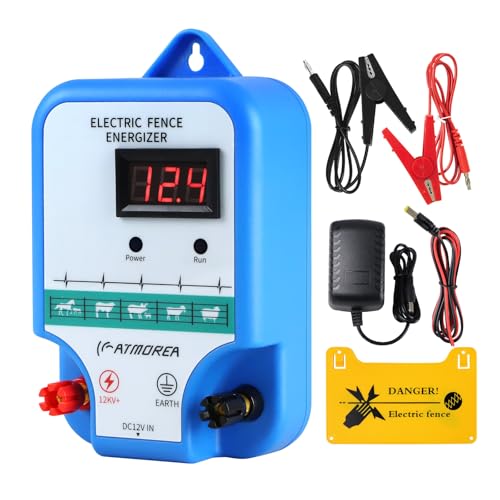
3. Electric Fence Charger – Multi-Powered, 12 kV 3 Joules High-Power (ATMOREA)
The 3-joule multi-power unit that runs on AC, battery, or solar for truly remote placement.
This charger packs the highest stored energy in the list — 3 joules at 12 kV — with a 10-mile range and the rare ability to switch between 110V AC, 12V battery, or solar panel inputs. That versatility matters when you want to move a fence to a new paddock or run it off-grid. One buyer used it for about 10 months on both AC and DC setups, keeping escape-artist goats contained, and many praise the LED display that shows real-time voltage at a glance.
The catch is durability: multiple reviews note failure around the one-year mark, and the IPX5 waterproof rating does not mean you can leave it fully exposed — a dry enclosure is recommended if rain is frequent. The panel design also draws more current from batteries than some owners expected, draining a 12V battery faster than a typical low-impedance unit.
Biggest Strengths
- 3 joules / 12 kV output — highest stored energy here
- Flexible AC, 12V DC, or solar input options
- LED display for real-time voltage monitoring
- IPX5 water-resistant outer casing
Weak Points
- Several owners mention failure after roughly one year
- High power draw drains 12V batteries quickly
- Not truly waterproof; needs protection from heavy rain
Best for: off-grid setups where you need maximum joules and power source flexibility.
Skip if: you want a set-and-forget charger that lasts years inside a barn — the Zareba EAC50M-Z is more durable for continuous AC use.
4. Patriot PE10 Electric Fence Energizer, 0.30 Joule

A no-fuss 0.3-joule unit that tests at around 9,600 volts, compared to its 5,000-volt rating in real use.
Patriot rates this energizer at 5,000 volts no-load, but many owners measure it closer to 9,600 volts — making it significantly hotter than the spec sheet suggests. The 0.30-joule output handles small to medium properties with light vegetation, effectively keeping deer, squirrels, and raccoons out of gardens and bird feeders. One owner used a Patriot unit 24/7 for 4 years straight with only a Ziploc bag weatherproofing job, while another runs the PE10 on a porch timer for crop protection.
The PE10 is not weatherproof; it needs to be sheltered from rain or placed in a dry box. Some buyers also note the pulse rate is slow — every few seconds — which can be less effective for agile animals like squirrels if the fence design gives them a way to climb over in between pulses. For goats, pigs, and dogs, though, it works great and the build quality is widely praised.
what separates it
- Real-world voltage often runs much higher than the rated 5,000V
- Weighs only 1.5 pounds — easy to mount anywhere
- Made in New Zealand with a 1-year full replacement warranty
- Proven track record: customers note 4 years of continuous use
Considerations
- Not weatherproof — must be protected from rain
- Slow pulse rate (every few seconds) may not deter all climbers
- Only 0.30 joules; cannot handle heavy weed contact
Works well for: protected garden plots, small goat pens, and backyard dog fences where you can shelter the unit.
Not for: exposed pastures in rainy climates — get the weather-resistant Zareba EAC25M-Z instead.
5. ANDMON MINI160 10 Miles Solar Electric Fence Charger
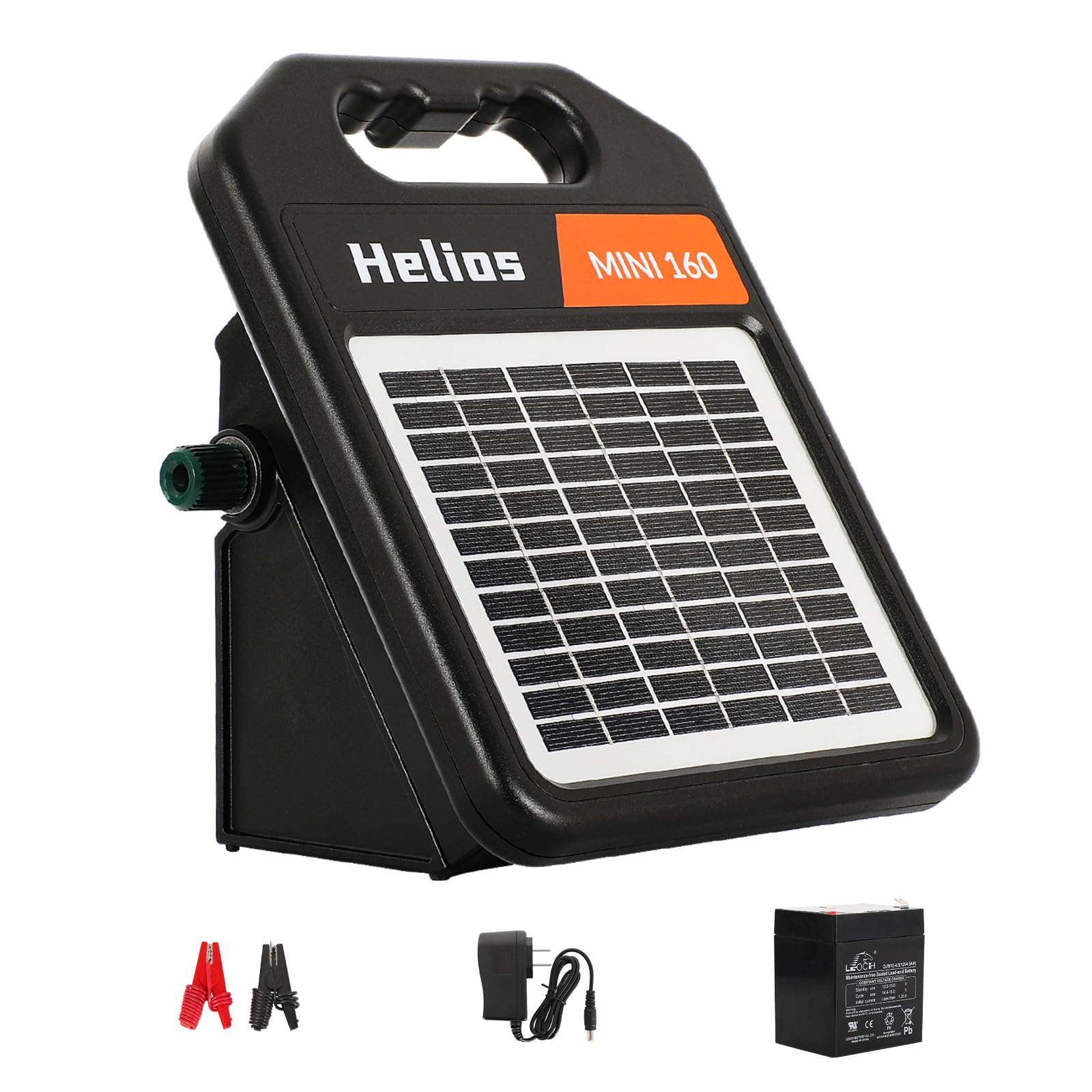
A lightweight, portable solar charger that mounts on a T-post and keeps running on cloudy days.
The MINI160 delivers 0.16 joules from a built-in solar panel and internal GEL acid battery, energizing up to 10 miles of fencing. The unit rotates a full 360 degrees on a T-post so you can adjust toward the sun throughout the day. Owners use it to protect gardens from deer and elk, and the battery charges even in cloudy conditions — a common weak spot for cheaper solar units. The day/night mode ensures 24-hour protection without any manual switching.
Where this falls short is raw stopping power. Several owners find it lacks the punch to deter deer from a small garden, and one reported receiving the 2-mile model instead of the advertised 10-mile version. The built-in GEL battery is not connected from the factory — you must open the housing and attach the red cable to the positive terminal and black to negative before use.
Why Go Solar
- Built-in solar panel with 360-degree rotation on T-post
- GEL acid battery charges in low-light conditions
- Day/night mode for round-the-clock fence operation
- Portable — easy to move for strip grazing or temporary fencing
The Limits
- 0.16 joules is among the lower-powered units here
- Some owners received the wrong model (2-mile instead of 10-mile)
- Battery requires manual connection from the start
Good for: portable garden protection and remote areas where you have no AC power.
Choose a plug-in if: you need reliable, high-energy output — the Happy Henhouse FX5AC costs less and delivers stronger shocks.
6. ANDMON MINI400 20 Miles Solar Electric Fence Charger
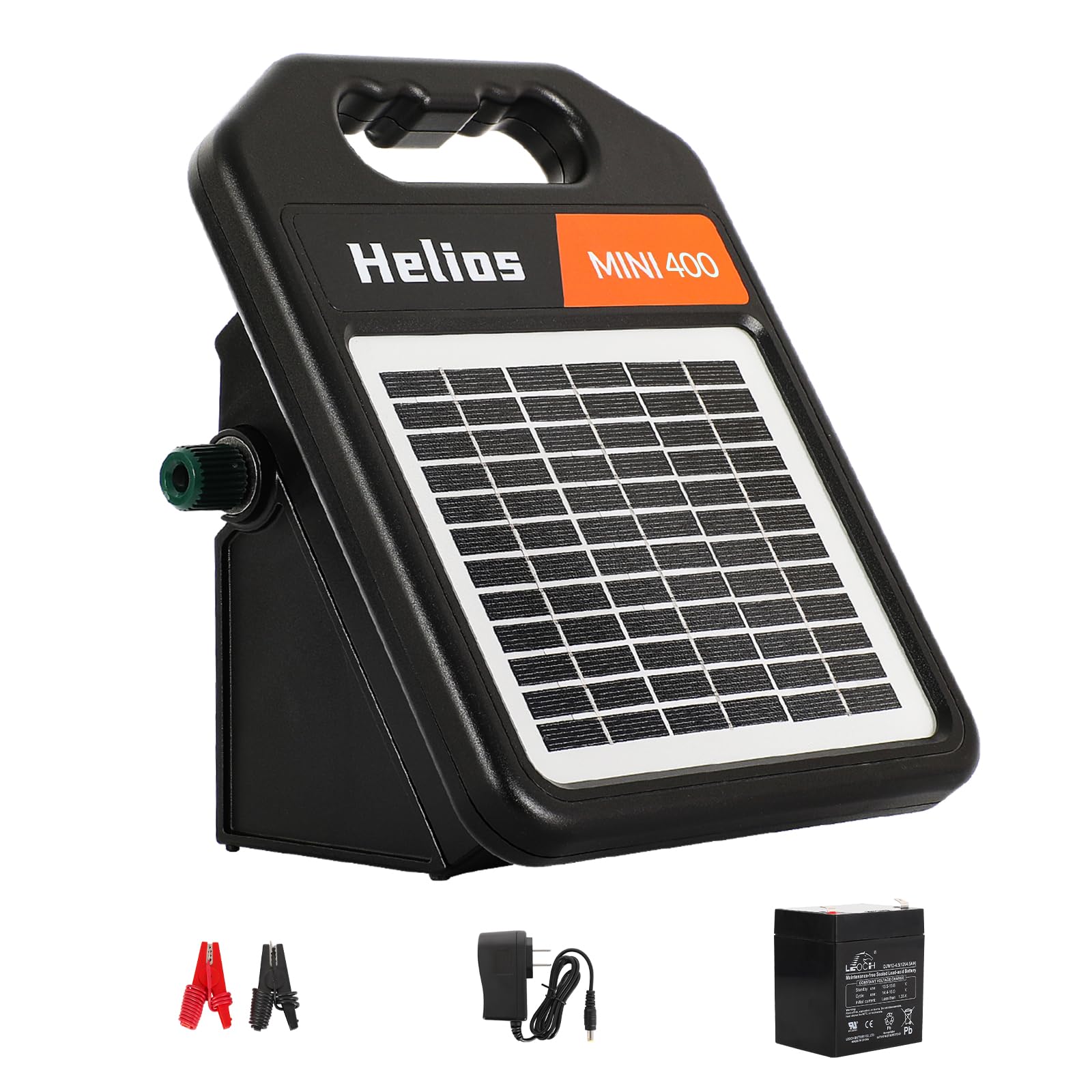
A 0.4-joule solar unit that runs 14 days without sunlight and powers 20 miles of fence.
With a 190×161 mm, 18.5V/3W solar panel and a 12V/4.5AH sealed lead-acid battery, the MINI400 delivers 0.4 joules of stored energy, compared to the MINI160’s 0.16 joules, and up to 20 miles of fence range. The battery can operate up to 14 days without sun, which makes it the most capable solar option in this comparison for cloudy weeks. Owners say it provides a good shock for 165-foot mobile fences, is easy to install on a T-post (the post doubles as the ground rod), and works even on old, high-resistance fence wire.
Durability is the real question mark here. The aspect data shows battery life and durability both get mixed feedback from owners, and one long-term review reports failure after one year with no fix from a new battery. The IPX4 ASA outer casing handles splashes and extreme temperatures (-20°C to 80°C), but this is still not a permanently outdoorsy unit if you live in heavy rain.
Solar Strength
- 0.4 joules with 14-day no-sun battery runtime
- 20-mile range covers larger pastures
- T-post mount doubles as ground rod for easy installation
- IPX4 weather-resistant ASA casing
Reliability Questions
- Mixed feedback on durability — some fail after 1 year
- Day/night mode instructions unclear for some owners
- Battery not connected from factory
Best for: off-grid pastures up to 20 miles where you need a solar unit with meaningful energy reserves.
Consider something else if: you need a charger that will last years past the warranty — the Gallagher S12 has much stronger reliability ratings from owners.
7. Zareba 25 Mile AC Powered Low Impedance Electric Fence Charger (EAC25M-Z)

The 1-joule Zareba that keeps a 25-mile fence hot even through 6 miles of heavy weeds.
This is the smaller sibling to the EAC50M-Z but still a strong performer: it delivers 1.0 output joules (the stored energy that powers the shock), reaches up to 25 miles in ideal conditions, and uses a low-impedance design (which means it pushes power through weeds and wet grass instead of shorting out). That design lets it work through 6 miles of heavy weeds and 12 miles with light vegetation. Owners use it for everything from containing hogs to protecting chicken coops, and many say it keeps deer out of gardens effectively. One buyer set up a single wire 6 inches high to train deer out of a blueberry patch and saw results within a few days.
The construction is identical to the 50-mile version — a rugged metal cabinet with weather protection — but the indicator light is equally faint, which owners consistently note as a minor annoyance. At 3.1 pounds, it is nearly the same weight as the 50-mile model but delivers 1.0 joules compared to the 50-mile model’s 2.0 joules, so it suits you if your fence line is under 25 miles and you do not need the extra capacity of the EAC50M-Z. skip it if your fence runs through heavy brush or exceeds 12 miles, because the lower power may not punch through reliably.
What You Get
- 1.0 joules for 25-mile range with low-impedance performance
- Heavy weed performance: 6 miles through thick brush
- Sturdy metal weatherproof housing
- 2-year warranty including lightning damage
Minor Gripes
- Indicator light is hard to see in daylight
- At 3.1 pounds, heavier than solar alternatives
- Only 1.0 joules — the EAC50M-Z provides 2.0 joules, covering up to 50 miles
Right for: 10–25 acre pastures with medium weed pressure where you want Zareba durability without over-buying on joules.
Upgrade to the 50-mile model if: your fence exceeds 12 miles or you face heavy weed growth — the extra 1.0 joules makes a real difference under load.
8. Gallagher S6 Solar Electric Fence Charger

A palm-sized solar charger with a LiFePO₄ battery that sends squirrels airborne on 0.06 joules.
At 0.06 stored joules, the S6 is the lowest-power unit here — yet owners consistently say it works perfectly for its intended role. The Gallagher mounts directly to an unpainted grounding rod up to 0.5 inches in diameter, using that rod as both the physical mount and electrical ground. The LiFePO₄ (Lithium Iron Phosphate) battery provides up to 3 weeks of operation without sunlight, and unlike standard lithium-ion batteries, it contains no cobalt and is highly resistant to overheating. A buyer using two pieces of chicken wire and a rebar ground reports the S6 “zaps squirrels airborne” and has worked perfectly for over two years.
This is a light-duty unit by design. It delivers a mild shock suitable for deer deterrence and small pets, but it will not stop a large bull or power through heavy weeds. The sealed case does not allow battery replacement — Gallagher handles that — and the price has climbed notably since launch. For backyard gardens and chicken coops, though, the S6 is arguably the most reliable solar energizer at its power level.
Why Owners Love It
- LiFePO₄ battery lasts 3 weeks without sun, stable and safe
- Grounding rod mount = 5-minute installation
- Compact 5.7 x 5 x 6.7-inch size blends into yard
- Green operation light confirms power status
The Trade-Offs
- Only 0.06 joules — strictly light-duty use
- Sealed battery must be replaced by manufacturer
- Does not mount to T-posts; requires a grounding rod
Ideal for: gardens, chicken coops, and pet enclosures where a mild shock keeps small animals out.
Not for: any fence line with tall grass or animals that need a strong deterrent — the Zareba EAC25M-Z is the right call there.
9. Gallagher S12 Solar Electric Fence Charger

The go-to solar charger for homesteads that need 4 miles of fence with Gallagher reliability.
With 0.12 stored joules and a 4-mile range (or 0.6 miles on multi-wire fencing with vegetation), the S12 is the step-up from the S6 for small pastures and hobby farms. It uses a grounding rod mount identical to the S6 — drives an unpainted rod at least 18 inches into the soil, and the rod serves as both mount and ground. Reviewers point out it holds charge through cloudy and rainy days, and one buyer says it has worked flawlessly for over four years. The product summary describes it as “working well for 2.5 years” and “hurts like hell!” when a proper ground wire is added.
The S12 is not a heavy-duty unit — it cannot compete with the 2.0-joule Zareba in raw output — but for solar, it is the most reliable option in this list based on owner consensus. The main complaint is that some units stop working after about two years, though Gallagher’s 3-year warranty and U.S.-based support team are well-reviewed. Charge the battery in direct sun for 2–3 days before first use for best results.
Reliability Highlights
- 0.12 joules on solar with 4-mile single-wire range
- Holds charge through cloudy weather for days
- Gallagher 3-year warranty with responsive U.S. support
- Compact mount blends into landscape
Honest Limitations
- Some units reported failure around the 2-year mark
- Only suitable for small pastures and garden fencing
- Multi-wire range drops to 0.6 miles with vegetation
Right pick for: small pastures, goat pens, and deer protection where solar is the only option and reliability matters most.
Choose the plug-in Zareba if: you have an outlet nearby — the EAC25M-Z delivers 1.0 joules versus the S12’s 0.12 joules for a similar investment.
Understanding the Specs
Joules: The Real Measure of Punch
A joule is a unit of energy — specifically, how much the charger stores in its internal capacitors before releasing it in a pulse. A higher joule rating means the charger can drive a strong shock through vegetation, poor ground conditions, and long fence lines. The Zareba EAC50M-Z (2.0 joules) can push through heavy weeds at 12 miles, while the 0.16-joule ANDMON MINI160 will struggle the moment grass touches the wire. For a chicken run under 2 miles with no vegetation contact, 0.25 joules works; for a cattle pasture with weeds, you need at least 1.0 joules.
Low Impedance vs Standard Design
Low-impedance chargers are engineered to maintain output voltage even when the fence is loaded down by weed contact or wire resistance. A standard charger might read 10,000 volts with no fence attached, but drop to 1,000 volts when wired to a mile of fence. A low-impedance unit — like the Zareba EAC25M-Z — only drops from 10,000V to maybe 5,000V under load, which still gives a painful shock. If you have vegetation, use polywire, or fence on a slope, always buy low-impedance.
FAQ
How many joules do I need for cattle vs chickens?
Can I use a solar fence charger in heavy shade?
What is the difference between a plug-in charger and a battery-powered one?
How long does an electric fence charger last?
Will my fence charger work if I have a lot of weeds touching the wire?
Can I use an electric fence charger to keep deer out of my garden?
How do I properly ground my electric fence charger?
Is a 0.25-joule charger too weak for my property?
What does the IPX4 or IPX5 rating mean on a fence charger?
How many fence wires can one charger power?
Final Thoughts: The Verdict
For the majority of shoppers, the best electric fence charger winner is the Zareba EAC50M-Z because its 2.0 joules, 50-mile range, and proven low-impedance performance cover the widest range of livestock and weed conditions. If you want a budget-friendly plug-in for chickens and a small garden, grab the Happy Henhouse FX5AC. And for a reliable solar-powered fence on a remote pasture, the Gallagher S12 is the one to reach for.
How We Picked
We do not accept paid placement. Every pick is matched to a real buyer and a real use-case; we do not hands-on test units.
Sources & Methodology
Specifications: manufacturer listings and product documentation. Review insights: verified customer reviews, as of July 2026. Pricing: not shown on this page (it changes often); check the current price via the retailer link.
As an Amazon Associate, WellFizz earns from qualifying purchases. This does not affect which products we feature.
Related Guides

Mo Maruf
I created WellFizz to bridge the gap between vague wellness advice and actionable solutions. My mission is simple: to decode the research and give you practical tools you can actually use.
Beyond the data, I am a passionate traveler. I believe that stepping away from the screen to explore new environments is essential for mental clarity and physical vitality.