Our readers keep the lights on and my smoothie glass nicely filled. As an Amazon Associate, I earn from qualifying purchases.
Specs are compiled from manufacturer listings and verified buyer reviews and can change over time — please confirm the key details on the product page before buying.
If you just bought an electric car, the included Level 1 charger turns a full battery into an overnight-plus ordeal. A Level 2 home charger fixes that by running on 240V — the same power your oven uses — and adding 30 to 46 miles of range per hour of charging. That means you plug in when you get home, and you wake up to a full battery every single morning without ever thinking about a public station.
I’m Mohammad Maruf — the founder and writer behind WellFizz. This guide is built by comparing the manufacturers’ published specifications and the patterns across verified customer reviews, so you get each pick’s real strengths and trade-offs instead of marketing spin.
The bottom line: a 48-amp hardwired unit is the fastest home option, while a 40-amp plug-in model is easier to install and move. Here is a clear breakdown of the best electric car charger picks for your garage, ranked by performance, smarts, and real owner experience.
Our Picks at a Glance


How To Choose The Best Electric Car Charger
Before you buy a home EV charger, ask yourself three things: how fast you need to charge, how your home’s electrical system is set up, and if you want smart features. Answer those, and the right unit basically picks itself.
Match the Amperage to Your Car and Panel
The charger’s amperage rating — 40A or 48A — sets your charging speed. A 40A unit adds roughly 30-38 miles per hour, while a 48A unit climbs to about 46 miles per hour. But your car only pulls what it can handle, so a 48A charger plugged into a car that maxes out at 32A just runs at 32A. Your home’s breaker panel matters too: a 40A charger needs a 50A breaker, while a 48A hardwired unit needs a 60A breaker.
Plug-In vs Hardwired
A plug-in charger with a NEMA 14-50 plug just goes into an existing outlet — it’s the easier, more portable route, and you can take it with you if you move. A hardwired charger connects directly to your electrical panel, which lets it safely pull the full 48A for maximum speed. Hardwiring usually needs a licensed electrician, so factor that into your decision.
Decide How Much “Smart” You Need
Smart chargers connect to WiFi and let you schedule charging for off-peak hours when electricity is cheaper. Some add RFID cards so only authorized users can start a charge. A simpler plug-and-charge unit skips the app entirely and just works when you plug in — perfect if you want zero fuss or don’t have reliable WiFi in your garage.
Quick Comparison
| Model | Best For | Max Amperage | Cable Length | Install Type | Amazon |
|---|---|---|---|---|---|
| EVIQO EVIPOWER 48A★ Best Overall | Tesla owners wanting native NACS plus app control | 48 A | 25 ft | Hardwired | Amazon |
| SEGUMA 40ABest Value | Budget buyers who want a portable plug-in workhorse | 40 A | 25 ft | Plug-in (NEMA 14-50) | Amazon |
| VEIPHLOX 40A (UC101)Cleanest Design | No-fuss plug-and-charge with tidy cable storage | 40 A | 25 ft | Plug-in (NEMA 14-50) | Amazon |
| VEIPHLOX 40A (UC102) | Households wanting RFID security and a big screen | 40 A | 25 ft | Plug-in (NEMA 14-50) | Amazon |
| NexCyber 48A | Owners who want 48A speed from a plug-in unit | 48 A | 25 ft | Plug-in (NEMA 14-50) | Amazon |
| WOLFBOX 40A | Smart-home fans who want Alexa and voice control | 40 A | 25 ft | Plug-in (NEMA 14-50) | Amazon |
| ApexCharger MACH 1 | Tesla and J1772 households wanting one unit for both | 48 A | 30 ft | Hardwired or Plug-in | Amazon |
| Lectron Nexus 48A | Tesla owners wanting a native NACS hardwired charger | 48 A | 23 ft | Hardwired | Amazon |
| Autel 40A MaxiCharger | Buyers wanting a trusted brand with a plug-in design | 40 A | 25 ft | Plug-in (NEMA 14-50) | Amazon |
| Emporia 48A | Energy trackers who want deep data and load control | 48 A | 25 ft | Hardwired | Amazon |
| Autel 50A MaxiCharger AC Elite | Speed seekers wanting the highest amperage available | 50 A | 25 ft | Hardwired | Amazon |
In‑Depth Reviews
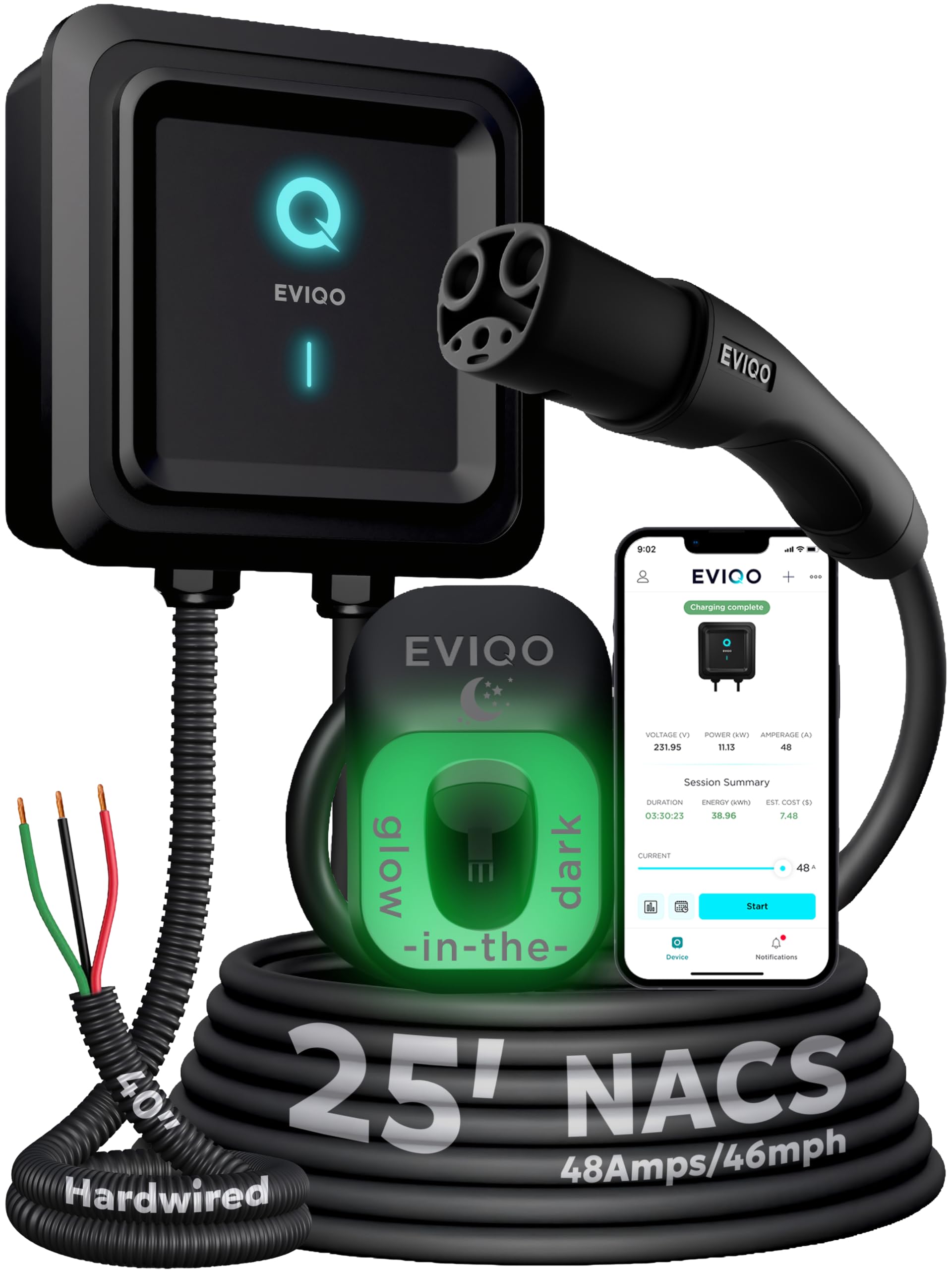
1. EVIQO EVIPOWER 48A Hardwired
Our pick — over 4.5★ from 300+ verified ratings; the strongest balance of quality and price.
The native NACS charger that plugs straight into any Tesla without an adapter.
If you drive a Tesla, this is the unit that removes the biggest annoyance of most home chargers: the adapter. Its NACS connector (the Tesla-style port) fits Model S, 3, X, and Y directly, and it even opens your car’s charge port from the button on the handle. At a full 48A on a 240V hardwired connection, It delivers up to 50 miles of range per hour, so most cars are fully charged overnight.. Buyers confirm the speed, with a VW ID.4 going from empty to full in 5-7 hours.
The EVIQO is built for the outdoors as much as the garage, with an IP66/NEMA-4 weatherproof enclosure that shrugs off rain, snow, heat, and dust. A glowing fluorescent holster absorbs light and stays visible at night, so you can find the connector in the dark without fumbling. The smart app handles start/stop, amperage from 6-48A, reminders, and tracks consumption and cost right on your phone — one owner said a utility rebate made the whole thing free.
Buyers report the install is straightforward because the cable and conduit come pre-attached, and the WiFi connects immediately. The thing everyone raves about is reliability — 5 months of daily use with zero issues is the common story. One careful note: owners advise that for a full 50A draw you need a 4-gauge wire on a 70A breaker, or with a 100A service you’ll cap at 48A, which is still faster than almost anything else here.
What wins owners over
- Native NACS plug — no adapter needed for Tesla
- 48A max output for up to 50 mph of range
- IP66 weatherproof enclosure for outdoor mounting
Fair trade-offs
- Hardwired install usually needs an electrician
- The soft plastic plug can scratch if you’re not careful
The crowd favorite: this is the one to grab if you own a Tesla and want maximum speed with zero adapter fuss.
Think twice if: your home only has a 100A service, since you’ll be capped at 48A anyway and a cheaper unit could match it.
2. SEGUMA 40A Level 2 Charger
The portable plug-in charger that is six times faster than a wall outlet and travels with you.
The SEGUMA earns its best-value badge by delivering premium features at a fraction of the cost. It’s a true plug-in unit with a NEMA 14-50 connector (the standard 240V outlet for dryers and EV chargers), a 25-foot cable that reaches across most garages, and a carrying bag — so it works as a wall-mounted home charger and a mobile charger you toss in the trunk for road trips. It pulls up to 40A at 240V for a max of 9.6kW, which the brand says is six times faster than a standard Level 1 charger (the slow 120V wall outlet type).
Owners mention it auto-adjusts its current to match the car — one 2024 Dodge Hornet R/T Plus PHEV owner watched it settle at the car’s 32A limit and still fill a 33kWh battery from 0-100% in about 2 hours. The build quality gets consistent praise: a thick, heavy cable, a quality plug, and a 2.4-inch TFT display (a color screen that shows live amperage, voltage, power, kWh, and charging time). It has survived a full year outside in snow, rain, and summer sun without fault, per one report.
The adjustable current (10A/16A/20A/24A/32A/40A) and delay timer let you schedule charging for off-peak rates and cut your utility bill. It also beats older units on heat — one owner swapped out a failed 32A charger and found the SEGUMA runs around 105°F at 40A where the old one hit 175°F. The only recurring gripe is the loose dust cap that can fall off easily, and the timer function is genuinely untested by most owners.
Why it’s a steal
- 6x faster than a Level 1 charger at up to 9.6kW
- Portable — carry bag, wall holder, and control box holder included
- IP66 waterproof with a -22°F to +122°F working range
The small stuff
- Loose rubber dust cap can pop off
- Delay timer function hasn’t been widely tested by owners
Reach for this if: you want one charger that lives on the wall at home and rides along in the trunk on trips.
Look elsewhere if: you need a native Tesla plug — this uses the J1772 standard and requires an adapter for Tesla.
3. VEIPHLOX 40A No-App Charger
A no-frills workhorse with an integrated holster that needs no app and no complex setup.
If the idea of another app on your phone makes you tired, the VEIPHLOX is your charger. It uses a pure plug-and-charge design — you plug in the J1772 connector and it just works, no WiFi, no account, no configuration. Owners describe it as simple and reliable, with one comparing its looks to a futuristic gas pump. Don’t mistake the simplicity for a lack of safety: it’s UL-certified and built into an IP65/NEMA-5 waterproof, dustproof, fire-resistant housing.
The standout feature is the integrated storage — the cord wraps around the unit and the connector slots into a side-mounted socket, so you don’t need a separate holster hanging on your wall. It keeps the garage neat and the cable off the floor. The 25-foot cable is a highlight, with the build quality feeling premium, and it delivers the full 40A/9.6kW it promises. Customers note the NEMA 14-50 plug stays cool even after 3 hours of Level 2 charging.
Because there’s no display, you read the status from color-coded lights: red for emergency stop, blue for ready, flashing green while charging, solid green when done. Adjustable settings live behind internal switches, so you set it once and forget it. Reviewers point out it delivers around 30-40 miles per hour, and one owner described it as cheaper than a hardwired install while being highly satisfying to use daily.
Set-and-forget appeal: this is the pick for anyone who wants to mount it once, plug in every night, and never think about a charger app again. The tidy wrap-around cable storage is the detail owners mention most.
Who it’s not for: if you want scheduling, cost tracking, or remote start from your phone, the lack of any smart features will feel limiting.
4. VEIPHLOX 40A RFID Lock Charger

This one adds RFID key-card access — so strangers in a shared garage can’t siphon your power.
The second VEIPHLOX on our list builds on the same reliable foundation but answers a specific problem: unauthorized use. If your charger lives in a shared or semi-public spot — like an accessory dwelling unit or a parking area others can reach — the RFID card lock means only card holders can start a charge. Owners found this genuinely useful, noting it protects against power theft and works across multiple EVs in one household with easy switching.
Beyond security, this model steps up the display game with a 4.3-inch LCD screen showing charging rate, actual temperature, current, voltage, power, and charged amount. A colored LED strip mirrors the status, so you can read it from across the garage. It charges at up to 8x the speed of a Level 1 charger, adding about 38 miles per hour, and shoppers say a full charge in roughly 2 hours instead of 14+.
The amperage is adjustable across 10/16/20/24/32/40A, and the delay-charge function lets you schedule off-peak charging to lower your electricity bill. Buyers consistently rate reliability and easy installation as the top strengths, and it works with a Tesla when you add a J1772-to-NACS adapter. The one honest caveat: a single owner reported their unit worked great for a year before developing an error loop — a rare outlier given the strong consensus, but worth knowing for a long-term purchase.
Security & visibility
- RFID card start/stop blocks unauthorized charging
- Large 4.3″ LCD shows live charging data
- 8x faster than Level 1, about 38 miles per hour
Honest caveats
- The card-swipe step is extra friction if you’re the only user
- A rare unit developed an error loop after about a year
The secure option: choose this when your charger is reachable by others and you want card-controlled access with a big, readable screen.
skip it if: you’re the sole user in a private garage — the RFID swipe adds a step you don’t need.
5. NexCyber 48A WiFi Charger
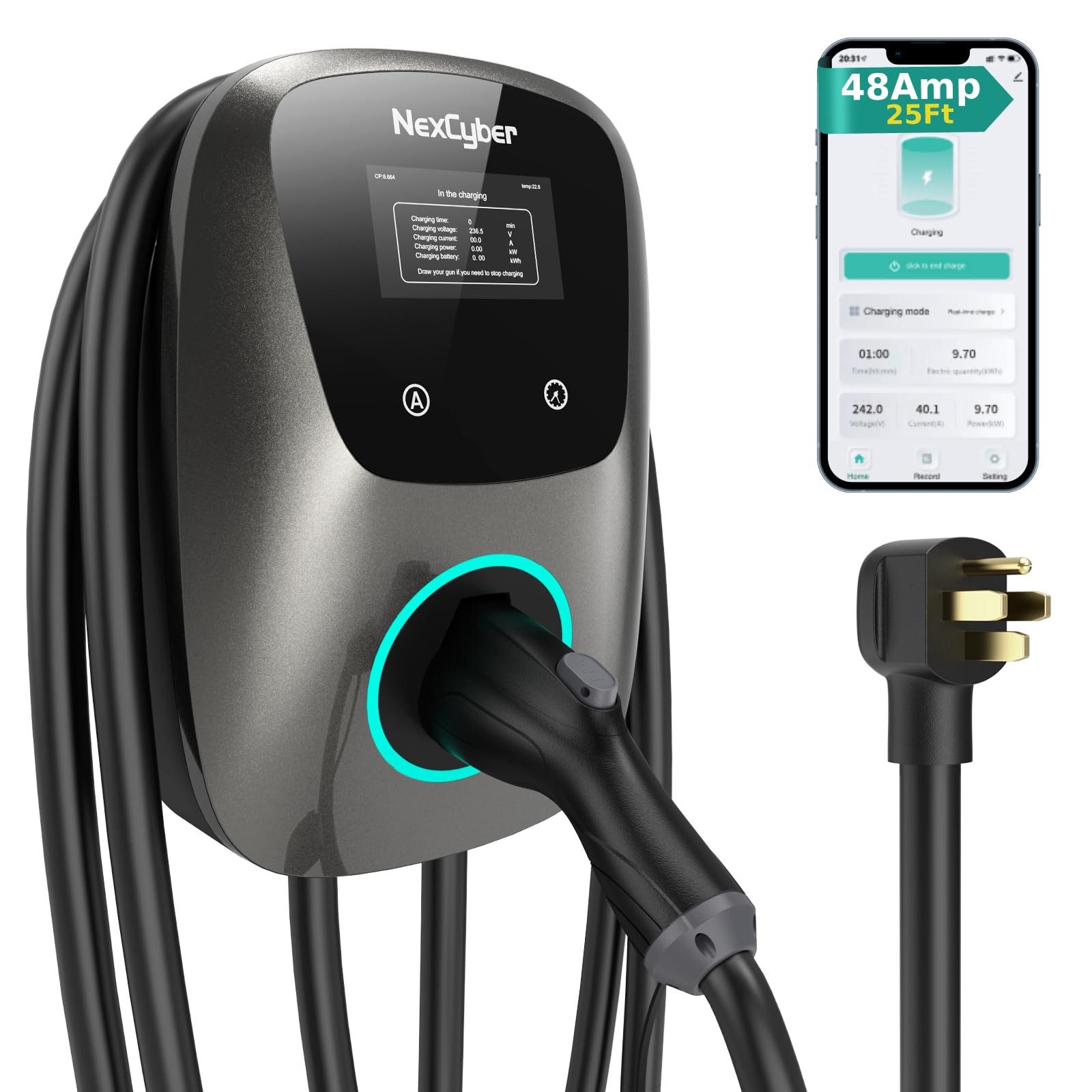
A plug-in unit that open up 48A speed normally reserved for hardwired chargers.
The NexCyber is the clever middle ground — it’s a plug-in NEMA 14-50 charger that can still push the full 48A when hardwired, delivering up to 46 miles per hour of range. Plug it into a standard outlet and it runs at 40A (about 38 miles per hour); hardwire it and you get the full 48A. Owners praise the fast charging, with one reporting a 42A charge completed in under 3 hours using a 60A breaker and 6-gauge wire. The J1772 connector covers all North American EVs, with an adapter needed for Tesla.
You get both control methods here: a smart touch screen on the unit itself and a WiFi app for remote monitoring. The screen shows charging amperage, speed, input voltage, and delay time, and long-pressing the buttons lets you adjust from 16A to 48A or set a start time. The app adds wireless tracking of cost, history, and full-charge notifications, and lets you schedule for off-peak periods. The smart-home setup is described as easy, with owners praising the visible status lights and quality build.
What wins people over is the ease of use — it’s genuinely plug-and-play, with a 25-foot military-grade cable and a drop-resistant plug rated for over 10,000 charges. The unit is NEMA Type 3 rated (meaning it’s built for outdoor use) with a level of IP65 waterproofing (dust-tight and protected against water jets), though the brand suggests avoiding direct sun or rain exposure. The bundled 3-year warranty adds confidence, and owners consistently say it performs as well as much pricier options.
The flexibility wins
- Plug-in now, hardwire later, up to 48A/46 mph
- Touch screen plus WiFi app for full control
- 25ft military-grade cable and 3-year warranty
Small frustrations
- The app interface needs polish, per owners
- Installation instructions are light on detail
Grab this if: you want the speed of a 48A charger but aren’t ready to hardwire today — plug in now at 40A, then upgrade later.
Pass if: you hate finicky apps; the smart screen is great, but the WiFi app performance is the weakest link.
6. WOLFBOX 40A EV Charger

The voice-controlled charger that answers to Alexa and Google Assistant.
If your whole house runs on smart assistants, the WOLFBOX fits right in. It integrates with Alexa and Google Assistant for voice control, and it lets you log in with your Google account, share device access across your household, and let multiple users control it at once. The 4.3-inch LCD screen shows the charging rate, time, voltage, and charged amount so you always know what’s happening. It delivers 38 miles of range per hour, which the brand says is 7x faster than a Level 1 charger.
One plug-in hybrid owner saw charge time drop from 12 hours on a Level 1 to just 3.5 hours. The unit is CSA certified and meets UL 2594 safety standards (the safety standard for EV charging equipment), built into a sturdy NEMA 4X waterproof housing. It comes with a 25-foot premium cable and includes both RFID card control (a card you tap to start charging) and the smart app, so you can let a friend charge without handing over your phone or app login. The RFID start/stop is actually preferred by some owners over the app because it’s quicker in practice.
Installation is genuinely simple — mount it on the wall and plug into a NEMA 14-50 outlet, with detailed instructions included. The app gets strong praise for being intuitive, with scheduling, history, and cost data all easy to find. One 10-year EV owner called it an excellent price-to-performance design. The honest caveats: WiFi setup can be finicky initially, the RFID stays active until re-swiped (a minor security consideration), and the time-of-use scheduling has quirks — it needs to be plugged in before the window starts.
Voice-first convenience: this is the pick for a connected home — say the word and your car starts charging, then check the cost on your phone later.
Know the quirks: the scheduling window logic and WiFi setup need patience; it’s best for owners who will use the app daily rather than set-and-forget.
7. ApexCharger MACH 1 48A
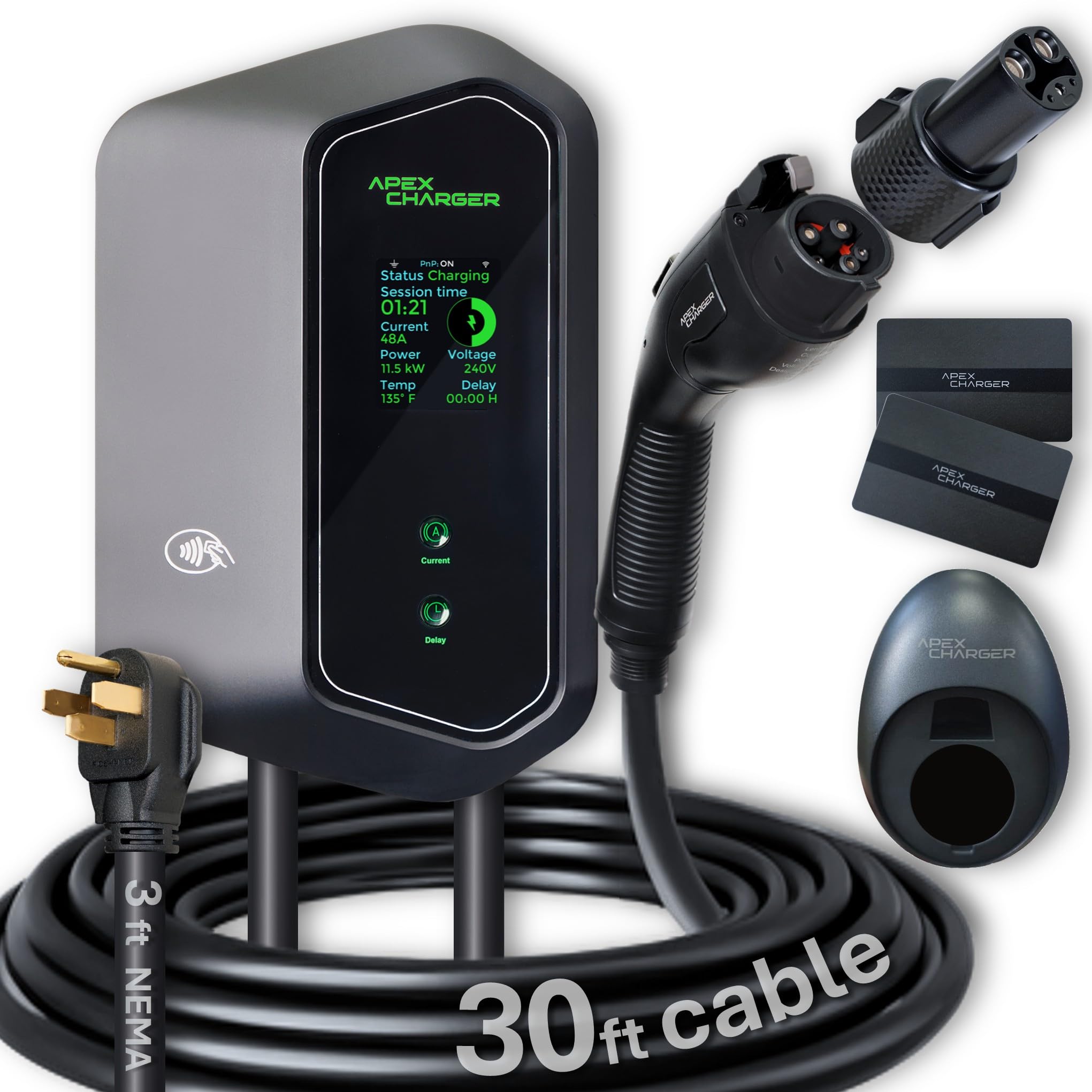
The longest 30-foot cable on our list with a Tesla adapter included in the box.
Parking situations vary, and the ApexCharger MACH 1 answers with the longest cable here — a full 30 feet. Owners confirm it reaches across garages and driveways without an extension, covering both sides and the front of the car comfortably. It’s also the most EV-inclusive unit on our list: it comes with a J1772 connector for most North American cars and an exclusive PRO 1 adapter so it also works as a Tesla charger from the start. That’s a turnkey solution for a two-EV household with different plug types.
Flexibility extends to installation. Run it at 40A on a NEMA 14-50 plug with a 50A breaker, or hardwire it for the full 48A on a 60A breaker. Buyers report dialing the adjustable current down to 24A to safely run on a 30A outlet without issues. The unit is ETL, Energy Star, and UL certified to the UL 2594:2022 standard, and it’s built into an outdoor equipment enclosure for harsh weather. A 2.4-inch LED display panel and light-assisted indicator keep you informed, and an anti-theft bolt and fittings secure the unit.
The customer support story here is exceptional and worth highlighting. When one owner hit an “overheating” error after a storm, the support team responded within an hour on a Sunday with a reset fix. Another owner’s “relay error” was resolved through a firmware update pushed via the app, turning an initial 1-star frustration into a 5-star recommendation. An October 2024 update fixed a Tesla scheduling bug, and owners mention the app is good and the connectors run cooler than the charger itself.
Why it stands out
- 30ft cable — the longest on this list
- J1772 plug plus included Tesla NACS adapter
- Adjustable current from 0-48A for any circuit
What to watch
- Time-of-day settings lack day-of-the-week selection
- Firmware updates are essential — an older unit had a Tesla scheduling bug
Best for mixed households: if you have a Tesla and a J1772 car, this is the single unit that covers both without a separate adapter purchase.
Consider otherwise if: your car parks close to the wall — the 30ft cable is generous but the time-of-day scheduling is less flexible than rivals.
8. Lectron Nexus NACS 48A
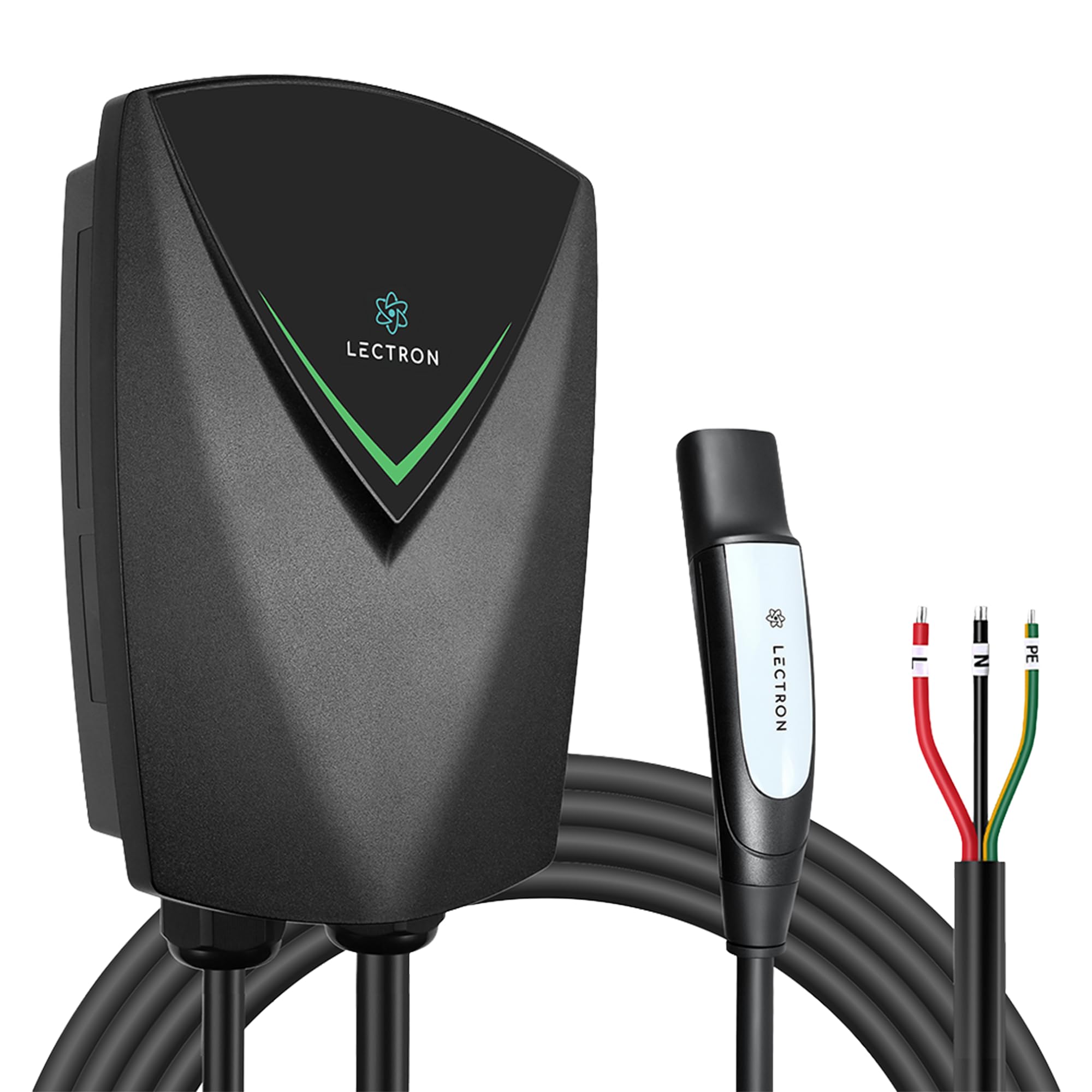
A future-proof NACS charger built for Tesla today and the next wave of EVs tomorrow.
The Lectron Nexus is the vision of what all EVs are moving toward — the NACS connector (also known as SAE J3400) is becoming the North American standard. It works flawlessly with Tesla Model S/3/X/Y and Cybertruck today, and it’s compatible with upcoming native-NACS cars like the 2025 Hyundai Ioniq 5, 2025 Kia EV6, and 2027 Chevrolet Bolt. That makes this the most future-proof pick on our list, ready for your next car whether it’s a Tesla or not.
Its 48A hardwired output delivers up to 46 miles of range per hour at 11.5kW — owners with a Tesla Model X confirm the full-speed charging with great Level 2 rates, and one owner installed it on a 60A circuit for an 11kW throughput. The 23-foot cable reaches across most garages easily, and the included holster keeps the garage tidy. It’s rated IP66 weatherproof (fully dust-tight and protected against powerful water jets), so rain, snow, heat, and dust are all non-issues for outdoor mounting.
Safety credentials are comprehensive: UL 2594, UL 2231, and UL 2251 certified with ETL listing, plus Energy Star and FCC certification. Buyers describe it as a “nice basic charger at a reasonable price,” with solid build quality and a durable cable. The 3-year Lectron warranty backs it all up. One honest note from the data: it’s new enough that the review pool is smaller than the more established units, so you’re slightly earlier to the party.
Future-proof pick: this is the one to buy if you want your next car — Tesla or not — to plug in with no adapter, thanks to native NACS support.
Not for renters: it’s hardwired only, so you’ll need a permanent 240V circuit and, ideally, an electrician to run the 60A breaker and 6-gauge wire.
9. Autel 40A MaxiCharger Home
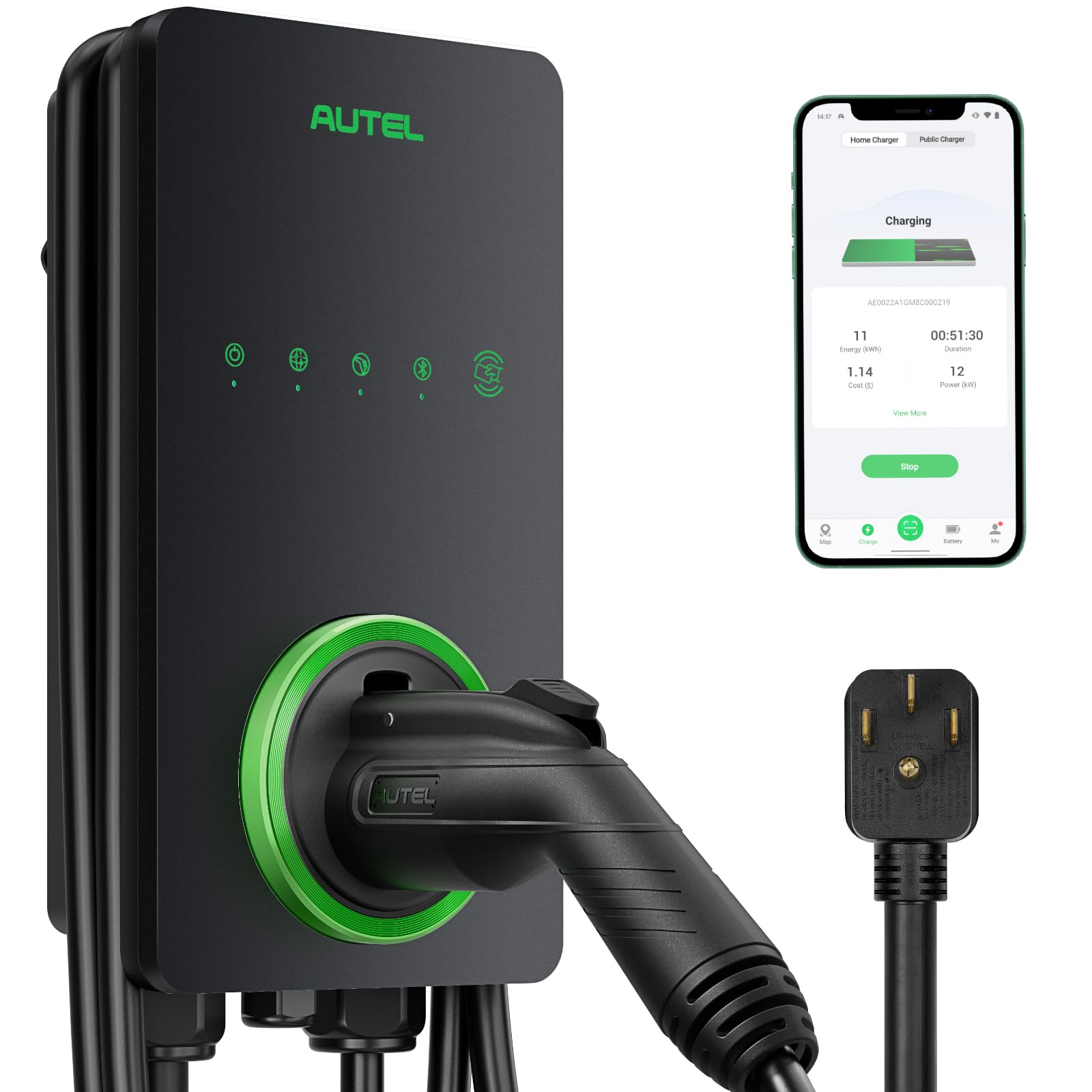
An automotive-diagnostics giant applies 20 years of expertise to home charging.
Autel has built automotive diagnostic and energy solutions since 2004, and it shows in the MaxiCharger’s polish. This plug-in unit installs in about 5 minutes — mount it, plug into a NEMA 14-50 outlet, and you’re done, saving potentially thousands on electrician costs for a hardwired install. Owners consistently describe it as a quality charger that works great, with one 7-EV veteran calling it the best Level 2 charger they’d used. The J1772 connector covers all standard North American EVs, with an adapter needed for Tesla.
The Autel Charge App is a genuine strength. It adjusts charging power from 16A to 40A in 1-amp increments, sets smart schedules for off-peak rates, and adds RFID start/stop access for security. Customers note the app is simple and helpful, and one noted it auto-charges at the car’s maximum rate then slows at the end to prevent overheating and battery damage. The setup process is smooth, with the phone app connecting easily over WiFi.
Its NEMA 4X rating makes it dust-tight, water-tight, and resistant to snow, rain, and ice — built for a harsh outdoor mount year-round. The 25-foot cable is thick, flexible, and durable per owner reports. Autel backs it with a 3-year warranty, automatic OTA app updates, and 24/7 customer support. Two minor notes from the data: adjusting the amp limit below 50 requires multiple covers, and the app’s schedule can conflict with your car’s own schedule if both are active.
Why it’s a premium pick
- 1-amp increments from 16-40A for exact current matching
- 5-minute plug-in install, no electrician needed
- NEMA 4X weatherproof for any outdoor climate
The fine print
- Amp-limit adjustment below 50 needs extra covers
- App scheduling can conflict with the car’s own schedule
Choose this for: a trusted brand with granular app control, easy portability, and a 3-year warranty from a company that’s been in automotive tech for two decades.
Reconsider if: you don’t want to fiddle with an app — the smart features are excellent but the plug-and-charge rivals here are more hands-off.
10. Emporia 48A Hardwired
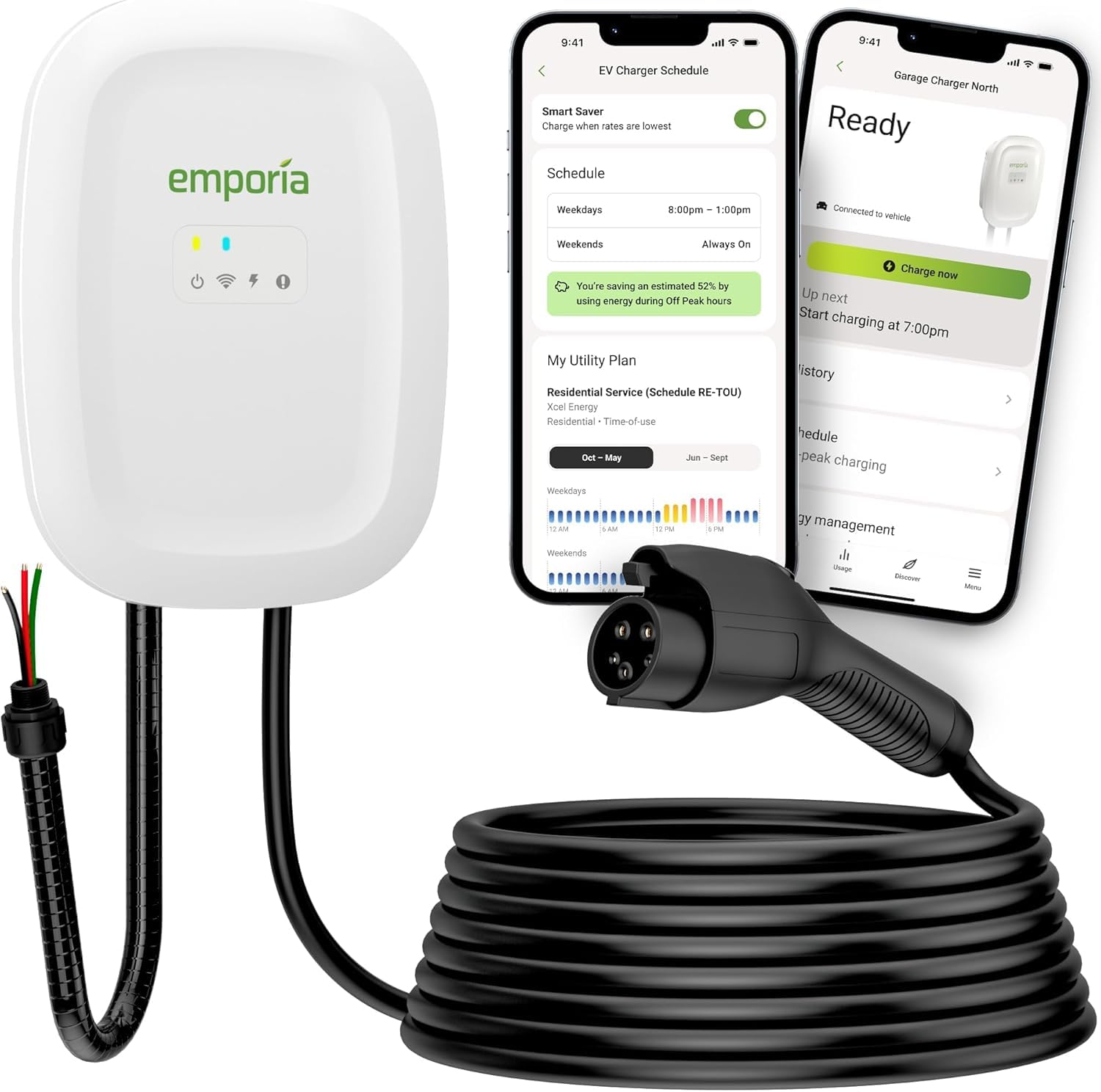
The data-obsessed charger that shows you every kWh and dollar your car consumes.
If you’re the type who loves spreadsheets and energy data, the Emporia is your charger. It integrates with the Emporia Vue home energy monitoring system, so you can see exactly how much power your car draws, its charging history, and the kWh and dollar cost per charge and per month. That’s a level of visibility none of the others match. Reviewers point out full charges in 4-5 hours for an Ioniq 5 and 1 hour for a Sportage PHEV, all while tracking every cent.
At 48A on a hardwired connection, it delivers up to 46 miles per hour — which the brand says is 9x faster than a standard wall outlet. It’s UL listed and ENERGY STAR certified, meeting strict standards including NEC 625, SAE J1772, and UL 2251. The included 25-foot cable is a practical bonus; owners note it avoids the need to back the car into the garage. An expert EVSE installer since 2013 called it their preferred charger for over 3 years, praising the easy install, excellent tech support, and honored warranty.
The smart features run deep. Via 2.4 GHz WiFi, the app manages real-time energy data, schedules charging for off-peak utility rates, and — when paired with the Emporia Vue — enables solar-only charging, demand limits, and load shedding. One owner reported cutting their on-demand electricity costs using the load-control features. The app itself gets consistent praise for its intuitive interface and control. The trade-off: advanced features like load management need a licensed electrician to set up, and it doesn’t support the 277V found in some commercial settings.
The data advantage
- Integrates with Emporia Vue for full-home energy tracking
- 48A hardwired for up to 46 miles per hour
- Solar-only charging and load shedding with Vue
Know before you buy
- Advanced features need the Emporia Vue system and an electrician
- No native NACS cable — Tesla needs the separate Emporia Tesla charger
Get this if: you want to master your home’s energy picture — it pairs with Emporia’s monitoring to show exact kWh, costs, and even solar-only charging.
Look elsewhere if: you just want to plug in and charge; the energy-tracking ecosystem is powerful but overkill for basic needs.
11. Autel 50A MaxiCharger AC Elite
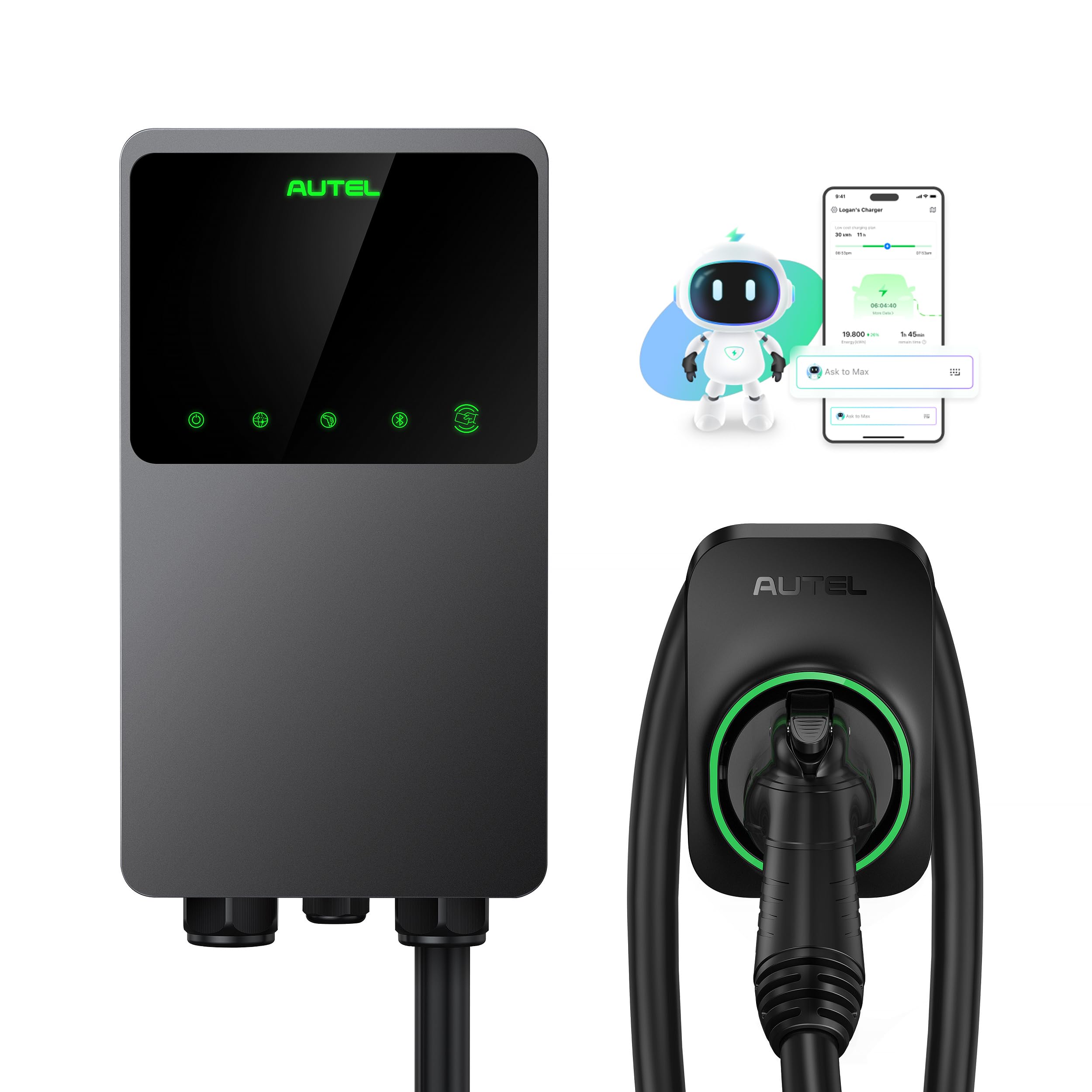
The 50-amp flagship that adds 37 miles per hour with a cable that stays flexible in the deep cold.
This is the fastest charger on our list. The Autel AC Elite pushes a full 50A at 12kW, adding 37 miles of range per charging hour — so even a big-battery EV is ready to go in a few hours rather than overnight. It’s CSA certified and NEMA Type 4 rated, meaning it’s protected against snow, rain, hail, and sleet whether you mount it outdoors or in a garage. The brand builds it for cold climates too, with a 25-foot cable that stays flexible even down to -40°C.
Shoppers say the install is straightforward because it arrives completely pre-assembled — just wire it into a 240V circuit and go. The Autel Charge app handles scheduling, cost tracking, and remote control, and a physical amperage selector on the unit lets you dial in exactly what your breaker can handle, from 32A on a 40A breaker up to 40A on a 50A. One owner chose it over a Grizzl-E specifically because the adjustable amperage solved their Chevy Bolt’s 32A draw issue.
Buyers describe the cable as sturdy and flexible even in Chicago winter, and praise the Bluetooth/WiFi reliability and working schedule function. A 6-40A adjustable range (via board and app) gives you fine control over charging speed. Autel’s support is another standout — one owner’s unit failed, and a replacement shipped within 2 days after a professional interaction. The 3-year warranty and automatic OTA updates round out a genuinely premium package. The only con reported: it’s on the heavier side.
Pure speed option: this is the one for drivers who want maximum home charging speed, especially in cold climates where a floppy frozen cable is a real annoyance.
Worth noting: it’s a bigger, heavier unit and hardwired only, so confirm your panel can handle the 50A draw with a 60A breaker before committing.
Understanding the Specs
Amperage and Charging Speed
The amperage rating — 40A vs 48A vs 50A — is the single most important number because it decides how many miles of range you add per hour. A 40A charger adds roughly 30-38 miles per hour, a 48A unit reaches up to 46 miles per hour, and a 50A unit like the Autel AC Elite hits 37 miles per hour at 12kW. Your car only pulls what it’s designed to accept, so a 48A charger on a car that maxes at 32A simply runs at 32A. Match the charger’s amperage to both your car’s intake limit and your home’s breaker panel capacity.
Plug-in vs Hardwired
A plug-in charger with a NEMA 14-50 connector goes into a standard 240V outlet — it’s easier to install, portable, and usually takes under 15 minutes to set up. A hardwired unit connects directly to your electrical panel, which allows it to safely pull the full 48A or 50A for maximum speed, but it typically requires a licensed electrician and a dedicated breaker. Your choice depends on whether you prioritize easy portability or maximum sustained charging speed.
Connector Types: J1772, NACS, and Adapters
Most non-Tesla EVs in North America use the J1772 connector (also called a Type 1 or SAE J1772). Teslas use the NACS connector, which is becoming the industry standard under the name SAE JJ3400. Some chargers ship with a native NACS plug for Tesla, while others include a J1772-to-NACS adapter so one unit handles both. If you plan to keep your car for years, a native NACS unit is the more future-proof route as more automakers adopt the standard.
Smart Features and App Control
Smart chargers connect to WiFi so you can schedule charging for off-peak hours, track consumption and cost, and get notifications when your car is full. Some add RFID card access so only authorized users can start a charge — useful in shared garages. If reliable WiFi is a concern in your garage, or you simply don’t want another app, a plug-and-charge unit with no app is a perfectly sensible choice. The best smart chargers also integrate with home energy systems like the Emporia Vue for solar-only charging and load management.
Weatherproofing and Build Quality
An IP66 or NEMA 4X rating means the charger is sealed against dust and powerful water jets — safe for rain, snow, and even direct hose-downs. A NEMA Type 3 rating offers similar outdoor protection. Cable quality matters just as much: look for thick, heavy-duty cables that stay flexible in cold weather, and connectors that survive thousands of plug/unplug cycles. A charger with a 3-year warranty signals the manufacturer trusts its build quality.
FAQ
Will a 48A charger work if my car only accepts 32A?
Do I need an electrician to install a Level 2 charger?
Can I use a Tesla charger on a non-Tesla EV, or vice versa?
What size breaker do I need for a 40A vs 48A charger?
How long does it take to fully charge an EV with a Level 2 charger?
Is it safe to leave an EV charger plugged in outdoors in rain or snow?
What’s the difference between a smart charger and a plug-and-charge model?
Can I take my Level 2 charger with me when I move?
Are all Level 2 chargers compatible with all EV brands?
How much does it cost to run a Level 2 charger?
Final Thoughts: The Verdict
Across the board, the electric car charger winner is the EVIQO EVIPOWER 48A because it delivers the fastest Level 2 speeds with a native NACS plug (the Tesla-style connector) for Tesla owners, a weatherproof IP66 build, and an app that tracks cost and schedules off-peak charging — a rare complete package. If you want budget-friendly portability, grab the SEGUMA 40A and take your charging on the road. And for maximum speed with a flexible cold-weather cable, the Autel 50A MaxiCharger AC Elite is the one to reach for when only the fastest home charge will do.
How We Picked
We do not accept paid placement. Every pick is matched to a real buyer and a real use-case; we do not hands-on test units.
Sources & Methodology
Specifications: manufacturer listings and product documentation. Review insights: verified customer reviews, as of August 2026. Pricing: not shown on this page (it changes often); check the current price via the retailer link.
As an Amazon Associate, WellFizz earns from qualifying purchases. This does not affect which products we feature.
Related Guides

Mo Maruf
I created WellFizz to bridge the gap between vague wellness advice and actionable solutions. My mission is simple: to decode the research and give you practical tools you can actually use.
Beyond the data, I am a passionate traveler. I believe that stepping away from the screen to explore new environments is essential for mental clarity and physical vitality.