Our readers keep the lights on and my smoothie glass nicely filled. As an Amazon Associate, I earn from qualifying purchases.
Specs are compiled from manufacturer listings and verified buyer reviews and can change over time — please confirm the key details on the product page before buying.
You know the drill — slicing a fresh loaf of sourdough or a thick baguette by hand usually gives you uneven slabs, crushed crust, and crumbs everywhere. An electric bread slicer turns that chore into a quick, repeatable process that gives you restaurant-style slices every time, whether you are meal-prepping sandwiches, stocking the freezer, or just tired of fighting with a serrated knife. This guide lines up six top-rated models so you can pick the one that fits how you actually cook.
I’m Mohammad Maruf — the founder and writer behind WellFizz. This guide is built by comparing the manufacturers’ published specifications and the patterns across verified customer reviews, so you get each pick’s real strengths and trade-offs instead of marketing spin.
Each model reviewed here delivers dependable, motor-driven slicing for bread, deli meats, cheese, and more. Here is everything you need to choose the best electric bread slicer for your kitchen.
Our Picks at a Glance


How To Choose The Best Electric Bread Slicer
A slicer that works great for deli meat might struggle with a crusty boule. The key is matching the machine’s motor power, blade design, and build quality to the foods you slice most. Here are the three specs you cannot ignore.
Motor Power and Duty Cycle
Motor wattage tells you how much torque (turning force) the slicer has. A 200-watt motor handles dense loaves and firmer foods without slowing down, so you get clean slices through a hard crust. A 130-watt to 150-watt motor is fine for softer breads and occasional use. Just as important is the duty cycle — the amount of time the slicer can run before it needs a cooldown. Machines with a 10-minute run limit need a 30-minute rest. That matters if you are slicing five or six loaves in one go.
Blade Size and Material
Blade diameter determines the maximum size of bread or meat the slicer can handle. A 7.5-inch blade is the standard for home use and fits most standard loaves. Stainless steel blades resist rust and stay sharp longer. Serrated blades (with a jagged edge) grip the crust and slice cleanly without tearing the crumb (the soft inside of the bread), which is why they are the best choice for bread.
Build Quality and Ease of Cleaning
Die-cast aluminum and stainless steel housings are more stable and durable than plastic builds, especially when you are pushing against the blade. Removable blades and carriages (the sliding platform that holds the food) are the single biggest time-saver for cleanup — look for parts that detach without tools. Non-slip suction feet keep the machine planted on the counter, which makes a real difference when slicing.
Quick Comparison
| Model | Best For | Motor Power | Blade Length | Weight | Amazon |
|---|---|---|---|---|---|
| TOKASS 200W★ Best Overall | Heavy-duty all-purpose | 200W | 7.5″ | — | Amazon |
| Cuisinart FS-75Brand Favorite | Trusted brand, warranty | 130W | 7.5″ | 11 lbs | Amazon |
| OSTBA SL-517 | Budget entry-level | 150W | 6.7″ | 6.3 lbs | Amazon |
| Nutrichef NUGJ801 | Value bread & meat | 200W | 7.5″ | — | Amazon |
| Elite Gourmet EMT-625B | Crowd-favorite durability | — | 7.5″ | 10.6 lbs | Amazon |
| Nutrichef NUGJ801.5 | Compact power | 200W | 7.5″ | — | Amazon |
In‑Depth Reviews
1. TOKASS 200W Meat Slicer (Silver, 2 Blades)
Our pick — over 4★ from 500+ verified ratings; the strongest balance of quality and price.
The motor that keeps going loaf after loaf without a sweat.
This is the pick for anyone who wants a single machine that handles bread, meat, cheese, and vegetables without swapping gear. The 200-watt motor gives it the torque to push through a crusty sourdough without bogging down, and you get two 7.5-inch blades — one serrated (jagged-edge) for bread, one non-serrated for meat — so cross-contamination between raw and cooked food is not an issue. The blade length matches the best in class at 7.5 inches, meaning it handles standard loaves and roasts easily.
The thing owners rave about most is the slicing performance. That is the aspect with the most mentions by a wide margin — nearly 50 people single it out. Durability gets more mixed feedback, but one owner says after a year the machine “works perfectly fine like new,” and the build uses high-carbon stainless steel. The adjustable dial goes from 0 to 15 mm, so you can go paper-thin for deli meat or a thick slice for toast. Cleaning is straightforward because the blade, food carriage (the sliding platform that holds the food), slide-rod extension, and food pusher all come off. The safety lock requires pressing two buttons at once, which keeps accidental starts from happening, especially around kids.
The honest trade-off is that this costs more than budget options like the OSTBA SL-517, but the dual-blade kit and 200-watt motor justify the step up. The recurring gripe is that some parts do not come apart for cleaning, and a minority of owners find it less powerful than a commercial deli slicer — which is a fair comparison for a home machine. Still, this unit holds a rating from 500+ owners who broadly agree it delivers.
Where It Excels
- 200W motor handles dense bread and meat without stalling
- Two included 7.5″ blades (serrated + non-serrated) prevent raw/cooked cross-contamination
- Safety lock with dual-button start prevents accidental use
- Removable blade, carriage, and pusher simplify cleanup
Keep In Mind
- Pricier than entry-level models, but the dual-blade kit and motor power justify it
- A few owners note some crevices are tough to reach during cleaning
- Not as powerful as a commercial deli slicer, which is expected at this price tier
Who This Fits: Home cooks who slice bread, deli meat, and cheese regularly and want a single machine that does all three without compromise.
Consider Another If: You only slice bread occasionally and prefer a lighter, more compact unit — the 16.3-inch footprint needs counter space.
2. Cuisinart Kitchen Pro FS-75 Food Slicer
A trusted name with a heavy-duty feel and a warranty that backs it up.
Cuisinart built a reputation on countertop appliances that last, and the FS-75 follows that playbook. The 7.5-inch stainless steel blade handles bread, roasts, and firm cheeses, and the slice control knob adjusts from 1/32-inch (paper-thin prosciutto) all the way up to 1/2-inch (thick-cut toast). The build uses premium-coated steel and die-cast aluminum housing, so this 11-pound machine stays planted on the counter without sliding around. It is the heaviest slicer on this list by a clear margin — 11 pounds vs. the 6.3-pound OSTBA — which is the main reason it feels so solid during use.
The slice control knob is the feature owners appreciate most because it holds its setting even after multiple loaves. The blade, food guide, and stainless steel carriage all come off, so cleanup takes about a minute. But the biggest differentiator here is the warranty — Cuisinart backs the motor with a limited 3-year warranty. That is a meaningful safety net when you are investing in a mid-range slicer.
The honest catch is the motor. At 130 watts, it is the weakest on the list, and several owners note a 10-minute runtime limit before it needs a rest. It can struggle with frozen meat and harder cheeses if you push it. The food guard is plastic and feels flimsy compared to the metal housing. Still, for bread slicing and occasional deli work, this is a reliable, repairable machine from a company that stands behind it.
Best For Light-to-Medium Use: If you slice a loaf or two per week plus deli meats, the Cuisinart’s build quality and 3-year motor warranty give you confidence that lighter plastic machines cannot match.
The Limitation: The 130-watt motor means you cannot run it continuously — plan for 10 minutes of slicing, then a cooldown before the next batch.
3. Elite Gourmet EMT-625B Deli Meat Slicer

The most-reviewed slicer on the list with die-cast aluminum that actually lasts.
Over 3,500 owners have shared their experience with this machine, which makes it the most-vetted slicer in this guide by a huge margin. The body is made from die-cast aluminum, not plastic, which means it resists rust and stays sturdy over years of use. The 7.5-inch serrated blade is removable for cleaning, and the thickness dial goes from razor-thin up to 1/2-inch slices, so you can tackle everything from paper-thin hotpot meat to thick-cut sandwich bread.
The adjustable thickness is what wins people over most. Reviews consistently call it “great value” and “easy to clean.” The machine weighs 10.6 pounds, which is heavy enough to stay put on the counter during slicing. Owners who use it for homemade jerky, cheesesteaks, and baguettes report consistent results. The primary feedback is that the carriage and slider can stick at first — a dab of vegetable oil on the sliding surfaces resolves that in seconds.
The trade-off is that this is not a low-maintenance machine. A few owners note the blade rubs against the housing, and cleaning the crevices around the carriage takes 15 to 20 minutes if you are thorough. Bread slicing is good but not exceptional — it is better suited to meat. If bread is your main use, the Nutrichef or TOKASS above may edge it out, but for overall versatility at a mid-range price, this is the proven workhorse.
Whom It Serves Best: Anyone who wants a metal-built, budget-friendly slicer that thousands of other owners have already confirmed works — the die-cast body is rare at this price.
The Fine Print: Cleaning the carriage area takes extra time, and bread slicing is good but not the standout feature — meat is where this machine shines.
4. Nutrichef NUGJ801 Electric Meat Slicer

200 watts in a compact footprint — a surprising amount of punch for the size.
This unit delivers the same 200-watt motor and 7.5-inch blade as the premium picks but in a more compact body (13.9 x 9.9 x 10.9 inches) that fits neatly under upper cabinets. The adjustable thickness dial covers 0 to 15 mm, and the safety guard with a center-hub blade removal system means you do not need tools to take the blade off for cleaning. The build is a mix of ABS plastic and aluminum, which keeps the weight down without feeling flimsy.
Functionality is the most-discussed aspect — nearly 90 owners highlight it positively. The machine excels at bread, deli meat, and even sourdough loaves, which is the specific use case several owners emphasize. The 200W motor is a 33% power increase over the OSTBA’s 150W, and at 7.5 inches the blade is 0.8 inches longer, giving you more clearance for taller loaves. That power difference matters when you hit a hard crust — the Nutrichef cuts cleanly where the lower-wattage machine can bog down.
The practical downside is the duty cycle (the recommended maximum run time before a cooldown). Like most home slicers, this one has a 10-minute continuous run limit and requires a 30-minute cooldown. The food carriage is a bit small — roughly 4 inches of blade depth — so very large roasts or whole hams do not fit. A minority of buyers report the plastic pusher can crack over time. If your slicing is intermittent and you value counter space, this is a strong mid-range value.
The Highlights
- 200W motor punches above its size — handles crusty bread better than 150W rivals
- Compact dimensions (13.9″) fit smaller kitchens
- Removable blade and carriage simplify cleaning
Watch For
- 10-minute continuous run limit with 30-minute cooldown
- Small carriage limits large roasts and whole hams
- Plastic pusher can crack with heavy use
Ideal For: Home cooks who want 200W power in a compact machine and primarily slice bread plus occasional deli meat.
Not The Best Fit If: You need to slice large quantities in one session — the cooldown period interrupts batch work.
5. OSTBA SL-517 Meat Slicer

A legit entry-level slicer that won’t punish your wallet or your counter space.
At 6.3 pounds and 11.7 x 7.78 x 10.2 inches, this is the smallest and lightest slicer in the lineup — a genuine space-saver. The 150-watt motor drives a 6.7-inch serrated stainless steel blade, and the adjustable thickness dial runs from 0 to 15 mm. It handles bread, cheese, cold cuts, and vegetables, and the non-slip suction feet keep it secure on the counter. The blade and food pusher are dishwasher-safe, which is rare at this price and simplifies cleanup significantly.
Slice performance is the top positive aspect by a wide margin — nearly 70 owners praise it. Owners specifically call out how well it works for portion-control dieting, slicing meats and breads into uniform pieces that fit meal-prep containers. The machine “works great” for bread, cold cuts, and cheese, and the compact footprint means it can live on the counter full-time without dominating the space. The suction feet are a genuine help — they keep the machine planted even when you are pushing a dense loaf through the blade.
The honest trade-off is the motor. At 150 watts, the motor is less powerful than the 200-watt TOKASS and Nutrichef. One owner’s note sums it up: “can only run for 5 minutes then needs 15 minute rest.” The smaller 6.7-inch blade also means you cannot fit the tallest artisan loaves — standard sandwich bread is fine, but a tall boule (a round, crusty loaf) may require trimming. Those who want ultra-thin slices report inconsistent results at the thinnest settings. If your budget is tight and your slicing is light, this is a solid starter.
Who This Is Right For: First-time buyers who want a low-cost introduction to electric slicing and only need consistent results for standard bread, cold cuts, and cheese.
When To Pass: If you need to slice more than a couple of loaves at a time or want razor-thin deli slices — the 150W motor and 5-minute duty cycle limit batch work.
6. Nutrichef NUGJ801.5 Meat & Bread Slicer
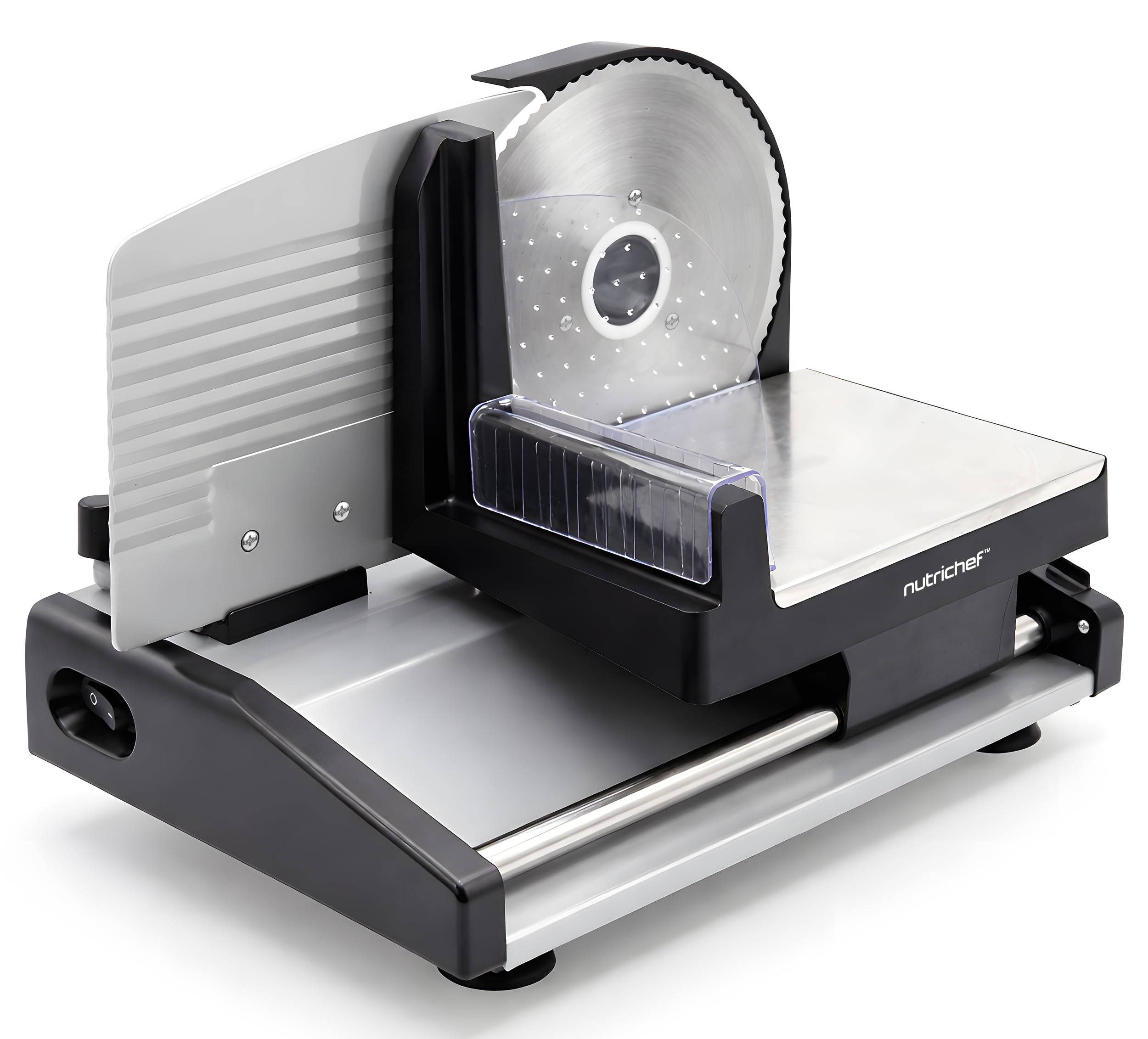
Nearly identical to the NUGJ801 above, but with a 1-year warranty and a growing fan base.
This is effectively the same machine as the Nutrichef NUGJ801 — same 200-watt motor, same 7.5-inch stainless steel blade, same 0-to-15 mm adjustable thickness, same compact 13.9 x 9.9 x 10.9-inch dimensions. The key difference is a 1-year manufacturer warranty (versus the NUGJ801’s unspecified “Manufacturer Warranty”) and a smaller but very positive review base of nearly 30 owners who rate it highly. Ease of cleaning and slice quality both get the most positive mentions, with 7 owners each calling them out.
The blade cuts cleanly through sourdough, shaved steak, and beef jerky, and the safety guard with the center-hub blade removal system makes disassembly straightforward. Owners describe it as “sturdy” and “smooth” and specifically note it works “great for shaved steak and beef jerky.” The adjustable thickness dial goes from thin deli cuts to thick bread slices, and the anti-slip feet keep the machine stable during use. For the price, this is a direct competitor to the Elite Gourmet and the other Nutrichef model.
The limitation is the small review sample — with fewer than 30 ratings, the long-term reliability picture is less clear compared to the 800+ ratings on the NUGJ801. One owner describes it as “not a very powerful slicer,” which is note for very dense loaves. The hybrid ABS/aluminum build is the same as the NUGJ801, so the 10-minute run limit and small carriage apply here too. If you prefer a fresh warranty and a slightly newer variant, this is the pick.
What Stands Out
- 200W motor in a compact package — same power as the top pick
- Owners highlight easy cleanup and slice quality equally
- 1-year manufacturer warranty offers confidence
What To Know
- Small review count makes long-term durability harder to assess
- 10-minute continuous run limit with 30-minute cooldown
- Some owners find it underpowered for very dense foods
Pick This If: You want the 200W/7.5-inch spec combo with a fresh warranty and do not mind a newer, less-vetted model.
Look Elsewhere If: You prefer a proven track record with thousands of reviews — the Elite Gourmet or the other Nutrichef model have more owner history.
Understanding the Specs
Motor Wattage (Power)
Motor wattage is the single most important spec for a bread slicer because it determines whether the blade will power through a hard crust or stall halfway. Entry-level machines run 130 to 150 watts — fine for soft bread and cold cuts. Mid-range and premium slicers use 200 watts, which handles dense sourdough, baguettes, and semi-frozen meat without slowing down. If you slice bread daily, spend up to a 200-watt machine.
Blade Length and Material
Blade diameter sets the maximum height of what you can slice. A 7.5-inch blade is the standard and fits most standard loaf pans and roasts. A 6.7-inch blade works for smaller loaves but limits you on taller artisan breads. All blades on this list are stainless steel, which resists rust and holds an edge longer than carbon steel. Serrated blades grip the crust better for bread; non-serrated blades give cleaner cuts on meat and cheese.
Adjustable Thickness Range
The thickness dial controls how thick or thin each slice comes out. Most home slicers offer a range from 0 to 15 mm — that is from paper-thin (about 1/32 inch) to a hearty half-inch. A wider adjustment range gives you more versatility: thin slices for deli sandwiches and jerky, thick slices for toast and roasts. Make sure the dial clicks into place and holds its setting during use rather than slipping as you slice.
Duty Cycle (Run Time)
Duty cycle is the manufacturer’s recommended maximum continuous run time before the motor needs to cool down. Home slicers typically have a 5- to 10-minute run limit followed by a 15- to 30-minute rest. This matters if you plan to slice multiple loaves or large batches in one sitting. Machines with 200-watt motors often have the same duty cycle as lower-wattage ones, so plan your workflow accordingly.
FAQ
Can an electric bread slicer also cut meat and cheese?
How thick can an electric bread slicer cut?
How long can I run an electric slicer continuously?
Are electric bread slicers safe to use?
How do I clean an electric slicer?
What size blade do I need for bread?
Is a serrated blade better for bread?
Do I need a 200-watt motor for bread slicing?
Can I slice hot bread straight from the oven?
How long does an electric slicer blade stay sharp?
Final Thoughts: The Verdict
The best electric bread slicer for most users is the TOKASS 200W because it combines a powerful 200W motor, two 7.5-inch blades for raw and cooked foods, and a removable design that makes cleaning straightforward — all backed by over 500 owners who rate it a crowd favorite. If you want a proven workhorse with die-cast aluminum durability and the most owner feedback on the market, grab the Elite Gourmet EMT-625B. And for a compact 200W option that fits small kitchens, the Nutrichef NUGJ801 delivers the same power in a smaller footprint without the premium price.
How We Picked
We do not accept paid placement. Every pick is matched to a real buyer and a real use-case; we do not hands-on test units.
Sources & Methodology
Specifications: manufacturer listings and product documentation. Review insights: verified customer reviews, as of July 2026. Pricing: not shown on this page (it changes often); check the current price via the retailer link.
As an Amazon Associate, WellFizz earns from qualifying purchases. This does not affect which products we feature.
Related Guides

Mo Maruf
I created WellFizz to bridge the gap between vague wellness advice and actionable solutions. My mission is simple: to decode the research and give you practical tools you can actually use.
Beyond the data, I am a passionate traveler. I believe that stepping away from the screen to explore new environments is essential for mental clarity and physical vitality.