Our readers keep the lights on and my smoothie glass nicely filled. As an Amazon Associate, I earn from qualifying purchases.
Specs are compiled from manufacturer listings and verified buyer reviews and can change over time — please confirm the key details on the product page before buying.
You have a standard 30-inch gap in your kitchen, and you need a new electric range. The biggest choice is whether one oven suffices or you need two separate temperature zones. This guide compares four electric 30-inch ranges, from the double-oven GE to an induction model that boils water in half the time. Your choice depends on household size and if you need to cook at two different temperatures simultaneously.
I’m Mohammad Maruf — the founder and writer behind WellFizz. This guide is built by comparing the manufacturers’ published specifications and the patterns across verified customer reviews, so you get each pick’s real strengths and trade-offs instead of marketing spin.
If you need to cook two dishes at different temperatures simultaneously, choose the GE double oven. If you want the largest single oven with smartphone control, choose the Samsung. If even, fast baking on a budget is your priority, the Kenmore with True Convection is your pick. These are the best electric 30-inch range options worth your attention today.
Our Picks at a Glance

How To Choose The Best Electric 30-Inch Range
Before you compare brands, focus on three things: how much oven space you actually need, if you want separate temperature zones (a double oven), and how the cooktop heats your pans. Each of these choices affects your daily cooking far more than the brand name on the front.
Oven Capacity: Single Oven vs. Double Oven
The most practical split in this category is between single large ovens (4.8 to 6.6 cubic feet) and double ovens that give you two smaller chambers. A single big oven can hold a turkey plus a casserole dish, but you cook everything at the same temperature. A double oven lets you bake cookies at 350°F in the top while roasting a chicken at 425°F in the bottom — that flexibility matters if you regularly cook multiple dishes for a crowd.
Cooktop Elements: Radiant, Induction, or Sealed
Radiant elements sit under a smooth glass top and glow red-hot; they are the most common type and heat any flat-bottomed pan. Induction burners use a magnetic field to heat the pan directly — they are faster and more energy-efficient, but you need cookware with a magnetic base (test it with a fridge magnet). Sealed burners are raised coils that are durable and easy to replace but harder to clean than a smooth top. Your choice depends on whether you value speed (induction) or universal cookware compatibility (radiant).
Convection, Air Fry, and Self-Cleaning
Convection uses a fan and a heating element to circulate hot air, which cooks food up to 25% faster and gives you more even browning. Air fry is simply convection on a high-speed setting with a basket — it gives you crispy results with little to no oil. Self-cleaning heat cycles (some ranges offer steam clean as an option as well) burn off food residue so you do not have to scrub the oven walls by hand.
Quick Comparison
| Model | Best For | Oven Capacity | Oven Count | Cooktop Elements | Amazon |
|---|---|---|---|---|---|
| Kenmore B0CGMC72GG★ Best Overall | Value seekers wanting True Convection | 4.8 cu. ft. | Single | 5 radiant (2 Turbo Boil) | Amazon |
| GE JBS86EPES | Holiday cooks who need two ovens | 6.6 cu. ft. | Double | 5 radiant (includes Power Boil) | Amazon |
| Samsung NE63A6511SS | Smart-home users & large single-oven fans | 6.3 cu. ft. | Single | 5 sealed (smooth glass touch) | Amazon |
| Rangaire RRI303GS | Tech enthusiasts wanting induction speed | 5 cu. ft. | Single | 4 induction (PowerSurge Boost) | Amazon |
In Depth Reviews
1. Kenmore Front Control Electric Range with True Convection (B0CGMC72GG)
Our pick — over 4★ from 100+ verified ratings; the strongest balance of quality and price.
True Convection — a third heating element behind the fan — so your cookies brown evenly across both racks without hot spots.
This Kenmore gets the key detail right: True Convection uses a third heating element that works with the fan to circulate truly hot air around your food, not just fan-blown air from a single top element (which standard convection does). That means your sheet tray of roasted vegetables browns evenly edge to edge. On the cooktop, you get five radiant elements including two 3,000-watt Turbo Boil burners — they bring a pot of water to a rolling boil fast, which is useful for pasta nights.
The front control layout puts the knobs in front of you so you do not reach over hot burners to adjust settings. It includes an air fry setting with a basket, a steam-clean option, and a self-clean cycle. Owners especially like the storage drawer below the oven — a pull-out bin for baking sheets and muffin tins that the double-oven GE lacks entirely. At 4.8 cubic feet, the oven is the smallest here, but it still fits a 22-pound turkey or a lasagna pan for a family of six. For a buyer focused on even baking without paying double-oven money, the Kenmore delivers True Convection that the Samsung and GE do not offer.
The most-discussed caveat among owners is the oven heating speed — it takes noticeably longer to preheat than some competitors. A small number of shoppers say error codes or burners that stopped working early. Buyers report one experience where a Thanksgiving turkey was not cooked after two hours, accompanied by an error code E13 (a heat default). At 174 pounds, it is 26 pounds heavier than the Samsung and the second-heaviest range in this group — you definitely need a helper and a dolly for delivery day. On the positive side, most owners say the burner heat distribution is excellent once it gets going, and the modern stainless steel finish earns consistent compliments on appearance.
Value standout: You get True Convection — a third heating element plus a fan — without paying premium-brand prices. This is the best value if even baking is your priority.
Patience required: The oven preheats slower than the GE or Samsung, and a small number of owners mention early reliability issues.
Choose this if: you want accurate, even convection baking and a usable storage drawer — all without spending double-oven money.
skip it if: you need the fastest preheat times — the GE’s double-oven or the Samsung’s larger single cavity heat up faster.
2. GE 30 in. Freestanding Electric Double Oven Convection Range (JBS86EPES)

Two separate ovens in one 30-inch body — you get to bake cookies at 350°F and roast a chicken at 425°F simultaneously.
This GE range solves the single biggest limitation of a single oven: you can only run one temperature at a time. With 6.6 cubic feet of total capacity split across two chambers, you can preheat the upper oven to 425°F for roasting vegetables while the lower oven holds at 350°F for a casserole. Both ovens include a self-clean and a steam-clean cycle. Buyers report the no-preheat air fry setting in the upper oven is the standout feature — you get crispy results without waiting for the cavity to warm up first.
On the cooktop, you get five radiant elements (glowing heating coils under a smooth glass top) including a Power Boil burner (a high-wattage element designed to boil water faster) and a dedicated warming zone to keep sides hot. The knobs feel responsive, and the textured slate finish hides fingerprints better than shiny stainless. Owners mention the small upper oven is the star for weeknight meals — you do not heat a huge 6.6-cu.-ft. space just to warm a single sheet pan of fish. The 8-pass bake element in the upper oven and 6-pass bake element in the lower oven spread heat evenly across both chambers.
The one trade-off you notice immediately: this range has no storage drawer below the lower oven — that pull-out compartment for baking sheets is gone because the second oven sits at floor level. A few owners note the glass cooktop can scratch if you slide heavy pans, though most say it holds up fine with normal care. At 47.5 inches tall and 29.88 inches wide, it fits a standard 30-inch cutout (a 30-inch wide cabinet opening), but check your counter depth — it extends 28.25 inches deep with the handles.
Two-oven flexibility: Cooking at two different temperatures at the same time is a genuine standout for holiday meals and meal-prepping families — no other range here offers that.
Lost storage: You trade the under-oven drawer for the second oven, so pots and pans need a home elsewhere in your kitchen.
This is for you if: you cook for a crowd, entertain often, or just want two separate oven zones without upgrading to a 36-inch or dual-fuel range.
Think twice if: your kitchen lacks cabinet space and you rely on that bottom bin for baking sheets and roasting pans — that storage is not present here.
3. Samsung 6.3 Cu. Ft. Smart Freestanding Electric Range (NE63A6511SS/AA)

A 6.3-cubic-foot single oven you can preheat from your phone, with no-preheat air fry that works from a cold start.
This Samsung has the second-largest oven cavity here — it fits a turkey, two casseroles, and a pie on the same rack set. You can check the cooktop status or adjust the oven temperature from your couch using the SmartThings app, and it works with Alexa, Bixby, and Google Assistant for voice commands. The sealed heating elements (burners enclosed under a smooth glass top) heat up fast, and the touch controls give it a sleek look. The no-preheat air fry feature means you put the basket in the cold oven, select Air Fry, and the convection fan with a heated element circulates hot air immediately — no waiting.
Customers note that the oven cooks evenly thanks to the convection system, and the large capacity easily handles big casserole dishes and roasting pans. At 148 pounds, it is the lightest of the four ranges here — 26 pounds lighter than the Kenmore — making it noticeably easier to move into place.
A consistent note from owners involves the touch control panel. Some say the push buttons can be unresponsive, needing multiple presses or varied hold times to register — reviewers point out the timer and bake functions can be frustrating. The 28.69-inch depth and 46.31-inch height mean it stands taller than most competitors, so measure your counter gap and overhead microwave clearance before ordering. It is still a two-person carry at 148 pounds, but it is lighter than every other range in this comparison.
What wins people over
- Large 6.3 cu. ft. single oven fits large roasting pans and multiple dishes
- Wi-Fi (wireless internet) and voice control via Alexa, Bixby, or Google Assistant
- No-preheat air fry works from a cold start — saves time and energy
The sticky point
- Touch control buttons can be unresponsive for some owners, requiring extra presses
- Taller than average at 46.31 inches — check your kitchen overhead clearance
Best for: smart-home enthusiasts who want to preheat the oven from the bedroom and need the largest single-cavity oven at this 30-inch width. This is a strong alternative to the GE if you do not need two ovens but want the biggest usable space.
Not ideal if: you prefer physical knobs you can operate by feel — the smooth glass touch panel requires your full attention and sometimes extra taps.
4. Rangaire RRI303GS 30″ Glass Touch Induction Range Oven
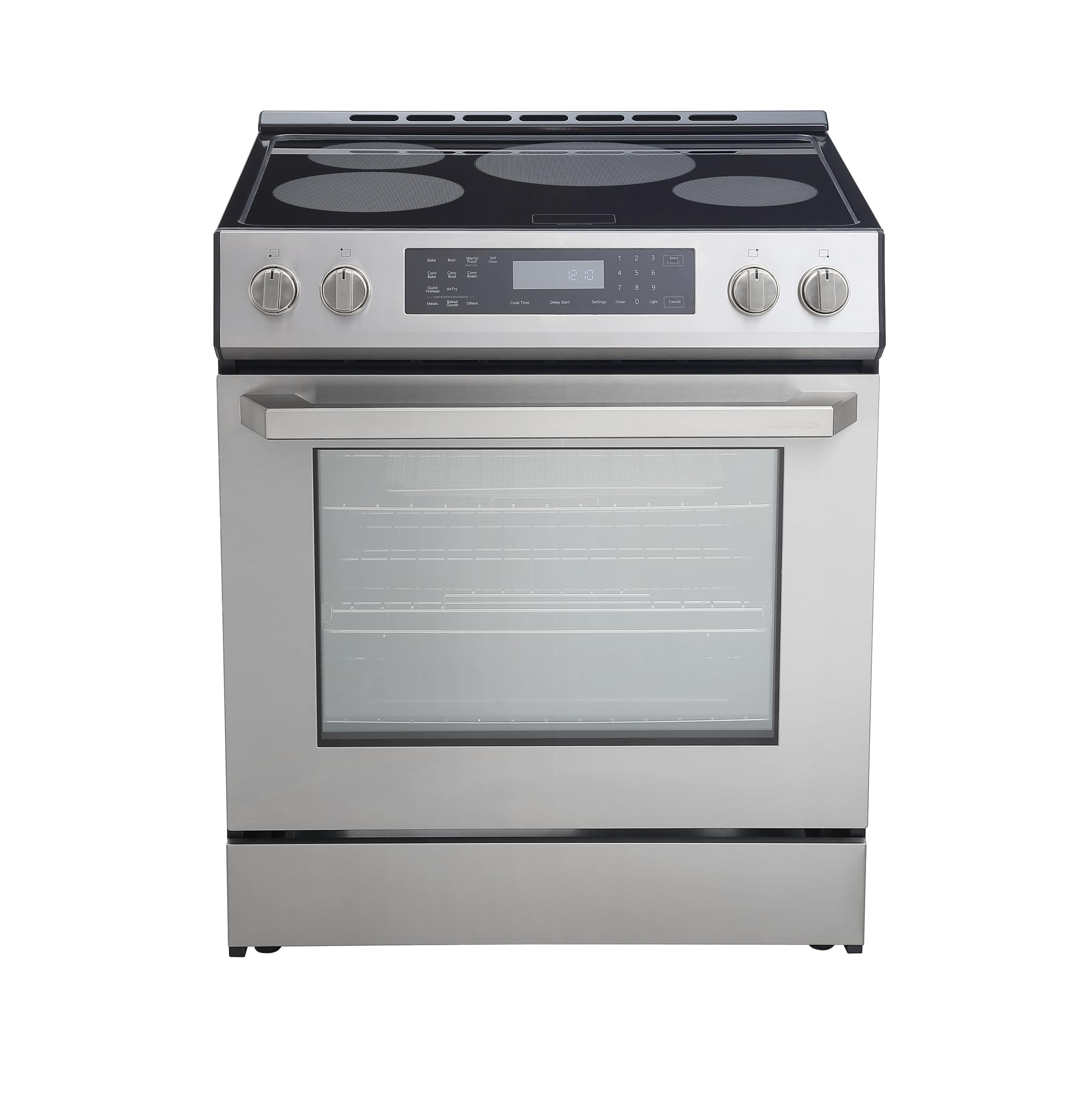
Induction burners heat the pan directly — not the glass — so water boils in roughly half the time of a radiant element.
If speed and precision matter more than anything, induction is the clear winner. This Rangaire uses magnetic fields to heat the pan directly, not the glass surface, so a pot of water boils in roughly half the time it takes on a radiant element. The four induction burners include PowerSurge Boost technology — the right rear burner hits 3,700 watts with Boost (a temporary surge of extra power for searing or boiling). The total cooktop output of 8,800 watts is remarkable for a 30-inch range, putting it in a different league than the radiant-element competitors. Owners mention that when it works, it cooks faster than any other range here.
The oven spans 5 cubic feet with TrueAire Convection — a dedicated convection heating element and fan that circulate hot air for even browning. It includes an air fry mode with a basket, a meat probe (a temperature sensor that goes into the meat and tells you when it is done) for perfect roasts, and both self-clean and glass touch controls. The brushed stainless steel finish and 25-inch depth make it the shallowest range here, which helps if your counters are tight. At 180.5 pounds, it is the heaviest product in this comparison — even heavier than the Kenmore — so the shipping weight alone requires serious planning.
Reliability concerns dominate owner experiences. The most common pattern is burner failure within months — the large burner heating only a 6-inch center that scorches food while the outer ring stays cold, or burners turning off randomly mid-cook. The controls use glass touch panels that look sleek but require precise taps, and the timer needs a double-press on the Start button to save a setting before beginning the countdown. If you are willing to accept these durability risks, the induction performance when it works is genuinely impressive — but the crowd-sourced feedback suggests careful inspection and a solid return policy are essential here.
Where it shines
- Induction heating is class-leading for speed — 8,800W total cooktop power with 3,700W Boost on the largest burner
- Shallow 25-inch depth fits tighter counters better than any other range here
- Meat probe and true convection for advanced cooking control
The real trade-off
- Burner reliability is a recurring theme among owners — some report failures within 6 to 12 months
- Sharp feet can scratch flooring, and the 180.5-pound weight makes installation a multi-person job
- Glass touch controls can be finicky, requiring multi-step sequences for the timer
Who this works for: dedicated cooks who prioritize rapid induction heat and are comfortable managing warranty coverage — the performance ceiling here is real.
Who should pause: buyers who expect trouble-free operation in year one — the reliability record is weaker than the GE or Samsung ranges.
Understanding the Specs
Oven Capacity & Configuration
Oven capacity is measured in cubic feet — it tells you how much food fits inside at once. A 4.8 cu. ft. oven comfortably holds a 22-pound turkey plus one dish. A 6.3 or 6.6 cu. ft. oven can handle the turkey plus two large casserole pans. Double ovens split that total across two smaller chambers so you can cook at two different temperatures simultaneously — the upper oven is typically smaller and preheats faster for weeknight meals.
Convection: True vs. Fan-Only
Standard convection uses a fan to blow air from the top heating element. True Convection adds a third heating element behind the fan, so the air being circulated is already hot instead of just stirred around. That third element gives you more even browning across multiple racks and typically reduces cooking time by 20-30%. The Kenmore and Rangaire here both feature true convection; the GE and Samsung use standard convection with a fan.
Cooktop Technology: Radiant vs. Induction
Radiant elements sit under a smooth glass top and glow red — they accept any flat-bottomed pan (stainless, non-stick, cast iron, copper). Induction uses an electromagnetic field that heats only magnetic cookware (pans with a base a fridge magnet sticks to). Induction is faster, safer — the glass stays cool to the touch — and more energy-efficient because no heat is lost to the air. The catch is you need pans with a magnetic base: test it with a fridge magnet. If the magnet sticks to the pan bottom, it works on induction.
Air Fry Mode
Most modern ranges now include an air fry setting. It uses the convection fan at a higher speed plus an included basket to crisp food with little or no oil. Some ranges, like the Samsung and GE, advertise no-preheat air fry — you put the basket in a cold oven and it starts circulating hot air immediately instead of waiting for the cavity to reach a target temperature. The results are comparable to a countertop air fryer, but the range version handles larger batches.
FAQ
Will a 30-inch electric range fit into a 30-inch cutout?
Can I use my existing pots and pans on an induction range?
What is the actual difference between a single oven and a double oven?
How important is True Convection vs. standard convection?
Why are some electric ranges much heavier than others?
Do I need a special electrical outlet for an electric range?
How often should I run the self-clean cycle?
Is the air fry feature on a range as good as a dedicated countertop air fryer?
What does the warming drawer on the GE range actually do?
Which electric range is easiest to clean?
Final Thoughts: The Verdict
Across the board, the best electric 30-inch range is the GE JBS86EPES because its double-oven configuration gives you two independent cooking temperatures in one standard-width footprint — a flexibility that single-oven ranges simply cannot match. If you want the largest single oven cavity with smart-home integration, the Samsung NE63A6511SS is the right choice. And if your priority is True Convection baking at a solid mid-range price, the Kenmore B0CGMC72GG delivers even roasting without the premium price tag.
How We Picked
We do not accept paid placement. Every pick is matched to a real buyer and a real use-case; we do not hands-on test units.
Sources & Methodology
Specifications: manufacturer listings and product documentation. Review insights: verified customer reviews, as of July 2026. Pricing: not shown on this page (it changes often); check the current price via the retailer link.
As an Amazon Associate, WellFizz earns from qualifying purchases. This does not affect which products we feature.
Related Guides

Mo Maruf
I created WellFizz to bridge the gap between vague wellness advice and actionable solutions. My mission is simple: to decode the research and give you practical tools you can actually use.
Beyond the data, I am a passionate traveler. I believe that stepping away from the screen to explore new environments is essential for mental clarity and physical vitality.