Our readers keep the lights on and my smoothie glass nicely filled. As an Amazon Associate, I earn from qualifying purchases.
Specs are compiled from manufacturer listings and verified buyer reviews and can change over time — please confirm the key details on the product page before buying.
Palpitations, dizziness, or a fluttering feeling that comes and goes — waiting for a doctor’s appointment to capture it on a monitor can take weeks. A personal EKG machine puts a medical-grade heart rhythm check in your hands, recording the exact moment symptoms appear and giving your cardiologist a clear trace to read.
I’m Mohammad Maruf — the founder and writer behind WellFizz. This guide is built by comparing the manufacturers’ published specifications and the patterns across verified customer reviews, so you get each pick’s real strengths and trade-offs instead of marketing spin.
If you’re shopping for a device to record AFib or irregular rhythms at home, here are the best EKG machine options that fit your wallet and your lifestyle.
Our Picks at a Glance

How To Choose The Best EKG Machine
Before you pick a monitor, know what a personal EKG can and cannot do. These devices record the heart’s electrical rhythm and flag common arrhythmias like AFib, tachycardia, and bradycardia. None of them detect a heart attack, and none replace a full 12-lead hospital diagnostic — so set your expectations around rhythm monitoring, not emergency diagnosis.
Lead Count: The Data Your Doctor Sees
A single-lead EKG captures one view of the heart’s electrical activity, which is plenty for spotting basic rhythm issues. A 6-lead device records six different views at once, which means more detail for your doctor to interpret and the ability to better distinguish where an irregular beat originates. If your concern is a specific arrhythmia your doctor wants to track, the extra leads give them a much richer picture.
The Subscription Question Nobody Wants to Ask
Some devices are genuinely free forever — you record a trace and the app saves it. Others bundle a free first year of a paid membership that auto-renews, open up features like cardiologist review or extra arrhythmia detection. Read the fine print on the box before buying. If you only want basic detection and sharing, a no-subscription device saves you the annual hassle.
Form Factor: What You’ll Actually Use
Think about where symptoms hit. If your palpitations strike at work or while traveling, a credit-card-size monitor that lives in your wallet wins. If you’re mostly home and already track blood pressure, a 2-in-1 cuff that does both might suit you better. The best monitor is the one that’s within reach when you feel a skip in your chest.
Quick Comparison
| Model | Best For | Leads | Weight | Battery | Amazon |
|---|---|---|---|---|---|
| EMAY Portable ECG Monitor★ Best Overall | Best Overall — Built-in display & no subscription | 1-Lead | 80 g | Rechargeable lithium | Amazon |
| KardiaMobile CardTrue Pocket Size | Wallet-size portability | 1-Lead | 7.4 g | 2,000 EKGs | Amazon |
| OMRON Complete 2-in-1 | BP + EKG combo in one cuff | 1-Lead | 1.21 lbs | 4 AA batteries | Amazon |
| KardiaMobile 6-Lead | 6-view detail for doctor visits | 6-Lead | 24 g | CR2016, ~1 year | Amazon |
| KardiaMobile 6L Max | 6-lead + 1-year cardiologist reviews | 6-Lead | 24 g | CR2016, pre-installed | Amazon |
| WITHINGS BeamO | Multi-function temp + ECG at home | 1-Lead | 0.08 kg | Nonstandard battery included | Amazon |
| Withings ScanWatch Nova | ECG on a watch you wear 24/7 | 1-Lead | — | 30 days, 2h charge | Amazon |
In‑Depth Reviews
1. EMAY Portable ECG Monitor
Our pick — 4.5★ from 450+ verified ratings; the strongest balance of quality and price.
The pocket monitor with a real screen that frees you from your phone for every reading.
You get your heart rhythm on the EMAY’s own 1.8-inch screen the moment you finish recording — no need to open up your phone for instant feedback. Cardiologists in the reviews call the tracings “clear” and “accurate,” with one physician noting the built-in display beats the KardiaMobile on convenience. At 80 g, it’s chunkier than the KardiaMobile Card’s 7.4 g, but that extra bulk buys you a screen, a rechargeable lithium battery, and zero subscription fees — you record, upload, and export PDFs through the free PC and phone software.
The software is where the EMAY shines. You can review saved cases, set recording lengths, and export enlargeable PDF reports that are easy to share with your doctor — one owner sends readings straight to MyChart for their cardiologist. The device records Lead I signals (a single electrical view of your heart) and displays heart rate, which is exactly the front-line screening a home user needs. It’s built for OTC use and explicitly not recommended with implanted pacemakers, and it won’t replace a hospital diagnostic device — but as a first-line tool to catch arrhythmia, tachycardia, or bradycardia between clinic visits, it holds its own against monitors costing far more.
The recurring trade-off owners flag is the micro-USB charging port — not USB-C — and a grip that demands clean, consistent contact on the two metal pads; wet skin helps if yours runs dry. The crowd consensus lands firmly on accuracy as the reason to buy, with over a hundred owners calling that out as the standout strength. And for a brand that posts this level of trace quality, the “no subscription” promise is the final clincher — you pay once and the device is yours, no annual membership to cancel later.
Why Owners Choose It
- Accuracy is the #1 praised trait — over 100 owners call it out
- Built-in 1.8-inch display means no phone needed for a reading
- Rechargeable lithium battery, no subscription, PDF export for doctors
Know Before You Buy
- Charges via micro-USB, not the modern USB-C
- Grip on the contact pads needs practice for clean traces
- 80 g body is noticeably less pocket-friendly than credit-card rivals
Reach for this if: you want a standalone EKG with its own screen, rechargeable battery, and no subscription — the best all-rounder on this list.
Think twice if: your priority is a monitor that vanishes into a wallet; at 80 g this is a small device, not an invisible one.
2. KardiaMobile Card — Credit-Card Sized EKG
A medical-grade EKG thinner than a credit card that slips into your wallet for arrhythmias that don’t wait.
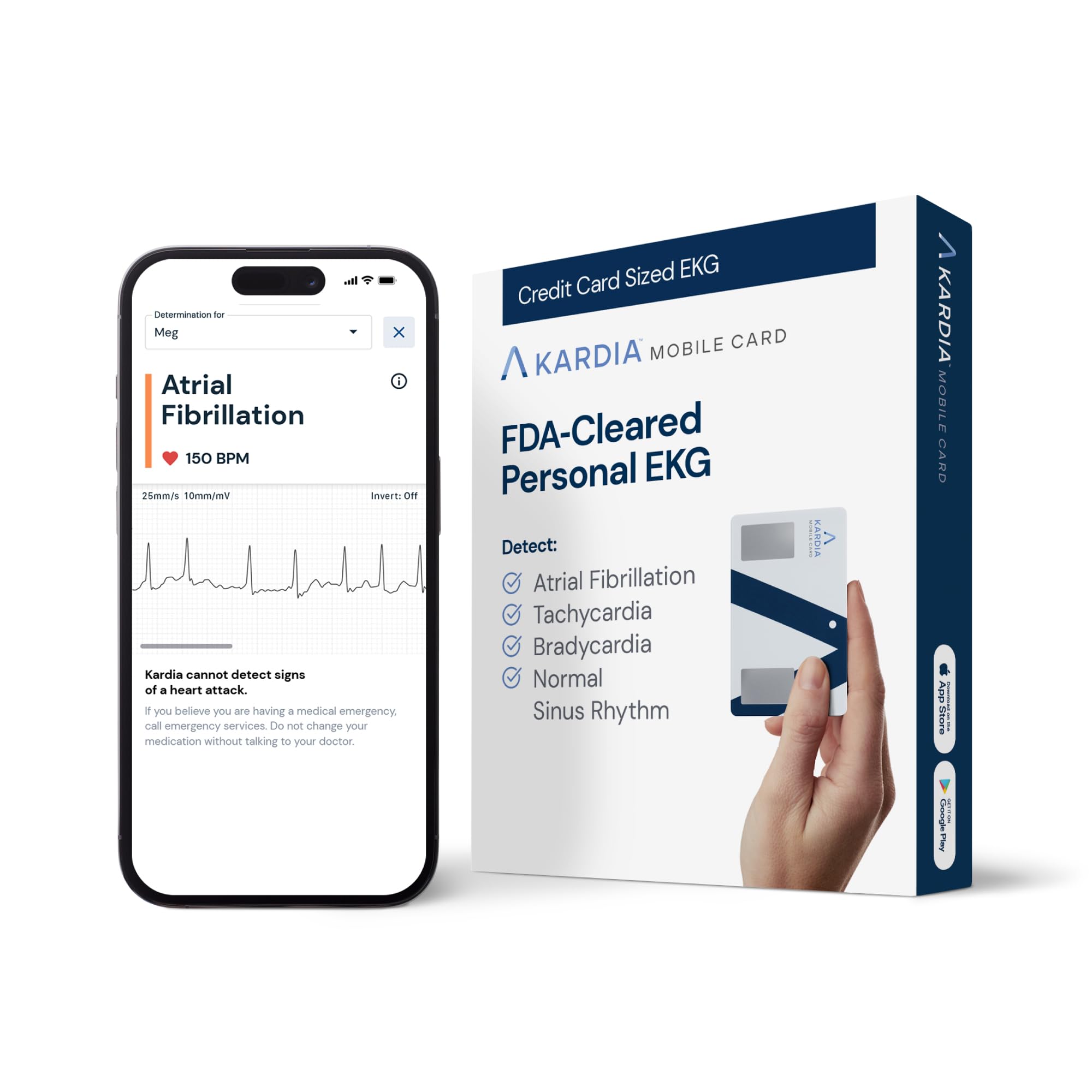
At 7.4 g, the KardiaMobile Card is the lightest EKG here — roughly the weight of a single sheet of paper — and it’s built to live in your wallet, tested for the wear and tear of daily carry. When your heart flutters at the grocery store or at your desk, you slide it out, press the power button, and rest two fingers on the sensors to get a medical-grade reading in about 30 seconds via Bluetooth to your phone. Unlike the EMAY above, there’s no built-in display — the free Kardia app is where you see, save, and share every trace.
What wins people over is the ease of use — the most-cited praise in the reviews — plus detection of AFib, bradycardia, tachycardia, and normal sinus rhythm without a subscription. The built-in battery is rated for a minimum of 2,000 EKGs, and it auto-shuts off after 10 seconds of inactivity to save power. For a non-tech owner, the setup and app registration were simple enough to call “fabulous,” and one user’s cardiologist used the recorded episodes to track arrhythmia frequency.
The catch — and it’s a real one — is that the battery is built in and can’t be replaced. As buyers report, “you can’t replace the battery, as it’s built in,” which is why some owners swap this for the 6-lead or another Kardia model with a replaceable cell. The app also nudges you toward the optional KardiaCare membership, though basic recording and sharing stay free. Context: the card is FDA-cleared and carries the brand’s reputation as the #1 cardiologist-recommended personal EKG, with over 350 million EKGs recorded on the platform.
Wallet-ready verdict: If a monitor that’s always on you matters more than a replaceable battery, this is the thinnest, easiest path to a recorded rhythm — just know the battery’s lifespan is fixed at roughly 2,000 reads.
3. OMRON Complete 2-in-1 Blood Pressure Monitor + EKG
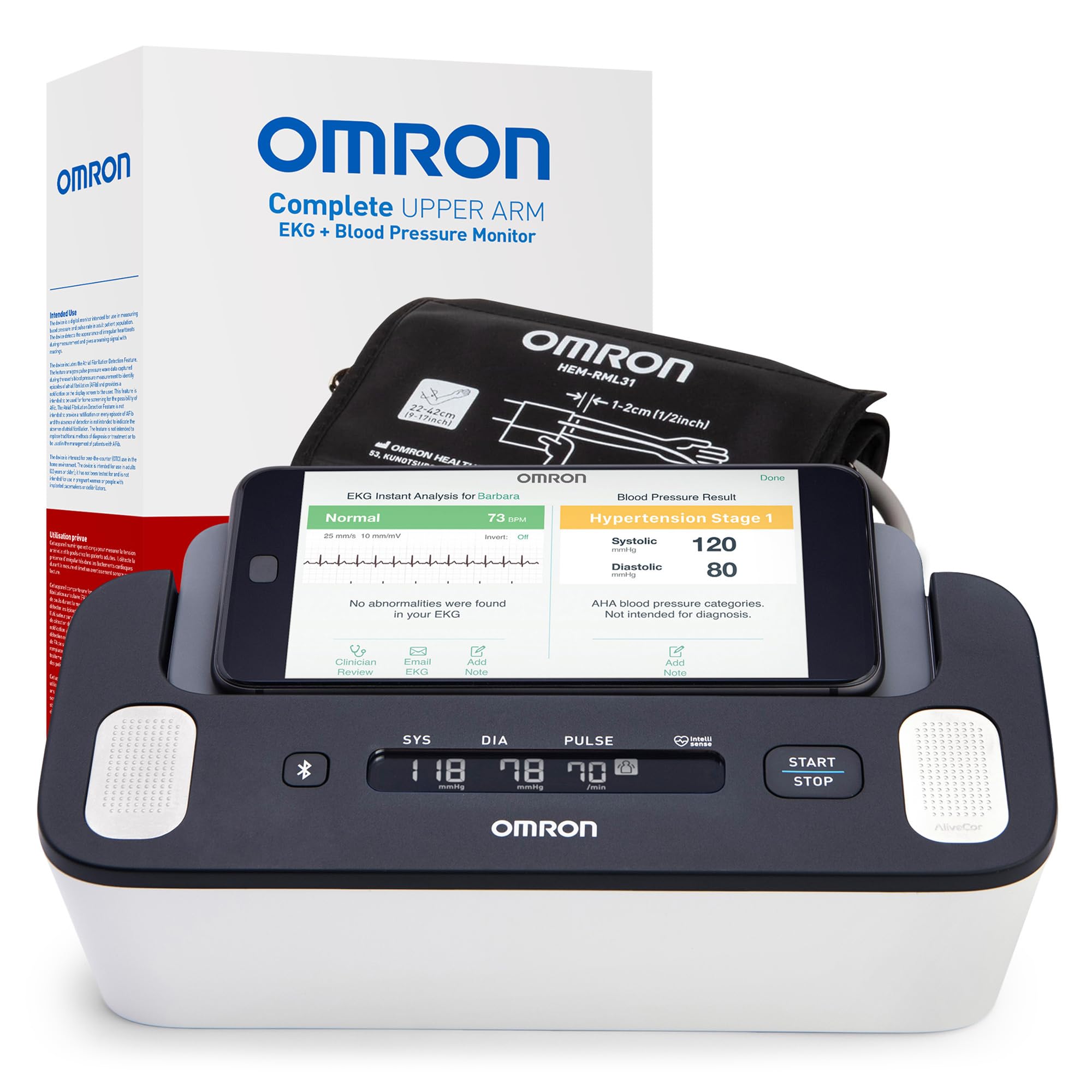
The upper-arm monitor that pairs blood pressure with a single-lead EKG for one daily heart check.
If you already track blood pressure, the OMRON Complete folds an EKG into the same routine — one cuff that measures both, storing up to 90 readings on the device itself. It ships with a wide-range D-ring cuff that fits arms 9″ to 17″, a storage case, and four AA batteries, ready to use from the start. The free OMRON connect app syncs via Bluetooth, tracks unlimited readings and trends, and shares reports with your doctor; it’s also compatible with Apple Health and Google Fit.
The body-movement detection that alerts you to an unstable reading is a genuinely useful touch, helping you avoid the inaccurate measurements that come from shifting mid-test. One owner — a user with three TIAs — relies on it daily and says it impressed their doctors, calling it potentially life-saving for BP and EKG tracking. Reliability is the most-discussed trait in the reviews, rating as mixed: some find the app pairing flawless after an initial hitch, while others report inconsistent readings and Bluetooth drops, so your mileage on the app side may vary.
Set expectations on the EKG side: this is a single-lead screen that flags fast, slow, or irregular rhythms — it won’t break down an arrhythmia the way a 6-lead device will. Some owners also note the AA batteries drain quicker than they’d like with daily use. Weighing in at 1.21 lbs, this is a home-base device, not a pocket companion — but for someone who wants both numbers in one trusted-brand workflow, it’s a strong, clinically validated starting point.
The Case For It
- Two heart metrics (BP + EKG) in one upper-arm cuff
- Alerts you to body movement during readings
- 90-reading on-device memory plus free app trends
Watch For
- App reliability is mixed in owner reviews
- Single-lead EKG won’t detail specific arrhythmias
- AA batteries drain fast with frequent use
Look elsewhere if: you need detailed arrhythmia breakdowns or a device that travels in your pocket.
4. KardiaMobile 6-Lead Personal EKG Monitor
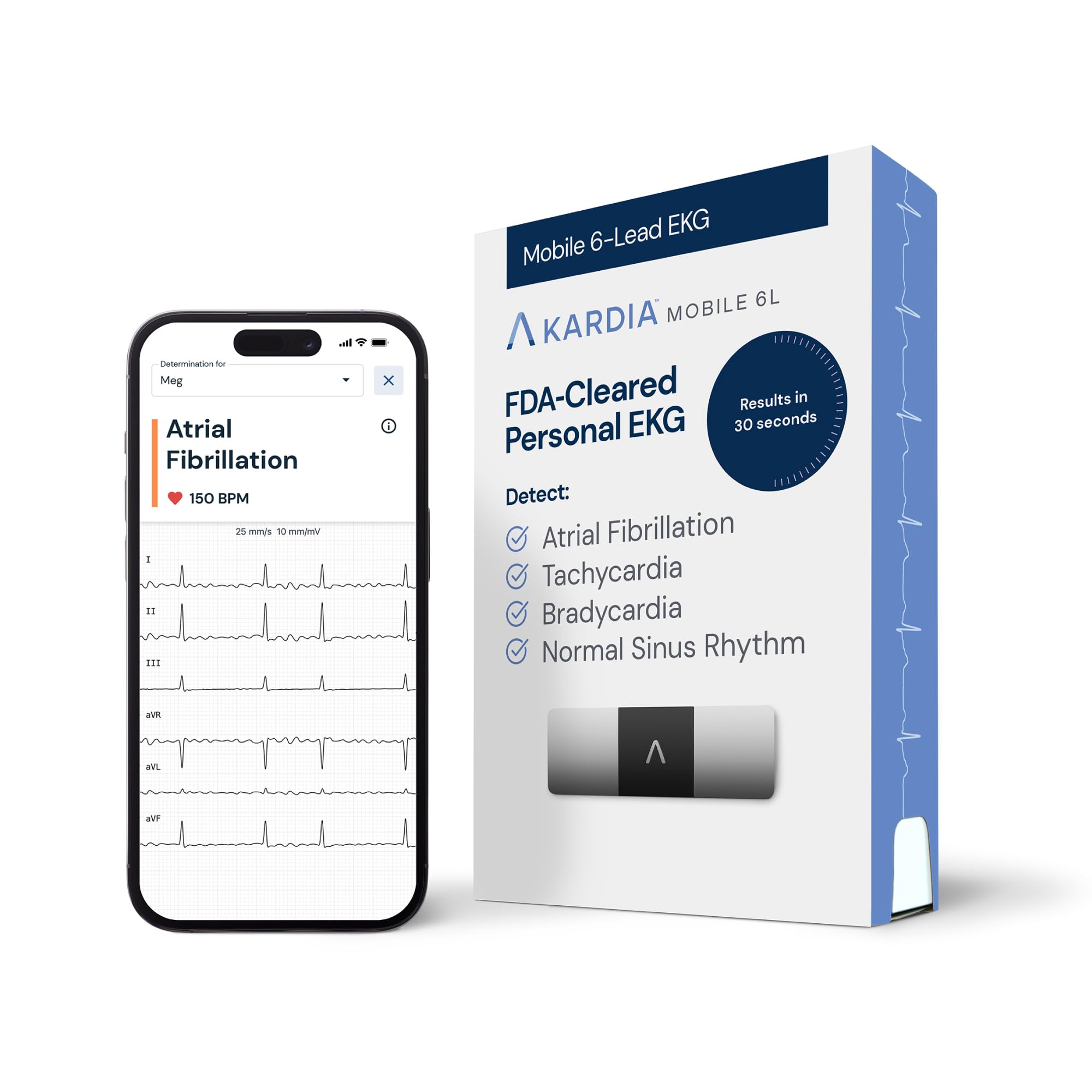
The 6-lead recording that gives your cardiologist six views of your heart in 30 seconds.
This is the EKG that beats a smartwatch on detail — it records a medical-grade six-lead trace that distinguishes atrial from ventricular rate, something a watch or single-lead device simply can’t separate. At 24 g it’s barely heavier than the credit-card Card above, yet it captures data from six leads per trace while the Card captures from one, making it a favorite for anyone whose doctor wants a richer picture of a suspected arrhythmia. The replaceable CR2016 battery is a meaningful upgrade over the Card’s built-in cell — owners note it lasts about a year and orders online for a few dollars.
It detects AFib, bradycardia, tachycardia, and normal sinus rhythm right on your smartphone without any subscription, and the free app lets you record 30-second traces, export PDFs, and email them to your doctor within minutes. A paramedic with 20+ years of experience rates it highly, noting the 6-lead filters artifact well and picks up limb leads like aVR, aVL, and aVF — real clinical utility for home monitoring. The battery life claim of 200 hours and the 3.54″ x 1.18″ x 0.28″ body make it a travel-friendly companion for daily rhythm checks.
Honest limits: the free tier won’t interpret lethal arrhythmias like SVT, V-Tach, or AV blocks, and there’s no way to delete saved ECGs from the app. A paramedic’s review deducts a star for the high subscription fees on advanced features. It’s the device that replaced a broken Apple Watch EKG and led one owner’s cardiologist to adjust their medication correctly.
The richer trace: Buy the 6-lead if you want your doctor to see where an irregular beat originates — the replaceable battery is the cherry on top.
5. KardiaMobile 6L Max EKG Monitor
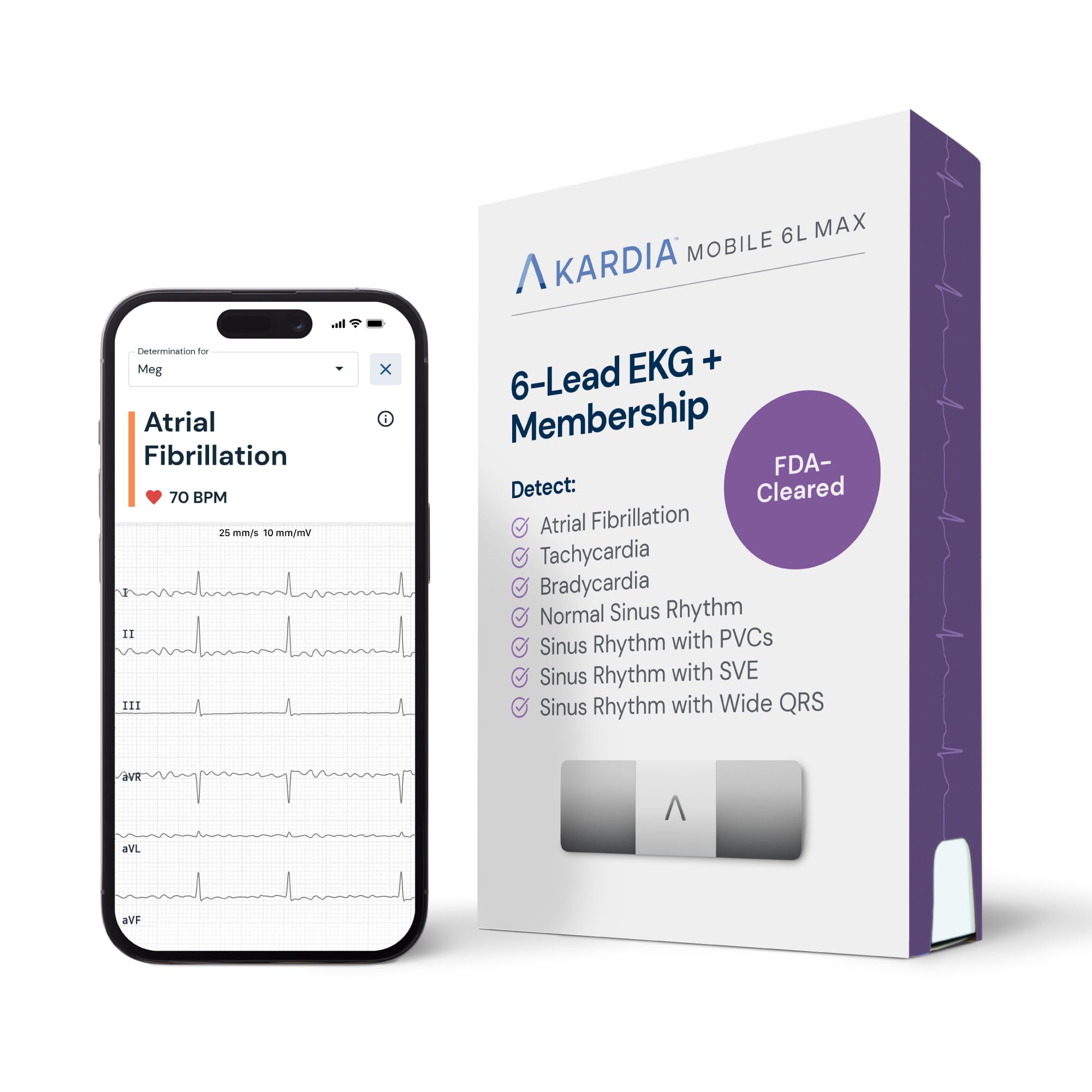
The 6-lead monitor that bundles a year of cardiologist-reviewed EKG analyses into the box.
Where the standard 6-lead stops at basic detection, the 6L Max layers on a full year of KardiaCare — a membership that includes four free board-certified cardiologist EKG reviews per year, automatic emailing of results to anyone you choose, and detection of six common arrhythmias including PVCs (premature ventricular contractions), SVE (supraventricular ectopic beats), and Wide QRS rhythms (abnormal heart conduction). That’s a meaningful step up for someone who wants a professional’s eyes on their traces, not just an algorithm’s flag. The device itself is identical in portability to the standard 6-lead — 24 g, 3.53″ x 1.18″ x 0.28″ — and records a medical-grade six-lead EKG in 30 seconds via Bluetooth to your phone or tablet.
Owners describe it as “brain-dead simple”: rest your thumbs on the top electrodes, place the bottom sensor on your thigh or knee, and read the result in the app. One user monitors their SVT at home and shares every trace with their cardiologist, calling the 4 free annual analyses excellent value. Another found it helpful for calming panic attacks — confirming a normal rhythm when anxiety strikes. The stainless steel construction and compact size make it a durable travel companion, ideal for the office, gym, or trips.
The one snag is the subscription nature: the 6L Max requires KardiaCare to function, and while the first year is included, it auto-renews unless you cancel — you’ll be prompted for payment details upfront. A few owners hit activation hiccups where the included membership didn’t trigger correctly and support was slow to resolve it. If you’re disciplined about canceling before the renewal, this is the most feature-rich personal EKG on this list; if subscriptions give you anxiety, the standard 6-lead keeps things simpler.
What the Bundle Buys
- 4 cardiologist EKG reviews per year included
- Detects 6 arrhythmias, beyond standard AFib/tachycardia
- Auto-emails results to your doctor or family
Mind the Fine Print
- Membership required to use the device at all
- First year free, then auto-renews at full price
- Occasional activation issues reported with support lag
Pick this for: the buyer who wants cardiologist-reviewed interpretations and automated sharing without managing a separate membership purchase.
skip it if: you refuse to touch a subscription model — the standard KardiaMobile 6-Lead recordings stay free forever.
6. WITHINGS BeamO Contactless Thermometer + ECG
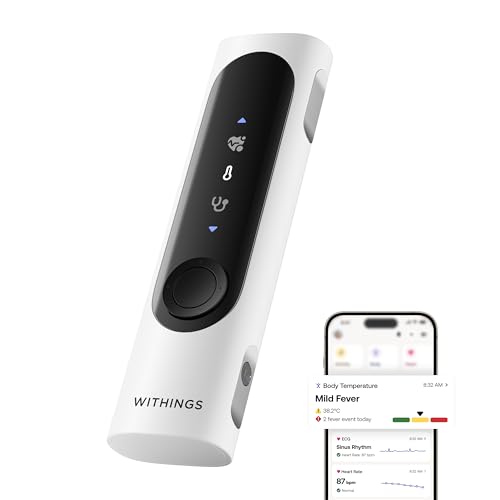
A contactless all-in-one that reads temperature, heart rhythm, and lung sounds in a single pass.
The BeamO breaks the mold of dedicated EKG monitors — it’s a 5.3-inch wand that, in about one minute, gives you a full picture of your heart, lungs, and temperature. As a health tool, it offers a 1-lead ECG in 30 seconds with an optional upgrade for a cardiologist review within 24 hours, alongside contactless temperature detection for all ages. Weighing just 0.08 kg and connecting via Wi-Fi, it’s designed to be the family’s first stop when someone feels off — a check-up device for the whole household rather than a rhythm specialist.
Owners praise it as a fast, accurate temperature reader first — “accurate and consistent” with readings matching what doctors get, delivered in about 2 seconds per swipe. Everything is tracked and saved automatically in the Withings app, which makes it easy to show a pediatrician a week of temperature history during a visit. For heart monitoring, the ECG function captures your rhythm and the Health Link feature lets you share respiratory data with healthcare professionals when you need a second opinion.
The trade-off is scope: a 1-lead ECG is basic rhythm detection, not a deep cardiac analysis — and the app requires an account to use at all, which some owners flag as a hurdle. There’s also a bulky feel to the wand that makes it “not travel-friendly” for some. But if your priority is a broad family-health device that catches a temperature spike and offers a quick rhythm check, the BeamO is the most versatile box on this list — one device instead of three cluttering your shelf.
Family-first verdict: Buy the BeamO if your home needs a do-it-all health check; choose a dedicated EKG if rhythm monitoring is your sole focus.
7. Withings ScanWatch Nova — Smart Watch with ECG

The Swiss-style watch that never stops tracking your heart, temperature, and sleep for 30 days straight.
If your concern is constant, passive monitoring rather than on-demand checks, the ScanWatch Nova redefines what a personal EKG machine can be. This stainless steel watch tracks your heart rhythm 24/7 with ECG and AFib detection on your wrist, plus overnight heart rate variability, on-demand SpO2, and the TempTech24/7 module for baseline body temperature. It’s the most worn-friendly form factor on this list — you don’t reach for it when symptoms hit because it’s already there, logging your rhythm around the clock, including temperature fluctuations that may signal approaching illness.
The battery is the headline spec: a single charge lasts 30 days, and it recharges in about 2 hours — putting every other device on this list to shame on longevity. Owners call it “very classy,” with one noting it “reminds me of a Rolex or Omega watch.” The health-tracking suite is broad: 40+ automatically detected activities, a Sleep Quality Score, VO2 max estimation, and menstrual cycle tracking. For someone managing sleep apnea or wanting heart-rate-variability trends over months, this watch is a medical-grade companion that looks like a dress watch.
The honest friction points:, this is a premium purchase, and some owners find the software on the slower side — no on-watch alarm, a limited companion app, and a non-replaceable battery being the main gripes. Appearance is the most-praised aspect across owners, ahead of quality, so the aesthetic payoff is real. And unlike a dedicated monitor you’d throw in a bag, this lives on your wrist — making it ideal for overnight respiratory and rhythm trends that a 30-second spot check simply can’t capture.
The Always-On Advantage
- 24/7 heart rate and overnight HRV tracking
- 30-day battery with 2-hour recharge
- Multi-sensor: ECG, SpO2, temperature, sleep
The Premium Compromise
- Highest price tier on this list
- Non-replaceable battery inside the watch
- App software feels limited for the cost
Choose this for: someone who wants round-the-clock cardiac context — sleep, stress, and rhythm — without charging a device every night.
Opt for a dedicated EKG instead if: you need high-detail multi-lead traces for a specific arrhythmia rather than broad passive trends.
Understanding the Specs
Lead Count and What It Reveals
A “lead” is an electrical view of the heart captured between two sensors. A single-lead EKG sees the heart from one angle — enough to detect rate and basic rhythm problems like AFib. A 6-lead device records the same heartbeat from six different angles, giving your doctor a more complete picture of where an irregular beat starts, such as the atrium versus the ventricle. More leads means more interpretable data, but also usually a larger sensor placement area.
Battery and Power Expectations
Personal EKG monitors fall into two camps: rechargeable lithium cells you top up with a cable, or button-cell batteries like the CR2016 that last around a year before replacement. Rechargeable devices generally cost less over time and are easier to top up, while button-cell devices are lighter and often smaller. Some monitors claim a battery life in hours (like 200 hours of use) and others in total readings (like 2,000 EKGs). Match the power type to your comfort with replacing tiny cells versus remembering to charge.
FAQ
Can a personal EKG machine detect a heart attack?
Will an EKG monitor work if I have a pacemaker?
What is the difference between a 1-lead and a 6-lead EKG monitor?
Do I need a subscription to use these EKG machines?
Will my doctor accept a reading from a home EKG monitor?
How do I get a clean EKG reading every time?
What is KardiaCare and is it worth the cost?
Which is better for daily use — a watch with ECG or a dedicated EKG monitor?
How long does the battery last on these devices?
Can I use an EKG monitor if I’m not tech-savvy?
Final Thoughts: The Verdict
For most buyers, the ekg machine winner is the EMAY Portable ECG Monitor because it pairs a built-in display with rechargeable power and zero subscription fees at a budget-friendly price. If you want six views of your heart for your doctor, grab the KardiaMobile 6-Lead. And for round-the-clock passive monitoring that catches trends your spot checks miss, the Withings ScanWatch Nova is the premium choice worth the money for serious heart-health tracking.
How We Picked
We do not accept paid placement. Every pick is matched to a real buyer and a real use-case; we do not hands-on test units.
Sources & Methodology
Specifications: manufacturer listings and product documentation. Review insights: verified customer reviews, as of August 2026. Pricing: not shown on this page (it changes often); check the current price via the retailer link.
As an Amazon Associate, WellFizz earns from qualifying purchases. This does not affect which products we feature.
Related Guides

Mo Maruf
I created WellFizz to bridge the gap between vague wellness advice and actionable solutions. My mission is simple: to decode the research and give you practical tools you can actually use.
Beyond the data, I am a passionate traveler. I believe that stepping away from the screen to explore new environments is essential for mental clarity and physical vitality.