Our readers keep the lights on and my smoothie glass nicely filled. As an Amazon Associate, I earn from qualifying purchases.
Specs are compiled from manufacturer listings and verified buyer reviews and can change over time — please confirm the key details on the product page before buying.
Most folks think an efficient solar panel is the one with the highest watt number on the sticker. That is wrong — efficiency is really about how much usable electricity a panel squeezes out of the same patch of sunlight, especially when the sky is gray or the roof space is tight. This guide breaks down the most efficient solar panels available right now, explaining which N-type cells and bifacial designs actually deliver extra power and which ones just sound good on paper.
I’m Mohammad Maruf — the founder and writer behind WellFizz. This guide is built by comparing the manufacturers’ published specifications and the patterns across verified customer reviews, so you get each pick’s real strengths and trade-offs instead of marketing spin.
If you want honest output numbers that real owners see day-to-day — not just lab-perfect figures — skip the grid and read the reviews below. The one that often surprises people is the ECO-WORTHY 400W N-Type setup, which regularly pushes over 400 watts in real use with its four 100-watt panels.
Our Picks at a Glance


How To Choose The Best Efficient Solar Panels
Choosing an efficient solar panel is less about the peak watt number and more about what happens when the sun isn’t perfect. You want a panel that keeps producing when shaded, hot, or cloudy.
Cell Technology: N-Type vs P-Type
N-type cells use a different silicon base that resists light-induced degradation. This means they hold their efficiency longer and perform better in low light than traditional P-type cells. Most high-efficiency panels in this guide use N-type cells paired with 16 or 18 busbars (the thin metal lines on the cell surface) to reduce micro-cracks and improve current collection.
Bifacial Design
Bifacial panels have a transparent backsheet instead of an opaque one. This lets them capture reflected sunlight from the ground or roof surface behind the panel, boosting total output by up to 30 percent in ideal conditions. They are especially effective over light-colored surfaces like gravel, concrete, or snow.
Quick Comparison
| Model | Best For | Wattage | Efficiency | Cell Type | Amazon |
|---|---|---|---|---|---|
| ECO-WORTHY 400W N-Type★ Best Overall | Budget off-grid starter | 400W (4x100W) | 25% | N-Type 16BB | Amazon |
| Renogy 200W N-TypeCompact Van Fit | Compact Class B vans | 200W | 25% | N-Type 16BB | Amazon |
| AeternaSol 400W N-Type 18BBBifacial Power | High-efficiency bifacial | 400W (2x200W) | 25.2% | N-Type 18BB | Amazon |
| BougeRV Arch Pro 200W | Curved surfaces & RTT | 200W | 25% | N-Type 16BB | Amazon |
| JJN Bifacial 400W | Durable weather resistance | 400W (2x200W) | 23% | 10BB Mono | Amazon |
| EPOCH 430W Bifacial | High watt density per panel | 430W | 25% | N-Type 16BB | Amazon |
| JJN Bifacial 425W | Large home/off-grid arrays | 425W | 25% | N-Type 16BB | Amazon |
| Callsun 400W Bifacial | Anti-shade performance | 400W (2x200W) | 25% | N-Type 16BB | Amazon |
| Renogy 400W Portable Suitcase | Portable camping power | 400W | 23% | Mono A+ | Amazon |
In‑Depth Reviews
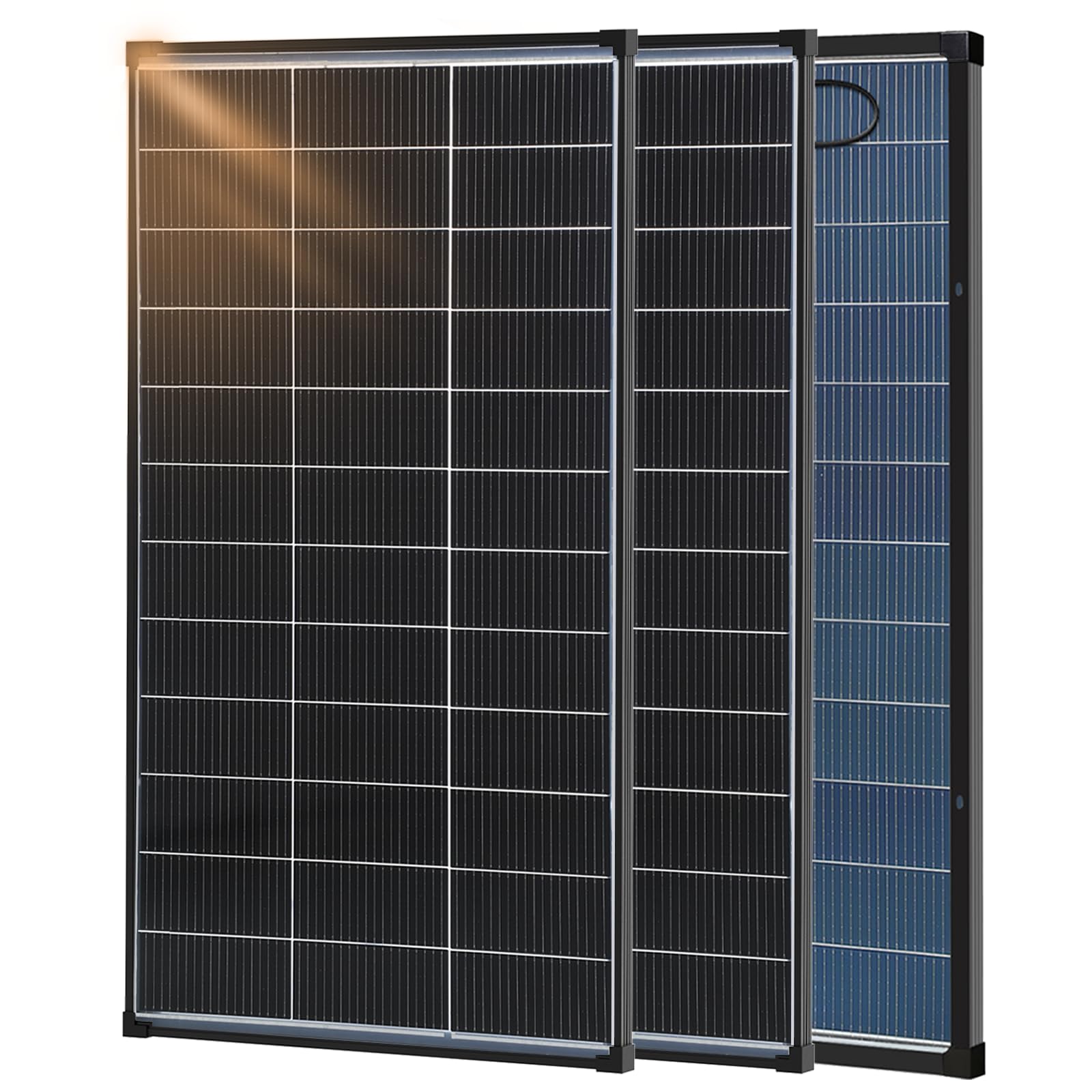
1. ECO-WORTHY 400W Solar Panels N-Type 4pcs 100 Watt 18V Monocrystalline
Our pick — over 4.5★ from 550+ verified ratings; the strongest balance of quality and price.
A modular four-panel kit that frequently over-delivers in full sun for the price.
Each 100-watt panel uses N-type cells with 16BB busbars (the thin metal lines that collect current) to push up to 25% efficiency. Buyers report pairing the four panels with an EcoFlow Delta 3 Plus and seeing a peak output of 449 watts, often staying above 400 watts in good conditions. That is real-world headroom above the combined 400W rating.
The 1.18-inch thick frame helps heat dissipate quickly, and the built-in bypass diodes keep power flowing even when part of a panel dips into shade. At 35.63 inches long and 23.03 inches wide per panel, these are compact enough to fit on an RV roof or shed. The trade-off is that you get two separate boxes in shipment — you need to wait for both to arrive — and some owners note the pre-attached cable leads feel less secure than aftermarket connectors. Some owners mention they only produce about 75 watts per panel in bright sun.
The thing the crowd raves about is the performance-per-dollar — 54 owners single it out as the standout quality. Value for money and build quality both get frequent praise. The recurring honest note is that 100 watts is a lab rating that needs ideal conditions; in real life, expect slightly less and you will be happy when it peaks higher.
Smart value setup: Excellent entry into N-type efficiency without a big spend. The four-panel format lets you wire them in series/parallel to match 12V or 24V battery banks easily. Best for anyone building a first off-grid system on a budget who wants room to expand.
Who should pause: If you need a single higher-voltage panel to simplify wiring or have very tight roof space, individual 200W panels (like the Renogy N-Type below) are a tidier fit.
Best for first-timers: Low cost per watt plus modular expandability make this the easiest bet for a new off-grid setup like a shed, camper, or garden.
Think twice if: You are okay waiting for two separate packages and prefer the simplicity of a single, larger rigid panel.
2. Renogy Solar Panels 200 Watt N-Type, 200W Solar Panel 16BB 25% High-Efficiency
A lightly built 200-watt panel that charges portable power stations even in dappled shade.
This Renogy panel is 7.5% smaller and 11.7% lighter than its previous model — at 49.7 by 30.1 inches and just 23.4 pounds. That weight saving comes from a lightweight aluminum frame that customers note feels well-balanced on a van roof. The N-type 16BB cells deliver the same 25% efficiency and a low temperature coefficient, meaning it keeps producing in hot climates where other panels fade.
Reviewers point out it performs well in shade and clouds, delivering near its advertised specs in full sun, and they mention it charges Jackery units even when partially shaded. The maximum voltage runs higher than many comparable panels at 37.44 volts. That voltage means you need to check your charge controller’s input limit before wiring two in series — stacking two could exceed 70 volts. The amperage is 6.85 A, a 38% increase over the ECO-WORTHY’s individual 100W panel current.
Build quality is the top praise — 34 owners call it out — with durability and power output both getting strong marks. The honest gap: you have to buy the four mounting feet separately; they are not included. For a quick shed or ground install, that is a minor extra step. For a van roof, it is expected.
Light and shade-tolerant: At 23.4 pounds this is one of the easiest 200W panels to lift and mount alone. The low-light performance is the real differentiator — it keeps your batteries floating even when the sun plays hide-and-seek.
Reach for this if: You have a Class B van or small roof and want a single 200W panel that works with common power stations like Jackery and Anker without fuss.
Look elsewhere if: You want a full 400W kit from one box — this is a single panel, so you buy a second if you need more.
3. AeternaSol 400W Solar Panel N-Type, 2Pcs 200 Watt Solar Panels 12V 18BB, 25.2% High-Efficiency
A bifacial 400W kit with 18 busbars that captures light from the ground below.
Each 200-watt panel in this set uses N-type A+ grade cells with 18 busbars (the industry standard is 9 to 16, so this is a dense grid that collects current very efficiently) and hits 25.2% conversion efficiency. The bifacial backsheet lets the panel absorb reflected sunlight from the roof or ground surface, which owners say adds meaningful wattage on bright days. The advanced potting technology in the IP68 junction box creates a seal that stops water and steam from reaching internal wires.
Buyers consistently report averaging around 300 watts from the pair with proper angle adjustment, and some push up to 350 watts. One owner upgraded from two old 100W panels and found these “a little larger than I thought” but worth the space for the extra output. The 18BB design keeps degradation below 1% in the first year and just 0.4% annually after that, which supports the long-term reliability claim.
The main honest note from the review data: quality control on the busbar soldering can be inconsistent — one buyer received panels with suspect busbar connections and advised inspecting each panel before mounting. This is rare in the reviews but worth checking; most owners are delighted with the performance relative to the price.
Why it stands out
- Up to 15% more energy than single-sided panels via bifacial design
- Highest efficiency in the list at 25.2%
- Rigid, well-built with 3.2mm tempered glass
One thing to check
- Potential busbar solder defects on some units — inspect before mounting
- Panels are 52.8 inches long; measure your roof first
Best for maximum harvest: The dual-sided light capture and 18BB cells make this the top choice if your roof or ground surface reflects light well (white gravel, concrete, snow).
skip it if: You prefer a single-panel solution to minimize wiring — these are two 200W panels that need pairing.
4. BougeRV Arch Pro 200W Anti-Shading N-Type Fiberglass Flexible Solar Panel
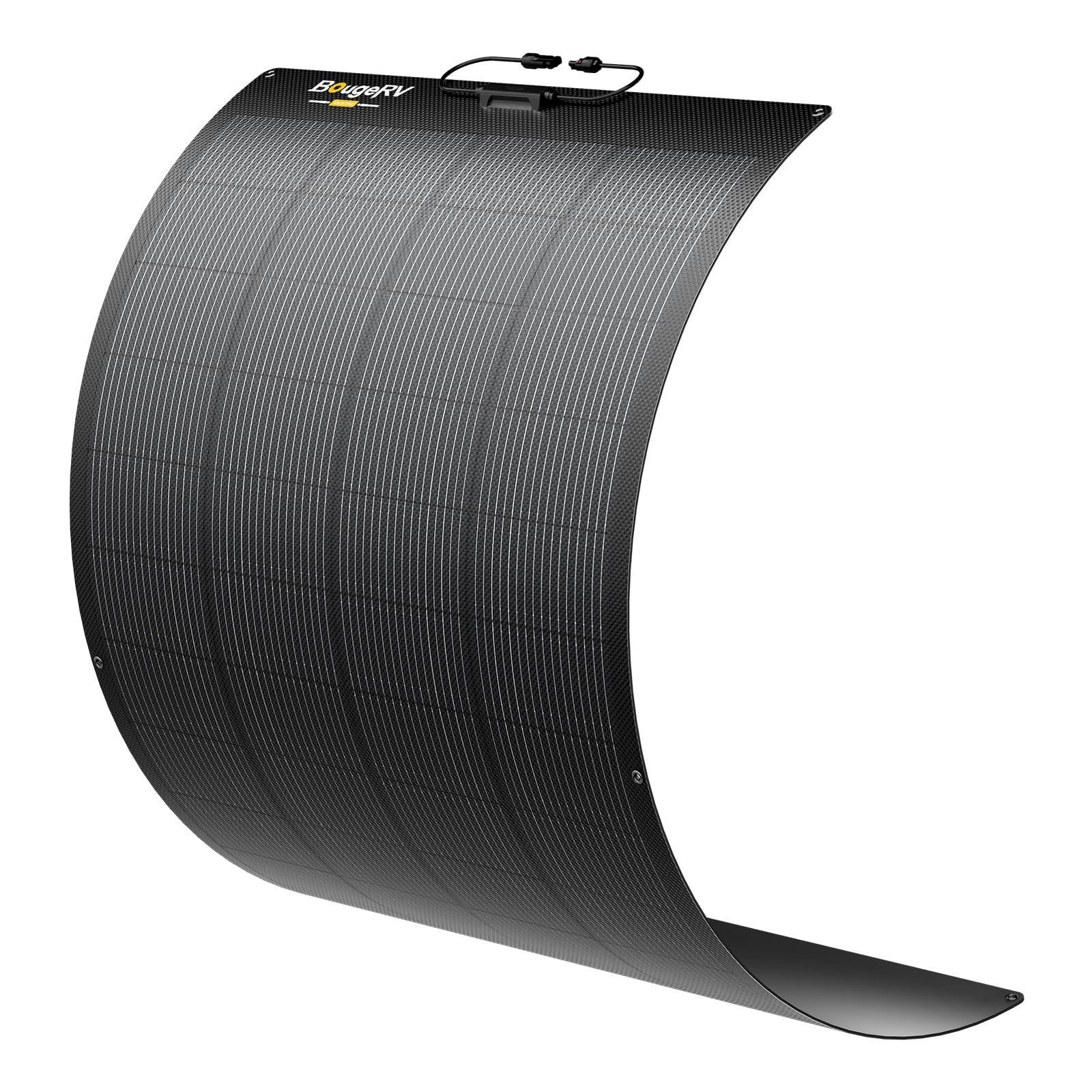
An ultra-thin panel at just 7.9 pounds that bends up to 270 degrees to fit curved roofs.
This is the lightweight specialist of the list. At only 0.1 inches thick and 7.9 pounds, the BougeRV Arch Pro uses N-type 16BB cells for 25% efficiency, but its big trick is the flexibility: it can wrap around curved van fronts, roof-top tents, or boat cabins where rigid glass panels cannot go. The ETFE coating (a tough, UV-resistant film instead of standard PET) makes the surface scratch-resistant and self-cleaning, ideal for exposed outdoor mounting.
Buyers who mounted it to a roof-top tent with 3M VHB tape report it stayed solid during 80 mph highway driving and drew 190 watts to a Jackery on a sunny day. One owner in Tennessee paired two Arch Pro panels with an Anker C1000 and recorded 300-350 watts at a 12-degree tilt, surviving three wind storms with proper anchors. The honest downside: panel output drops to 60-65% of rating when mounted flat, and the open-circuit voltage around 36 volts may not be compatible with some power stations — check your gear’s input spec before buying.
The thing that wins owners over is the weight and versatility — you can stick this where no rigid panel fits. The compromise is lower daily watt-hour totals on flat mounts compared to tilted rigid panels of the same rating.
Curved-surface specialist: Ideal for RV curves, van tops with limited flat space, or roof-top tents. The flexibility plus 200W rating is a combination you rarely find this light.
Reach for this if: Your mounting surface is curved or you need to save every pound on a small camper or overlanding setup.
Consider another if: You want the highest absolute daily output from a flat roof — a rigid panel at the same wattage will outperform it when not tilted.
5. JJN Bifacial 400 Watt Solar Panels 12V 10BB Monocrystalline High Efficiency (2 PCS 200 Watt)

A rugged pair of 200W bifacial panels rated for heavy snow loads and backed by 30 years.
The JJN panels use 10BB (10 busbar) monocrystalline cells with half-cut technology, which splits each cell in half to reduce power loss from partial shading. The efficiency is 23% — slightly below the N-type panels above — but the build is exceptionally sturdy: the corrosion-resistant aluminum frame withstands 2400 Pa wind pressure and 5400 Pa snow load, meaning a foot of heavy snow is not a problem. The IP65 junction box and IP67 connectors seal well against rain and debris.
Buyers consistently report impressive output: an 800W rated setup (four panels) peaked at 1060 watts in cool full sun, exceeding the rating by 60 watts per panel. Another owner runs eight panels on a full-time camper setup with a 17.4 kWh battery and powers everything except AC and the water heater. The handful of complaints center on packaging — some panels arrive with minor shipping scratches or, in rare cases, a shattered panel (replaced quickly by support).
The 30-year transferable power output warranty is the standout trust factor here. If you plan to stay in one place for a long time, this warranty covers you through decades of use.
Why it wins
- 30-year transferable power output warranty is the longest here
- Half-cut cells reduce shading impact significantly
- Can survive snow loads of 5400 Pa (about 112 lbs per sq ft)
A caution
- Packaging needs improvement — occasional shipping damage reported
- 23% efficiency trails the N-type competition
Best for climates with snow: The high snow-load rating and sturdy frame make this a top pick for northern winters. The 30-year warranty is a serious ownership benefit.
Think twice if: You want the absolute highest efficiency per panel — the N-type options above squeeze out more power from the same space.
6. EPOCH 430W Bifacial Solar Panel, N-Type Class A 12/24 Volt Monocrystalline

A single 430-watt panel that pushes 90 percent of its rating even on cloudy days.
The EPOCH is the highest-wattage single panel in this roundup, combining N-type 16BB cells with PERC (a reflective layer on the back of the cell that catches light passing through) and half-cut technology. The top transparency rating of 91.5% means more light reaches the cells, helping this panel hit 25% efficiency even with the larger surface area. The IP68 junction box and IP67 MC4 connectors give full dust and water protection.
Shoppers say real-world results that match or beat the sticker: one owner measured 380+ watts per panel (about 90% of rated capacity) and 100+ watts on cloudy days, with two panels in parallel generating 1200-1500 watts and 6000-10000 watt-hours per day. Another Florida owner mounted five panels flat on an RV roof and saw peaks up to 430 watts each — the full rating. The honest gap: the 44.6 by 67.8 inch footprint is large, and the packaging has drawn criticism — some units arrived with frame damage even though the panels themselves worked fine.
The highest praise from owners is the quality and power output — 16 and 15 mentions respectively, the top two aspects by count. If you have the roof space for one big panel, this delivers the most watt-hours per square foot of any single panel here.
High-wattage workhorse: The 430W rating is the ceiling of this list. If you want to minimize panel count and boost roof coverage, this is your pick.
Reach for this if: You have a large RV or shed roof and want to cover it with as few panels as possible — each one produces like two standard 200W panels.
Consider carefully if: The large dimensions (67.8 inches tall) mean it will not fit all roof layouts — measure your space before buying.
7. JJN Bifacial 425 Watt Solar Panel, N-Type UL 61730 16BB, 25% High Efficiency
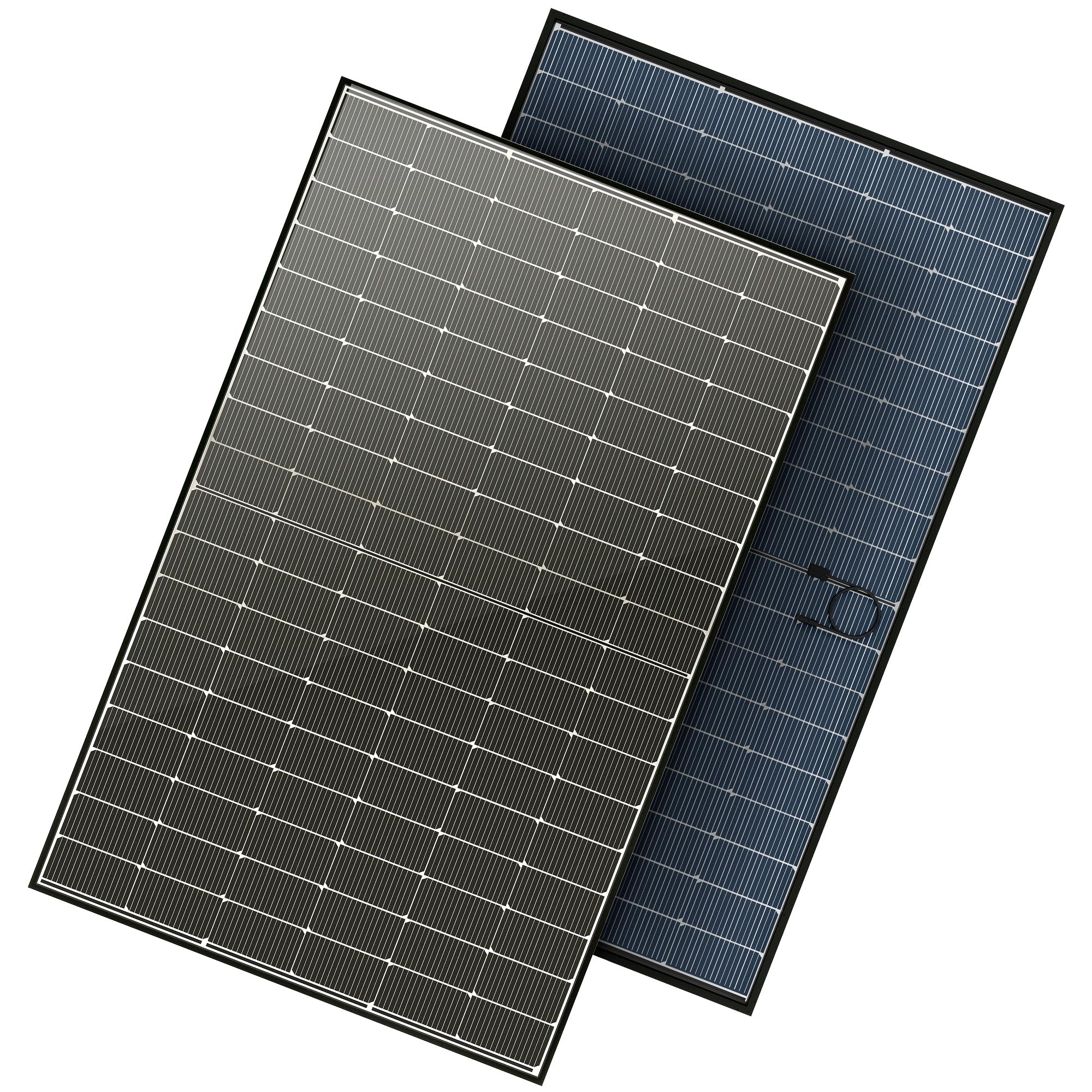
A UL-certified 425W N-type panel that often over-produces its rated wattage in the real world.
The big brother to the JJN 400W above, this 425-watt panel steps up to N-type 16BB cells for 25% efficiency — a meaningful jump from the 10BB version. The UL 61730 certification (a recognized US safety standard for PV modules) adds a layer of insurance for permanent rooftop installations. Like the 400W model, it withstands 2400 Pa wind and 5400 Pa snow loads, making it equally tough. The transparent backsheet enables bifacial capture from both sides.
Buyers report performance that regularly beats the rating: one owner’s 800W system (four panels) hit 1060 watts in cool 62-degree full sun, a 106% output rate. Others running 200W versions of the same panel line saw 220 watts each consistently, exceeding their rating. The panel’s performance in overcast conditions is also singled out — one RV owner said it kept a fridge, lights, and devices running all afternoon under cloudy skies without the voltage drop typical of cheaper panels. The main critique is cosmetic: some panels arrive with small dots on the cells where micro-damage occurred during manufacturing. The panel still works perfectly, but it is not visually flawless.
With 25% efficiency and a 30-year transferable warranty, this is built for long-term homeowners. If an occasional aesthetic dot does not bother you, the output is fantastic.
Why it stands out
- UL 61730 certified for permanent home/roof use
- Frequently over-produces its rated wattage
- Maintains output in overcast conditions
One thing to know
- Some cells arrive with visible micro-dots — cosmetic only, not performance
- At 51.6 pounds, it is one of the heavier panels here
Best for permanent builds: UL certification and the long warranty make this suitable for home roof arrays or large off-grid sheds. The over-production is a nice bonus.
pass on it if: You need a lighter panel for portable use — the Renogy suitcase below is easier to carry.
8. Callsun N-Type 16BB 400W Bifacial Solar Panel, 2Pcs 200 Watt, 25% High Efficiency
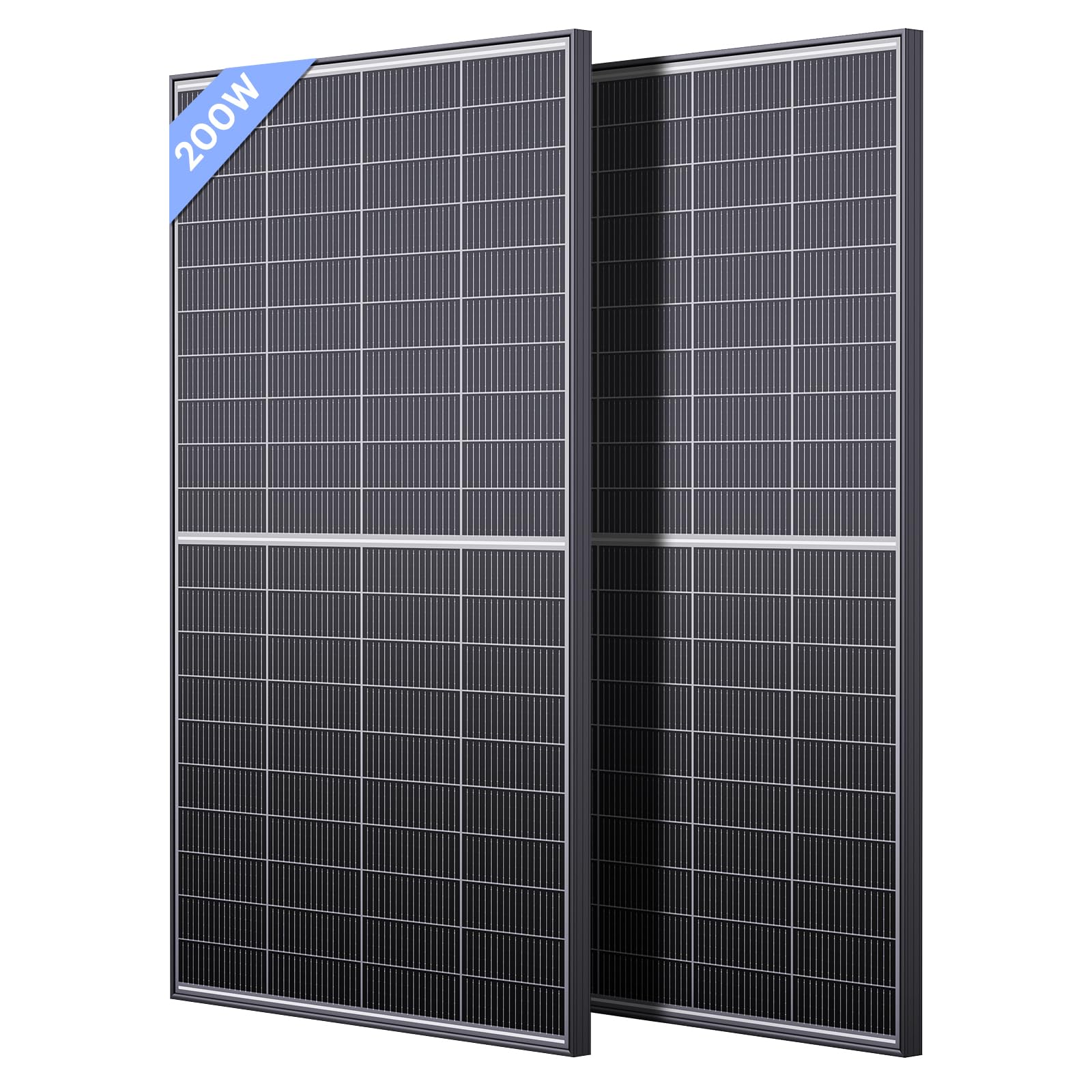
A two-panel kit with a clever split-cell design that halves the impact of shade.
The Callsun kit uses a TwinCell design that splits each panel into two independent halves. If a tree branch shades one half, the other half keeps generating at full power. This boosts shading tolerance by up to 50% compared to a conventional single-piece panel. The cells are N-type with 16 busbars at 25% efficiency, and the bifacial backsheet captures light from both sides to increase total output by up to 30% in reflective conditions. The temperature coefficient of just -0.3%/K means hot summer days have less impact on output than typical panels.
Buyers consistently report over-production: one owner measured a peak of 420 watts (above the 400W rating) thanks to bifacial gain from the concrete driveway. Another owner with seven panels averages 275-300 watts per panel on sunny days. The split design earns particular praise for keeping power flowing in mixed shade conditions. The packaging is sturdy — several owners mention no damage on arrival — and the 25-year performance commitment (maintaining at least 84.5% output after 25 years) backs the long-term claim.
The main trade-off is the higher price point for the N-type bifacial combination. You pay more per watt here than for the ECO-WORTHY kit, but you get the anti-shade resilience and lower thermal loss.
Anti-shade specialist: If your roof has partial shadow from vents, antennas, or nearby trees, the TwinCell design is a genuine advantage — it keeps half the panel running instead of the whole row dropping out.
Reach for this if: Your installation site has unavoidable partial shade from roof obstructions or trees. The split-cell design is the best shade mitigation here.
Consider the ECO-WORTHY if: Shade is not a concern and you prioritize the lowest cost per watt.
9. Renogy 400W Portable Solar Panel Suitcase, 23% High Efficiency Foldable Solar Charger

A folding 400-watt suitcase that sets up in 60 seconds and still delivers solid power in real weather.
This is the portable champion of the list. The Renogy folds to 33.7 by 27.9 by 3.2 inches and weighs 30.2 pounds, which is about four times more compact than a rigid 400W panel. The fiberglass construction with ETFE coating (a tough, clear protective layer) makes it hail-resistant and UV-stable, and the IP67 waterproof rating means it handles rain without worry. The 23% efficiency comes from A+ monocrystalline cells — a bit lower than the N-type panels above, but competitive for a portable unit. The built-in kickstands are rust-proof and fold out for ground setup in under a minute.
Customers note real-world output ranging from 200 watts in overcast Seattle to 395 watts in full sun. One owner measured 300 watts even under full cloud cover, which is impressive for a portable panel. The parallel wiring inside the suitcase means that shading one panel section does not drag down the other, a thoughtful feature for camping under partial tree cover. The honest trade-off: some owners find the folding wire legs a bit flimsy in wind — staking it down is wise on breezy days. The folded size is large enough that it takes up noticeable space in a vehicle.
The build quality and sturdy frame earn consistent praise. If portability is your priority and you do not need the highest efficiency numbers, this Renogy suitcase is the easiest way to carry 400 watts to a campsite.
Why it is useful
- Sets up in about a minute with no tools
- ETFE coating resists scratches and hail
- Parallel wiring prevents partial shade from ruining the whole output
What to expect
- Heavy at 30.2 lbs — not a one-hand carry over long distances
- Peak output often sits below 300W in real-world flat placement
Best for campers and preppers: If you move your panel between campsites or keep it for emergency backup, the folding design is a standout for setup speed.
it’s not for you if: You are leaving panels on a roof permanently — rigid panels give more power per dollar and a better output-to-weight ratio when mounted flat.
Understanding the Specs
Efficiency Rating (%)
This is the percentage of sunlight that gets turned into electricity. A 25% efficient panel converts one-quarter of the light hitting it into usable power. Higher efficiency means you get more watts from the same surface area, which matters most when roof space is limited. The jump from 23% to 25% sounds small, but on a 400W panel, that is roughly 40 extra watts per panel in direct sun.
Bifacial vs Monofacial
A monofacial panel only collects light from the front, with an opaque white or black backsheet. A bifacial panel uses a transparent backsheet so it can also absorb light reflected off the ground, roof, or snow. In practice, bifacial panels can give you 10-30% more total daily watt-hours depending on the reflectivity of the surface below them. They cost more upfront but can reduce the number of panels needed.
FAQ
What does N-type mean in a solar panel?
Does a higher efficiency rating always mean more power for me?
Do I need a special charge controller for bifacial panels?
How long will these high-efficiency solar panels last?
Can I mix N-type panels with older P-type panels in one system?
What is the real-world output I can expect from a 400W panel?
Are flexible solar panels as efficient as rigid glass panels?
What does the IP68 or IP67 rating mean for a solar panel?
Final Thoughts: The Verdict
If you want one dependable pick, the efficient solar panels winner is the ECO-WORTHY 400W N-Type kit because it delivers 25% N-type efficiency at a price per watt that undercuts the competition, and real owners regularly see 400+ watts from the four-panel setup. If you have limited roof space and want a single high-output panel, grab the EPOCH 430W Bifacial — it packs the most wattage per panel in this list. And for portability on camping trips, the Renogy 400W Portable Suitcase is the one to reach for — it folds up small and produces solid power even under cloud cover. Backed by thousands of verified owners across all picks, every panel here will reliably charge your batteries, but the ECO-WORTHY kit gives you the best efficiency-to-dollar ratio for starting or expanding an off-grid system.
How We Picked
We do not accept paid placement. Every pick is matched to a real buyer and a real use-case; we do not hands-on test units.
Sources & Methodology
Specifications: manufacturer listings and product documentation. Review insights: verified customer reviews, as of July 2026. Pricing: not shown on this page (it changes often); check the current price via the retailer link.
As an Amazon Associate, WellFizz earns from qualifying purchases. This does not affect which products we feature.
Related Guides

Mo Maruf
I created WellFizz to bridge the gap between vague wellness advice and actionable solutions. My mission is simple: to decode the research and give you practical tools you can actually use.
Beyond the data, I am a passionate traveler. I believe that stepping away from the screen to explore new environments is essential for mental clarity and physical vitality.