Our readers keep the lights on and my smoothie glass nicely filled. As an Amazon Associate, I earn from qualifying purchases.
Specs are compiled from manufacturer listings and verified buyer reviews and can change over time — please confirm the key details on the product page before buying.
Picking the right Canon EF lens is really a decision about the kind of light you shoot in and how far away your subject usually stands. A fast f/2.8 zoom keeps you shooting indoors without a flash, while a slower lens forces you to raise your ISO and accept grainier files. This guide walks you through eleven EF-mount lenses that span everything from a budget fisheye to professional telephoto workhorses, so you can match the glass to your camera body and your real-world shooting habits.
I’m Mohammad Maruf — the founder and writer behind WellFizz. This guide is built by comparing the manufacturers’ published specifications and the patterns across verified customer reviews, so you get each pick’s real strengths and trade-offs instead of marketing spin.
Whether you’re chasing portraits, sports, astro, or architecture, these are the ef lenses that earn their place in a Canon shooter’s bag.
Our Picks at a Glance


How To Choose The Best EF Lenses
An EF lens is built for Canon’s full-frame and APS-C DSLR bodies, and it uses the classic bayonet mount that predates the newer mirrorless RF system. The first question to answer is whether your camera has a full-frame sensor or a smaller APS-C crop sensor, because that changes the effective reach of every focal length you mount.
Prime vs Zoom: Start With the Question of Flexibility
A prime lens has a single fixed focal length, like 35mm or 135mm, which forces you to move your feet but typically delivers wider apertures and sharper results for the dollar. A zoom lens covers a range of focal lengths, like 24-70mm or 70-200mm, which lets you frame shots without changing lenses mid-shoot. If you shoot events or travel where you cannot reposition easily, a zoom earns its keep; if you shoot portraits or astro where you control the distance, a prime often wins on speed and quality.
Aperture Is the Doorway to Low Light
The maximum aperture, written as f/2.8 or f/3.5, tells you how much light the lens lets through when fully open. A lower number means a wider opening and better performance in dim conditions, plus a shallower depth of field that blurs backgrounds into creamy bokeh. A constant f/2.8 zoom holds that wide opening across the entire zoom range, which is why pros pay a premium for it, while a variable-aperture zoom like f/3.5-5.6 gets darker as you zoom in.
Image Stabilization vs Raw Speed
Image stabilization, often branded IS or OS, compensates for shaky hands by shifting lens elements to counteract movement, which lets you shoot at slower shutter speeds without blur. It is a lifesaver for handheld telephoto work but does nothing for a moving subject, which still demands a fast shutter speed and therefore a wide aperture. Some professional zooms skip stabilization entirely because the camera body or the shooter’s technique covers it.
Quick Comparison
| Model | Best For | Focal Length | Max Aperture | Autofocus | Amazon |
|---|---|---|---|---|---|
| Canon EF 70-200mm f/2.8L IS III★ Best Overall | Pro telephoto work | 70-200mm | f/2.8 | Ring USM | Amazon |
| Meike 8mm f/3.5 FisheyeCreative Pick | Creative fun on APS-C | 8mm | f/3.5 | Manual | Amazon |
| Altura Photo 8mm f/3.0 FisheyeBest Value | Budget fisheye entry | 8mm | f/3.0 | Manual | Amazon |
| Rokinon 135mm f/2.0 | Astro and portraits | 135mm | f/2.0 | Manual | Amazon |
| Sigma 70-200mm f/2.8 Sports | Durable sports glass | 70-200mm | f/2.8 | HSM | Amazon |
| Canon EF 24-70mm f/2.8L II | The all-rounder standard | 24-70mm | f/2.8 | Ring USM | Amazon |
In‑Depth Reviews
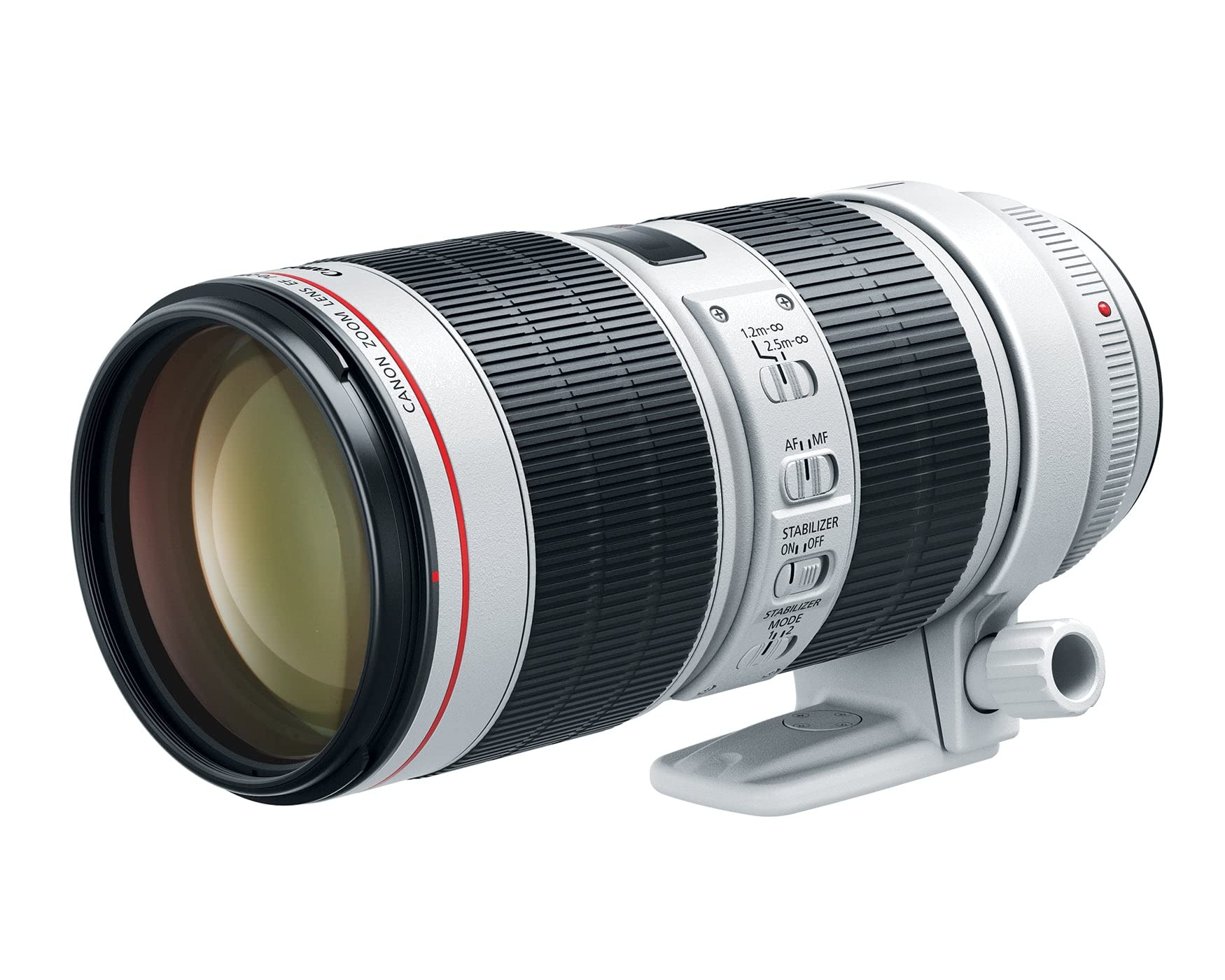
1. Canon EF 70-200mm f/2.8L IS III USM
Our pick — over 4.5★ from 550+ verified ratings; the strongest balance of quality and price.
The white workhorse that turns distant action into tack-sharp, beautifully blurred frames.
This is the lens that owners call an incredible workhorse, and the praise centers on two things: sharpness that rivals prime lenses and a focusing speed you can trust when the moment matters. It pairs a constant f/2.8 aperture across the whole 70-200mm range with Canon’s Air Sphere Coating to minimize ghosting and flare, so you get clean contrast even shooting into tricky light. Its optical stabilization compensates for up to 3.5 stops of camera shake., which means you can drop your shutter speed and still come home with crisp handheld shots.
At 200mm and f/2.8, the bokeh is gorgeous and the low-light performance is strong enough that buyers report f/2.8 is adequate under stadium lights. The honest catch is reach: for sideline sports where you cannot move closer, owners say the 200mm end still leaves you cropping in post, and a 1.4x teleconverter works best stopped down. It is a heavy 3.2 pounds, so it demands a solid grip or a monopod for long days, but the build quality and weather resistance make it feel like a tool built for years of abuse.
What wins people over is the lens quality, the most-praised aspect by a wide margin, followed by image quality and focus speed. Owners mention it is “sharp, fast AF, beautiful bokeh” and that it pairs beautifully with a Canon 6D Mark II. If you shoot portraits, events, or wildlife and want one lens that delivers professional results, this is the one the whole list orbits around.
What owners rave about
- Laser-sharp focus and beautiful f/2.8 bokeh
- Fast, quiet autofocus with full-time manual override
- The IS III system compensates for up to 3.5 stops of camera shake.
- Dust and water resistant for harsh conditions
The honest trade-offs
- 200mm feels short for sports — cropping required
- Premium price that some owners still question
- 3.2-pound weight demands a good grip
Grab it for: professionals and serious hobbyists who need a reliable, sharp telephoto for portraits, events, and wildlife.
Think twice if: you mostly shoot sideline sports where 200mm won’t reach, or you want a lighter lens for travel.
2. Meike 8mm f/3.5 Ultra Wide Angle Fisheye
A solid-metal fisheye that makes ordinary scenes look gloriously, deliberately weird.
You get a dramatic 200° field of view (the lens sees behind itself and bends straight lines into curves) with this manual-focus rectangle fisheye. On an APS-C body like the Canon Rebel T6 or T5i, it fills the frame with that classic fisheye look, and the metal build with smooth focus and aperture rings feels far more expensive than it costs. The minimum focusing distance of just 35cm lets you get close enough to make everyday objects look enormous.
The catch is that it is a manual lens, so you must enable “M mode” or “Release without lens” in your camera settings, and the focus ring takes patience. One buyer put it perfectly: “Really thought I was gonna return this but now I’m obsessed!” — admitting they could not fully master the focus but loved the artistic blur anyway. Owners also note the lens is heavy and compact, best treated as a creative macro or effects tool rather than a normal wide-angle for everyday shots.
What wins people over is the lens quality, the most-praised aspect, with solid image quality, value, and build quality close behind. You get two lens caps, a sun visor, a lens bag, and a lens cloth in the box, and because the field of view is so extreme, edge warping is part of the charm. If you want a fun, affordable way to experiment with fisheye perspectives on a crop-sensor Canon, this is a great entry point.
Why it’s a blast
- 200° field of view for full-frame fisheye curves
- Solid metal build with smooth rings
- Sharp center with good low-light performance
- Removable lens hood, unlike some rivals
Know before you buy
- Manual focus takes practice — expect trial and error
- Corners are softer than the center
- Produces a circular vignette on full-frame bodies
Reach for this if: you want a budget-friendly, creative fisheye for street photography, landscapes, or skate videos on an APS-C Canon.
Look elsewhere if: you need autofocus or a clean, undistorted wide-angle for architectural work.
3. Altura Photo 8mm f/3.0 Fisheye
A metal fisheye with a removable hood that open up stunning 180° views while staying affordable.
Altura Photo’s 8mm f/3.0 fisheye is built around a hybrid aspherical element and multi-layer lens coating, which keep images sharply defined even at an extreme 180° field of view. The all-metal construction feels substantial in hand, and the included custom protective case makes it easy to store safely between shoots. At just 1.1 pounds, it is noticeably lighter than the Meike fisheye above, which matters if you are hiking to a scenic overlook.
Owners describe the quality as the standout trait, with value for money the second most-praised aspect, and the build quality earning strong marks. One buyer summed up the experience: “I am only an amateur at best… a bit of a learning curve but that is on me not the lens” — a fair warning that manual focus on an ultra-wide demands practice, especially since the wide field of view makes viewfinder focusing impractical. The trick, as owners note, is switching to Live View with 10x focus assist and metering carefully to protect highlights.
The f/3.0 aperture lets in enough light for basic night-sky shots at this budget level., and the vast depth of field means focusing at 2 feet often covers infinity. The recurring trade-off is chromatic aberration and softness at the infinity focus setting, plus the fact that it works best as a creative tool rather than a clinical wide-angle. For a fisheye beginner who wants to learn on a budget, this is a seriously fun place to start.
What stands out
- Quality build with a hybrid aspherical element
- Removable hood for stunning 180° views
- Light 1.1-pound weight and compact size
- Great for night sky and astro on a budget
Where it stumbles
- Manual focus is tricky — expect trial and error
- Softest at infinity focus setting
- Hood can appear in the frame if not careful
Pick this when: you want an affordable, well-built fisheye to learn on and you are happy to master manual focus.
skip it if: you need autofocus or you plan to shoot on a Canon mirrorless R or M body, which it does not fit.
4. Rokinon 135mm f/2.0 ED UMC
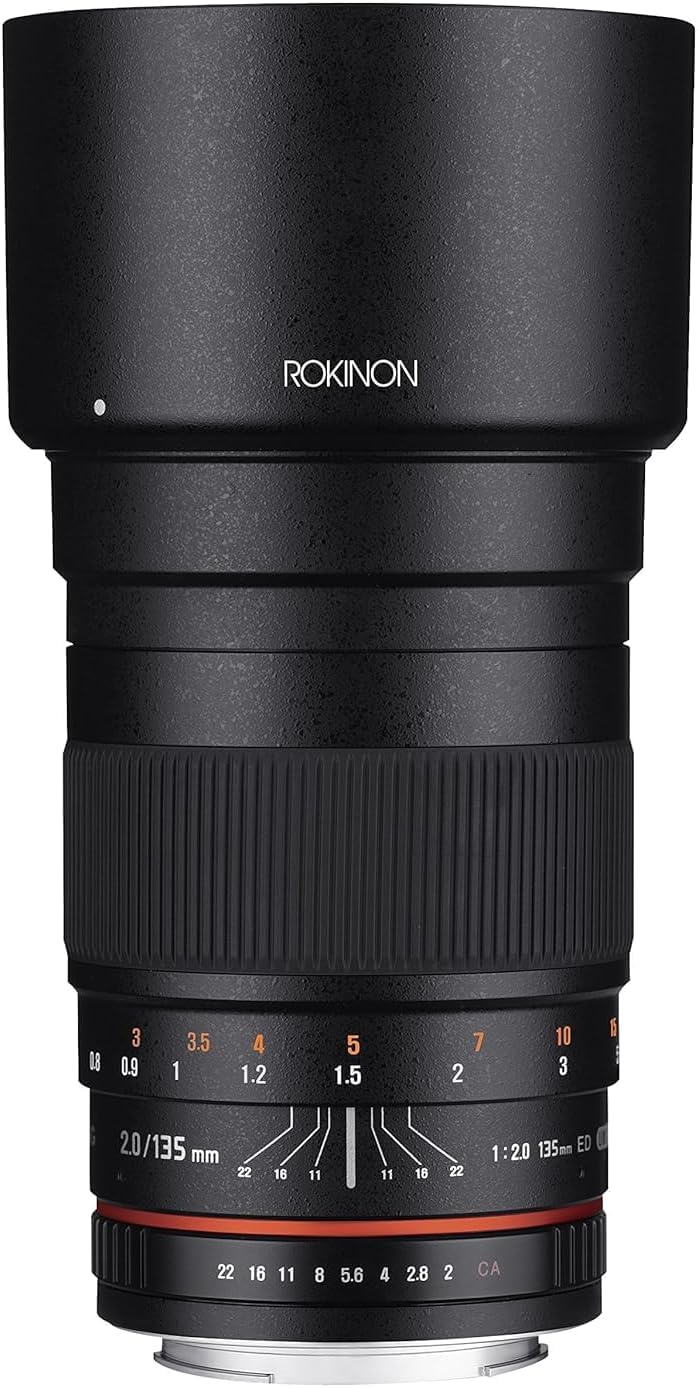
The manual prime that astrophotographers swear by for its near-flawless stars and buttery background blur.
This 135mm prime is famous in astro circles for one reason: At f/2.0 it delivers near-flawless optics wide open, with owners reporting no coma, no astigmatism, and perfect color correction on dedicated astro cameras.. The ultra multi-coated optics and one extra-low dispersion element keep chromatic aberration under control, while the fast f/2.0 to f/22 aperture range pulls in plenty of light for deep-space targets. It is a full-frame lens with an 18.8° angle of view on full-frame bodies and a tighter 12.4° on APS-C, making it a versatile telephoto for portraits too.
The 9 diaphragm blades produce smooth, pleasing bokeh., and the minimum focusing distance of 2.6 feet gives you room to work. Owners consistently call it the sharpest lens they have tested, even against L-series and Sigma rivals, and the stiff, long-throw focus ring is praised for aiding precision. The catch is that it is fully manual — no autofocus at all — and the 1.8-pound weight can affect tracking on some mounts, so it is best suited to patient shooters who do not need AF.
What wins people over is the build quality and the optical performance for both astro and portraiture, with the smooth focus ring called out as excellent for wide-field imaging. One owner called it “a true APO for astrophotography,” noting minimal vignetting as its only real weakness on full-frame. If your bag is mostly tripod work under dark skies, this lens is a legend for a reason.
Why astro shooters love it
- Near-flawless optics at f/2.0 with zero coma.
- Fast f/2.0 aperture for low-light targets
- Smooth focus ring with an infinity stop
- Sharp at all f-stops, from center to edge
The manual reality
- No autofocus — manual only, all the time
- 1.8-pound weight can affect tracking mounts
- Copy variation is a known luck-of-the-draw risk
Choose this for: dedicated astrophotographers and portrait shooters who want elite sharpness and do not need autofocus.
Pass if: you shoot fast-moving subjects or rely on AF, since this lens demands manual skill.
5. Canon EF 28-135mm f/3.5-5.6 IS USM

The classic walk-around zoom that proves you do not need L-series glass for brilliant travel shots.
You get a genuinely useful zoom range with built-in image stabilization (which reduadvantage is built-in OS (Optical Stabilization) — a feature Canon does not even offer on its equivalent. That stabilization is a genuine asset for handheld video and low-light shooting, and owners say the image quality is crisp at every focal length. The lens is built with 19 elements in 14 groups, delivering outstanding color rendition and pretty bokeh that owners praise.
The autofocus is fast and reliable, with owners using it on Canon R-series bodies via an EF adapter and reporting excellent results. One buyer called it a “perfect alternative to the canon equivalent,” noting the image stabilization was a must-have that Canon’s version lacks. The recurring trade-offs are the weight — it is heavy, though owners say it feels solid and well-built — and some durability concerns, with a few reporting autofocus issues after months of heavy use.
Lens quality is the most-praised aspect, followed by image quality and fast autofocus, with value for money also earning strong marks against the pricier Canon RF equivalent. The lens hood does not lock and can slowly twist off, which is a minor but common complaint. If you want one lens that covers the crucial 24-70mm range with stabilization and Art-series sharpness, this is a serious contender.
Why it stands out
- Built-in OS stabilization — Canon’s version lacks it
- Crisp images at all focal lengths
- Outstanding color rendition and bokeh
- Fast, reliable autofocus
What owners flag
- Heavy build — solid but tiring over long shoots
- Hood does not lock and can twist off
- A few durability reports after months of use
Pick this for: event, wedding, and lifestyle shooters who want a stabilized, sharp 24-70mm that saves money over Canon’s version.
Think twice if: you want the lightest possible kit or you are wary of third-party durability long-term.
6. Sigma 70-200mm f/2.8 Sports DG OS HSM

A rugged, weather-sealed telephoto built to survive five years of pro abuse and still deliver.
Sigma’s 70-200mm f/2.8 Sports is the lens for shooters who treat their gear hard, with a dust- and splash-proof structure and a magnesium alloy barrel that shrugs off the elements. Inside, 9 FLD and 1 SLD low-dispersion glass elements control chromatic aberration, while the 11-blade rounded diaphragm produces ultra-smooth bokeh. The tripod socket features 90 click stops and an Arca Swiss type clamp, making it a natural fit for gimbals and tripods.
Pros who have used it for years report outstanding image quality, fast and accurate autofocus, and no focus breathing — a boon for video work. One 10-year professional called it “just as good or better than canon,” praising the sharpness and weather sealing, while another noted it is ideal for capturing high-resolution images of distant structures without climbing them. The biggest trade-off is the weight: at 3.97 pounds, it is heavier than Canon’s equivalent, and the non-removable tripod ring is a minor annoyance for some.
Lens quality is the most-praised aspect, with image quality, sharpness, and value for money close behind. Owners note the focus and zoom rings are swapped compared to Canon’s layout, which takes getting used to, but the locking hood with a release button is superior. If you shoot sports, wildlife, or weddings in harsh conditions and want a telephoto that will not quit, this Sigma is built like a tank for a reason.
The pro-grade strengths
- Dust- and splash-proof build for harsh conditions
- Outstanding image quality and sharpness
- No focus breathing for video work
- Superior locking hood with release button
The heavy cost
- 3.97 pounds — heavier than Canon rivals
- Non-removable tripod ring
- Rings swapped vs Canon layout — adjustment needed
Choose this for: working pros and serious hobbyists who shoot sports or wildlife in demanding conditions and want a telephoto that lasts.
Pass if: you want a lightweight travel telephoto or you prefer Canon’s familiar ring layout.
7. Canon EF 24-70mm f/2.8L II USM

The professional standard zoom that owners say eliminates the need for half their other lenses.
Canon’s 24-70mm f/2.8L II is the lens many pros mount first and the one that earns the “workhorse” label. The 24-70mm range covers everything from wide environmental shots to flattering portraits, and the constant f/2.8 aperture keeps you shooting in low light without switching lenses. Two types of aspherical lenses reduce spherical aberration for edge-to-edge sharpness, and the ring-type ultrasonic autofocus is so fast that owners describe it as almost instantaneous.
The lens quality is the most-praised aspect by a massive margin, with sharpness and image quality close behind, and owners say it rivals prime lenses across the zoom range. One buyer called it “the best all-purpose lens” for travel, street, portraits, and landscapes, while another noted the sharpness, bokeh, and contrast match a 50mm f/1.2 at f/2.8. The closest focusing distance of 0.38m (1.25 ft) lets you get surprisingly close, and the 82mm filter thread gives you room for pro-grade filters.
The catch is that there is no image stabilization, so you will rely on your shutter speed and technique in low light, and the weight draws mixed feedback. Owners also note the value is debatable given the price, though most agree the performance justifies it. If you want one lens that does nearly everything at a professional level, this is the standard by which other zooms are judged.
The professional edge
- Razor-sharp across the zoom range — rivals primes
- Almost instantaneous autofocus
- Constant f/2.8 for low-light flexibility
- Versatile for travel, portraits, landscapes
The honest catch
- No image stabilization — technique required
- Premium price, with mixed value feedback
- Weight is a factor on
- Premium price with mixed value feedback
- Weight draws mixed opinions from owners
Grab it for: photographers who want a single, versatile, razor-sharp workhorse that covers most shooting scenarios.
Think twice if: you rely on image stabilization for handheld low-light work — this lens has none.
Understanding the Specs
Focal Length and Crop Factor
Focal length, measured in millimeters, determines how much of the scene you see and how large your subject appears. A shorter length like 8mm gives an ultra-wide, distorted view, while a longer length like 200mm compresses perspective and brings distant subjects closer. On an APS-C crop-sensor Canon, multiply the focal length by roughly 1.6 to find the effective reach — so a 28-135mm zoom acts more like a 44-216mm on a crop body.
Maximum Aperture
The maximum aperture, written as f/2.8 or f/3.5, controls how much light reaches the sensor when the lens is fully open. A lower number means a wider opening, better performance in dim conditions, and a shallower depth of field for creamy background blur. A constant aperture like f/2.8 holds that light-gathering power across the entire zoom range, while a variable aperture like f/3.5-5.6 gets darker as you zoom in, forcing you to raise ISO.
FAQ
Will an EF lens work on my Canon mirrorless R-series camera?
What is the difference between EF and EF-S lenses?
How do I know if a manual focus lens will work on my camera?
Is a 70-200mm f/2.8 lens worth the premium price?
What does image stabilization actually do for me?
Can I use a teleconverter with my EF telephoto lens?
What is the difference between a fisheye and a regular wide-angle lens?
Why is the 24-70mm f/2.8 considered the standard professional zoom?
Is a renewed or international version lens a good idea?
What is the best lens for astrophotography on a Canon DSLR?
Final Thoughts: The Verdict
For most people, the ef lenses winner is the Canon EF 70-200mm f/2.8L IS III because it delivers the professional combination of sharpness, fast autofocus, and image stabilization that owners consistently call a workhorse. If you want a versatile all-rounder that covers most shooting, grab the Canon EF 24-70mm f/2.8L II. And if you are chasing stars or creative fisheye effects on a budget, the Rokinon 135mm f/2.0 and Meike 8mm are the ones to reach for.
How We Picked
We do not accept paid placement. Every pick is matched to a real buyer and a real use-case; we do not hands-on test units.
Sources & Methodology
Specifications: manufacturer listings and product documentation. Review insights: verified customer reviews, as of August 2026. Pricing: not shown on this page (it changes often); check the current price via the retailer link.
As an Amazon Associate, WellFizz earns from qualifying purchases. This does not affect which products we feature.
Related Guides

Mo Maruf
I created WellFizz to bridge the gap between vague wellness advice and actionable solutions. My mission is simple: to decode the research and give you practical tools you can actually use.
Beyond the data, I am a passionate traveler. I believe that stepping away from the screen to explore new environments is essential for mental clarity and physical vitality.