Our readers keep the lights on and my smoothie glass nicely filled. As an Amazon Associate, I earn from qualifying purchases.
Specs are compiled from manufacturer listings and verified buyer reviews and can change over time — please confirm the key details on the product page before buying.
You want a toy that grabs your 1-year-old’s attention and builds real skills like walking, talking, and hand-eye coordination. At this age, every toy teaches something — the best ones grow with your child instead of being outgrown in a month.
I’m Mohammad Maruf — the founder and writer behind WellFizz. This guide is built by comparing the manufacturers’ published specifications and the patterns across verified customer reviews, so you get each pick’s real strengths and trade-offs instead of marketing spin.
For a first birthday gift or a daily-play upgrade, these educational toys for a 1-year-old are the ones that truly engage and teach, not just sit in the corner.
Our Picks at a Glance


How To Choose The Best Educational Toys For A 1-Year-Old
A 1-year-old is caught between babyhood and toddlerhood — they can sit up, maybe stand, and want to touch everything. Your job is to pick toys that meet them exactly where their skills are right now, with a little room to grow.
Match the toy to the current milestone
At 12 months, most babies are mastering sitting, pulling up, and the pincer grasp (picking up small things between thumb and finger). A toy with big easy-grip pieces or a sturdy push handle supports those exact movements — while a toy with tiny parts will just frustrate them.
Look for multiple ways to play
Toys that work in more than one mode — a detachable activity panel, a walker that becomes a floor toy, a cube with eight sides — stretch your money across months. When your child masters one activity, they move to the next side or mode, so the toy stays interesting longer.
Check materials and safety honestly
Everything ends up in a 1-year-old’s mouth. Smooth, splinter-free wood and BPA-free plastics with rounded edges are the safe zones, and a toy sturdy enough to survive being thrown is a toy you won’t regret buying.
Quick Comparison
| Model | Best For | Play Modes | Age Range | Material | Amazon |
|---|---|---|---|---|---|
| VTech Sit-to-Stand Learning Walker★ Best Overall | First steps & motor skill growth | Walker + detachable panel | 9 Months – 3 Years | Plastic | Amazon |
| KMTJT Montessori Sorting ToyBest Value | Color & shape recognition | Sorting, matching, stacking | 12+ Months | Wood | Amazon |
| VTech Pull and Sing PuppyLanguage Builder | Language & gross motor play | Pull-along + push buttons | 6 – 36 Months | Plastic | Amazon |
| LeapFrog 100 Words Book | First words & bilingual learning | Touch-to-hear pages | 18+ Months | Plastic (electronic) | Amazon |
| Joyreal Hammering Toy Set | Hammering, music & hand-eye coordination | Pounding, xylophone, fishing, gears | 18+ Months | Wood | Amazon |
| Duchong Pop Up Animals | Cause-and-effect discovery | Pop-up + sound & light modes | 12 – 36 Months | ABS Plastic | Amazon |
| LUCKFUTURE Spinning Stacker | Color recognition & gripping | Spin-stack tower | 12+ Months | Plastic | Amazon |
| Bravmate Wooden Activity Cube | Multi-activity exploration | 8-in-1 cube + bonus board | 12+ Months (18 M+ recommended) | Wood | Amazon |
| Fisher-Price Song & Story Chair | Pretend play & fine motor skills | 3 modes: Learning, Music, Imagination | 12+ Months | Plastic | Amazon |
In‑Depth Reviews
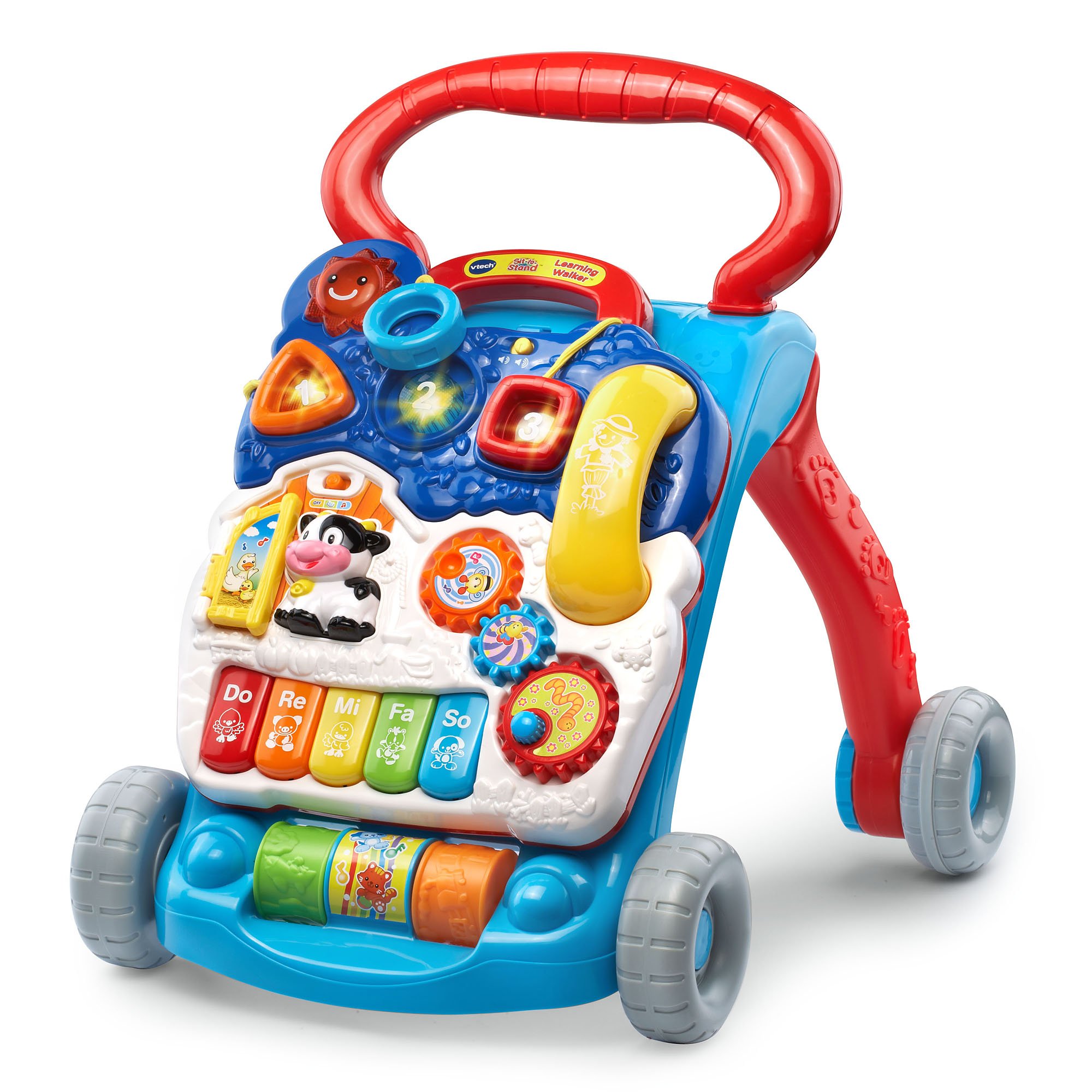
1. VTech Sit-to-Stand Learning Walker (Blue)
Our pick — over 4.5★ from 98,000+ verified ratings; the strongest balance of quality and price.
The walker that turns wobbly first steps into confident laps around the living room.
The VTech Sit-to-Stand Learning Walker earns its keep for over two years — rated for 9 months to 3 years, it starts as a sit-down activity panel and transforms into a push walker when your baby’s legs are ready. The detachable tray is the smartest part: babies who can sit up get the buttons, piano keys, and shape sorters at floor level, then the panel snaps back on for moving play across both carpet and bare floors.
Motor development is the headline here — three shape sorters, light-up buttons, and spinning rollers build fine motor skills while the two-speed control switch lets the walker grow with your child’s pace. Buyers report it survived outdoor weather, three kids, and years of daily use without needing a battery change or losing a button. One buyer bought it for a 6-month-old in December 2025 and it became a daily hit by 8-9 months.
The honest trade-off? The sounds are plentiful, and some parents find them a bit much over time — it’s a toy that makes noise whenever it’s touched. But the quality, the play value, and the fact that it genuinely supports balance and stability development make it the default pick for a reason.
What wins parents over
- Grows from floor toy to walker — one purchase, two stages
- Wheel stopper prevents sliding for nervous new walkers
- Built tough enough to survive years of play
The realistic caveat
- Sounds and music can grate on adult ears after a while
- At 4.6 pounds, it’s sturdy but not travel-light
Reach for it if: you want one toy that carries your child from sitting up to confident walking — the longest useful life on this list.
Think twice if: you’re in a tiny apartment and can’t handle another battery-powered toy making noise all day.
2. KMTJT Montessori Color Sorting & Stacking Toy
A screen-free sorting box that quietly hypnotizes toddlers for surprisingly long stretches.
What wins people over here isn’t bells and whistles — it’s the satisfying click of 50 solid wood blocks in 5 bright colors and 5 shapes dropping into the right slot. The box lid flips over to switch between sorting by shape or by color, and 14 answer cards add an advanced mode that grows with your child from simple matching to logical thinking.
At 11.1 x 3.78 x 2.83 inches, it’s compact enough for a shelf or a diaper bag, yet the sanded-smooth edges and heavy, high-quality wood make it feel built to last. Owners describe toddlers sitting with it for “such a long time” — one 2.5-year-old stays absorbed while building motor skills, and an 18-month-old sorts and stacks with mom’s help. It’s even found a following with teachers using it as a sensory-break activity for students.
The catch is the details parents don’t see until after purchase: the lid slots are narrow, so younger kids need supervision, and the small pieces are best kept away from mouths. But for a first birthday gift that teaches colors, shapes, and fine motor control without a single battery, this is a hard one to beat at the price.
The strengths
- Smooth, splinter-free wood with vibrant non-toxic finish
- Reversible lid doubles the sorting options
- 66 total pieces including answer cards for progression
Watch for
- Narrow lid slots need adult supervision for younger toddlers
- Small blocks are a choking risk if still mouthing
Best aligned for: teaching colors and shapes with real wood quality, ideal for the 2-4 crowd as much as a first birthday.
Not ideal if: your child still mouths everything — the many small pieces demand supervision.
3. VTech Pull and Sing Puppy
A pull-along pup that turns a 1-year-old’s first steps into a language lesson on the move.
The Fisher-Price Song & Story Chair rewards movement — tug the cord and the toy activates music, words, and sounds, so a baby taking those first shaky steps gets immediate feedback that makes them want to keep going. Rated for 6 to 36 months, it’s one of the earliest usable picks here, making it a smart buy well before the first birthday and useful for a long time after.
Three colorful push buttons introduce numbers, colors, and body parts, while the light-up nose flashes along with the voice and music to keep little eyes locked on. The durability record is strong — owners mention it surviving a year or more of daily play, with one household of a 4-year-old, 20-month-old, and 10-month-old all playing with the same unit. The sound is reportedly “not obnoxious,” and there’s an adjustable volume to dial it down.
The most-discussed gripe is the string: at the included length, many parents say it’s simply too short for comfortable pulling. It’s a small fix — a longer string solves it — but it’s worth knowing before you buy. If you want a first language toy that doubles as a walking motivator, this is it.
Why it works
- Pull action builds gross motor skills while teaching
- Numbers, colors, and body parts in one compact toy
- Adjustable volume and durable build
The limitations
- Pull string too short for some toddlers
- Requires 2 AAA batteries (included for demo only)
Choose this for: a younger baby — it’s usable from 6 months, earlier than almost every other pick here.
Pass if: you want a quiet toy; this one sings, talks, and flashes by design.
4. LeapFrog Learning Friends 100 Words Book

A touch-to-hear book that teaches 100 first words in two languages without a screen in sight.
Meet Turtle, Tiger, and Monkey — the learning friends who narrate more than 100 age-appropriate words across categories like pets, animals, food, colors, and opposites. The magic is in the touch: little fingers press a picture and the book speaks the word, plays a sound effect, and shares a fun fact, turning independent play into a vocabulary-building session.
What sets this apart from the other electronic picks is the bilingual depth. Every word, song, and instruction can be heard in both English and Spanish, which families report is a huge value-add — especially for households raising bilingual kids. The pages have survived “daily use” as a household staple, per owners, and the light-up star button plays the Learning Friends theme song and “My Favorite Word” for a little musical reward.
The one thing to know: it’s rated for 18+ months, not 12. That means a 1-year-old at the younger end may need a few months to really engage with it — but as a first-birthday gift that hits its stride right around 18 months, it’s a gift that keeps giving. It needs 2 AA batteries, and at 9.4 inches wide and 1.5 pounds, it’s easy for small hands to hold and flip.
Standout features
- 100+ expert-chosen words across 12+ categories
- Full bilingual English/Spanish experience
- Durable pages built for daily toddler use
Consider this
- Made for 18+ months, so a younger 1-year-old may need patience
- 2 AA batteries needed; included only for demo
Ideal for: early language development, especially bilingual households wanting English and Spanish exposure from day one.
Hold off if: your child is exactly 12 months — this book really shines closer to 18 months.
5. Joyreal Wooden Hammering Toy Set
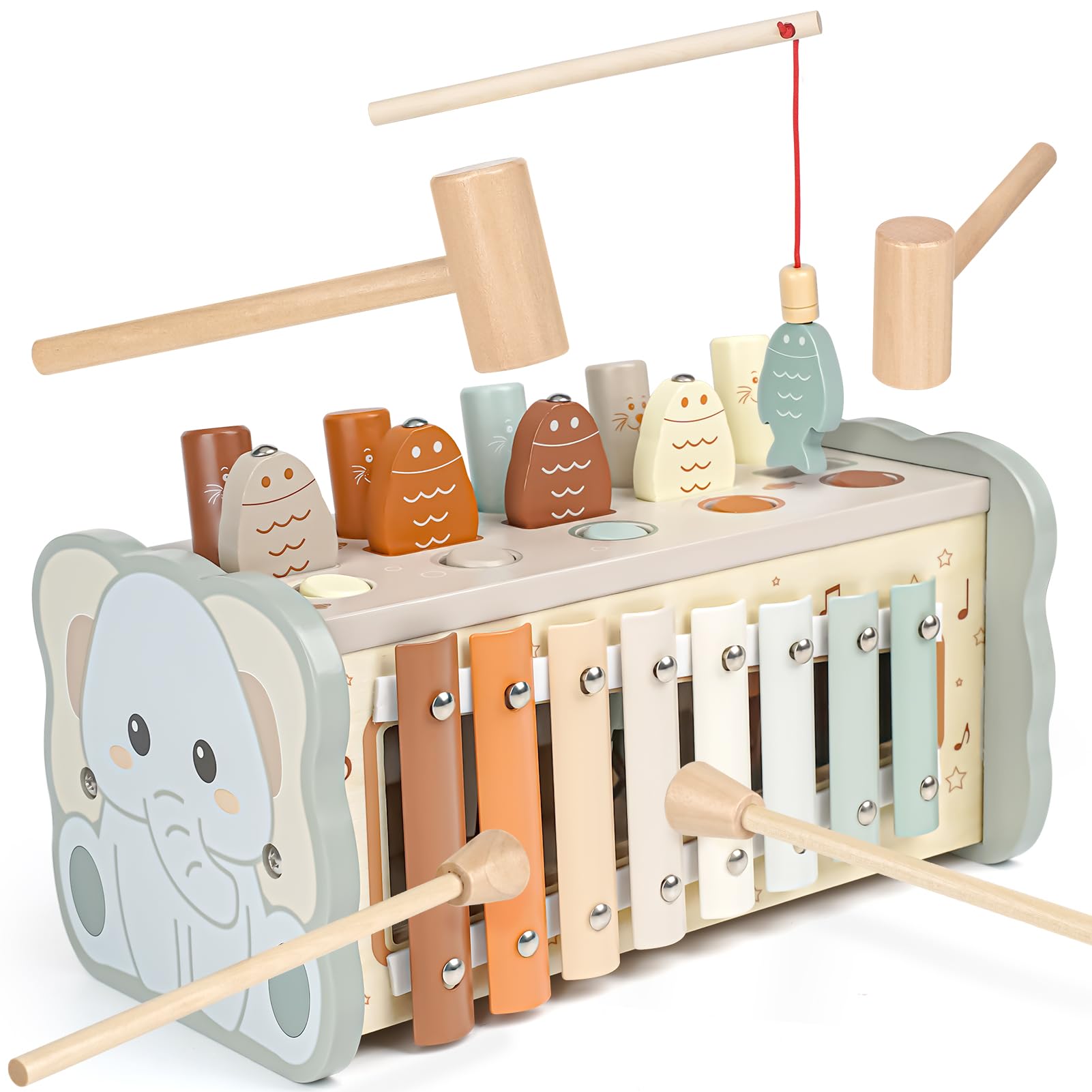
Wooden pound-and-play set whose calm colors fit right into a modern, screen-light nursery.
Four classic Montessori activities live in one compact set: a pounding bench where wooden pegs send cheerful hamsters bouncing, a musical xylophone, a magnetic fishing game, and a gear-spinning station. The neutral color palette is the quiet standout — instead of the usual neon-bright plastic, this uses calming water-based tones designed to be “gentle on your baby’s eyes” and promote focused play.
It comes with two hammers and two mallets, so it’s built for shared play — a parent-child bonding moment or a playdate with a friend. The pieces are “the perfect size for little hands to grasp,” and the sturdy wood has survived being thrown by toddlers without breaking. Owners describe one-year-olds giggling and absorbed in hammering, fishing, and making music on the xylophone.
The mixed feedback lands on sound: some love the noises it makes, while others find the xylophone notes out of tune. It’s a minor point for a toy that’s really about motor skills and reflexes. Rated for 18 months and up, it’s a better fit for the older end of the 1-year-old range.
What stands out
- Four activities in one thoughtful wooden set
- Calming neutral colors — a break from loud plastic
- Two hammers encourage shared or social play
Keep in mind
- Xylophone tuning is imperfect to some ears
- Rated 18+ months, so a young 1-year-old may need help
Best for: parents who want the Montessori vibe with a calm aesthetic and multi-activity value.
Skip if: you’d rather have one perfectly-tuned musical instrument than four broad activities.
6. Duchong Pop Up Animals Toy

A pop-up animal game that makes the cause-and-effect lightbulb click for curious 1-year-olds.
There’s a moment when a baby realizes that their own action makes something happen — a lever they push, a switch they flip, and an animal pops up. This toy is built entirely around that discovery. With a lever, switch, dial, and button, each activating a different pop-up animal, it turns four simple interactions into a mini lesson in cause and effect.
Three play modes keep it fresh: Animal Sound mode plays the animal’s name and sound when it pops, Game mode follows the light to find hidden animals, and Quiet Mode lets the animals pop up with no batteries and no music. That quiet mode is a genuine parenting win — it works as a pure mechanical toy when you don’t want another electronic beep in the house.
Made of BPA-free ABS plastic with smooth, rounded edges, it’s built for toddler handling — one owner’s niece throws everything on the floor and this has “stood the test of time.” The mix shows on durability, though: some report the flaps can get stuck when pushed too hard. It’s lightweight and easy to grasp, making it a strong fit from 12 months through the second birthday.
Why it engages
- Four different mechanisms teach real cause and effect
- Quiet Mode works without batteries for low-stim play
- BPA-free ABS with smooth, toddler-safe edges
Heads up
- Flaps sometimes stick if pushed with too much force
- Batteries not included for sound modes
Grab this for: a 12-month-old who loves discovering how things work — it’s the purest cause-and-effect lesson here.
Pass if: you need something indestructible; occasional stuck flaps mean it’s durable but not armor-plated.
7. LUCKFUTURE Rainbow Spinning Stacker

A stacker where the rings spin — turning color-matching practice into a satisfying sensory game.
Standard stacking rings teach size and order. This one adds a twist: the rings actually spin as they stack, so a 1-year-old gets the satisfaction of watching each disk whirl down the rod. The concave and convex edges (the way the ring’s inner and outer rims curve) give tiny fingers a better grip, which directly builds fine motor skills.
The KMTJT Montessori Sorting Toy uses rainbow color matching to stimulate color discrimination and visual recognition while your child separates and stacks. Owners describe toddlers “captured for a long amount of time,” and the toy is simple enough that a child can rotate the disks to the bottom to finish the stack in their own random order, then pull the rod to watch everything spin and fall again.
The trade-off shows in stability: while many call it sturdy, a notable share report it falls over constantly and comes apart a little too easily when knocked. At 16 inches tall, it’s a statement piece on the nursery floor, but it’s best played with on a flat, soft surface. Used by a physical therapist and loved across multiple ages, it’s a solid sensory pick for the 1-3 range.
What makes it fun
- Spinning rings add sensory appeal beyond standard stacking
- Concave/convex edges improve grip and fine motor skills
- Bright rainbow colors teach visual recognition
Manage expectations
- Can tip over easily during energetic play
- Comes apart fairly easily if knocked hard
Great for: sensory-seeking toddlers who love motion — the spinning action is the whole point.
Not for: families needing a low-maintenance toy that survives roughhousing without being reassembled.
8. Bravmate Wooden Activity Cube

A wooden cube that packs eight toys into one footprint, with a bonus board to boot.
If variety is what keeps your toddler engaged, this cube delivers it eight ways on six sides: a bead maze, a baby xylophone, a learning clock, a shape sorter, an abacus, spinning gears, sorting & stacking blocks, and word cards. Your child rotates from one side to another as their interest moves — hours of entertainment without you having to swap toys.
Built from natural rubber wood with rounded edges and water-based paint that won’t splinter, it’s a toy designed for years of service. The top bead maze detaches for separate play and can flip over to fit inside the box for compact storage — a genuine travel-friendly touch. Families report it’s kept little ones busy as a favorite toy and survived two years of solid use, though the many small pieces mean a lost one here or there.
The honest limits: at 7.6 x 7.5 x 7.7 inches, it’s smaller than many expect for an activity cube, and the weight (1.55 kg) makes it a little heavy for a baby to tote around. There’s also a mixed safety note around small parts. For a toddler who loves rotating between activities, though, this is a complete play station in one box.
Why it’s a crowd-pleaser
- Eight activities in one footprint, plus a bonus Stack & Sort Board
- Detachable bead maze makes travel storage easy
- Natural wood build that holds up for years
Be aware
- Compact size surprises some buyers
- Heavy enough that babies struggle to move it
Pick this for: maximum activity variety in one purchase — it’s a mini play center, not a single toy.
Reconsider if: you have very limited floor space and need something your baby can carry themselves.
9. Fisher-Price Laugh & Learn Song & Story Chair

A story-time chair that springs to life the moment your toddler sits down.
This isn’t a toy your child pushes buttons on — it’s a toy that reacts to them. The seat “magically” responds when a toddler sits or stands, rewarding movement with songs and phrases. That’s a clever way to reinforce gross motor skills (the act of sitting and standing) while the hands explore the light-up lamp, musical crayons, and flipbook pages that tell a story.
Three play modes — Learning, Music, and Imagination — change what the chair teaches, from alphabet and numbers to colors, opposites, and stories. The musical crayons are a particular favorite, with owners noting they “sing quite a bit” and the chair gets heavy daily use. At 12.6 x 20.2 x 15.1 inches and 3.7 pounds, it’s sized perfectly for little ones to climb in and out of, and assembly is reportedly straightforward.
The feedback catches on one thing: the seat sensor doesn’t always work perfectly for every unit, so the “magic” response can be inconsistent for some families. It’s also the most expensive pick here, so it’s a splurge. But for a first birthday gift that becomes a beloved “reading corner” for pretend play, it delivers a different kind of value than a walker or a stacker.
The charm
- Seat responds to sitting and standing, rewarding movement
- Three modes teach alphabet, numbers, colors, and stories
- Interactive lamp, crayons, and flipbook for hands-on play
Before you buy
- Seat sensor can be inconsistent on some units
- Premium price for a single-purpose toy
Splurge on this for: a child who loves pretend play and music — it’s a whole little “world” they can own.
Look elsewhere if: you want maximum learning variety per dollar; the cube and sorting toys cover more ground.
Understanding the Specs
Age Range vs. Readiness
The age range on the box (like “9 Months – 3 Years”) is a guide, not a rule. A toy rated for 6 months can usually be used at 12 months with more value, while a toy rated for 18 months may frustrate a young 1-year-old. the balance is a toy that’s slightly ahead of your child’s current skill — something to grow into, not something they’ve already mastered.
Play Modes & Longevity
The single biggest predictor of a toy’s lifespan is how many ways it can be played. A walker with a detachable panel, a cube with eight sides, or a toy with multiple modes stretches a single purchase across many months. If a toy only does one thing, a 1-year-old will likely outgrow it within weeks.
FAQ
What is the most important skill to target with a 1-year-old?
Will my 1-year-old actually use a toy rated for 18+ months?
Wood or plastic — which is better for a 1-year-old?
How many toys does a 1-year-old really need?
Are battery-powered toys worth it for a 1-year-old?
What should I look for in a first birthday gift?
How do I know if a toy is safe for a 1-year-old?
Is a walker safe for learning to walk?
How do I clean and maintain wooden toys?
Can educational toys really make a difference at this age?
Final Thoughts: The Verdict
For most families, the educational toys for a 1-year-old winner is the VTech Sit-to-Stand Learning Walker because it carries a child from 9 months to 3 years, covering both floor play and first steps with one sturdy, beloved purchase. If you want screen-free, hands-on color and shape learning, grab the KMTJT Montessori Sorting Toy. And for a splurge-worthy first birthday showstopper that rewards movement with music and stories, the Fisher-Price Song & Story Chair is the one to reach for.
How We Picked
We do not accept paid placement. Every pick is matched to a real buyer and a real use-case; we do not hands-on test units.
Sources & Methodology
Specifications: manufacturer listings and product documentation. Review insights: verified customer reviews, as of August 2026. Pricing: not shown on this page (it changes often); check the current price via the retailer link.
As an Amazon Associate, WellFizz earns from qualifying purchases. This does not affect which products we feature.
Related Guides

Mo Maruf
I created WellFizz to bridge the gap between vague wellness advice and actionable solutions. My mission is simple: to decode the research and give you practical tools you can actually use.
Beyond the data, I am a passionate traveler. I believe that stepping away from the screen to explore new environments is essential for mental clarity and physical vitality.